As an Amazon Associate we earn from qualifying purchases. We may earn a commission from links on this page, at no extra cost to you. Learn more.
Miyabi makes thin, hard, Japanese-profile blades in Seki, and the right one depends on three things: how you hold a knife, how much sharpening you will tolerate, and how much care you will give the handle. The blade shapes are close across the range. The steel, the balance and the handle are where the six knives below really split apart.
We kept the lineup to the 8-inch chef's knife in six Miyabi lines, from the approachable Evolution to the showpiece Birchwood SG2. If you are also weighing other makers, our Japanese knife reviews cover the wider field. The Kaizen II is our pick for most cooks; this guide explains why and who would be better served by another model.
Miyabi Chef Knives at a Glance
Six knives, one blade length, and very different personalities. Use this table to narrow the field, then read the section for any knife that catches your eye.
Model / size
Steel
Handle
Buyer fit
Main compromise
Evolution 8-inch
FC61
Triple-rivet POM
Familiar Western grip, an easy entry to the range
Rear-heavy in a pinch grip
Kaizen 8-inch
VG10
D-shaped linen Micarta
Classic patterned blade and textured grip
Less wear resistance than SG2
Kaizen II 8-inch
FC61
D-shaped black Pakkawood
FC61 steel with a Damascus look
Rear balance; grip-sensitive
Artisan 8-inch
SG2
D-shaped Cocobolo Rosewood Pakkawood
SG2 with a substantial wood-composite grip
Harder sharpening; bulky for some hands
Mizu SG2 8-inch
SG2
D-shaped Micarta
SG2 with a moisture-tolerant composite grip
Rear-heavy balance; possible spine pressure
Birchwood SG2 8-inch
SG2
Karelian birch
Natural-wood showpiece and fine slicing
Premium finish and natural-wood care
How We Tested These Miyabi Chef Knives
We compared how the six knives cut tomato skin, onion and boneless meat, how comfortable their handles remain as your grip tires, and how much effort each steel takes to sharpen on a stone.
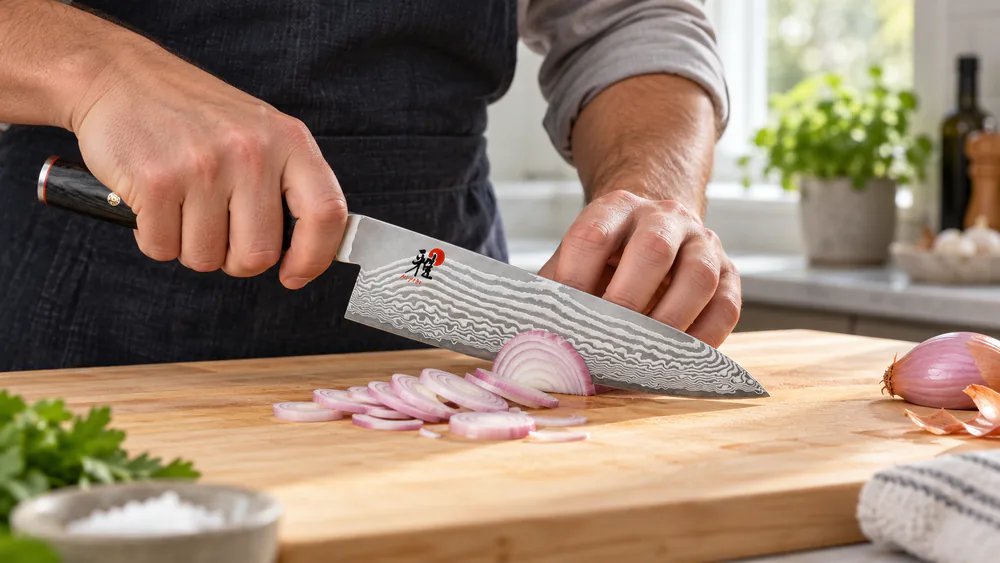
The prep tasks that told us the most were onions and shallots, thick carrots, tomatoes, herbs and boneless meat, because they show wedging, food release and edge bite quickly.
Four questions drove every verdict. Does the knife feel balanced in a pinch grip? Does food release from the blade or cling to it? Does the handle stay comfortable through a long session? And how much work does it take to restore the edge?
We also paid attention to what each handle asks of you afterward. A natural-wood handle and a composite handle are cleaned the same way on day one, but they do not tolerate the same habits by day thirty.
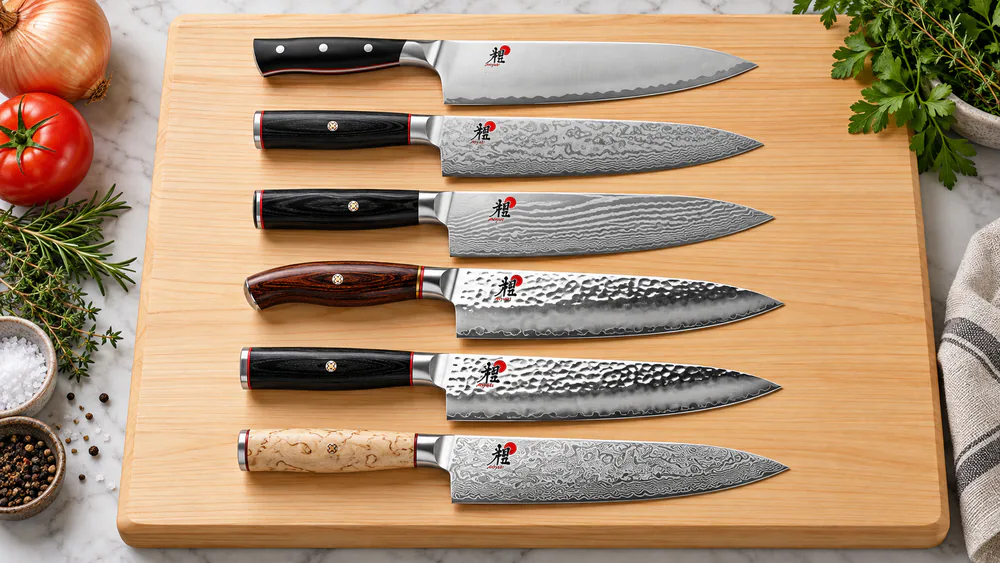
The six 8-inch Miyabi chef's knives we compared.
Note. Ratings below are our own, built from handle comfort, edge feel, food release and care effort. They are not price scores, and a higher number does not mean the knife suits every hand.
The Evolution is the easiest Miyabi to pick up if you grew up on a Western chef knife. The familiar handle makes the move straightforward, and the polymer grip is easier to keep dry and clean than natural wood.
Pros
FC61 steel at 61 HRC, a hard and fine edge
Familiar, curved triple-riveted handle that eases the switch from Western knives
Polymer handle is easy to keep dry and clean
Rounded spine, heel and bolster
Cons
Handle-heavy balance can lift the tip in a pinch grip
Smooth blade face can drag and retain food
Plain finish has the least visual flair in the range
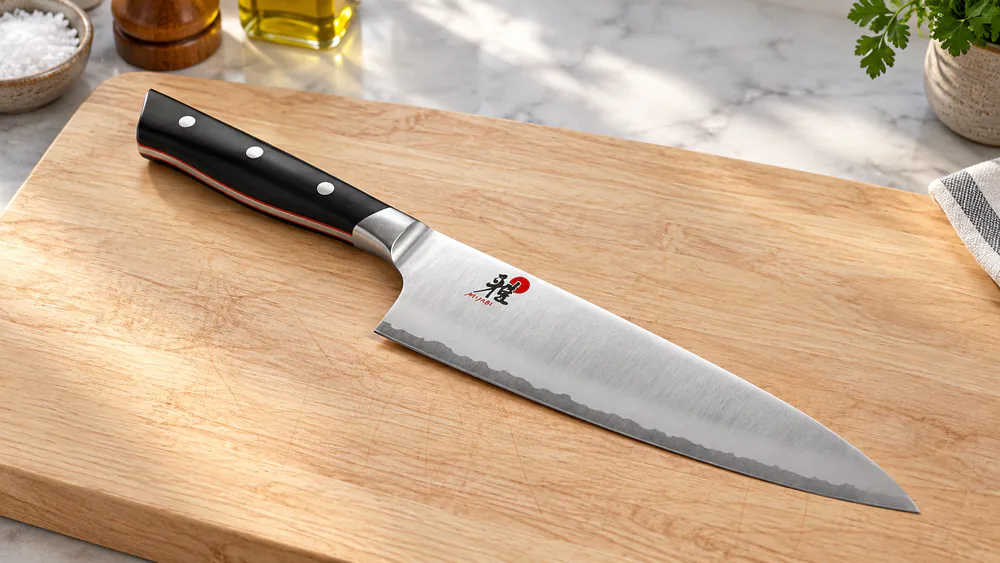
The Evolution runs FC61 steel at 61 HRC, with a mirror finish, a sandblasted katana edge and an exposed tang. It is the plainest knife here, and that is part of its appeal.
Who the Evolution Is For
Buy the Evolution if you want a first Japanese-profile knife and your muscle memory is Western. The grip never asks you to relearn how you hold a knife. It also shrugs off a wet counter better than the wood-handled models.
Cooks who care about a patterned blade will find it plain next to the Damascus models, so it suits those who value function over finish.
Where the Evolution is plain, the Kaizen is the knife we would hand to a cook who wants the Miyabi look without SG2 sharpening effort. Tomato skins yield to a clean slice without repeated sawing, and the textured Micarta grip feels wood-like and supports both a pinch grip and a full handle grip.
Pros
VG10 core with a flower Damascus finish
Textured Micarta handle suits pinch and handle grips
Slices tomato skin cleanly without sawing
VG10 edge is easier to restore on a whetstone than SG2
Cons
Less wear resistance than the SG2 knives
Nominal 60 HRC is the softest hardness here
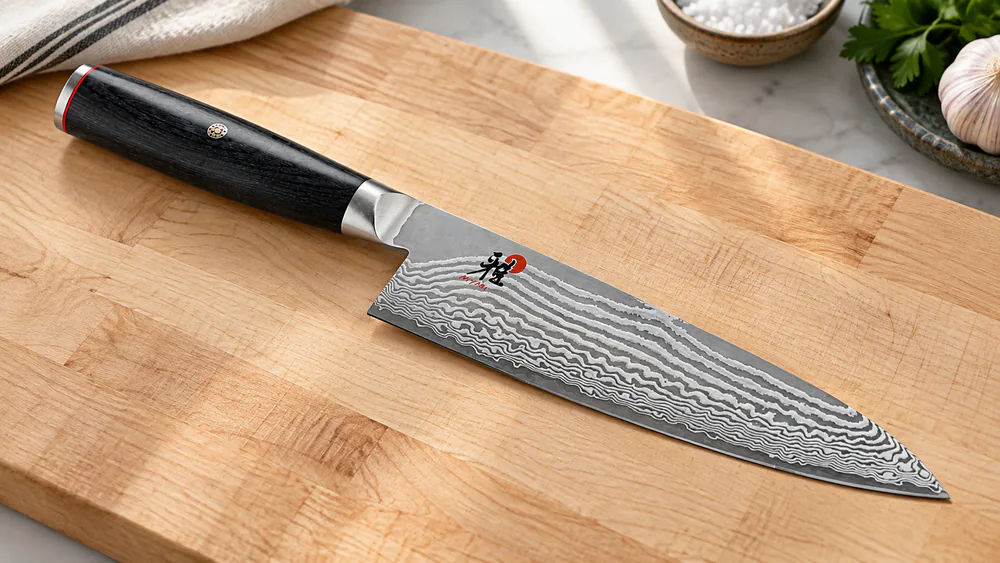
The Kaizen layers a VG10 core inside 64 cladding layers, for 65 total layers, and carries a factory edge of 9.5-12 degrees. Its nominal hardness is 60 HRC, within a specification range of 60-62 HRC. This is the knife for a cook who sharpens at home and wants the process to feel forgiving: the D-shaped Micarta handle gives a secure, grippy hold, and the steel responds quickly to a stone. Plan on regular stone work rather than treating it as set-and-forget, and do not confuse it with the Kaizen II: the original Kaizen uses VG10, while the Kaizen II uses FC61.
Compared with the Kaizen, the Kaizen II is the knife we would buy again for everyday prep. The rounded spine reduces finger pressure in a pinch grip, and onions, shallots and thick carrots cut readily without conspicuous wedging.
Pros
FC61 core with acid-darkened flower Damascus
Rounded spine eases finger pressure in a pinch grip
Cuts onions, shallots and thick carrots without wedging
Light stone touch-ups restore the edge after heavy prep
Cons
Rear-heavy balance in a pinch grip for some hands
Careful straight cutting needed to avoid small chips
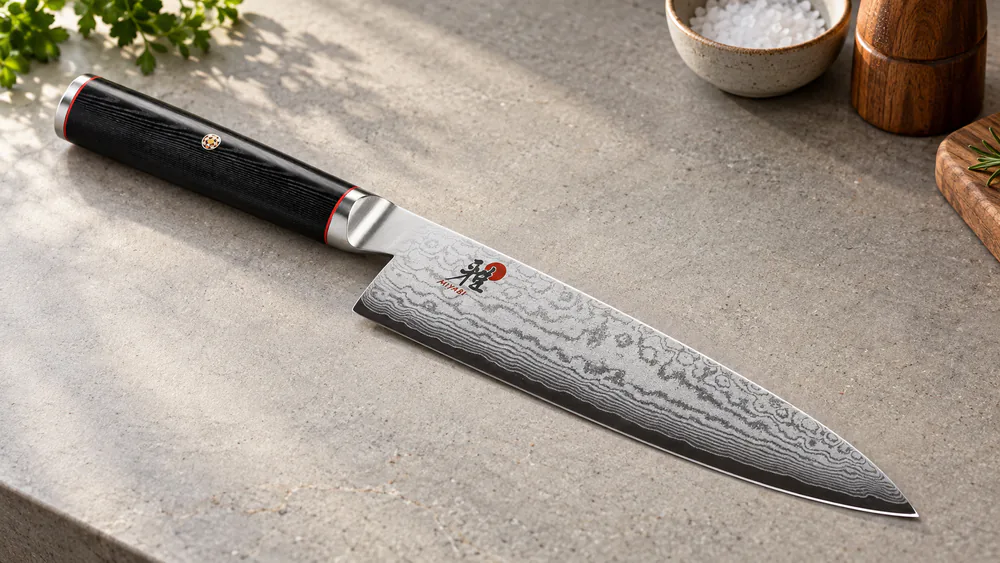
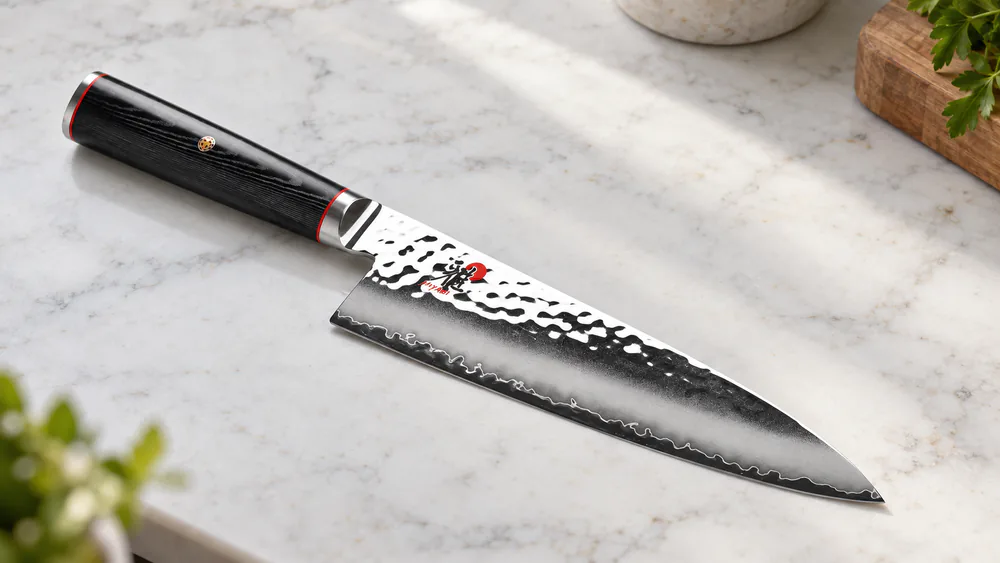
The Kaizen II pairs an FC61 core with 48 cladding layers, for 49 total layers, and the factory edge range is 9.5-12 degrees. Its nominal hardness is 61 HRC, inside a specification range of 60-62 HRC. The handle is a D-shaped black Pakkawood with a thicker rounded bolster and a mosaic pin.
Why the Kaizen II Is Our Pick
Choose the Kaizen II if you want one knife to handle most of what a home kitchen throws at it. It cuts dense vegetables without the wedging that slows thicker blades, a light stone touch-up restores the working edge after heavy prep, and the Pakkawood handle tolerates ordinary kitchen life better than raw wood. Cut straight down and forward, never twisting through a carrot, because a thin hard edge can chip when you ask it to pry.
The Kaizen II is the all-rounder, while the Artisan shows what SG2 steel offers. The edge stays useful through long vegetable sessions, and slicing boneless roast meat feels easy and comfortable. The polished spine and choil feel smooth in a pinch grip with no sharp unfinished corners.
Pros
SG2 powder-steel core at 63 HRC
Edge stays useful through extended vegetable prep
Smooth, polished spine and choil
Hammered face reduces some food adhesion
Cons
Sharpening the hard steel takes more work than softer blades
Substantial handle can feel bulky in smaller hands
Thick produce can push the blade off line
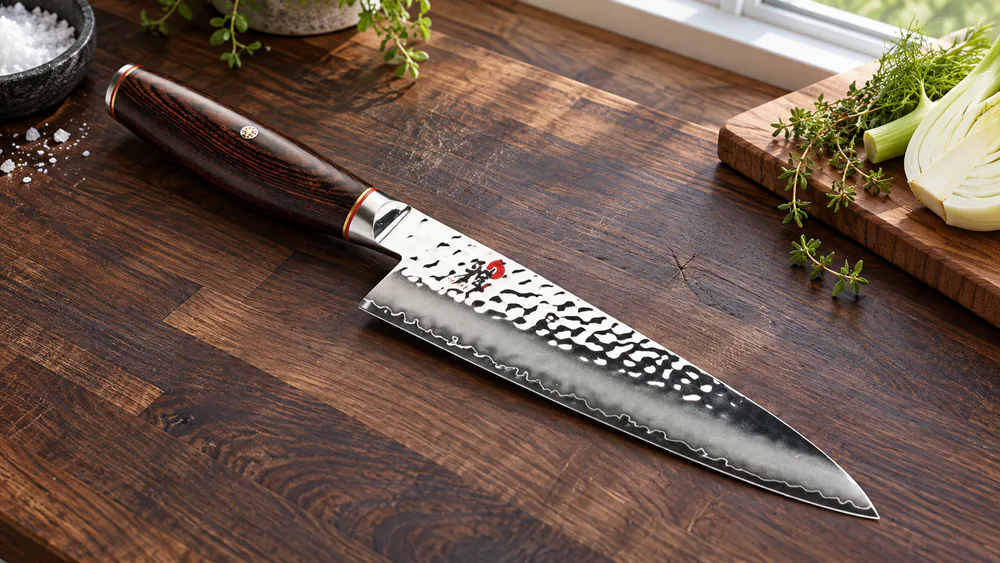
The manufacturer lists the Artisan at 63 HRC with an SG2 core, CRYODUR hardening and a 9.5-12 degree factory edge. The face has a hammered tsuchime finish, and the handle is a D-shaped Cocobolo Rosewood Pakkawood with brass and red spacers.
SG2 Edge Life and What It Asks of You
The Artisan suits a cook who values edge life and has hands large enough to fill the handle. The rounded, substantial grip feels comfortable if you are used to Western handles, and the hammered face reduces some sticking, though it does not remove it. Own a proper sharpening setup before you buy. For a big brisket, a longer slicing knife is the better tool.
Unlike the Artisan, the Mizu is the one we reached for when the board held herbs and small onion. The fine edge bites readily into fruit skins, vegetables and boneless meat, and rock-mincing is particularly comfortable.
Pros
SG2 core at 63 HRC in a 3-layer construction
Fine edge bites into fruit skins, vegetables and boneless meat
Comfortable for rock-mincing herbs and small onion
Micarta handle tolerates incidental moisture better than birch
Cons
Rear-weighted balance favors draw cuts over push cuts
Firm pinch grip can create an index-finger pressure spot
Sharpening takes more effort than with softer steels
The Mizu uses a 3-layer construction with an SG2 cutting core, hammered tsuchime cladding and a double-bevel Honbazuke edge. The factory angle is given as a range of roughly 9 to 12 degrees per side, and it weighs about 7.4 to 7.5 ounces. Pick it if you mince a lot and prefer a rocking stroke. The Micarta handle forgives incidental moisture better than natural birch, though the knife still needs hand washing and drying every time.
Beside the Mizu's working-kitchen focus, the Birchwood SG2 is the work of art in this lineup, and it cuts like one. It feels light and controlled slicing vegetables, fish and boneless meat, and the rounded spine and heel soften contact with your gripping fingers. The curved belly favors a rocking motion over a completely flat chopping stroke.
Pros
SG2 core at 63 HRC in 101-layer flower Damascus
Light, controlled feel for fish, vegetables and boneless meat
Rounded spine and heel soften contact with the fingers
Karelian birch handle is the most attractive in the range
Cons
Natural wood adds a drying and care obligation
Pale handle needs to stay away from meat juices and dirty boards
A protective sheath may need to be bought separately
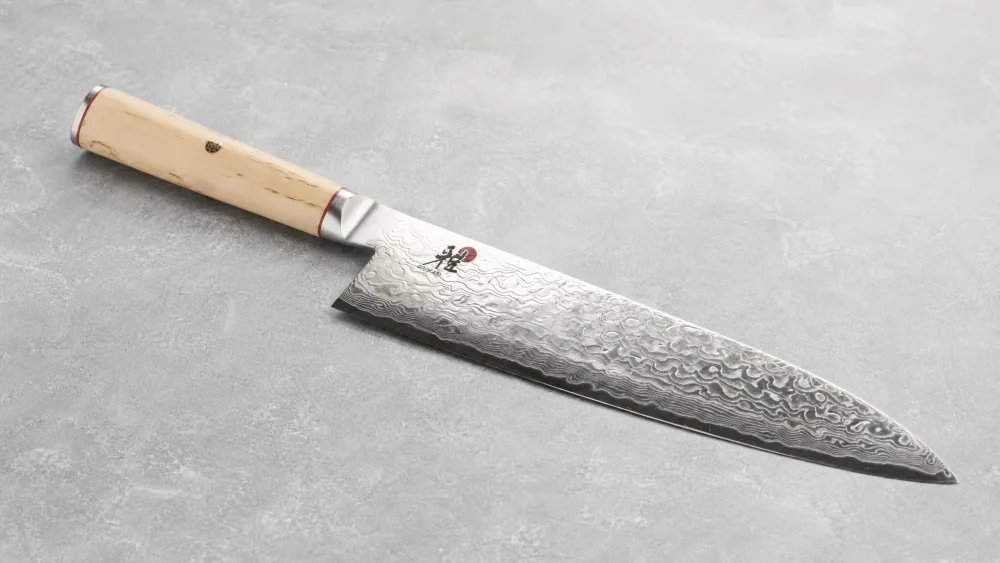
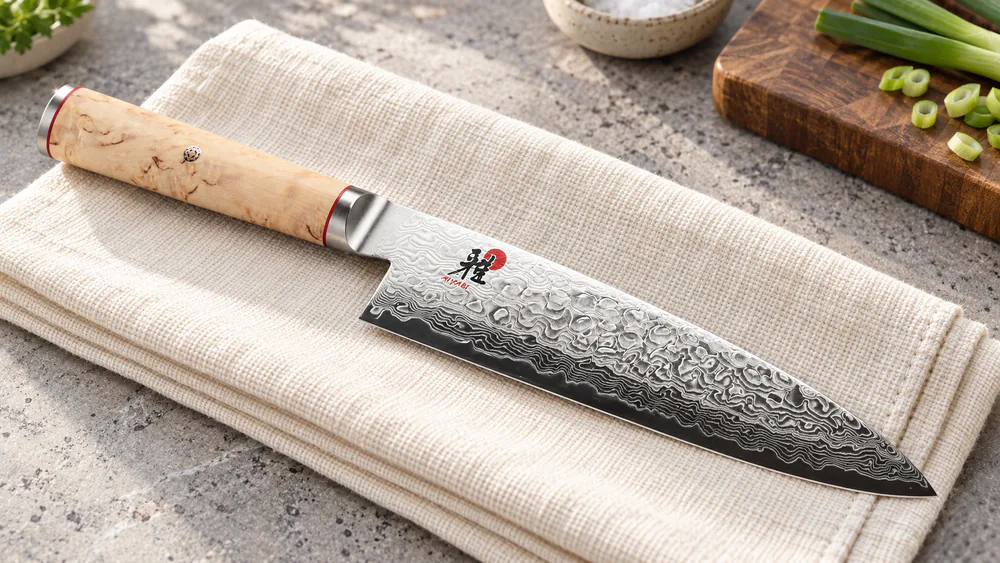
The Birchwood pairs an SG2 core with 100 cladding layers, for 101 total layers, at 63 HRC. The factory edge range is 9.5-12 degrees, and the net knife weight is 0.38 lbs. The handle is Karelian birch with a concealed tang.
What the Birchwood Asks of You
This is the choice if you slice fish, vegetables and boneless meat more than you chop, and you enjoy owning a beautiful tool. It is the lightest-feeling knife in the group, and that control carries into delicate work.
The cost is habit. Natural wood wants drying right after use and a clean, separate spot from meat juices. It is also the most expensive knife here, so it is a splurge pick rather than a default.
How to Choose a Miyabi Chef Knife
Start with how you cook, not the steel. The best Miyabi chef knife is the one whose balance, handle and sharpening demands match your habits.
Steel, Edge Retention, and Sharpening Effort
Harder steel holds an edge longer but resists the stone. The VG10 Kaizen is easiest to sharpen, the FC61 Evolution and Kaizen II require moderate effort, and the SG2 Artisan, Mizu and Birchwood take the most work on a stone but retain a working edge longest.
Artisan, Mizu and Birchwood share an SG2 cutting core, but handle, weight distribution and geometry still change how each cuts. Equal steel does not mean identical cutting.
Tip. If you do not own whetstones and do not want to, lean toward the Kaizen or Kaizen II. A hard SG2 edge is a joy until it needs attention and you have no way to give it.
Blade Length and Cutting Style
We kept every pick at 8 inches because that length covers most home prep without crowding a normal board. Longer blades suit large roasts, and a dedicated slicer is better for briskets. Rock choppers should look at the Mizu and Birchwood, while push cutters tend to prefer the better-centered feel of the Kaizen II.
Handle Shape, Handedness, and Balance
Handle shape changes how a knife feels more than any spec line. The Evolution has the most Western shape, while the other five use D-shaped handles. How a D-shape feels depends on your hand and grip, and no universal rule says it suits or excludes left-handed cooks. Hold one if you can.
Balance matters just as much. The Evolution, Kaizen II and Mizu all lean toward the handle. If you pinch the blade hard, that rearward weight is the first thing you will notice.
What the Price Premium Buys You
The Evolution is the budget pick of the six, the Kaizen and Kaizen II sit in the mid-priced tier, the Artisan and Mizu are premium, and the Birchwood is the splurge. Extra money buys harder steel, a more refined finish and a nicer handle, not a faster way to cut an onion.
If you want to spend more and stay in the Miyabi range, the Black 5000MCD67 is a premium alternative worth a look, though we kept it out of this lineup.
Caring for a Miyabi Chef Knife
A hard, thin edge rewards good habits and punishes careless ones. These steps apply to all six knives.
Cutting Boards and Tasks to Avoid
Use wood or a soft board. Hinoki is the recommended surface, and glass or other hard surfaces will damage the edge fast. Skip shellfish, frozen food and other hard foods, and never tilt or twist the blade in a cut.
Warning. Do not use a Miyabi to pry, scrape a board with the edge, or cut through bone and frozen food. A hard, thin edge chips instead of bending.
Washing, Drying, and Storage
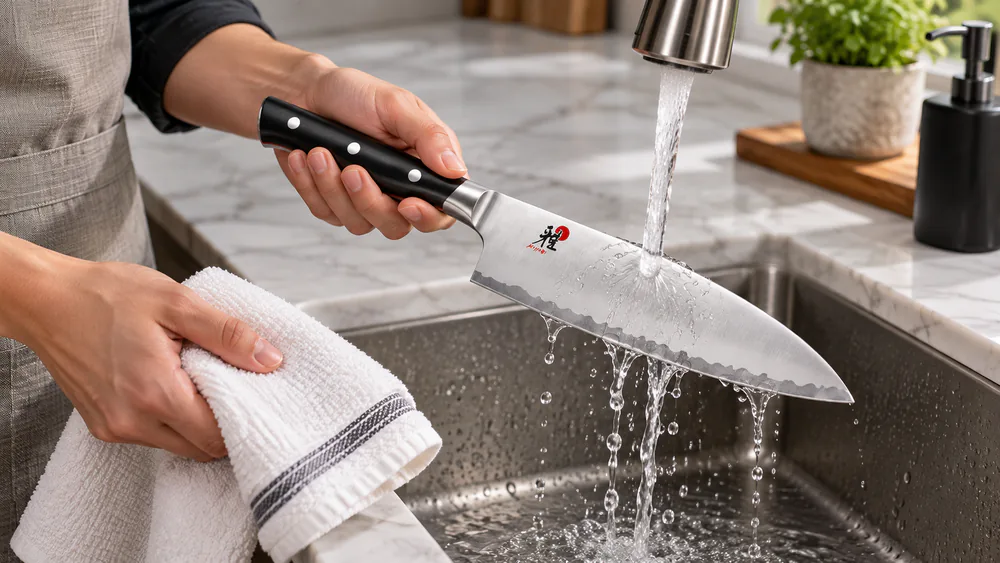
Hand wash with a little detergent under running water, and dry carefully right after use. Never leave a knife wet or dirty, and never run it through the dishwasher.
For storage, protect the edge in a block, a sheath or on a magnetic strip, and keep it away from loose utensils. The Birchwood needs the most care here, because natural wood does not like to stay damp.
Sharpening and Professional Maintenance
Use suitable professional sharpening tools. Toishi Pro stones and the Miyabi knife sharpener are the manufacturer's recommendations, so follow that tool's instructions closely. Not every generic home sharpener is safe for a hard, fine edge, so check before you buy one. For a wider look at the options, see our professional knife sharpener picks.
The limited warranty covers defects in material and workmanship for the initial purchaser. It excludes ordinary wear, misuse and abuse, and US purchases from authorized sellers need proof of purchase.
Frequently Asked Questions
Which Miyabi chef knife suits a beginner?
The Evolution is the easiest to adapt to, thanks to its familiar Western handle and easy-care polymer grip. If you want a patterned blade and are willing to sharpen on a stone, the Kaizen is a gentle step up.
What is the difference between Kaizen and Kaizen II?
The original Kaizen uses a VG10 core, a linen Micarta handle and 65 total layers. The Kaizen II uses FC61, a black Pakkawood handle with a thicker rounded bolster and 49 total layers. Check the model name before you assume the steel.
How do Artisan, Mizu, and Birchwood compare?
All three share an SG2 core, but they differ in finish and handle. The Artisan has a hammered face and a substantial Pakkawood grip. The Mizu has a hammered finish and a moisture-tolerant Micarta handle with a rearward balance. The Birchwood has flower Damascus and a natural birch handle that needs more care.
Should you choose Miyabi or Shun?
Both make Japanese-style blades, and the better fit comes down to grip and care. Miyabi leans toward hard, fine edges and D-shaped handles. Our Shun chef knife comparison lays out that side in the same detail.
Final Verdict: Which Miyabi Chef Knife Should You Choose?
Beyond the Kaizen II, match the knife to the cook. If you are new to Japanese knives, the Evolution is the gentler start. Pick the Kaizen if you want the easiest edge to restore, and choose the Artisan or Mizu if you accept the stone work for longer edge life. The Birchwood is the one to buy if you want a showpiece and will dry the handle every time.