Helping you create a kitchen you love.

Knives & Cutlery

Best Tumbler Knife Sharpener: Tumbler Models and Rolling Alternatives

As an Amazon Associate we earn from qualifying purchases. We may earn a commission from links on this page, at no extra cost to you. Learn more.

Best Tumbler Knife Sharpener: Tumbler Models and Rolling Alternatives

Our pick is the Tumbler Pro for most home cooks, with the Work Sharp Rolling Knife Sharpener as the better choice if you own knives with different bevel angles. Our deciding factor was how easily each sharpener kept the abrasive flat against the edge, because a rolling sharpener only works as well as the angle it holds.

"Tumbler" is a brand, and "rolling sharpener" is the category. A rolling sharpener is a weighted roller with abrasive faces on its ends, and a magnetic support holds the blade at a fixed angle while you roll the abrasive along the edge. We compared two Tumbler models and one rival from Work Sharp, so you can see what the brand does well and where another design fits better. If you want to compare against other approaches, our knife sharpener reviews cover pull-throughs, stones and electric models.

We judged all three on blade fit, angle control, edge quality and upkeep, the same things a working kitchen asks of a sharpener.

How We Tested These Tumbler and Rolling Sharpeners

We judged each sharpener the way a working kitchen would. We looked at how easily a blade seated on the magnetic support, how steadily the roller tracked along the edge, and how fine an edge the finishing face left behind. For the Original, we also cut onions and carrots with a dulled santoku afterward, because a clean slice through a thin onion skin tells you more than any spec sheet.

A burr is the thin ridge of displaced metal that forms on the edge as you grind. We watched how each design helped or hindered the central steps of sharpening: raising an even burr and then removing it with lighter passes.

Here is what we weighed:

  • Blade fit on the magnetic support, including narrow blades
  • Roller tracking along the edge
  • Finish from the finishing face
  • Upkeep, storage, and what happens when a disc wears out
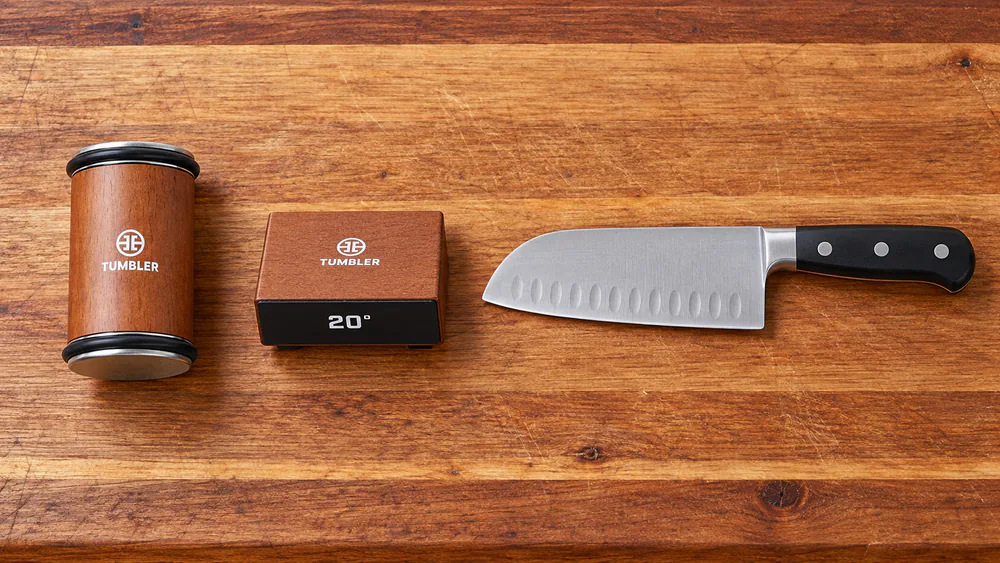
A santoku, wooden roller and magnetic support laid separately on a cutting board
Lay out the components and check the blade’s fit before mounting it on the support.

Quick Comparison: Which Sharpener Fits Your Knives?

This table covers the base kits as they ship. Extras such as stands, strops and upgrade discs are sold separately, so we list them in their own row.

FeatureTumbler OriginalTumbler ProWork Sharp Rolling Knife Sharpener
Intended user and setupStraightforward kitchen upkeep; turn the roller to finishKitchen upkeep with optional upgrades; verify the generationMixed angle needs; swap discs between stages
Standard angles, per side15 / 20 degrees15 / 20 degrees; extra holder sold separately15 / 17 / 20 / 25 degrees
Sharpening and finishingD35 diamond / steel helix4-layer diamond / ceramic320 diamond / 600 diamond / ceramic
Blade limitationsNarrow blades and curved tips need care; no serrations or ceramicSame magnetic-fit checks; no serrations or ceramicSmall blades may shift; tall blades and bolsters need clearance
Disc replacementFixedRemovable; current upgrades require a compatible generationReplaceable magnetic discs
Included equipmentRoller and angle supportRoller with diamond and ceramic faces, standard supportRoller, angle block with riser, three abrasive discs, organizer packaging
Optional extrasStand, stropHolder, stand, strop, coarse and polishing discsReplacement discs

Our Tumbler and Rolling Sharpener Shortlist

All three sharpeners can restore a working edge on a broad kitchen knife. They differ in angle range, how you replace worn abrasive, and how forgiving they are with smaller blades.

Tumbler Original: Who It Suits and Its Limitations

Tumbler Original
2

Tumbler Original

Simplest Setup
Check Price on Amazon
4.2/5

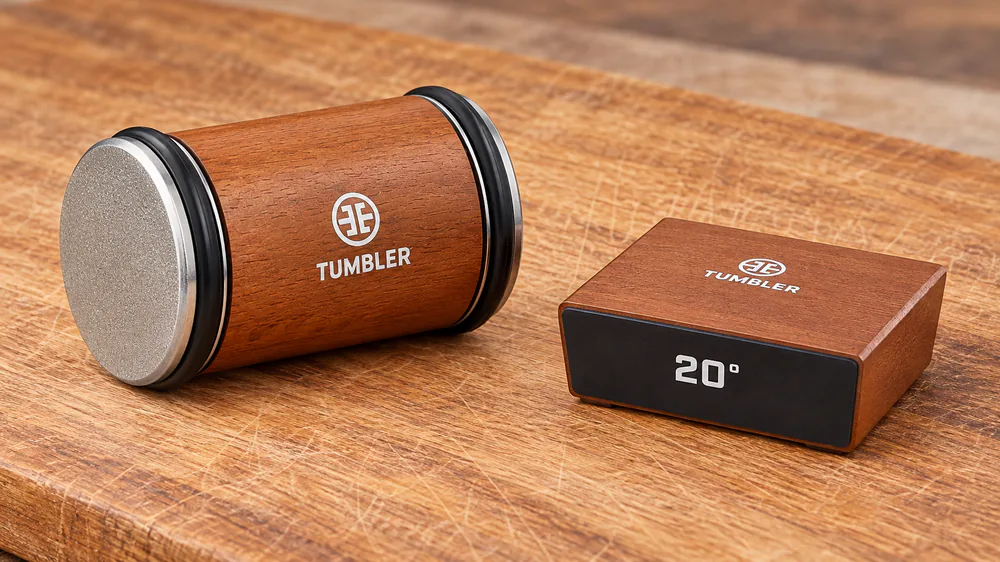
The Original rolls smoothly along a broad, flat-ground kitchen blade, and it is the easiest of the three to understand. The base set is just a wooden roller and a magnetic angle support, with a diamond face for sharpening and a stainless steel helix face for finishing. A dulled santoku cut onions and carrots cleanly again after a session, and the compact pieces tucked away in a drawer without fuss.

Pros

  • Offers 15 and 20 degrees per side on the angle support
  • Roller weight of 8 oz feels light and easy to guide
  • Smooth, predictable rolling on broad, flat-ground blades
  • Compact enough for a small kitchen

Cons

  • Fixed discs cannot be swapped when the abrasive wears
  • Narrow blades sit too close to the holder for useful contact
  • Needs far more work on a badly dull or chipped edge
  • Only two angles

The steel finishing face gives a usable kitchen edge, but refining it takes patience. The Original handles a relatively straight santoku edge more easily than a chef's knife with a pronounced curved tip, where the roller has to be guided around the belly.

The limitation to weigh is the abrasive. The disc is fixed to the roller, so repeated use can dull the cutting performance, and there is no straightforward swap. Disc life varies with steel, pressure and how often you sharpen. The D35 label identifies the original diamond abrasive, but do not equate it directly to another brand's numbered grit.

On a badly dulled or chipped edge, the Original demands substantially more work than routine maintenance. Narrow blades are the other weak spot, since the magnet holds them too close to the holder for the disc to reach the edge properly. This model suits a cook with a few large knives and light, regular upkeep.

The wooden Tumbler Original roller and magnetic angle support resting separately on a cutting board
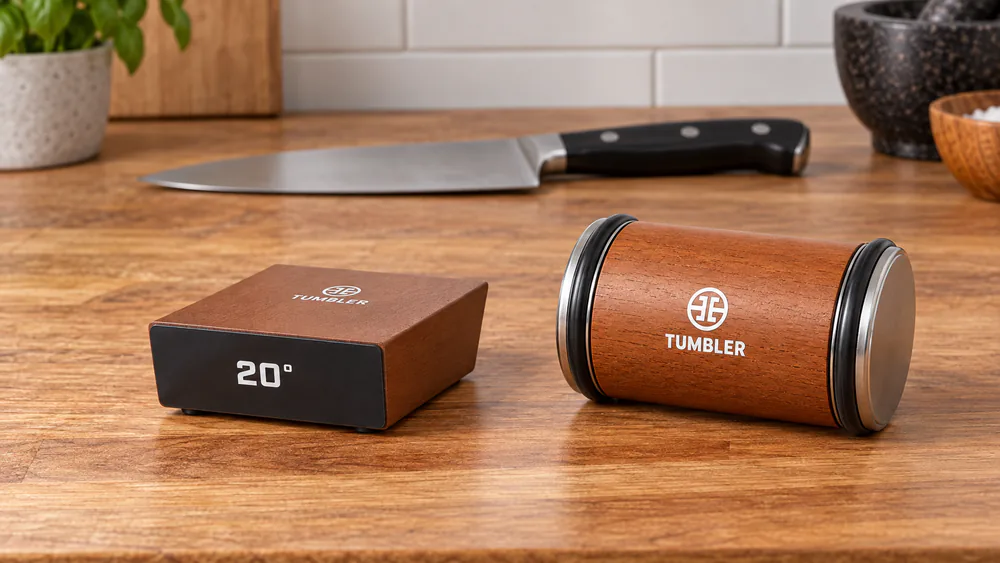
The Original roller and angle support, laid out before use.

Tumbler Pro: What the Upgrade Adds

Tumbler Pro
1

Tumbler Pro

Best Overall
Check Price on Amazon
4.4/5

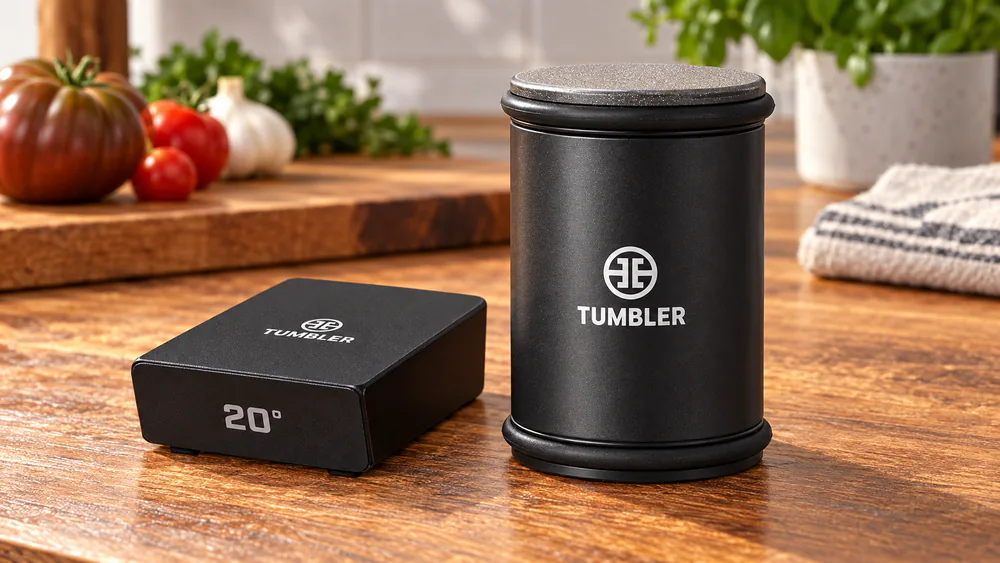
The Pro is the one we would buy again. The resin body feels substantial in the hand, and the instructions and linked video make first setup straightforward. The diamond-then-ceramic sequence leaves a finer edge on chef's knives and long slicers than the Original's steel face does. Like every Tumbler, it rewards patient, sustained rolling before the edge feels truly sharp, and the sharpening dust wipes off the blade with a cloth.

Pros

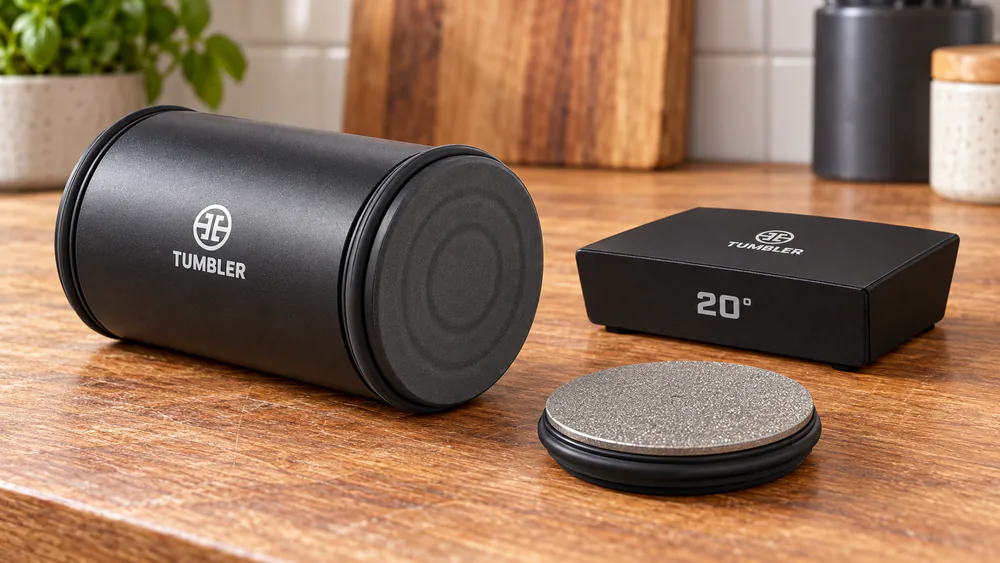
  • 4-layer diamond disc is removable, so a worn disc can be replaced
  • Ceramic honing face gives a finer finish after the diamond face
  • Resin roller weight of 14 oz gives a solid, steady feel
  • Works on chef's knives and long slicing knives
  • Optional coarse and polishing discs extend what it can do

Cons

  • Extra angles and upgrades are separate purchases that raise the total cost
  • Current upgrades only fit Pro models purchased after June 1, 2025
  • No serrated knives, scissors or ceramic blades

The Pro keeps the same two standard angles as the Original, 15 and 20 degrees per side, but it changes the abrasive system. The base roller carries a diamond face and a ceramic face, with a standard magnetic support. Polishing discs are optional, not standard equipment.

Be careful with configurations. The standard Pro kit has two angles plus the diamond and ceramic faces; a four-sided holder, fine polishing disc and stand are separate purchases. Extra angles need that separate holder or an appropriate Starter Set, and older accessory descriptions list different angle combinations, so check the exact holder generation before you count on them.

We would not carry any complaint about fixed-disc wear from the Original over to the Pro, since the Pro's disc is removable. We also have no long-term wear verdict on it yet, so we do not promise how long a disc will last.

The Tumbler Pro charcoal resin roller showing its diamond disc and ceramic honing face next to the magnetic knife support
The Pro's removable diamond disc and ceramic honing face.

Work Sharp Rolling Knife Sharpener: An Alternative to Compare

Work Sharp Rolling Knife Sharpener
3

Work Sharp Rolling Knife Sharpener

Most Angle Choices
Check Price on Amazon
4.3/5

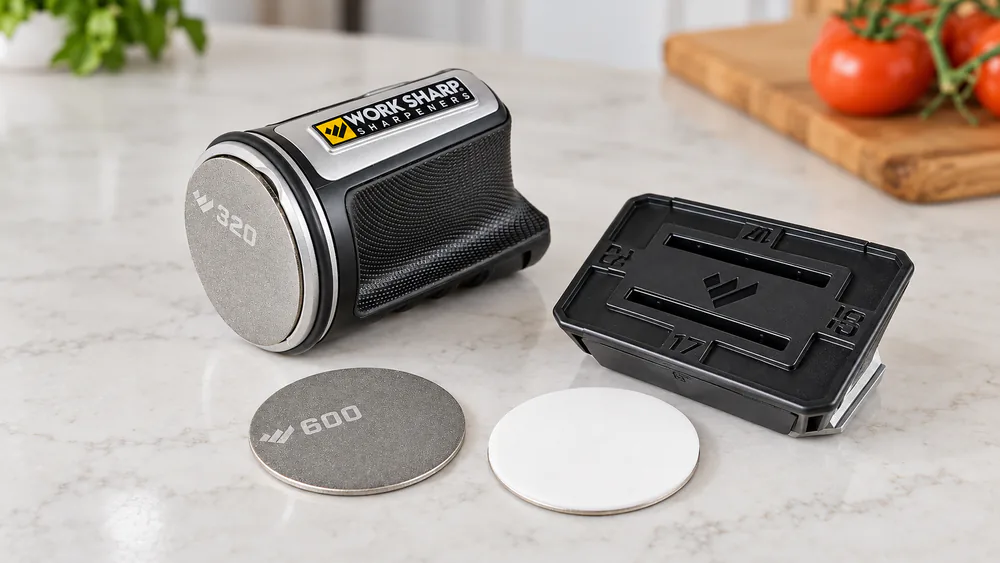
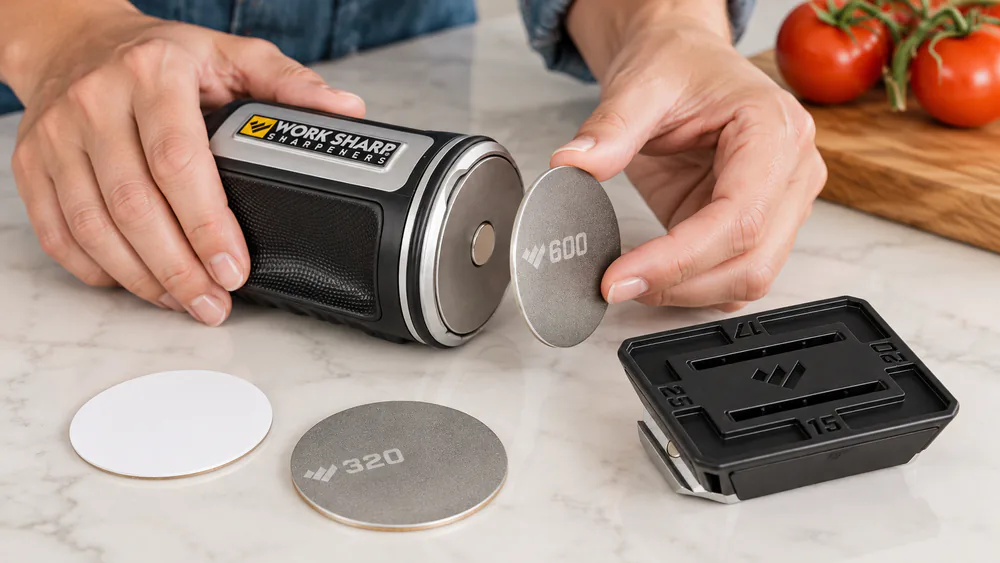
The Work Sharp has the most angle choices of the three, and the magnetic discs change quickly. The grip is comfortable, and its diamond-to-ceramic progression can produce a keen working edge on kitchen knives without an added strop. It asks for more attention than the Tumblers, though: the roller drifts toward the hand, so you have to guide it actively to keep the abrasive on the blade.

Pros

  • 15, 17, 20 and 25 degrees per side
  • 320-grit diamond, then 600-grit diamond, then a fine ceramic disc
  • Interchangeable magnetic discs change in seconds
  • 3-year sharpener warranty
  • Packaging doubles as a drawer organizer

Cons

  • Roller drifts and needs active guidance
  • Extra positioning needed around bolsters, tall blades and long flexible knives
  • Small knives can shift against the magnets
  • No strop in the base kit

The Work Sharp earns its place with the wider angle range shown in the comparison table. Its fine diamond and honing stages also refresh an already serviceable edge without starting at the coarse face.

The ceramic face is very smooth, so it works best after you have removed most of the burr on the fine diamond face first. The diamond surface can wear, and the ceramic disc is thin, so it helps that replacements are available.

It handles large kitchen blades more reliably than small folding knives, which shift against the magnets. We would not recommend it for scissors, because the angle block does not describe a procedure for them. It is also small enough to put away readily between sessions.

A hand swapping a magnetic abrasive disc onto the Work Sharp rolling sharpener beside its angle block with blade riser
Swapping magnetic discs on the Work Sharp.

Tumbler Original vs. Pro: Which Features Matter?

The two Tumblers look alike on a counter, so the choice comes down to two things: what the roller is made of and what its abrasive does over time.

Sharpening and Finishing Discs

The Original pairs a diamond face with a steel helix finishing face. It is simple, and the steel face gives a usable edge, but it takes patience to refine. The Pro uses a 4-layer diamond disc and a ceramic honing face, which gives a finer finish after the diamond pass.

The Pro also opens a path the Original cannot follow. An optional 150 coarse diamond disc handles repair work before standard sharpening, and an optional 3000/6000 polishing progression takes the edge further. These upgrades require Pro models purchased after June 1, 2025, with a hex recess above the screw threads, and they are incompatible with the Original.

Upgrade Options and Total Kit Cost

The Original costs less than the Pro, and the Work Sharp sits at a similar mid-priced level. Both the Pro's base kit and its upgrades add up, though. A holder for extra angles, a stand, a strop, and the coarse and polishing discs each raise the total, so decide what you really need before you buy.

Our advice is simple. If you sharpen a few large knives a few times a year, the base Pro is enough. If you want the option to repair edges later, the Pro's upgrade path is why we ranked it first, and that path is closed to Original owners.

How to Choose a Rolling Knife Sharpener

Three checks cover almost every buying decision: angle, fit and abrasive. Get them right and the brand matters much less.

An empty magnetic support and roller with a chef’s knife resting separately behind them
Check the support’s height against your blade before setting up the sharpener.

Match the Sharpening Angle to Your Knife

Start with your knife maker's angle guidance. Many Western chef's knives are ground around 15 to 20 degrees per side, and Japanese-style knives often sit lower. The table above shows which kit offers which presets.

If you mostly own knives that fit 15 or 20, you do not need more presets. If your set is mixed, the extra angles matter.

Check Blade Height, Shape, and Magnetic Support

Blade height and shape decide whether the sharpener works at all. A narrow blade may sit too low or shift on the support, and a riser does not guarantee compatibility. Test fit before you roll. Tall blades need clearance, and for a blade taller than the disc, a stable cutting board beneath the roller can raise the abrasive to the edge.

Serrated knives and scissors are excluded on the Tumblers, and ceramic blades cannot attach to the magnetic holder. A pronounced curved tip is harder to track than a straight santoku edge.

Warning. Do not assume a "fits most kitchen knives" claim covers your small paring or folding knife. Seat it on the magnet and check that the abrasive reaches the full edge before you start.

Compare Abrasives, Grit Progression, and Replacement Discs

Do not compare numbers across brands. D35 is a Tumbler label, not a grit you can match to the Work Sharp's 320 or 600. Compare the progression instead: coarse for shaping, finer for refining, and a hard, smooth face to finish.

Then ask what happens when the abrasive wears. The table shows which kits let you swap discs. Lifetime warranty banners cover manufacturing defects. They do not establish unlimited abrasive replacement.

A rolling sharpener is only as good as the angle it holds and the abrasive you can replace.

How to Use a Tumbler Knife Sharpener

The process is the same on any rolling sharpener. Work on a flat, stable surface and keep your fingers clear of the edge.

Set Up the Knife and Follow the Correct Angle

  1. Choose the angle that matches your knife maker's guidance, and set the magnetic support.
  2. Lay the blade flat on the support with the edge toward you and confirm the full edge is clear.
  3. Place the diamond face on the edge so it contacts the bevel evenly.

On a very long blade or one with a bolster, shift the knife along the support in sections so the abrasive reaches the whole edge.

Sharpen, Finish, and Check the Edge

Roll the abrasive along the edge with steady, light pressure. Develop an even edge before you refine it. The first session takes longer when the preset changes the bevel, and later touch-ups are easier. Expect sustained, patient rolling before the edge feels sharp.

Switch to the finishing face and use lighter, alternating passes to remove the burr. Wipe the blade, rinse it as you normally would, and dry it before food prep. Then test on something soft, like a tomato or onion skin, and let the result decide whether you need another pass.

Tip. On the Work Sharp, remove most of the burr on the fine diamond face before using the ceramic. Its very smooth ceramic works best on a refined edge.

Cleaning, Storage, and Disc Replacement

On the Pro, wipe the standard discs with a dry cloth after use and clear debris around the holder and discs. The standard diamond and ceramic faces need no oil or water. The sharpening dust it leaves on the knife wipes off easily with a cloth.

We have no verified washing, soaking or lubrication instructions for the Original or the Work Sharp, so we stay with a dry wipe and follow each maker's guidance. Store the roller and support together so the magnets do not collect grit.

On disc replacement, the Original's fixed abrasive means that when it wears, the sharpener has reached the end of its useful life. The Pro's removable disc and the Work Sharp's magnetic discs can be replaced. Both makers also handle returns: the Tumbler offers a 30-day return window through its own store, and Work Sharp's direct return pages disagree on the window, so confirm the seller's terms before you buy.

Frequently Asked Questions

How can you tell a disc is worn out?

Watch the edge, not the calendar. If sustained, patient rolling stops producing a keener edge than it used to, the abrasive has likely lost its bite. Disc life varies with steel, pressure and use, and there is no reliable number of sharpenings to count on.

Does the lifetime warranty cover replacing a worn disc?

Not as far as we can establish. The advertised Tumbler lifetime warranty covers manufacturing defects and does not promise unlimited abrasive replacement, so treat disc replacement as a separate purchase and check the seller's terms.

Can a rolling sharpener handle single-bevel knives?

Only with blade-specific guidance. A one-sided grind needs the right geometry and back-side treatment, so do not apply the ordinary two-sided routine automatically. Serrated blades, scissors and ceramic blades are excluded on the Tumblers.

How long does sharpening take?

There is no universal number. The first session takes longer when the preset changes the bevel, and later touch-ups are quicker. Let the edge's cutting performance guide you.

How often should you sharpen your knives?

Sharpen when the knife starts to slip on a tomato skin or crush an onion instead of slicing it. A calendar schedule is less useful than the way the edge actually cuts.

When is a whetstone or professional sharpening a better choice?

Choose a whetstone when you want to set your own angle freely, and a professional for deep chips, broken tips or valuable knives with uncertain geometry.

Final Verdict: Choose for Your Knives and Budget

Our ranking holds if your drawer is mostly full-size kitchen knives. The Original only earns a place if you own a few large, broad blades and accept that its disc cannot be swapped out. The Work Sharp is the one to pick if your knives sit at different angles.

Skip all three if your collection leans on paring knives, folding knives, serrated blades or scissors, or if you are facing deep chips or a broken tip. A whetstone or a professional sharpener is the better route there.

Read next

Final Verdict: Choose for Your Knives and Budget

Browse more kitchen buying guides or get our newsletter for help choosing your next kitchen tool.