
Knives & Cutlery
Types of Japanese Knives: Find the Right Blade
As an Amazon Associate we earn from qualifying purchases. We may earn a commission from links on this page, at no extra cost to you. Learn more.
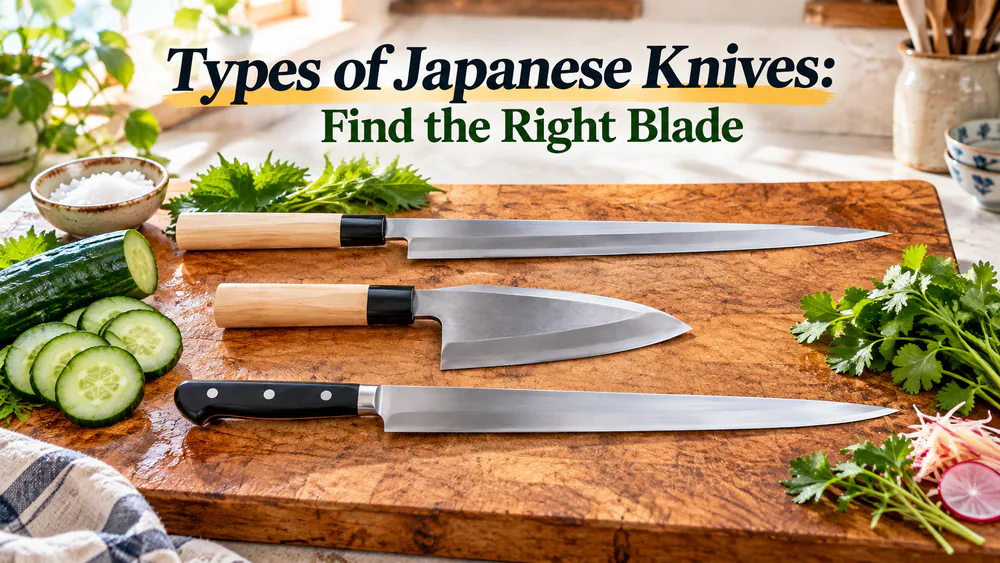
Japanese knives are named for the job their blade shape does. A gyuto handles most of a cook's daily prep, while a yanagiba exists to slice raw fish in one long pull. Understanding the difference between general-purpose and specialist blades makes choosing a knife easier. Here is how we sort the types across our Japanese knife reviews.
Japanese Knife Types at a Glance
Most Japanese knives fall into a few families: all-purpose, vegetable, slicing and fish, and utility. The table lists the core types. Regional forms and modern hybrids vary, so treat the bevel column as typical rather than guaranteed.
| Knife type | Primary task | Usual bevel | Suitable user |
|---|---|---|---|
| Gyuto | General prep | Double | Everyday cooks |
| Santoku | Compact general prep | Double | Everyday cooks |
| Bunka | General prep, tip detail | Double | Cooks wanting a pointed tip |
| Kiritsuke | Traditional vegetable and fish work; modern general prep | Traditional single; modern often double | Match experience to the variant |
| Nakiri | Vegetables | Double | Frequent vegetable prep |
| Usuba | Fine vegetable techniques | Single | Practiced specialists |
| Sujihiki | Boneless protein slicing | Double | Frequent carving |
| Yanagiba | Sashimi | Single | Practiced fish slicers |
| Deba | Whole-fish butchery | Traditional single | Cooks learning fish butchery |
| Petty | Small trimming jobs | Double | Companion to an everyday knife |
| Honesuki | Poultry boning | Varies; check the grind | Frequent poultry preparation |
Single-Bevel and Double-Bevel Knives Explained
Bevel is the grind that forms the cutting edge. Double-bevel knives have cutting bevels on both sides. Traditional single-bevel knives have a principal bevel on one face and a different geometry on the back.
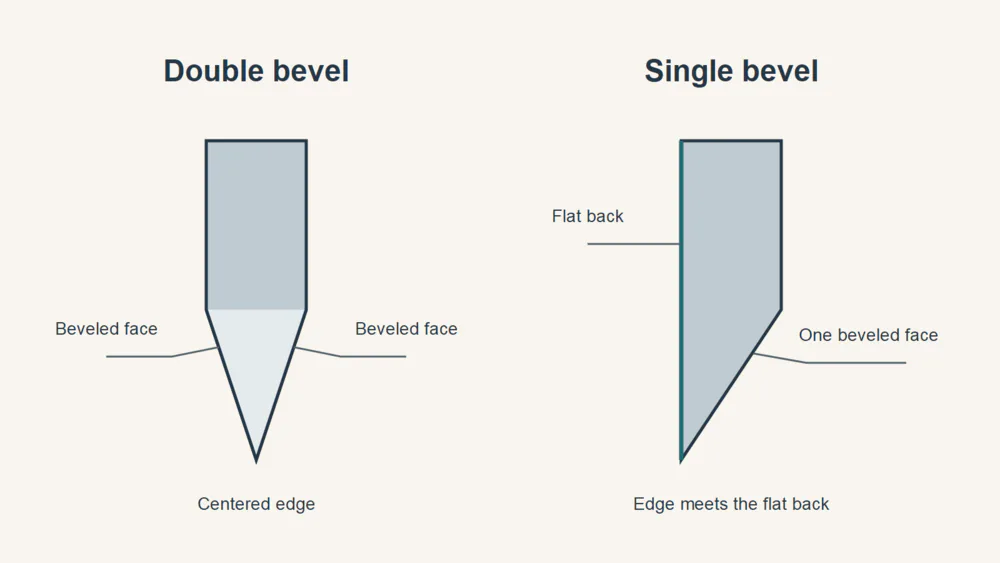
What the bevel changes about use and sharpening
A single-bevel knife can make precise cuts, but using it well takes more practice. Sharpening includes the flat back, and that takes whetstone practice or a skilled sharpener. Double-bevel knives are easier to maintain, which is why most home cooks do well starting there.
Handedness and choosing a first Japanese knife
True single-bevel knives are handed, so you buy a right-hand or left-hand version. Most double-bevel knives suit either hand, but some have asymmetric grinds, so check the actual knife. For a first purchase, pick a double-bevel gyuto or santoku in stainless steel. Stainless needs less upkeep than carbon, which reacts with moisture and acidic foods and develops a patina.
All-Purpose Japanese Knives
These four cover the widest range of daily cutting. Most kitchens need only one of them.
Gyuto: the versatile chef's knife
The gyuto is the Japanese take on the Western chef's knife. It has a pointed tip, a curved cutting edge and, usually, a double bevel. It cuts vegetables, boneless meat and fish, so it is the knife we would hand a cook who wants one blade for everything.
Santoku: a compact everyday knife
The santoku is shorter, with a flatter edge and a sheepsfoot profile. It suits vegetables and boneless proteins, and it feels nimble on a small board. A smooth, curved bolster is comfortable in a pinch grip, while sharp corners can press into your fingers during long prep sessions. Whether a bolster blocks your grip adjustment is worth checking before you buy.
Bunka: an all-purpose knife with an angled tip
The bunka is a general-purpose double-bevel knife with an angled, reverse-tanto tip. That tip is useful for detail work such as scoring and trimming.
Kiritsuke: traditional single-bevel and modern double-bevel styles
Note. The name covers two different knives. The traditional kiritsuke is a single-bevel hybrid of the yanagiba and usuba. The modern kiritsuke-style gyuto is double bevel and serves general prep. An angled tip alone does not tell you which one you are holding.
Check the listing for the bevel before you buy. A traditional kiritsuke is a specialist tool, while the modern version behaves much like a gyuto.
Japanese Vegetable Knives
Vegetable knives are tall, flat and made for straight up-and-down cuts.
Nakiri: everyday vegetable preparation
The nakiri has a tall rectangular blade, a relatively flat edge and a double bevel. The flat edge finishes cuts against the board, so fewer slices stay joined underneath. The tall blade also guides your knuckles and sweeps chopped vegetables off the board. A thin blade passes through produce cleanly, while a thick one resists. Heavy models can be hard to steer through carrots. Its cleaver-like look is misleading, because a nakiri is not built to cut bone.
Usuba: precise traditional vegetable work
The usuba is a traditional single-bevel vegetable specialist. It makes thin slices, decorative cuts and katsuramuki, the rotary peeling of a vegetable into a long sheet. Using it well takes practice, so we recommend that most home cooks start with a nakiri.
Japanese Slicing and Fish Knives
These knives are long and narrow so a single draw can finish the cut.
Sujihiki: slicing boneless meat and fish
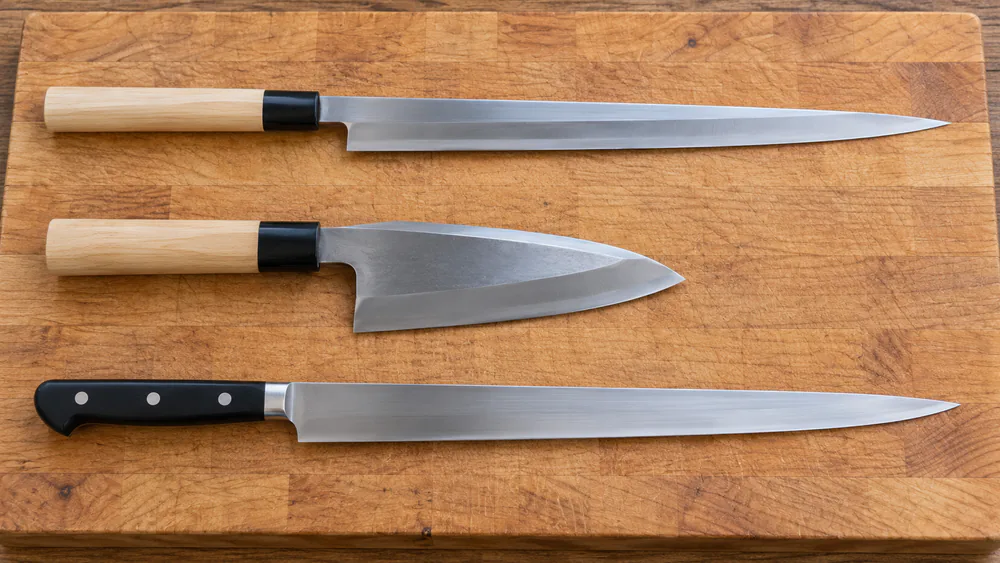
The sujihiki is a long, narrow double-bevel slicer for boneless raw or cooked meat and fish. Its length allows long drawing cuts, which makes it the natural choice for roasts and cooked brisket.
Yanagiba: sashimi slicing
The yanagiba is a traditional single-bevel sashimi knife. It is designed for one continuous pulling cut through fish flesh, with no sawing. Fish slicers who practice often get the most from it.
Deba: breaking down whole fish
The deba is thick, heavy and traditionally single bevel. Its pointed front helps with filleting, and the robust heel can handle suitable small fish bones. Bone-cutting ability depends on the blade, the fish size and your technique. A suitable deba can process small fish bones, but it is not a general-purpose bone cleaver or a frozen-food knife.
Utility and Poultry Knives
Petty: small trimming and detail work
The petty is a small double-bevel utility knife for trimming, fruit and precise cuts. It does the small jobs a large gyuto handles awkwardly, so it works best as a companion to your main knife.
Honesuki: boning poultry
The honesuki is a stiff, triangular poultry-boning blade. Its pointed tip follows joints and separates flesh from bone rather than chopping through hard bone. Bevel construction varies, with both double-bevel and single-bevel versions made, so check the individual blade's grind and handedness.
Other Specialized Japanese Knife Types
A few more shapes turn up in specialist kitchens. Pankiri is a serrated bread knife that cuts crust without crushing the loaf. Mukimono is for fine decorative fruit and vegetable work, with an angled tip for precise incisions. Menkiri is a broad, straight-edged noodle knife for cutting dough into strands, and it also goes by sobakiri and udonkiri.
Several relatives are worth knowing by name. The funayuki is a fisherman's general-preparation knife, thinner than a typical deba. The mioroshi deba is a slender deba that fillets and slices, though it does not replace a dedicated yanagiba. The unagisaki opens eels and varies by region. The garasuki is a larger poultry-butchery relative of the honesuki, and the hankotsu is a compact trimming knife that is not a bone chopper.
Which Japanese Knife Should You Choose?
Choose by the food you cook most, not by how impressive the blade looks.
Choosing an everyday knife
Start with a gyuto or santoku that suits your routine prep. Choose stainless steel if you want simpler care. A gyuto gives you more reach for large vegetables and meat, while a santoku fits smaller boards and hands.
Adding a specialist for the food you cook
Add a second knife when you regularly struggle with a task your main knife cannot handle well. A petty covers small trimming, a nakiri helps if you chop vegetables daily, and a sujihiki makes sense for regular carving. Yanagiba, usuba and deba reward practice, so wait until you know you will use them.
Caring for Japanese Knives
Careful habits protect a fine edge, and they take only a few minutes a day.
Cleaning, drying, and storage
Hand-wash with mild soap and dry the blade thoroughly. Avoid dishwashers and soaking. Do not leave the knife loose in a drawer. Use a sheath, block or magnetic strip that protects the edge.
Cutting surfaces, blade limits, and sharpening
Use a wooden or suitable soft board, and avoid glass and stone. Do not twist the blade sideways.
Warning. Keep Japanese knives away from frozen food and hard bones. The edge is hard and thin, and it can chip when forced.
Sharpen to the blade's original geometry and follow the maker's guidance. For single-bevel knives, that includes the back.
Frequently Asked Questions
How many types of Japanese kitchen knives are there?
There is no single authoritative total. Regional forms, subtypes and modern hybrids overlap, and makers name patterns differently. A dozen or so core types cover most home and professional needs.
Is Damascus a knife type?
No. Damascus describes layered blade construction and its visible pattern. It can appear on a gyuto, a santoku or any other knife type.
Do Japanese knives all have a single bevel?
No. Gyuto, santoku, nakiri, bunka and petty are usually double bevel. Yanagiba and usuba are traditionally single bevel, and deba usually is. Kiritsuke and honesuki come in both forms.
Can Japanese knives cut through bones or frozen food?
Most should not. A suitable deba or honesuki can work around small fish bones or poultry joints, but none of them replaces a cleaver for hard bone or frozen food.
Final Thoughts: Start with the Knife You Will Use Most
Pick the blade that matches your daily prep, learn its care, and add specialists slowly. For most cooks, that means one stainless gyuto or santoku first.
Read next
Final Thoughts: Start with the Knife You Will Use Most
Explore our buying guides to find a knife that fits your everyday prep.