
Knives & Cutlery
How to Sharpen a Knife With Another Knife: What Actually Works
As an Amazon Associate we earn from qualifying purchases. We may earn a commission from links on this page, at no extra cost to you. Learn more.
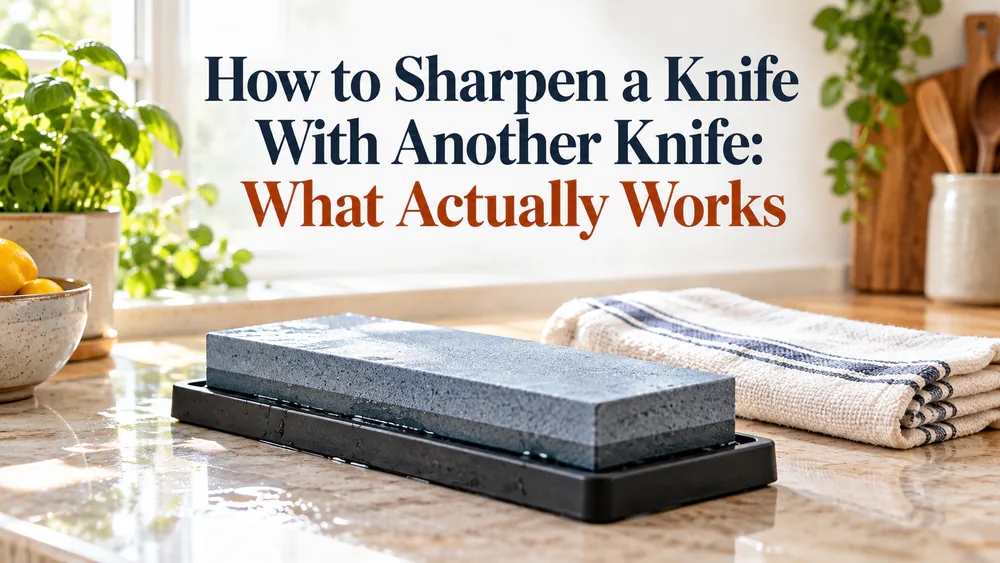
If your knife has gone dull and you have no sharpener in the house, rubbing it against another knife is tempting. We don't recommend it, because another knife is not a dependable substitute for a honing rod or an abrasive sharpener, and rubbing two blades together can damage both edges.
There are better ways to restore a dull edge than rubbing it against a second knife. This guide explains what changes at the edge, what can go wrong, and what to reach for instead. If you want the full tool picture, our knife sharpener guides cover each option in more depth.
Can You Really Sharpen a Knife With Another Knife?
Not reliably. Some guides describe improvised methods, but none establishes a procedure with a stated angle, pressure, or pass count. Any improvement you get depends on the condition of the edge and on which surfaces touch. Damage is just as possible as improvement.
Honing vs. sharpening: what changes at the edge
Honing maintains an edge between sharpening sessions. Sharpening removes material to renew the cutting edge. People often describe honing as simply straightening a bent edge, but that picture is incomplete. A worn edge can be blunted and thickened rather than bent sideways, so straightening it does not necessarily bring back its original shape. Steel rods can also remove a little metal, depending on the rod surface and the state of the edge.
That is why we treat honing as upkeep and sharpening as the real repair.
What another knife can and cannot do
A second knife is a cutting tool, not an abrasive surface or an angle guide. Relative hardness alone does not make it a safe or effective sharpening surface, and no hardness threshold guarantees a good result.
At best it nudges a slightly rolled edge. It cannot remove material in a controlled way, fix a chip, or give you a repeatable angle. On a worn edge, it can add scratches or nicks.
What to Do When Your Knife Goes Dull During Prep
Check the edge before choosing a method
Inspect the cutting edge under good light. Then try the paper test. A sharp edge slices paper cleanly, while folding or shredding the paper is a sign that the edge needs attention.
Choose a tool and follow its supported technique
If the knife has only lost a little of its sharpness, use a compatible honing rod. Rest the rod tip on a nonslip surface, hold the knife at its specified angle, and draw the edge down the rod from heel to tip. Alternate sides and keep the strokes light. Fast, forceful strokes can damage the edge, while gentle, controlled ones are much easier to manage. Hand wash the knife afterward to remove residue.
For the angle, follow the maker. Shun's standard honing guide uses 16 degrees per side, and WUSTHOF's general steel instructions specify 14 degrees, with separate guidance for Asian-style blades. Those are two manufacturer examples, not a rule for every knife, and they are not instructions for knife-on-knife contact.
If the paper test still fails, move to a whetstone or a suitable sharpener, covered below.
Check the result and know when to stop
Run the paper test again after a few light passes. If it cuts cleanly, stop, because extra strokes only raise the odds of harming the edge.
If the knife still fails after honing, that points toward sharpening. Also keep in mind that a knife can cut well again while deeper nicks remain visible. Better sharpness does not mean all the damage is gone.
Tip. In a pinch, the best no-gear move is to stop cutting hard foods with the dull knife and switch to a sharper one. A dull blade slips more, which is the bigger safety risk.
What to Know Before Bringing Two Blades Together
Why the spine and cutting edge are different
The cutting edge is the sharpened working boundary of the blade. The spine is the back. They are not interchangeable, and a description of spine contact should never be pictured as edge-to-edge rubbing. Edge against edge is the contact most likely to roll, chip, or dull both knives.
Blade damage and handling risks
Two blades moving in your hands invite slips and cuts. Uncontrolled contact can leave an edge jagged. A mismatched pull-through sharpener can do the same thing and require corrective sharpening afterward, so a random second knife is a bigger gamble still.
Warning. Never rub blades together at speed, and never hold one knife in the air while striking it with another. Keep your fingers behind both edges and work slowly, or skip the method entirely.
Better Tools for Honing and Sharpening
A honing rod for routine edge maintenance
A rod gives you controlled heel-to-tip contact, light strokes, and a knife-specific angle. Use a rod and angle approved for your particular knife. A Japanese knife is not automatically incompatible with every honing steel, but check the maker's guidance first. Ceramic and diamond rods remove steel, so do not treat them as identical to a maintenance steel.
A whetstone or suitable sharpener for a dull edge
Whetstones use abrasive surfaces to renew an edge, and coarse and fine stages serve different jobs. Guided sharpeners have preset angles, so compatibility with your knife matters. No single soaking time, grit progression, or pass count fits every stone and knife, so follow the instructions that come with yours. If you want a walkthrough, see how to sharpen a knife with a whetstone.
When to use a professional sharpening service
A professional service can restore worn edges and repair some chips and tips. Check what the service accepts for your type of damage and blade. Single-bevel knives require a sharpening method suited to their geometry, so leave them to someone familiar with that style instead of using a generic alternate-sides routine.
How to Keep Your Knife Cutting Well
Sharpen based on how the knife cuts, not on a calendar. Wear varies with use, board, knife geometry, and how well you maintain the edge.
Protect the edge between uses. Inspect it before you cook, since hard cutting surfaces and loose drawer storage can damage fine edges. Dry the knife before you put it away, and store it where the blade will not knock against other tools. A wood or plastic board is kinder than glass, stone, or tile.
For a broader routine, our beginner guide to sharpening a knife and the best way to sharpen a knife pick up where this page leaves off.
Frequently Asked Questions
Is there a correct angle for using another knife?
No verified angle exists for knife-on-knife contact, so we won't give one. For a honing rod, follow the angle your knife maker specifies. Two manufacturer examples are 16 degrees and 14 degrees, but those apply to their own rods and knives.
Can you use a ceramic knife as a sharpener?
We wouldn't. A ceramic blade is hard but does not flex, and twisting, prying, or impacts can break it. It is a cutting tool, not a purpose-built sharpening rod. Kyocera also says a ceramic sharpening rod is not suitable for its ceramic blades, and specifies a compatible diamond-wheel sharpener or a sharpening service.
Does this work on serrated knives?
No supported method exists. Serrated knives need specific tools or services, and some makers will hone serrated edges but not sharpen or repair them. Check compatibility before you try anything.
What if the knife still will not cut after honing?
Then the edge needs sharpening, not more honing. Repeat the paper test, and if it still folds or shreds the paper, move to a whetstone, a compatible sharpener, or a professional service.
Final Verdict
Skip the knife-on-knife trick. It has no verified procedure and a real chance of damaging both blades. Hone gently with a rod made for your knife, use the paper test to judge the result, and move to a whetstone or a service when honing stops working.
Read next
Ready to upgrade your kitchen?
Explore our buying guides for tools that help keep your kitchen knives cutting well.