
Recipes
German Chocolate Cake Frosting (Coconut Pecan)

As an Amazon Associate we earn from qualifying purchases. We may earn a commission from links on this page, at no extra cost to you. Learn more.
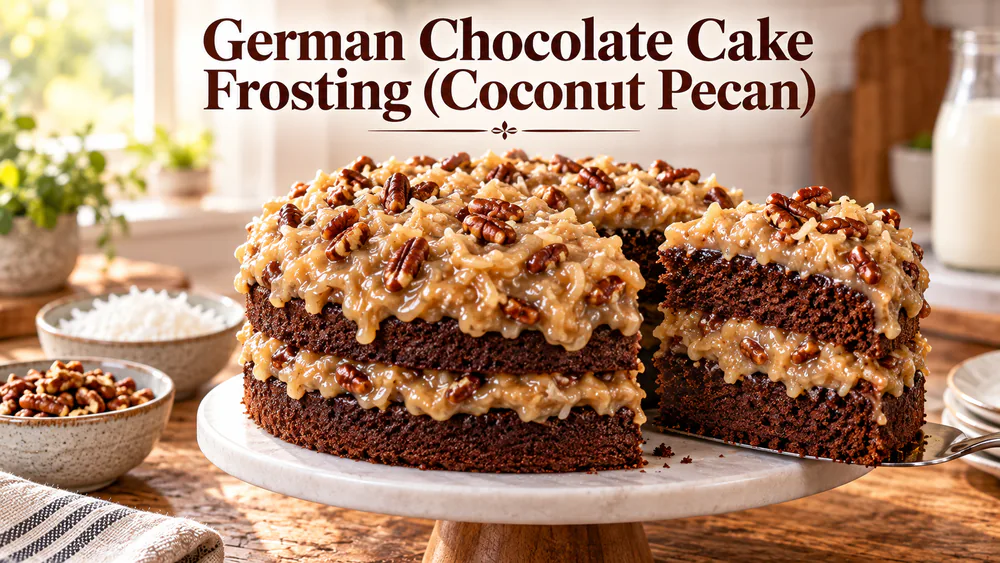
German chocolate cake frosting is not a fluffy buttercream. It is a cooked coconut-pecan topping, built on a stovetop custard of evaporated milk, egg yolks, butter, and sugar, then folded with shredded coconut and chopped pecans. That custard base is what makes the finished frosting taste rich, thick, and faintly caramel rather than sweet and airy.
We make this topping every time a German chocolate cake lands on our counter. It comes together with pantry staples in about 40 minutes of active work, plus cooling time before it spreads.
Why You'll Love This Frosting
It tastes like the classic, because it is the classic: a stovetop coconut-pecan topping made from scratch, with a caramel depth you cannot get from a can. It is practical, too. One batch covers a whole cake, it keeps for days, and it actually improves when you make it ahead.
What Is German Chocolate Cake Frosting?
Despite the name, German chocolate cake is American. It is named after Samuel German, who developed German's Sweet Chocolate in 1853 for the Baker's Chocolate Company, and the possessive was later dropped. You can read the history of German chocolate cake for the full story. The coconut-pecan cake rose to fame after the recipe appeared in Dallas, Texas newspapers in 1957.
What makes the frosting work is the egg yolk. The yolks thicken the milk and sugar into a custard that sets soft as it cools, so it holds its shape without a mountain of powdered sugar.
Ingredients You'll Need
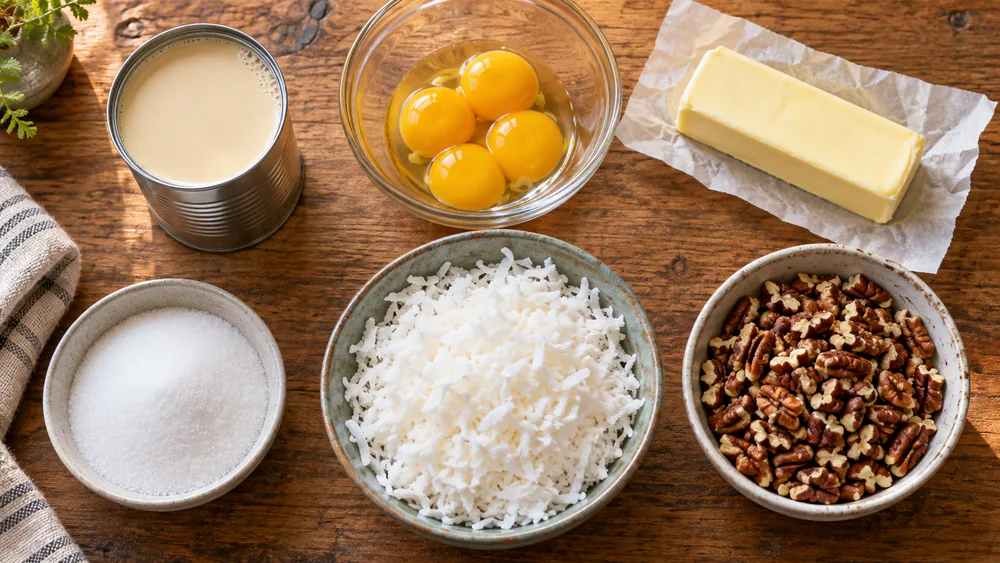
You likely have most of these on hand:
- Evaporated milk (not sweetened condensed milk)
- Sugar, granulated or light brown
- Egg yolks, 3 large
- Butter
- Vanilla extract
- Shredded coconut
- Chopped pecans
Ingredient Notes and Substitutions
The single most important detail is the milk. This frosting uses evaporated milk, which is unsweetened and lets you control the sweetness through the sugar. Sweetened condensed milk is a different product and will throw off both texture and flavor.
Granulated sugar keeps the topping lighter, while light brown sugar deepens the caramel note; both are traditional. We call for 3 egg yolks, though some recipes use four for a firmer set. And toasting the pecans is worth the extra step, since it noticeably deepens the nutty flavor.
How to Make German Chocolate Cake Frosting (Step-by-Step)
The whole recipe happens in one saucepan plus a quick toast for the pecans. Reach for a large heavy-bottomed pan, because the even heat is the practical fix for scorching and uneven thickening.
Step 1: Cook the Custard Base
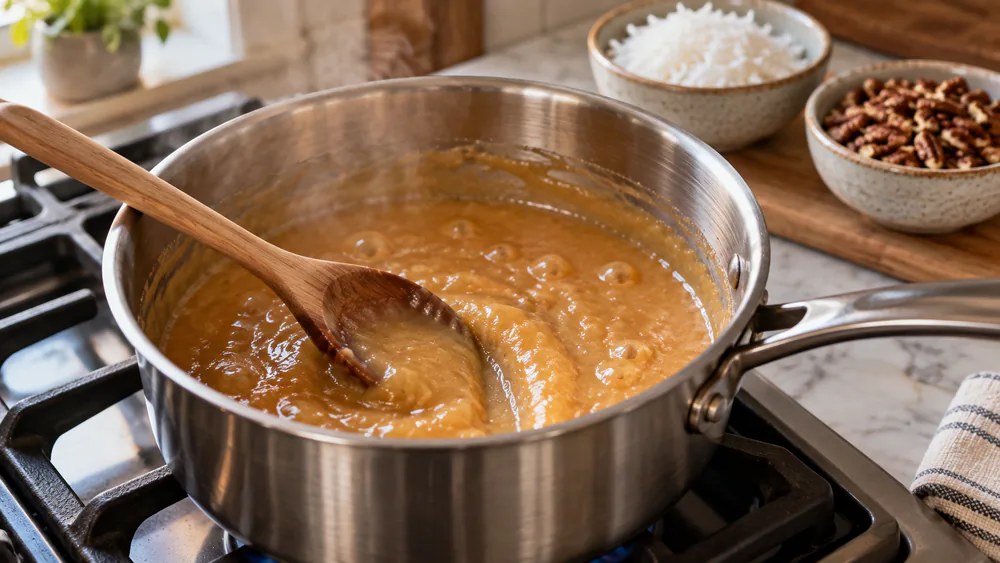
Combine the evaporated milk, sugar, egg yolks, and butter in the saucepan over medium heat. Cook and stir constantly for about 10 to 15 minutes, until the mixture boils, thickens, and turns a light caramel color. Do not walk away: step away and the egg yolks scramble at the bottom and the frosting turns grainy. Exact time shifts with pan and heat, so cook to the visual cue rather than the clock.
Warning. Never let the base sit still over the heat. The egg yolks will scramble against the hot pan bottom in seconds and leave you with a grainy, curdled frosting.
Step 2: Add Coconut and Toasted Pecans
While the base cooks, toast the pecans in a 350F oven for 7 to 10 minutes, until fragrant. Once the custard is off the heat, stir in the vanilla, coconut, and toasted pecans until everything is evenly coated. The frosting will look thin and soupy at this point, and that is exactly right. It thickens dramatically as it cools, which fools first-timers into overcooking it on the stove.
Step 3: Cool to Spreading Consistency
Pour the frosting into a bowl and let it cool completely before spreading, roughly 1 to 1.5 hours at room temperature or 2 to 3 hours in the fridge. Warm frosting slides right off the cake. Once fully cooled it spreads more easily and holds its shape, so patience here is the difference between a neat finish and a runny mess.
Tip. The base is done when it coats the back of a spoon and holds a line when you drag a finger through it. If it looks thin off the heat, trust the cooling rather than returning it to the burner.
Tips for the Perfect Coconut Pecan Frosting
Cook to the cue, not the timer: the signal is when the custard coats the back of a spoon and turns light caramel. Toast those pecans, keep the heat moderate and the spoon moving, and let the frosting cool fully before you spread it. High heat is the fastest route to a scorched, grainy batch.
How to Fix Runny, Grainy, or Too-Thick Frosting
Runny frosting almost always means you pulled it off the heat too early. Return it to medium heat and keep stirring until it coats the spoon, then let it cool and firm up.
Grainy or curdled frosting comes from not stirring enough. Constant stirring on medium heat prevents it; once the yolks have scrambled you cannot fully rescue the batch, so prevention is the real fix.
Too-thick frosting is usually just chilled frosting. Let it sit at room temperature until it loosens, or stir in a splash of evaporated milk by hand.
Variations (Eggless, Vegan, Brown Sugar)
The classic invites easy swaps. For a brown-sugar version, replace the granulated sugar with light brown sugar for a deeper, more caramel-forward topping.
Eggless and vegan or dairy-free versions are common too, usually leaning on a starch such as cornstarch to thicken in place of the yolks, with plant milk and vegan butter standing in for the dairy, while keto takes swap the sugar for a granulated substitute. Exact ratios vary, so follow a dedicated eggless or vegan formula rather than improvising this one.
How to Use This Frosting
The obvious home is a German chocolate cake, spread between two 9-inch layers and over the top, but one batch is versatile. Use it to fill and top cupcakes, to crown a pan of brownies, or to sandwich between cookies. It is also lovely spooned over ice cream while slightly warm.
Storage and Make-Ahead Tips
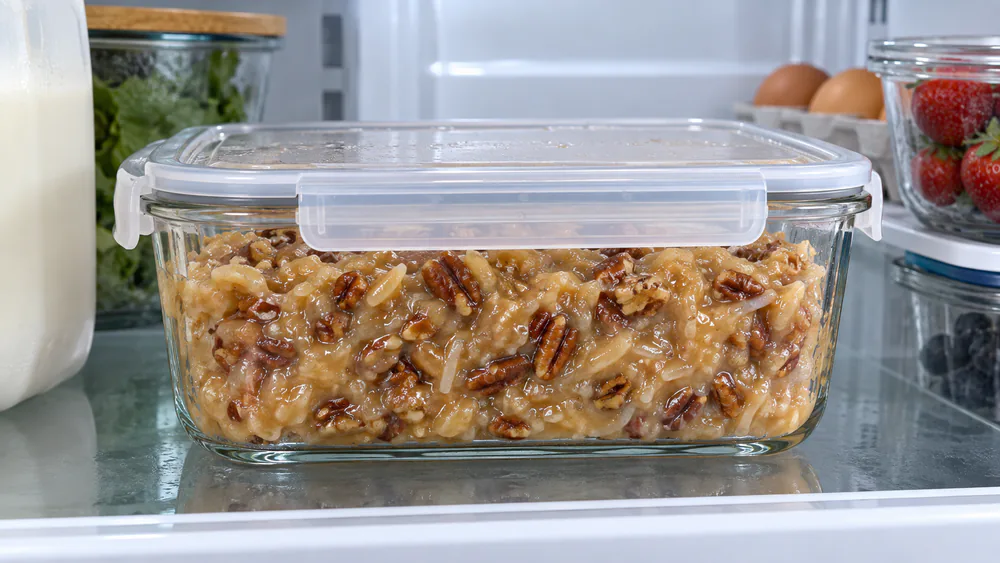
This frosting stores beautifully. Keep it in an airtight container in the refrigerator for up to 4 days, or freeze it for up to 3 months in a freezer-safe container.
Straight from the fridge it sets up quite stiff, so let it sit at room temperature for 20-30 minutes before spreading. Making it a day ahead is more than a convenience: in our experience the flavors settle and the topping improves overnight.
Recipe Card
German Chocolate Cake Frosting (Coconut Pecan). Active time: about 40 minutes. Cooling: 1 to 3 hours. Yield: roughly 2 to 2.75 cups, enough for a two-layer 9-inch cake, a 9x13 cake, or 12 cupcakes.
- Toast the pecans at 350F for 7 to 10 minutes.
- Combine evaporated milk, sugar, 3 egg yolks, and butter in a large heavy saucepan over medium heat.
- Cook and stir constantly for 10 to 15 minutes, until it boils, thickens, and coats the back of a spoon.
- Off the heat, stir in vanilla, coconut, and toasted pecans.
- Cool completely, about 1 to 1.5 hours, before spreading.
Frequently Asked Questions
How much frosting does this recipe make?
One batch makes roughly 2 to 2.75 cups, depending on the exact coconut and pecan amounts. That is enough for a two-layer 9-inch cake, a 9x13 cake, or 12 cupcakes.
Does German chocolate frosting need to be refrigerated?
Yes. Because of the egg yolks and dairy, keep it in an airtight container in the refrigerator for up to 4 days. It also freezes for up to 3 months.
How do I thicken the frosting?
If it is runny, it was pulled off the heat too soon. Return it to medium heat and stir constantly until it coats the back of a spoon, then let it cool, since it thickens a lot as it cools.
Why did my frosting turn out grainy?
Graininess comes from not stirring enough. Keep the heat at medium and stir constantly so the egg yolks never scramble against the pan bottom.
Can I make it ahead of time?
Yes. It keeps 4 days in the fridge and 3 months in the freezer, and the flavor settles overnight. Let chilled frosting sit at room temperature 20-30 minutes before spreading.
Final Thoughts
German chocolate cake frosting rewards attention at two moments: the stovetop, where constant stirring keeps it smooth, and the cooling bowl, where patience turns it spreadable. Make it a day ahead, let the coconut and toasted pecans settle into that caramel custard, and you will taste why it has outlasted the cake's confused name for decades.
Read next
Ready to upgrade your kitchen?
Browse more from-scratch recipes and the gear that makes them easier, tested in our own kitchen.