
Kitchen Appliances
How to Set Up, Use, and Maintain a Hamilton Beach Ice Cream Maker

As an Amazon Associate we earn from qualifying purchases. We may earn a commission from links on this page, at no extra cost to you. Learn more.
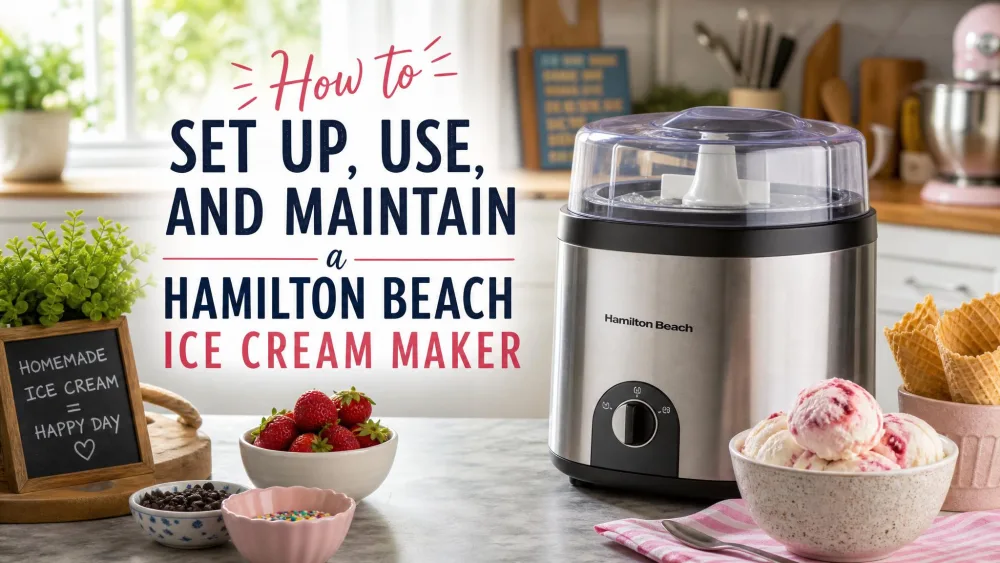
Wondering how to get your Hamilton Beach ice cream maker set up and churning your first batch? This guide covers it all: what comes in the box, how to prep the bowl or canister, how to load ice and rock salt, how long to run the machine, and how to clean it so it lasts.
We have run both kinds of these machines through real batches, from the big 4-quart ice-and-salt bucket to the smaller gel-canister models, and we learned where beginners get stuck.
What's in the Box and How the Hamilton Beach Ice Cream Maker Works
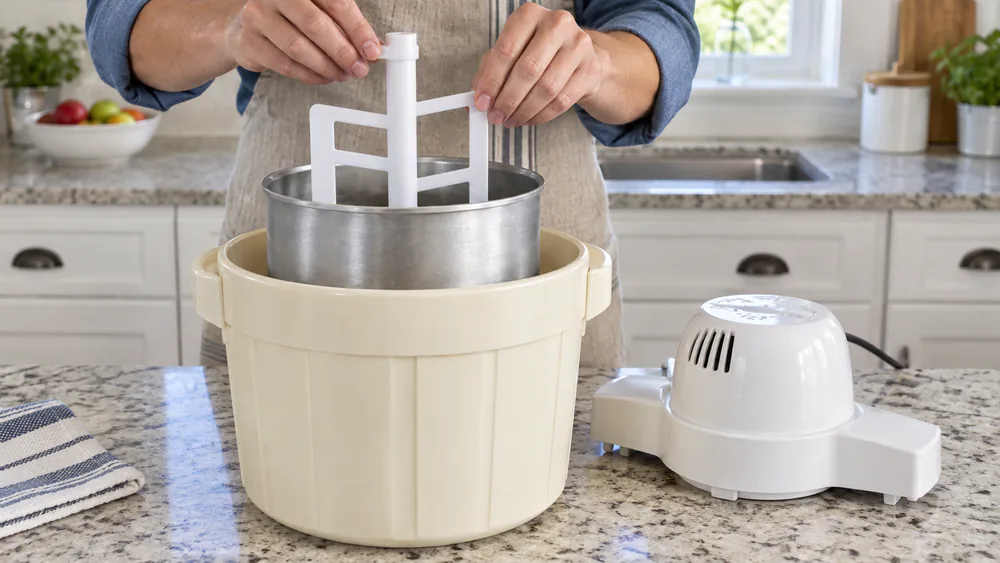
Open the box and you will find the motor unit, the outer bucket or base, the inner freezer canister, the mixing paddle (also called a dasher), and a lid that holds the motor. Most models include a recipe booklet, and the 4-quart 68330 family ships with over 20 recipes.
Hamilton Beach makes two very different kinds of machine, and the instructions are not interchangeable. The first is the ice-and-rock-salt bucket, like the 4-quart 68330, 68330N, and 68330R. The second is the gel-canister model, like the 1.5-quart 68320, 68880, and 68881.
The ice-and-salt models freeze your mixture by packing ice and rock salt around a metal canister. The salt lowers the melting point of the ice, which pulls heat out fast. The gel-canister models skip the ice entirely: you pre-freeze a canister filled with cooling gel, then let the frozen walls do the work. Both kinds are fully automatic, and the 68330 even stops on its own when the mixture gets too stiff for the motor to turn.
Before First Use: Freezing the Bowl and Prepping Ingredients
Prep is where most first batches go right or wrong. The ice-and-salt bucket needs almost none. You do not have to pre-freeze anything on the 4-quart model, so a spur-of-the-moment batch is realistic even on a busy weeknight. The only prep is mixing your base and gathering ice and rock salt.
Gel-canister models are the opposite. The canister has to be frozen solid before you start, and that takes hours, not minutes. Plan a day ahead.
Whichever model you own, chill your mixture in the refrigerator first. A cold base freezes faster and comes out smoother. When we skipped this step on the gel models, batches finished with more ice crystals and a less creamy texture.
Tip. Chill your ice cream base in the fridge for at least four hours, or overnight, before churning. A base that starts cold gives the machine less work to do and a creamier finish.
How Long to Freeze the Bowl or Chill the Canister
Freeze time for the gel canister depends entirely on how cold your freezer runs. Hamilton Beach lists a wide range for the 68320.
| Freezer temperature | Time to freeze the gel canister |
|---|---|
| -22F | 8 to 9 hours |
| -13F | 12 to 13 hours |
| 0F | 20 to 22 hours |
| 5F | 24 hours or more |
Most home freezers sit around 0F, so plan on roughly a full day. A canister that is not fully frozen is the top reason gel-model ice cream stays soupy. Shake it before you start; if you hear liquid sloshing inside, it needs more time.
Step-by-Step Setup and Assembly
Assembly is the same short routine every time.
- Place the freezer canister into the bucket or base.
- Pour your chilled mixture into the canister, stopping at the FILL LINE marked inside.
- Seat the mixing paddle so it sits flat on the bottom.
- Set the motor and lid on top, then lock it into place until it seats firmly.
- For ice-and-salt models only, pack ice and rock salt around the canister once the lid is on.
The FILL LINE matters more than it looks. Your mixture expands as air churns into it, so it needs headroom. Overfilling past the FILL LINE leaves the ice cream soft because there is no room for it to grow.
How to Make Ice Cream: Operating Instructions
Once the machine is assembled, running it is simple. The steps differ by model type, so follow the section that matches your machine.
Using Ice and Rock Salt Models (e.g., 68330)
With the mixture poured to the FILL LINE and the motor locked on, start layering ice and salt. Pack about 8 to 12 pounds of ice around the canister, adding 3 cups of rock salt in layers, until it reaches near the top of the bucket.
Turn the machine on. The 68330 churns for 20 to 40 minutes, then stops on its own when ready. In our kitchen the 4-quart model ran the longest churn of any machine we tested, so plan on the full 40 minutes rather than the low end.
Expect noise. The motor is loud and audibly strains on thick or custard-heavy bases, which is normal. As the ice melts, top up with more ice and a little salt to keep the level high. Finished ice cream from this bucket comes out dense yet fluffy and genuinely creamy, which lets the flavors come through.
Using Frozen-Bowl / Gel-Canister Models (e.g., 68320, 68880)
Gel models are even simpler because there is no ice or salt to manage. Pour your chilled base into the fully frozen canister, up to the FILL LINE, then lock on the motor and paddle and turn it on.
The 68320 makes ice cream in 25 to 40 minutes with no rock salt needed, and the 68880 runs about 20 to 40 minutes. Because these models rely on the canister's stored cold, a well-frozen canister and a cold base decide your texture. If the mixture is still soft after the run, move it to the freezer rather than churning longer on a warming canister.
Storing and Hardening the Ice Cream
Fresh from any of these machines, ice cream has a soft-serve texture. For firmer scoops, harden it further. On the ice-and-salt bucket, add an optional extra 4 pounds of ice and 1 cup of rock salt, then let it sit one to two hours. For any model, you can instead scoop it into an airtight container and freeze it for a couple of hours. Press parchment against the surface before sealing to keep ice crystals off the top.
Troubleshooting Common Problems
Most problems trace back to prep or assembly, not a broken machine.
Ice Cream Won't Freeze or Stays Soft
If the batch never firms up, start with temperature. On gel models, the canister was probably not frozen solid, or the base went in warm. On ice-and-salt models, check your ratio: too little salt, or not enough ice packed high around the canister, slows freezing badly. Add more and keep the level up as it melts. Also confirm you did not overfill; a canister filled past the FILL LINE cannot freeze properly.
Motor Stops or Won't Churn
When the machine will not churn, the usual cause is the paddle not seated correctly or the canister not locked in place, not a dead motor. Turn it off, take the lid apart, and reseat the paddle so it sits flat before locking the motor back on. Remember that the 68330 is designed to stop on its own when the ice cream is thick enough, so an auto-stop after 20 to 40 minutes is not a fault.
Warning. Never force a stalled motor by pushing down on the lid or running it in short bursts. Over time the motor and gears are the parts that wear out, and underpowered churning is the most common long-term complaint on the 4-quart model.
Cleaning and Maintenance Guidelines
Clean the machine right after each batch, while everything is easy to rinse. On the ice-and-salt models, melted ice and rock-salt brine is the real cleanup chore. Wipe the bucket and lid with warm soapy water right after churning, before the salt residue dries on.
The freezer canister, paddle, and lid should be hand-washed in warm soapy water and dried well. Here one rule is non-negotiable: the gel or cooling canister must be hand-washed only. It never goes in the dishwasher, because the heat can ruin its ability to freeze. Keep water away from the motor housing; wipe it with a damp cloth only and never submerge it.
Model-Specific Instructions and Where to Download the Manual
Because the ice-and-salt and gel-canister families work so differently, always match your steps to your exact model number, found on a label on the base of the machine.
| Model | Capacity | Cooling method | Pre-freeze needed | Churn time |
|---|---|---|---|---|
| 68330 / 68330N | 4 quart | 8 to 12 lb ice + 3 cups rock salt | None | 20 to 40 minutes |
| 68320 / 68320B | 1.5 quart | Pre-frozen gel canister, no salt | 8 to 24+ hours | 25 to 40 minutes |
| 68880 | 1.5 quart | Pre-frozen gel canister, no salt | Freeze bowl ahead | 20 to 40 minutes |
| 68881 | 1.5 quart | Pre-frozen gel canister, no salt | Freeze bowl ahead | 20 to 40 minutes |
For the full original instructions, download the PDF for your model. You can read Hamilton Beach's official use and care guide for the exact setup sequence, ratios, run times, and cleaning steps. If your model number differs, look up that model's use and care guide on the manufacturer's site instead.
Recipes and Usage Tips (Ice Cream, Gelato, Sorbet, Frozen Yogurt)
These machines are more flexible than the name suggests. The 68330 makes ice cream, frozen yogurt, custard, sorbet, gelato, and sherbet, and the gel models handle the same lineup at smaller batch sizes.
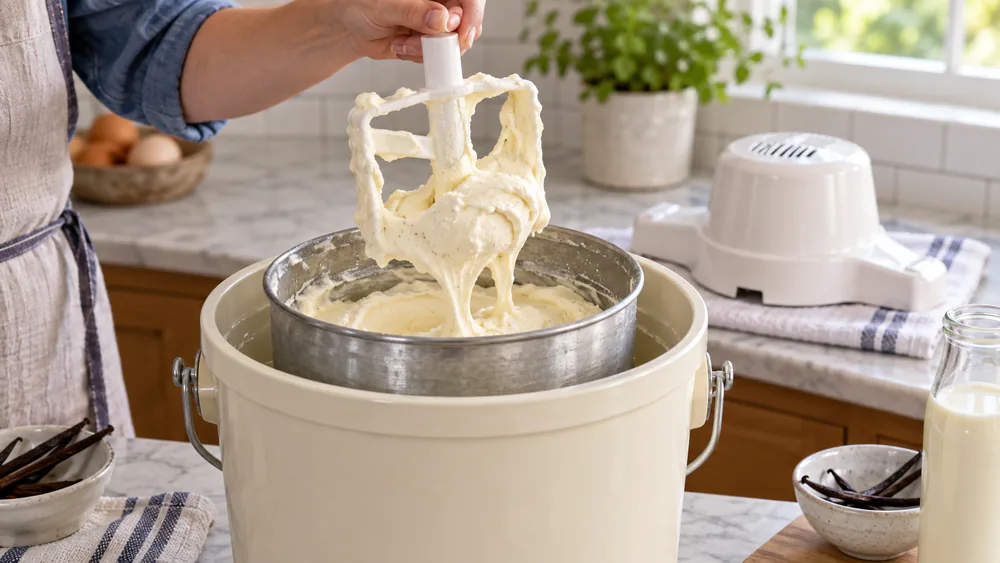
A simple vanilla base is the best place to start: whole milk, heavy cream, sugar, and vanilla, whisked until the sugar dissolves and chilled cold. For a custard base, cook egg yolks with the dairy and sugar into a thin custard, then chill it fully; it is richer, but the motor works harder on it. For sorbet, use a chilled fruit puree with sugar syrup and no dairy. Gelato uses more milk and less cream, giving it a denser, silkier texture, and frozen yogurt swaps plain yogurt for part of the dairy. In every case, chill hard first and stop at the FILL LINE.
Safety Precautions
A few habits keep the process safe. Keep hands, utensils, and long hair away from the moving paddle while the motor runs, and turn the machine off and unplug it before you take the lid apart. Never immerse the motor unit in water, and keep the cord away from the salty brine that pools around ice-and-salt buckets, since rock salt water is corrosive. Use the machine on a stable, level surface where it will not walk off the counter as it vibrates.
Frequently Asked Questions
How do I set up and assemble the Hamilton Beach ice cream maker?
Place the freezer canister in the bucket, pour your chilled mixture to the FILL LINE, seat the paddle flat, then lock the motor and lid on top. On ice-and-salt models, pack ice and rock salt around the canister after the lid is on.
How much ice and rock salt do I need?
For the 4-quart 68330, use about 8 to 12 pounds of ice and 3 cups of rock salt, added in layers around the canister. Top up as it melts during the churn.
How long does it take to churn?
Expect 20 to 40 minutes for most models, and 25 to 40 minutes for the 68320. The 68330 stops on its own when ready, and the 4-quart model tends to run near the full 40 minutes.
Why won't it churn or freeze properly?
If it won't churn, the paddle is usually not seated or the canister is not locked in. If it won't freeze, the gel canister was not frozen solid, the base went in warm, or an ice-and-salt bucket needs more salt and ice.
Can I make gelato, sorbet, or frozen yogurt?
Yes. These machines make ice cream, gelato, sorbet, sherbet, custard, and frozen yogurt. Just chill the mixture cold first and fill only to the FILL LINE.
Where do I download the manual for my model?
Download the use and care PDF for your exact model number, found on a label on the base. Start with the manufacturer's official use and care guide, then match the file to your 68330, 68320, 68880, or 68881.
Final Thoughts
Making ice cream at home comes down to a few habits: chill the base cold, fill only to the FILL LINE, match your steps to your model, and clean up before the brine dries. The ice-and-salt 68330 rewards you with the creamiest, most generous batches, while the gel-canister models trade capacity for the convenience of skipping ice entirely. Whichever you own, the routine is short and repeatable, and the results get better every time.
Read next
Ready to make your first batch?
Chill your base, match the steps to your model, and let the machine do the rest. Explore more kitchen how-tos and buying guides to get more from your gear.