As an Amazon Associate we earn from qualifying purchases. We may earn a commission from links on this page, at no extra cost to you. Learn more.
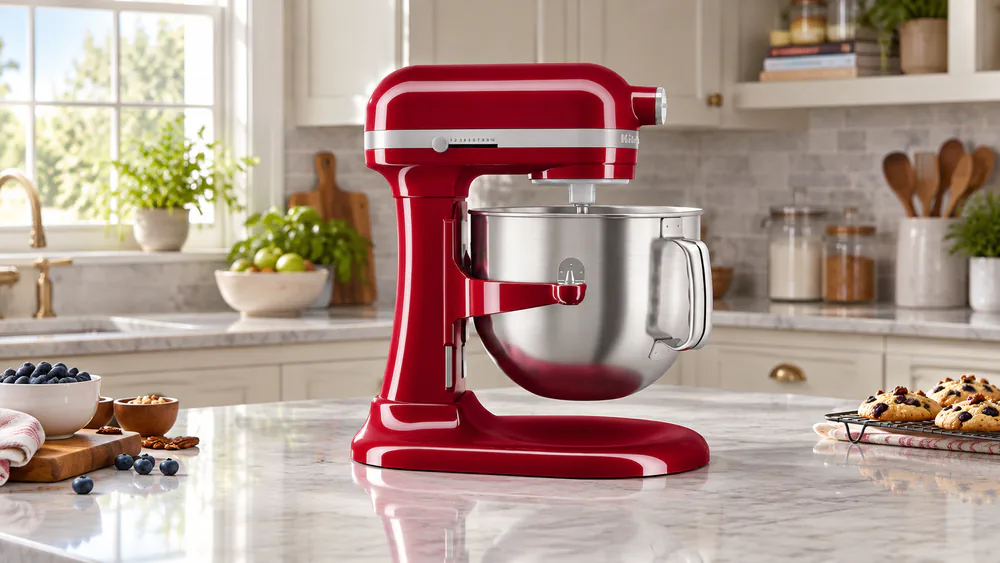
The KitchenAid 7-quart bowl-lift (KSM70) is a workhorse for large batches, bread dough, and big households, and it is the wrong buy for small-batch bakers or kitchens with low cabinets. In a house that feeds seven, a bowl that swallows double batches of cookie dough saves real time. It also takes real counter space, so we weigh both sides below. For more models in this family, browse our stand mixer reviews.
Quick Verdict
Key takeaway. Our rating: 4.4 out of 5. Right-sized for weekly bread bakers and crowd cooks, wrong for cabinet storage.
How we rate: we score a mixer the way a busy family kitchen uses it. That means capacity for a real dinner-party or bake-sale batch, how stable it stays under stiff dough, noise, cleanup, and whether a teenager can run it safely. We use KitchenAid's rated figures for capacity and power, and judge stability, noise, and cleanup by how the machine behaves in a family kitchen. We also flag any disagreements between published figures.
If you bake a lot, this is the size that fits. KitchenAid rates it to knead over 8.5 lbs of bread dough, mash over 7.5 lbs of potatoes, and mix 13 dozen cookies in one batch. For a family that bakes several loaves at a time, or fills cookie tins for a school fundraiser, that headroom matters.
It is a poor match if you bake small. The mixer stayed stable while kneading a 2 lb pizza dough on low for about seven minutes, but the bowl felt oversized for that batch. A big bowl is least efficient with small loads. If your cabinets are low or your counters are crowded, the footprint is a real trade-off.
Design and Bowl-Lift Stability
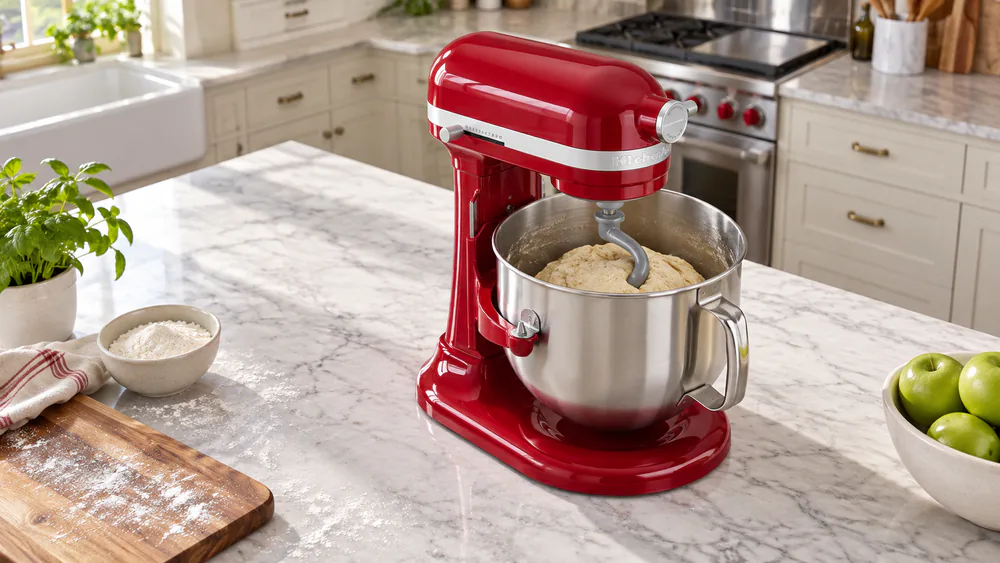
The bowl lock and the machine's weight keep it planted under dense bread dough, and it does not scoot across the counter. The 3-point locking bowl holds the bowl firmly, so the head stays rock solid instead of bouncing when the dough gets stiff.
The bowl raised into its locked position.
It is tall and heavy, so it works best parked on the counter rather than lifted in and out of a cabinet. Published weights range from the mid-20s to the mid-30s in pounds depending on source and color, so think of it as roughly 30 pounds. The bowl arrives already attached, which makes first-day setup quick.
Tip. Do the dime test before your first bread dough. If dry flour collects at the bottom of the bowl, the beater is sitting too high.
Warning. Measure before you buy. The mixer stands about 16.5 inches tall, and the head needs clearance above it. It is not a machine to slide under a standard upper cabinet.
Motor, Power, and Bread Dough
500 Watts and Long Kneads
KitchenAid rates the motor at 500W, though Consumer Reports lists 450W, so treat 500W as the rated figure. The company also claims 2x the power in the bowl of the tilt-head KSM150, measured as peak horsepower in the bowl above speed 2.
Kneading 1800 g of flour mix on speed 2 ran without trouble. A very large flour load, about 11 cups, slows the motor and makes it click, but it keeps going without overheating. Run stiff dough above speed 2 and you risk losing the motor mid-batch, so keep it on 2.
Heat and Noise
Long, heavy kneads can trigger a heat shut-off. Letting the motor cool about 30 minutes gets it going again, so plan back-to-back loaves with a break.
Noise is moderate at low speeds and loud at high speeds. Thick mixes can vibrate and walk slightly at higher speeds, so stay nearby when you push the speed dial up. It is quieter than an older, decades-old KitchenAid, and quieter than the 6-quart Professional 600. Kids helping at the counter can handle the speed dial, but an adult should set speed 2 for dough and stay nearby for thick mixes.
Mixing Performance
Day to day, this mixer behaves like a larger Artisan with more room and a steadier base. The half speed folds delicate ingredients gently, which helps with whipped egg whites and folded batters.
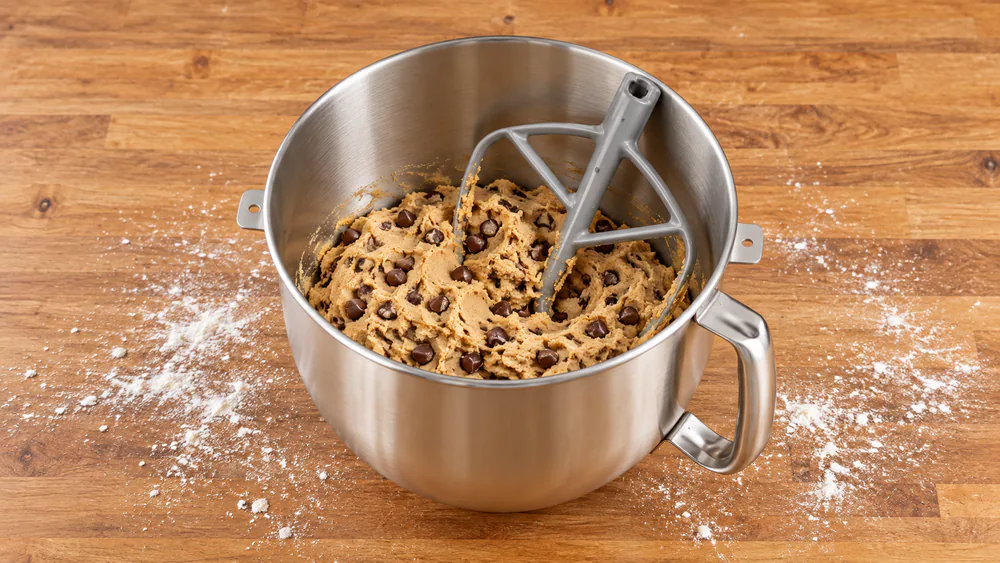
Double batches fit with room to spare.
Big batches of cookie dough and several loaves' worth of bread dough in one run go through without the motor straining, and the bowl-lift design stays steady on the counter during tough kneading. That steadiness is the main reason a crowded household gets more from this size than from a smaller tilt-head. We have not pinned down how far very stiff dough climbs the hook or whether the very largest loads need splitting, so check the fill level against KitchenAid's rated capacities and divide the dough if it crowds the bowl.
Flat Beater and Flex Edge Beater
The 7-quart bowl handles a 10-inch cheesecake batter, big pound cakes, and about 5 lbs of flour with room to spare. The double flex edge beater scrapes the bowl as it turns, which cuts down on stops. Even so, scraping the bowl sides is harder than on a tilt-head, because the head does not tip back.
Wire Whip
The 11-wire whip is built for large volumes of whipped cream or meringue. It is also the fiddliest part to clean, because batter clings to the beater shaft and the bowl cradle area.
Dough Hook
The coated dough hook is the reason to buy this size. It works stiff bread dough on speed 2 without the head lifting. If you only knead pizza dough for one or two pies, a smaller machine does the same job.
Capacity, Attachments, and What's in the Box
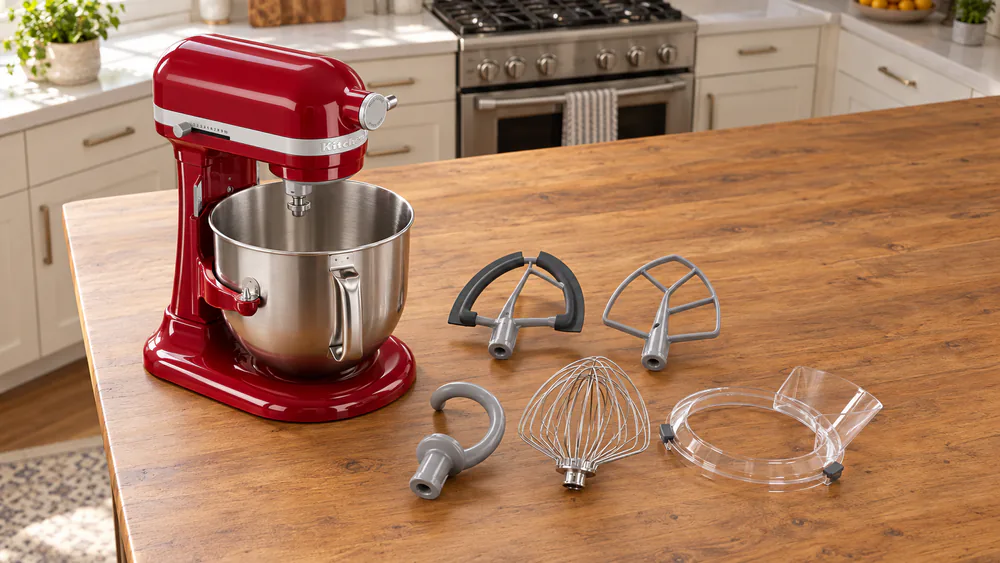
The box includes the 7-quart stainless bowl, a double flex edge beater, a coated flat beater, a coated dough hook, an 11-wire whip, and a pouring shield. KitchenAid publishes 13 dozen cookies and over 8.5 lbs of bread dough per batch, against 9 dozen cookies for the 5-quart Artisan.
Everything that ships in the box.
That is four dozen more cookies per batch than the 5-quart Artisan's 9 dozen, a useful difference when you bake for a seven-person household and a school bake sale. The mixer uses KitchenAid's universal power hub, and more than ten hub attachments are sold separately. KitchenAid describes attachment fit only in general terms, so confirm your specific attachment before buying a replacement.
Cleaning, Care, and Durability
The stainless bowl is fine in the dishwasher. The coated beaters and hook are safer washed by hand. Coated beaters can chip or wear over time, so hand-washing them and drying them right away is the routine we recommend.
The wire whip is the chore in a busy kitchen. It takes time to get batter out from around the beater shaft and the bowl cradle, and a kid helping with dishes will need to be shown how.
Durability has one caveat. On an unlucky unit the motor cuts out about 3 to 5 minutes into mixing icing or roll dough, with no tripped breaker and no heat. KitchenAid replaces the unit when that happens. Put it through a real bake in the first week so a bad unit shows itself while the return window is open.
Pros and Cons
1
KitchenAid 7 Quart Bowl-Lift Stand Mixer KSM70SKXX
For a family kitchen that bakes in volume, this is the KitchenAid we would buy. It stays stable while kneading, it is hefty but not unmanageable, and the 7-quart bowl absorbs double batches that would crowd a 5-quart tilt-head.
Stays planted under dense bread dough
7-quart bowl for double batches
11 speeds, including a gentle half speed
Universal hub for attachments
Bowl is dishwasher safe
Specifications
Bowl
7-quart
Motor
500W rated
Speeds
11
Weight
Roughly 30 lbs
Pros
Stays planted under stiff bread dough
Bowl holds double batches and about 5 lbs of flour
Half speed folds delicate ingredients gently
Quieter than older KitchenAid models
Universal hub accepts the attachment range
Cons
Tall and heavy, so it lives on the counter
Long heavy kneads can trigger a heat shut-off
Scraping the bowl is harder than on a tilt-head
Early motor failure is possible, though KitchenAid replaces the unit
Wire whip and coated pieces take extra cleaning care
Price, Warranty, and Value
This is a premium-priced mixer, and the price varies by color and goes on sale often. The warranty is a 1-year limited term on current retail listings. Older 7-quart models differed, so confirm the term on the page you buy from.
At that price, value depends on use. If you bake bread weekly, the capacity is worth the premium over the Artisan. If you bake occasionally, the smaller machine does the job for much less.
KitchenAid 7-Quart vs Tilt-Head and 6-Quart Bowl-Lift
The tilt-head Artisan KSM150 is the machine most families own. It holds 5 quarts, has 10 speeds, and mixes 9 dozen cookies per batch. Its head tips back, which makes scraping easier, but it gives up the capacity and the locked stability of the bowl-lift. For more head-to-head picks, see best KitchenAid stand mixers compared and our KitchenAid stand mixer review.
The 6-quart bowl-lift sits between them. We have not verified its spec sheet, so the table leaves those cells open. What we can say is that the 7-quart runs more quietly than the 6-quart Professional 600.
Row
7-quart bowl-lift
5-quart tilt-head
6-quart bowl-lift
Bowl
7-quart
5-quart
6-quart
Speeds
11
10
Check the listing
Cookies per batch
13 dozen
9 dozen
Check the listing
Bread dough
8.5 lbs
Not published
Check the listing
Head style
Bowl-lift, 3-point lock
Tilt-head
Bowl-lift
Frequently Asked Questions
What should I do if the motor quits in the first week?
Stop mixing and contact KitchenAid. In this failure, the motor cuts out about 3 to 5 minutes into mixing icing or roll dough, without tripping a breaker or getting hot. KitchenAid replaces the unit. That is why we run a real bake in week one.
What do I do when a coated beater starts to chip?
Stop using it, since coated beaters can chip or wear over time. Hand-washing and drying right away slows the wear. For a replacement, confirm the part against your exact model listing, because we have not verified part fit for the KSM70.
How long is the power cord?
Cord length is not published, so we cannot give a number. Because the mixer stands about 16.5 inches tall and sits best on the counter, put it within reach of an outlet before you buy.
Is the warranty the same on older 7-quart models?
Not necessarily. Current retail listings show a 1-year limited term, while an older 7-quart Pro Line was described differently, so confirm the term on the page you buy from.
Final Verdict: When to Pick Something Else
The 4.4 rating holds for bakers who fill the bowl. If you mostly knead one or two pizza doughs, the bowl feels roomy and a tilt-head is easier to scrape and store. We have not verified the 6-quart bowl-lift, so we cannot call it the better middle ground yet; check its listing against the table above. To compare alternatives, browse every KitchenAid we have tested.