As an Amazon Associate we earn from qualifying purchases. We may earn a commission from links on this page, at no extra cost to you. Learn more.
If you are trying to choose between a 3-cup and a 20-cup Aroma, or between a nonstick pot and a stainless one, the model names alone will not help you. We sorted the lineup by how each cooker fits a real kitchen, from a single-serving counter to a family meal-prep table. Our collection of rice cookers covers other brands, but here we stay with Aroma and tell you which one we would buy.
We judge each pick on rice quality, cleanup, and which parts wear first. When we lack hands-on findings for a model, we say so rather than guess.
Our Top Picks at a Glance
Three cookers cover most households: the digital 4-cup for everyday cooking, the 3-cup for tight budgets, and the 20-cup for big batches. All three are full reviews below, alongside four more.
Here are all seven side by side, with prices shown as tiers.
Model
Capacity (uncooked / cooked)
Inner pot
Presets / controls
Steam tray
Keep warm
Price tier
ARC-914SBD
4 / 8 cups
Nonstick
Digital: White, Brown, Steam, Flash Rice
Yes
Automatic
Budget to mid
ARC-150SB
10 / 20 cups
Nonstick
Digital: adds Slow Cook
Yes
Automatic
Mid
ARC-363-1NGB
3 / 6 cups
Nonstick
One-touch
Yes
Automatic
Budget
ARC-757SG
Up to 14 cups cooked
Uncoated 304 stainless
One-touch
Not listed
Automatic
Mid
ARC-966BD
6 / 12 cups
Nonstick (unconfirmed)
Digital: 6 presets
Yes
Automatic
Mid
ARC-994SB
4 / 8 cups
Nonstick
Digital: 7 automated controls
Yes
Not stated
Mid
ARC-743-1NG
3 / 6 cups
Nonstick
One-touch
Yes
Automatic
Budget
The 7 Best Aroma Rice Cookers
Each pick below carries a rating, a short checklist, and an honest list of pros and cons. We open every entry with the verdict so you can skim to the size you need.
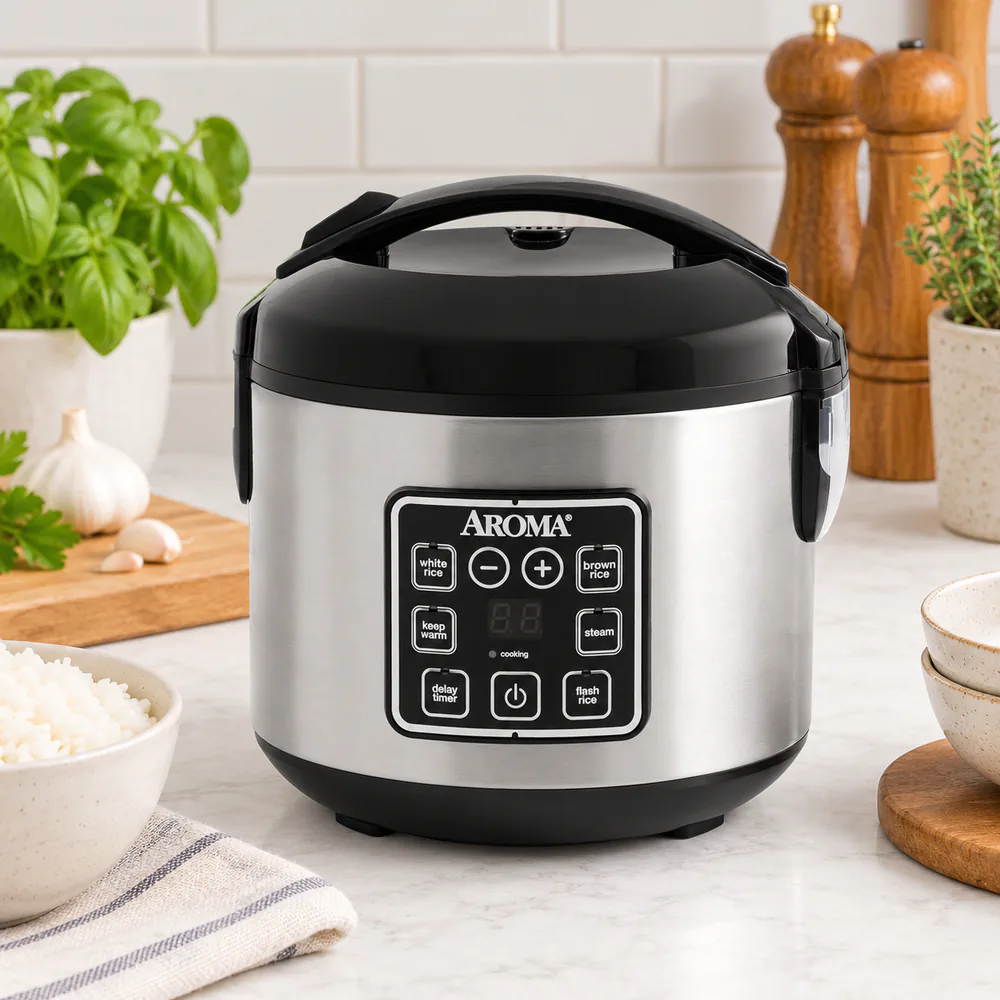
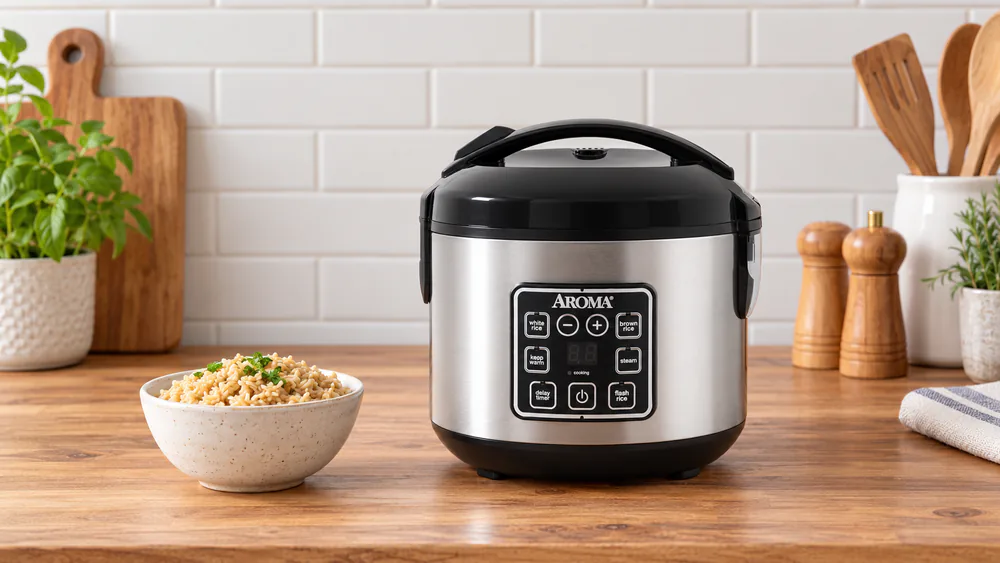
1. Aroma ARC-914SBD Digital 4-Cup (8-Cup Cooked): Best Overall
This is the Aroma we would hand to most people. It turned out fluffy white jasmine and brown basmati, and even a 2-cup batch cooked properly, which matters because many small cookers struggle with small portions. It is a workhorse for weeknights, and the preset list is short enough that nobody needs the manual after the first cook.
8-cup cooked capacity from a 2 Qt pot
White Rice, Brown Rice, Steam, and Flash Rice presets
15-hour delay timer for rice ready at dinnertime
Automatic Keep Warm
Specifications
Capacity
4 cups uncooked / 8 cups cooked
Pot
Nonstick, 2 Qt
Timer
15-hour delay
Flash Rice cuts cooking time by up to 50%, and Sensor Logic controls the internal temperature through the cycle, so the pot is more than a timer with a heating plate. That combination is why the brown basmati came out cooked through instead of crunchy in the center, which is the usual failure on cheaper machines. The fill lines inside the pot are hard to read in low light, so measuring with the included measuring cup is easier and gives the same result every time.
The steam tray and nonstick coating are the likeliest parts to wear first, and rice occasionally sticks to the bottom. It is easy to clean, but durability is the weak spot: some units stop working after a few months. That risk is the only reason this cooker does not score higher.
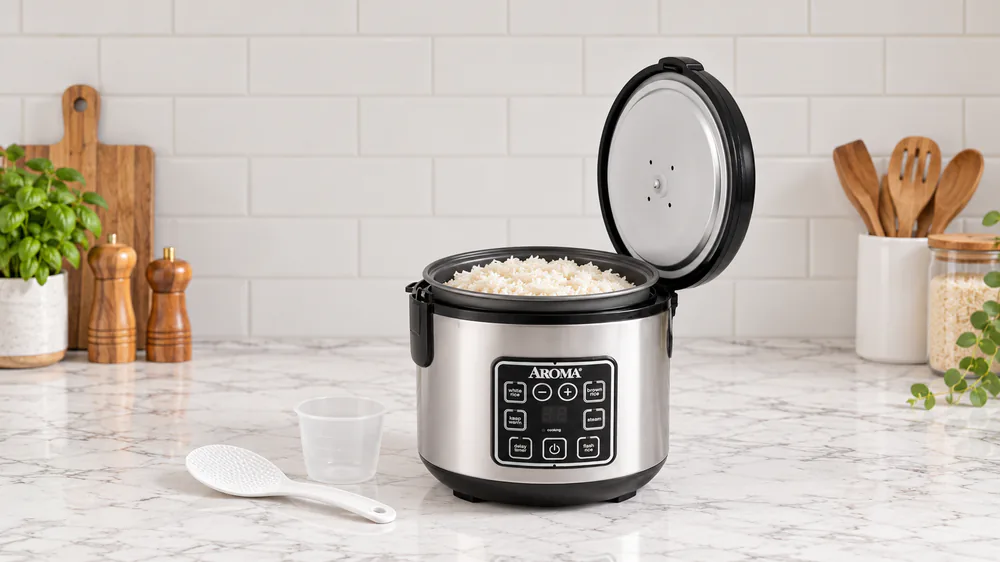
Jasmine rice from the 4-cup digital model.
Pros
Fluffy white jasmine and brown basmati, including 2-cup batches
Flash Rice preset shortens the cook
Delay timer and automatic Keep Warm
Easy to clean
Cons
Durability is the weak spot, with some units quitting after a few months
Fill lines are hard to read in low light
Rice dries out past about two hours on Keep Warm
Who it's for: two to four people who want one cooker that handles white and brown rice without fuss.
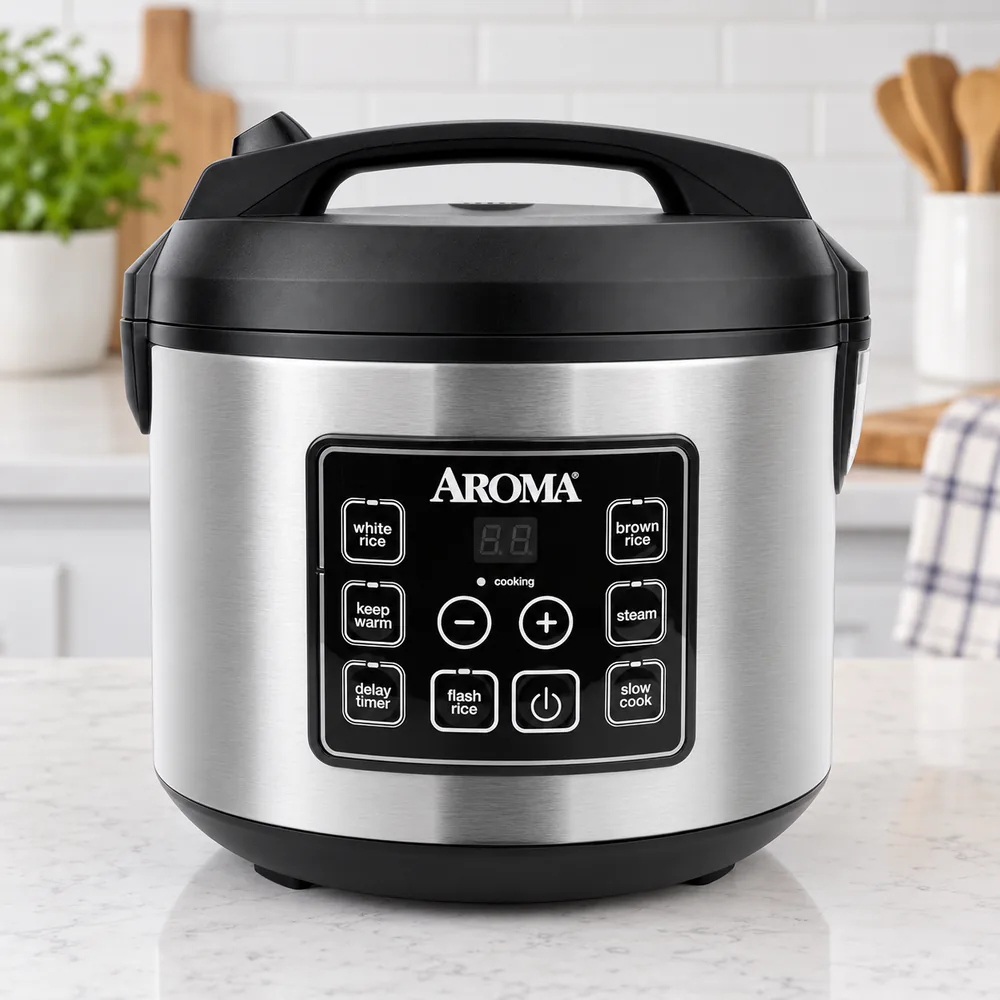
2. Aroma ARC-150SB Digital 20-Cup: Best for Families and Meal Prep
Where the 4-cup suits a small table, this one is built for a crowd. A full batch of about 10 cups of jasmine came out fluffier here than from the cheaper Aroma units, which is the main reason it earns second place. It makes 4 to 20 cups of cooked rice, enough to feed a crowd or fill a week of lunch containers.
20-cup cooked capacity for large households
White Rice, Brown Rice, Steam, Flash Rice, and Slow Cook presets
Sensor Logic and automatic Keep Warm
Steam tray included
Specifications
Capacity
10 cups uncooked / 20 cups cooked
Pot
Nonstick
Footprint depth
About 11 inches
Cleanup is quick for a machine this size. The top chamber wipes clean, and the nonstick pot rinses in under a minute. It comes with quirks, though. The plastic steam tray stains, and the condensation collector overflows if you lift the lid right after cooking, so give it a minute before you open it.
The preset list covers white and brown rice only, so sticky and basmati results depend on the batch. It is also too big for a small household, with a deep footprint of about 11 inches, so measure your counter and the space under the cabinets before you order. Longevity looks decent: some units run close to five years without issue, though cook time can be inconsistent. The Slow Cook setting turns it into a second pot for soups and braises, which helps justify the space if you cook for a crowd.
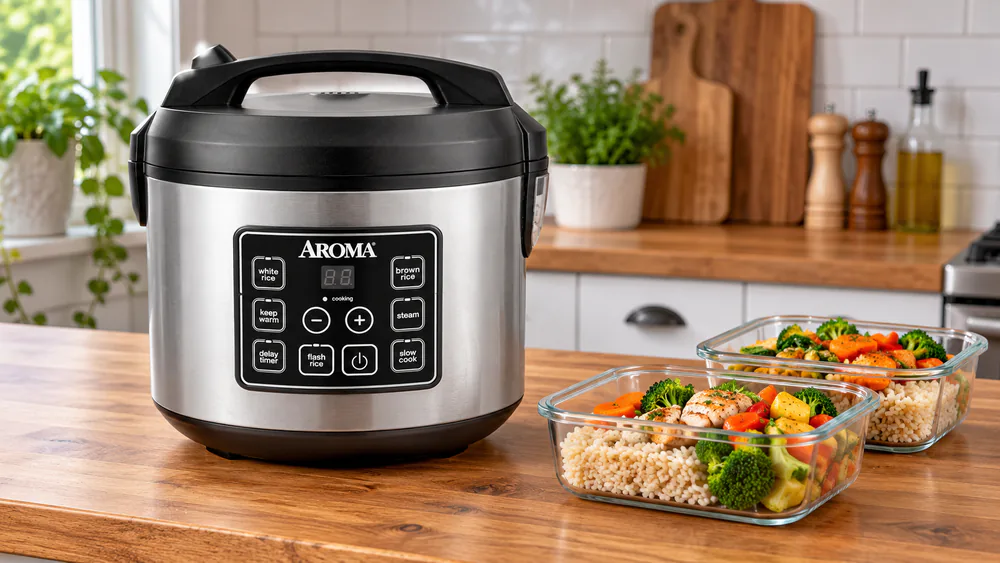
A 10-cup batch of jasmine in the 20-cup digital cooker.
Pros
Large batches come out fluffier than from cheaper Aroma models
Slow Cook preset and steam tray add versatility
Top chamber wipes clean and the pot rinses fast
Some units run close to five years
Cons
Too big for a small household, with a footprint about 11 inches deep
Plastic steam tray stains
Condensation collector overflows if the lid is lifted right after cooking
Rice at the bottom can brown after a long Keep Warm stretch
Cook time can be inconsistent
Who it's for: families of five or more, and anyone who cooks rice once and eats it all week.
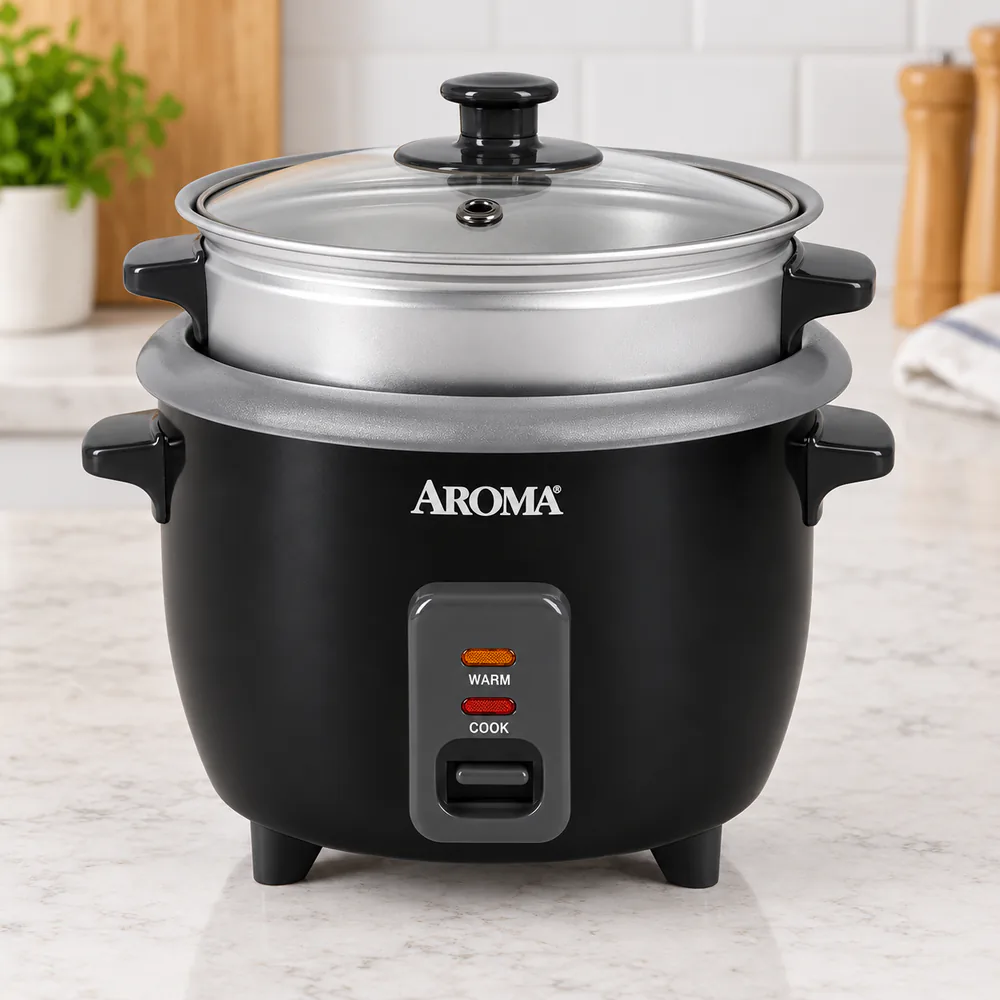
3. Aroma ARC-363-1NGB 3-Cup (6-Cup Cooked): Best Budget
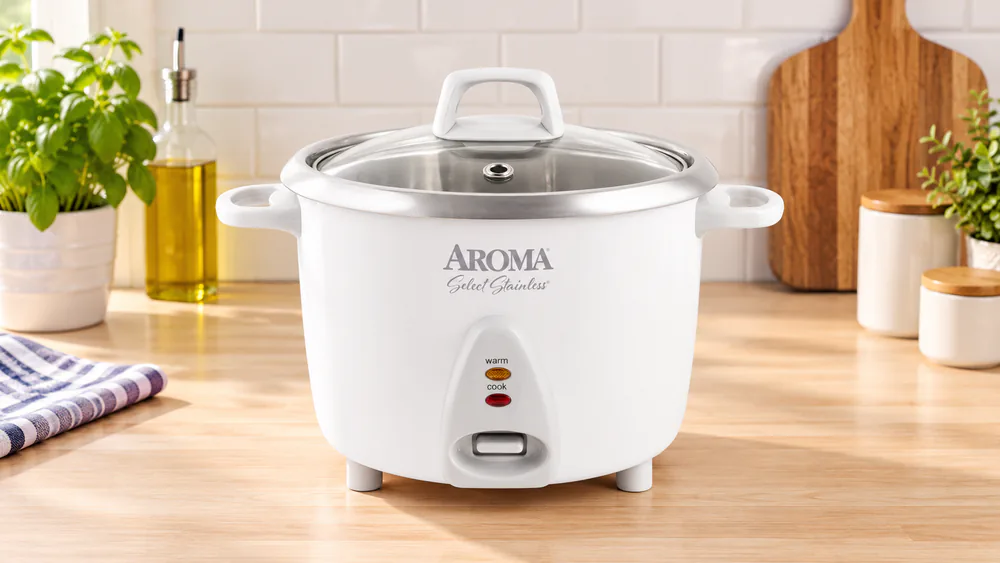
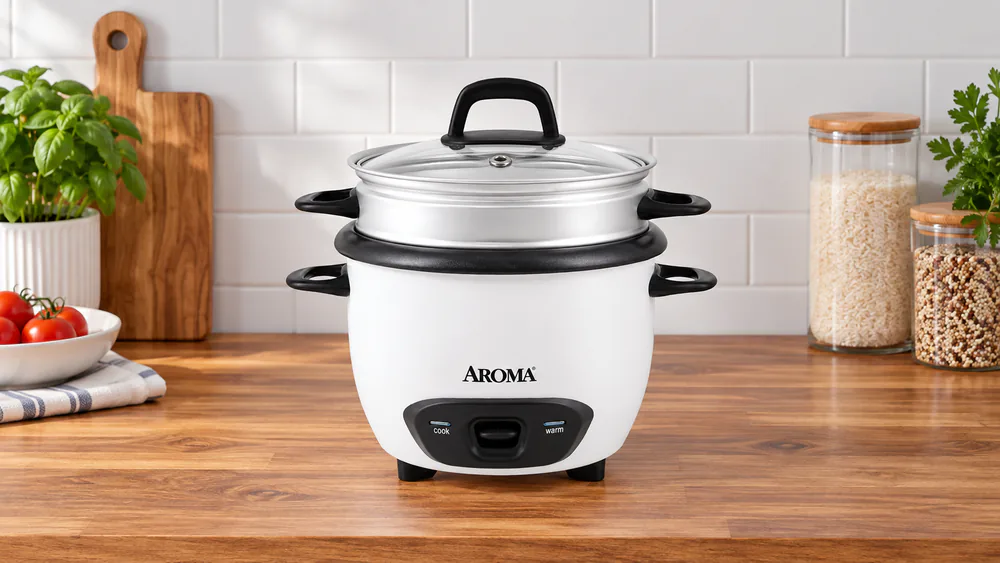
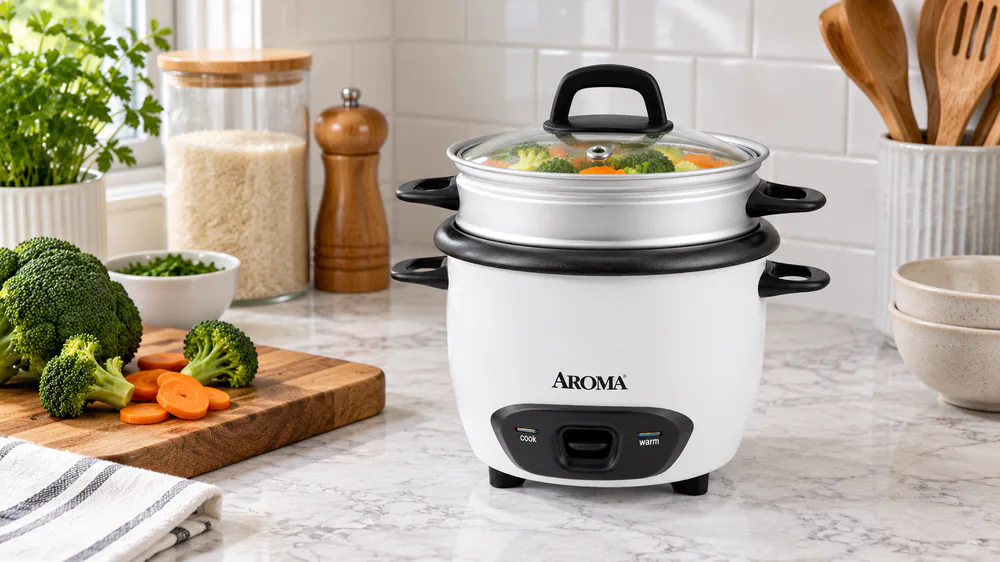
This cooker takes up far less counter space than the large model above. For plain rice on a budget, this is the cooker we would buy first. It cooks rice indistinguishable from the ARC-743-1NG, and simultaneous steaming works as described, so you can set vegetables on the tray while the rice cooks underneath. It is a set-it-and-forget-it machine in the most literal sense: one switch, no menu.
6-cup cooked capacity from a 1.5 Qt pot
One-touch cooking with automatic Keep Warm
Dishwasher-safe nonstick pot and tempered glass lid
Aluminum steam tray and a 2 Year warranty
Specifications
Capacity
3 cups uncooked / 6 cups cooked
Power
300W, 120V/60Hz
Warranty
2 Year
The drawbacks are small but real. The short cord means the cooker needs to sit close to an outlet. Metal utensils scratch the nonstick coating, so use the supplied plastic spatula. The nonstick inner pot is dishwasher safe, which keeps cleanup nearly free, and the 2 Year warranty is a decent safety net at this price.
At 300W it is not a fast cooker, and it does not pretend to be. What you get is a reliable one-switch machine that takes up very little room. If you want presets for brown rice or a timer, move up to the ARC-914SBD. If you do not, this is the better value.
Pros
Lowest price tier in the lineup
Rice quality matches the ARC-743-1NG
Steam tray works at the same time as the rice
Dishwasher-safe nonstick pot and a 2 Year warranty
Cons
Short cord
Metal utensils scratch the nonstick
No digital presets
Who it's for: students, couples, and anyone who wants simple fluffy rice for the least money.
4. Aroma ARC-757SG Select Stainless 14-Cup: Best Non-Coated Pot
This one asks more of you than the nonstick models, which is why it lands fourth rather than higher. In return, the uncoated 304 stainless steel inner pot contains no aluminum, and it gave good white rice.
Uncoated 304 stainless steel pot, no aluminum
14-cup cooked capacity from a 3 Qt body
One-touch operation with automatic Keep Warm
Replacement stainless pots are available
Specifications
Capacity
4 to 14 cups cooked
Power
500W
Pot
Uncoated 304 stainless, 3 Qt
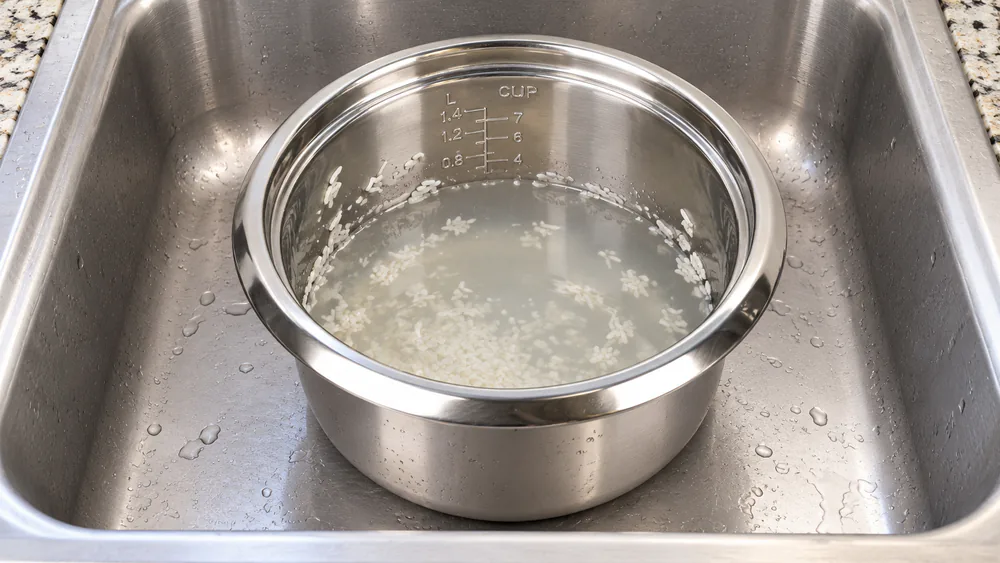
Stainless sticks slightly unless the rice is soaked first, and it needs more water than nonstick models. It also boils over with too much water, so measure carefully. Rice can stick to the bottom even with care. The upside is cleanup: we filled the pot with water and let it soak, and it came clean in minutes. A stainless pot does not scratch the way a coated one does.
The on/off switch is the part that tends to fail after 2 to 3 years of heavy use, and replacement stainless pots are available if the pot itself ever needs swapping. The 3 Qt body also reads small to some cooks. The listing does not mention a steam tray, so do not buy this one expecting to steam on top.
The stainless pot soaks clean in minutes.
Pros
Uncoated stainless with no aluminum in the pot
Good white rice
Soaks clean, and replacement stainless pots are available
Cooks up to 14 cups
Cons
Needs soaked rice and extra water to avoid sticking
Boils over if you overfill the water
No steam tray listed
The on/off switch tends to fail after 2 to 3 years of heavy use
5. Aroma ARC-966BD Digital 6-Cup (12-Cup Cooked): Best Mid-Range Digital
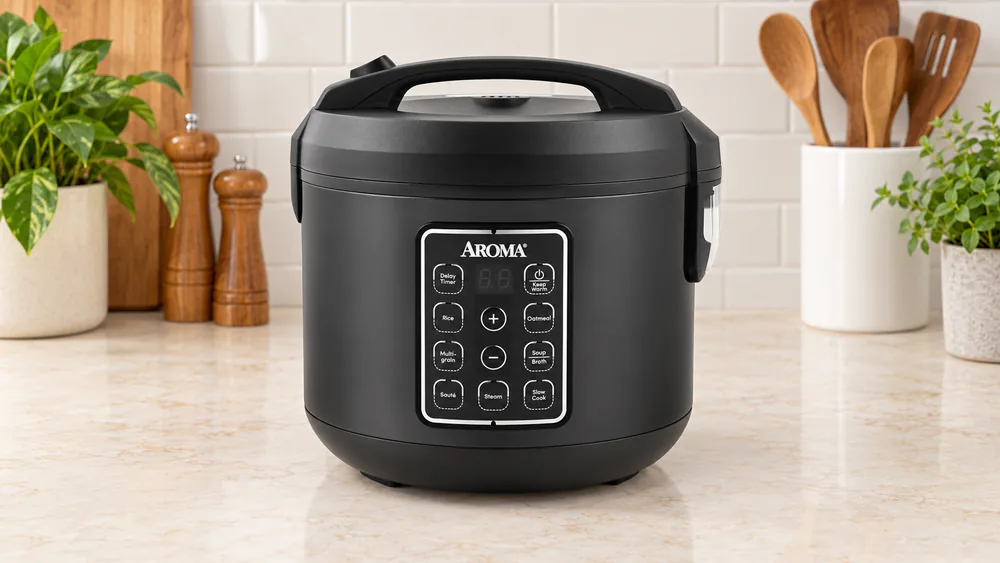
Step up from the one-touch stainless model and the cooker starts doing more than rice. It has 6 presets (Rice, Multigrain, Slow Cook, Steam, Saute, and Soup/Broth), and it cooked steel-cut oats overnight on the delay timer. The steam tray handled dumplings and vegetables over rice, so a whole dinner can come from one pot.
12-cup cooked capacity from a 3 Qt pot
6 presets, including Multigrain, Saute, and Soup/Broth
15-hour delay timer
Steam tray and automatic Keep Warm
Specifications
Capacity
6 cups uncooked / 12 cups cooked
Presets
6
Weight
About 4 lb
At about 4 lb it is easy to move, though the 12-cup cooked size feels smaller than the name suggests. The water-ratio directions also confuse beginners, so read them before the first cook and keep a note of the ratio that works for you.
The delay timer is the feature that sets this one apart from the one-touch models. We loaded the pot, set the delay timer, and left the steel-cut oats to cook overnight, which is the one job the one-touch models cannot do. The 15-hour timer means breakfast oats can be ready on schedule. It is the most flexible machine here for people who cook beyond white rice, and the price reflects that.
We rate this one on its presets, its steam tray, and its overnight oats rather than on plain-rice results, so if white or brown rice is all you cook, the ARC-914SBD is the safer buy.
Pros
Six presets cover rice, grains, soup, and sauteing
Overnight oats on the 15-hour delay timer
Steam tray handles dumplings and vegetables
Light at about 4 lb
Cons
Water-ratio directions confuse beginners
The 12-cup cooked size feels smaller than the name suggests
Costs more than the one-touch models
Who it's for: cooks who want oats, soups, and steamed dinners from the same pot as their rice.
6. Aroma ARC-994SB Rice and Grain Cooker: Best for Grains and Slow Cooking
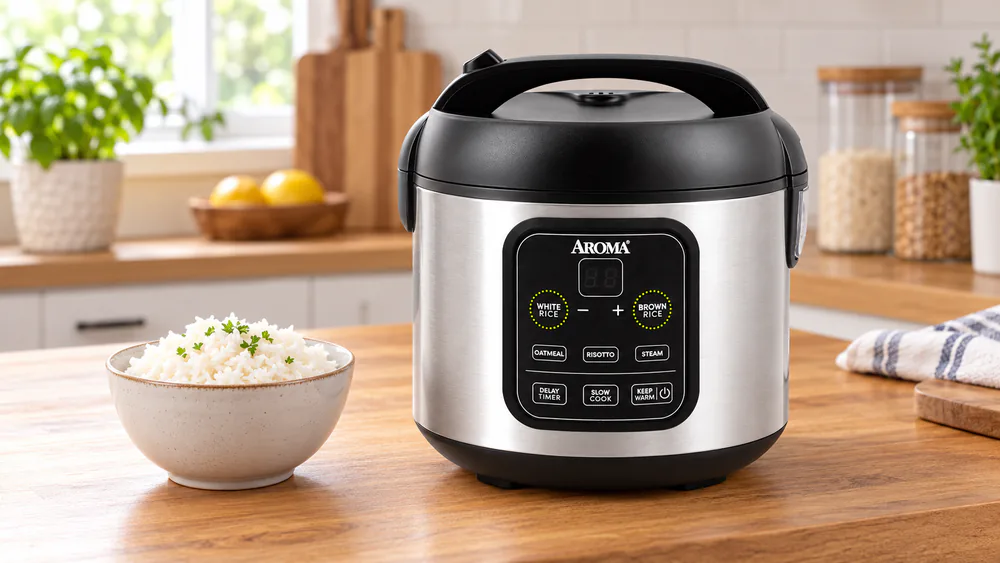
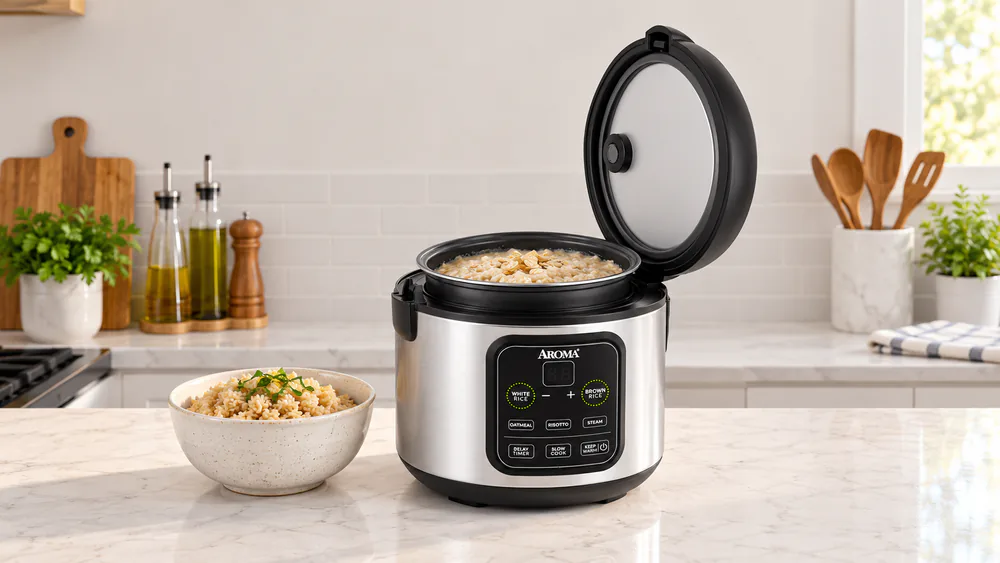
The ARC-994SB is the Aroma for grains. It offers 7 automated controls: steam, white rice, brown rice, oatmeal, risotto, and slow cook, among others, on a 4-cup uncooked, 8-cup cooked pot that matches the capacity of our top pick. It lands sixth because it costs about as much as the ARC-150SB and its 8-cup cooked size reads small for the money.
8-cup cooked capacity from a 2 Qt pot
7 automated controls including oatmeal and risotto
Nonstick pot, steam tray, and BPA-free parts
Measuring cup and plastic spatula included
Specifications
Capacity
4 cups uncooked / 8 cups cooked
Controls
7 automated
Pot
Nonstick
In our kitchen it turned out consistently well-cooked white, jasmine, and wild rice, and the water lines inside the pot help with the ratio. The oatmeal program cooks oats with little fuss, and the nonstick pot rinses clean easily. Two things hold it back: 8 cups cooked reads small for big families or batch cooking, and the manual is confusing, so keep the box or a how-to video handy for the first cook. We have no finding on the risotto setting or on long-term lid and coating wear, so treat those as untested.
The listing claims a coating 8x stronger for scratch resistance, but that is a maker claim without a stated test basis. We would still use plastic or wood utensils. Keep Warm is not stated in the listing, so confirm it before you count on holding rice for dinner.
The appeal is the menu. Oatmeal and risotto settings mean the cooker does the timing for dishes that normally need stirring and watching. If you only cook rice, the ARC-914SBD gives you the same capacity with a track record we can describe in more detail.
The grain-focused model offers oatmeal and risotto settings.
Pros
7 automated controls, including oatmeal, risotto, and slow cook
Same 8-cup cooked capacity as the ARC-914SBD
Steam tray and BPA-free parts
Cons
Keep Warm is not stated in the listing
The "8x stronger" coating claim is a maker claim only
Less proven than the top picks
Who it's for: cooks who rotate through oatmeal, risotto, and rice and want presets for each.
7. Aroma ARC-743-1NG 3-Cup: Best for Singles and Small Kitchens
For one or two people, this little cooker handles fluffy rice plus oatmeal, mac and cheese, and soup. It cooks a small batch in about 25 to 30 minutes, and white rice, brown rice, and quinoa all worked. We rank it last only because of how little separates it from the ARC-363-1NGB, and because some units quit after about a year of regular use.
6-cup cooked capacity, yielding 2 to 6 cups
One-touch cooking with automatic Keep Warm
Full-view tempered glass lid and steam tray
Dishwasher-safe nonstick pot
Specifications
Capacity
3 cups uncooked / 6 cups cooked
Pot
Nonstick, 1.5 Qt
Lid
Tempered glass
The cup holds 3/4 of a standard cup, which trips up first-time users. The inner marking lines are inaccurate, so measure the rice with the cup and fill to the line only as the manual says. Using too little water on the first try makes the cooker look broken. Boil-over happens if the ratios are off, and there is no off button.
Cleanup is the bright spot. A burnt egg cooked with the rice, and the pot sat in the sink for a while before we got to it, yet it still cleaned easily. Day to day it is simple: rinse, fill to the line, cover, and walk away. Wash the pot with mild soap. The two-person steamer setup also makes it a good fit for a studio apartment.
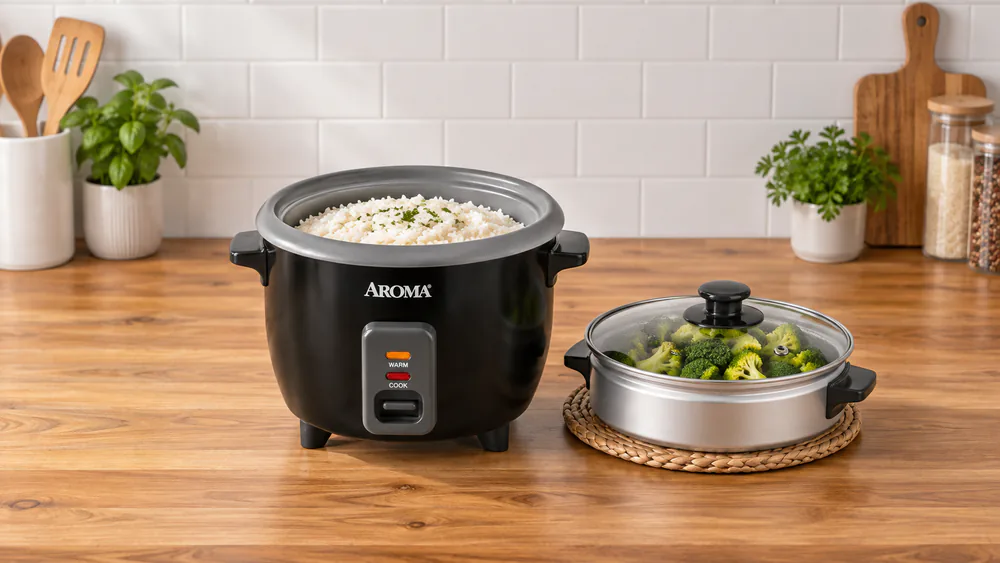
The small cooker suits one or two servings.
Pros
Fluffy rice for one or two, plus oatmeal, mac and cheese, and soup
Pot cleans easily, even after burnt egg
Full-view tempered glass lid
Budget price
Cons
A durability gamble, with some units quitting after about a year
Inner lines are inaccurate and the cup is 3/4 of a standard cup
No off button and boil-over if ratios are off
Who it's for: one or two people in a small kitchen or dorm who want a low-cost cooker and will use the cup and the manual's fill line.
How We Rate and Choose Aroma Rice Cookers
We score rice quality first: how fluffy the grains are, whether the bottom browns, and whether a small batch still cooks properly. Then we weigh cleanup, how forgiving the water ratio is, and how the pot and tray hold up. Price comes last, because a cheap cooker that quits in a year is not a bargain.
Every model in the lineup needs the supplied cup, so we judge each one against the same handful of criteria below. If you are new to the brand, our guide on how to use an Aroma rice cooker covers the first cook step by step.
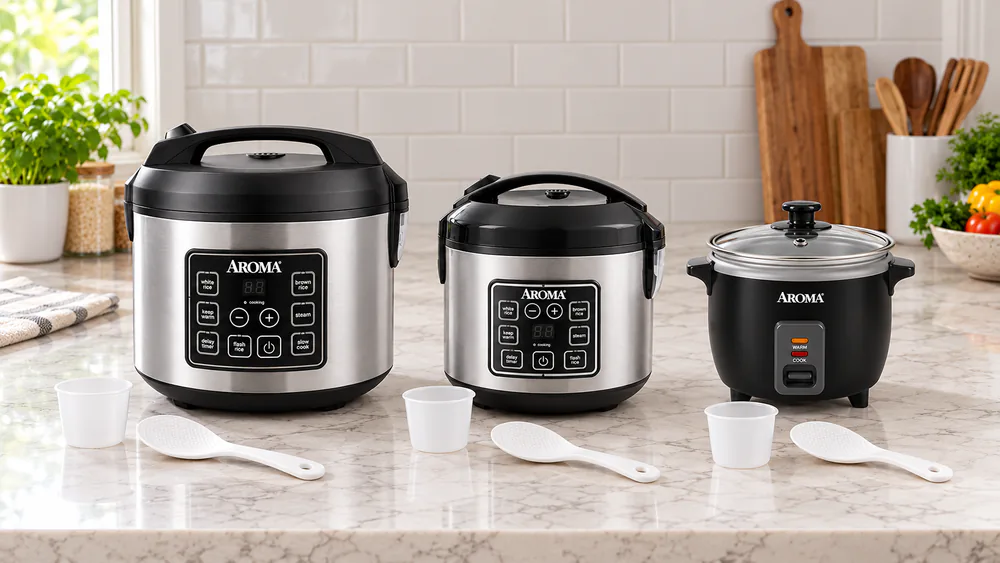
Sizes from the 3-cup to the 20-cup, side by side.
Capacity: Aroma's 3/4-cup measuring cup explained
Aroma's capacity numbers confuse people because the included cup holds 3/4 of a standard US cup, about 6 oz. A cooker sold as 6-cup holds 3 of those cups of dry rice and makes about 6 cups cooked. The 4-cup ARC-914SBD makes 8 cups cooked, the 20-cup ARC-150SB starts from 10 cups uncooked, and the ARC-966BD makes 12 cups cooked.
Always measure with the supplied measuring cup. The inner-pot lines are unreliable for rice, and on the ARC-743-1NG they are inaccurate, so use the lines only for water, as the manual describes. For exact ratios, see our guide to rice cooker water ratios.
Tip. Rinse the rice until the water runs mostly clear, level the cup with a finger, then fill the water to the line for that cup count. Those three steps prevent most first-cook failures.
Pot material: non-stick vs stainless
Nonstick is the default across the lineup, and it is the easiest to clean and the most forgiving with rice that wants to stick. The tradeoff is wear. Metal utensils scratch it, and the coating is among the first parts to age. The ARC-757SG is the exception with its uncoated 304 stainless pot, which does not scratch the way a coating does, though it sticks slightly unless the rice is soaked and it needs more water.
Our default advice is to choose nonstick for convenience, and to choose stainless if you want no coating at all and will adjust your water.
Controls and functions: one-touch vs digital Sensor Logic
One-touch models (ARC-363-1NGB, ARC-743-1NG, ARC-757SG) have a single switch and cook until the rice is done. Digital models add presets such as White Rice, Brown Rice, Steam, Flash Rice, and Slow Cook. Sensor Logic on the digital units controls the internal temperature through the cycle.
Digital controls are worth paying for if you cook brown rice often, want a delay timer, or plan to use the cooker for oats. If you only cook white rice, a one-touch unit does the job for less. A steam tray, which most of the lineup includes, lets you cook a side of vegetables or dumplings over the rice.
Warning. Do not use metal utensils on a nonstick pot. They scratch the coating, which is among the first parts to age, so stick with the plastic spatula in the box.
Keep Warm and cleanup
Keep Warm is useful but not infinite. On the ARC-914SBD, rice starts to dry out past about two hours, and the larger cookers can brown the bottom layer. We recommend pulling the pot once the meal is served.
For cleanup, the nonstick pots on the ARC-363-1NGB, ARC-743-1NG, and ARC-914SBD are easy to wash, and the stainless pot on the ARC-757SG soaks clean. The tray and lid are the usual trouble spots: plastic trays stain, and condensation collects around the lid.
Aroma vs Other Rice Cookers
Aroma's strength is value: you get digital presets, steam trays, and big capacities at budget prices. The compromise is durability and fine-tuning. If you want induction heating, fuzzy-logic cooking, or a pot built to last many years, look at our best rice cookers roundup, where Aroma is only one brand among many.
Zojirushi is the obvious step up, and we cover it in our best Zojirushi rice cooker guide. It costs several times more, so the question is whether you cook rice often enough to justify it. For occasional cooks and tight budgets, an Aroma remains worth your money.
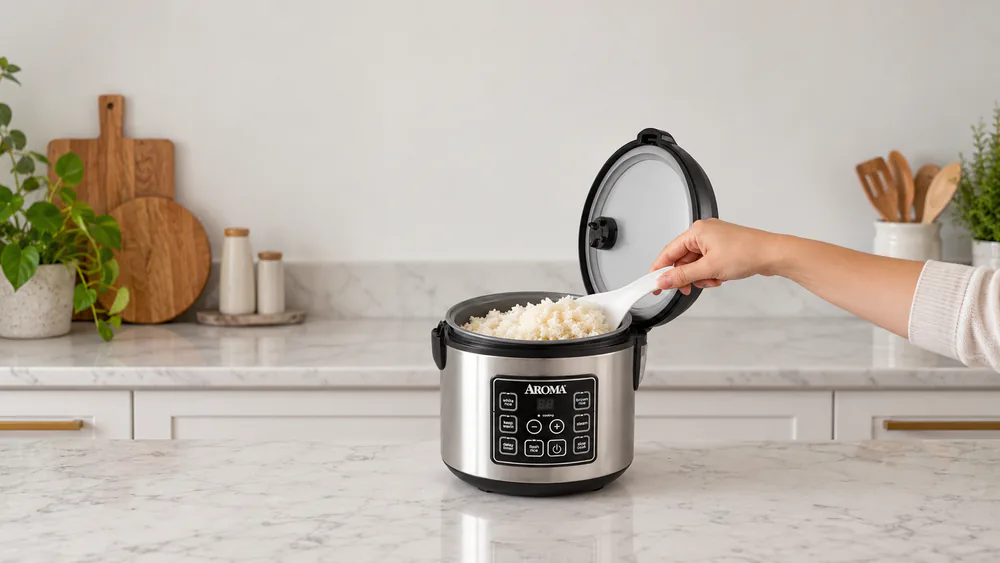
Nonstick pots rinse clean quickly.
If you are new to rice cookers in general, our guide to how to use a rice cooker is a good starting point.
Frequently Asked Questions
Is Aroma a good rice cooker brand?
Aroma is a good value brand. It delivers fluffy rice, useful presets, and big capacities at low prices, but durability is the trade: some models stop working after a year or a few months. Treat it as an affordable cooker, not a decade-long one.
Why does my Aroma brown rice come out underdone?
Brown rice in the digital models can come out underdone at the stated water level. Adding roughly a quarter more water fixes it.
Can I get replacement parts or a warranty?
It depends on the model. Replacement stainless pots are available for the ARC-757SG, and the ARC-363-1NGB carries a 2 Year warranty.
Why is my Aroma rice cooker taking so long?
Too little or too much water, a lid lifted mid-cycle, or cold rice from the fridge can slow a cook. A small batch in the 3-cup models runs about 25 to 30 minutes, and Flash Rice on the ARC-914SBD cuts cook time by up to 50%.
Can you cook other things in an Aroma rice cooker?
Yes. The ARC-743-1NG handles oatmeal, mac and cheese, and soup, and the ARC-966BD cooked steel-cut oats overnight on its delay timer. Quinoa works too, and you can read more in our guide to cooking quinoa in a rice cooker.
Why does the rice at the bottom of the 20-cup cooker brown?
On the ARC-150SB it happens after a long Keep Warm stretch, so we pull the pot once the meal is served.
Final Verdict
Our pick is covered in the first review, so here is what to do if it is not the right fit. For a big family, go for the 20-cup ARC-150SB. For plain rice on a tight budget, the ARC-363-1NGB is the sensible alternative, and the ARC-757SG is the choice if you want a stainless pot.
One thing we would do differently: buy based on how you cook, not how large the name sounds. Check the cooked capacity, use the measuring cup, and treat the cheapest units as affordable, replaceable appliances rather than lifetime purchases.