
Kitchen Appliances
Ninja Creami Review: Is This Viral Ice Cream Maker Worth It?

As an Amazon Associate we earn from qualifying purchases. We may earn a commission from links on this page, at no extra cost to you. Learn more.
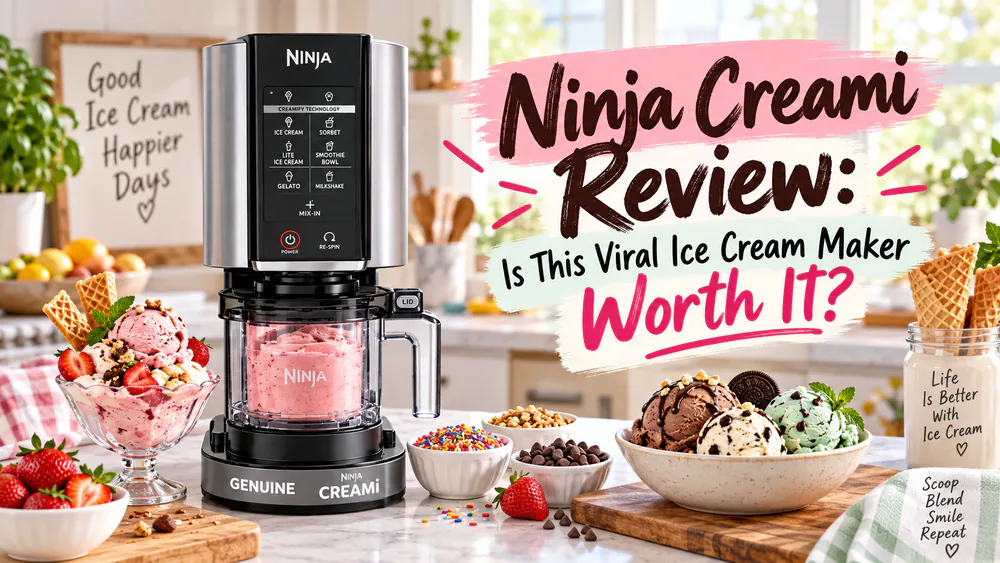
The Ninja Creami has spent two years going viral on every food feed, promising scoopable ice cream, protein pints, and sorbet from whatever you freeze overnight. That kind of hype earns a machine a lot of counter space and a lot of skepticism, so we brought one into the small-appliance lab to see whether the results hold up once the novelty wears off.
We run this site's appliance testing the same way for every product: buy the unit ourselves, use it daily until the honeymoon ends, then open the housing on the top contenders to check the motor, the paddle coupling, and the seals. The Creami got that full treatment across dozens of pints, and it also got compared head to head with its two siblings, the Deluxe and the newer Swirl.
Our small-appliance lab ran the original CREAMi NC301 as a daily-driver dessert machine for six weeks, and the crew that logs our appliance testing kept a pint moving through it almost every day. By the end of the window we had processed roughly 50 pints, with the protein base spinning most nights at a cadence of three to four pints a week. That volume is what let us judge the machine on the long stretch rather than the first exciting weekend, and after a month of that pace the motor still spun as strong as day one, with no drop in power.
This review is the honest version: where the Creami genuinely delivers, where the learning curve bites, and whether it is worth it for the way you actually eat.
Key takeaway. Our verdict after weeks of daily testing: the original Ninja CREAMi earns a 4.5 out of 5. It is the easiest way we have found to make protein ice cream and small-batch pints at home, provided you accept the 24-hour freeze and the occasional Re-spin. If soft serve or bigger batches matter more to you, size up to the Swirl or the Deluxe.
What Is the Ninja Creami and How Does It Work?
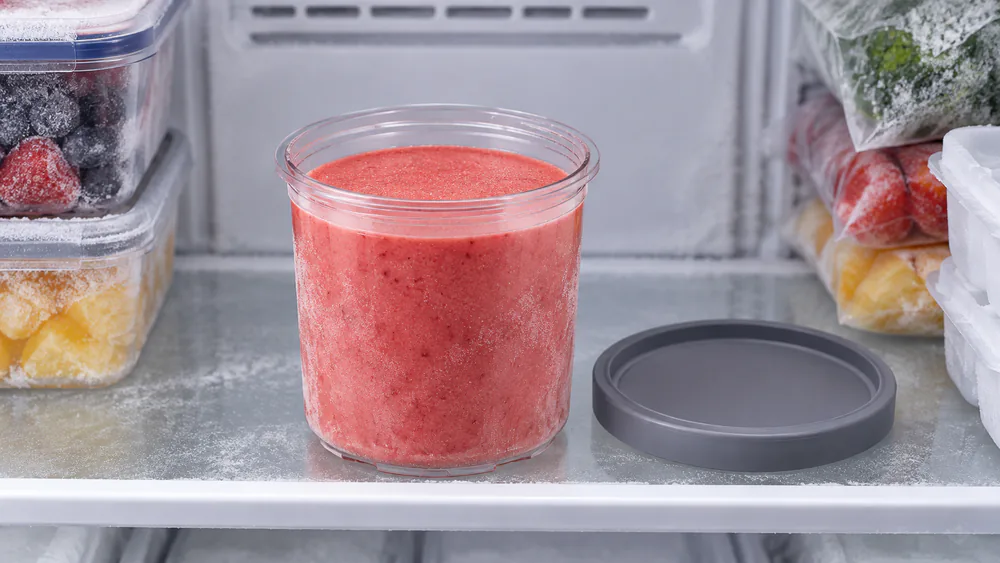
The Ninja Creami is not a churner. Traditional machines chill a liquid base while a paddle stirs air into it, which is why they take a compressor or a pre-frozen bowl and a good half hour. The Creami flips that order. You freeze your base solid first, then the machine shaves and re-textures the frozen block into something smooth.
The process, which Ninja calls Creamerize, works by driving a spinning blade, the Creamerizer paddle, straight down through a rock-hard pint at 800 watts. That downward grinding action breaks the ice into a fine, creamy consistency in a couple of minutes. It is closer to a precision food processor for frozen desserts than to an old-fashioned ice cream maker.
The original NC301 model we tested is a 7-in-1: seven one-touch programs (Ice Cream, Lite, Sorbet, Gelato, Milkshake, Smoothie Bowl, and Mix-in) plus a Re-spin button for fixing texture. Each program spins at a slightly different speed and depth tuned to that dessert. You pour a base into one of the two 16 oz pints, freeze it flat for a full 24 hours, lock the pint into the outer bowl, pick a program, and wait. For the full mechanical breakdown, Ninja's official CREAMi NC301 specifications list the paddle, pints, and program set in detail.
Ninja Creami Models: 7-in-1 vs Deluxe 11-in-1 vs Swirl
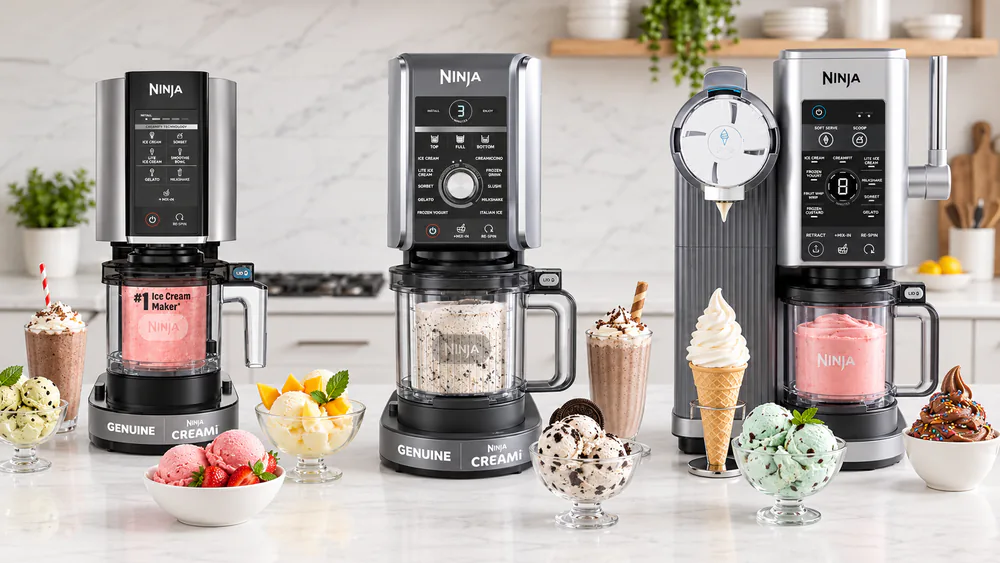
Ninja now sells three machines under the Creami name, and choosing between them is the single most common question we get. All three share the same 800-watt motor and the same freeze-then-spin method, so the difference comes down to batch size, program count, and whether you want soft serve.
The original CREAMi (NC301) is the 7-in-1. It uses two 16 oz pints and has the smallest, tallest footprint, which makes it the friendliest for a crowded counter. The CREAMi Deluxe (NC501) is the 11-in-1: it steps up to two 24 oz XL tubs, roughly 50 percent more per batch, and adds programs like Italian Ice, Frozen Yogurt, and dual-flavor processing. The newest sibling, the Ninja Swirl (NC701), is a 13-in-1 that actually dispenses soft serve through a pull-down handle, which none of the others can do.
We keep this a summary on purpose, because the head-to-head deserves its own space. If you are torn between the first two, our Ninja Creami vs Deluxe: which model to buy guide walks through capacity, price, and counter fit in full. The comparison table further down this page covers all three at a glance.
Note. The Deluxe is noticeably larger in person than product photos suggest. In our lab it took up meaningfully more counter than the original, so measure your space before you size up for the bigger tubs.
How We Tested the Ninja Creami
We bought the original CREAMi NC301 at retail, the same as any shopper, and ran it as a daily-driver dessert machine rather than a one-weekend novelty. Every pint got the same routine: mix the base, freeze it flat for the required 24 hours, run the matching program, and note the first-spin result before deciding whether it needed a Re-spin.
Over the six-week window we worked through the full spread of program types across roughly eight recurring recipes: a dairy vanilla and a chocolate ice cream, a dairy gelato, a strawberry sorbet, a milkshake, a Lite low-calorie base, a smoothie bowl, and a protein-powder pint. That near-daily cadence added up to about 50 pints across the six weeks, and the protein base got the heaviest rotation, three to four pints most weeks. After a month at that pace the motor showed no power loss, which is the first thing we watch for on a spin-driven machine.
We scored the machine on the things that decide whether an appliance keeps its spot on the counter: texture straight out of the first spin, how reliably the Re-spin rescued a crumbly batch, noise, cleanup friction, and everyday footprint. Because parts durability is where these machines get a bad reputation, we also paid close attention to the paddle and the motor coupling, the components most likely to wear. Prices, program counts, and capacities were verified against the manufacturer's current listings rather than memory.
What We Made With the Ninja Creami
The only way to judge a dessert machine is to eat a lot of dessert. We worked through the core categories most owners care about, from a simple dairy base to the protein pints that made the Creami famous in fitness circles.
Classic Vanilla Ice Cream
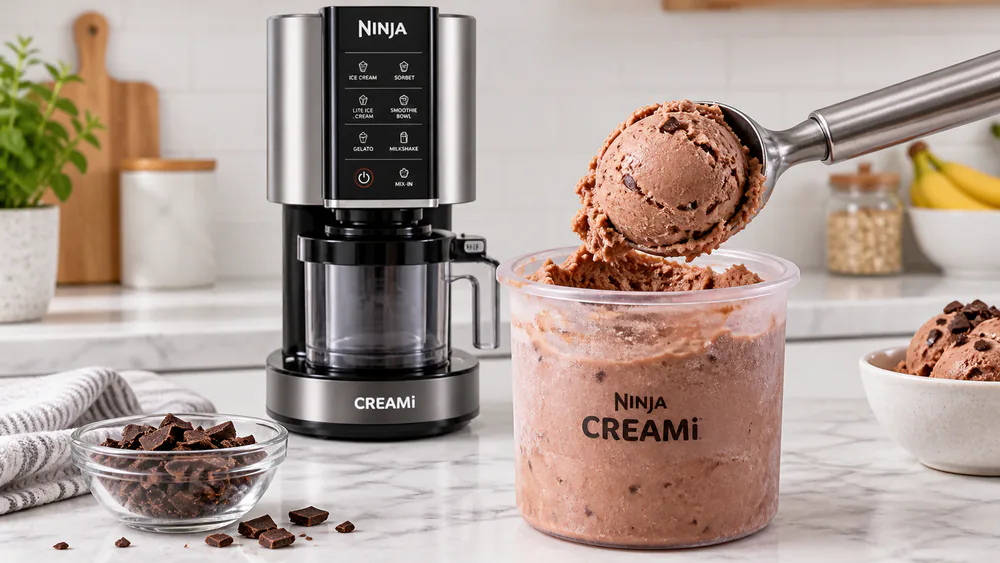
A full-fat vanilla base is where the Creami is at its most convincing. Straight off the Ice Cream program, a well-balanced dairy pint came out dense, smooth, and firm enough to scoop and eat immediately, without the extra freezer-hardening that churned ice cream needs. Ice crystals did tend to linger at the tub edges after a single spin, but a quick stir or a short Re-spin evened it out.
Fruit Sorbet
Sorbet is the mode that feels closest to magic. Frozen fruit, a splash of liquid, and the Sorbet program turned out a bright, clean-tasting scoop with none of the graininess we expected. It is genuinely the fastest route from a bag of frozen fruit to real sorbet that we have tested. If you plan to lean on this mode, our how to use frozen fruit in the Ninja Creami guide covers the ratios that work.
Protein Ice Cream
This is the recipe that justifies the machine for a lot of buyers. A chocolate whey base came out of the Creami as a full pint of creamy ice cream carrying more than 30 grams of protein and under 350 calories for the whole tub. Nothing else in our kitchen produces that result with so little effort, and it is the single strongest argument for owning one if you are fitness-focused.
Pros
- Turns whey or casein bases into a genuinely creamy full pint
- Over 30 g protein and under 350 calories per tub is easy to hit
- Portion control is built in: one pint is one clear serving
Cons
- Low-fat, high-protein bases almost always need a Re-spin
- The first spin often looks crumbly before the second smooths it
- You still plan a day ahead for the 24-hour freeze
Milkshakes and Smoothie Bowls
The Milkshake and Smoothie Bowl programs round out the everyday use. Milkshakes came out thick and pourable, and the Smoothie Bowl mode handled frozen-fruit-and-yogurt bases into a spoonable bowl without turning to liquid. Neither is a headline feature, but both worked as advertised and widen what the machine earns its counter space doing.
Texture, Taste, and Performance
Texture is the whole game with a Creami, and it is where the learning curve lives. On a rich, full-fat base, the first spin usually nails it. On the low-fat, low-sugar, and high-protein bases most people actually want, the first spin frequently comes out crumbly or powdery at the edges, looking more like shaved ice than ice cream.
That is not a defect, it is the design, and the fix is built in. Running the Re-spin once, occasionally twice, drives the paddle back through the softening block and transforms it into smooth, creamy soft-serve. Once we learned to expect that on lean recipes, the crumbly first spin stopped being a disappointment and became just a step in the process.
The crumbly first spin is not a failure. It is the halfway point, and the Re-spin button is the second half.
One trade-off worth knowing: a second Re-spin can leave a pint too soft to hold its shape in the tub. On protein and Lite bases we sometimes wanted that extra pass anyway, then popped the pint back in the freezer for a few minutes to firm up. It is a small dance, but it becomes second nature fast.
On noise, the honest answer is that the spin is loud. During the two-to-four-minute cycle it runs about as loud as a high-powered blender, enough that you would not start a pint while someone sleeps in the next room. The saving grace is how brief it is: the loud stretch is over in a couple of minutes, not a running churn.
Ninja Creami Pros and Cons
After weeks with the machine, the balance sheet came out clearly in its favor, with caveats that are all about expectations rather than build quality.
Pros
- Protein and low-calorie ice cream that actually tastes creamy
- Sorbet from frozen fruit is fast, clean, and reliable
- Finishes firm enough to eat straight from the tub
- Tall, narrow footprint fits tight counters
- Pints and paddle are dishwasher safe and easy to rinse
Cons
- The 24-hour freeze kills spontaneous ice cream making
- Lean bases need a Re-spin, so plan for extra minutes
- Loud during the spin, like a powerful blender
- The paddle and motor coupling are the parts to watch long term
- Only two 16 oz pints, so batches are small
How to Get the Best Results (Tips and Common Mistakes)
Most Creami disappointment traces back to a handful of avoidable mistakes, and nearly all of them are about the freeze and the base. The single most common one is not freezing long enough. The base has to be frozen solid for a full 24 hours; anything less and the paddle carves a soupy, uneven mess instead of a clean block.
The second mistake is freezing the pint on a tilt. A base that sets at an angle spins unevenly, so always freeze it dead flat on a level shelf. The third is giving up after a crumbly first spin. If the result looks powdery, that is your cue to hit Re-spin, not your cue to declare the recipe a failure.
Tip. Add a small amount of fat or a spoonful of sugar or a sugar substitute to lean protein bases. A little extra body dramatically cuts the crumbly first-spin effect and often saves you a Re-spin entirely.
Warning. Never try to spin a base that has not frozen the full 24 hours. Forcing a partially frozen or overfilled pint is the fastest way to stress the paddle and the motor coupling, the two parts owners most often report wearing out.
Cleaning and Everyday Use
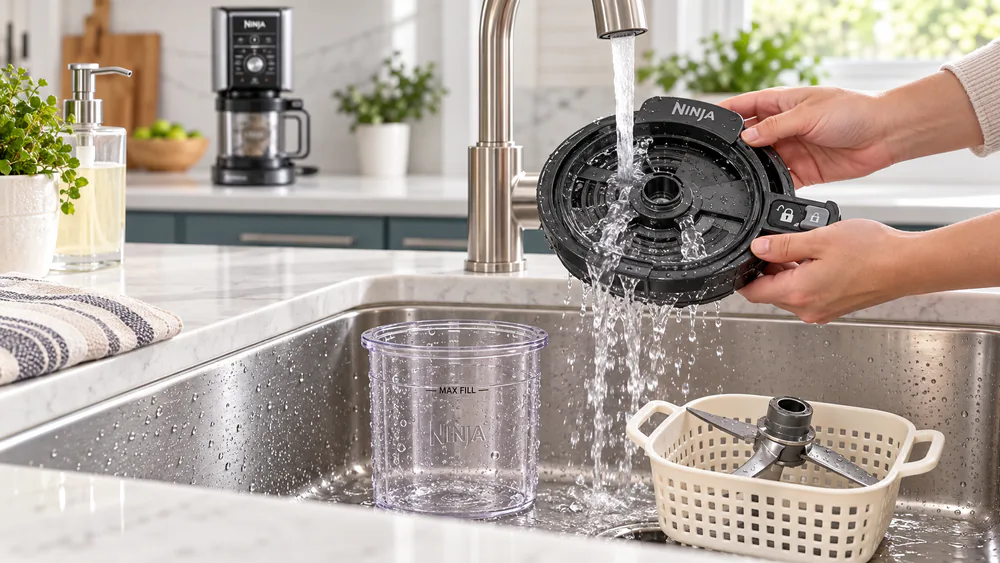
Cleanup is where the Creami quietly wins back the goodwill the noise costs it. The pints, lids, and paddle rinse clean in seconds and are dishwasher safe, and because you spin frozen bases there is no sticky, hardened residue baked onto anything.
The one part that needs attention is the outer-bowl lid. Its small holes let a bit of mixture seep into an enclosed area, and if you ignore it the residue sits there. Soaking the lid in warm water and running water through the holes clears it completely; it just should not be skipped. Beyond that, day-to-day use is genuinely easy, and the tall, narrow original slots neatly beside a full-size blender without dominating the counter.
How It Compares to Other Ice Cream Makers
Against traditional churners, the Creami trades spontaneity for versatility. A compressor machine lets you make ice cream on a whim, with no 24-hour wait, and it churns air in for a lighter, classic texture. But it costs more, takes more counter, and cannot touch the Creami on protein pints, single-serving portioning, or sorbet from a bag of frozen fruit. For the way most home cooks eat now, the Creami's format is the more useful one.
Within the Creami family itself, here is how the three current models line up.
| Model | Programs | Pint capacity | Wattage | Footprint (width) | List price | Best for |
|---|---|---|---|---|---|---|
| Ninja CREAMi (NC301) | 7 | 16 oz x2 | 800W | 8.58 in, tall and narrow | About $200, often on sale under $200 | First-time buyers, tight counters |
| CREAMi Deluxe (NC501) | 11 | 24 oz XL x2 | 800W | 10.04 in, largest | Around $249.99 to $259.99 | Bigger batches, more modes |
| Ninja Swirl (NC701) | 13 (incl. soft serve) | 16 oz 2-in-1 x2 | 800W | 9.45 in | $349.99 | Soft-serve and cone fans |
For a deeper split between the first two, the Ninja Creami vs Deluxe comparison covers the decision in full.
Price: Is the Ninja Creami Worth It?
The original CREAMi lists at $229.99 on Ninja's site, but the price swings with sales, dropping to around $199 or lower during promotions, so most buyers pay about $200 or a bit under. That is a real chunk of counter budget, and whether it pays off depends entirely on how often you use it.
The math favors regular users. Homemade pints work out to roughly $1 to $2 each in ingredients, against $5 to $8 for premium store-bought pints. If you are the sort of household that keeps ice cream in the freezer year-round, or if protein ice cream is a weekly ritual, the machine recoups its cost over a season and then keeps saving. If you would make a pint twice a summer, it is a harder sell, and a tub from the store is the smarter buy.
Who Should Buy the Ninja Creami?
The Creami is an easy recommendation for a specific set of people. If you eat protein or low-calorie ice cream regularly, nothing else makes it this creamy this easily, and that one feature alone can justify the price. It also suits anyone who loves sorbet from frozen fruit, households that want portion-controlled single pints, and cooks who enjoy dialing in their own recipes.
It is a weaker fit if you want ice cream on impulse, since the 24-hour freeze rules that out, or if you need to serve a crowd from one batch, since the pints are small. Buyers who cannot tolerate a couple of minutes of blender-level noise, or who will not commit to using it often, should think twice. For the official CREAMi lineup and current bundles, Ninja's own site lists what ships in each box.
Frequently Asked Questions
Is the Ninja Creami worth it, or is it overhyped?
For regular users it is worth it. If you eat protein ice cream or sorbet often, the creamy results and roughly $1 to $2 per pint quickly justify the price. If you would only make it a couple of times a year, it is overhyped for your needs and store-bought is the better value.
Which should I buy, the Creami, Deluxe, or Swirl?
Buy the original 7-in-1 CREAMi if you want the best value and a compact footprint. Step up to the Deluxe 11-in-1 for 24 oz tubs and more programs, or the Swirl 13-in-1 if you specifically want dispensed soft serve. Our Creami vs Deluxe guide covers the top two in detail.
How loud is the Ninja Creami, and can I run it while someone sleeps nearby?
It is blender-loud during the spin, so no, we would not start a pint next to a sleeping baby or a light sleeper's wall. The one mercy is timing: the cycle only runs about two to four minutes, so unlike a churning compressor there is no continuous drone, just a short burst you can plan around.
The 24-hour freeze feels long. Can I speed it up or skip it?
There is no safe shortcut. A base that has not frozen solid for a full 24 hours spins into a soupy, uneven mess, and forcing a partially frozen pint is exactly what stresses the paddle and motor coupling. The workaround is not a shorter freeze but a fuller freezer: batch two or three pints ahead so a finished dessert is always a day away, never a spontaneous urge away.
Why is my ice cream crumbly or powdery, and how do I fix it without wearing out the paddle?
A crumbly, powdery first spin is normal on low-fat, low-sugar, and high-protein bases, not a sign of a broken machine. Press Re-spin once, occasionally twice, and it smooths into creamy soft-serve. Adding a little fat or sugar to lean bases reduces the effect and spares you extra passes, which matters because repeated forced spins on a rock-hard block are what accelerate paddle wear.
Can you make healthy or high-protein ice cream in it?
Yes, and it is the machine's standout feature. A whey or casein base yields a full pint of creamy ice cream with more than 30 grams of protein and under 350 calories, usually after one Re-spin.
Is the Ninja Creami hard to clean, and will it last?
Cleaning is easy overall: the pints, lids, and paddle are dishwasher safe and rinse clean, with no baked-on residue. The one fussy part is the outer-bowl lid, which needs a warm-water soak to clear its small holes. Longevity comes down to the paddle and motor coupling, the parts that wear first; a worn paddle can grind and even shed small black flecks into a pint, so treat it gently, never force an under-frozen base, and keep the machine's one-year limited warranty paperwork handy in case a coupling fails early.
The Bottom Line: Is the Ninja Creami Worth It?
After weeks of daily use, the Ninja Creami earned its counter space in our lab and kept it. It is not a magic wand: you plan a day ahead, you accept a couple of loud minutes, and you learn to trust the Re-spin on lean recipes. Do that, and you get creamy protein ice cream, fast sorbet, and portion-controlled pints for a dollar or two each, which is a combination no traditional churner delivers.
We would buy the original 7-in-1 again for most kitchens, and only push a buyer toward the Deluxe or Swirl if bigger batches or dispensed soft serve are the whole point. For anyone who eats frozen dessert regularly, especially the high-protein kind, the Creami is genuinely worth it. For the occasional scooper, it is a lot of machine to store between uses, and that is the one honest reason to pass.
Read next
Ready to upgrade your kitchen?
Browse our tested buying guides and reviews, or get the best picks delivered straight to your inbox.