As an Amazon Associate we earn from qualifying purchases. We may earn a commission from links on this page, at no extra cost to you. Learn more.
If you squeeze enough lemons and oranges that your wrist starts to complain, an electric citrus juicer earns its counter space quickly. Our top pick is the Breville Citrus Press BCP600: its lever works smoothly across citrus sizes and it stays quiet enough to talk over. The main trade-off is a tall arm that makes cabinet storage awkward, and a lighter base that sits less planted than the heavier Breville Pro.
The other four picks solve different problems. One is the cheapest way to get fresh juice into a pitcher, one squeezes the fruit without you holding it, one lets you dial pulp up or down, and one handles repeated glasses with the least effort. Every pick here is a dedicated citrus reamer or press, so none of them is a general-purpose juicer. If you are comparing styles more broadly, our juicers hub covers the rest of the category.
Electric Citrus Juicers at a Glance
The table below sets the five picks side by side on the things that decide daily use: how you operate it, where the juice goes, how you control pulp, and what cleanup involves. The relative-value column groups the juicers by price tier so you can identify picks that suit your budget before reading the reviews.
Product
Best use
Activation
Collection
Pulp control
Cleaning
Relative value
Breville Citrus Press BCP600
Overall value in a lever press
Hold lever down
Separate glass or jug
Fixed filter
Removable food-contact parts are dishwasher-safe
Premium
BLACK+DECKER CJ625
Budget everyday juice
Hold fruit down
About quart-size pitcher
Adjustable strainer
Removable parts dishwasher-safe; layered filter needs attention
Budget
Vinci Hands-Free Citrus Juicer
Hands-free extraction
Close lid and press button
12-ounce bowl or direct pour
Fine and coarse filters
Removable parts top-rack safe; hinged lid awkward
Mid-priced
Cuisinart Pulp Control CCJ-500P1
Adjustable pulp in small servings
Hold fruit down
Separate glass
3 settings plus Final-Spin
Removable parts dishwasher-safe
Budget
Breville Citrus Press Pro 800CPXL
Repeated household batches
Hold lever down
Separate glass or jug
Do not assume adjustable filters
Removable food-contact parts dishwasher-safe
Splurge
How We Tested These Electric Citrus Juicers
We judged every juicer on the questions that matter once the novelty wears off. How much effort does each squeeze take, and does the machine stay put while you lean on it? Do small limes and large grapefruit halves fit the same cone? How much pulp ends up in the glass, and can you change that? How loud is it at seven in the morning, and how long does cleanup take once the pulp has dried?
We looked at how each of the five handles oranges, lemons, limes and grapefruit, and how it behaves over repeated glasses. The lever presses take every fruit with little effort, though the BCP600 needs a rinse when pulp builds up across several glasses. The press-down models work fine on small batches, but pulpy oranges demand frequent screen clearing on the Cuisinart. The Vinci handles large grapefruit well but needs each half loaded and latched.
We scored performance first, then noise, cleanup and storage, and we only gave a slot to a juicer whose trade-offs we could describe plainly. Awards are editorial judgments based on those trade-offs, not laboratory scores, and we did not measure decibels or yield percentages, so you will not find invented numbers here.
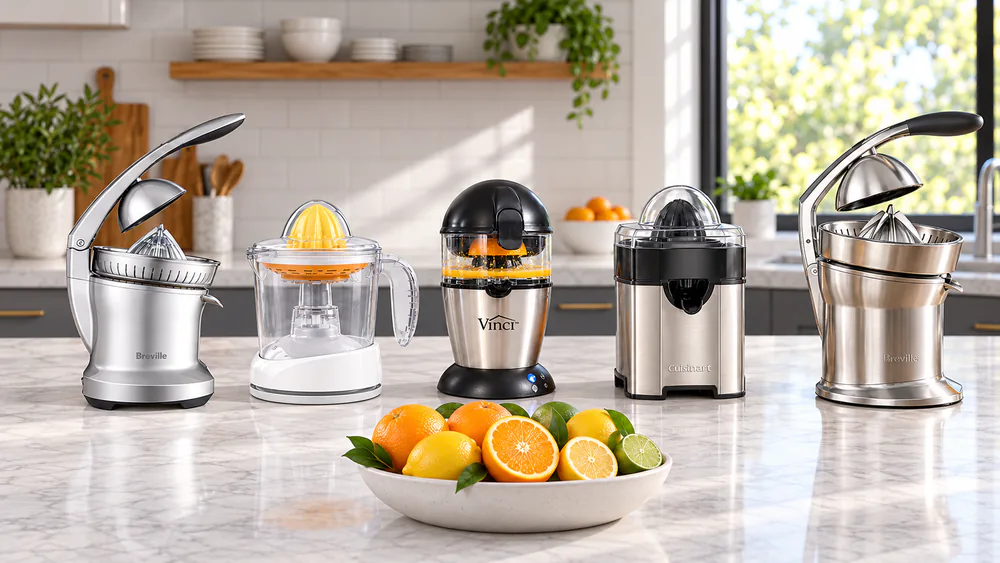
The five picks, set up for comparison.
Note. Wattage alone does not tell you how much juice a machine extracts. Published power figures for several of these models also conflict from one source to the next, so we compare how each one squeezes rather than how large its motor looks on paper.
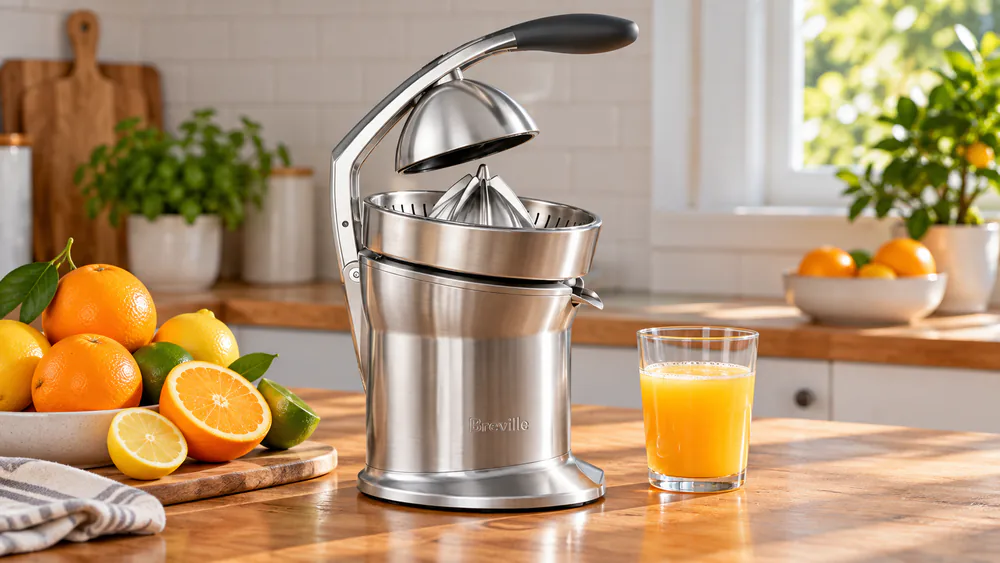
1. Best Overall Electric Citrus Juicer: Breville Citrus Press BCP600
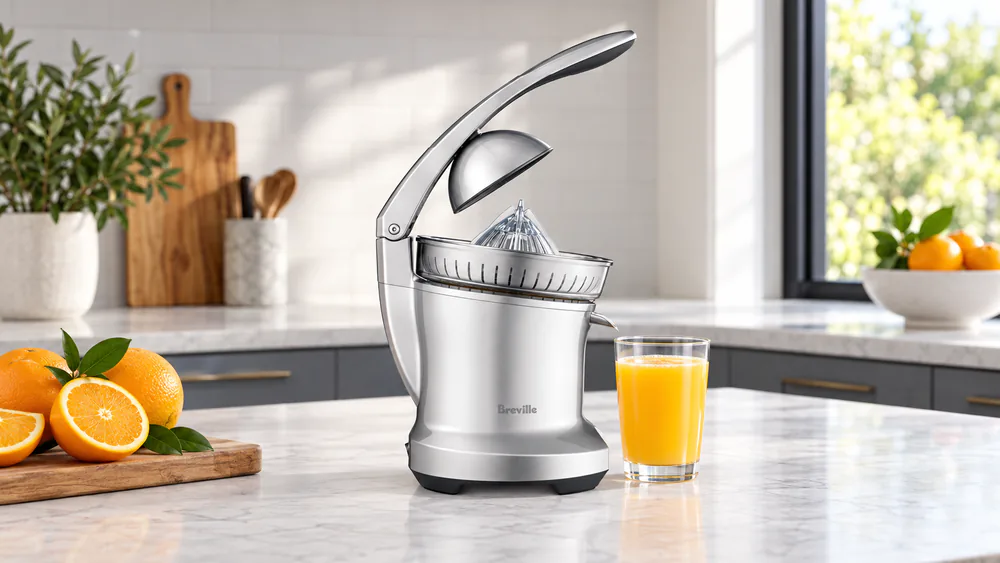
The BCP600 was the juicer we were happiest to reach for. The lever worked smoothly across citrus of different sizes, extraction was effective, and the quiet motor let conversation carry on in the same room. The parts fit together intuitively, and lifting the closed spout assembly limits drips when you clean up. It is the lighter, polymer-bodied Breville, so it costs less than the Pro while keeping low-effort lever juicing.
Lever-operated: the cone only starts with the lever lowered and pressure on the cone
Universal finned cone fits small and large citrus
Drip-stop spout and removable magnetic fruit dome
Cone, collector, filter and dome are dishwasher-safe; wipe the housing rather than immersing it
Specifications
Motor
110W
Warranty
1-year limited
Body
Polymer housing with stainless steel filter
Collection
Separate drinking vessel required
Cord
Storage included
Who This Juicer Suits (BCP600)
This is the one we would buy for a household that juices a few times a week and wants it to feel easy. You lower the lever, the cone spins, and the fruit gives up its juice without you pressing down on a spinning reamer. Because the 110W motor runs quietly, it fits households where the kitchen doubles as a living space.
It also suits people who want a Breville but do not need the heavier build of the Pro. The fixed filter keeps things simple, and the dishwasher-safe cone, collector, filter and dome make cleanup a rinse and a load. Plan for a glass or jug of your own, since nothing to catch the juice comes in the box.
Trade-offs to Consider (BCP600)
The base is lighter and less planted than the Pro's, so you will notice it more under a firm press. The tall arm makes cabinet storage awkward, and published footprints vary between sources, so measure the exact unit against your shelf and leave room for the raised lever. Pulp can also build up over repeated servings, which means a quick rinse before you continue.
The plastic reamer feels modest for a premium appliance, and the base can leave dark marks on a light countertop. The overload protection can stop the motor, so squeeze smaller batches rather than forcing a long run. Warranty coverage is 1-year, which is standard for this class.
2. Best Budget Electric Citrus Juicer: BLACK+DECKER CJ625
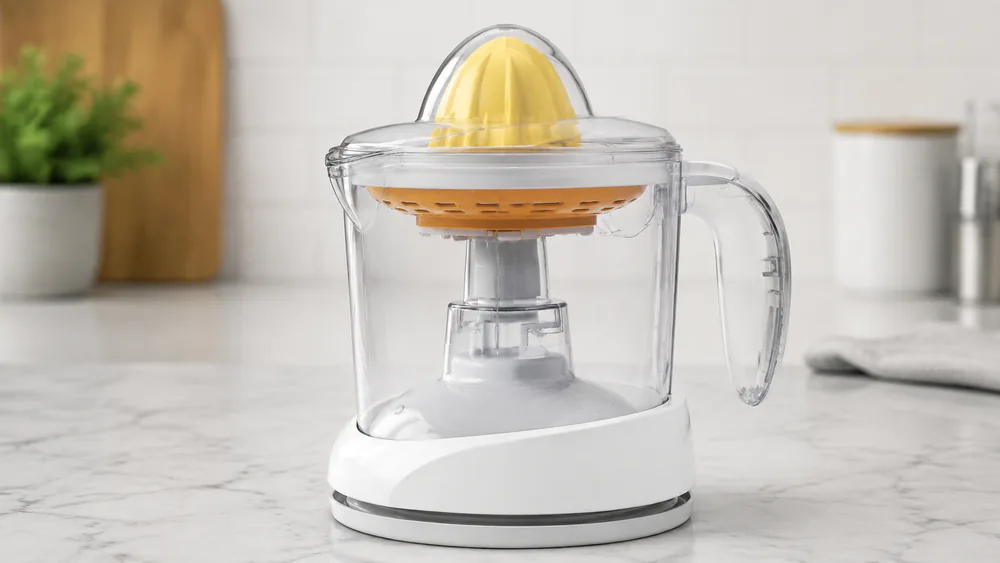
The CJ625 is the juicer for anyone who wants fresh juice without a big outlay, and it does the basic job well. Lemon extraction was effective, and the reversing action helps work the fruit over the cone. The compact body and removable parts make small recipe quantities easy to manage. The trade-offs are noise and filter cleanup: operation is loud, and the light body can shift under pressure.
Pressure-activated reversing cone with small and large reamers
Adjustable pulp basket
Clear pitcher with a handle and pouring lip that doubles as a serving vessel
Cover and cord storage
Specifications
Activation
Pressure on the fruit
Collection
Pitcher of about a quart
Warranty
2-year limited
Cleaning
Removable parts dishwasher-safe; keep the powered base dry
Who This Juicer Suits (CJ625)
Choose the CJ625 if you juice now and then, you want a pitcher you can pour from, and you would rather not spend much. The two reamers let you match the cone to the fruit, and the clear pitcher shows how much you have squeezed so far. It can remain reliable through routine juicing and repeated dishwasher cleaning, and its 2-year limited warranty is the longest of these five on paper.
It also fits small kitchens. The footprint is compact, and the pitcher, cover and cord all store with the unit. Confirm the model and footprint before you plan for a very tight shelf, because published dimensions differ.
Trade-offs to Consider (CJ625)
It is loud, and you hold the fruit down yourself, so the light body can slide as you lean on it. The layered pulp strainer catches fibers between its surfaces and needs extra attention during washing. The pitcher handle is plastic and a vulnerable part, so inspect it when the box arrives.
On older units, a split socket beneath the small reamer can let the shaft turn without driving the cone, so if the small reamer stops spinning the fruit, look there first. Power and capacity figures conflict across sources, so check the rating label and the pitcher markings on your exact unit instead of relying on a listed number.
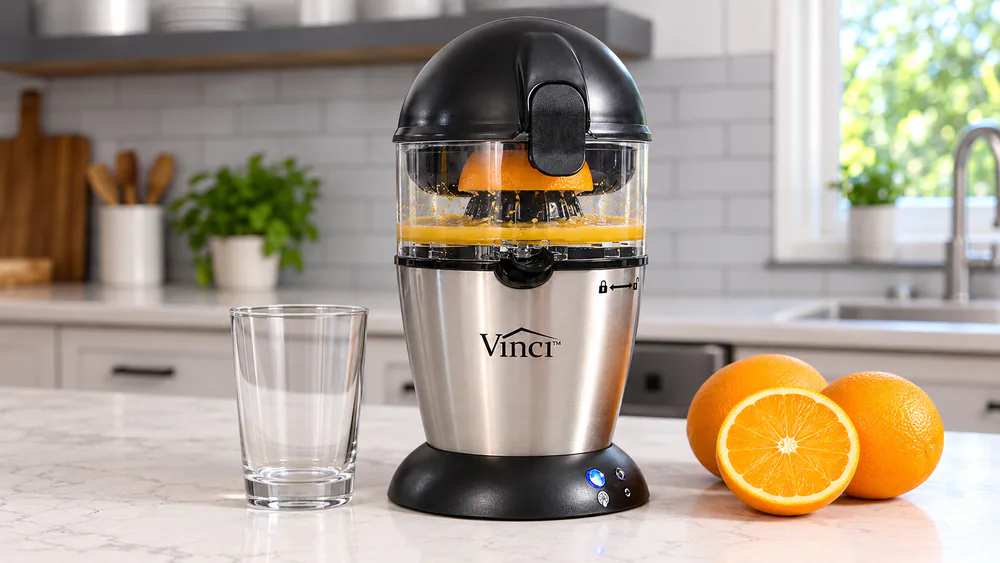
3. Best Hands-Free Electric Citrus Juicer: Vinci Hands-Free Citrus Juicer
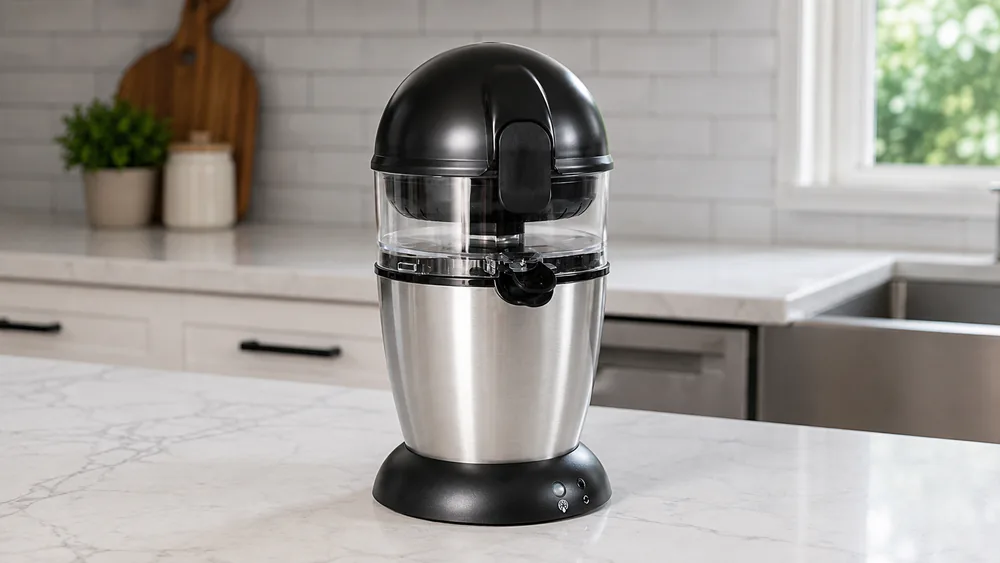
The Vinci removes the part of electric juicing that tires your hand. The button-driven cycle means you no longer hold fruit down throughout extraction: you load a half, close the lid, and let the reamer rise and lower on its own. Oranges and grapefruit juice effectively, though some fruit can develop a slightly bitter edge. The trade-offs are a more awkward wash and a stop-start rhythm on large batches.
Automatic rising and lowering reamer with pressure-sensitive operation
Locking lid and lockable spout
Fine and coarse pulp filters
Removable top-rack dishwasher-safe parts
Specifications
Juice bowl
12-ounce
Fruit limit
Up to 4.5 inches in diameter
Warranty
1-year manufacturer warranty
Activation
Close the lid and press the button
Who This Juicer Suits (Vinci)
If holding fruit against a spinning reamer is what puts you off electric juicers, this is the answer. It suits people with tired hands or anyone juicing while they cook something else, since you can walk away from the cycle once it starts. The fine and coarse filters let you choose how much pulp reaches the glass, and the plastic removable parts rinse clean readily after ordinary orange-juice preparation.
The 12-ounce bowl is about right for one or two glasses, and the unit takes fruit up to 4.5 inches across, which covers most oranges and lemons.
Trade-offs to Consider (Vinci)
Loading and latching each half interrupts the rhythm of larger batches, so it is slower than a lever press when you need a full pitcher. The attached hinged lid makes washing more cumbersome. A partly raised lid can fall onto your fingers, so open it fully while loading.
Expect an audible whir during the cycle; how intrusive it sounds depends on the room and the listener. Pressure sensing also does not guarantee bitterness-free juice, since fruit shape and contact with the pith can still affect flavor. The motor protection helps when force is excessive, but labored operation and incompletely squeezed oranges can signal wear. The manufacturer offers a replacement-parts route, so check the part inventory before you order.
The Vinci mid-cycle with the lid closed.
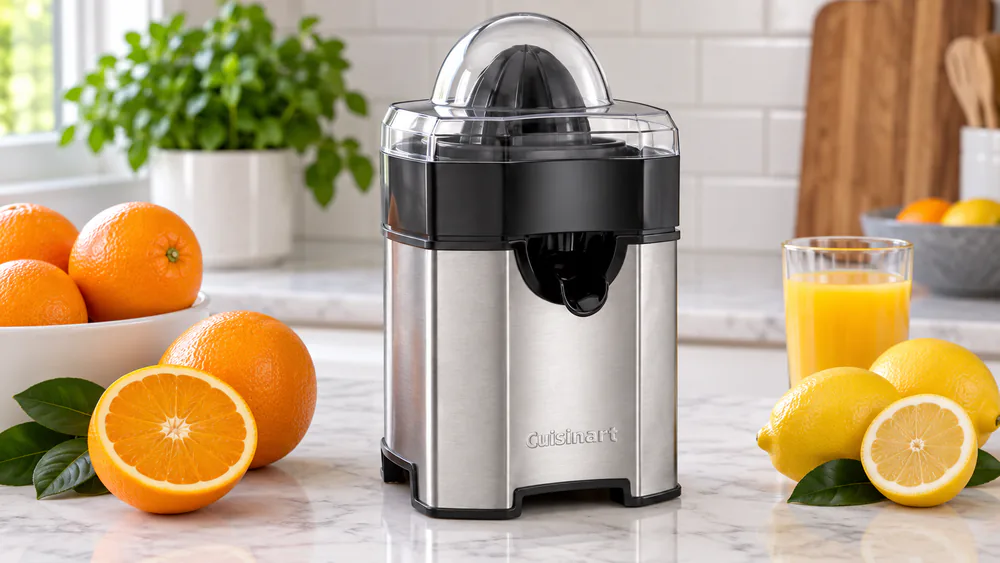
4. Best Electric Citrus Juicer for Pulp Control: Cuisinart Pulp Control CCJ-500P1
Pulp is a matter of taste, and the CCJ-500P1 lets you settle it with a dial. Oranges and lemons are convenient for everyday small servings, with quick disassembly afterward, and the pulp-control assembly separates readily for washing. We would not call it the best at squeezing; it earns its slot for adjustable texture and the Final-Spin on small servings, not for class-leading yield or effortless large batches.
3 pulp settings: low, medium and high
Pressure-activated universal reversing reamer
Lid-activated Final-Spin and snap-up anti-drip spout
Dishwasher-safe removable parts and cord storage
Specifications
Pulp control
3 settings plus Final-Spin
Collection
External glass required
Warranty
Wording varies between 1-year and 3-year; confirm with your purchase
Activation
Pressure on the fruit
Who This Juicer Suits (CCJ-500P1)
This one suits people who care about texture: pulp-free for a pitcher of lemonade, extra pulp for breakfast orange juice. The pulp sieve is easier to remove and wash than the layered strainers on pitcher-style juicers, which matters when you juice every morning. It is also a sensible budget pick for one or two glasses at a time.
Trade-offs to Consider (CCJ-500P1)
Pulpy oranges can clog the screen during repeated servings and interrupt the batch. A low-pulp setting reduces pulp but does not promise completely pulp-free juice, so very pulpy oranges can need an extra fine strainer even at the lowest setting. Small limes may need repositioning and extra pressure to contact the cone well.
Short collecting vessels fit more comfortably than tall glasses, and published dimensions do not consistently identify the same height, so check the spout clearance against your glass. Manipulating the spout can make the upper assembly feel loose. A failure we would watch for is continued spinning that throws pulp outward rather than stopping normally.
5. Best Electric Citrus Juicer for Batch Juicing: Breville Citrus Press Pro 800CPXL
The Pro is the machine to choose when you squeeze glass after glass. The heavy base stays planted and the lever needs little effort, so repeated pressing does not wear you out. Citrus of different sizes fits the same cone, the exterior wipes down easily, and operation is quiet. It sits at the splurge end of this roundup, and batch suitability here means repeated household servings, not commercial continuous duty.
Die-cast body with stainless steel cone and filter
Soft-grip lever with dual-switch activation
Spout flap for switching glasses without dribbling
Removable dome, cone, filter and collector are dishwasher-safe; keep the motor base out of water
Specifications
Warranty
1-year limited, household use only
Collection
Separate glass or jug; no serving pitcher included
Pulp
Pulp basket keeps solids separate
Activation
Hold lever down
Who This Juicer Suits (800CPXL)
Pick the Pro if you juice for a family, host brunches, or make citrus-heavy recipes. The spout flap makes switching collecting glasses convenient without dribbling, and the pulp basket keeps solids separate so you can spoon pulp back into the drink if you like it. Next to the BCP600, the difference you feel is the base: it does not move when you lean into a stubborn grapefruit.
Trade-offs to Consider (800CPXL)
The tall, unlocked arm complicates storage, and the lever needs working clearance well beyond the body, so do not treat the closed-body dimension as the operating height. Continuing to press an exhausted half can scrape too deeply into the rind, and fruit skins can remain caught in the dome after pressing.
Do not assume the current configuration includes multiple filter baskets or a pulp-adjustment dial; verify the contents if adjustable pulp matters. The internal plastic drive gears in older units can strip even when the exterior still looks sound; this is a reason to keep your proof of purchase and know how to contact support, rather than a verdict on current builds. Commercial use is outside the household warranty.
How to Choose an Electric Citrus Juicer
Start with how you want to work, then match the machine to the fruit you squeeze most. Everything else, from warranty to footprint, is a tiebreaker.
Press-Down, Lever-Operated or Hands-Free
There are three ways to activate a citrus juicer, and each changes the effort. With a press-down model such as the CJ625 or the CCJ-500P1, you hold the fruit against a spinning reamer, and the cone starts when you push. It is the cheapest design, and it asks the most of your hand and wrist.
A lever press, like the two Breville models, makes the machine do the pressing. You lower the arm, the cone turns, and the weight of the arm applies the force. The cone only starts with the lever lowered and pressure on the fruit, which is a safety feature as well as a convenience. Lever presses are quieter and gentler on your hands, but the raised arm needs vertical clearance.
A hands-free model such as the Vinci takes you out of the loop entirely. You load a half, close the lid and press a button. That helps if you have limited grip strength or want to cook something else while it runs, but loading and latching each half slows large batches.
The best juicer is the one whose effort you can stand to repeat every morning.
Fruit Size, Pulp Control and Juice Collection
Check fruit fit first. A universal cone handles small limes through large grapefruit, but very small citrus may need repositioning to contact the reamer well. The Vinci takes fruit up to 4.5 inches across, so measure your biggest grapefruit before relying on it. Halve citrus across its segments, keep the rind on, and place the cut side on the cone. If the fruit has a prominent tip, trim it so the dome sits properly.
Pulp handling comes next. A fixed filter gives you one texture. An adjustable strainer or settings, like the 3 settings on the Cuisinart, let you choose, though no filter promises completely pulp-free juice. Seeds are caught by the filter on every model here, but a strainer that clogs on pulpy oranges will interrupt a batch.
Finally, think about where the juice lands. A pitcher, like the CJ625's, doubles as a serving vessel and a place to store leftovers. A direct-to-glass design saves a vessel to wash, but you need a glass that clears the spout. Both Breville presses need a jug or glass of your own, so factor that in. Capacity matters less than how often you stop to empty the bowl or clear the screen.
Cleaning, Storage and Everyday Usability
Cleanup decides whether you keep using the machine. Unplug it first, remove the food-contact parts, rinse away pulp before it dries, and follow the model's dishwasher instructions. Wipe the powered base with a cloth and never submerge it. Look for a filter you can pull out and rinse in one piece; the layered strainer on the CJ625 and the hinged lid on the Vinci are the fussiest parts among our five.
Then consider storage. Lever models have tall arms that make cabinet storage awkward, so measure vertical clearance, not just footprint. Compact press-down models tuck away more easily, and cord storage keeps the counter tidy.
Noise, warranty and materials are worth a glance, too. The Breville presses ran quiet, the CJ625 ran loud, and the Vinci has an audible whir. Warranties here run from 1-year to a 2-year limited term, so read what the exact purchase includes. A support route for replacement parts is worth knowing about, but it is not a guarantee a part will be in stock in two years.
Which Electric Citrus Juicer Should You Choose?
Pick the Breville BCP600 for the easiest all-round juicing, the CJ625 if budget comes first and noise does not bother you, and the Vinci if you want to stop holding fruit altogether. Choose the Cuisinart CCJ-500P1 when texture matters, and step up to the Breville Pro 800CPXL if you squeeze for a crowd every week.
If you are weighing a manual press against these, see our best orange juicers, electric and manual for the wider field. One caution applies to all five: none of them is a continuous-duty commercial machine, so give them a pause when the motor warms up.
Electric Citrus Juicer FAQs
Is an Electric Citrus Juicer Worth It Compared With a Manual One?
It depends on how often you juice. A handheld press suits an occasional splash of juice for a recipe, and it costs little and stores in a drawer. Electric operation becomes more useful once you are squeezing repeated glasses or recipe quantities, because the motor or lever saves your hand from doing all the work.
Should You Halve or Peel Citrus Before Juicing?
Halve it, don't peel it. Cut the fruit across its segments, keep the rind on, and place the cut side on the cone. If a prominent tip stops the dome from sitting properly, trim it. Peeling removes the rind that gives the reamer something to grip.
Can One Electric Citrus Juicer Handle Limes and Grapefruit?
Most of these can, with caveats. The universal cones on the Breville and Cuisinart models take a range of sizes, but small limes may need repositioning and extra pressure on the Cuisinart. The CJ625 offers a small and a large reamer, and the Vinci takes fruit up to 4.5 inches across.
How Do You Clean an Electric Citrus Juicer?
Unplug it, remove the food-contact parts, and rinse off pulp straight away. Most removable parts on these models can go in the dishwasher, but follow your model's instructions, and wipe the motor base with a damp cloth without submerging it. Pay extra attention to layered strainers and hinged lids, where fibers collect.
How Does a Citrus Juicer Differ From a General-Purpose Juicer?
A dedicated citrus juicer uses a reamer or press and handles only citrus halves. Centrifugal and masticating juicers process a wider range of produce, but they involve a different preparation and cleanup routine, with more parts and more prep. If citrus is what you squeeze, a reamer-style machine is simpler.