As an Amazon Associate we earn from qualifying purchases. We may earn a commission from links on this page, at no extra cost to you. Learn more.
Global makes thin, light, all-steel Japanese-style chef knives, and the real choice for a home cook is rarely about steel. It is about blade length and how the handle sits in your hand. Our pick for most kitchens is the Global G-2 8-inch chef's knife, because it cuts like a precise tool and gets out of the way. The catch is that its small steel handle divides cooks, so the fit caveat matters as much as the verdict.
We looked at five distinct Global chef knives, from the nimble G-2 to the long G-16 and the heavyweight GF-33, judging each on handling, edge and how willingly the steel comes back on the stones. If you are comparing Global against other thin, hard blades, our Japanese knife reviews cover the wider field.
Global Chef Knives at a Glance
Here is the short version. Every knife below is a distinct Global chef knife model, and each one trades something for what it does well. The table lists the blade length, the construction, who it suits, and the main tradeoff. The only reliable knife-only weight we have is 9.2 oz for the Model X, so we have left weights out of the table rather than guess the others.
4mm spine at the heel, taller blade, larger grip and bolster
Cooks who want a fuller grip and a substantial feel
Thick blade can feel cumbersome
Global SAI-01
7.5-inch / 19cm
3-layer hammered blade, curved handle with thumb recess
Grip contour and a premium finish
Left-hand comfort and wet grip need care
Global G-16
24cm (9.5-inch, often sold as 10-inch)
Long Classic chef profile
Large produce, herb bundles, long slices
Needs board space and some adaptation
Global GF-33
8.25-inch / 21cm
Forged heavyweight blade
A rigid, weighty chef knife
Less delicate on fine vegetable work
A quick way to read it: pick the G-2 if you want one dependable knife, the Model X or GF-33 if you like weight in your hand, the G-16 if you cook big and have the counter space, and the SAI-01 if the curved handle fits your grip. Each of those calls is explained in the reviews below.
Key takeaway. Blade length and handle fit decide more than any steel number here. The Classic line, Model X and GF-33 all use CROMOVA 18 stainless, so the spec sheet will not pick a winner for you. Your hand and your board will.
How We Tested These Global Chef Knives
This is a hands-on handling and edge assessment, not a lab test. There are no stopwatch chopping races and no numeric sharpness readings, because we would rather tell you what a knife felt like than invent a number for it.
We score each knife on fit for the job, handling and balance, how secure the handle stays with dry hands versus greasy ones, how easily it cleans up, and how readily the edge recovers on waterstones. A blade that still slices a sheet of paper cleanly tells you something a spec sheet cannot, so edge checks by feel and on paper are part of how we judge sharpness. The per-knife observations below, such as how the G-2 steered through onions and tomatoes or how the GF-33 took a keen edge on the stones, are the findings behind each score.
We also weigh each blade against the board space it needs, because a long knife that feels wonderful on a big butcher block can feel clumsy on a modest counter. Cleanup follows Global's own advice: hand wash, dry straight away and store the blade protected.
The limits matter, so here they are. Grip comfort is personal, and edge life depends on your cutting surface and technique, so we do not offer a universal sharpening interval. Where manufacturers publish conflicting numbers, such as hardness on the SAI-01 or the GF-33, we say so and do not pick a side. We rate knives out of five on those same criteria.
A word on how the ratings work. They are editorial judgments, not averages of a numeric rubric, and they are not built from marketplace star counts. Fit for the job and handling carry the most weight, because a knife that does not suit your hand or board will sit in the block however good the steel is. Edge recovery and cleanup break ties. That is why a shorter, specialized knife can land below the G-2 without being a bad knife: it simply suits fewer cooks, and the score reflects how many kitchens it fits.
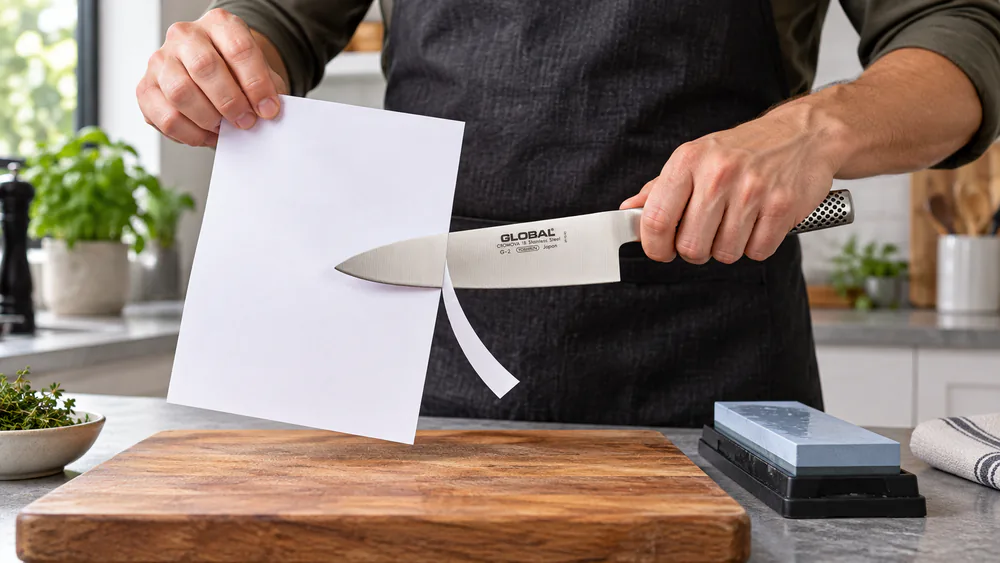
A paper slice is a quick check on whether an edge needs the stones.
Note. Global's own care guidance steers you away from bones, frozen food and twisting a stuck blade. The extra heft of the Model X or GF-33 does not make either suitable for those tasks.
The Best Global Chef Knives to Consider
All five knives below share the Global look: a seamless, dimpled stainless handle weighted with sand, a thin edge, and Japanese manufacture. Beyond that they diverge on length, thickness and handle shape. We kept the 8-inch class as the baseline, since it is the size most home cooks reach for, and then branched out to shorter, longer and heavier options.
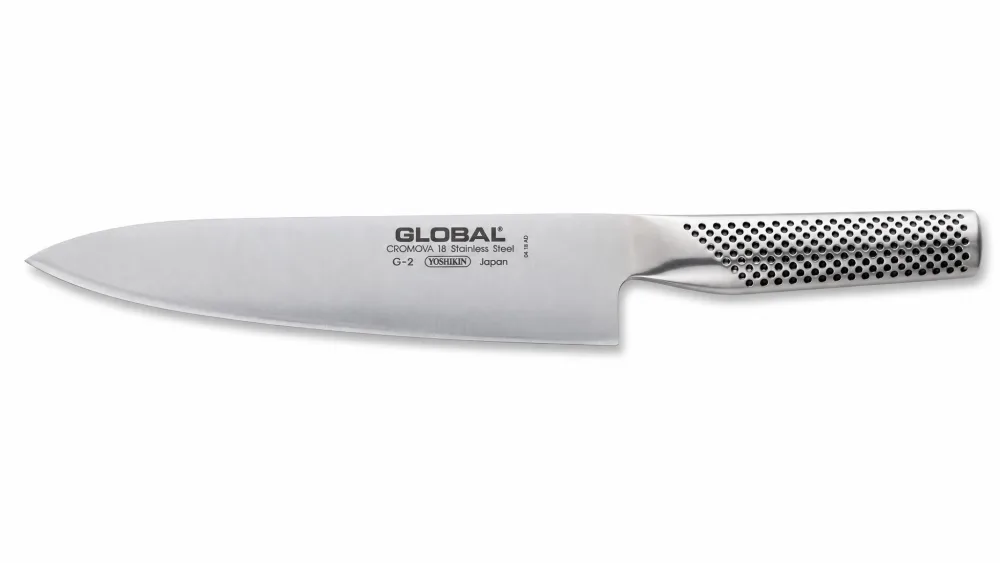
The G-2 is the knife we would hand to most home cooks, and it earned that spot by being agile rather than imposing. Through repeated vegetable cuts it felt nimble, and its low mass favors guided slicing, so you steer the blade instead of leaning on its weight. Onions and tomatoes gave up their pieces with real precision, and small vegetable detailing felt easy. The handle can feel too light if you prefer a heavier grip, and we noticed the steel feels secure with dry hands but less reassuring with greasy ones.
Agile and light for vegetables, fruit and herbs
8-inch blade suits most home boards
Smooth exterior wipes clean quickly
Restores well on waterstones
Specifications
Blade length
8-inch / 20cm
Steel
CROMOVA 18 stainless, 56-58 HRC
Edge angle
15-degree cutting edge
Handle
Dimpled hollow steel, sand-weighted
Made in
Japan
The numbers back up the feel. It is an 8-inch blade, also designated 20cm, made from CROMOVA 18 stainless steel at 56-58 HRC with a 15-degree cutting edge. That is thin, hard and pleasant to sharpen. In regular home use it kept enough bite for clean paper cuts, though that is no promise of a universal sharpening interval. When the edge faded, sharpening on stones restored it; how long it stays sharp afterward depends on your board and technique.
Cleanup is where the smooth exterior pays off. The G-2 washes clean easily by hand, and the seamless surface wipes down without crevices to catch food. We dried it right away every time, as Global advises, because stainless steel can still rust if neglected.
The G-2 is the knife that disappears into the work, which is the highest compliment we pay a chef knife. It does not demand a special grip or a big board, and it does not tire the wrist. The adjustment is learning to guide the knife rather than push it, since there is no weight to lean on. Cooks coming from a heavy German-style blade should expect a few sessions of adapting to that.
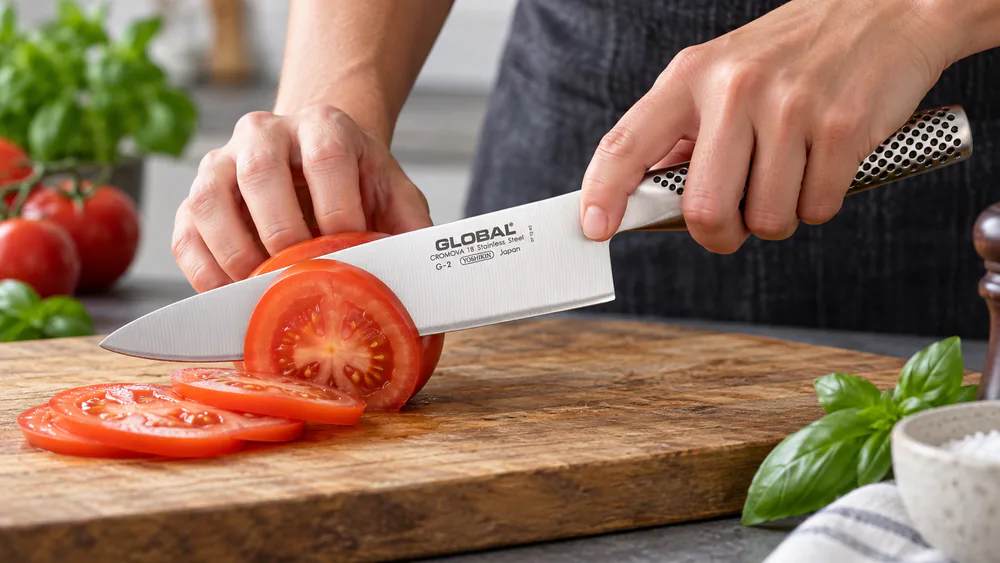
The G-2 through a ripe tomato, where its thin blade shows its strength.
The Model X is the Global for people who wished the G-2 had more handle. The grip is distinctly fuller and the whole knife feels more substantial, with a pronounced increase in heft, blade height and bolster presence compared with the G-2. For a cook who pinches the blade, that bolster gives your fingers something solid to meet, and the fuller handle stays comfortable longer.
Pros
Larger handle and more prominent bolster than the G-2
Substantial feel that suits longer prep sessions
Double bevel, 8-inch blade, made in Japan
Cons
Thick blade can feel cumbersome on fine work
Taller, heavier profile is less agile than a G-2
Easy to confuse with the hollow-edge GF-99
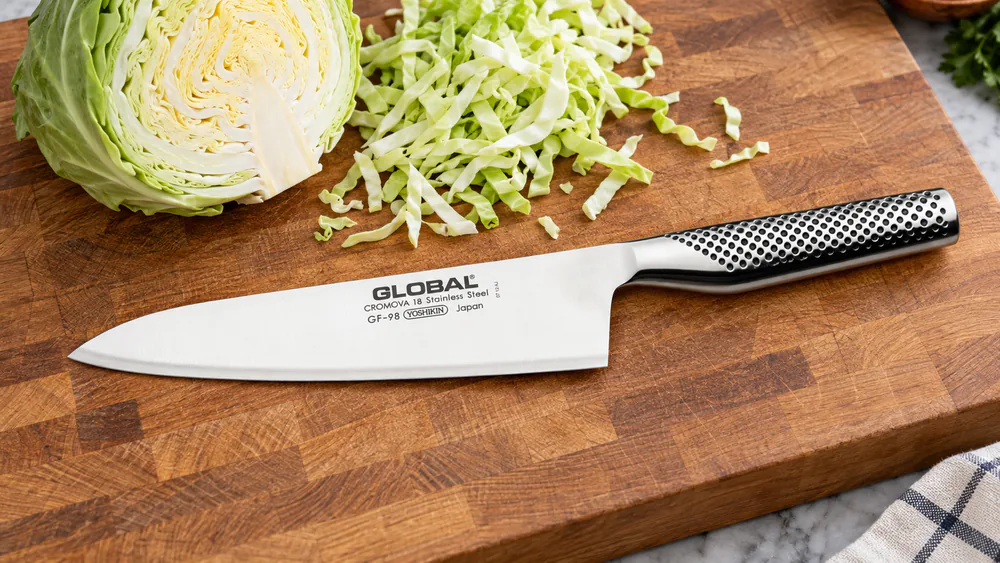
Be sure you are buying the right one. The GF-98 is the fine-edge Model X chef, distinct from the hollow-edge GF-99. It is an 8-inch blade with a 4mm spine at the heel and a 9.2 oz knife weight, made from CROMOVA 18 with a sand-filled dimpled steel handle and a double bevel. That thicker spine is the reason it feels sturdy, and it is also the reason it does not feel like a G-2.
In use, the thick blade can feel cumbersome through food if a thin, nimble cutter is your goal. That showed on delicate work like thin tomato slices, where the G-2 simply glided. Where the Model X shines is firmer ingredients and longer sessions, when a comfortable handle matters more than a razor-thin profile.
Think of the Model X as a middle ground between the Classic line and a conventional heavy chef knife. It keeps the Global look and the thin Japanese geometry in spirit, but it brings the handle size that Western-style knives usually offer. If you were tempted by the G-2 and worried about hand fatigue, this is the model to test against it.
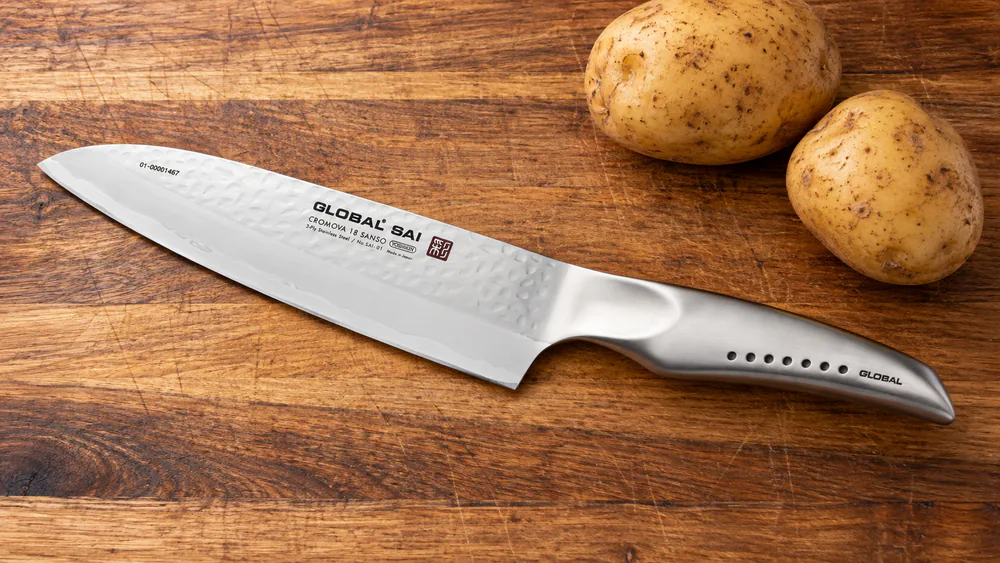
Where the Model X gives you a big, bolstered grip, the SAI-01 goes the other way with a shorter 7.5-inch blade (designated 19cm) and a sculpted handle. Buyer note: the compact SAI-M01 is a 5.5-inch utility knife, a different tool. The SAI-01 felt balanced and sharp for ordinary food prep, and its 3-layer blade, a hard CROMOVA core between softer stainless outer layers, gives it a more refined look than the Classic line.
Pros
3-layer blade with a hard CROMOVA core
Hammered face helps release potato slices
Balanced and sharp for normal prep
Curved handle with a thumb recess
Cons
Thumb recess is awkward for left-handed cooks and forward pinch grips
Satin handle gets slippery when wet
Shorter 7.5-inch blade; costs more than the other picks
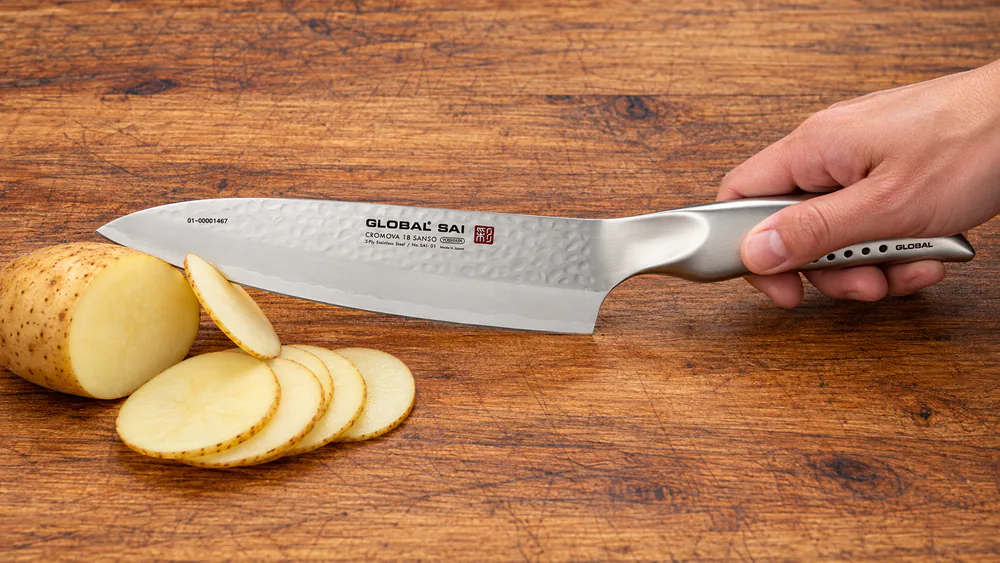
The hammered blade face does real work. Potato slices released from it more easily than from a smooth face, which cuts down on the sticking that slows you down on starchy vegetables. Out of the box the edge was usable, though a light ceramic touch-up improved it, and under moderate home use it held a working edge. Heavier restaurant-style use calls for more maintenance.
The ergonomics are less universal. The curved handle has a thumb recess, but a forward pinch grip does not put your hand there, so the feature does not help every cook. The recess can feel uncomfortable in the left hand, and the satin handle becomes slippery during washing or when your hands are slick. Dry the grip every time.
The SAI-01 also rewards a particular style of cooking. It is a good fit for a cook who works mostly with vegetables and fish, who likes a shorter blade, and who holds the knife with the handle sitting back in the palm. For that cook, the thumb recess feels like part of the hand. For anyone else it is a decorative curve.
On the details that are not settled, we stay honest. Published hardness numbers for the SAI differ between sources, as do the exact edge angle and the outer cladding specification, so we would not buy it on a hardness figure. Buy it because the handle shape agrees with your hand and you like the finish. It is the splurge pick of the group.
The hammered face of the SAI-01 releases starchy slices more readily than a smooth blade.
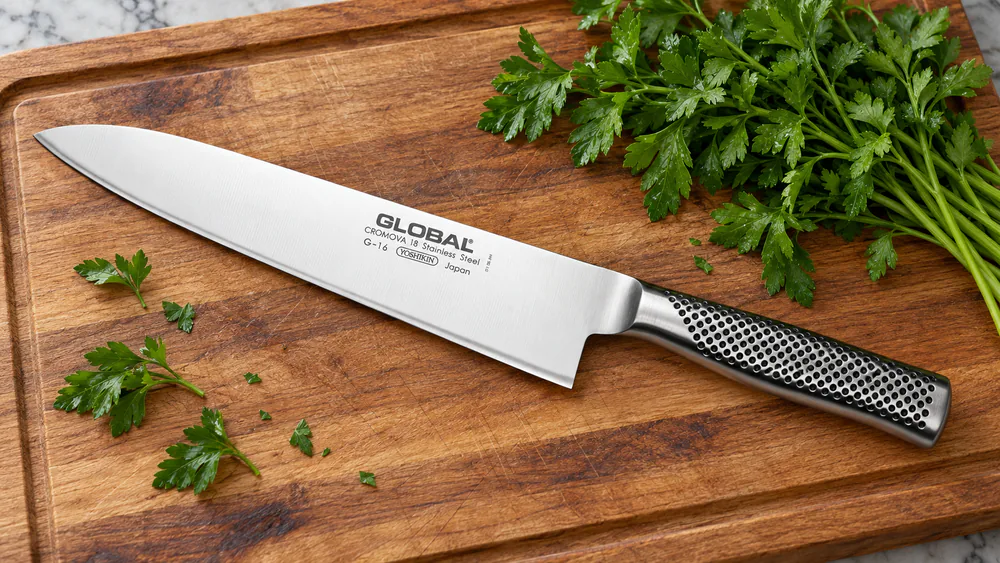
The G-16 is the knife for cooks who run out of blade on the G-2. Its extra length makes large herb bundles and broad ingredients easier to work across, and the long edge keeps tip contact while rocking over onions. Despite the length, it balances comfortably for ordinary slicing, which surprised us. It is effective on boneless meat, soft produce and herbs, and its thin edge does not make it a bone chopper.
Pros
Long blade covers big produce and herb bundles
Comfortable balance for its length
Smooth exterior wipes clean
Sharpens readily on stones
Cons
Takes up much of a small board
Feels oversized until you adapt
Not for bones; careless use can chip the edge
A note on the name: the manufacturer lists a 24cm blade, which is a 9.5-inch metric designation, and US retailers often sell it as a 10-inch. That label is a retail size, not an exact conversion, so buy by the model number and 24cm length.
The cost of the extra blade is space. It takes up much of a modest board, and it can feel oversized and awkward at first. A shorter chef knife is easier to place in a small working area, so skip the G-16 if your counter is tight. If you are used to a long knife from a restaurant background, the G-16 will feel familiar, and it is the closest thing in this group to a classic cook's knife. For long slicing jobs like a boneless roast or a big cabbage, the extra inches give you a single clean pass instead of two. Treat it with respect as well. It can regain a useful edge readily on stones, but careless use can leave tiny chips.
For cleanup it behaves like the rest of the Classic line: the smooth steel exterior wipes clean easily, although discoloration is still possible. Hand wash and dry it promptly.
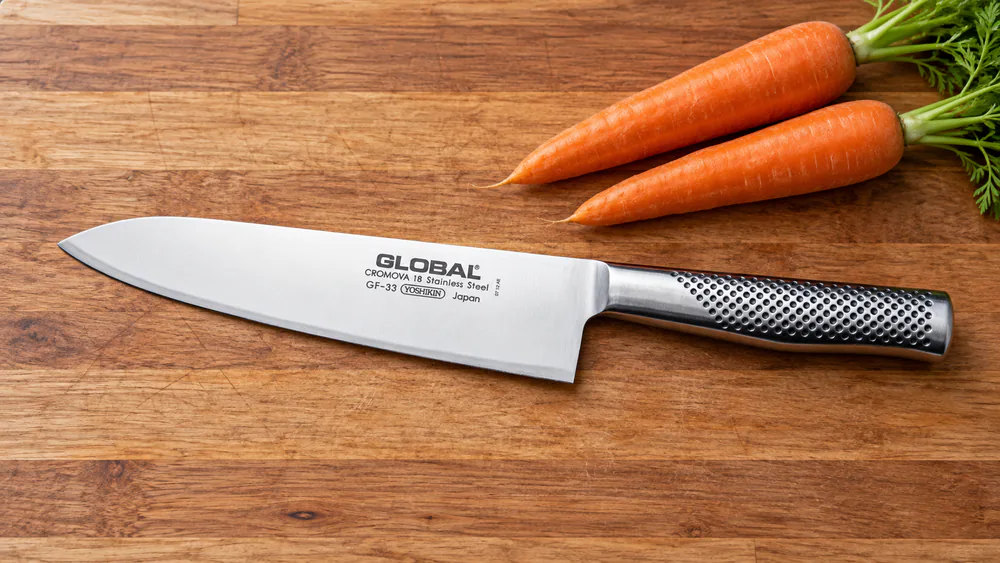
The GF-33 is the weighty Global, and you feel that the moment you pick it up. The blade is 8.25-inch (designated 21cm), forged from CROMOVA 18, with a 15-degree cutting edge and a heavier construction than standard G knives. It feels rigid and substantial, with very little flex, and that stiffness trades away some delicacy.
Pros
Forged, rigid, substantial blade
Weight helps on root vegetables
Takes a keen edge on whetstones
Cons
Less nimble on peppers, tomatoes and fine work
Weight can make it a knife you skip for routine prep
Edge still needs regular renewal
That weight helps with root vegetables, where the knife does more of the work. On peppers and tomatoes the thick blade feels less nimble, and the G-2 is plainly the better choice there. Even with its heft it remains balanced, and the pointed, curved profile offers useful control. On the stones it took a clean, keen edge after careful finishing.
We would not call the GF-33 a bad knife, just a specific one. If your prep is mostly squash, carrots, potatoes and cabbages, it can be a pleasure, and the stiffness gives you a feeling of control that a thin blade cannot. If you mostly cut tomatoes, herbs and delicate fish, you will want the G-2.
There is a practical downside. The weight can discourage you from reaching for it on routine prep, and the working edge still needs regular renewal. If you notice the knife staying in the block while a lighter one does the weeknight chopping, it was the wrong knife for you. The manufacturer lists the hardness at 56-58 HRC, though other published figures differ, so treat that range as approximate.
How to Choose a Global Chef Knife
Choosing a Global is mostly about fit. The steel is similar across the Classic family, so the questions that matter are how long a blade your board can take, how the handle feels over a full prep session, and whether you want a thin or a thick blade. The Japanese-style tradeoff applies throughout: a thinner, harder edge cuts beautifully, but it asks for more care than a soft German-style blade. It will chip if you twist it in a bone or a frozen block.
Blade Length and Available Prep Space
Blade length is the first filter because it decides how the knife feels on your counter. Start with your board. An 8-inch blade is the sweet spot for most home cooks, which is why four of our five picks live near it. It is long enough to slice a cabbage and short enough to stay out of your way.
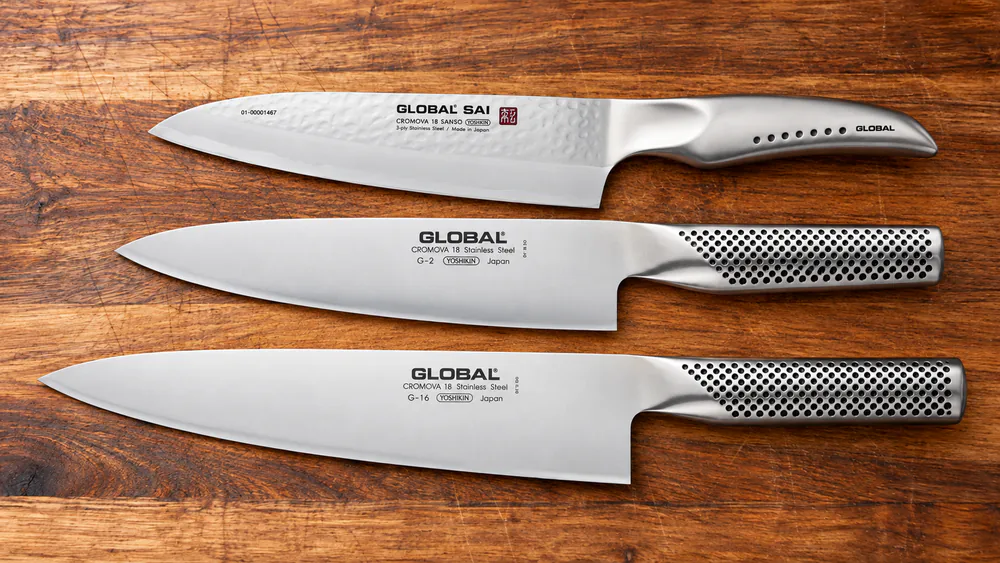
Step up to the 24cm G-16 only if you have the room. A long blade makes herb bundles and big ingredients easier, but on a modest board it eats the working area. Step down toward the 7.5-inch SAI-01 if your counters are tight or your hands are small. A shorter blade is quicker to place and feels more controlled for smaller tasks.
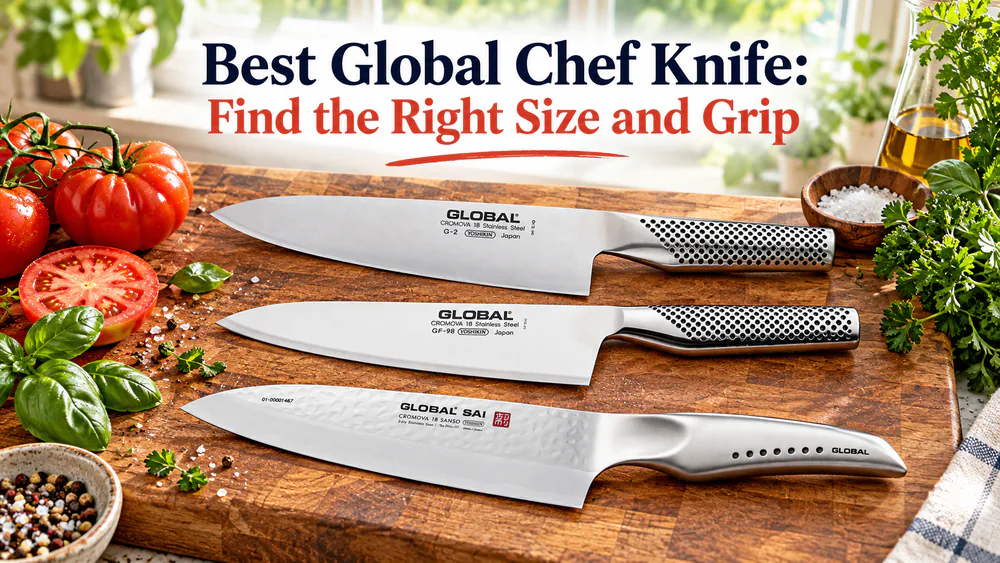
The SAI-01, G-2 and G-16 side by side show how much board each one needs.
Handle Comfort, Grip and Balance
The all-steel handle is Global's signature, and it either suits you or it does not. The dimpled grip is filled with sand to balance the blade. With dry hands it feels secure, and with greasy hands it becomes less reassuring, so keep a towel nearby when you cut fatty meat.
Hold the knife the way you hold a chef knife for a minute at the counter, not just in a shop. Handle size is the main variable. Classic handles can feel small and uncomfortable in a long session, so a larger grip like the Model X is worth trying if your hands run big. Balance matters too. The G-2 feels light and nimble, the G-16 balances comfortably despite its length, and the GF-33 stays controlled even with its heft.
If you use a pinch grip, think about the SAI-01. Its thumb recess is not where a forward pinch grip puts your hand, so the best ergonomic feature on the knife may go unused. Choose by holding the knife and by how you grip, not by the photo.
The right Global is the one whose handle you forget about by the second onion.
Blade Shape, Edge Style and Food Release
Most of these knives have a smooth blade face and a thin edge ground to about 15 degrees. The SAI-01 changes the picture with a hammered face that releases potato slices more easily, which helps with sticky foods but does not turn it into a different knife. The Model X's thicker, taller blade adds stiffness and takes some of the glide out of the cut.
Food release is a quiet but real part of daily comfort. A smooth face lets food cling when you slice wet or starchy ingredients, so a hammered face like the SAI-01 helps there. The best habit with any of these knives is to slice with a smooth draw rather than forcing the blade straight down, since the thin edge does its best work when it is allowed to glide.
A thin edge slices cleanly and sharpens fast, but it is delicate. The GF-33's rigidity gives it a different character: it handles roots with authority and loses some finesse on soft produce. Choose the profile that matches what you cut most.
Match the Knife to What You Cut Most
Before you compare models, list the three things you chop most often. If it is onions, tomatoes, herbs and peppers, you want the thin, light geometry of the G-2. If it is squash, carrots, potatoes and cabbage, the extra mass of the GF-33 or the thicker Model X blade does more of the work for you. If it is potatoes and other starchy vegetables that cling, the hammered SAI-01 face is the one with a real food-release advantage. And if you break down big batches of produce, the G-16 saves passes.
This simple sort prevents the most common regret with Global, which is buying a knife for how it looks in a block and then discovering it is wrong for your daily prep. Rank your tasks first, then pick the blade.
Price, Warranty and What Comes in the Box
Global knives are premium purchases, and within this shortlist the G-2 is the mid-priced option while the G-16, GF-33 and SAI-01 cost more, with the SAI-01 as the splurge. We do not quote prices here because they change often, so check the live listing before you buy.
Warranty deserves a careful read. In the US, Global covers manufacturing defects for the original purchaser under normal use, and it excludes chips, broken tips, rust, accidents and misuse. The word "lifetime" on a listing should not be read as unconditional breakage protection, and coverage depends on your region, an authorized purchase and the cause of damage. Buying from an authorized dealer matters.
Returns depend on who sells the knife. Global's own US store allows a 30-day window from receipt for unused merchandise with the receipt, and other sellers apply their own policies. We cannot promise any accessories in the box, so do not assume a sheath or sharpener comes with a standalone knife.
Tip. Before you click buy, confirm the model number. The G-16 sells under a 10-inch name despite its 24cm blade, and the Model X GF-98 is easy to confuse with the hollow-edge GF-99.
Global Classic, Model X, SAI and UKON: What Changes?
Global sells several lines that look alike at a glance. Knowing the differences helps you avoid paying for something you do not need.
Construction and Blade Differences
The Classic line, including the G-2 and G-16, uses CROMOVA 18 stainless in a thin, light blade. The seamless exterior can mislead you into thinking each knife is a single forged piece. It is not: standard Classic blades and hollow handles are assembled, while GF models like the GF-33 are forged. That is part of why the GF-33 feels so much more rigid.
The Model X keeps CROMOVA 18 but makes the blade taller and thicker, with a 4mm spine at the heel. The SAI changes the layout more: a 3-layer blade with a hard core between softer stainless outer layers, plus a hammered face. UKON, a related line we did not shortlist, uses CROMOVA 18 in thicker blades than the Classic, with additional grinding and finishing.
The practical effect is that the lines feel different in your hand more than they look different on a page. The Classic and Model X share a steel but not a feel, and the SAI and UKON add refinements that appeal to a particular type of cook. That is why we shortlisted a single knife from each family rather than stacking the Classic models.
For all of them, expect a hard, thin edge that rewards good habits and punishes bad ones.
A few buyer notes keep the families straight. The Model X GF-98 is the fine-edge chef, while the GF-99 is a hollow-edge version, so check the model code before you order. The SAI-01 we shortlisted is a 7.5-inch chef knife, and the compact SAI-M01 is a 5.5-inch utility knife, a different tool for a different job. UKON is the line to look at if you want an ambidextrous thumb rest, though we did not shortlist it. Check the model number before buying, because these lines look similar and their differences can be hard to spot in a photo.
Handle Design and Weight
Handle design is where the lines separate most. The Classic uses the small dimpled steel handle that defines the G-2 and G-16. The Model X enlarges the handle and bolster, so it feels fuller and heavier. The SAI uses a curved handle with a thumb recess and a satin finish that gets slippery wet. UKON places an ambidextrous thumb rest closer to the blade.
Weight follows the same pattern. The G-2 is light, the Model X comes in at 9.2 oz, and the GF-33 is the heaviest of our five by construction. If you are unsure, start with the lightest knife and move up only if you feel the handle is lacking.
Caring for Your Global Chef Knife
A thin, hard blade is forgiving in the kitchen only if you look after it. A few habits do most of the work, and they cost nothing.
Cleaning, Drying and Storage
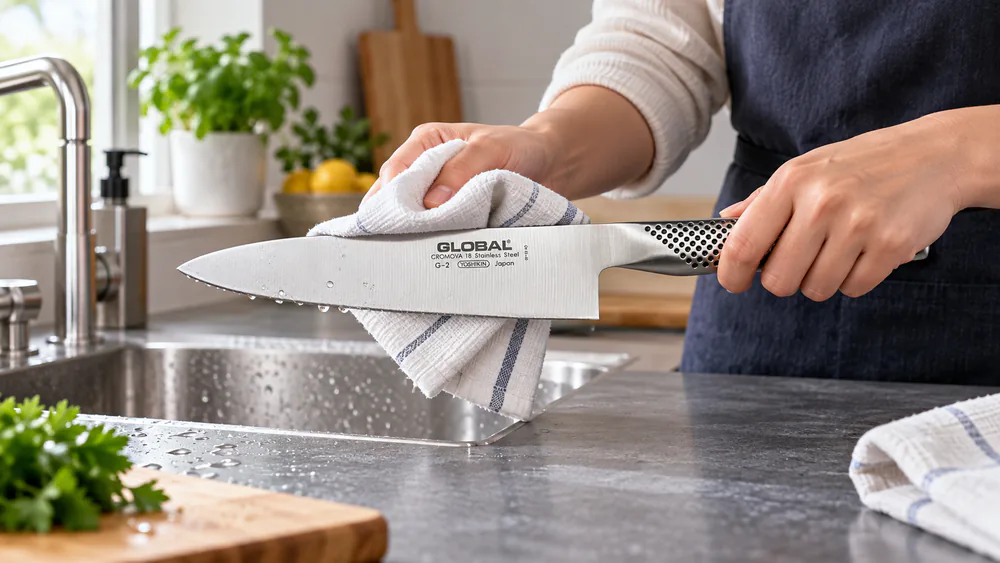
Wash by hand in warm soapy water, rinse and towel dry straight away. Keep the knife out of the dishwasher, do not leave it soaking, and avoid bleach, because stainless steel can rust if neglected. The smooth steel exterior wipes clean easily, but discoloration is still possible if you leave residue on it.
Dry the handle as well. The satin SAI grip is slippery when wet, and any Global handle is less secure when slick. For storage, use a block, a magnetic rack, a dock or a knife roll, so the edge does not bang against other metal in a drawer.
Hand wash, dry at once, and store the blade protected.
Sharpening and Suitable Cutting Boards
Global recommends waterstones or ceramic stones, and that matches what we saw on the bench. Use a medium grit for routine work and keep coarse grit for blunt or damaged edges, then remove the burr from both sides. Between sessions, a fine ceramic or diamond rod is fine. Traditional steels of other materials are discouraged.
The G-2, G-16 and GF-33 all came back to a keen edge on stones, and the SAI-01 benefited from a light ceramic touch-up even when it arrived usable. How long an edge lasts depends on your board and technique, so a soft board does more for you than any steel upgrade.
When the stones come out, go slowly. A thin 15-degree edge responds quickly, so a few careful passes on each side usually beat an aggressive session. Check your progress on a sheet of paper. A clean slice means you are done, and a snag means the burr is not fully removed yet.
Pick a board that is kind to a thin edge: end-grain wood, a good soft wood or a quality synthetic. Avoid glass, stone, marble and tile, which dull and chip a blade. Skip bones, frozen food and any lateral twisting of a stuck blade, because Global's care guidance lists all of them as things to avoid, and a thin edge cannot take the abuse.
Warning. A chip or a broken tip is excluded from Global's US warranty. Board choice and careful use protect your edge more than any coverage will.
Frequently Asked Questions
The questions below come up most often when readers are choosing between these knives. Sets get their own section after the list.
Does a Global chef knife need a honing rod?
A fine ceramic or diamond rod is fine between stone sessions. Global discourages traditional steels of other materials, and a thin 15-degree edge responds quickly, so use light passes.
Can you put a Global knife in the dishwasher?
No. Global's care guidance says to wash by hand and dry straight away, and its US warranty excludes damage from misuse, so a dishwasher cycle is a risk you do not need.
Should you choose a chef knife or a santoku?
A chef knife has a curved belly that rocks through herbs and onions, while a santoku is shorter with a flatter profile that suits straight-down chopping. If you cut a lot of herbs and want one all-purpose knife, take the chef knife. If you prefer a compact, chop-first feel, a santoku is a fair alternative.
Which Global models suit a left-handed cook?
The Model X is double bevel and UKON has an ambidextrous thumb rest, so they are the safer starting points.
Can you return a Global knife after trying it in your kitchen?
Only if it is still unused. Global's US store allows returns within 30 days of receipt for unused or unopened merchandise with the receipt, so a knife you have already cut with will not qualify. Other sellers set their own rules, and return postage is not covered by the direct-store policy, so read the seller's terms before you buy.
Is a Global Knife Set Better Value Than a Single Chef Knife?
A set looks like a bargain until you count the pieces you actually use. Buying individual knives avoids unused set pieces when a chef knife and a small detail knife cover the work you really do. For most home cooks that means one chef knife from this list and a companion paring knife for peeling, trimming and hand-held jobs, and nothing more.
A set makes sense in a narrower case: you are furnishing a kitchen from nothing, you want a block and a matching look, or you plan to use a bread knife and a utility knife regularly. Even then, check what is in the box, because we could not verify that any of these standalone picks ships with a sheath, a sharpener or an accessory. Do not assume a bundle.
If you do want to compare sets, our best chef knife set guide is the place to start. Otherwise, spend the money on the one blade you will use daily and a good board.
Alternatives for Cooks Who Dislike an All-Metal Handle
Some cooks never warm to a steel handle, however well balanced it is. If that is you, the sensible move is to try the larger Model X grip first, since it is the most generous handle in this group. If steel is the problem and not the size, look at a Japanese-style knife with a wood or composite handle. Our Shun chef knife roundup covers that kind of option, and the thinner, harder-steel tradeoffs are the same.
Final Verdict: Which Global Chef Knife Should You Choose?
Our overall pick stays the G-2, because it fits the widest range of cooks and tasks without asking for much. It is the one we would reach for on a normal weeknight and the one we would recommend to a friend who just wants a good Japanese-style knife.
Beyond that, the choice is about adjustment. If the G-2 handle is too small or too light, step up to the Model X. If you cook big and have the board for it, the G-16 earns its length. If you like weight, the GF-33 is the committed pick, and if the curved handle suits your grip, the SAI-01 is the refined option. Whatever you choose, treat the edge well, and the knife will repay you.
One last practical point on buying. Match the model number and length on the listing to the knife you want, buy from an authorized dealer so the defect coverage applies, and keep the receipt for the return window. The G-16 and the Model X are the two where a wrong click is easiest, and a few seconds of checking saves a return.
If you are still torn between two knives, let your hands decide. Borrow or handle each one if you can, and ask yourself which grip you would still enjoy at the end of a long Sunday prep session. A lighter knife suits fast weeknight cooking, and a heavier one suits cooks who like to let the blade do the work. Neither choice is wrong, as long as it matches how you actually cook.