As an Amazon Associate we earn from qualifying purchases. We may earn a commission from links on this page, at no extra cost to you. Learn more.
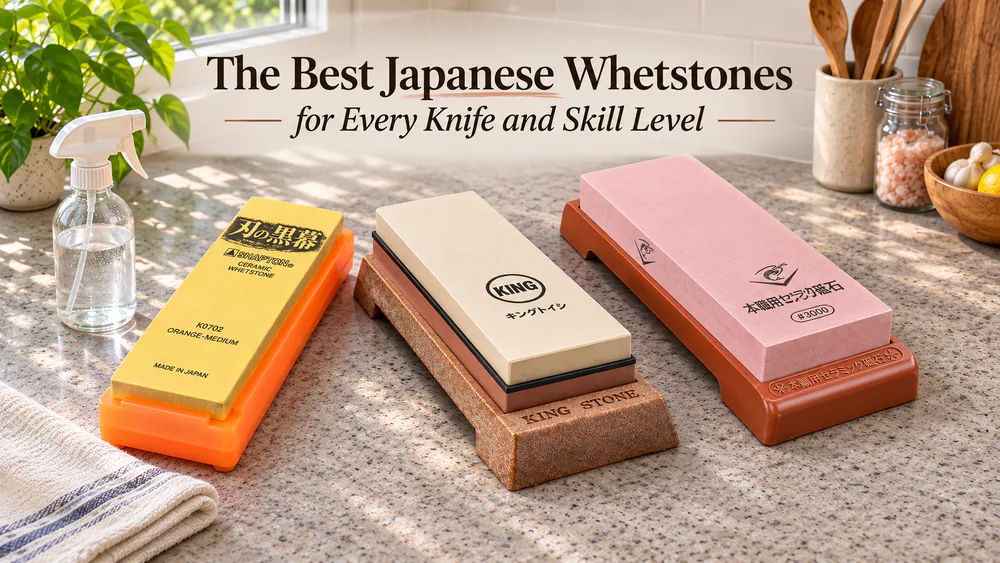
We compared Shapton, King, Naniwa and Suehiro stones on cut speed, feel, flatness and cleanup, with VG-10 Japanese knives and older German stainless in mind. Three stones came out ahead. The Shapton Pro Kuromaku #1000 is our best overall pick, the King KW65 1000/6000 is the best first stone, and the Shapton Kuromaku #5000 is the finisher we would buy.
Most home cooks do not need a drawer full of stones. A two-stone kit, one medium and one fine, covers nearly every kitchen. If you are weighing stones against a pull-through gadget, our guide to knife sharpeners covers the other options, and this page stays on Japanese whetstones.
Comparison Table: Grit, Soak Needed, Size, Best For
The table covers every stone we reviewed in full. Price tiers are relative, so check the current listing before you buy.
Stone
Grit
Binder/type
Soak needed
Size
Best for
Price tier
Shapton Pro Kuromaku #1000
1000
Ceramic
Splash-and-go
8.3 x 2.8 inches
Everyday sharpening
Mid-priced
King KW65
1000/6000
Soft waterstone
5-15 minutes
About 8 by 2.5 by 1 inches
First-time sharpeners
Budget
Naniwa Chosera
400, 1000, 3000
Professional waterstone
Splash-and-go
210 x 70 x 25 mm
Premium mid and fine work
Splurge
Suehiro Cerax
1000 or 6000
Traditional waterstone
5-15 minutes
Check the listing
Freehand feel
Check the listing
Shapton Kuromaku #5000 / #8000
5000, 8000
Ceramic
Splash-and-go
210 x 70 mm
Finishing and polish
Premium
Naniwa Chosera #400
400
Professional waterstone
Splash-and-go
210 x 70 x 25 mm
Chips and reprofiling
Splurge
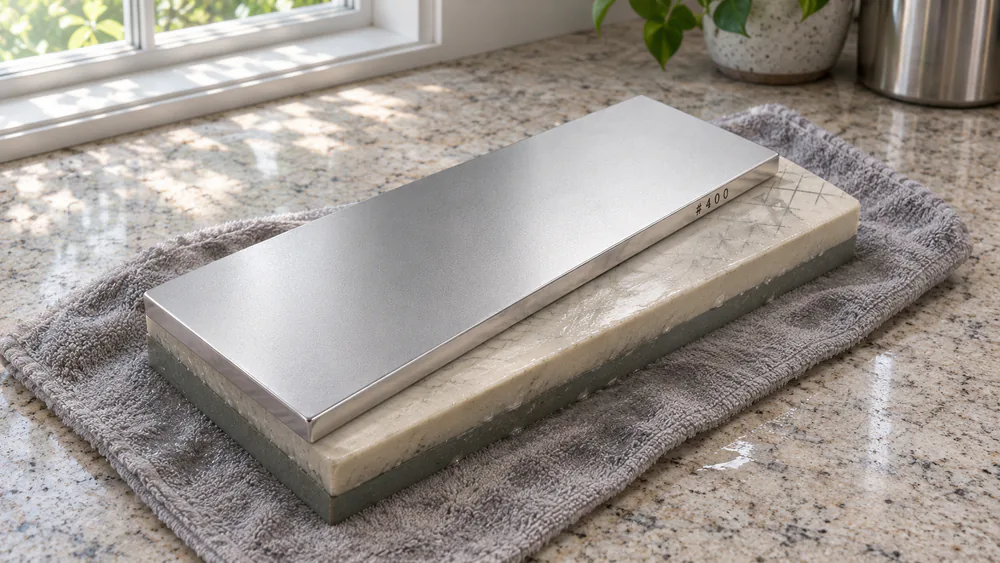
Atoma 400
400
Diamond plate
None
8 x 2.77 inches
Flattening stones
Premium
How We Rate These Whetstones
We score each stone on four things: how fast it cuts, how it feels under the blade, how long it stays flat, and how much work cleanup takes. Cut speed decides whether a stone earns a place in a busy kitchen, and feel decides whether a beginner can learn on it.
Each pick has to work on both harder, thinner Japanese VG-10 gyuto and petty knives and softer, older German stainless blades. We also weigh how evenly a stone wears, how it rinses and how it behaves wet, because a stone that dishes quickly or clogs is a chore to keep.
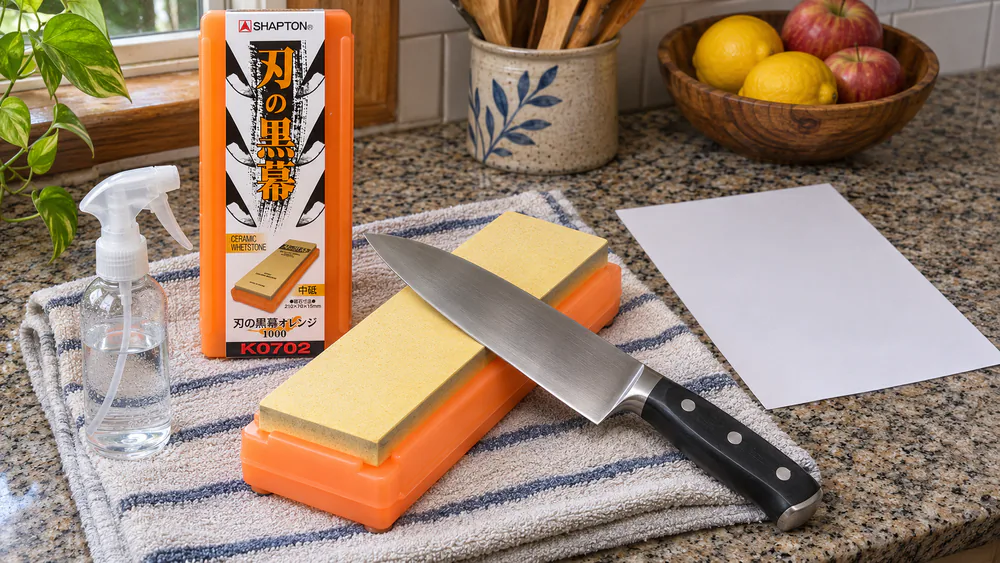
The basic kit: stone, spray bottle, and a sheet of paper to check the edge.
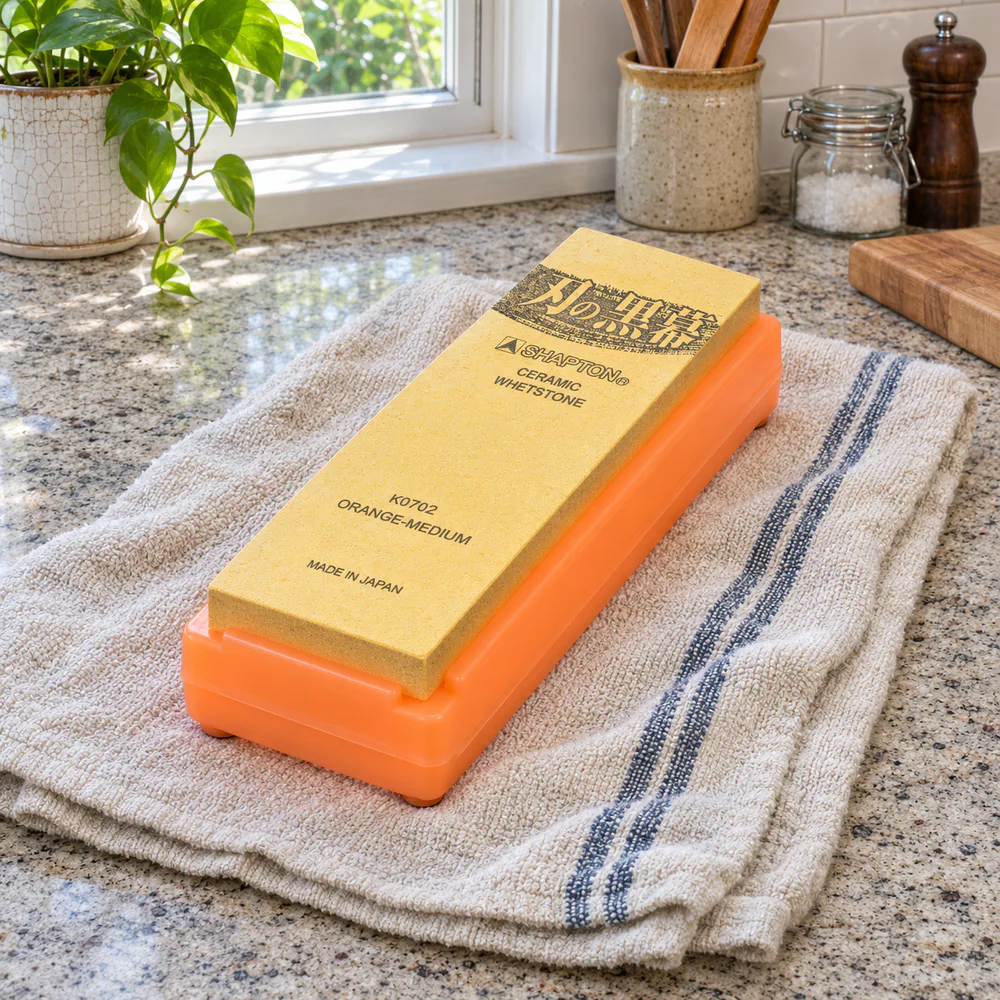
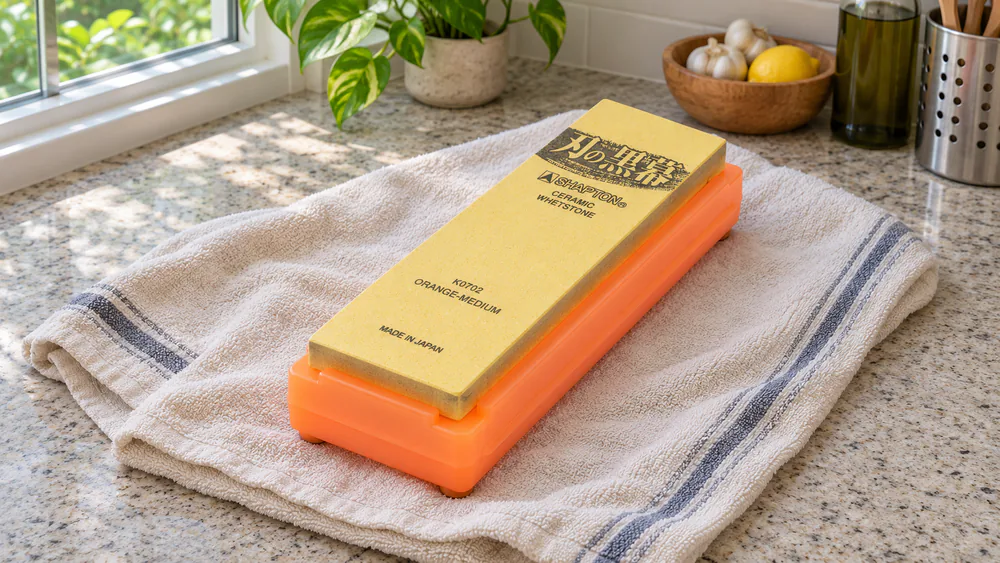
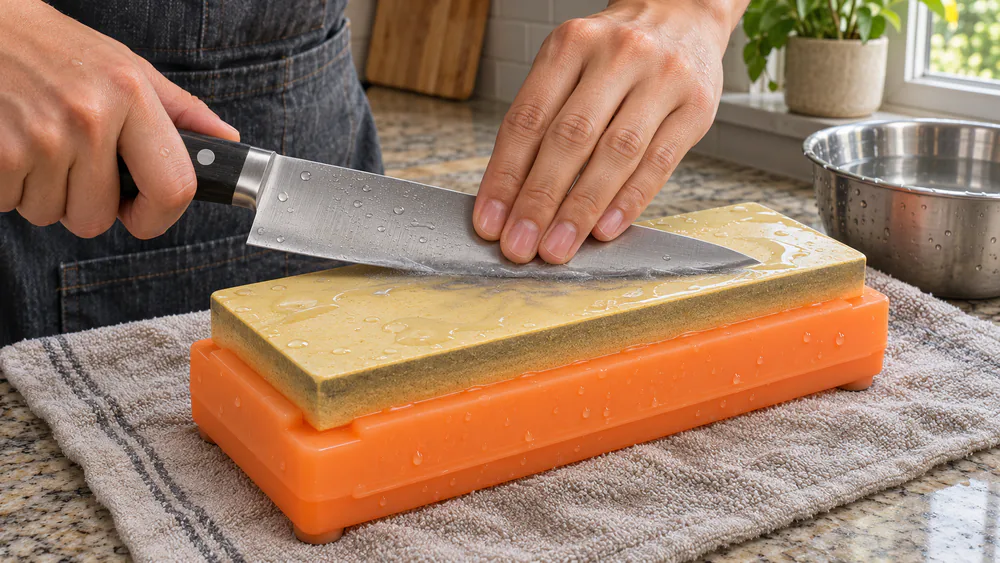
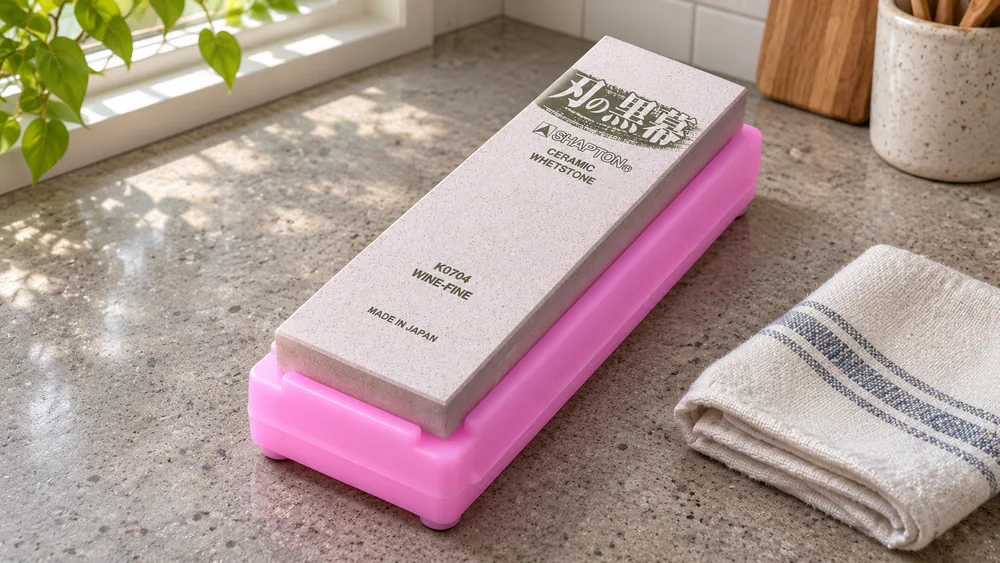
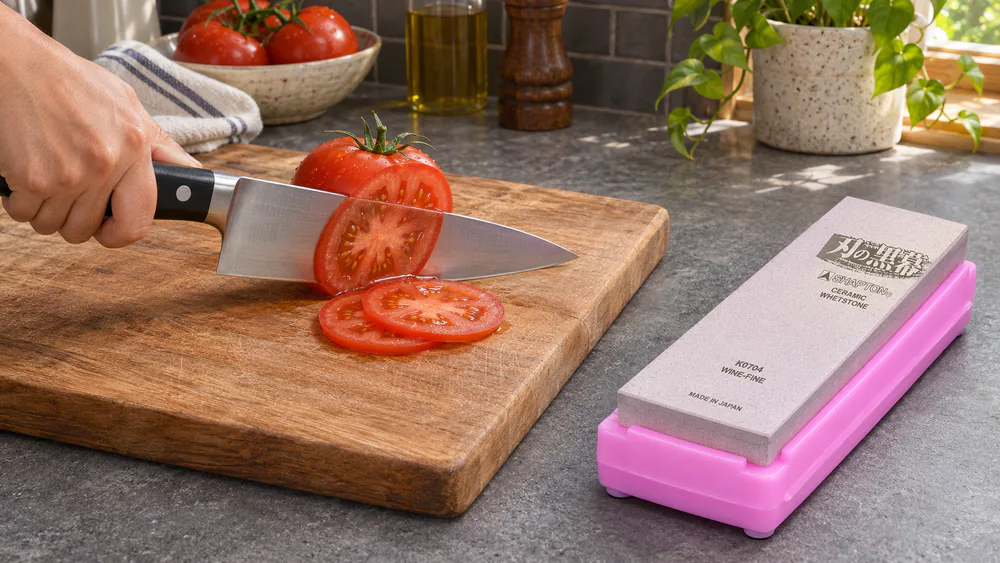
The Shapton #1000 is dense and hard, and it has a learning curve. Once the feel clicks, the edges come up very sharp on thin-skinned tomatoes and onions. It suits both older German steel and Japanese VG-10 type steel.
Pros
Cuts quickly and keeps cutting
Splash-and-go, no soaking
Works on both Japanese and German steel
Steel marks rinse off with water
Cons
Firm feel with a learning curve
Packaging instructions are in Japanese only
Mid-priced, more than a basic King
Choose it if you want one stone that works for the whole knife block. It measures 8.3 x 2.8 inches, which is comfortable for a gyuto, and the thin ceramic stone survives a three-foot drop onto tile. Beginners should expect a few rough sessions, because it is firmer than a soft King.
2. King KW65 1000/6000 - Best Value Combination Stone
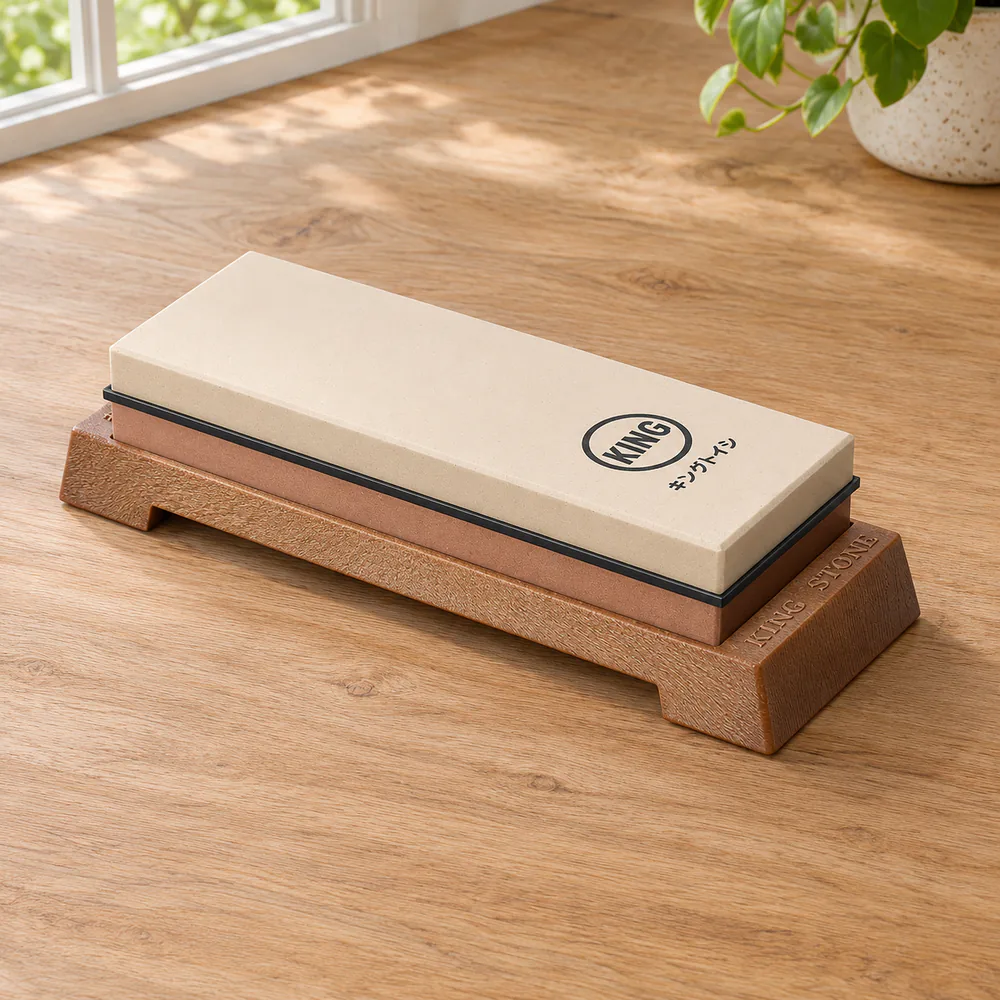
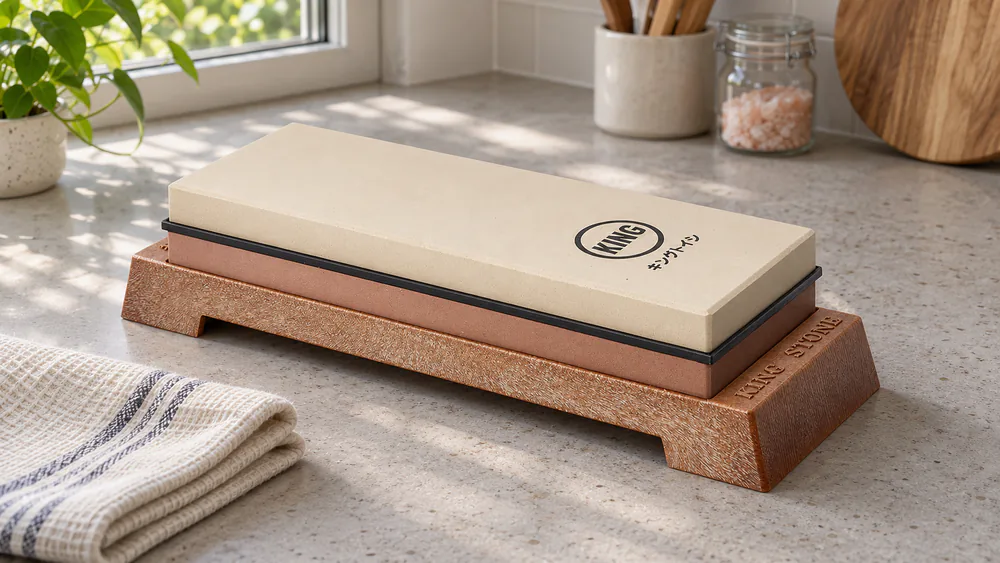
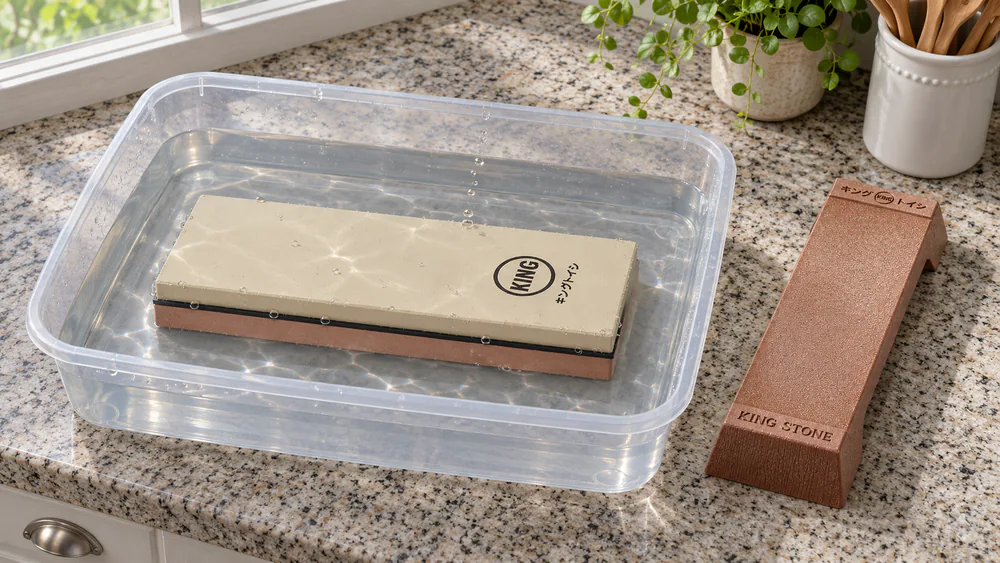
Unlike the firm Shapton, the King is the stone we hand to someone who has never sharpened. A ten-minute session puts a working edge on a VG-10 gyuto and a petty knife. The 1000 side does the cutting and the 6000 side tidies the edge, so one stone covers a basic routine.
Pros
Two grits on one stone
Soft and forgiving for beginners
Budget price tier
Cons
Needs a 5-15 minute soak
Messy slurry
The 6000 side feels less consistent than the 1000
Can chip with rough handling
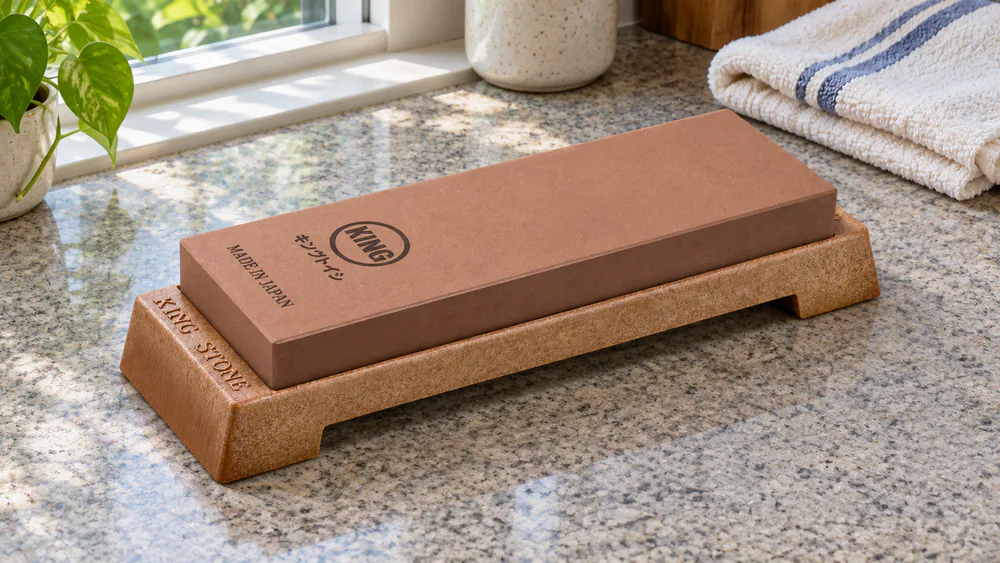
It sits on a plastic base at about 8 by 2.5 by 1 inches. Its soft surface dishes sooner than harder stones. The estimate of 20-30 sharpenings between flattenings is only a rough guide; steel and pressure affect that interval. Handle it gently, since a side can chip or crack. We think that is a fair trade for what it costs.
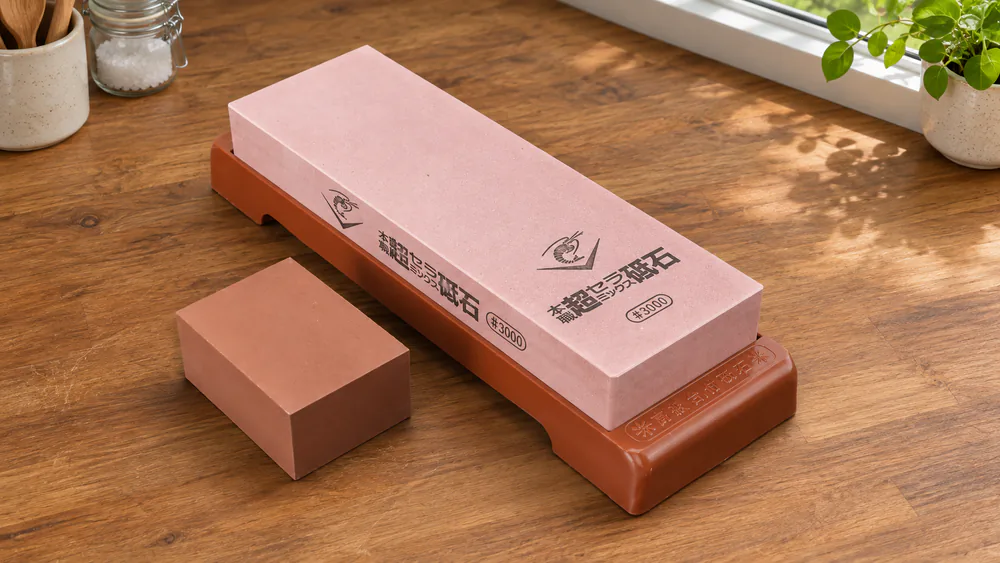
Where the King is soft, the Naniwa Chosera is a refined stone. The Chosera line is sold in #400, #1000 and #3000, and we went with the #3000 because that is where it shines. It polishes well above its stated grit while keeping enough bite for tomato skin, and it cuts about five times faster than an Arkansas stone.
Pros
Splash-and-go, no mud
Resists dishing
Polishes well above its stated grit
Loads up slowly
Cons
Splurge price tier
Needs air drying after use
Can arrive cracked, so inspect it
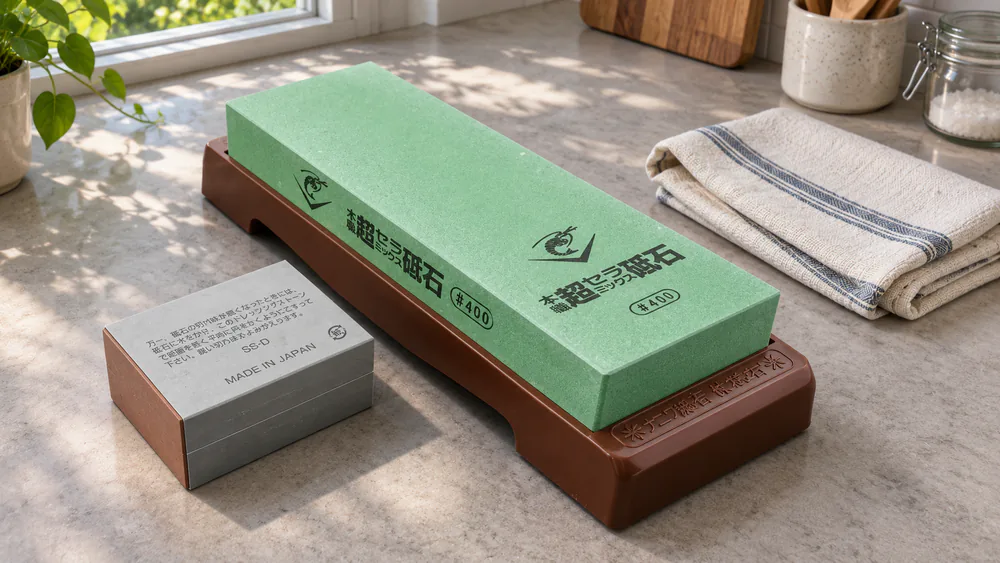
It arrives as a 210 x 70 x 25 mm stone with a base and a small dressing stone. Naniwa advises against soaking its Professional stones, so just splash and sharpen. Inspect yours when the box arrives, since Chosera stones can crack. We did not find a #800 listing, so the #1000 and #3000 are our picks from this line.
4. Suehiro Cerax 6060 #6000 - Best Feel for Freehand Sharpening
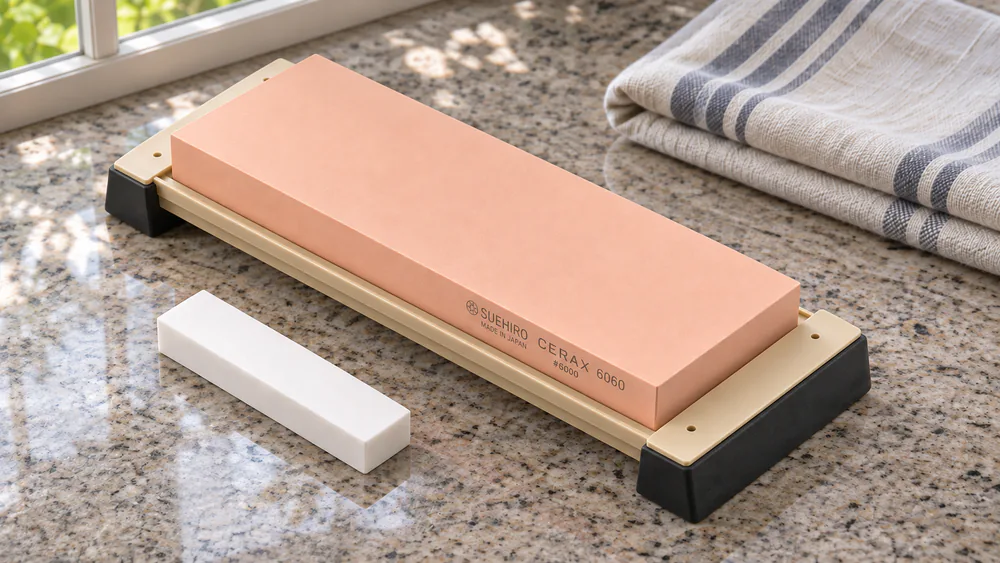
The limit comes first: the Cerax #6000 barely moves a dull edge, so it is a refiner, not a repair tool. Beyond that, it is the stone to buy if you care about how sharpening feels. It is a traditional soaking stone (5-15 minutes in water) with a creamy, consistent slurry, and after a #1000 session it leaves an edge that glides through tomatoes.
Pros
Creamy, consistent feel
Leaves a fine edge that glides through tomatoes
Good for learning slurry control
Cons
The #6000 barely moves a dull edge
Soaking stone
Hard to find as a single listing
This entry refers to the Suehiro Cerax 6060 #6000, which measures 205 x 73 x 23 mm; the buy button opens a search, so confirm that model before ordering. If you want one stone to start from scratch, buy the King or the Shapton. The Cerax earns its place once you already have a medium stone and want a nicer second step.
5. Shapton Kuromaku #5000 and #8000 - Best Finishing Stone
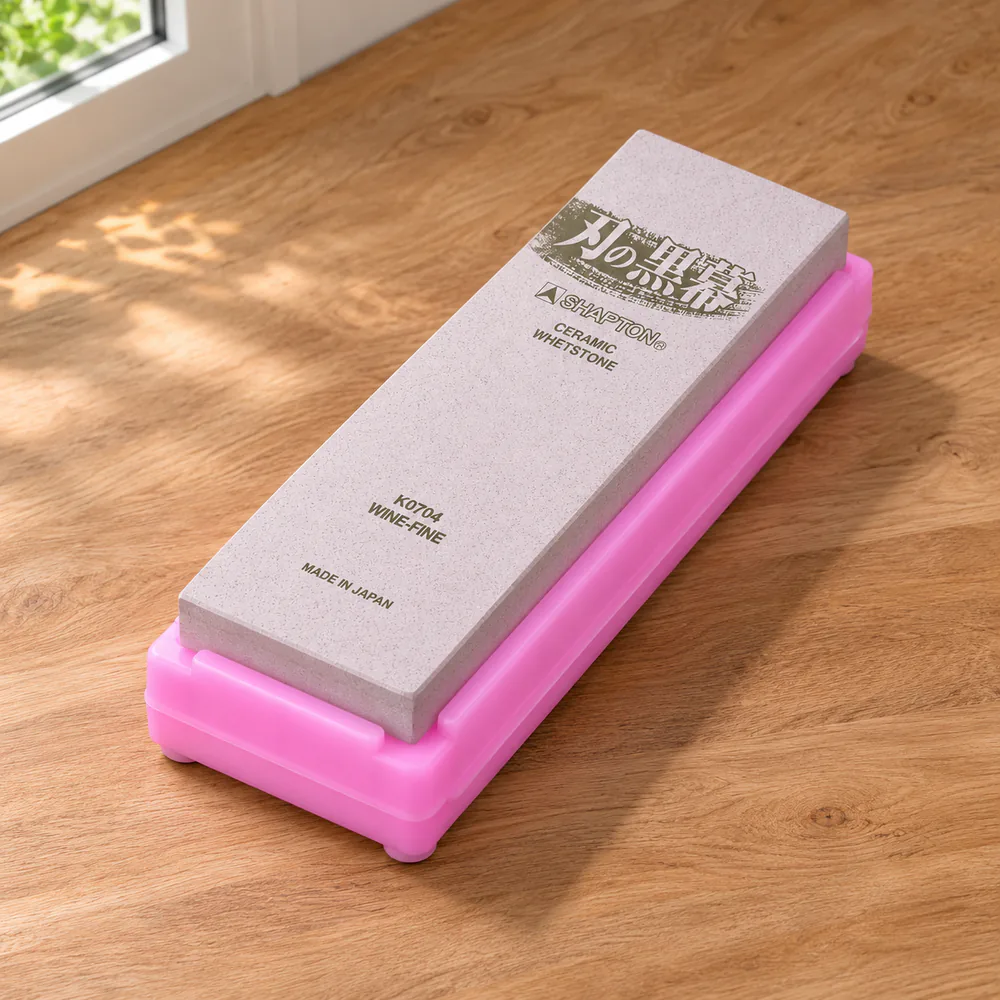
Start on a #1000, then use a few light strokes on the #5000. Finishing stones refine an edge; they do not restore a dull knife. These are the Kuromaku (Pro) line, not Shapton Glass, and both are 210 x 70 mm.
Pros
Forgiving for a finishing stone
Mirror finish
The #8000 tunes up a knife in minutes
Cons
Premium price tier
Does not repair dull knives
The #8000 is a luxury for most home cooks
The #5000 is the forgiving one and gives a mirror finish. The #8000 (the Melon stone) has a smooth finish like a natural stone and tunes up a knife in minutes, but it pays off mainly for a hard, fine-grained steel. If you only buy one, make it the #5000.
6. Coarse Repair Stone (#220-400) - Best for Chips and Reprofiling
6
Naniwa Chosera #400
4.3
A coarse stone for chips and reprofiling. Choose it over a diamond plate if you want the same splash-and-go feel as the rest of the Chosera line.
A coarse stone does the heavy work, such as fixing a chip or changing a bevel. The Shapton #320 is also a strong reprofiling stone for very dull knives, and a #320 Kuromaku exists if you prefer the Shapton line. Most cooks need a coarse stone once every year or two, so do not overbuy.
7. Budget or Travel Pick
7
King K65 #1000 single-grit stone
4.0
A budget way to get a #1000 in your hands if the KW65 is out of stock. The King K65 #1000 is the specific single-grit option shown here; we did not test it, and the buy button opens search results.
The King KW65 is already our budget pick, so treat this entry as a backup. A budget stone should be soft, forgiving and cheap, which is the King recipe.
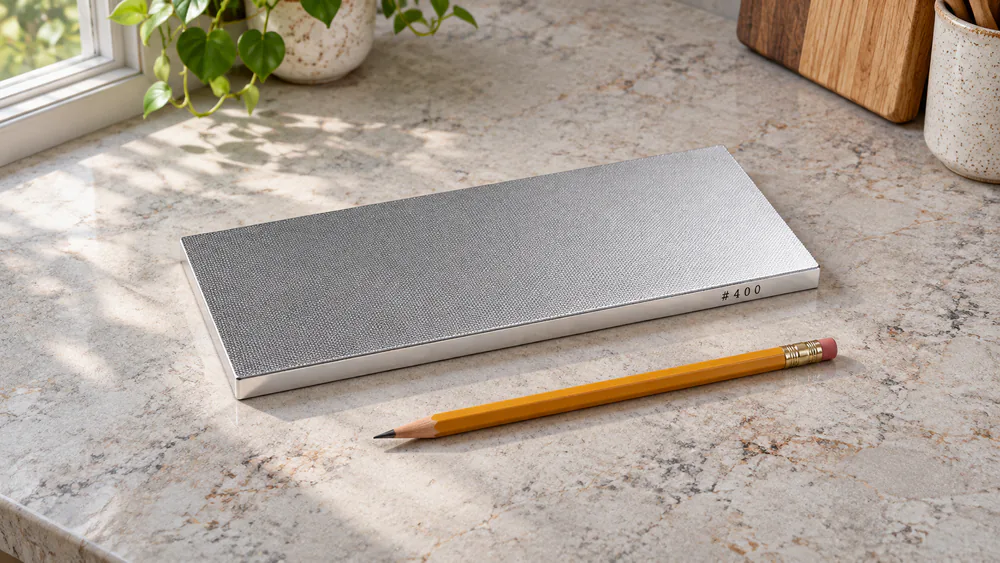
Stones dish with use, and a dished stone grinds a curved edge, so flatten every few sessions. The Atoma #400 flattens ceramic stones effectively and cuts fast. It also handles waterstones. Harder Naniwa stones can go months between flattenings, while a soft King needs the plate more often. Cheaper flattening stones exist, so this one is a premium choice.
A pencil crosshatch shows when the stone is flat again.
How to Choose a Japanese Whetstone
Start with the knife, then pick the grit. A thin, hard Japanese blade rewards a good finisher. A softer German blade is happy with a medium stone and a light polish.
Size matters less than people think, but it is not nothing. A stone around 8 inches long gives a gyuto room to travel, so you can sharpen the full length of the blade without running off the end. A thin stone on a holder or base stays steady, and a wet towel under it keeps it from sliding. Whatever you buy, set it up on a stable counter where you can stand comfortably for ten minutes.
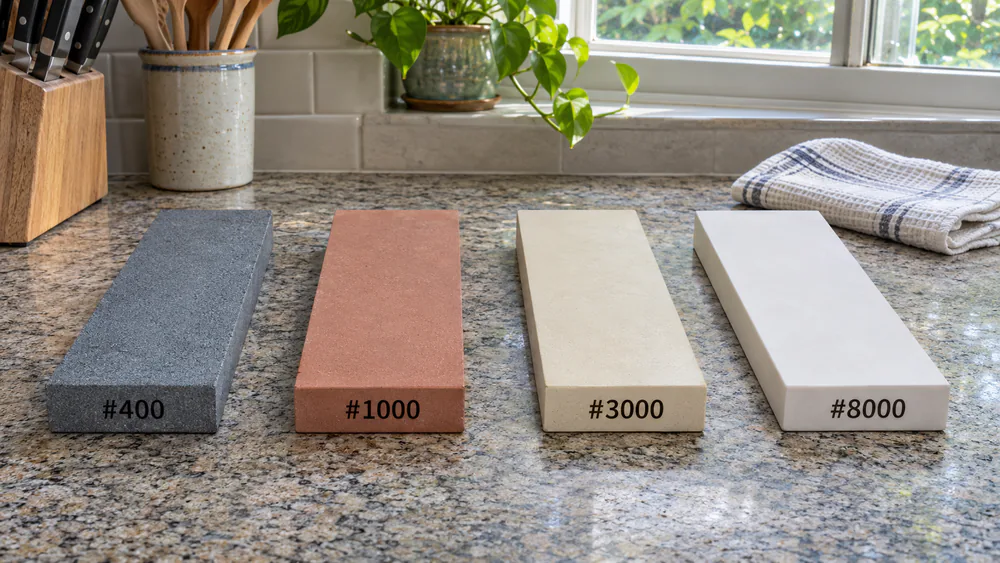
From coarse repair to fine polish, the grit order we use.
What grit do you need?
Grit comes in three working bands. Coarse stones run roughly #200 to #700 and repair chips or reshape a bevel. Sharpening stones run from #800 to #2000, and a #1000 is the sweet spot for everyday work. Polishing stones run from #3000 to #8000 and beyond, and they refine an edge you have already made sharp.
For a repair, a major reprofile starts at #100-200 and small repairs sit at #200-500. A #1000 handles general sharpening, and #5000 and above polish a hard steel.
Tip. Buy a #1000 first. Add a finisher around #5000 only when you are happy with the edge your #1000 leaves.
Soaking vs splash-and-go stones
Soaking stones, like the King and the Suehiro Cerax, need 5-15 minutes in water before use. They are soft and make plenty of slurry. Splash-and-go stones, like the Shapton Kuromaku and the Naniwa Chosera, need only a splash from a spray bottle. For a busy kitchen, splash-and-go is the easier habit.
The best whetstone is the one you will actually pull out on a Tuesday night.
Natural vs synthetic Japanese stones
Natural stones are cut from quarries around Kyoto and are sold by hardness and rarity. They give a lovely finish, but they vary a great deal and cost more. Synthetic stones are consistent and cut faster, which is why every pick on this page is synthetic. If you want a note on a natural rock, novaculite, the sedimentary rock behind Arkansas natural stones, is a good place to start.
Warning. Do not soak a stone that the maker says to keep dry. Naniwa advises against soaking its Professional stones.
Stone care is short. Rinse the stone and the knife after each session, wipe the steel marks off with plain water, and let the stone air dry before you put it away. Keep a spray bottle next to your stone, and flatten before the surface develops a visible dip. Check a new stone for cracks the day it arrives, because a stone that cracks on first use is much easier to return when you catch it early.
How to avoid overbuying
You can build a perfectly good kit from three items: a #1000, a finisher and a flattening plate. Skip the #220 stone unless you chip blades, and skip the #8000 until you love polishing. A combination stone is a cheap way to start if you are unsure, and it saves you from learning on a stone you will outgrow.
A good rule is to buy stones in the order you will use them. Many people buy a coarse repair stone first because it sounds serious, then never touch it. Others buy a high polish stone before they can hold a steady angle, and the finish is wasted. Learn on a medium stone until your edges look even under a bright light, and only then spend on a finisher. If a seller bundles five stones, a case and a guide into one kit, ask which grits you will actually use. In most kitchens that is two.
Frequently Asked Questions
What grit whetstone should a beginner buy first?
A #1000. It cuts fast enough to restore an edge and fine enough for kitchen work. The King KW65 gives you a #1000 and a #6000 on one stone.
What should I do if my whetstone cracks?
Check a new stone the day it arrives and return it if a crack shows. A stone that cracks on first use is easiest to return when you catch it early. Do not keep sharpening on a split stone.
Do I need a nagura or stone fixer?
Not for the stones on this page. The Naniwa Chosera ships with a small dressing stone, and a flattening plate such as the Atoma handles the rest.
Is a Japanese whetstone worth it over a pull-through sharpener?
If you like your knives, yes. A whetstone lets you control the angle and the finish, and a pull-through gadget removes more steel for a coarser edge.
Does the sharpening angle matter more on a whetstone than a pull-through?
Yes. A pull-through fixes the angle for you, while a whetstone leaves it to your hand. That control is why a whetstone gives a finer edge, and why steady angle practice on a medium stone comes before a finisher.
Final Verdict: Which Whetstone to Buy
Match the stone to how you sharpen. A hard, thin Japanese blade will show you every difference between stones, so it justifies a finisher sooner. A softer German knife does fine on a #1000 and a few light passes on a #5000. If your budget is tight, the cheapest sensible kit is the King and a flattening stone, and you can swap in the Shapton later. If you want a stone that gets out of the way, buy the Shapton #1000. If you are not sure you will stick with it, start with the King. Add a Kuromaku #5000 once you are satisfied with the edges from your #1000. Buy the Atoma when the stone starts to dish.