Helping you create a kitchen you love.

Knives & Cutlery

Best Manual Knife Sharpeners: 8 Picks for Every Kitchen

As an Amazon Associate we earn from qualifying purchases. We may earn a commission from links on this page, at no extra cost to you. Learn more.

Best Manual Knife Sharpeners: 8 Picks for Every Kitchen

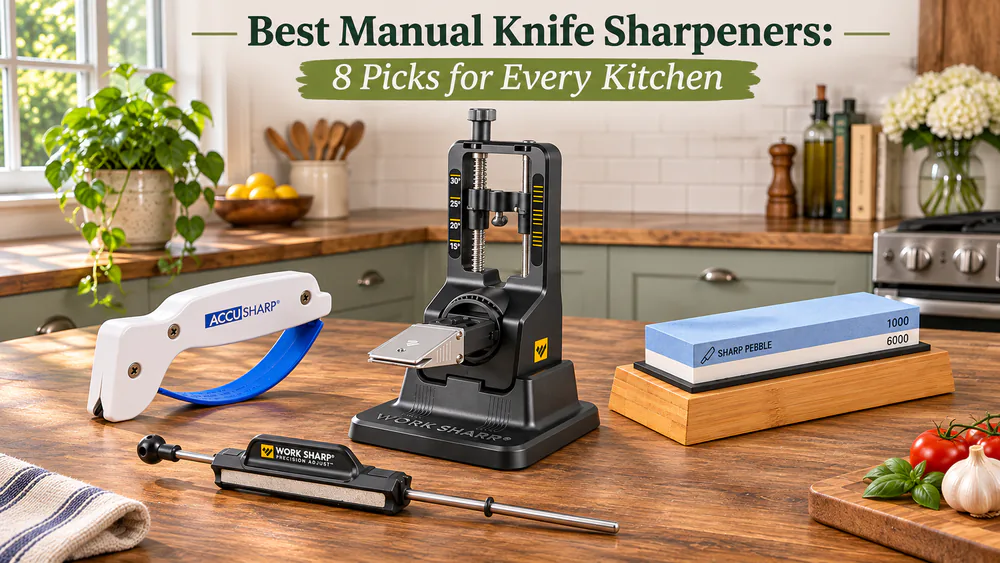
The dull knives that reach a sharpening counter all tell the same story. A tomato skates across the skin, an onion crushes instead of slicing, and the cook has been pressing harder for months without noticing. We judge every sharpener by the edge it leaves behind, so that is how we ranked these eight, and our top pick is the Work Sharp Precision Adjust.

Here is how we rate them: each sharpener is scored on the edge it leaves, how much skill it asks for, and how safe it feels in the hand.

Manual sharpeners need no outlet, take up little space, and remove far less steel than a grinder. They also range from a ten-second pull-through to a whetstone that rewards patience. If you want every option in one place, our knife sharpener reviews cover the wider field.

Our Top Picks at a Glance

RankProductBest forTypeRatingBuy
1

Work Sharp Precision Adjust

Best Overall
Matching a knife's original angle Guided, 15-30 degrees 4.7 View on Amazon
2

AccuSharp

Best Budget
Fast touch-ups on workhorse knives Hand-held carbide 4.5 View on Amazon
3

Sharp Pebble Whetstone Kit

Best for Beginners
Learning whetstones Whetstone, 1000/6000 4.4 View on Amazon
4

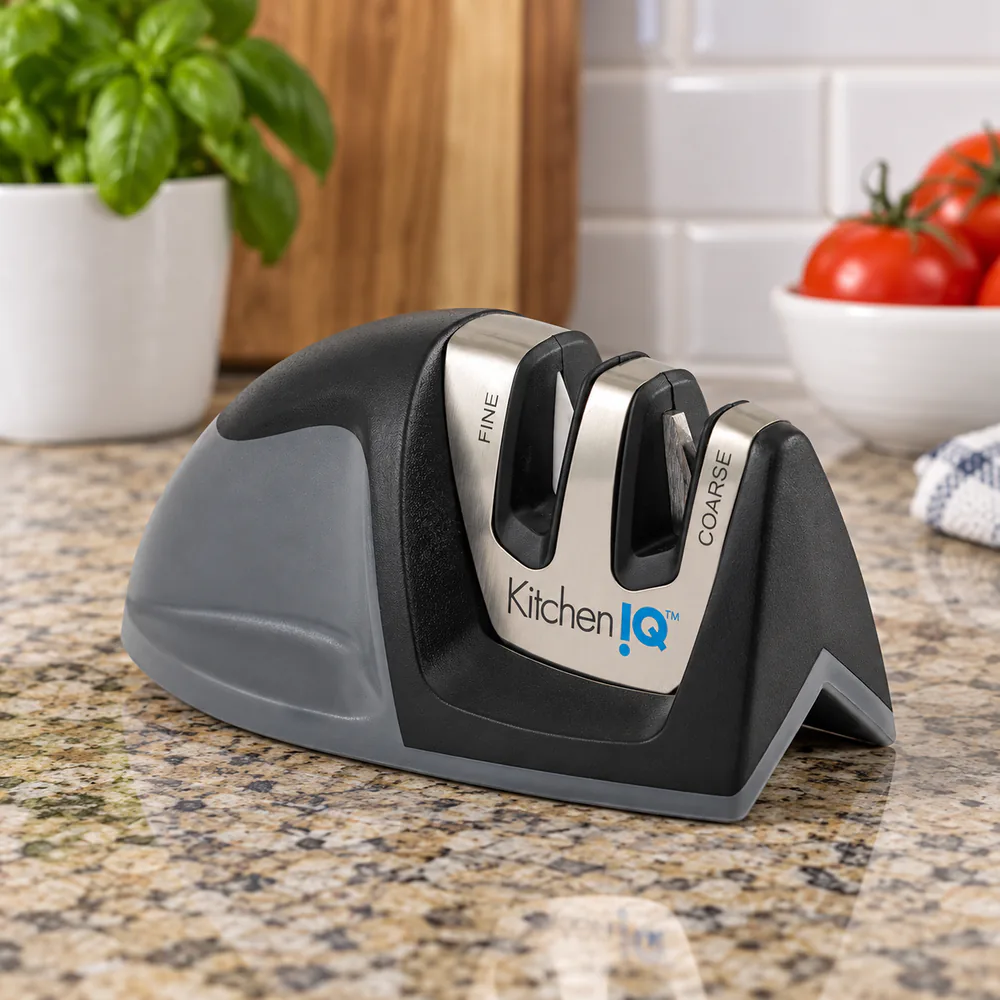
KitchenIQ Diamond Deluxe Edge Grip 2-Stage

Best Pull-Through for German Knives
Quick fixes on Western knives Pull-through, 2-stage 4.3 View on Amazon
5

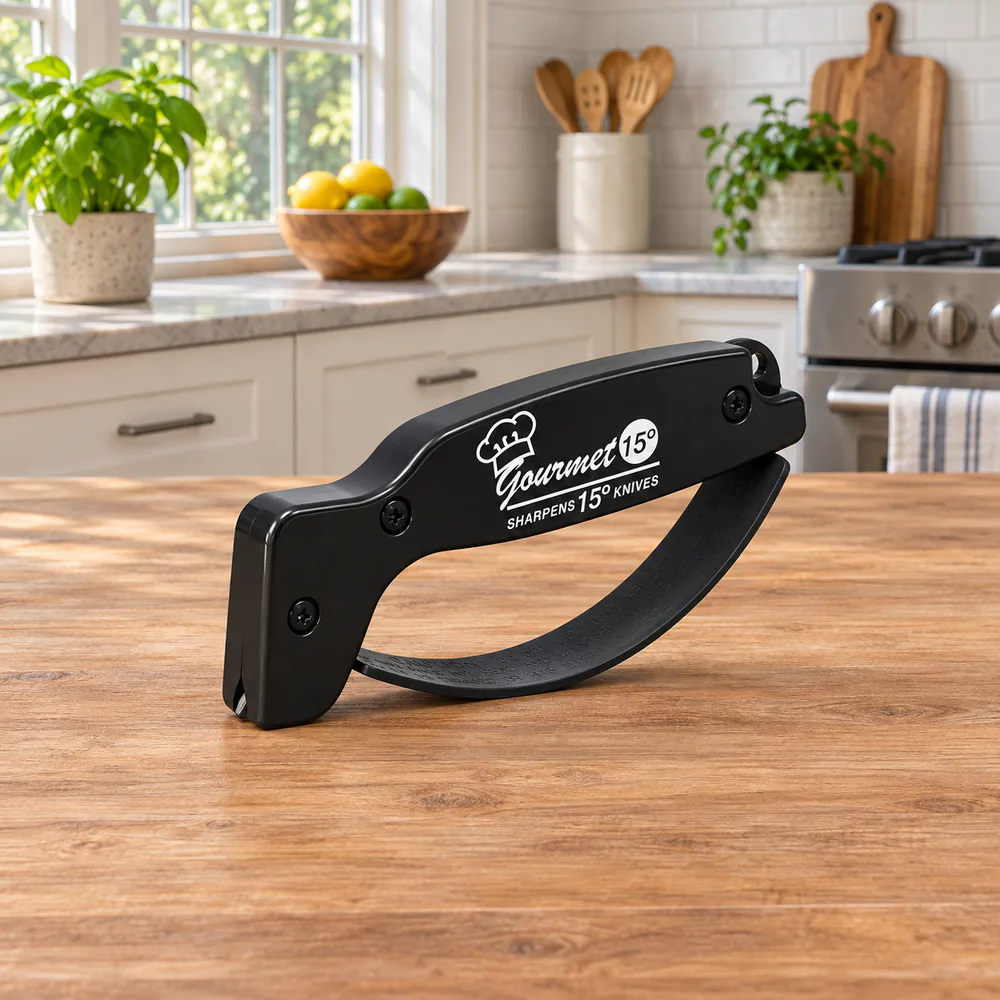
AccuSharp Gourmet 15-Degree

Best for Asian 15-Degree Knives
Japanese-style blades Hand-held, 15-degree 4.2 View on Amazon
6

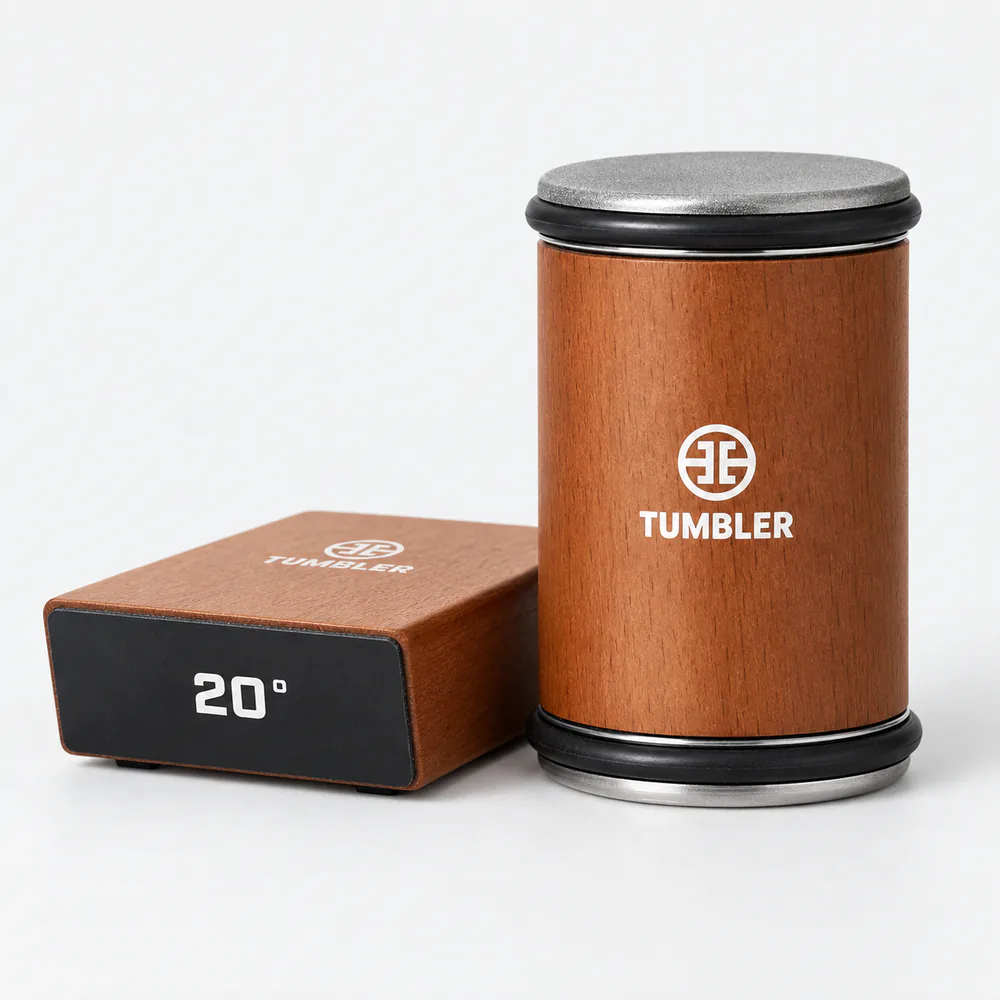
Tumbler Original Rolling Knife Sharpener

Best Rolling Sharpener
Foolproof angles on chef's knives Rolling, 15 and 20 degrees 4.2 View on Amazon
7

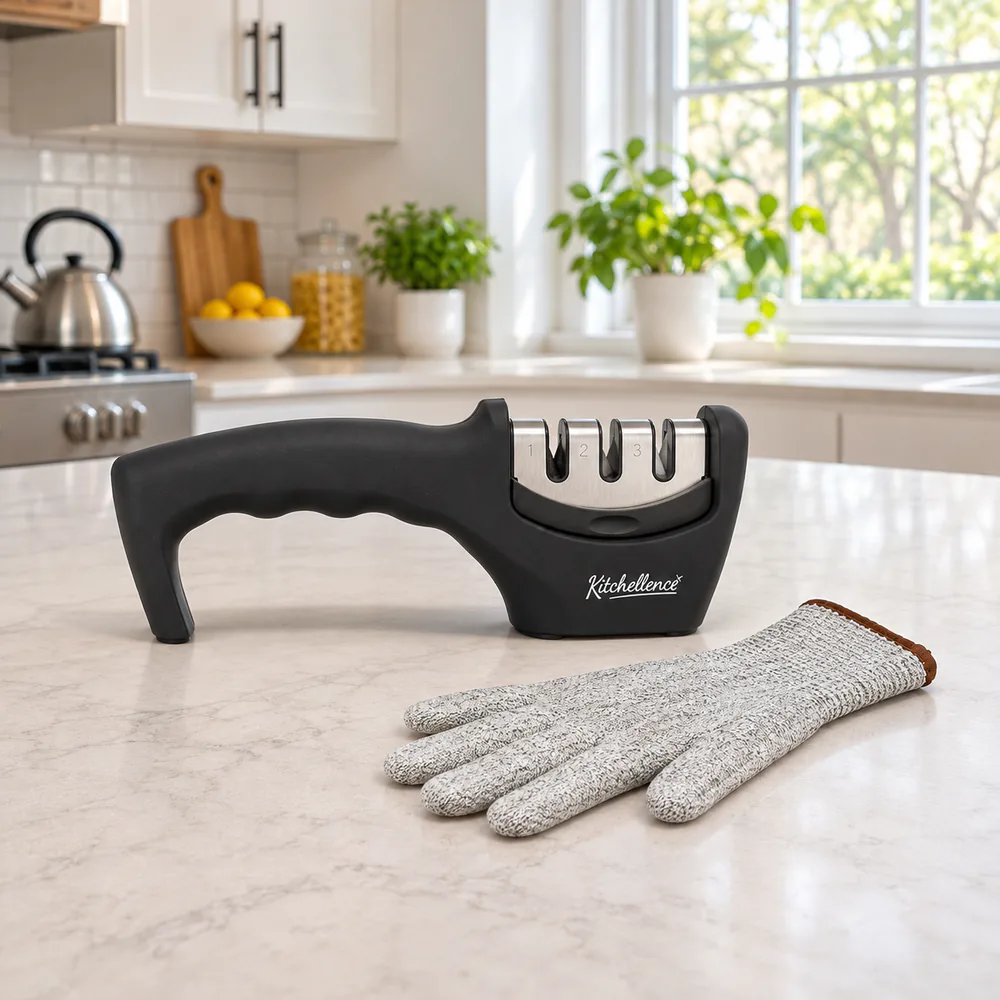
Kitchellence 3-Stage Knife Sharpener

Best Multi-Stage Pull-Through
Repair, sharpen and polish in one tool Pull-through, 3-stage 4.0 View on Amazon
8

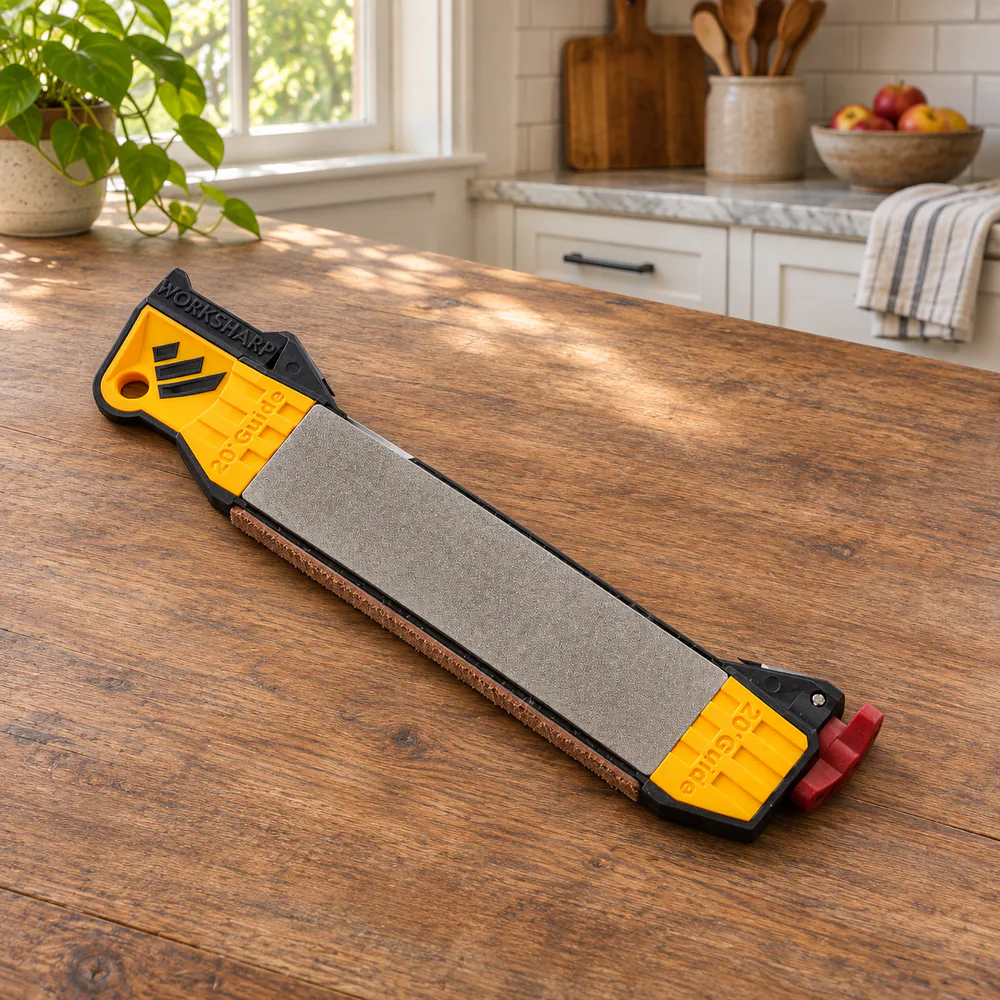
Work Sharp Guided Field Sharpener

Best Portable Sharpener
Pocket and utility knives Guided, 20 and 25 degrees 4.0 View on Amazon

We earn a commission if you make a purchase, at no additional cost to you.

See full comparison table

How We Tested

We rank sharpeners by the edge they leave, and we weigh how much skill each one asks for before that edge appears. Our scoring covers edge quality, how easy it is to hold the angle, safety for your fingers, stability on the counter, and how well each tool suits German, Japanese, or serrated knives.

We score the edge a sharpener leaves, not the number on the box. We also looked at what each sharpener asks of you afterward: soaking, flattening, cleaning, or nothing at all.

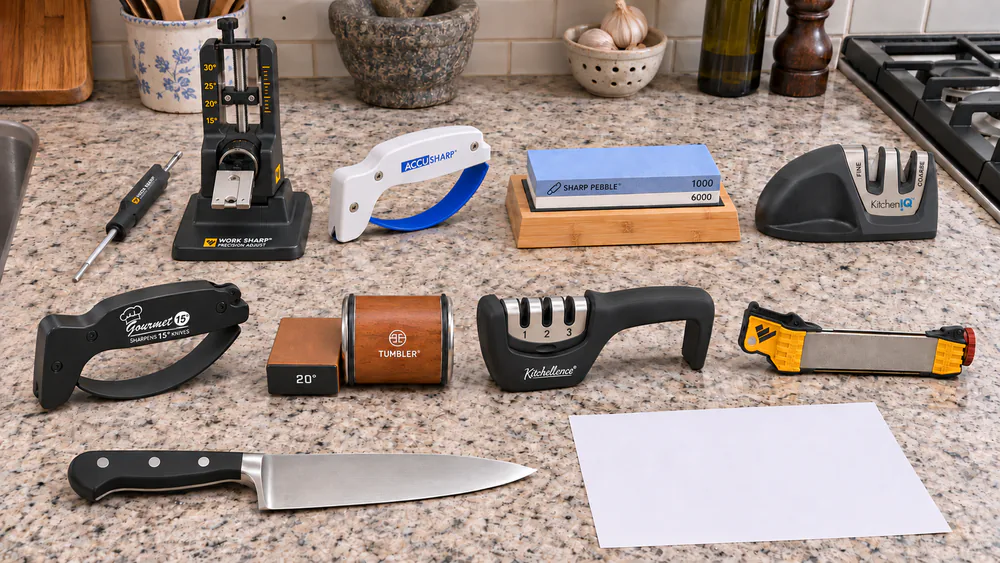
Eight manual knife sharpeners, from a whetstone to a rolling sharpener, lined up on a kitchen counter beside a chef's knife and a sheet of paper
All eight sharpeners we rank, lined up on a kitchen counter.

Tip. Test an edge before and after sharpening on the same sheet of paper. A clean, quiet slice tells you more than any spec sheet.

Quick Comparison Table

ProductTypeGrit / stagesAngleKnife typesOur rating
Work Sharp Precision Adjust Guided 3 abrasives 15-30 degrees German, Japanese, serrated 4.7
AccuSharp Pull-through (hand-held carbide) Single carbide blade Preset Straight and serrated 4.5
Sharp Pebble Whetstone Kit Whetstone 1000/6000 Freehand with guide German, Japanese 4.4
KitchenIQ Edge Grip Pull-through 2-stage Preset German, serrated touch-up 4.3
AccuSharp Gourmet 15 Hand-held carbide Single carbide blade 15-degree Japanese, 15-degree 4.2
Tumbler Original Rolling Diamond disc, steel hone, strop 15 and 20 Medium German and Japanese 4.2
Kitchellence 3-Stage Pull-through 3-stage Preset Straight, serrated touch-up 4.0
Work Sharp Guided Field Guided, portable 220/600 plus ceramic and strop 20 and 25 Small to mid, pocket 4.0

Best Manual Knife Sharpeners

Work Sharp Precision Adjust
1

Work Sharp Precision Adjust

Best Overall
Check Price on Amazon
4.7/5

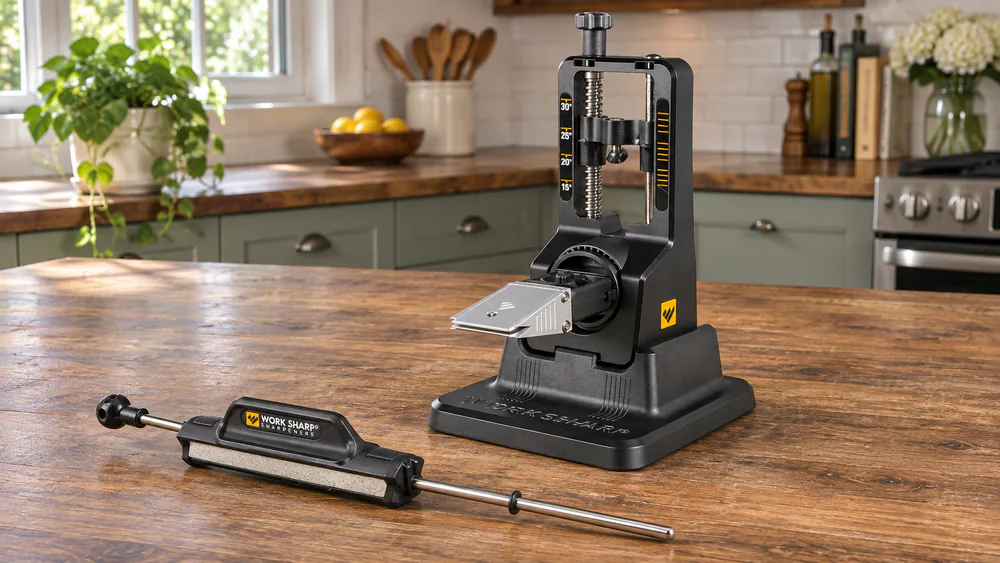
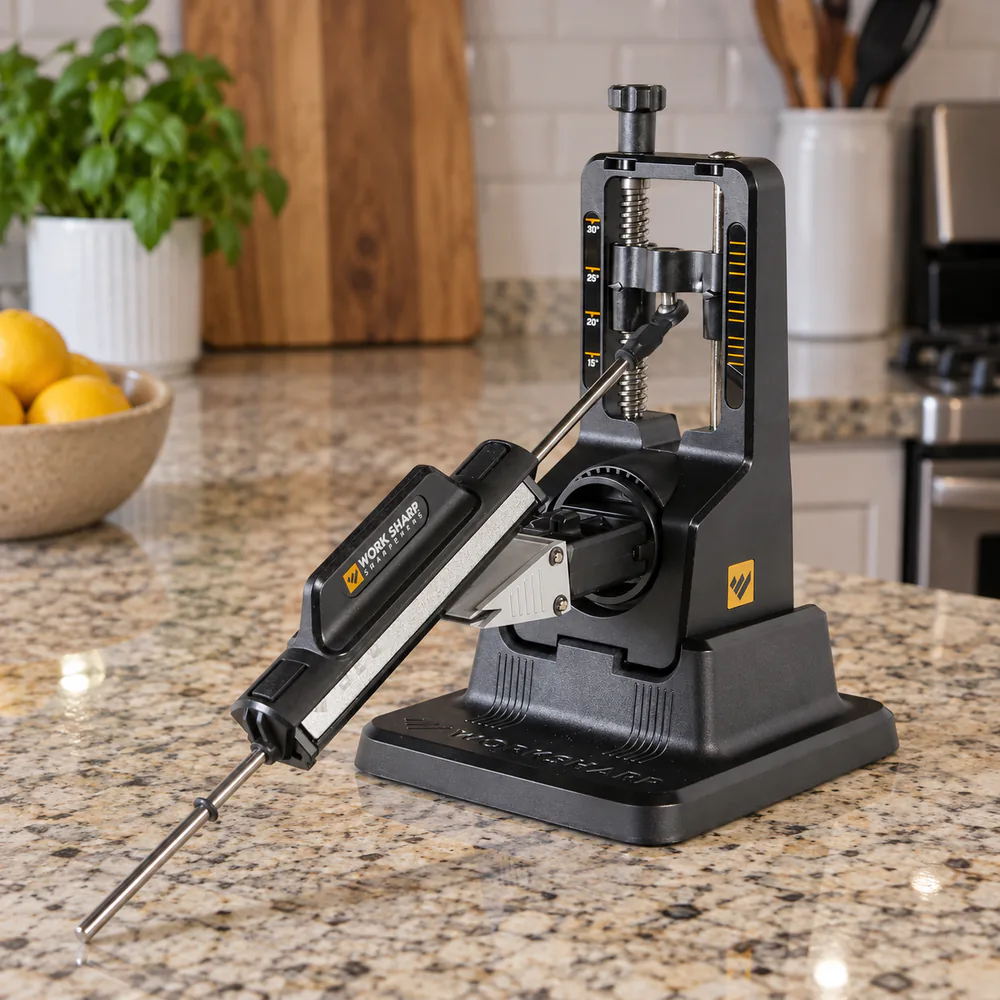
The Work Sharp Precision Adjust is the one we would buy first. It clamps the blade in a v-block and holds a fixed bevel, so a neglected chef's knife comes back to a clean, repeatable edge without any freehand skill. The angle adjusts from 15-30 degrees in 1-degree steps, which covers a Japanese gyuto and a German workhorse on the same jig.

Setup takes longer than a pull-through. You clamp the knife, set the angle, then index through three abrasives on a 3-sided rod: coarse diamond, fine diamond, and fine ceramic. That extra minute is the price of matching a knife's original angle, and it is the reason this is the sharpener we reach for when the knife matters. It also handles serrated blades. One caution: the angle scale is only approximate on thick or wide blades, so check the bevel by eye. The 3-year warranty is a nice vote of confidence.

Pros

  • Clamp holds a fixed bevel, so results repeat
  • Adjusts from 15 to 30 degrees for German and Japanese knives
  • Coarse diamond, fine diamond, and ceramic stages in one rod
  • Serrated-capable
  • 3-year warranty

Cons

  • Slower to set up than a pull-through
  • Angle scale is approximate on thick or wide blades
  • Premium tier, the most expensive guided pick here
AccuSharp
2

AccuSharp

Best Budget
Check Price on Amazon
4.5/5

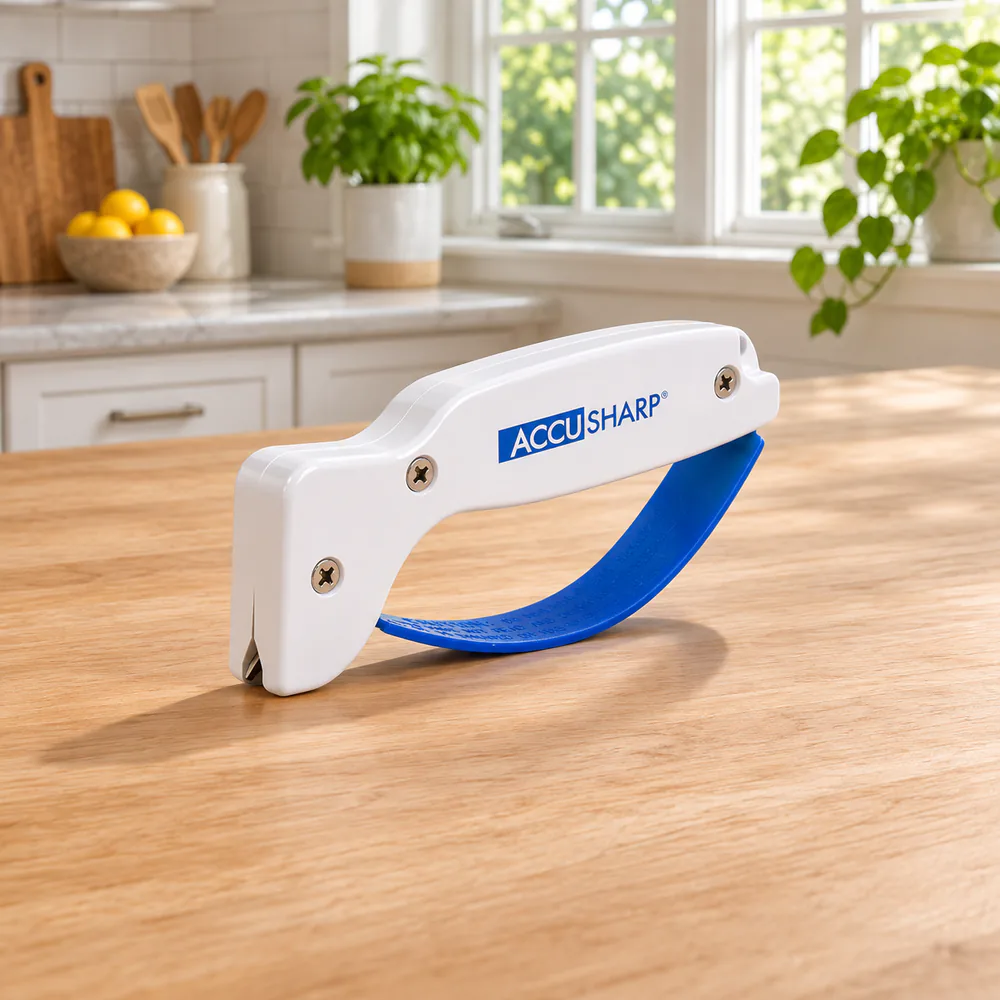
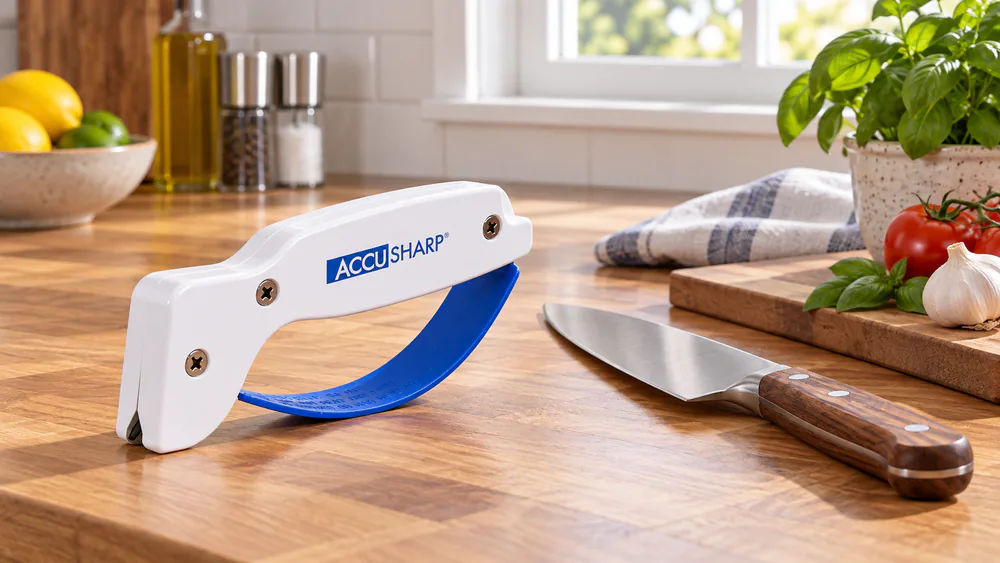
Where the Precision Adjust asks for setup, the AccuSharp asks for none. It is the cheapest pick here and still the one we hand to people who want no fuss. It pulls an edge back in seconds on tomato-skating knives, and the manufacturer says it sharpens most blades in around 10 seconds. The full-length finger guard keeps your fingers clear of the blade.

Its diamond-honed tungsten carbide blade reverses to double its life. To clean the sharpener, rinse it or put it in the dishwasher. It handles straight and serrated edges. We would keep it for workhorse knives rather than very fine or costly ones, because a carbide blade removes steel quickly. The compact head is awkward on small scissors and pruners, so do not count on it for garden tools.

Pros

  • Sharpens most blades in around 10 seconds
  • Full-length finger guard
  • Reversible carbide blade doubles its life
  • Dishwasher-safe
  • Cheapest pick in this roundup

Cons

  • Better for workhorse knives than very fine or costly ones
  • Compact head is awkward on small scissors and pruners
  • No angle control beyond the preset
Sharp Pebble Whetstone Kit
3

Sharp Pebble Whetstone Kit

Best for Beginners
Check Price on Amazon
4.4/5

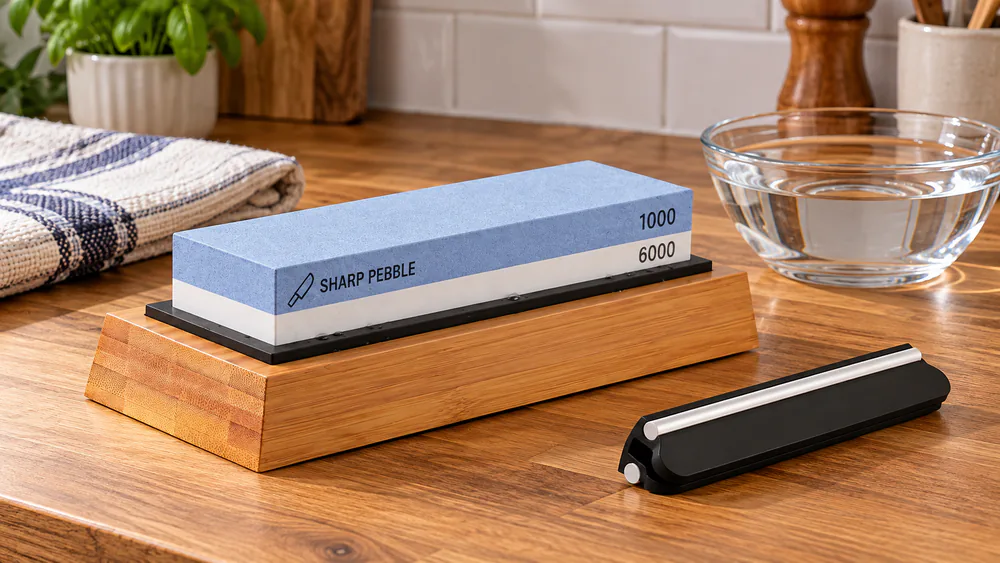
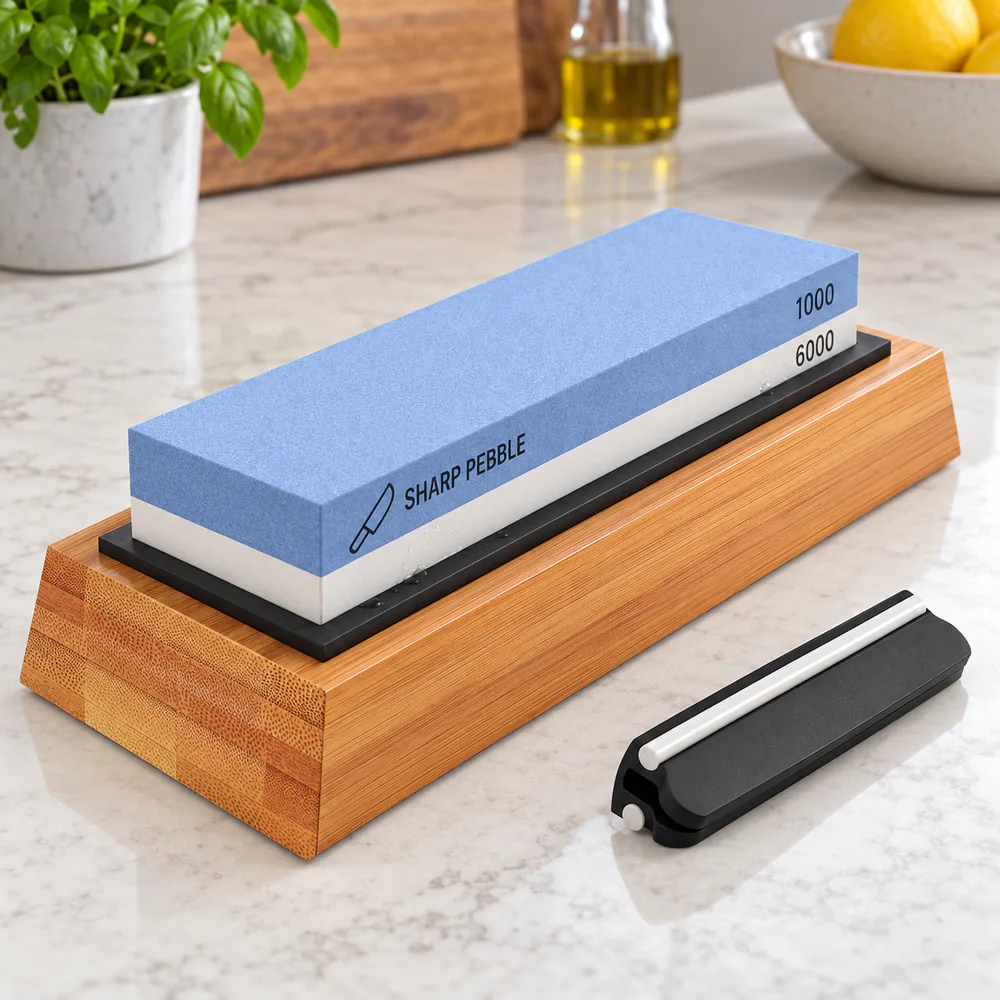
Where the AccuSharp trades finesse for speed, a whetstone does the opposite. It gives the sharpest edge of any manual tool, and the Sharp Pebble is the friendliest way in. The dual-grit 1000/6000 stone covers both jobs: the 1000 side restores a working edge and the 6000 side polishes it. The bamboo tray, gasket, and rubber base keep the stone stable and lift it high enough to protect your knuckles.

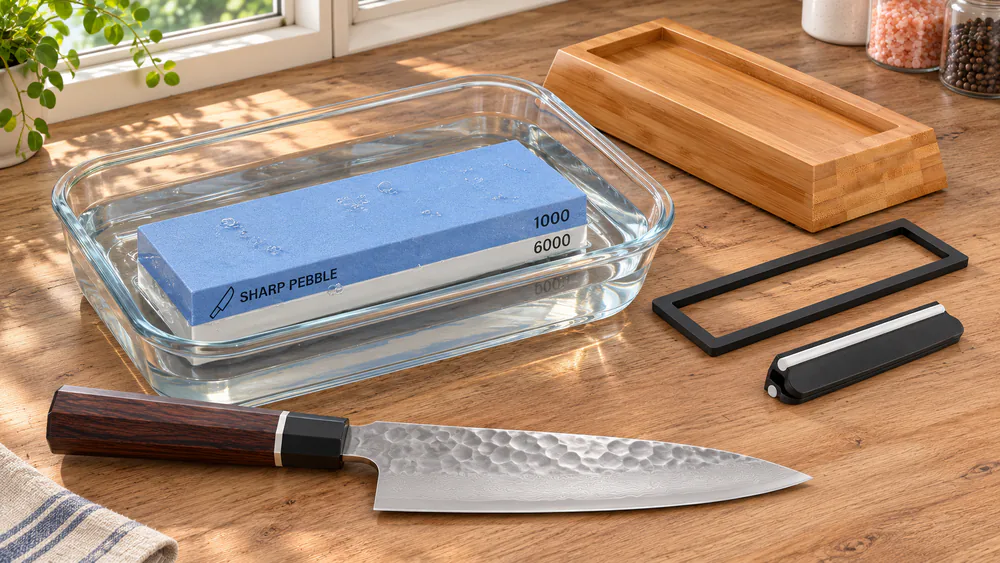
Be honest with yourself about the learning curve. Early passes come out uneven when the angle drifts mid-stroke, and the plastic angle guide does not lock onto thick blades like a cleaver. The stone also needs soaking before use, drying flat, and occasional flattening as it wears. That upkeep is the trade-off for a finer edge than any pull-through gives. The stone is water-based, so there is no honing oil to buy.

Pros

  • Dual 1000/6000 grit restores and polishes
  • Included angle guide helps first-timers
  • Bamboo base with gasket and rubber bottom stays put
  • Water-based, no honing oil
  • Finest edge of the manual types

Cons

  • Real learning curve; early passes can be uneven
  • Guide does not lock onto thick blades like cleavers
  • Needs soaking, flat drying, and occasional flattening
A dual-grit whetstone soaking in a shallow tray of water beside a Japanese chef's knife on a wooden counter
A whetstone wants a soak before every session.
KitchenIQ Diamond Deluxe Edge Grip 2-Stage
4

KitchenIQ Diamond Deluxe Edge Grip 2-Stage

Best Pull-Through for German Knives
Check Price on Amazon
4.3/5

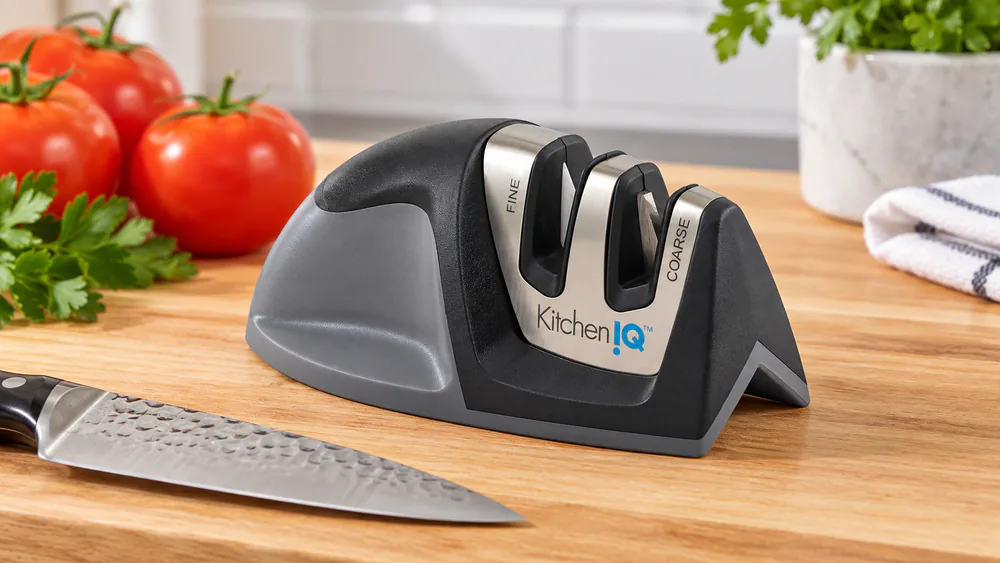
Where the Sharp Pebble asks for patience, the KitchenIQ asks for none, and it is our pick for German knives that need quick help. It is a 2-stage design: a diamond-coated coarse slot followed by a crossed ceramic fine slot, both at preset angles. You pull the blade through each slot a few times and you are done.

The V edge grip lets the sharpener sit on a counter edge so the blade tip clears the surface, and the non-slip base and soft-grip handle add control. It suits straight blades and light serrated touch-ups. A few pulls noticeably sharpen a standard chef's knife. The non-slip base steadies the tool on the counter, but its small body can be difficult to grip firmly. The manufacturer does not list grit values for either slot, so treat it as a maintenance tool, not a repair tool.

Pros

  • Two stages: diamond coarse, ceramic fine
  • V edge grip lets the blade tip clear the counter
  • Non-slip base and soft-grip handle
  • Budget tier
  • Straight edges and light serrated touch-ups

Cons

  • Preset angles only
  • No grit values listed
  • Better for maintenance than for very dull knives
AccuSharp Gourmet 15-Degree
5

AccuSharp Gourmet 15-Degree

Best for Asian 15-Degree Knives
Check Price on Amazon
4.2/5

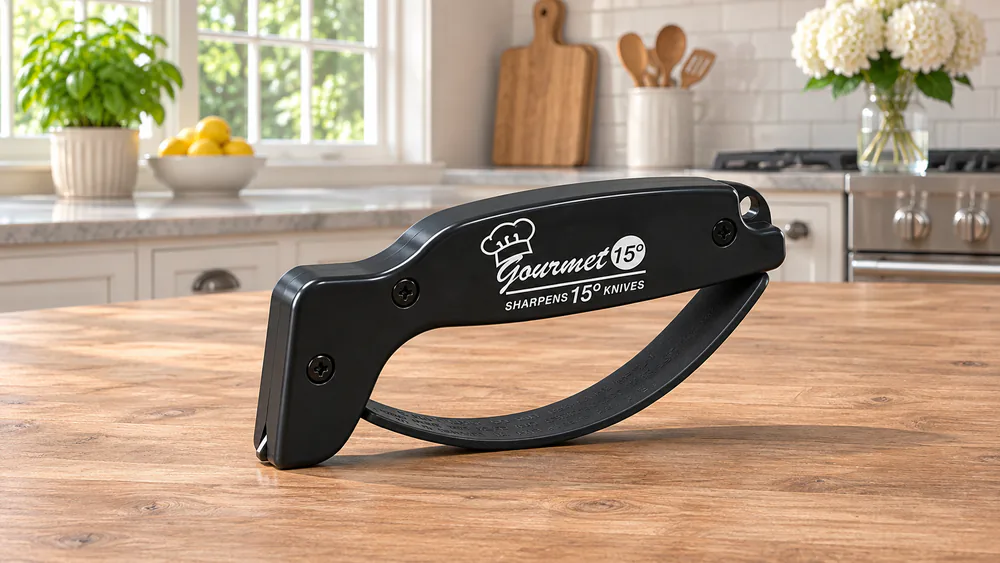
Japanese-style kitchen knives are typically ground to 15 degrees per side, while Western knives sit near 20. A sharpener with the wrong angle slowly rewrites the edge you paid for, which is why this 15-degree version of the AccuSharp exists. It has a fixed 15-degree sharpening angle made for gourmet and Asian-style knives.

The design matches the standard AccuSharp: a reversible diamond-honed tungsten carbide blade, a full-length finger guard, and a hand-held body that sharpens straight or serrated edges. If you own one or two Japanese knives and want a simple tool, this is the easy answer. In our kitchen's experience it restores a dull knife in roughly 30 seconds per blade with little effort. For a thin, hard blade you love, a whetstone is gentler.

Pros

  • Fixed 15-degree angle suits Japanese-style knives
  • Reversible carbide blade
  • Full-length finger guard
  • Straight or serrated edges
  • Budget tier

Cons

  • One angle only, so no use for 20-degree Western knives
  • Carbide removes steel quickly on fine blades
  • Hand-held, so you control the angle
Tumbler Original Rolling Knife Sharpener
6

Tumbler Original Rolling Knife Sharpener

Best Rolling Sharpener
Check Price on Amazon
4.2/5

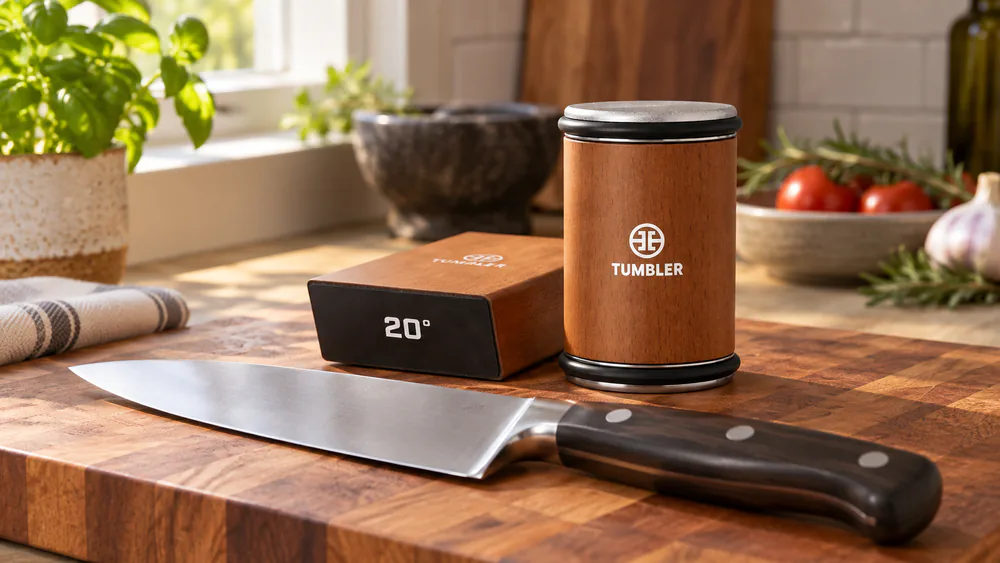
The Tumbler is nearly foolproof on medium chef's knives. Set the blade against the magnetic base at either 15 or 20 degrees, then roll the cylinder along the edge. One side is a diamond-plated disc, the other a stainless steel helix hone, and the kit adds a leather strop.

It does not reach quite the sharpest edge of the best traditional manual sharpeners, but it leads the other rolling sharpeners. The steel side removes the burr and the strop polishes. There are limits: small blades can hit the magnetic holder, very large blades are harder to manage, and very dull edges need extra passes. It is the priciest style in this roundup, so it earns its place only if the foolproof angle is the point.

Pros

  • Magnetic base locks 15 or 20 degrees
  • Diamond disc, steel hone, and leather strop included
  • Nearly foolproof on medium chef's knives
  • Best of the rolling sharpeners
  • Dual-sided base and display stand

Cons

  • Small blades can hit the magnetic holder
  • Very large blades are harder to manage
  • Very dull edges need extra passes
  • Splurge tier
Kitchellence 3-Stage Knife Sharpener
7

Kitchellence 3-Stage Knife Sharpener

Best Multi-Stage Pull-Through
Check Price on Amazon
4.0/5

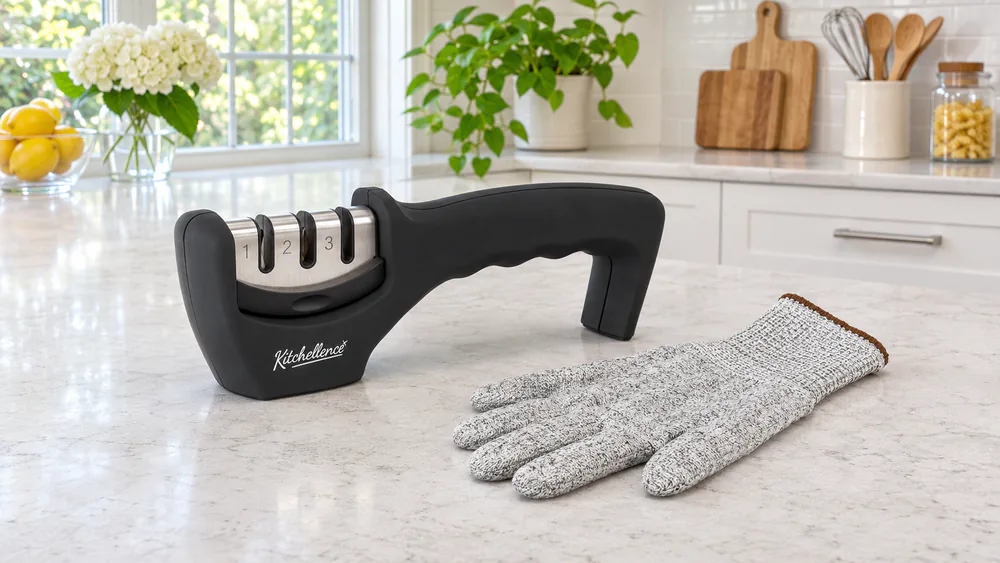
Step up from the KitchenIQ's two slots and you get the Kitchellence, a 3-stage pull-through: a diamond slot repairs a damaged edge, a second slot sharpens, and a third polishes. That repair-sharpen-polish order is what makes it a sensible multi-stage choice for straight kitchen blades.

The ergonomic handle and non-slip base make the tool easier to control with either hand, and a cut-resistant glove is included. A few strokes per slot restore a dull straight-edge knife, and the coarse, fine, and polish levels give a noticeably sharper edge. Durability is uneven, though, and a unit can wear badly or damage blades if forced. We would not buy it for true serrated knives. Pull-through slots reach serrations only partly, so serrated results vary by blade profile, and we treat it as a light touch-up option there.

Pros

  • Three slots: repair, sharpen, polish
  • Ergonomic handle and non-slip base
  • Works for left- and right-handed use
  • Cut-resistant glove included
  • Budget tier

Cons

  • Serrated results vary by blade profile
  • Preset angles only
  • No grit values listed
Work Sharp Guided Field Sharpener
8

Work Sharp Guided Field Sharpener

Best Portable Sharpener
Check Price on Amazon
4.0/5

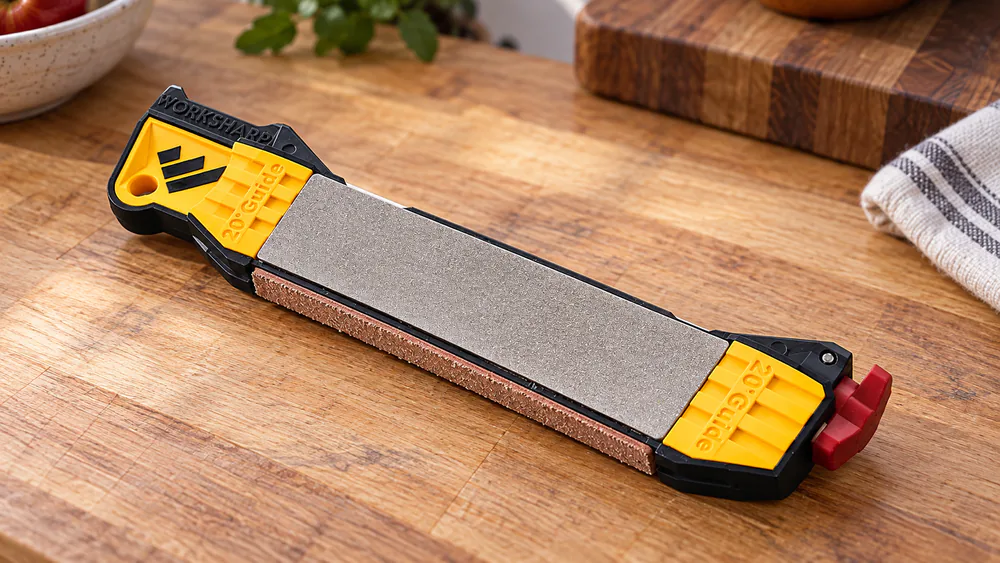
At 4.6 oz, the Work Sharp Guided Field Sharpener is light enough for a pack, and the built-in 20 and 25 degree guides make it hard to botch a pocket or utility knife. It has five surfaces: two diamond plates (coarse 220 and fine 600 grit), a ceramic rod for serrations and hooks, and a leather strop. No power is needed.

It suits small to mid-size blades better than big kitchen knives, and that keeps it at the bottom of this list. It also comes with a broadhead wrench and a lanyard hole, which tells you where it feels at home: the camp, not the cutting board.

Pros

  • Weighs 4.6 oz
  • 220 and 600 grit diamond plates plus ceramic and strop
  • Built-in 20 and 25 degree guides
  • Ceramic rod handles serrations and hooks
  • No power needed

Cons

  • Better for small to mid-size blades than big kitchen knives
  • Only 20 and 25 degree guides, nothing at 15
  • Mid-priced for a niche use

Types of Manual Knife Sharpeners

Pull-through sharpeners are the easiest and fastest. Guided clamp systems give better edges but take longer. Whetstones give the sharpest edge with the steepest learning curve. Each type trades speed for edge quality in its own way.

Pull-Through

A pull-through holds preset slots at a fixed angle, and you simply draw the blade through. The KitchenIQ and Kitchellence both work this way. They are the quickest route to a working edge, but they wear steel faster and cannot match a knife's exact original angle.

Rod and Honing Sharpeners

Rods and hones keep an edge aligned between sharpenings. A ceramic or steel rod does not rebuild a dull blade, it straightens the edge you already have. The Work Sharp Guided Field Sharpener carries a ceramic rod for serrations and hooks, while the Tumbler's steel hone removes the burr.

Whetstones

A whetstone is the oldest sharpener and still the finest. Our top whetstone pick has 1000/6000 grit on one block. Remember the upkeep: soaking, drying flat, and flattening as the stone wears.

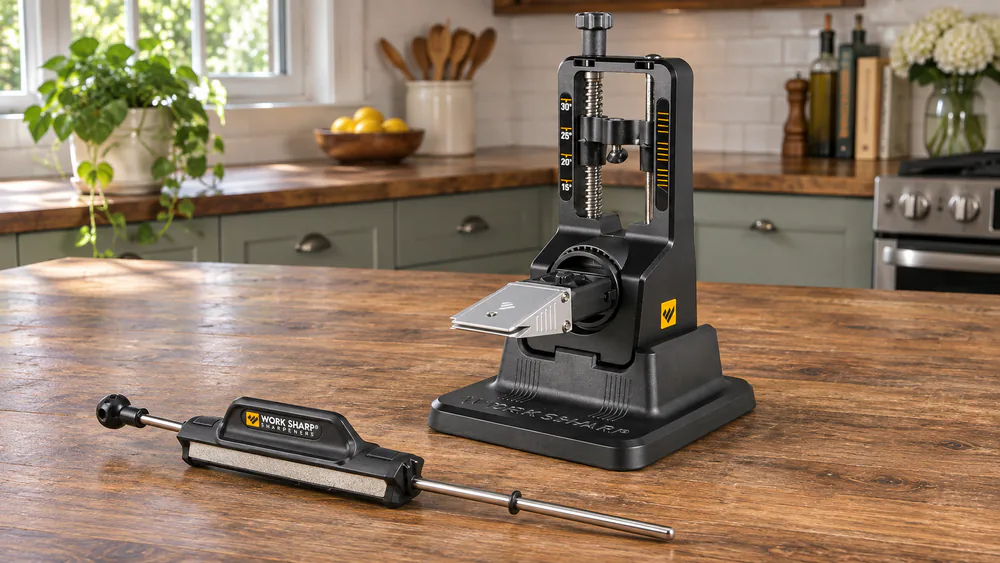
A Work Sharp Precision Adjust sharpener with an empty clamp and its abrasive rod resting beside the base
The Precision Adjust clamp and abrasive rod before a knife is fitted.

Guided Systems

Guided systems clamp the knife and fix the angle, so your hands do not have to. The Work Sharp Precision Adjust and Guided Field Sharpener are the guided picks here. They take longer than a pull-through but give better edges.

Rolling Sharpeners

A rolling sharpener sets the knife on an angled magnetic base, and you roll a cylinder along the edge. The Tumbler Original is our rolling pick. It is easy to use and tidy to store, though it asks more of a very dull edge.

How to Choose a Manual Knife Sharpener

Start with the knife, then the angle, then how much patience you have. A sharpener that fits all three is worth more than one with a long feature list.

Abrasive Material

Diamond cuts fast and stays flat, ceramic polishes, and stone gives the finest finish. Carbide, as in the AccuSharp, removes steel quickly. Pull-through makers rarely list grit values, so judge those tools by the edge, not the number. For whetstones, grit matters: 1000 restores and 6000 polishes.

Angle Compatibility

Japanese-style kitchen knives are typically ground to 15 degrees per side, and Western knives to 20 degrees. Match the sharpener to the knife. A 15-degree tool on a 20-degree knife will thin the edge, and a 20-degree tool on a Japanese blade will thicken it. An adjustable guide like the Precision Adjust sidesteps the question.

Match the angle to the knife, because the wrong angle slowly rewrites the edge you paid for.

Knife Type

German knives are tough and forgive a pull-through. Japanese knives are harder and thinner, so they reward a gentler tool. Serrated blades need a rod that fits the scallops, which most pull-through slots reach only partly. Pick the sharpener for the knife you use most.

Budget

Budget does not mean bad. The cheapest sharpener on this list is a fine choice for workhorse knives, and the priciest guided and rolling options earn their cost only if you value repeatability. Spend more on the sharpener only when your knives deserve it.

Warning. Avoid coarse pull-through slots on serrated and Japanese knives. They can chew serrations and reshape a thin, hard edge.

How to Use a Manual Sharpener

For a pull-through, set the sharpener on a stable surface and draw the blade heel to tip with light pressure. A few passes through the coarse slot, then a few through the fine, are plenty. For a whetstone, soak the stone, hold the angle steady, and work one side before flipping. Rinse the blade and test it on paper. For the full walkthrough, see how to use a knife sharpener.

Manual vs Electric Sharpeners

An electric sharpener is faster and gentler on your wrists, but it removes more steel and needs a plug. A manual sharpener asks for a little effort and gives you control over how much metal comes off. For a thin Japanese blade, that control matters. For a bag of everyday German knives, either one works.

Pros

  • No outlet needed, so you can use it anywhere
  • Smaller and easier to store
  • You control how much steel comes off

Cons

  • Takes more effort than an electric model
  • Whetstones and guided systems have a learning curve
  • Slower on badly damaged blades

Frequently Asked Questions

How often should I sharpen my knives?

Sharpen when the knife starts to skate on a tomato or crush an onion. For a home cook that is usually a few times a year, with a hone in between.

Should I use a whetstone or a pull-through for Japanese and serrated knives?

A whetstone or a 15-degree tool suits Japanese knives best. Serrated knives need a rod that fits the scallops, such as the ceramic rod on the Work Sharp Guided Field Sharpener.

Do pull-through sharpeners damage blades?

They remove steel quickly and at a fixed angle. That is fine for German workhorse knives and rougher on thin Japanese blades.

How often should I flatten a whetstone?

Flatten it whenever the surface develops a visible dip, which for a home cook is typically every few sessions. A dished stone cannot hold a steady angle.

What is the difference between honing and sharpening?

Honing realigns an edge that is bent. Sharpening removes steel to create a new edge.

Does a honing rod replace sharpening?

No. A rod straightens an edge that has bent over, but once the edge is worn it needs steel removed, which takes a sharpener.

Are manual sharpeners safe for expensive knives?

Yes, if the angle matches. A guided system or whetstone is the safest choice for a knife you value.

Final Verdict

Pick the sharpener that fits your knives, and the Work Sharp Precision Adjust is the one we would own. If you cook with a handful of workhorse knives and want a fast fix, the AccuSharp gets the job done. Choose the Sharp Pebble if you want to learn the whetstone.

Key takeaway. Buy the sharpener that matches your knife's angle and your patience, not the one with the longest feature list.

Read next

Ready to upgrade your kitchen?

Pick the sharpener that fits your knives and bring back a clean edge.