Helping you create a kitchen you love.

Knives & Cutlery

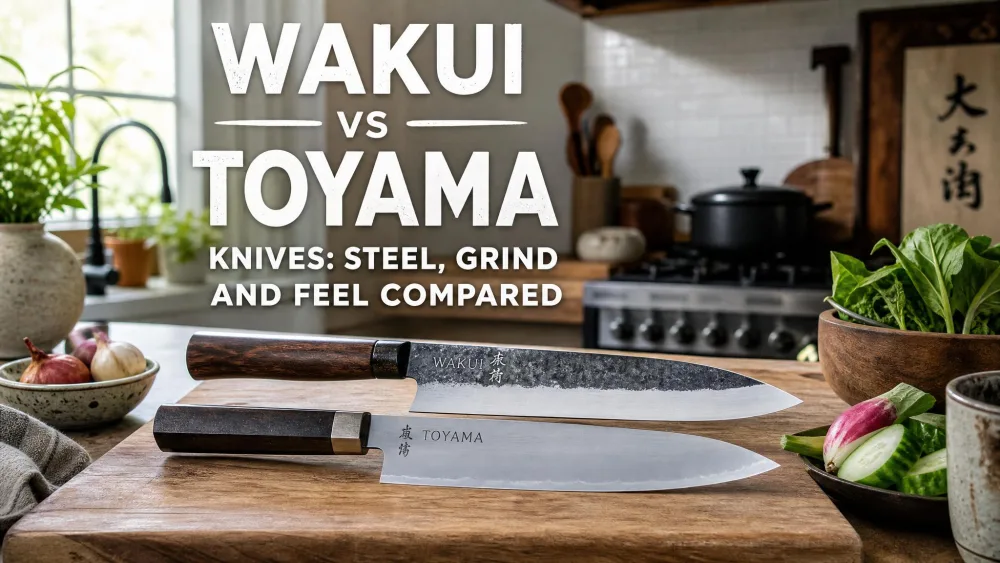
Wakui vs Toyama Knives: Steel, Grind and Feel Compared

As an Amazon Associate we earn from qualifying purchases. We may earn a commission from links on this page, at no extra cost to you. Learn more.

Wakui vs Toyama Knives: Steel, Grind and Feel Compared

Two hand-forged gyutos from the same small town in Niigata can sit side by side and behave nothing alike. That is the problem with shopping Wakui against Toyama. Both come out of Sanjo, both run carbon cores, both are workhorse grinds, and the price gap runs into the hundreds.

Toshihiro Wakui is a third-generation Sanjo smith who trained at Yoshikane before setting up his own forge. Shuji Toyama is a veteran blacksmith who works alone, finishing every knife himself. Those two working lives show up in the steel, in the height of the blade and in what you pay.

We judge both the way a working kitchen does: how the edge behaves after real prep, how the blade releases food, and how fast it comes back on a home stone. One is the easier knife to live with, and it is not the expensive one.

Quick Answer: Which Should You Choose?

Wakui is the better first Sanjo knife for most home cooks. It runs roughly $340 to $488 for a 240mm gyuto, comes back to sharp fast on a 1000-grit stone, and finishes above its price bracket.

Toyama is the knife you buy once you know what you want from a blade. It is taller, heavier, ground for outright food release, and it goes longer between sharpenings. It also runs around $712 to $801 in the Noborikoi line, and it is almost never in stock.

Neither is a mistake. Want one blade for a night of mixed prep that forgives imperfect stone work? Take the Wakui. Breaking down cases of vegetables? Wait for a Toyama.

The specs tell this story faster than prose. Watch the heel heights and spine figures: that gap is the difference in feel.

Wakui vs Toyama: Side-by-Side Comparison

FeatureWakuiToyama
Price, 210/240mm gyutoAround $340 to $488Around $712 to $801
Primary steelWhite #2, Blue #2 and V2 carbon coresBlue #2 core, White and honyaki on Noborikoi
Hardness63-64 HRC white lines; 62-63 HRC listed on blueNot published by maker or retailer
Grind and profileConvex workhorse grind, strong spine tapering to the tipTall asymmetric wide bevel, near-zero convex grind, subtle S grind
Cladding and finishKurouchi tsuchime, nashiji, migaki, damascus; stainless or iron cladKurouchi or stainless-clad kasumi
Weight and spine, 240mm196g to 213g, 3.4mm to 3.6mm spine200g to 239g, 3.9mm to 4.5mm spine
Heel height, 240mm48.2mm to 48.7mm54mm to 55.3mm
HandleOctagonal wa-handle, burnt chestnut or magnolia with horn collarD-shaped magnolia, chestnut or ho-wood; ebony on premium
Food releaseClean separation, very little wedgingExcellent release from height, mass and convexity
AvailabilitySells out per batch, restocks across several retailersPerpetually out of stock; Noborikoi is a JNS exclusive
Best forEasy sharpening, balance, lower entry priceMass, food release, long stretches between sharpenings

Key takeaway. One decision rule cuts through the spec sheet: choose iron-clad if you are the only person who will ever wash the knife, and stainless-clad if it lives in a shared kitchen where someone else might leave it wet on the board. Both makers offer both, so settle cladding before you settle on the smith.

Wakui 240mm Gyuto: Our Pick From Wakui

The Blue #2 honsanmai kurouchi nashiji gyuto is the Wakui we would put on a home board first. Its carbon core sits inside hand-laminated iron cladding, forge welded in house, which few smiths still do themselves.

Toshihiro Wakui Aogami Honsanmai Kurouchi Nashiji Gyuto 240mm
1

Toshihiro Wakui Aogami Honsanmai Kurouchi Nashiji Gyuto 240mm

Best Overall for Most Home Cooks
Check Price
4.7/5

This knife sits between a laser and a heavy workhorse, and that middle ground is why it suits so many kitchens. In a straight 240mm comparison it separates food cleanly and wedges very little, and the forward balance feels close to a Yoshikane, which makes sense given where Wakui trained. At 48.7mm tall with a 3.6mm spine and 213g of weight, there is blade enough to clear your knuckles without mass becoming the limit by hour three.

  • Comes back to a keen edge quickly on a 1000-grit stone
  • Fit and finish reads a step above the price bracket
  • Balanced 213g weight suits long prep sessions
  • Restocks across several specialist retailers

Specifications

Height at heel
48.7mm
Spine at heel
3.6mm
Weight
213g
Core steel
Blue #2, iron clad
Handle
Octagonal magnolia with buffalo horn collar
Pros

  • Sharpens easily and holds an edge better than the price suggests
  • Available as gyuto, nakiri, santoku, petty, deba and sujihiki from 150mm to 270mm

Cons

  • Very reactive in the first few weeks and throws a fast patina
  • Shorter at the heel than the Toyama, so less knuckle room
  • Iron-clad models want drying immediately after use

The stainless-clad White #2 nashiji version is the value play at around $340: 244mm of edge, 48.2mm at the heel, a 3.4mm spine and 196g on an octagonal burnt chestnut handle. A genuinely nimble knife.

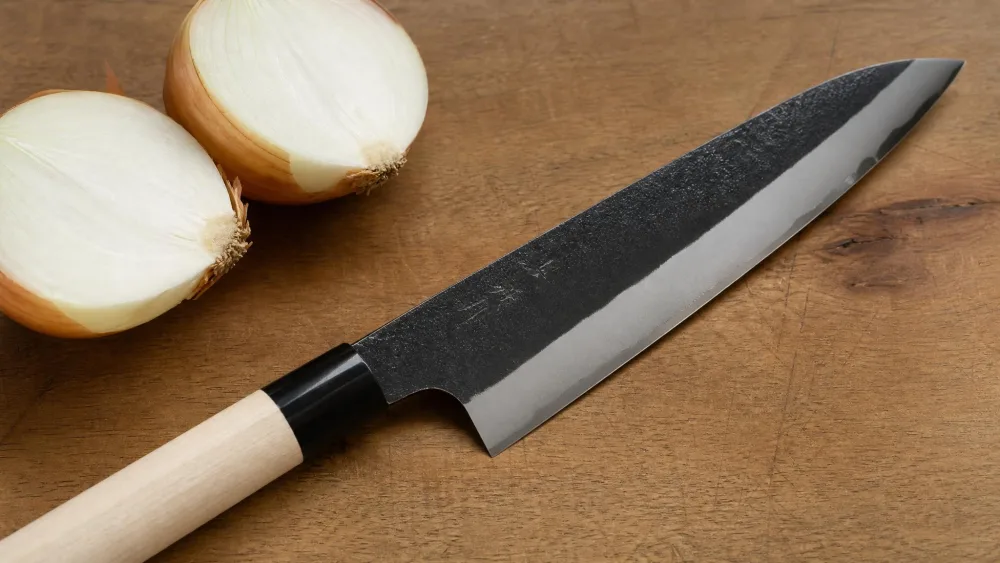
A Wakui Blue #2 kurouchi nashiji gyuto lying on a wooden cutting board beside halved onions, the dark forged finish above a bright polished bevel.
The kurouchi finish stops where the bevel begins, which is where the nashiji texture starts.

Toyama Aogami #2 240mm Gyuto: Our Pick From Toyama

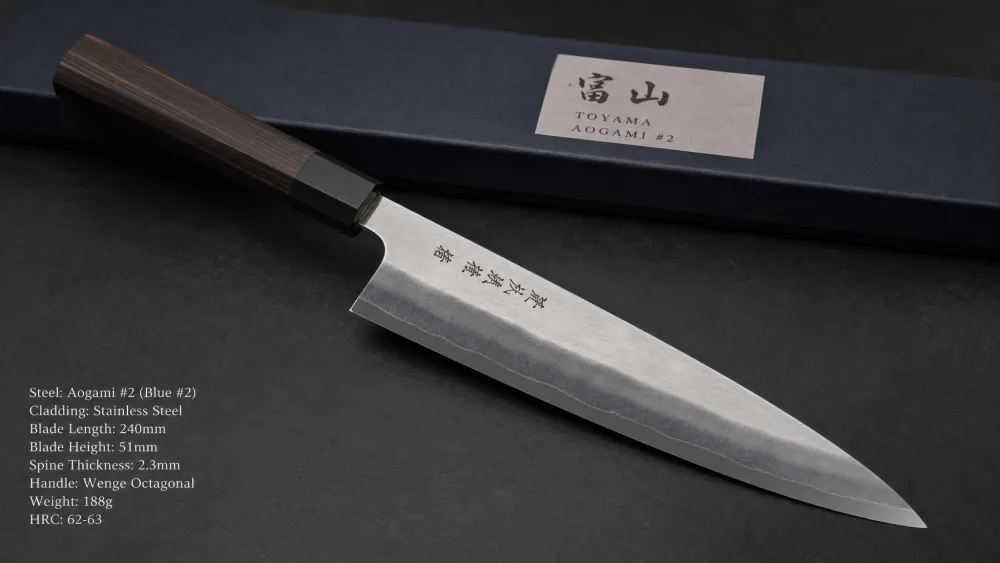
Toyama's stainless-clad Aogami #2 gyuto is the most attainable way into his work, and it shows what the height and mass buy you.

Toyama Aogami #2 240mm Gyuto, stainless clad
2

Toyama Aogami #2 240mm Gyuto, stainless clad

Best for Food Release and Heavy Prep
Check Price
4.6/5

Height is the first thing you notice, and 54.7mm at the heel changes how you work a board. The subtle S grind with its low convex bevels cuts everything cleanly and pushes food off the blade instead of letting it stick. The core is hard and very thin behind the edge, which is why it cuts superbly and why it is not the knife to hand to someone who hits bone.

  • Blue steel gets aggressively sharp and stays bitey between sharpenings
  • Wide bevel makes thinning straightforward once you learn it

Specifications

Edge length
242mm
Overall length
404mm
Height at heel
54.7mm
Spine at handle
3.9mm
Spine mid-blade
2.0mm
Spine near tip
1.3mm
Weight
215g
Handle
D-shaped magnolia with horn ferrule

Pros

  • Wide bevel thins cleanly once you learn the geometry
  • Long stretches between stone sessions
  • 54.7mm heel height gives real knuckle clearance

Cons

  • Roughly double the Wakui's price
  • Most sizes and finishes sit out of stock
  • Arrives with a delicate zero edge that chips until you lay your own bevel
  • No published HRC figure to compare against

Toyama's standard kurouchi gyuto, the iron-clad sibling of this model, runs heavier still at 239g and 55.3mm at the heel, with a 4.5mm spine.

Who Makes These Knives?

Sanjo, in Niigata, has forged tools for centuries, and both makers work inside that tradition.

Toshihiro Wakui: Third-Generation Sanjo Blacksmith

Wakui is the third generation of a Sanjo family that hand-forged crowbars. He apprenticed under Kazuomi Yamamoto at Yoshikane Hamono and mastered the craft in four years before going out on his own.

That lineage is not a marketing line. It shows in the forward balance and the convex grind, which is why the balance and grind feel close to a Yoshikane. Browse the Toshihiro Wakui collection at Knifewear to see the range that background supports.

Shuuji Toyama: Working Alone in Sanjo

Toyama works alone in Sanjo and makes every knife himself, start to finish. His single-bevel work gets rated against Shigefusa, which is about as high as that comparison goes.

Working alone explains everything about buying one. Output is small, sizes appear and vanish, and each knife is made one at a time, so dimensions vary between examples of the same nominal size.

One confusion worth clearing up: Toyama and Watanabe blades come out of one workshop tradition under two names, and retailers label the relationship inconsistently. Read them as the same Sanjo tradition, sold under two badges.

Blade Construction and Steel

Both build san-mai: a hard carbon core between softer cladding. What they clad it with, and how they finish it, is where they diverge.

Wakui Blade Construction: Options for Every Cook

Wakui's core steel comes in White #2, Blue #2 and a damascus iron build, always clad in san-mai over the carbon core. The white lines are hardened to 63-64 HRC. The Blue #2 stainless-clad gyuto is listed at 62-63 HRC, though hardness runs a point either side depending on which steel and which batch you get.

The geometry is classic Sanjo: a strong spine tapering toward the tip, a convex workhorse grind, and a rounded spine and heel. Beyond the standard lines sit the Seiryu line, finished on Japanese water wheels with natural stones, the Kokorozashi collaboration, and honyaki pieces made a few times a year.

Toyama Blade Construction: Purpose-Built Performance

Toyama runs blue steel as the mainstay, with white steel and honyaki appearing on the Noborikoi line. All of it is carbon, and all of it can rust without basic care after use. The full spread sits on the Toyama Noborikoi line at Japanese Natural Stones.

Noborikoi means Rising Carp, a symbol of perseverance and achievement. The line is a JNS exclusive built on his best heat treatment, his preferred steel, and better fit and finish than his standard work.

His blades come kurouchi or stainless-clad kasumi, on a tall wide-bevel convex grind, with D-shaped magnolia, chestnut or ho-wood handles and horn ferrules. No retailer publishes an HRC figure for his steel, so judge it by behaviour.

How Do They Actually Cut?

Both cut extremely well, differently enough that you will prefer one within a week.

Wakui Cutting Performance: Versatility Wins

The Wakui separates food cleanly, wedges very little, and sits between a laser and a heavy workhorse in feel. That middle position is its whole argument.

The V2 iron-clad line sharpens easily, takes a nice patina, and holds its edge better than the price suggests. It comes back fast on a home stone, which matters more than razor-sharp out of the box. Where it gives ground is release on dense root vegetables: good, not extraordinary.

Toyama Cutting Performance: Heavy-Duty Workhorse

The Toyama trades balance for mass and height. Its grind pushes food off the blade rather than letting it cling, the clearest performance gap between these makers.

Cladding changes the character. The iron-clad Toyamas carry more weight and convexity and are ground toward food release, while the stainless-clad ones are thinner overall and thinner behind the edge.

The blue steel gets aggressively sharp and stays bitey between sharpenings. Plenty of home cooks run one for months with no chipping.

How They Age Over a Year

A year in, both knives behave the way the geometry predicts.

The Toyama wins on mass, food release and time between sharpenings. The Wakui wins on how fast it comes back on a home stone.

Toyama and Watanabe out-cut a Yoshikane on feel, because of the height and mass. Those blades and the Wakui tsuchime sit in the same tier as Mazaki.

The factory edge is the one real caution on the Toyama. It arrives as a zero edge, beautiful to cut with but delicate, and it chips a little until you lay your own bevel on it. Then it settles down.

Fit, Finish and Design

Cutting performance splits these two, and so does everything you touch: handle shape, the spine under your index finger, the finish.

Wakui Design: Functional Beauty

The Blue #2 kurouchi nashiji gyuto wears an octagonal magnolia wa-handle with a water buffalo horn collar; the stainless-clad White #2 nashiji uses octagonal burnt chestnut. Both handles are light, so balance sits forward.

Rounded spine and heel mean no hot spots on a pinch grip through a long session. The finishes are restrained, and the damascus and Seiryu lines exist for anyone who wants more.

Toyama Design: Bold Traditional Character

Toyama goes D-shaped rather than octagonal, in magnolia, chestnut or ho-wood with a horn ferrule, and ebony with tamamoku on premium pieces. A D-shape locks a right-handed pinch grip in place, which some cooks love and some find restrictive.

The wide bevel is the visual signature, reading on a kasumi finish as a broad polished band the length of the blade. Character over polish is the honest summary, and Noborikoi is where his finishing peaks.

Price and Value: Is the Extra Cost Worth It?

The gap is large. The Toyama premium is not unjustified, but it is not a linear step in performance either.

What Do You Get for Your Money?

Wakui's Blue #2 nashiji gyuto runs about $488 in 240mm and $442 in 210mm; the stainless-clad White #2 nashiji sits near $340 in 240mm. Small-batch pricing moves with the yen and with each run, so treat those as bands.

Entry sizes are the surprise: White #2 stainless migaki nakiri and santoku in 165mm sit around $269. At the top, a damascus gyuto 210mm near $623 and a JNS Dama300 gyuto 240mm near $2,314.

Toyama's Noborikoi stainless-clad blue gyuto 240mm is about $801, the Noborikoi kurouchi about $712 at 225g, and the kasumi stainless-clad 270mm with an ebony handle tops the line near $1,157, all run-to-run figures rather than stable list prices.

Availability, Restocks and the JNS Exclusive

Stock is the real buying friction on the Toyama side: most sizes sit sold out, and you wait for a restock rather than choose.

Wakui's Sanjo workshop background sits with the same retailer, and his knives move through several shops, so waiting is measured in weeks.

Worth knowing: the 240mm Wakui Blue #2 gyuto was already sold out at the price we captured, so treat that as a last-listed figure. Both Japanese Knife Imports and Chef Knives To Go are worth watching for restock alerts.

Living With Carbon Steel: Care and Sharpening

Carbon asks for a habit rather than a chore, and the habit takes ten seconds.

Daily Care for Carbon Steel

The Wakui is very reactive in the first weeks and throws a fast patina, then calms down once that patina sets. That first fortnight is when people panic, and exactly when they should not.

Stainless cladding cuts the daily wipe-down anxiety on either maker, but the carbon core at the edge still stains and wants drying straight after use.

Warning. Carbon steel rusts if you leave it wet, and both knives run thin behind the edge. Never put either in a dishwasher, never leave one in the sink, and never take a Toyama through bone or frozen food. That hard edge chips rather than rolls.

Tip. Wipe and dry the blade between ingredients, not just at the end of prep. Acidic foods like onion and tomato grey a fresh blade fastest, which is how a protective patina gets started.

Sharpening Requirements

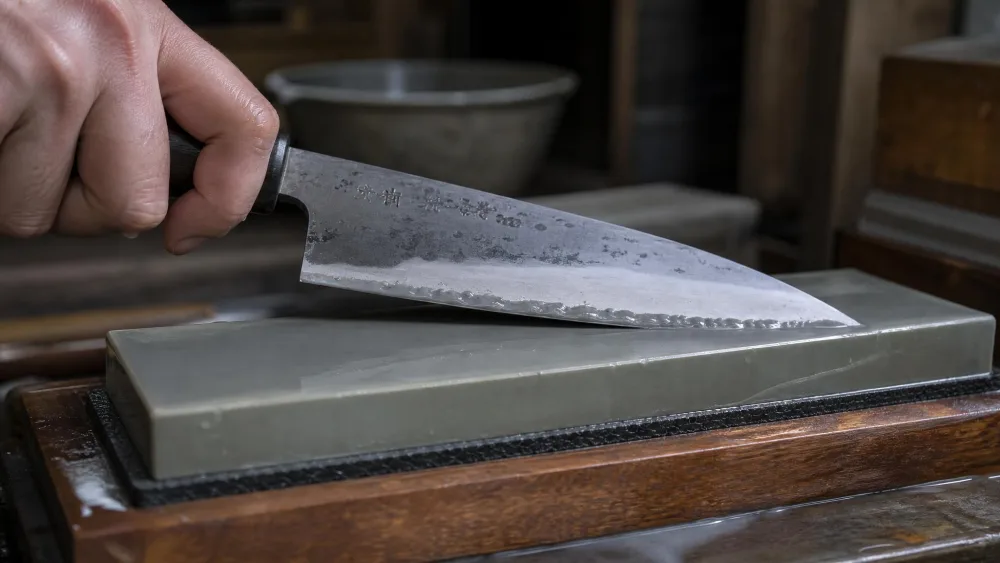
A 1000-grit medium stone handles routine sharpening, 3000 to 5000 refines the edge, and 80 to 400 grit is for chip repair only. Double-bevel gyutos want roughly 15 to 20 degrees per side.

There is no fixed schedule. Sharpen when you feel resistance and start leaning on the knife.

The practical split: the Wakui comes back faster and more forgivingly, while the Toyama's wide bevel rewards someone who can thin a blade.

A hand holding a carbon-steel gyuto at a low angle on a soaked 1000-grit waterstone, grey slurry building along the bevel.
A 1000-grit stone is the whole routine for both knives; coarse stones are for accidents.

Which Knife Fits Your Kitchen?

The two barely compete for the same cook.

Choose Wakui If You're...

Buying your first serious Japanese knife, or your first carbon one. It sharpens easily and does not punish you for learning on it.

Cooking mixed prep rather than volume, where 196g to 213g holds up through a long session better than mass does.

Shopping shapes beyond a gyuto: nakiri, santoku, petty, deba and sujihiki run from 150mm to 270mm, so one smith can cover a whole block.

Choose Toyama If You're...

Already comfortable on stones and able to thin a wide bevel when the grind needs it.

Prepping in volume, where 54mm to 55.3mm of heel height and 200g to 239g of mass turn into real food release.

Willing to wait, because if you need a knife this month, this is not the maker to shop. Noborikoi is the best expression of his work, and priced accordingly.

Alternatives Worth Considering

Several Sanjo makers sit between these two on price and feel.

Watanabe, Yoshikane, Mazaki and Munetoshi

Watanabe is the closest cross-shop to Toyama, effectively interchangeable output from one tradition. When a Toyama is out of stock, look here first.

Yoshikane is where Wakui trained, so its balance and grind feel familiar. Mazaki sits in the same tier at a friendlier price, and Munetoshi is the budget carbon entry point.

Budget and Premium Step-Offs

Budget kurouchi lines get you a hand-forged carbon gyuto for a fraction of the Wakui's price, with rougher finishing. Above these two, Wakui's own damascus gyuto near $623 and his rare honyaki pieces step up without changing smiths. Konosuke and Tanaka are the usual cross-shops.

Frequently Asked Questions

Which brand holds an edge longer, Wakui or Toyama?

Toyama. The blue steel stays bitey between sharpenings and goes longer between stone sessions. Wakui's advantage is the opposite: it comes back faster on a home stone.

Is either one a sensible first Japanese knife?

The Wakui is. It sharpens easily, finishes above its price bracket, and starts near $340 in a 240mm gyuto. The Toyama's delicate factory edge is a lot to ask of a first carbon knife.

My Toyama arrived with a chipped edge. Is that the retailer's problem or my stone's?

A few small chips along a zero edge are normal on arrival and yours to fix: a 1000-grit stone and a slightly more obtuse bevel takes them out in one session. A chip you can catch a fingernail in, a bent tip, or a crack is a retailer conversation instead, so photograph the blade under raking light the day it lands.

Aogami #2 versus Shirogami #2 in plain terms?

Blue #2 carries alloying that helps it stay sharp longer and makes it more stubborn on a stone. White #2 is purer: it takes a screaming edge and comes back quickly, but wants sharpening sooner. Wakui offers both, at 63-64 HRC on the white lines.

Does dimensional variance matter if I am buying sight-unseen?

It does. Each knife is made one at a time, so two blades of the same nominal 240mm can differ by several grams and a millimetre at the heel. Buy from a retailer that measures the actual example you will receive, and if knuckle clearance is the reason you are buying, confirm heel height before you pay.

Iron-clad or stainless-clad for a kitchen other people cook in?

Stainless-clad, without much debate. Iron cladding punishes a household where the knife gets rinsed and left on the drainer overnight. Stainless cladding leaves only the thin carbon core at the edge exposed, which stains rather than rusts and forgives a delayed wipe.

Final Verdict: Make Your Decision

Buy the Toyama second, once the Wakui has told you what you want more of. That order matters more than the choice itself, because until you have run a Sanjo carbon blade through a few months of prep, you do not know whether you want more height, more mass, or a thinner grind, and the Toyama pays back only one of those.

Start with the Wakui and it teaches you cheaply. A season on it tells you whether your hand wants a taller blade, and whether your stone work is ready for a wide bevel that needs thinning. If the answer is no on both counts, you have saved several hundred dollars and a long wait.

If the answer is yes, the Toyama will still be there, and by then its delicate factory edge and the stock roulette read as an acceptable cost rather than a surprise.

Read next

Ready to upgrade your kitchen?

Start with the blade that teaches you the most, then buy the second one knowing exactly what you want.