
Knives & Cutlery
How to Sharpen Cutco Knives at Home: Straight and Double-D Edges

As an Amazon Associate we earn from qualifying purchases. We may earn a commission from links on this page, at no extra cost to you. Learn more.
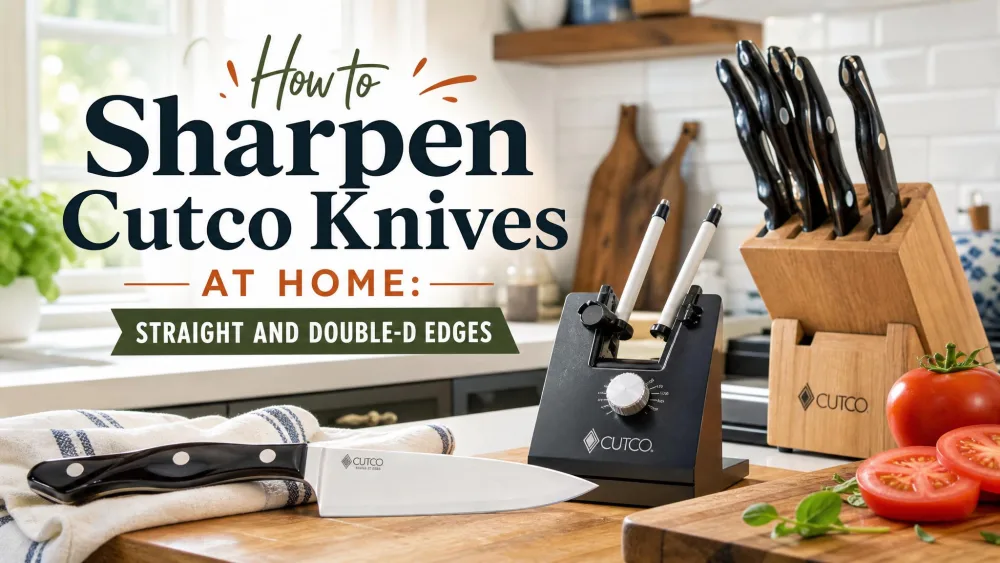
We see the same scene again and again. Someone inherits a family Cutco, finds it dull, and reaches for the cheap pull-through sharpener in the drawer. That one pass can ruin the knife. The right method depends entirely on which edge you own. Straight edges can be sharpened at home in a minute or two. Double-D edges should go back to the factory, and our knife sharpener guides explain why other tools fail them.
First, Check Which Edge Your Cutco Has
Straight (plain) edge
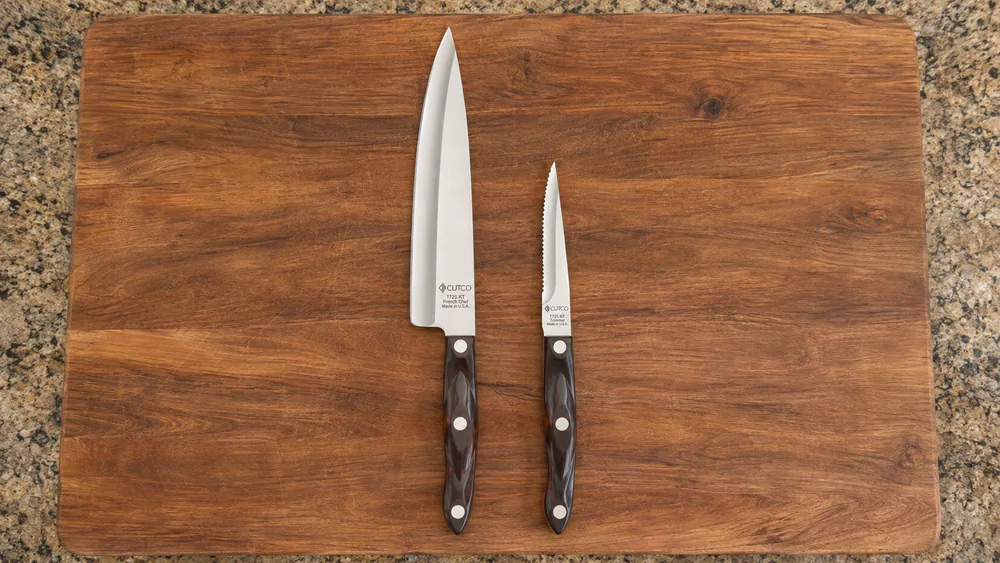
A straight edge is a smooth, continuous blade, like any ordinary kitchen knife. Look along the edge: it has no teeth or recesses. Cutco's steel here is a soft, 440A-class stainless that sharpens quickly, so a plain edge does not need heavy pressure or long sessions.
Double-D serrated edge
The Double-D edge was introduced in 1960. It has recessed cutting edges tucked between small protective points. Those points shield the edge as it works. The edge is ground on one side only, at 27 degrees, and cheese knives are ground at 12 degrees.
What You Need to Sharpen Cutco Knives
Cutco's handheld sharpener
The current Cutco #84 Sharpener works on straight-edge knives only. It uses carbide inserts set at an angle matched to the edge, so you do not have to guess a number. The inserts are v-shaped, and it works left- or right-handed. For most home cooks, this is the simplest option.
Alternatives for straight edges (whetstone, ceramic rod)
A whetstone also works on plain edges. A 1,000-grit stone does the main work, and a finer stone refines it. Pass counts and angles vary with the knife's existing bevel, so match the factory bevel rather than trusting one number. Sources disagree on that bevel, from 15 to about 20 degrees per side.
In our experience, whetstones are especially useful for neglected knives. A 50-year-old Cutco with a rolled-over plain edge came back to slicing a tomato cleanly after a 1,000, 3,000, and 6,000 grit progression. The steel and construction were intact. Our full whetstone walkthrough covers the stone technique in detail.
Prepare the Knife and Your Workspace
Wash the knife and dry it first. Grit on the blade will scratch the inserts and the steel. Then set up where you will not rush.
Sharpening throws off fine steel filings. They land on the counter and cling to the blade. Keep a damp paper towel nearby so you can wipe both when you finish.
Tip. Sharpen over a counter you can wipe down, not over a wooden board. Filings are easy to see on a clean, light surface.
How to Sharpen a Straight-Edge Cutco Knife
These steps follow Cutco's method; the illustrations use the current #84 Sharpener and the #1725 French Chef. The whole job takes a couple of minutes.
Step 1: Set up a stable surface
Put the sharpener on a sturdy, flat surface. Grip its handle firmly with one hand. If the sharpener slides around, your pulls become uneven, leaving an uneven edge.
Step 2: Position the knife and angle
Place the heel of the blade in the center of the v-shaped inserts. Hold the knife perpendicular to the top of the sharpener, with the tip angled slightly down. The inserts set the angle, so your job is to hold the knife steady.
Step 3: Pull through with light pressure
Pull the knife slowly toward you, all the way to the tip. Follow the natural curve of the blade. Use light pressure for 5 to 7 strokes. Then use very light pressure for 2 additional strokes to refine the edge.
Stroke counts vary with how dull the knife is, so treat 5 to 7 plus the 2 light finishing strokes as the baseline. We found that steady, light pulls work best. More pressure or more passes does not make the knife sharper, and it risks chipping.
Step 4: Check the edge
If the knife passes the checks below, stop. Extra passes only remove steel.
Step 5: Clean and store
Sharpening removes steel, so wipe the filings from the blade and wash it. Hand wash and dry the knife. Wipe the work surface with a damp paper towel. The sharpener itself is not watertight and not dishwasher safe, so keep it out of the sink.
How to Handle a Double-D Edge Knife
Warning. Never put a Double-D edge on a stone, a rod, or any pull-through sharpener. Keep your fingers behind the blade at all times. The points are small, and a slipping hand finds them quickly.
What you can safely do at home
Very little, and that is fine. You can hand wash and dry the knife, store it in its block or sheath, and cut on a board that is kind to the edge. When it stops cutting well, send it to Cutco. Do not hone it.
Why you should not use a regular sharpener
The protective points guard the recessed edges. A pull-through, stone, or rod grinds those points down, and then the knife dulls faster. The edge is one-sided too, so a two-sided sharpener changes the geometry. A pull-through with a serrated slot can grind the points off a Double-D in a single use, and the knife does not recover at home.
How to Test Whether Your Knife Is Sharp
For the tomato test, rest the edge on the skin. A sharp knife breaks the skin with almost no pressure. A dull one squashes the tomato, and that is the clearest everyday sign it is time to sharpen. A dull knife also takes more force and slips.
For the paper test, hold a sheet of printer paper by one corner. Slice down through it. A sharp edge cuts cleanly without snagging.
Run both tests after every sharpening. If the knife fails them after a careful session, the home touch-up has reached its limit. A touch-up realigns and refreshes the edge, but it does not replace a factory sharpening.
Cutco's Free Forever Sharpening Service
Cutco's Forever Guarantee covers sharpening for every knife, Double-D and Micro Double-D included. The sharpening itself is free. You pay a nominal return shipping and handling fee.
How to send knives in
Complete an online service request first. Print the confirmation and include it in the box. Ship to Cutco Cutlery, Return/Repair, 322 Houghton Ave, Olean NY 14760.
Cutco does not provide prepaid labels. You choose the carrier (USPS, UPS, FedEx, or DHL) and pay shipping to the factory. Pack carefully:
- Clean each blade and cover it fully with cardboard, such as a cereal box or the original sheath, plus tissue or newspaper.
- Never tape the blades or handles.
- Use a sturdy corrugated box, not a padded or paper envelope.
- Never ship the block or tray.
Turnaround and what to expect
Allow a few weeks after the knives arrive in Olean. A delivered tracking status does not mean service has started. Turnaround varies with the backlog and takes longer around holidays, so send knives early and check Cutco's posted Thanksgiving and Christmas return deadlines.
Products made before 1980 can usually still be serviced. If one cannot be, Cutco replaces it, or returns the original on request. Normal dulling is always covered. Damage from unconventional use is replaced at half the current retail price.
Common Mistakes to Avoid
The biggest mistake is dragging a family Cutco through a cheap gas-station style pull-through. Other mistakes we see:
- Using too much pressure on the Cutco Sharpener, which does not sharpen faster and can chip the edge.
- Using the Cutco Sharpener on a Double-D blade. It is for straight-edge knives only.
- Skipping the wipe-down, which leaves steel filings on the blade and the counter.
- Honing a Double-D edge on a rod.
How Often Should You Sharpen Cutco Knives?
Sharpen when the knife tells you to, not by the calendar. Guides give very different intervals, from every 2 to 3 months for straight edges up to every 12 to 18 months for light home use. Heavy use falls between, at roughly every 6 to 12 months. Your cutting surface and habits matter more than any number.
The signs are easy to read. The tomato squashes instead of slicing. Paper snags. You press harder than you used to. Any of these means the edge needs attention.
With proper care, Cutco says both edge types should last for years. When performance drops, send the knife in. Factory resharpening removes more steel than careful stone work, so a knife sent in every few years visibly shrinks over decades. That is another reason to use light home touch-ups in between.
Keeping the Edge Longer (Honing, Storage, Washing)
Honing keeps a plain edge straight between sharpenings. Use a smooth ceramic or smooth steel rod, not a grooved one. A few strokes every few uses, with light pressure, is plenty. Do not hone Double-D.
Wash by hand and dry right away. Cutco states its knives are dishwasher safe, but we hand wash. Hand-washed Cutcos stay looking new for a decade, while dishwasher ones look much older. The dishwasher hazes the blade and dulls the edge through rack contact.
Frequently Asked Questions
Can I sharpen Cutco knives myself?
Yes, if the knife has a straight edge. The Cutco Sharpener is built for that job. Double-D knives should go to Cutco instead.
Can I use a whetstone or regular sharpener on Cutco?
A whetstone works on plain edges if you match the factory bevel and keep the pressure light. Never use a stone, rod, or pull-through on a Double-D edge, because it grinds the protective points down.
Is Cutco sharpening really free, and do I need to be the original owner?
Sharpening is free for all Cutco knives. You pay a nominal return shipping and handling fee, plus your own shipping to Cutco. The guarantee covers the knife, not the receipt, so inherited and gifted knives are covered.
How often should Cutco knives be sharpened?
It depends on use and your cutting surface. Sharpen when the tomato or paper test fails, rather than on a fixed schedule.
How do I send in Double-D knives, and how long does it take?
File the online service request, print the confirmation, wrap each blade in cardboard, and ship in a sturdy box. Expect a few weeks after arrival, longer around the holidays.
Does it cover vintage knives?
Usually yes. Products made before 1980 can typically still be serviced. If not, Cutco replaces them or returns the original on request.
Conclusion
Three lines cover the whole job. Identify your edge first. Use the Cutco Sharpener, with light pulls, on straight edges. Send Double-D knives to Cutco's free Forever service, and keep every other tool away from them.
Read next
Ready to upgrade your kitchen?
Browse our buying guides for knives and tools that hold an edge.