Helping you create a kitchen you love.

Kitchen Appliances

7 Best Juicers for Beets: Top Picks and Buying Advice

As an Amazon Associate we earn from qualifying purchases. We may earn a commission from links on this page, at no extra cost to you. Learn more.

7 Best Juicers for Beets: Top Picks and Buying Advice

If you have ever stalled a juicer on a hard beet, or spent twenty minutes scrubbing magenta stains off a mesh filter, you know why this roundup exists. Beets are dense, fibrous, and messy, and they punish a machine that was built mostly for apples and leafy greens.

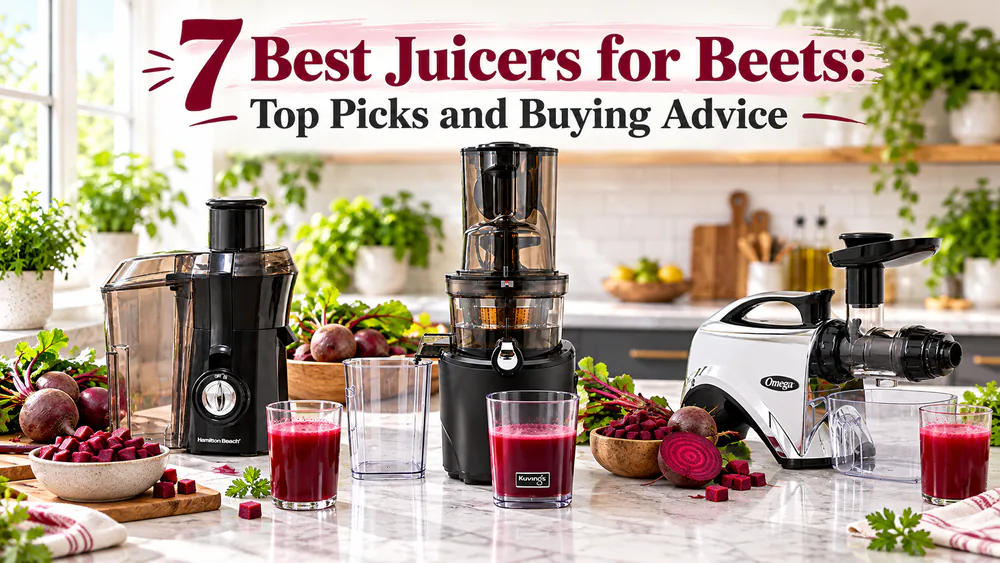
The Kuvings REVO830 is our top pick for a root-focused kitchen, and the Hamilton Beach Big Mouth is the one we would buy first on a tight budget. Every machine here involves trade-offs between prep time, pulp dryness, and cleanup, which we explain below. If you are comparing the wider category, our juicer reviews cover the rest of the lineup.

We chose these seven machines by weighing how each one is built to handle dense roots against what matters in a busy family kitchen: prep, noise, and cleanup.

Best Juicers for Beets at a Glance

Here is the short version. Pick the row that matches your household, then read the full review for the tradeoffs.

ModelTypeBest-fit buyerBeet prepCleaningMain limitation
Kuvings REVO830Vertical masticatingRoot-focused household willing to investSmall cubes, fed without forceScreen brush and hand washingCost, height, and beet prep
Hamilton Beach Big Mouth 67601ACentrifugalBudget beginnerWash and cut to fit the chuteDishwasher-safe parts; mesh needs brushingNoise, splash, variable pulp dryness
Omega NC900HDCHorizontal masticatingFrequent mixed-root and green juicingCut to pieces that fall freely through the chuteSmall screen needs brushingCounter length and manual feeding
Breville Juice Fountain Cold XLCentrifugalFamily batchesWash, trim, cut oversized roots, use BoostLarge pieces and fine meshJug and parts fill the sink and counter
Ninja NeverClog JC151Horizontal masticatingSmall counter, modest batchesPeel and cut small, feed graduallyDishwasher-safe juice-contact partsExtra chopping, weaker hard-root extraction
Hurom H400Vertical masticatingCleanup-first householdWash; cut smaller for bulky or faster batchesHand-wash split auger and pulp outletFine pulp and an assembly learning curve
Breville Juice Fountain Compact BJE200XLCentrifugalFast small batchesWash, cut to fit, feed slowlyBrush the mesh; top-shelf partsInternal pulp bin and duty-cycle pauses

How We Tested These Juicers for Beets

We judged each machine on what happens when a hard, fibrous root meets the feed chute: how much cutting it needs, whether it stalls, how dry the pulp comes out, and how long the cleanup takes afterward. In a family kitchen, noise, counter footprint, and whether a teenager can safely help also count.

We did not time every machine or measure pulp moisture, so our rankings rest on qualitative judgments about stalling, pulp dryness, and cleanup effort rather than lab numbers.

What We Looked At With Hard, Fibrous Roots

Beets expose weak points fast. We score for stalling, squeaking from the auger, pulp that stays wet, and juice that comes out foamy or watery.

Wattage alone told us very little. A 1200W centrifugal and a 150W slow juicer work in completely different ways, so we ranked how each one is built to handle beets rather than ranking motors. We also avoided publishing yield percentages, because we did not run a matched seven-machine, beet-only yield test.

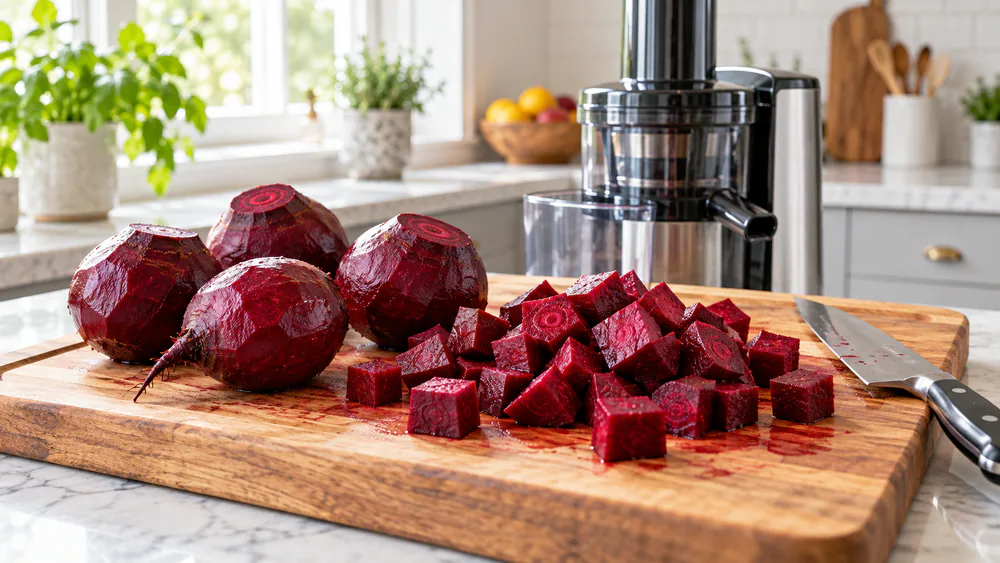
Scrubbed red beets on a wooden cutting board, half cut into small cubes, next to a juicer feed chute
Trimmed and cubed beets ready for the feed chute.

How We Compared Prep, Cleanup, and Ownership Costs

Prep covers washing, trimming, and how small each piece has to be. Cleanup covers how many parts there are, whether a brush is required, and how quickly beet pigment sets into plastic. Ownership costs mean the warranty and how often you will fight the machine, not the sticker price.

Our Juicer Picks for Beets

1. Kuvings REVO830: Best Overall

Kuvings REVO830
1

Kuvings REVO830

Best Overall
Check Price on Amazon

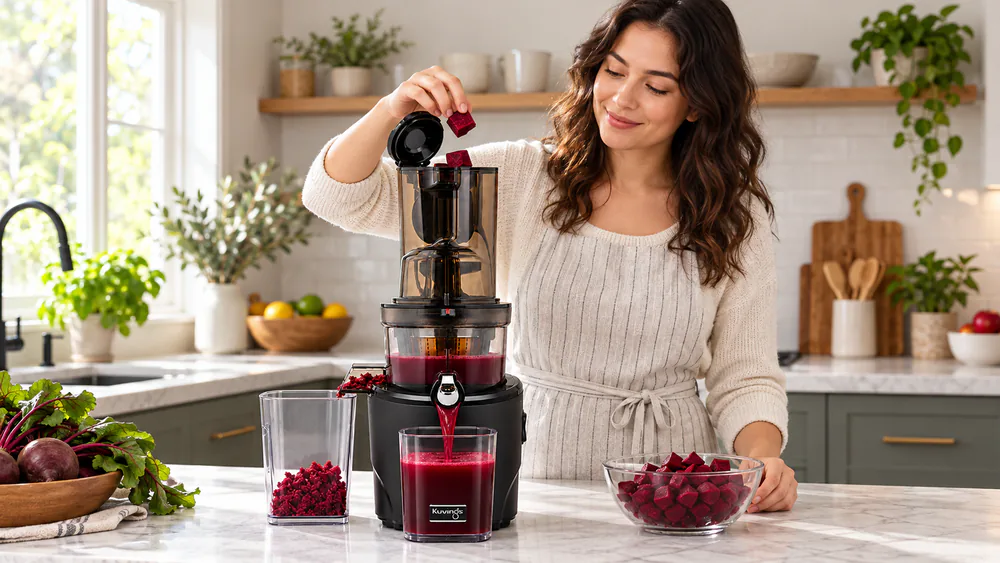
The REVO830 is the juicer we would pick for a household that juices roots every week and wants a machine that lasts. The wide opening is tempting, but a large hard beet can damage it, so we cube beets small and feed them in handfuls. In the kitchen it is the easiest of the slow juicers to put together, because the alignment marks show where each piece goes and the wraparound brush clears pulp trapped on the screen. The heavy base is best kept on the counter, and we clear the pulp outlet between batches because it can still clog despite its larger opening.

Pros

  • Vertical masticating design suited to dense roots
  • 15-year limited US warranty and a 240W motor
  • Alignment marks and a wraparound screen brush make cleanup manageable
  • Parts break down for storage

Cons

  • Premium cost relative to this shortlist
  • Needs 19 inches of clearance for the standing unit and feeding
  • Beets still need cutting into small cubes
  • Pulp outlet can clog
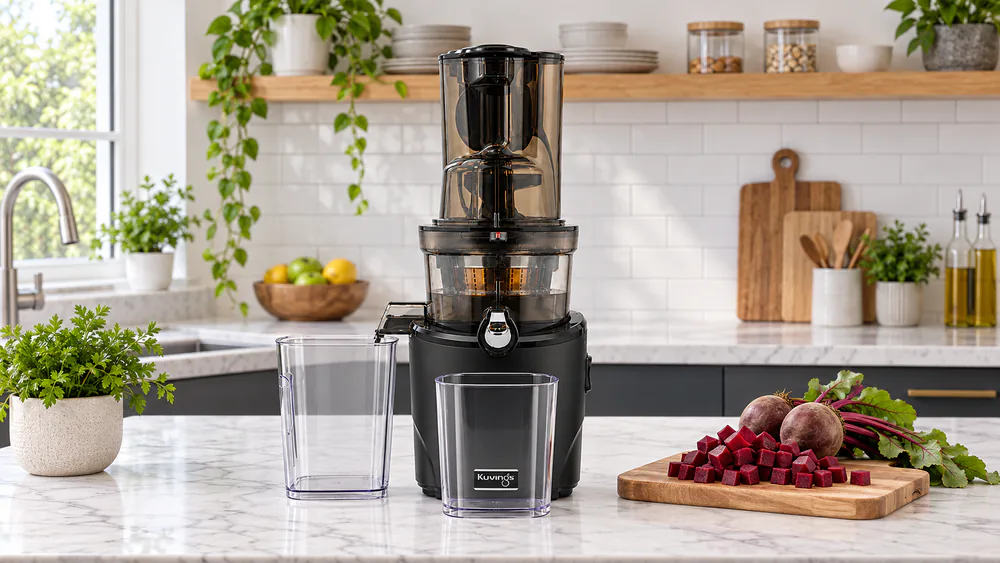
Small beet cubes being fed by hand into the wide chute of a Kuvings REVO830 vertical slow juicer on a kitchen counter

2. Hamilton Beach Big Mouth 67601A: Best Budget Pick

Hamilton Beach Big Mouth 67601A
2

Hamilton Beach Big Mouth 67601A

Best Budget Pick
Check Price on Amazon

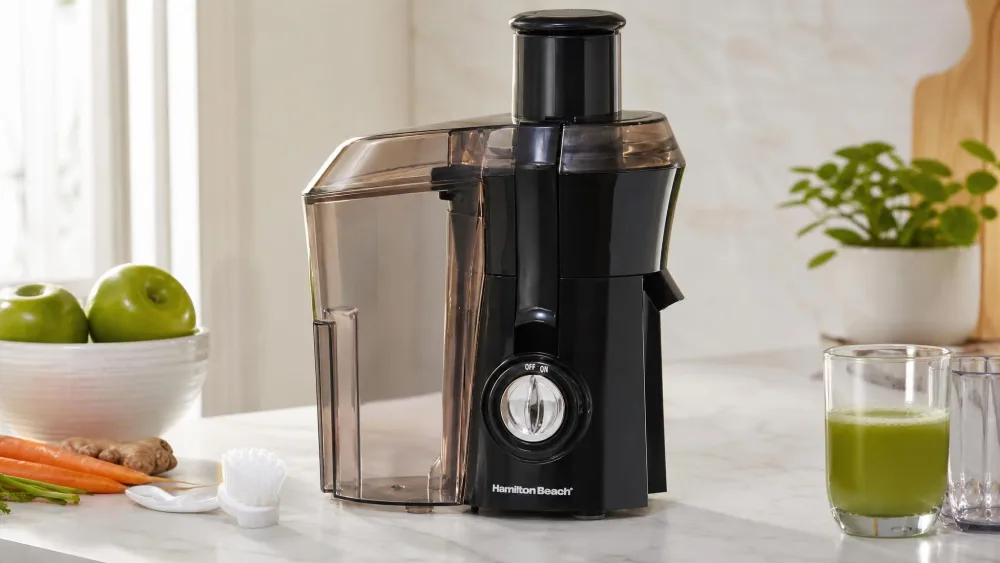
The Hamilton Beach asks for far less of you than the Kuvings: no cube-sized chopping, just beets cut to fit the 3-inch chute. Its 800W centrifugal cutter made a beet-and-carrot mixture that tasted good, though it kept noticeable pulp and a relatively watery texture. The removable pieces wash up easily, but the supplied brush can shed bristles, so check the mesh for strays after scrubbing. It is the one to start with if you want beet juice without spending much.

Pros

  • 800W motor and a 3-inch feed chute
  • Large 80 oz pulp bin means fewer interruptions
  • Removable parts that wash easily
  • 3-year limited warranty

Cons

  • Loud during use
  • Wet pulp and watery juice with some recipes
  • Spout can splash; basket is awkward to lift out
  • Brush can shed bristles

3. Omega NC900HDC: Best for Frequent Juicing

Omega NC900HDC
3

Omega NC900HDC

Best for Frequent Juicing
Check Price on Amazon

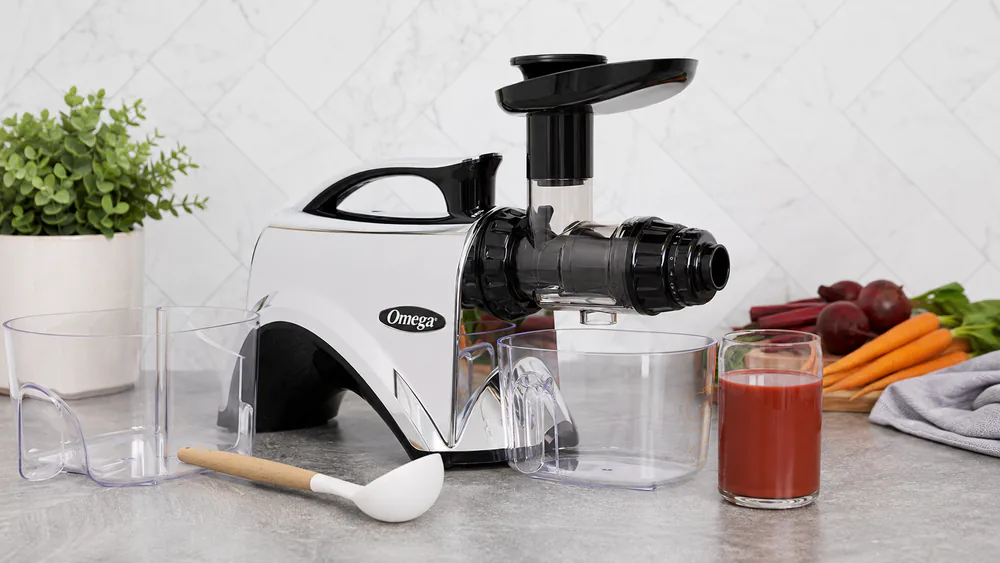
After the Hamilton Beach, the Omega feels like a different appliance: the motor is subdued rather than loud, and the parts fit securely and come apart readily. It suits mornings when you mix roots with greens and ginger. Beets need to be cut into pieces that fall freely through the chute, and eighths are often workable, though a bigger beet may need smaller cuts. The assembled machine takes substantial counter space, so measure it yourself because published footprints disagree; its chrome finish also shows fingerprints. We could not confirm a continuous run limit, so we rest it between big batches.

Pros

  • Quiet 150W motor with an 80 RPM auger
  • 15-year limited warranty advertised for the US model
  • Automatic pulp ejection and a built-in carry handle
  • Handles firm roots and ginger well

Cons

  • Long, bulky body that eats counter space
  • Beets must be fed by hand in cut pieces
  • The small screen needs brushing

4. Breville Juice Fountain Cold XL BJE830BSS: Best for Large Batches

Breville Juice Fountain Cold XL BJE830BSS
4

Breville Juice Fountain Cold XL BJE830BSS

Best for Large Batches
Check Price on Amazon

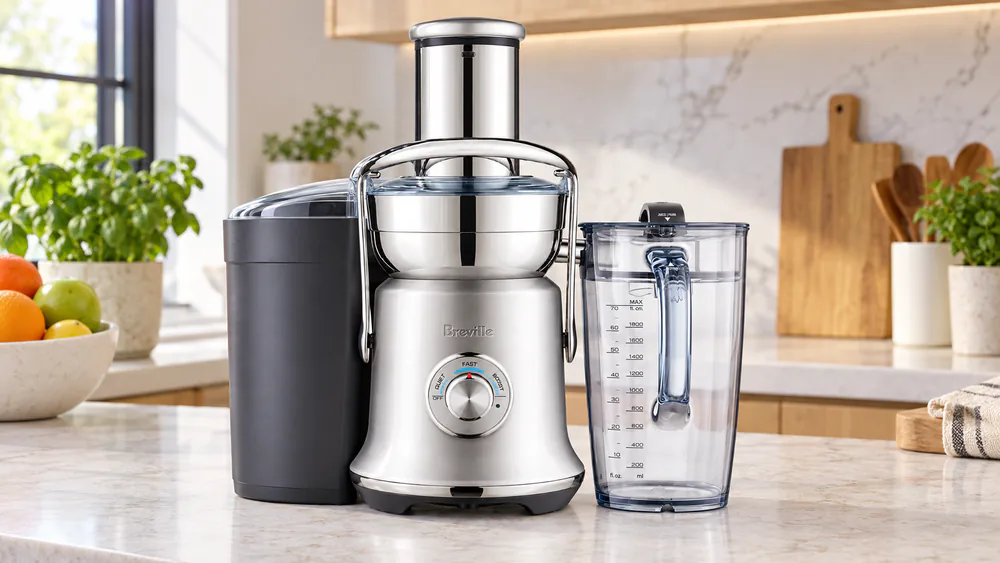
Skip it if you juice one glass a day. For a family that wants several glasses before school, the Cold XL's 70 fl oz jug and 1200W motor are the draw. The Boost setting is the one the manual assigns to beets and carrots, so ignore the Quiet mode for roots. We trim the leaves, scrub off the soil, cut oversized beets, and press the pusher slowly. Multiple large washable parts make cleanup a real part of the job, and if you overload it, switch it off, unplug it, and wait at least 30 minutes. The US chute is nominally 3.5 inches, though product copy varies by model year. We found no solid beet-only test of this exact model, so treat its beet performance as the least proven of the seven.

Pros

  • 70 fl oz sealable jug and fast extraction
  • Boost setting designed for beets and carrots
  • Single-glass spout when you do not need a large jug
  • 1200W motor

Cons

  • Large parts and fine mesh take time to clean
  • Takes up sink and counter space
  • 1-year limited warranty

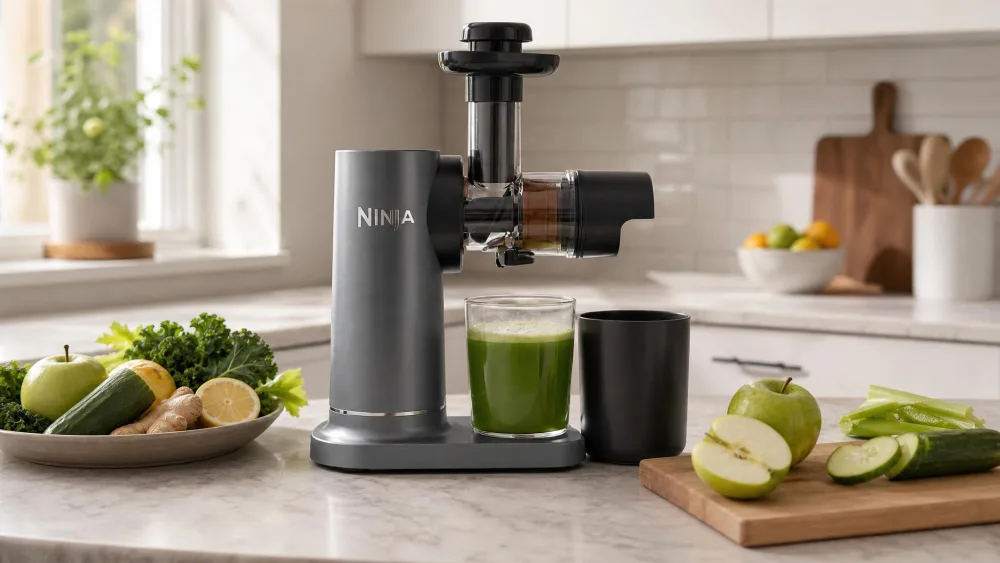
5. Ninja NeverClog JC151: Best for Small Kitchens

Ninja NeverClog JC151
5

Ninja NeverClog JC151

Best for Small Kitchens
Check Price on Amazon

The Ninja cannot match the others on hard beets, and that is the first thing to know before buying. What it offers is a slim 7.15-inch-wide body that fits where the other slow juicers will not. Beets can make the auger squeak, and the mixed beet drink gets smoother after straining. Chopping produce first means you do not lean on the pusher, and the juice can keep more texture than premium alternatives. The regional recipe guide peels beets and cuts them into small pieces, so check the manual for your unit.

Pros

  • 7.15-inch-wide body suits a small counter
  • Dishwasher-safe juice-contact parts
  • Two pulp filters for texture choice
  • Easy to dismantle, rinse, and reassemble

Cons

  • Narrow chute and extra chopping
  • Weaker with hard beets than with greens
  • Beets can squeak the auger
  • Small jug, with capacity listings that disagree

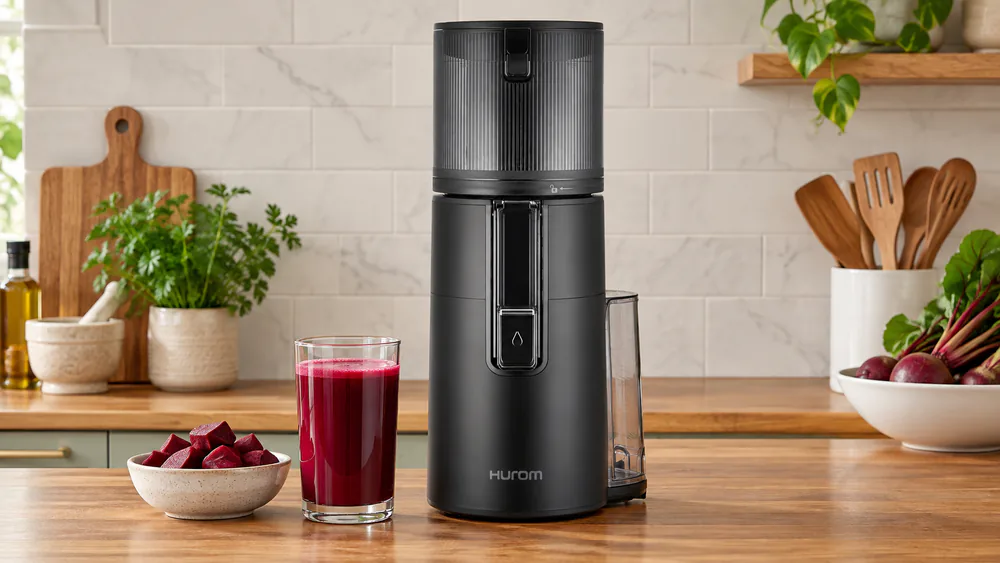
6. Hurom H400: Best for Easy Cleaning

Hurom H400
6

Hurom H400

Best for Easy Cleaning
Check Price on Amazon

Skip the Hurom if you want the fastest possible juice; it is for people who hate scrubbing. The mesh-free chamber cuts the brushing, and the motor is subdued. Wash it promptly, because dried pulp is much harder to clear. Carrots can bounce in the hopper instead of feeding straight into the auger, so wash roots, cut them to fit, and stay under the fill line. It runs up to 30 minutes continuously, and the European manual prohibits the dishwasher, so follow your regional one.

Pros

  • Mesh-free chamber reduces scrubbing
  • Quiet motor
  • 15-year motor and parts warranty for current US purchases
  • Nesting rear pulp container

Cons

  • Fine pulp can stay in the juice
  • Assembly takes practice
  • Dried pulp is hard to wash, and the manual calls for hand washing
  • Premium cost relative to this shortlist

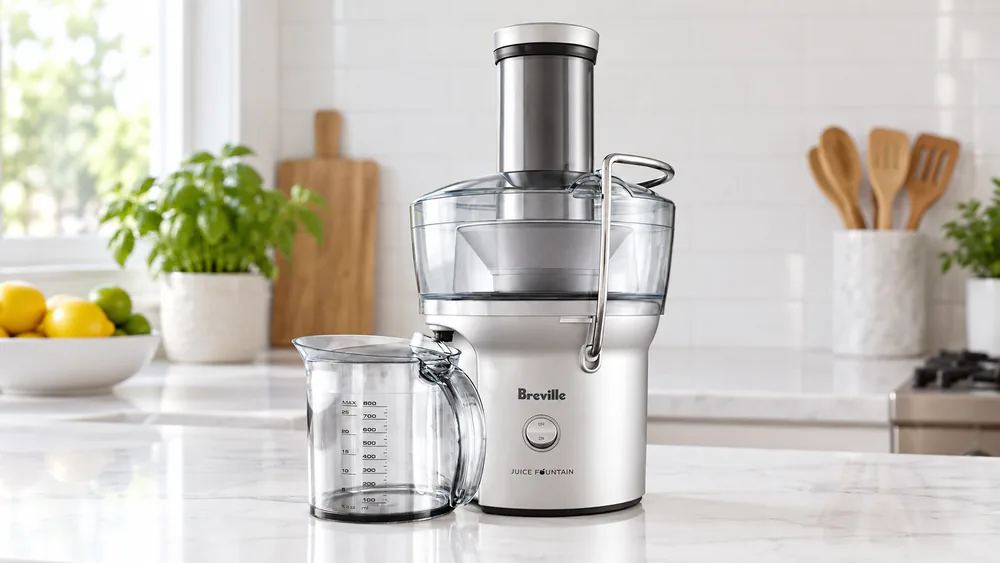
7. Breville Juice Fountain Compact BJE200XL: Best for Fast Juicing

Breville Juice Fountain Compact BJE200XL
7

Breville Juice Fountain Compact BJE200XL

Best for Fast Juicing
Check Price on Amazon

The Compact is the quick-glass machine, and it makes the most noise doing it. Its 700W motor and 3-inch chute handle carrots quickly, but hard beets take more effort, so cut them to fit and lower the pusher slowly. The integrated pulp container saves space but needs scraping, and the juice carries a foam layer. At rapid feeding or with firm pressure, the manual limits operation to 1 minute, then 1 minute of rest, so it suits small batches rather than a full week of juice.

Pros

  • Quick extraction and a small footprint
  • Pulp container sits inside the footprint
  • Top-shelf dishwasher-safe parts
  • Cord wrap and locking arm

Cons

  • Loud, with foam in the juice
  • Hard beets take more effort
  • Needs rests under heavy feeding
  • Mesh is awkward to wash

How to Choose a Juicer for Beets

Masticating (Cold Press) vs. Centrifugal Juicers

Slow augers crush and press, which is what a cold press juicer does, while centrifugal machines use a fast cutter and strainer. Neither mechanism wins every time. Hard-root performance is model-dependent, so wattage alone does not predict yield or stall resistance.

Pros

  • Masticating: slower, quieter, and often drier pulp from roots and greens
  • Centrifugal: fast, with a wide chute and often a lower entry cost

Cons

  • Masticating: more cutting, longer runs, and bulkier machines
  • Centrifugal: louder, with foam and sometimes wetter pulp

Juice Yield, Pulp Texture, and Stall Resistance

Wet pulp can signal a clogged mesh or feeding too fast. Stop, clean the filter, and feed more slowly rather than forcing more through. We did not run a matched yield test, so we do not quote percentages.

Feed Chute Size and Beet Preparation

A wide feed chute is not permission to feed whole hard beets. It saves you cutting on softer produce, but a large beet can still overload or damage the mechanism. Keep chute size, hopper volume, chamber volume, and jug capacity separate, since they are different measurements.

Cleaning, Staining, and Filter Design

Mesh filters need a brush, and beets stain parts. Mesh-free designs cut scrubbing but can leave fine pulp where the outlet meets the body.

Duty Cycle, Durability, and Kitchen Fit

Check the warranty length and the permitted run time: the Kuvings and Hurom allow 30 minutes continuously, while the Compact manual specifies 1 minute on and 1 minute off under the feeding conditions described above. Measure your shelf, because some machines need 19 inches or more of clearance.

How to Prepare Beets and Clean Up After Juicing

Wash, Trim, and Cut Beets for Your Machine

Scrub the soil off, trim the tops and tails, and cut beets until the pieces fall freely into the chute.

Feed Beets According to the Manufacturer's Instructions

Use only the supplied pusher and keep fingers and utensils out of the chute. A wide opening and slow auger are not permission for unsupervised child operation, so kids can wash and cut with us but should not run the juicer alone.

Clean the Filter and Rinse Stained Parts Promptly

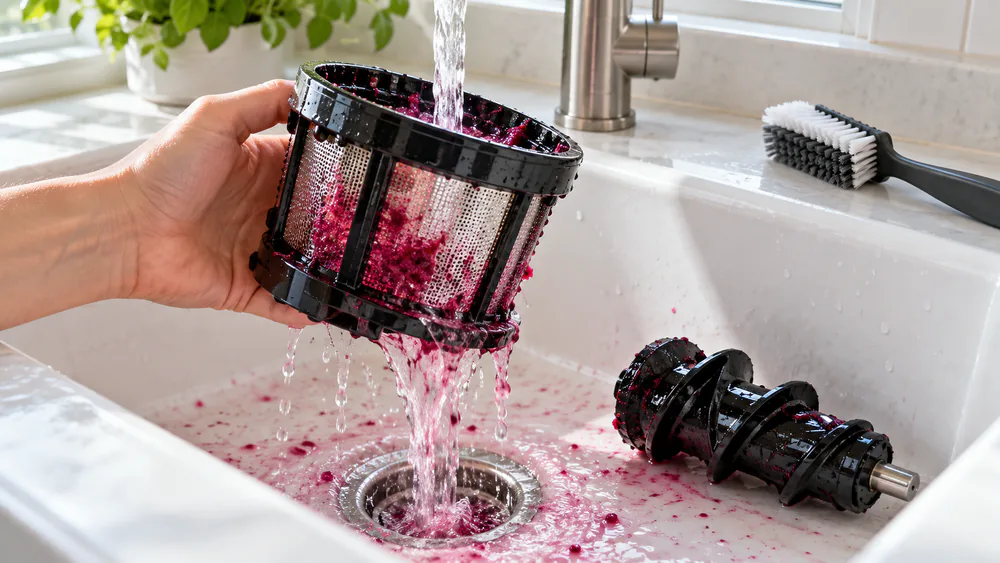
Tip. Remove the pulp and wash parts right after juicing. Beet residue stains and gets harder to clear once it dries. Unplug the machine before taking anything apart.

Check the filter against the light for blocked holes, and never use a damaged one. Keep motor bases out of water.

Pink-stained juicer auger and mesh filter parts rinsed under running water in a white kitchen sink with a cleaning brush beside them

Frequently Asked Questions

Do You Need to Peel Beets Before Juicing?

There is no universal rule. Breville's Cold XL guide says to wash and trim beets, while the Ninja guide removes the skins, so follow the manual for your machine.

Can the Same Juicer Handle Carrots and Beets?

Yes, in most cases. Carrots are easier, so beets set the cutting size and pace for the batch.

Does Beet Juice Turn Urine or Stool Pink?

It can. Beeturia is common and harmless for most people. If it worries you or comes with other symptoms, ask a doctor.

Can Juicer Parts Go in the Dishwasher?

It depends on the model and region. The Ninja's juice-contact parts and the Compact's top-shelf pieces are dishwasher safe, while the European Hurom manual calls for hand washing. Check your own manual.

Final Verdict: Which Beet Juicer Should You Choose?

Choose the Kuvings REVO830 if you juice roots weekly and will cube beets small. Choose the Hamilton Beach Big Mouth for the cheapest way in, the Omega NC900HDC for daily mixed juicing, and the Cold XL for family-size batches. The Ninja suits a small counter, the Hurom shortens washing, and the Compact is for quick small glasses.

Read next

Ready to juice your first beets?

Find more buying advice for the way your household cooks and juices.