As an Amazon Associate we earn from qualifying purchases. We may earn a commission from links on this page, at no extra cost to you. Learn more.
A masticating juicer, also known as a slow or cold-press juicer, grinds and presses produce rather than spinning it at high speed. A single auger chews fruit and vegetables against a static screen at low speed, squeezing out juice with less foam, less heat, and less oxidation than a centrifugal machine's spinning blades. That gentler extraction is the reason slow juicers cost more, and it is the reason most people who upgrade never go back.
The choice is harder than it looks. Slow juicers run from about $80 to more than $700, stand upright or lie flat, and every listing claims the driest pulp and best yield. Sorting the claims from the counter reality is what this guide is for.
We put seven of the most popular slow juicers side by side in our test kitchen, juicing carrots, kale, and apples through every machine to compare yield, ease of cleaning, and noise. Those three numbers decide which machine earns a permanent spot on the counter.
Every machine here spent weeks of near-daily use on our counter before a score was recorded. This roundup is the product of long-term usage testing, not surface-level checks: we ran the batches, cleaned up after them, and let each juicer's everyday behavior decide its place.
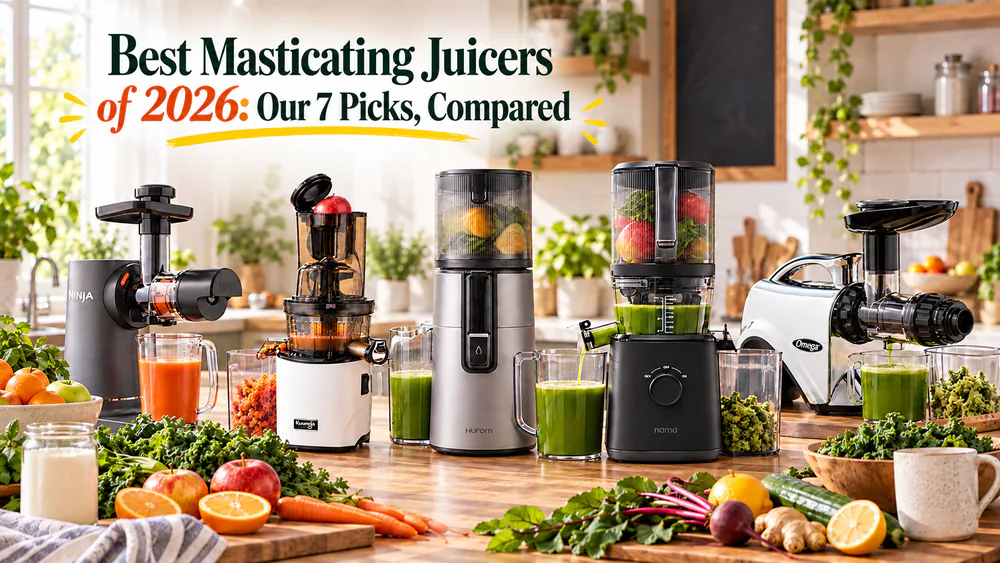
Quick Picks: Best Masticating Juicers at a Glance
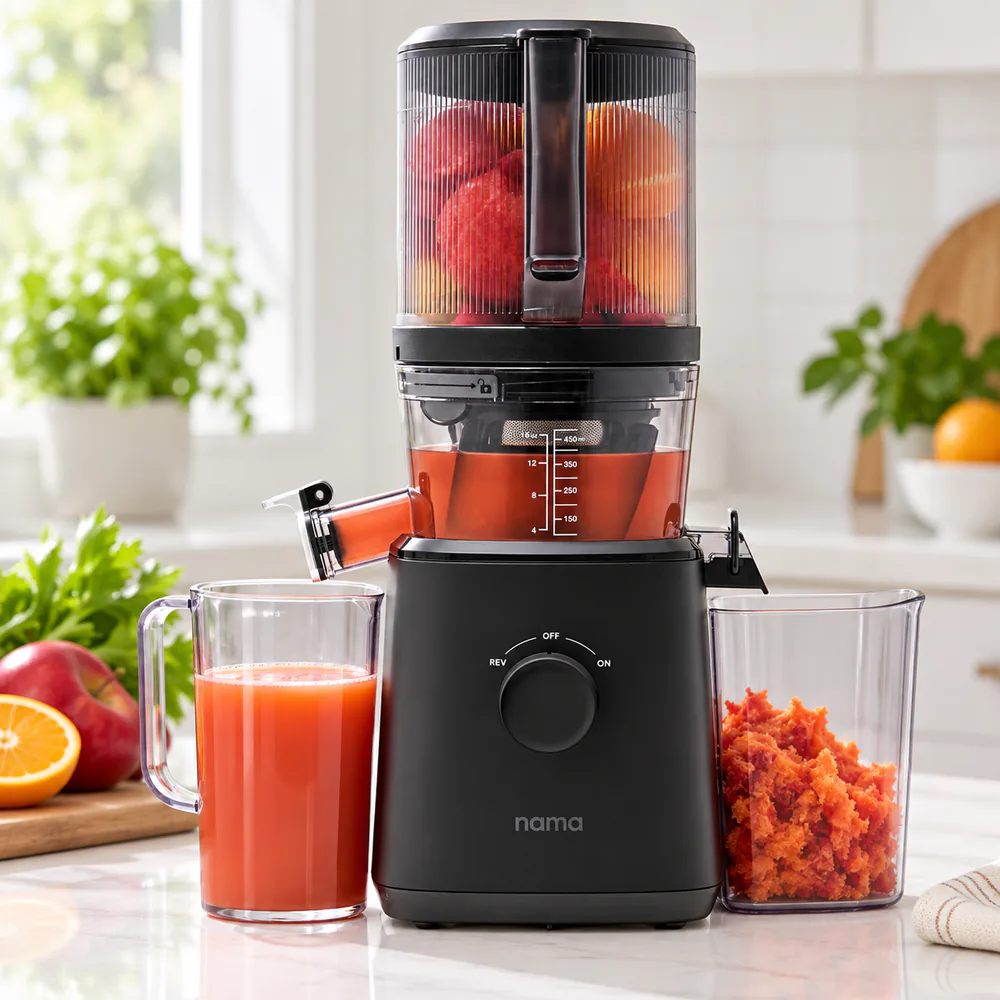
Best Overall: Nama J2 Cold Press Juicer
The most hands-free slow juicer we tested, with a self-feeding hopper that takes a whole recipe.
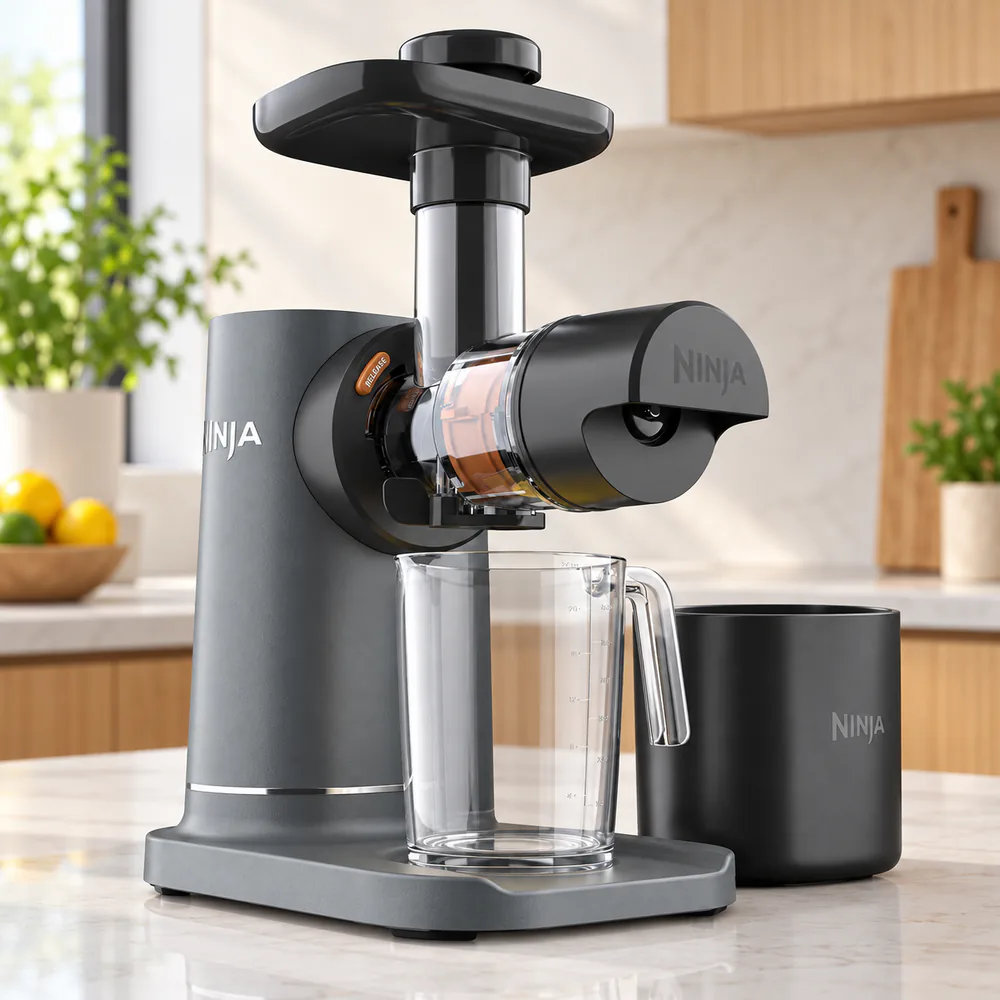
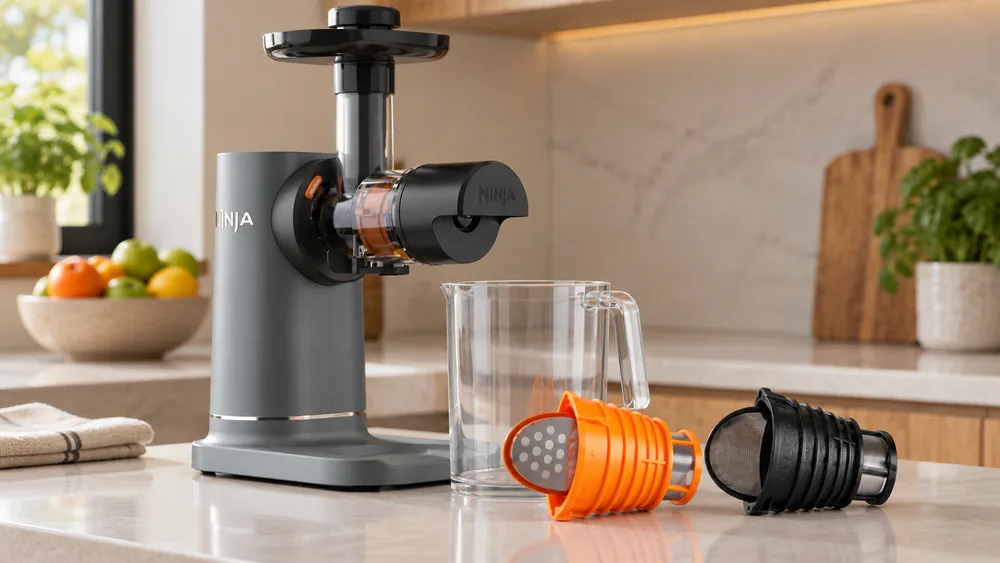
Best Value: Ninja NeverClog Cold Press Juicer
Around $150 with two pulp-texture filters and dishwasher-safe parts.
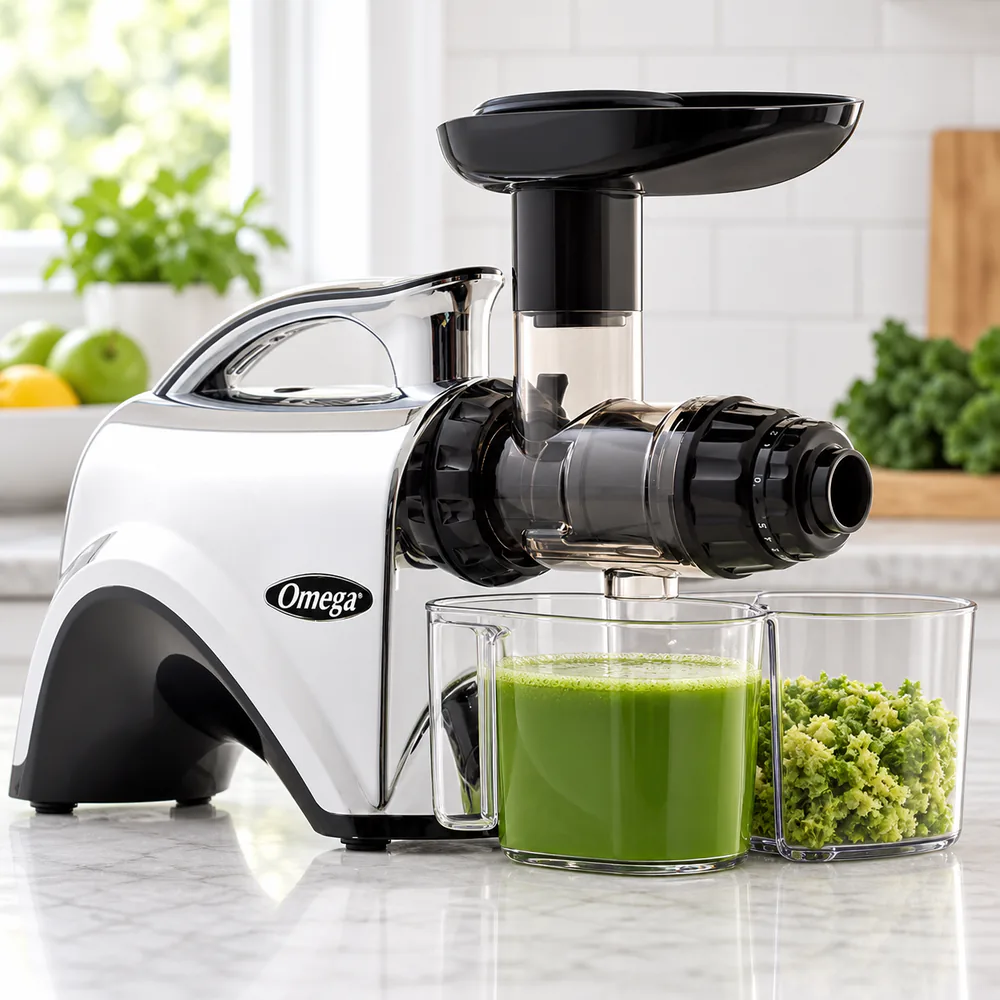
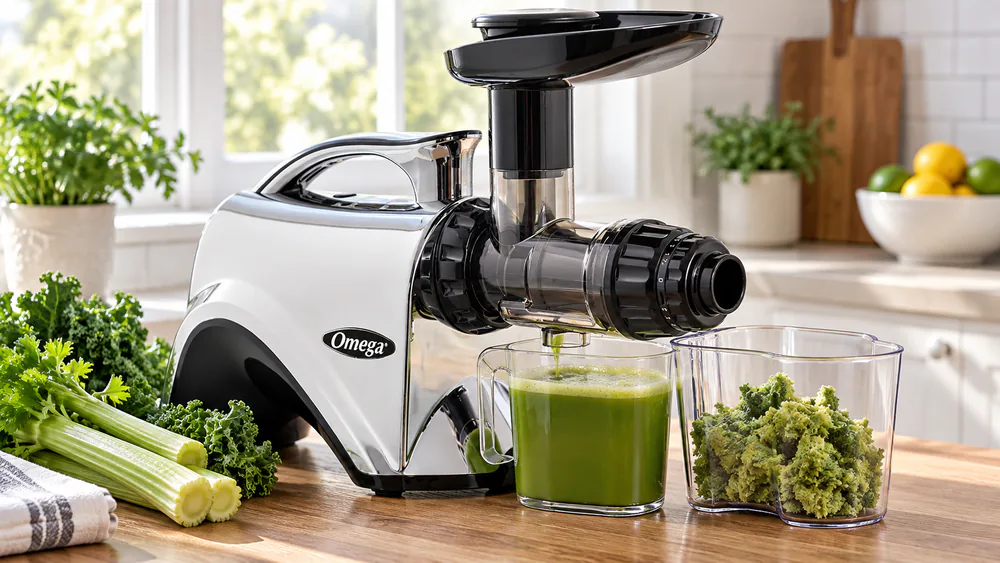
Best for Greens & Celery: Omega Slow Masticating Juicer
A horizontal design that powers through celery, leafy greens, and wheatgrass without jamming.
The full spec picture, side by side. Prices are street prices from our testing window and shift with sales.
Product
Price
Type
RPM
Chute size
Yield
Cleanup
Best for
Nama J2 Cold Press Juicer
$599.00
Vertical
50
Self-feeding hopper (whole recipe)
High, 20-30 oz per load
Moderate, mesh strainer
Best Overall
Ninja NeverClog Cold Press Juicer
$149.95
Vertical
Not published
Small, 2-inch pieces
High, dry pulp
Easy, dishwasher safe
Best Value
Kuvings REVO830
$649.99
Vertical
50
88 mm + 48 mm dual chutes
High, dry pulp
Easy-moderate
Best Premium
Omega NC900 HDC
$275.89
Horizontal
80
About 2 x 1.5 in
High, about 30% more than centrifugal
Fast, about 80 sec
Best for Greens & Celery
Hurom H400
$749.00
Vertical
90
Hopper fits whole produce
High
Easiest, screenless
Easiest to Clean
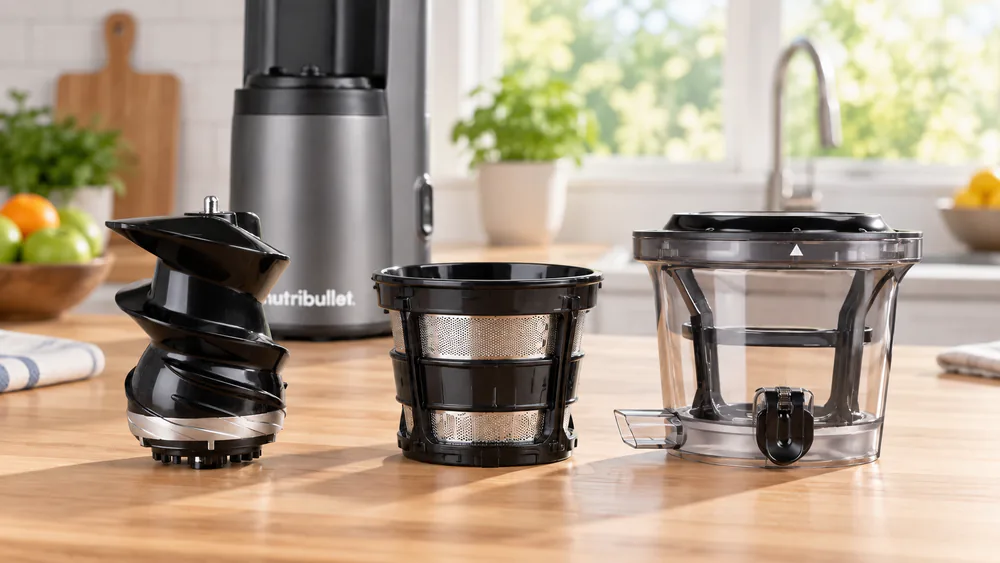
NutriBullet Slow Juicer
$152.29
Vertical
65
3 in
Mixed
Fiddly, mesh screen
Best Wide Chute for Beginners
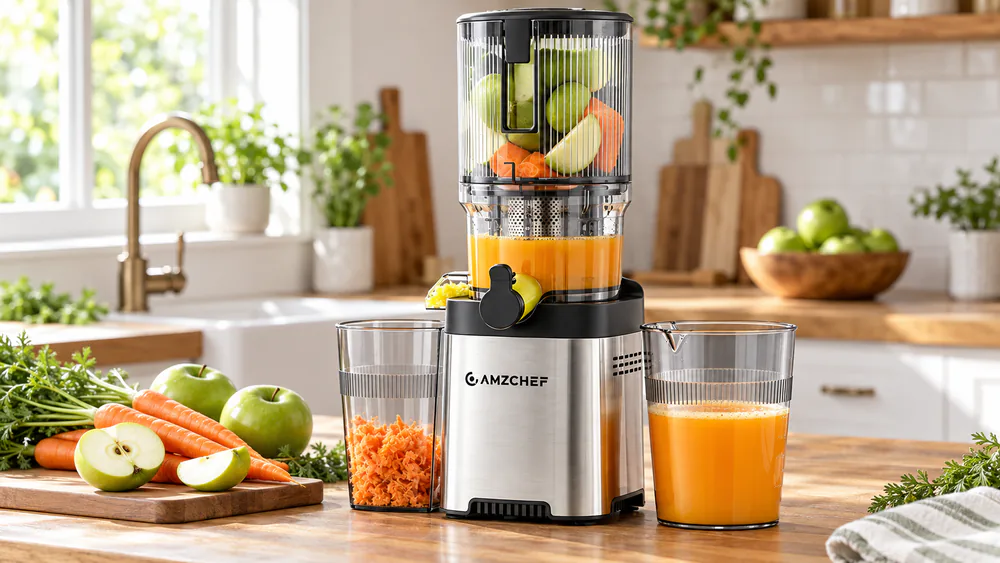
AMZCHEF Slow Masticating Juicer
$79.99
Vertical
Not published
5.4 in
Mixed, wet pulp reports
Easy, parts can bind
Best Budget
How We Tested Masticating Juicers
This is how we picked the seven machines above, and why you can trust the scores.
Our Test Criteria (yield, ease of use, cleaning, durability, performance, design, versatility, juice quality)
Every machine was scored on the same eight criteria, with yield and cleaning weighted the heaviest, since those are the two reasons a slow juicer wins or loses a place on the counter. Noise was tracked inside performance, and the ratings above are the rounded averages of the eight scores.
What We Juiced and How We Scored (7 produce types, per-item scores)
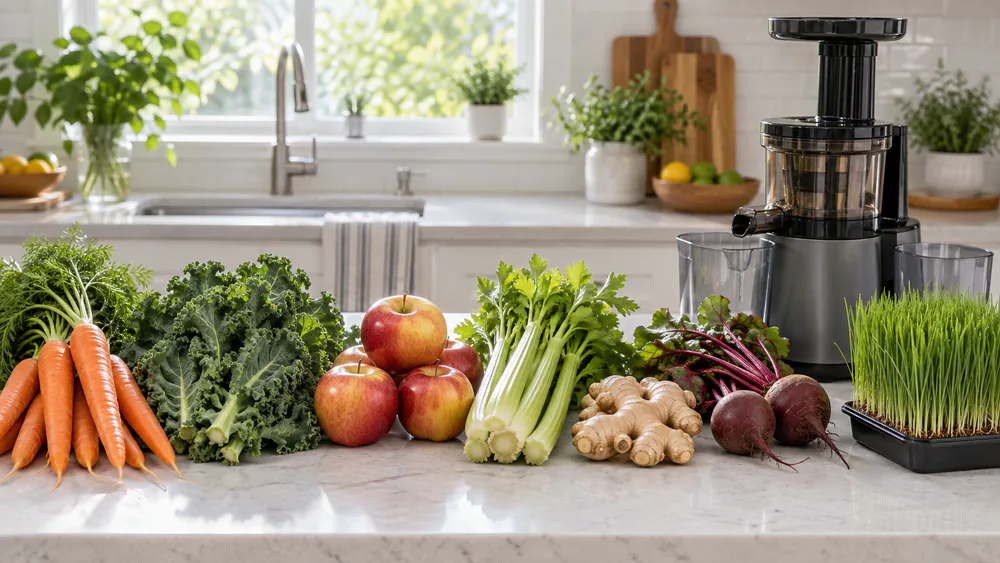
We juiced seven produce types in every machine: carrots for the dense-root test, kale and leafy greens for the fiber test, apples for everyday soft fruit, celery for long stringy stalks, ginger for tough fiber, beets for density, and wheatgrass for the greens specialist. Each produce type was scored separately, so a machine that aces apples but chokes on celery shows it. We weighed the juice and the pulp on a kitchen scale, timed every cleanup, and logged a decibel reading on each run. Hurom's published coverage puts its noise at about 60 to 64 dB, quiet enough for early mornings, while a centrifugal comparison unit ran past 90. Cleanup time ranged from about 80 seconds on the Omega to the NutriBullet's multiple brush-and-rinse rounds.
Seven produce types, one scoring sheet, run through every machine.
Why You Should Trust Us: Who Tested
Every juicer here was put through the same test: the same produce, the same scoring sheet, the same counter.
We bought all seven machines at retail with our own money. No manufacturer supplied a test unit, and none paid to be featured, so the only thing competing in this roundup is the juicing itself. That hands-on, real-world testing is the protocol behind every review we publish, and it is how these seven machines spent their weeks of near-daily use on our counter.
Durability judgments lean on warranty terms, materials, and the failure patterns our machines showed, not a single weekend of heroics. The Guardian's April 2026 hands-on test ran 30 lb of produce through a lemon, cucumber, apple, ginger, celery, and kale recipe. It named the same overall winner we did, the kind of outside corroboration we like to see. We publish weaknesses next to strengths, and every pick's limits appear in its cons list rather than being buried in the fine print.
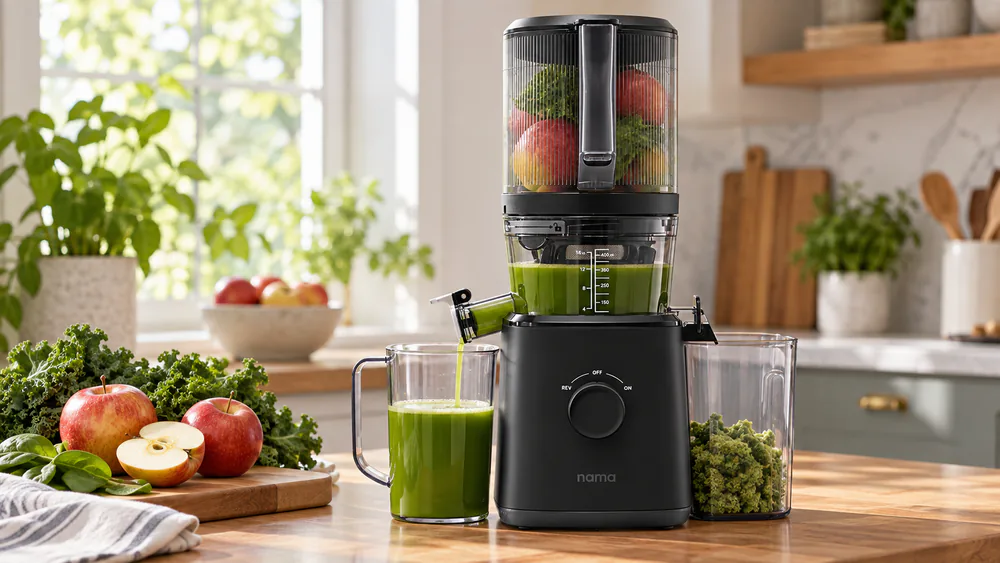
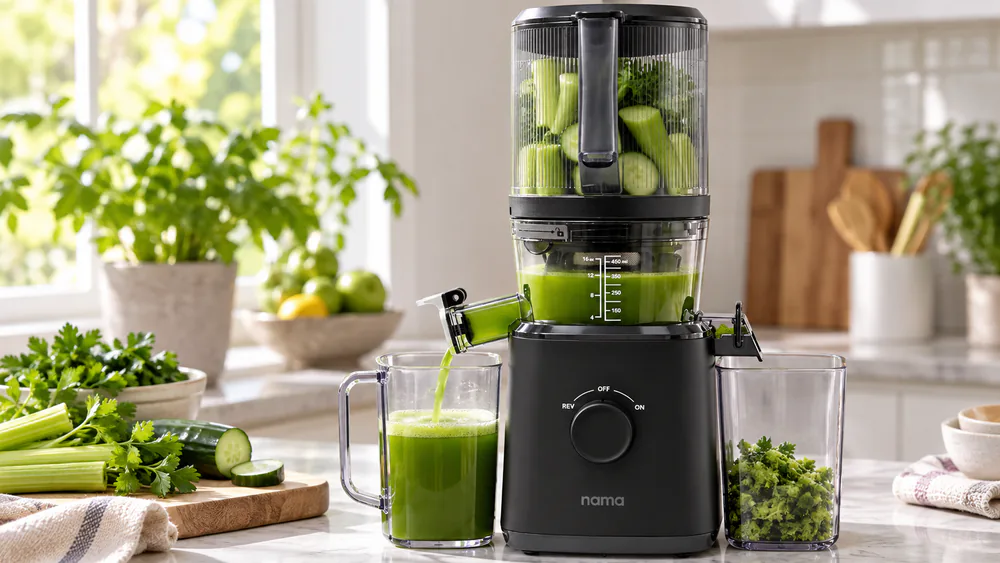
The Nama J2 Cold Press Juicer is the most hands-free slow juicer we tested. We loaded the hopper with celery, half a cucumber, parsley, and one orange, pressed the single button, and walked away. When we came back, the auger had finished the whole batch and left about 9 oz of bright green juice in the container. The self-feeding hopper genuinely lets you load a whole recipe at once, though long stringy items still get cut short first, and tightly packed greens can stall the auger. Coming from cheaper machines, we got dramatically more juice, drier pulp, and less foam, and it runs quieter than the centrifugal machines in our kitchen. That combination of hands-free yield and quiet operation is why it takes the top spot.
Pros
Self-feeding hopper takes a whole recipe at once
High yield with drier pulp and less foam
Quiet 200 W motor at 50 RPM
15-year warranty on all parts
Makes smoothies, soups, sauces, and plant milks
Cons
Long stringy items still need cutting before the hopper
Tightly packed greens can stall the auger
Roughly 13 parts to assemble, with a short learning curve
A $599 price that is steep for casual juicing
It runs at 50 RPM on a 200 W motor, and Nama rates the hopper at 20 to 30 oz of juice per load. The unit weighs 12.1 lb with the chamber set, fits under standard cabinets at 17.7 in tall, and the price is $599.00, with street pricing that moves week to week and drops during sales. Nama's own product page, Nama J2, lists the one-button operation plus smoothie, soup, sauce, and plant-milk modes, covered by the 15-year warranty on every part.
The J2 hopper takes a whole recipe, though long stringy items get cut short first.
Nama J2 Pros and Cons
The J2 is the pick for walk-away batches, and the Hurom takes less of your evening if cleanup matters more. The Ninja covers the same ground for less money.
2. Ninja NeverClog Cold Press Juicer – Best Value
Ninja NeverClog Review: NeverClog Technology & Pulp Control
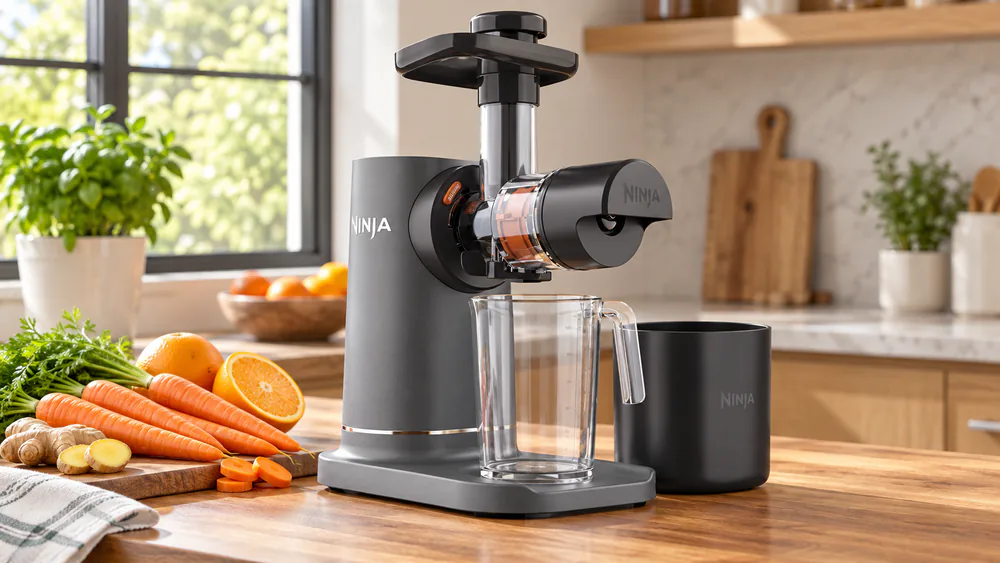
Where the J2 asks you to pay for hands-free convenience, the Ninja NeverClog Cold Press Pro goes the other direction on price. It turned out some of the driest pulp we saw in the roundup, the fastest way to tell a slow juicer is working. One prep-heavy morning we cut berries, lemons, melons, ginger, carrots, and cantaloupe down to about 2-inch pieces, and the whole batch ran clean through the auger. Apples were the one exception: a full-size chunk set off a squeal, and cutting the pieces smaller tamed it. We re-ran the pulp once, and the second pass still pulled more juice from the same produce. The friction point is the feed opening, which is small: everything goes in as roughly 2-inch pieces, so prep takes longer than extraction. That dry pulp at about $150 is what makes it the value pick of the roundup.
Pros
Around $150 with serious extraction value
All juice-contact parts are dishwasher safe
Two pulp filters for texture control
Compact, under-cabinet footprint
24 oz jug plus 36 oz pulp container
Cons
Small feed opening: 2-inch prep on everything
Apples and hard produce can bring on a squeal
Leafy greens are the one place it can clog
1-year warranty
The JC151 runs a 150 W high-torque auger motor with two one-touch programs, Start/Stop and Reverse. An anti-drip lever keeps the counter clean, every juice-contact part is dishwasher safe, and the machine weighs about 7.9 lb with a compact footprint that fits under cabinets. Pricing sits around $149.95, street prices move week to week, and the warranty is 1 year in the US, short for a motor appliance.
Ninja NeverClog Pros and Cons
This is the pick for a first slow juicer when you don't want to spend big: it cleans up fast, and the dry pulp tells you it is working. If greens are your main ingredient, the Omega in section 4 is the safer bet.
Total Pulp Control: two filters switch the texture from fine to pulpy.
3. Kuvings REVO830 Whole Slow Juicer – Best Premium
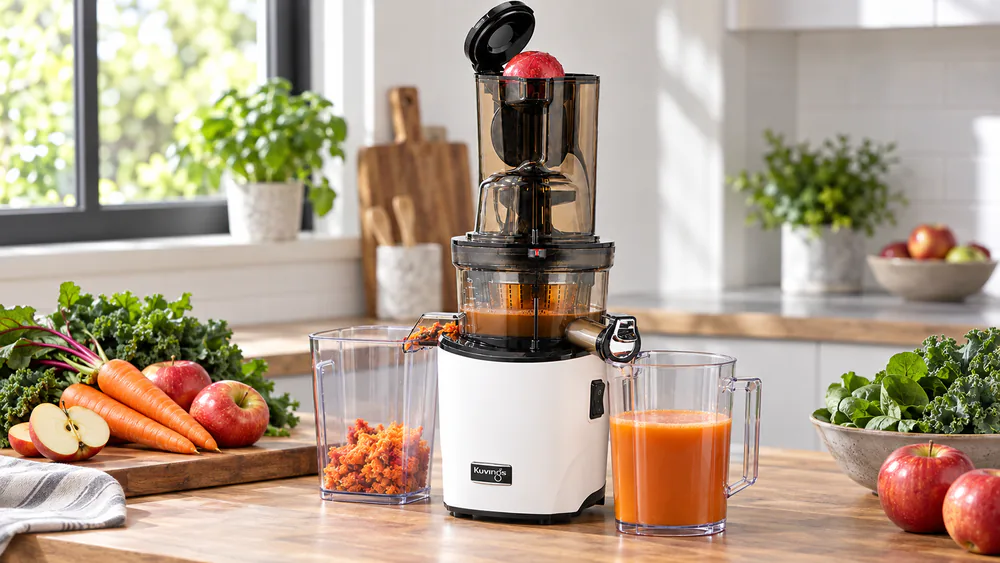
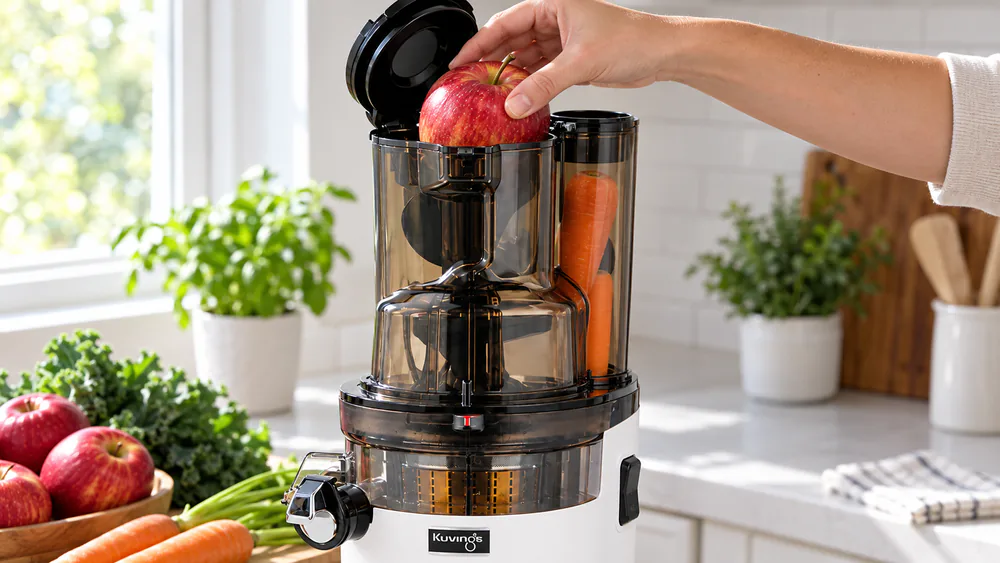
Kuvings takes the whole-fruit idea further than anyone else in this roundup. The Kuvings REVO830 swallowed whole apples, carrots, celery, beets, and cucumbers through its 88 mm flip-gate chute with no pre-cutting, and a second 48 mm auto-cut chute pre-slices long fibrous produce as it goes. Pulp came out noticeably dry in our runs, the marker we look for in effective extraction, and the motor ran quietly through its rated 45 minutes of continuous use. The whole-fruit promise has limits: one unit stopped powering on after about 10 uses, and a whole beet broke another, so treat the flip gate as a convenience, not a license to feed it anything.
Pros
Whole-fruit feeding that skips the cutting board
Quiet motor rated for 40 to 45 minutes of continuous use
15-year warranty
Smoothie, sorbet, and nut-milk strainers included
BPA-free Ultem, Tritan, and stainless construction
Cons
A $649.99 price that is firmly premium
Heavy at about 16.5 lb
Whole-fruit feeding has real limits
Turmeric leaves a resin that can compromise the lid seal over time
The REVO830 is a 240 W machine with a 50 RPM auger, and it ships with juice, smoothie, sorbet, and nut-milk strainers. It is the heavy pick at about 16.5 lb, though the stackable square jugs keep the footprint tidy, and it is built in South Korea. The price is $649.99, street pricing moves week to week, and the warranty runs 15 years.
The 88 mm flip gate clears whole fruit, but not everything belongs in it.
Kuvings REVO830 Pros and Cons
If prep is the reason you are reading a juicer roundup at all, the REVO830 is the one to beat, assuming the price fits. It is the machine we would call a lifetime buy for serious daily juicers.
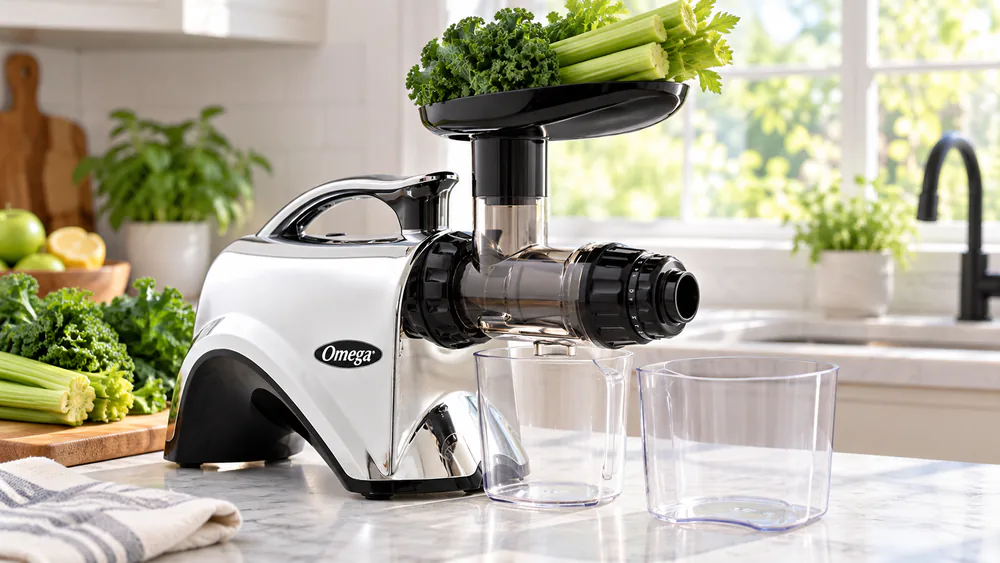
4. Omega NC900 HDC Nutrition Center – Best for Greens & Celery
Where the first three picks stand upright, the Omega NC900 HDC Nutrition Center lies flat, and that shape is exactly why it wins on greens. We ran celery, ginger, carrots, wheatgrass, and turmeric through it without a single jam, the batch of hearty roots that stalls vertical machines. The horizontal auger squeezes every last drop from a stalk: in our side-by-side runs it produced roughly 30% more juice than the centrifugal comparison unit, and five end-cap pressure settings dial the yield in either direction. It is also the quietest juicer we have used, and it handled a full celery-juice morning routine without complaint.
Pros
Best greens, celery, and wheatgrass performance in the group
Five end-cap pressure settings for yield control
Automatic pulp ejection for continuous juicing
Attachments handle nut butter, baby food, pasta, and coffee grinding
15-year warranty
Cons
Horizontal footprint takes more counter length
Screen durability is mixed at the margins
Dishwasher safe, but hand washing is recommended
The NC900 runs a 150 W motor through a gear reduction rated like a 2 HP motor, at 80 RPM, and the dual-stage extraction ejects pulp automatically so it can run continuously. The feed tray opening runs about 2 by 1.5 in, roughly 82% larger than the opening on the older J8006, and the extra-large tray takes a full bundle of celery at once. The included attachments turn the base into a nut butter, baby food, pasta, and coffee grinder. It lists at $399.95, usually sells around $275.89 with frequent deals closer to $200, and the warranty runs 15 years.
Omega NC900 Pros and Cons
If your juice is mostly celery and leafy greens, stop reading here; this is the one. If you only juice soft fruit, the vertical picks above serve you just as well on a shorter counter.
The flat auger path is what lets long stalks flow through without tangling.
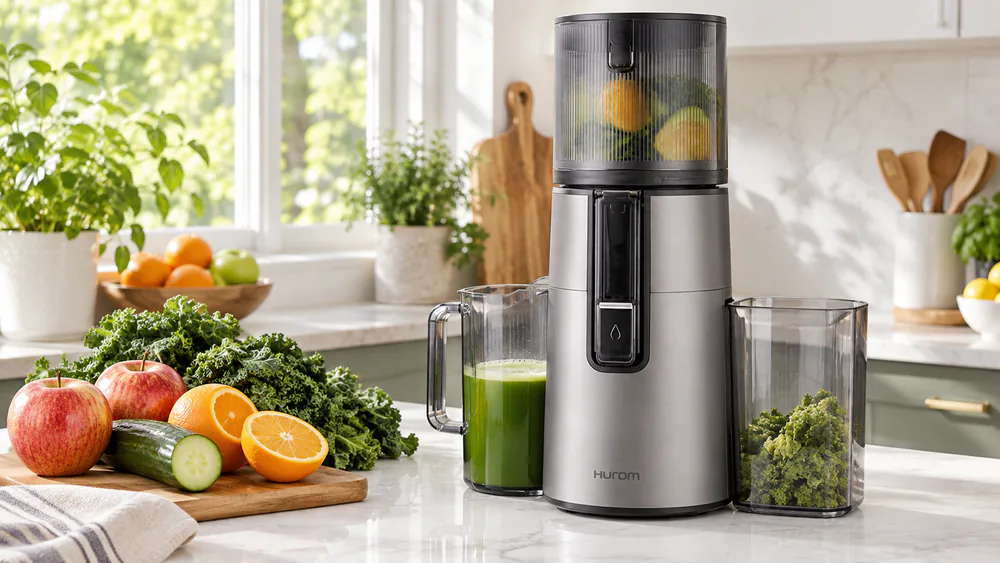
5. Hurom Easy Clean Slow Juicer – Easiest to Clean
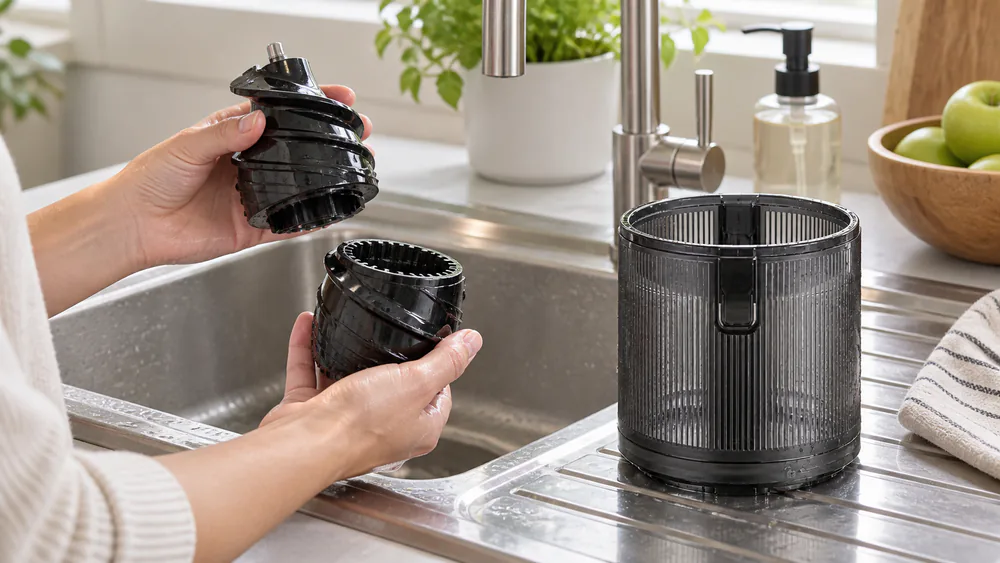
If the Omega is the greens specialist, the Hurom H400 is the machine you buy when cleanup is the first priority. Its screenless chamber is the whole trick: the two-piece auger doubles as the strainer, so about three parts sit in the sink instead of a mesh screen. The chamber rinsed clean faster than any mesh-screen juicer we have used. Hurom's own published coverage, Hurom H400 Easy Clean Slow Juicer, puts its noise at about 60 to 64 dB, quiet enough for early mornings in apartments with thin walls. It is not miracle-level clean: there is still produce prep, and celery clogged the pulp outlet mid-batch on our first greens run, so the pulp container stays handy. The spout seal also wants periodic attention to keep from leaking, which is the price of that clean design.
Pros
Screenless chamber: the fastest cleanup in the group
Whisper-quiet at 60 to 64 dB
Wide-mouth hopper fits whole produce
Sorbet and ice cream without changing strainers
15-year warranty coverage (US terms)
Cons
A $749 list price, the most expensive pick here
Heavy and tall at 14.8 lb and 18.5 in
Celery can clog the pulp outlet mid-batch
Spout seal needs periodic maintenance
The H400 runs a 150 W AC motor at 90 RPM with a 550 mL chamber, and it handles up to 30 minutes of continuous use. The wide-mouth hopper fits whole produce, a juice level gauge window shows when the jug is full, and it makes sorbet and ice cream from frozen fruit without changing strainers. It is the big one in the group at 14.8 lb and 18.5 in tall, so measure the counter spot first. The list price is $749.00, it often sells around $669, and US warranty coverage runs 15 years on motor and parts, with terms that vary by region.
Hurom Pros and Cons
Buy the H400 when you juice daily and hate cleanup more than any other kitchen chore. For occasional weekend batches, the price is hard to justify.
No mesh screen: the auger doubles as the strainer.
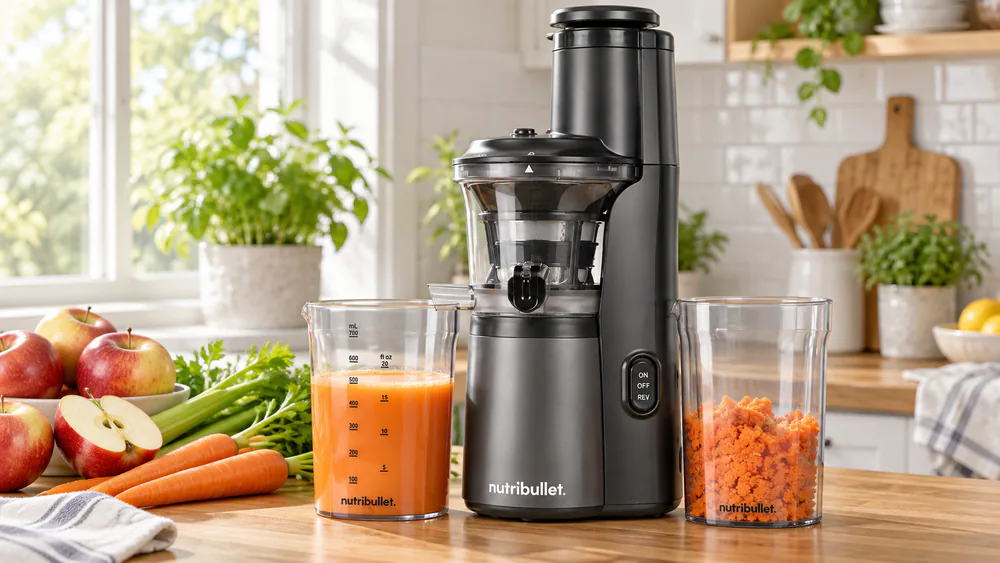
6. NutriBullet Slow Juicer – Best Wide Chute for Beginners
The NutriBullet Slow Juicer sits at the beginner end of this list: the most familiar blender name in the group, with a price to match. When it works, the pulp comes out practically dry, the machine runs quiet next to a blender, and the 3-inch chute is genuinely beginner-friendly. The trouble is everything between the hopper and the jug: assembly is fiddly, the auger is hard to take apart, the mesh screen is the cleanup pain point, and the machine sometimes stops mid-run until parts are re-seated correctly. It also struggles with celery and ginger even cut small: pulp clogs the chute, the machine overheats and auto-shuts off as a safety measure, and beets and thick carrots are the same kind of trigger.
Pros
Wide 3-inch chute is beginner-friendly
Dry pulp and quiet operation when it runs
Compact footprint at a starter price
Steel-tipped auger and stainless-steel sieve
Cons
Fiddly to assemble and disassemble
Clogs and overheats on celery, ginger, beets, and thick carrots
Plastic parts and containers are the durability weak spot
Mesh screen is a cleanup pain point
1-year warranty
The NBJ50300 runs a 150 W high-torque low-speed motor at 65 RPM, with a 3-inch feed chute and a 24 oz juice container, and it assembles to about 7 in long, 6.25 in wide, and 17 in tall. The steel-tipped auger and stainless-steel sieve are the right materials at this price. Pricing sits around $152.29, street price moves week to week, and the warranty is 1 year.
NutriBullet Pros and Cons
This is the honest trade: the NutriBullet is priced and shaped for beginners, but it wants soft produce and patience. Apples, berries, and melons are its lane; celery and ginger will send you to the Omega.
Every batch ends with a re-seat: parts sometimes need a nudge to click back in.
7. AMZCHEF / Aicok Slow Masticating Juicer – Best Budget
Budget Slow Juicer Review: What You Give Up vs. Gain
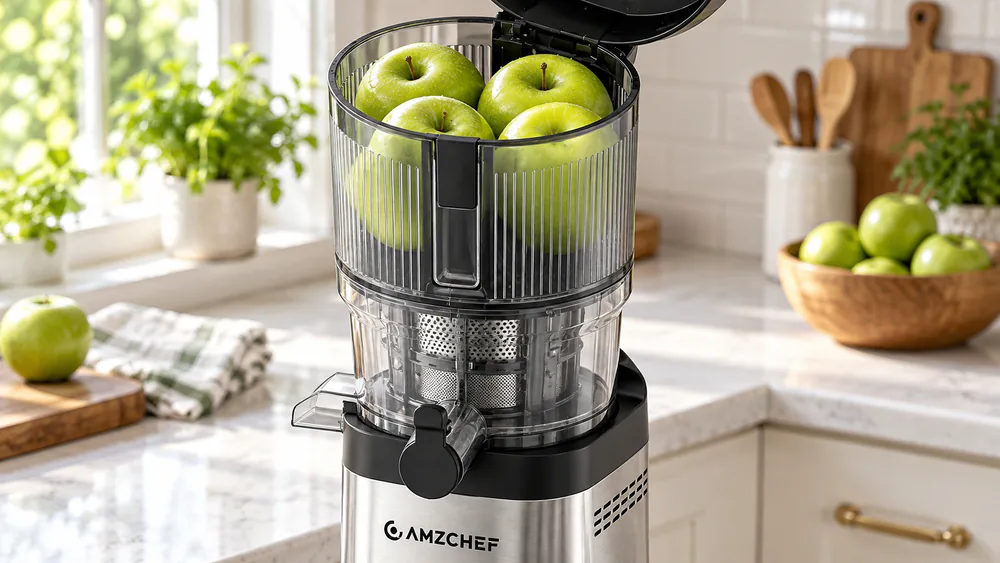
And if the real budget is around $80, the AMZCHEF Slow Masticating Juicer is where we would start. Its 5.4-inch chute is the headline: we dropped about four Granny Smith apples into it at once, and the self-feeding design really does skip most of the chopping. Carrot juice came out great at a fraction of what cold-press cafes charge, the machine ran quiet enough for early-morning juicing, and cleanup is a simple rinse-down. The trade-offs show up in the details: pulp can come back wet, and one pineapple batch wanted a re-spin. Parts can bind or refuse to come apart after juicing, which we saw more than once, and the motor wants short breaks on long sessions. Greens are a split: the machine squeezes spinach, kale, and wheatgrass acceptably, but it is not in the Omega's class for them.
Pros
About $80 for a genuine masticating juicer
Quiet early-morning operation
Simple rinse-down cleaning
3-year warranty
Cons
Pulp can come back wet
Parts can bind and resist disassembly
Greens results are mixed
Motor wants short breaks on long sessions
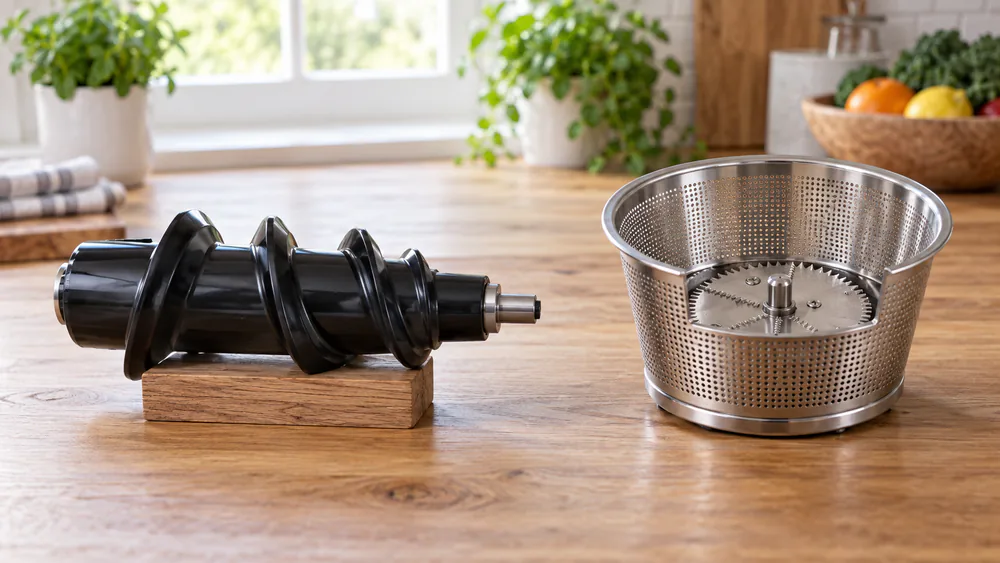
The AMZCHEF lists at $79.99 with a 5.4-inch extra-wide chute, a spiral auger, triple strainers, a stainless-steel blade, and a full stainless body. The listing publishes no wattage or RPM, so judge it by the chute and the price. The warranty runs 3 years, which is better than machines costing twice as much.
Four apples at once: the reason the AMZCHEF skips most chopping.
Budget Slow Juicer Pros and Cons
The AMZCHEF is a real masticating juicer at a price that undercuts every other pick, and it is the right answer to a whole-apple craving on a budget. Keep expectations calibrated on pulp and greens, and it earns its place.
How to Choose the Best Masticating Juicer: Buying Guide
Seven reviews, one takeaway: the machine that wins is the one that fits your kitchen. Here are the criteria that matter.
Masticating vs. Centrifugal Juicers: Key Differences
All juicers fall into two camps. A masticating juicer uses a single auger to compact and crush produce against a static screen at roughly 40 to 110 RPM, while a centrifugal juicer cuts with a spinning blade and separates juice by spinning at high speed. The full mechanics of slow juicers vs centrifugal juicers are laid out on Wikipedia. The slow crush means less heat, less foam, and less oxidation, and it usually leaves pulp drier, which is more juice in your glass. The costs are speed and noise: centrifugal models commonly run past 90 dB, about 30 dB louder than a quiet slow juicer, which is why slow machines own the early mornings.
Crush and press versus spin and shred: the two ways to get juice from produce.
Horizontal vs. Vertical Masticating Juicers
Horizontal machines like the Omega NC900 lie flat and take more length than height, and the straight auger path is what lets celery, leafy greens, and wheatgrass flow through without tangling. Vertical machines like the rest of our picks stand upright, take less counter width, and usually pack bigger hoppers. They need counter clearance for whole carrots and celery, and that height is a fit check people miss until the machine arrives. Measure the counter and the cabinet above it before you buy, whichever direction you choose.
Feed Chute Size and Prep Time
Chute size sets your prep time. Our picks span the full range: the Ninja's small opening wants roughly 2-inch pieces, and the AMZCHEF's 5.4-inch opening fits four apples at once. In between sit the NutriBullet's 3-inch chute and the Kuvings' 88 mm flip gate with its 48 mm auto-cut companion. The J2 and the Hurom skip the chute entirely with self-feeding hoppers, though the J2 still wants long stringy items cut short.
Tip. If you juice daily, a wide chute saves you ten minutes a morning; if you juice on weekends, prep time matters far less.
RPM, Motor Power, and Noise
RPM is the spec everyone quotes and the one that matters least at the extremes. The usable masticating band runs roughly 40 to 110 RPM, and our picks sit between 50 and 90, all slow enough for low-oxidation juice. What the number changes is noise and torque feel: our quietest pick runs quiet enough for early mornings, where a centrifugal machine is dramatically louder. Motor power, 150 to 240 W across our group, matters more for continuous running. The Kuvings is rated for the longest continuous sessions, the Hurom for 30 minutes, and the AMZCHEF wants short breaks on long sessions.
Juice Yield and Pulp Dryness
Yield is the reason most people upgrade from a centrifugal machine, and pulp dryness is the visible proof of extraction. In our runs the horizontal Omega delivered the clear yield advantage, the J2 turned in the largest single-load output of the group, and the Ninja and Kuvings both showed pulp dry enough to prove the auger was working. The nutrient story is quieter than the marketing: the research is mixed, with a 2019 study finding no significant differences in ascorbic acid, phenolics, or antioxidant capacity between slow and centrifugal juicers. Buy a slow juicer for yield, foam, noise, and greens performance, not for a magic nutrient edge.
Ease of Cleaning and Maintenance
Cleanup is where a slow juicer earns or loses its counter spot. Most machines have at least six components to disassemble, and dishwasher heat can dull or warp parts over time, so the included brush is the standard tool for strainers and pulp chutes. Our group spans the extremes: the Hurom's screenless chamber rinses fastest, and the Omega cleaned up in about 80 seconds in our hands. The Ninja and AMZCHEF are simple rinse-downs, while the NutriBullet's mesh screen is the one genuine pain point.
Tip. Buy the juicer you will actually clean. A machine that stays in the cabinet because the strainer needs brushing is worth less than the budget pick you use every day.
Price, Warranty, and Durability
Slow juicers run from about $80 to $750, and the price ladder maps roughly to motor quality, materials, and warranty. Nama, Kuvings, and Omega all back their machines for 15 years, the AMZCHEF offers 3, and the Ninja and NutriBullet stop at 1, a fair proxy for how long the maker expects the machine to live. Durability in our notes follows the same curve: Kuvings' older models have run daily for a decade before being passed down, and Omega machines run for years on a near-daily rhythm at their best. A 15-year warranty on a $600 machine makes the price worth the investment if you juice daily; at 1 year, plan for a possible replacement.
Frequently Asked Questions
What is a masticating juicer?
It is the same thing as a slow juicer or a cold press juicer: one auger compacts and crushes produce against a static screen instead of spinning blades that shred at high speed. That slow crush is what keeps foam down and yield up.
Is a masticating juicer the same as a cold press juicer?
Yes, the names are interchangeable. Cold press describes the low-heat, low-oxidation extraction that slow crushing produces, and masticating describes the chewing, crushing action of the auger. If a listing says cold press, it is a masticating or slow juicer.
Is a masticating juicer better than a centrifugal juicer?
Usually, yes, for yield, less foam, quieter operation, and greens performance, which is the trade most buyers are making. Centrifugal machines win on speed and price, and they are the louder machine in the kitchen. If greens and early mornings are your routine, the slow auger is the better tool.
Which masticating juicer is best for leafy greens and wheatgrass?
The horizontal Omega NC900 HDC. A horizontal auger has a straight feed path, so long fibrous material like celery, kale, and wheatgrass flows through without tangling, which is why it never jammed in our greens runs. It also handles turmeric without getting stuck.
How long does masticated juice last in the fridge?
About 72 hours, or 3 to 4 days if it stays below 41 F and you add something acidic like lemon. For peak nutrients, drink it within 20 minutes of juicing, because oxidation starts the moment the produce is crushed.
How do you clean a masticating juicer?
Rinse the parts in order right after the batch, starting with the auger and strainer, and use the included brush on the strainer mesh and pulp chutes. Warm water and hand washing are the safe default. If you want to use the dishwasher, check whether your manual allows it, since heat can dull or warp the strainer over time.
Are masticating juicers worth the extra money?
If you juice most days, yes: drier pulp, quieter mornings, and less foam, with the top machines working out to pennies a day. If you juice a couple of times a month, the budget picks under $150 cover you well enough.
Final Verdict: The Best Masticating Juicer for You
Match the machine to your bottleneck, because every pick in this roundup squeezes juice well. If chopping is the wall, the Kuvings REVO830 swallows whole fruit. If cleanup is the wall, the Hurom H400 is the fastest rinse in the group. If price is the wall, the AMZCHEF at about $80 and the Ninja at about $150 both deliver real masticating extraction, and if greens and celery are the routine, the Omega NC900 is the specialist. Should the J2's price give you pause, the runner-up math is simple: the Ninja NeverClog covers most of the same yield for a quarter of the cost. What we would do differently next round is spend more bench time on the sorbet and nut-milk strainers, since the Kuvings and Hurom both ship them, and that is where the premium machines justify their price.