As an Amazon Associate we earn from qualifying purchases. We may earn a commission from links on this page, at no extra cost to you. Learn more.
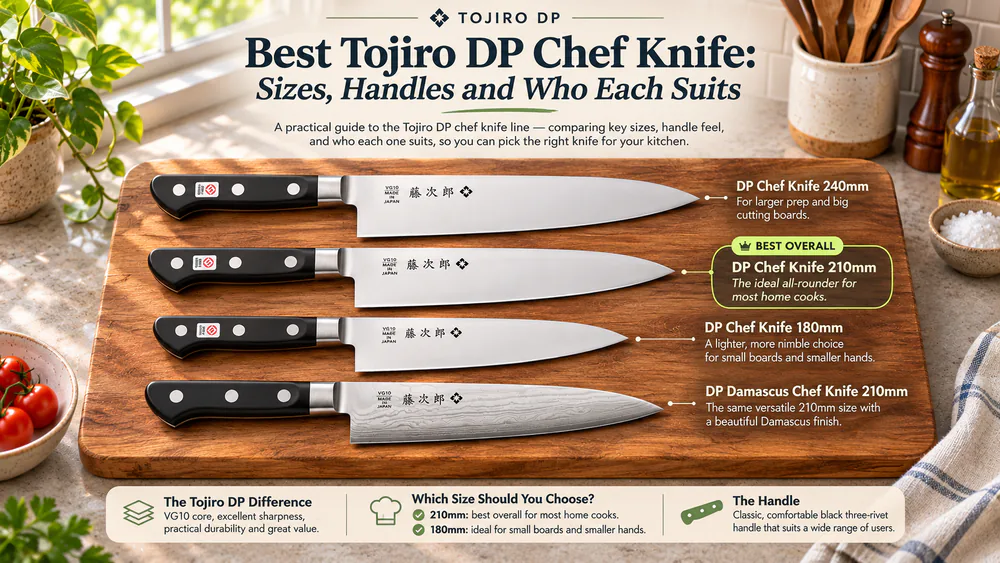
The Tojiro DP gyuto is a Japanese chef knife with a VG10 core wrapped in 13-chrome stainless steel, built in three layers and now sold under the name Classic. It is the workhorse that many cooks pick as a first Japanese knife. This guide ranks the 180 mm, 210 mm, 240 mm and Damascus versions by how they feel in the hand, who each one suits, and what care it asks for.
Quick Picks: Best Tojiro DP Chef Knives at a Glance
Four knives make up the DP gyuto lineup worth shopping, and the right one depends mostly on the size of your board and your hands. Here is the short version before we get into the detail.
The steel and the factory edge are shared across the line, so the real differences are length, weight and finish.
Spec
180 mm
210 mm
240 mm
Damascus
Steel
VG10 core, 13-chrome clad
VG10 core, 13-chrome clad
VG10 core, 13-chrome clad
VG10 core, 37-layer Damascus clad
Hardness (HRC)
60 +/-1
60 +/-1
60 +/-1
About 60
Blade length
180 mm
210 mm
240 mm
210 mm
Weight
Around 185 g
Around 200 g
Heaviest of the three, no firm figure
205 g
Edge angle
Around 15 degrees per side (approximate)
Around 15 degrees per side (approximate)
Around 15 degrees per side (approximate)
Around 15 degrees per side (approximate)
Best for
Small kitchens
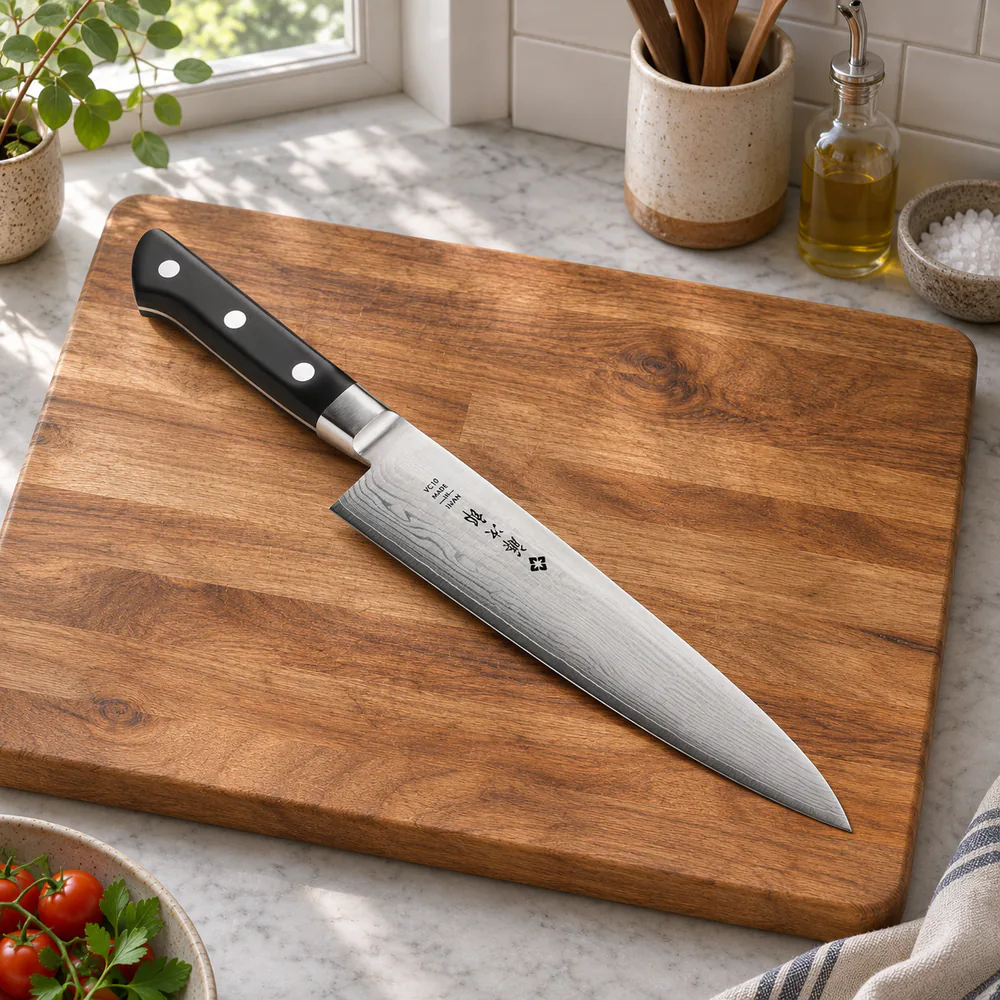
Most home cooks
Large prep
Upgrade finish
How We Tested and Rated These Knives
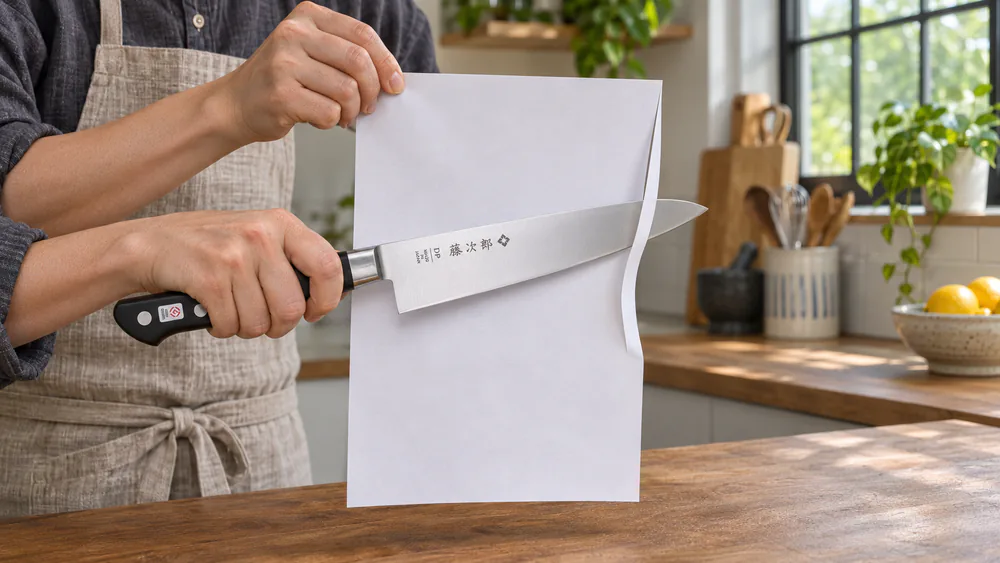
We judge these knives the way a sharpening bench does: by the edge and by the feel in the hand. We check the factory edge on paper, then see how far a fine ceramic rod or a 1000/6000 stone takes it, and we match each length to the board it suits.
Across the 180 mm, 210 mm, 240 mm and Damascus gyutos, the handling pattern is consistent. On a standard 12 to 14 inch home board the 180 mm is the easiest to control. The 240 mm wants a deep board of about 16 inches or more and balances at the heel. The 210 mm shaves paper out of the box and takes a higher edge from a 1000/6000 stone or ceramic rod. The Damascus cuts like the plain DP, since the layered cladding adds looks and some food release rather than edge performance.
Our ratings weigh four things. Out-of-the-box sharpness and how the edge cuts come first, since a knife that cannot push-cut a tomato cleanly fails at its main job. Handle comfort and balance come second, because a handle that tires the hand ends a prep session early. Edge retention and sharpening response come third. Care demands and value for the tier come last. If you want to see how the DP compares with other blades we have handled, our Japanese knife reviews cover the wider field.
One note on naming before we start. Tojiro renamed the DP line to Classic, and the knife itself is unchanged, with the same model numbers. You will see both names on shelves, and the Fujitora DP name turns up as well. We use DP throughout because that is what most shoppers still type.
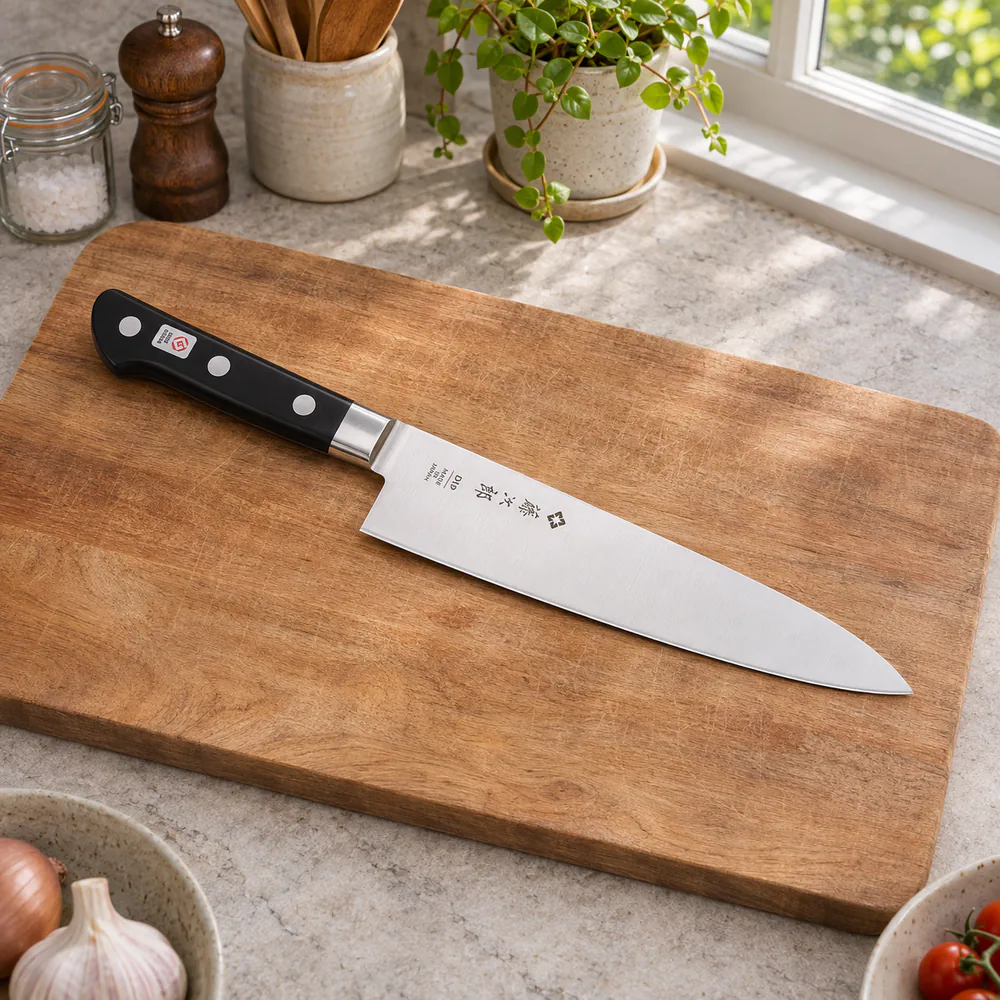
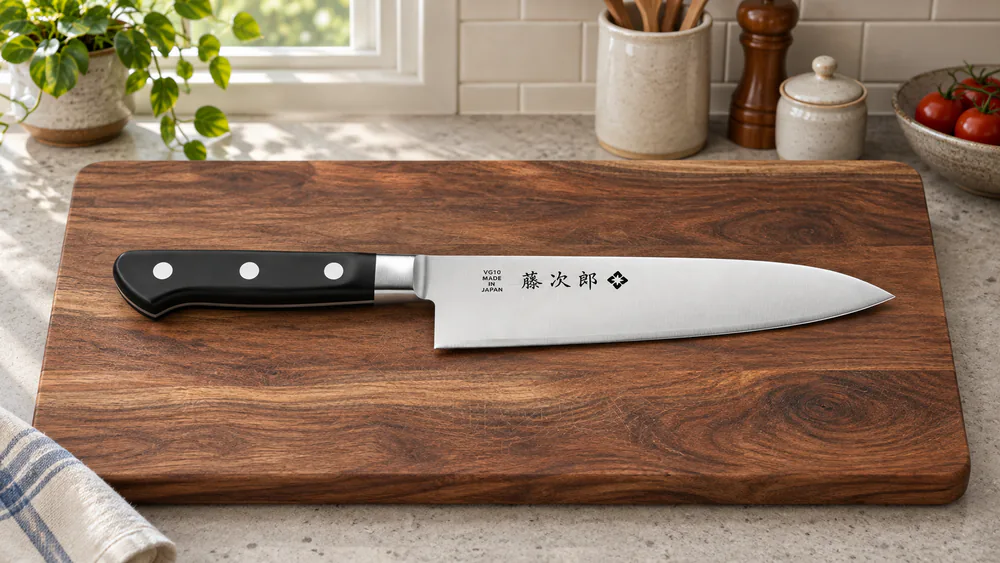
The F-808 is the DP we would hand to nearly anyone moving up from a block knife, and it is the size we would buy first. Straight out of the box, it shaved paper in our test and felt noticeably keener than a block of German knives; a fine ceramic rod or a 1000/6000 stone refines the edge further. Its mild curve suits both push cuts and rocking, while the thin edge slips through tomato skin with almost no pressure where a thick German blade needs a sawing stroke.
Shaves and passes the paper test out of the box
Light enough to cut by its own weight
Mild curve bridges Western and Japanese handling
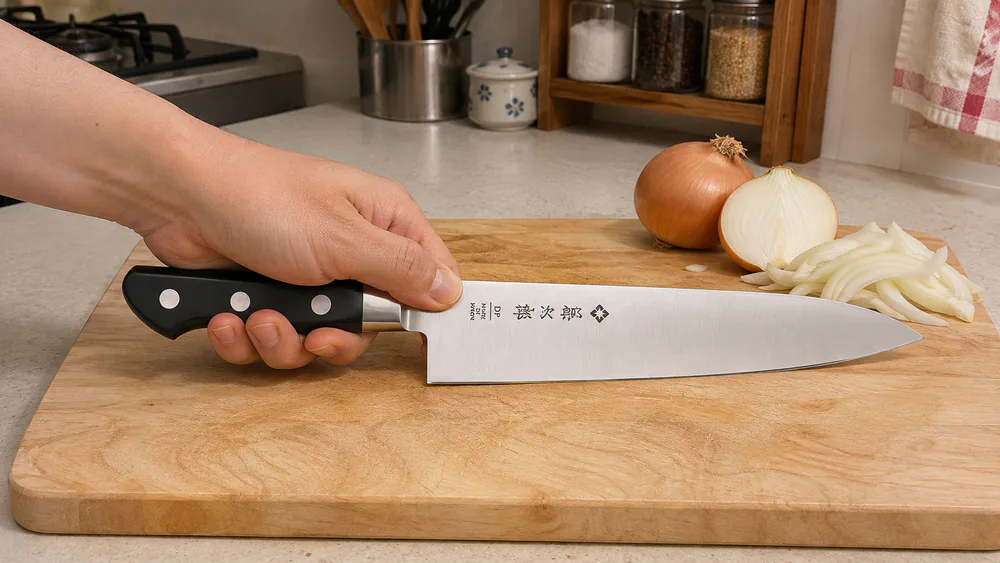
Bolster set back for a comfortable pinch grip
Specifications
Blade length
210 mm
Overall length
About 340 mm
Weight
Around 200 g
Spine
Just under 2 mm
Core
VG10 with 13-chrome cladding
Hardness
60 +/-1 HRC
It is a touch heavier than the ultra-light Japanese knives, which eases the switch from a German knife, yet it is light enough that the blade does the work. We found it comfortable for delicate jobs such as slicing for sushi rolls, and it still handles an onion and a chicken breast without complaint.
The handle is the plainest part of the knife. The utilitarian black laminated handle feels similar to POM and is the least attractive part of the knife, but it remains balanced and secure. The metal bolster sits farther back than on a German knife, so there is room for a pinch grip right at the heel of the blade.
With home sharpening the 210 mm keeps working for years. Minor chips appear after rough use or a drop, and the printed lettering wears off, which is cosmetic and nothing more. It is also the value benchmark of the lineup, sitting in the budget tier.
Pros and Cons
Pros
Sharp enough out of the box to pass the paper test
Light, balanced and comfortable for long prep
Responds well to a 1000/6000 stone or a ceramic rod
Stainless cladding keeps care simple
Budget-tier entry into Japanese knives
Cons
The handle looks plain
VG10 at this hardness can chip if twisted or dropped
Printed lettering wears off with use
Needs a whetstone rather than a pull-through sharpener
Who It Suits
This suits home cooks who want one knife for everything. If you are weighing it against another Tojiro line, our Best Tojiro Chef Knife roundup covers the wider range.
The set-back bolster leaves room for a pinch grip.
2. Tojiro DP Gyuto 180 mm (F-807): Best for Small Kitchens
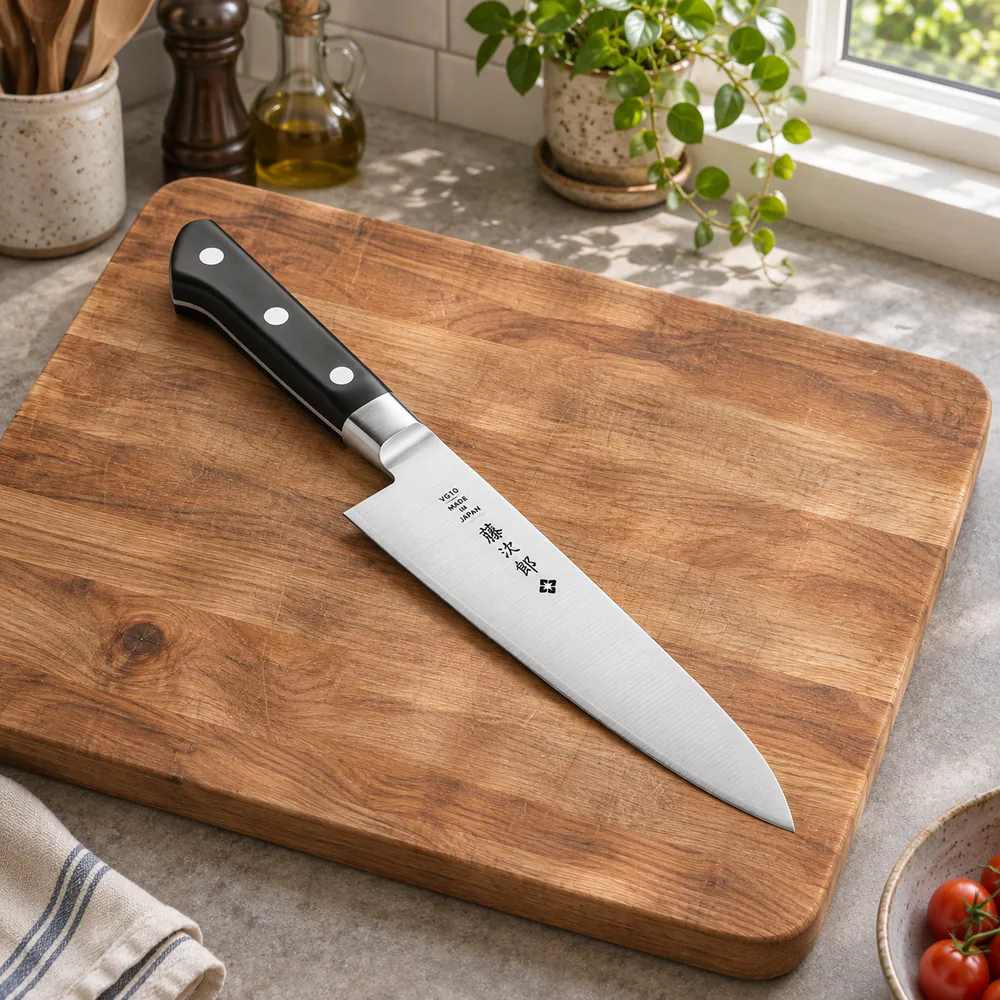
Where the 210 mm is the all-rounder, the 180 mm is the same knife in a smaller package, and it is easier to control on a standard 12 to 14 inch home board. Small hands tend to find the size ideal. The trade-off is reach: cooks with larger hands often find it too small, and it gives up some length for slicing a big roast or a whole cabbage.
Easy to control on a standard home board
Same VG10 core and edge as the larger sizes
Pinch-grip room carries over from the larger sizes
Specifications
Blade length
180 mm
Overall length
About 310 mm
Weight
Around 185 g
Blade height
About 44 to 45 mm
Core
VG10 with 13-chrome cladding
Hardness
60 +/-1 HRC
We reach for the 180 mm when counter space is tight, because on a standard 12 to 14 inch board it was the easiest of the lineup to control. The balance sits in the same place as the 210 mm, so the grip and the pinch-grip room carry over unchanged.
Where it falls short is volume. A big pile of vegetables takes more strokes, and the knuckle clearance shrinks if you have large hands. For that reason it earns second place rather than first, even though it handles beautifully in the right hands.
Pros and Cons
Pros
Easy to control on short boards
Lighter than the 210 mm
Holds its edge longer than a Victorinox 8 inch
Same sharpening behavior as the rest of the line
Budget-tier entry into Japanese knives
Cons
Too small for many larger hands
Less reach for big roasts and large produce
Same chip risk if twisted or dropped
Who It Suits
Choose the 180 mm if you cook on a modest board, have smaller hands, or want a compact second knife beside a longer one. It is also a sensible first Japanese knife for someone who feels intimidated by a long blade. If you already own and like a 7 inch knife, it will feel familiar from the first cut.
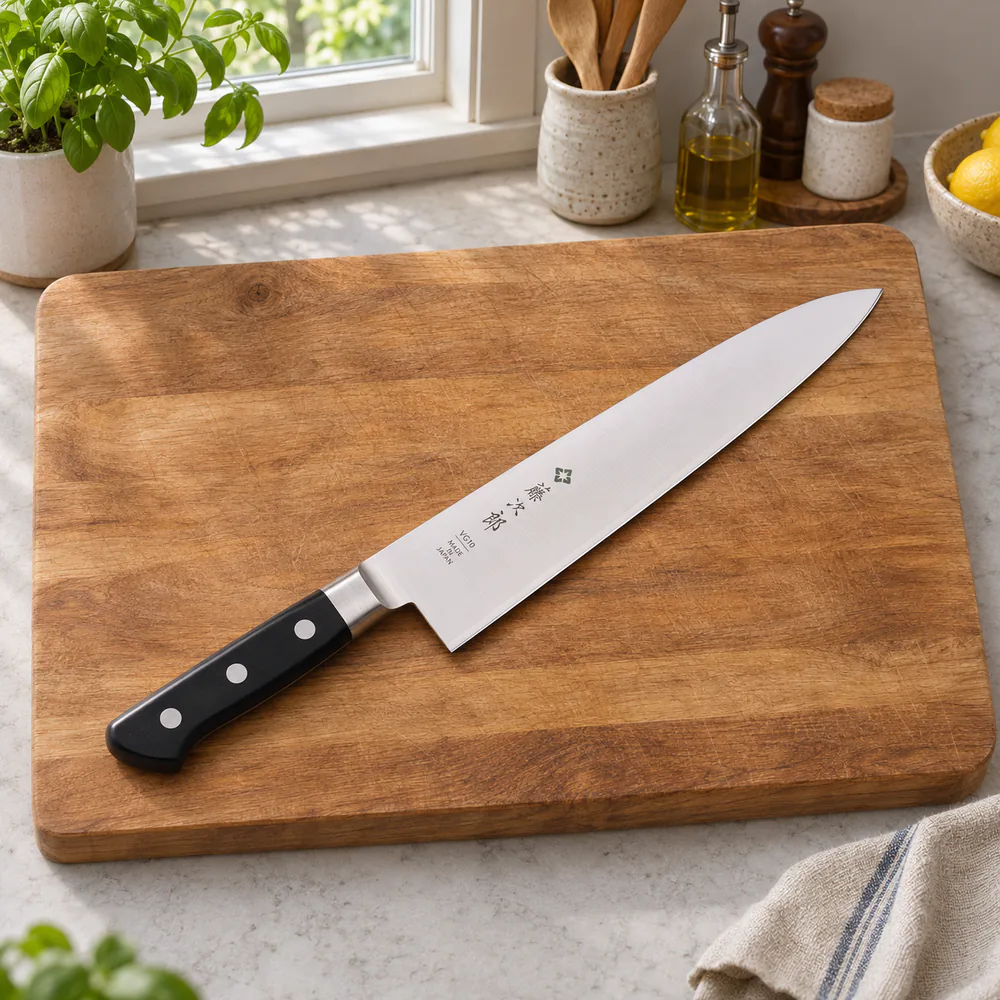
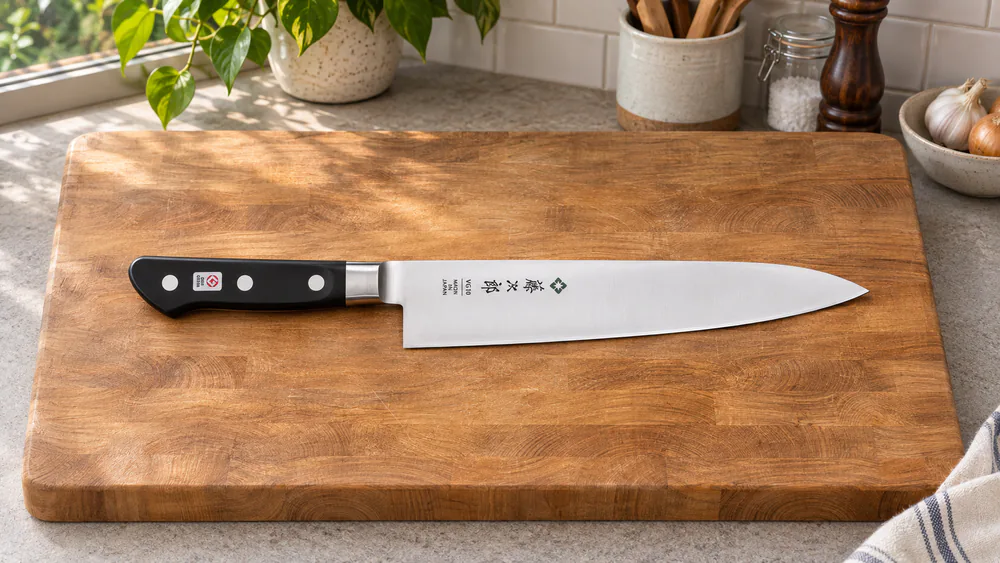
Where the 180 mm suits a short board, the 240 mm is the large-prep knife of the family. On a deep professional board of 16 inches or more it felt right, and it balances at the heel. On a small home board it feels like too much knife, so the board matters as much as the blade.
Long blade for big batches and slicing
Balances at the heel
Same VG10 core and edge as the smaller sizes
Specifications
Blade length
240 mm
Overall length
365 mm on the FU-809 import
Weight
Heaviest of the three plain DP sizes
Core
VG10 with 13-chrome cladding
Hardness
60 +/-1 HRC
Compared with the shorter knives above, a long blade changes how you cook. Slicing a big piece of meat, breaking down a whole cabbage or working through a tray of vegetables takes fewer strokes, and the length lets you finish a cut in one pull. The price of that reach is a bigger footprint on the board and in the drawer.
You will see this knife listed as FU-809 on the Fujitora-branded import and as F-809 in some shops, and the code is not consistent between sellers. We refer to it by its 240 mm length to avoid confusion, and we suggest you match the length and the DP name when you shop. It is the heaviest of the three plain DP sizes, though we have no dependable gram figure to give you.
Pros and Cons
Pros
Long blade for big batches and slicing
Balanced at the heel
Stays sharp through a full prep shift
Needs less honing than a Wusthof
Cons
Needs a deep board of 16 inches or more to feel right
Too large for small kitchens and small hands
Naming codes vary between sellers
Mid-priced, a step above the 210 mm
Who It Suits
This one suits cooks with a deep board and real volume to get through: batch prep, big roasts, a family that eats a lot of vegetables. If your board is a standard home size, stay with the 210 mm. If you cook in a professional or semi-professional setup, the 240 mm is the one that fits.
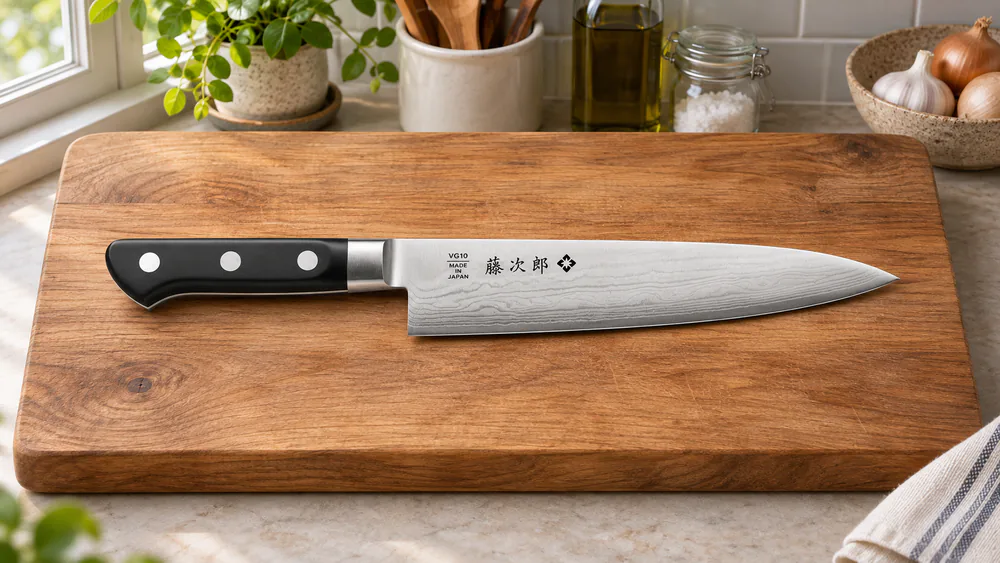
The Damascus version keeps the VG10 core and the 210 mm length, then adds a 37-layer Damascus cladding over the top. We expected a difference when cutting, but it performs like the plain DP: the cladding improves the appearance and offers some food release, so the premium buys finish more than cutting performance. It is a handsome knife, and it is the premium within the DP lineup.
37-layer Damascus cladding over a VG10 core
Same 210 mm length as the F-808
Some added food release
About 205 g in the hand
Specifications
Blade length
210 mm
Weight
205 g
Core
VG10
Cladding
37-layer Damascus
Hardness
About 60 HRC
If the rippled pattern appeals, the Damascus is a fair way to dress up the same reliable edge. The core steel and the geometry do the cutting, and the pattern changes how the knife looks on a magnetic strip or a counter rather than how it slices. We would not buy it expecting an upgrade in sharpness or edge life.
A word of caution on naming. Tojiro Flash is a separate 63-layer Damascus line with a pakkawood handle, and Atelier and Ouran are other lines altogether, so do not mix them up with the DP Damascus. The model code for this knife also appears inconsistently in shop listings, so we suggest you confirm the 210 mm length and the 37-layer description before you order.
Pros and Cons
Pros
Attractive layered cladding
Some added food release
Same VG10 core and 210 mm profile as the F-808
Close to the F-808 in weight
Cons
No real cutting gain over the plain DP
Premium within the DP lineup
Model code varies between listings
Easy to confuse with the Tojiro Flash
Is the Damascus Premium Worth It
For most cooks, no. The plain F-808 cuts the same way for less, and the money you save is better spent on a whetstone or a good board. The Damascus makes sense as a gift or for someone who values the look of the blade on the counter. If that is you, you lose nothing in performance by choosing it.
Tojiro DP vs Other Chef Knives in the Same Price Range
Most shoppers compare the DP with the German knives and the Japanese knives they can already find in a store. The differences are easier to feel than to read, so we focus on what changes in the hand.
Against a German knife such as a Wusthof, the DP is thinner, harder and keener. VG10 at about 60 HRC is harder than German steel, which is why it holds a fine edge longer but also why it chips if twisted. The profile is only mildly curved, so it rocks less aggressively than a Wusthof while still bridging Western and Japanese handling.
Against other Japanese lines, the DP is the plain, practical option. It is forged rather than stamped, has a full tang and a metal bolster, and comes with a single black laminated handle. It does not come with a fancy handle or a sharpener, and it does not try to. If you are comparing a Shun, a MAC, a Global or a Miyabi, the DP is the one that keeps things simple and leaves your budget for sharpening gear.
The DP is a strong fit if you want a keen edge and are happy to learn a little sharpening. It is a weaker fit if you want a decorative handle, if you plan to cut through bone, or if you want a knife that tolerates a pull-through sharpener.
How to Choose the Right Tojiro DP Chef Knife
Choosing a DP comes down to four decisions: length, steel behavior, handle and balance, and whether a gyuto is the right shape at all. Take them in that order.
Blade Length: 180 vs 210 vs 240 mm
Match the knife to the board first and your hands second. The 180 mm is easier to control on a standard 12 to 14 inch home board, which makes it the safer choice in a small kitchen. The 210 mm suits longer rocking and slicing and takes a week or two of adjustment coming from a 7 inch knife. The 240 mm pairs better with a deep professional board of 16 inches or more and reads as a large-prep knife.
If you are unsure, the 210 mm is the sweet spot. It is long enough to feel like a proper chef knife and short enough to fit most home boards.
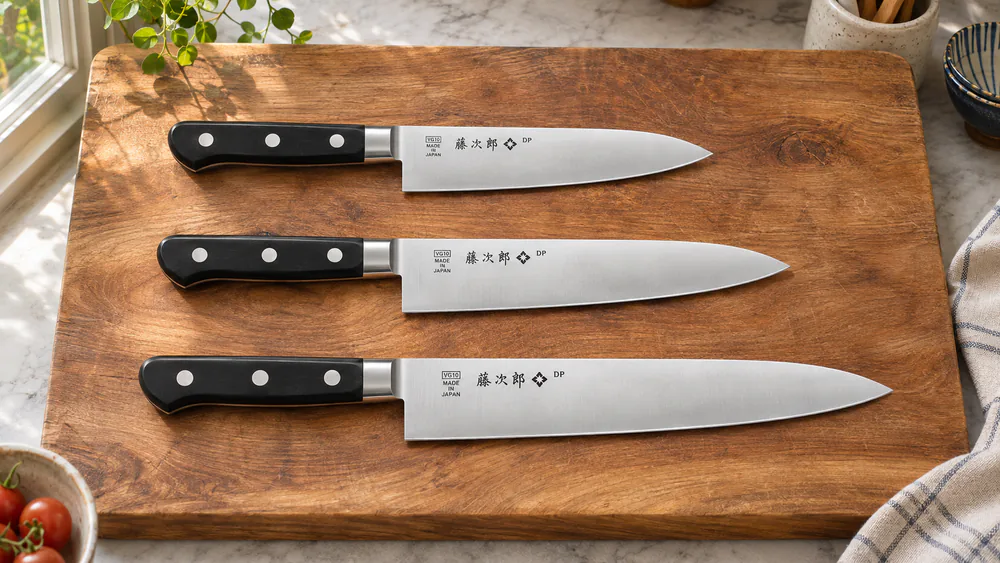
The three DP sizes laid side by side.
VG10 Steel, Hardness and Edge Retention
The core is a VG-10 stainless steel core clad on both sides in 13-chrome stainless, a san mai laminated construction of three layers. The hard VG10 core carries the edge, and the softer, stainless cladding keeps maintenance low.
Hardness is quoted as 60 +/-1 on the Rockwell hardness scale. Tojiro does not print its own Rockwell number, so that figure comes from specialist spec sheets, and the steel maker lists VG10 at HRC60 and above. In practice that makes the DP harder than German steel. It holds its edge well, and it also means the edge can chip if you twist the blade, use it on bone or cut on a glass board.
Note. DP and Classic are the same knife. Tojiro renamed the line and kept the model numbers, so a listing for the Classic gyuto is a listing for the DP.
Handle, Balance and Knuckle Clearance
The DP uses a Western-style handle in reinforced laminated material, with a full tang, three studs and a metal bolster set back from the heel. That set-back bolster leaves room for a pinch grip, which is how we prefer to hold a gyuto. The handle itself is plain, and it is the one part of the knife we would call dull to look at, but it is secure and well balanced.
Knuckle clearance depends on the size you choose. On a standard board the 180 mm and 210 mm leave comfortable room. The 240 mm wants a deep board so your knuckles do not collide with the edge of the surface mid-stroke. The edge is a 50/50 double bevel, so it works for right-handed and left-handed cooks alike.
The best DP is the one that matches your board, because a good knife on the wrong board still feels wrong.
When a Santoku Fits Better
A gyuto is a chef knife shape with a mild curve and a pointed tip, and it handles rocking, slicing and push cuts. A santoku has a flatter profile and a shorter, blunter feel, which some cooks prefer for straight chopping and for small spaces. If you chop mostly vegetables with a down-and-forward motion and dislike rocking, a santoku may fit you better. For general kitchen work, including meat and a lot of slicing, the gyuto is the more flexible tool.
Caring for and Sharpening a Tojiro DP
Care is simple, and it is where the DP rewards a little attention. The 13-chrome cladding means no reactive-steel babying: rinse and dry, and avoid soaking and the dishwasher.
Warning. Do not put a DP in the dishwasher or leave it soaking, and keep it off glass boards and bones. The edge can chip if twisted or used on glass, and VG10 at this hardness wants a whetstone rather than a pull-through sharpener.
Start with the box. Spine, heel and other non-sharpened edges can carry factory burrs, and fine-grit sandpaper removes them in minutes. That small step makes the knife far more comfortable in a pinch grip.
For sharpening, a two-stone kit covers most home kitchens. A 1000/6000 combination stone takes the factory edge higher, and a fine ceramic rod keeps it fresh between sessions. Work gently at around 15 degrees per side as an approximation, since Tojiro does not publish a factory angle and it varies by unit. Because the bevel is 50/50, you can sharpen both sides evenly.
A thinner, harder knife cuts beautifully but asks for more care than a soft German blade, and a good board matters nearly as much as the steel. A wood or soft synthetic board protects the edge, while glass, stone and hard bamboo dull and chip it.
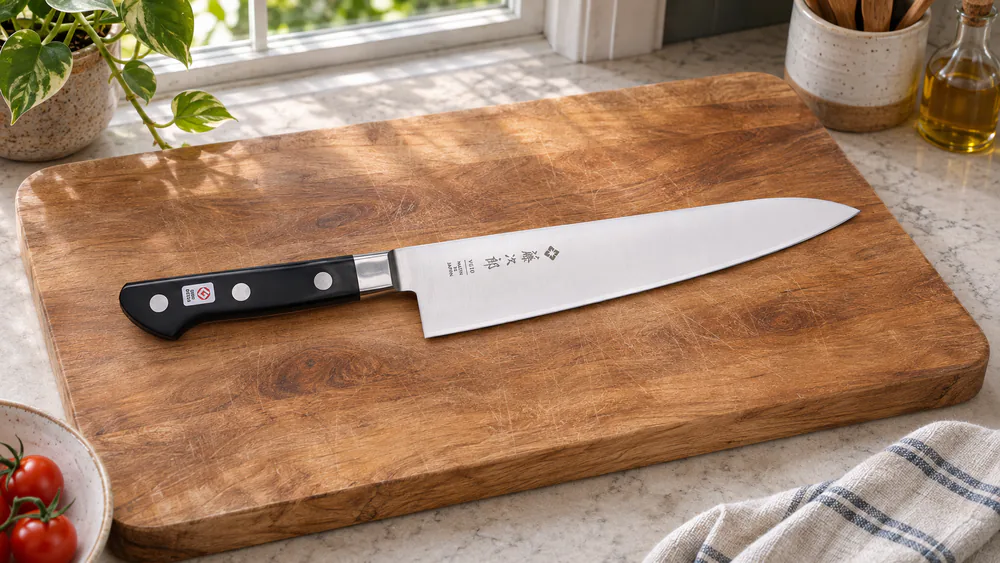
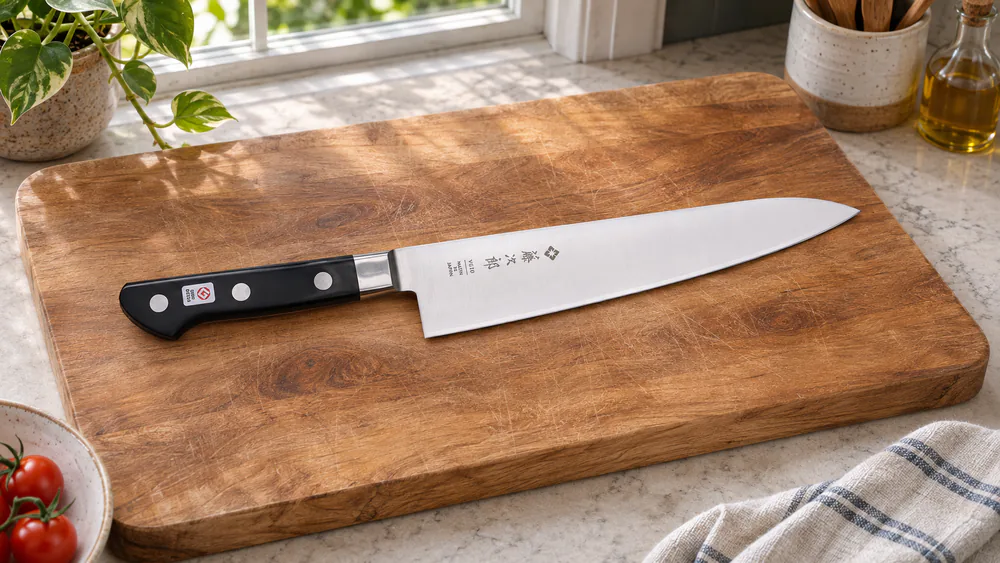
The Tojiro DP F-808 210 mm gyuto on a wooden cutting board.
Frequently Asked Questions
Is the Tojiro DP good for beginners?
Yes, with one condition. The DP is sharp out of the box, light and forgiving to handle, so it works well as a first Japanese knife. The condition is care: avoid twisting, bone and glass boards, and plan to learn basic stone sharpening.
What does DP mean, and how is it different from Classic?
Nothing is different. Tojiro renamed the DP line to Classic and kept the knife and the model numbers the same, and it is also sold as Fujitora DP.
Does the Tojiro DP rust?
It resists rust well. The VG10 core is clad in 13-chrome stainless on both sides, so rinsing and drying after use is enough. Avoid soaking and the dishwasher.
How often does it need sharpening?
It depends on use and board, so go by feel rather than a calendar. When the edge stops push-cutting tomato skin with almost no pressure, it is time for the stone. A ceramic rod between sessions delays that point.
Is the Tojiro DP worth the price?
Yes. The 210 mm is the value benchmark of the lineup and sits in the budget tier, and it delivers a keen edge and a fine steel core. The 240 mm costs more, and the Damascus is the premium pick for its finish rather than its cutting.
Final Verdict: Which Tojiro DP Chef Knife to Buy
The other three each solve a narrower problem than the 210 mm.
Take the 180 mm if your board is short or your hands are small. Take the 240 mm if you have a deep board and a lot to prep. Take the Damascus only if you want the finish, and go in knowing the cutting is the same as the plain DP.
Whichever you choose, plan on a stone and a decent board, because they matter as much as the knife.