As an Amazon Associate we earn from qualifying purchases. We may earn a commission from links on this page, at no extra cost to you. Learn more.
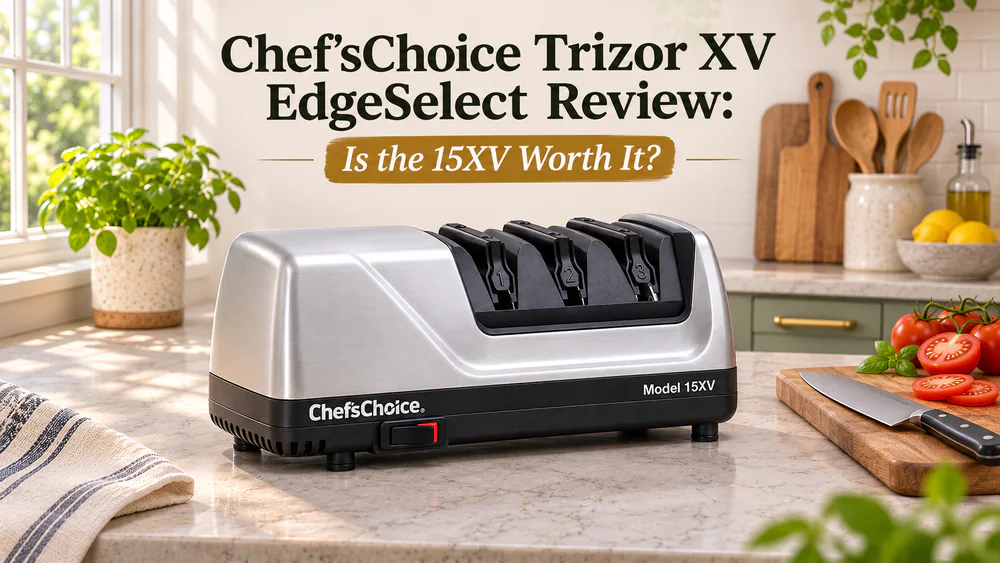
The Chef'sChoice Trizor XV EdgeSelect converts a traditional 20-degree factory edge into a 15-degree edge in three motorized stages. It suits cooks with German or American stainless knives who want a thinner, sharper edge without learning whetstones.
We ran a stock 20-degree stainless chef's knife through the first conversion and it came out with a 15-degree edge in about five minutes.
The Trizor XV EdgeSelect is a professional-grade electric sharpener for straight-edge kitchen knives. Our rating and recommendation sit in the verdict at the end.
Specifications and What Comes in the Box
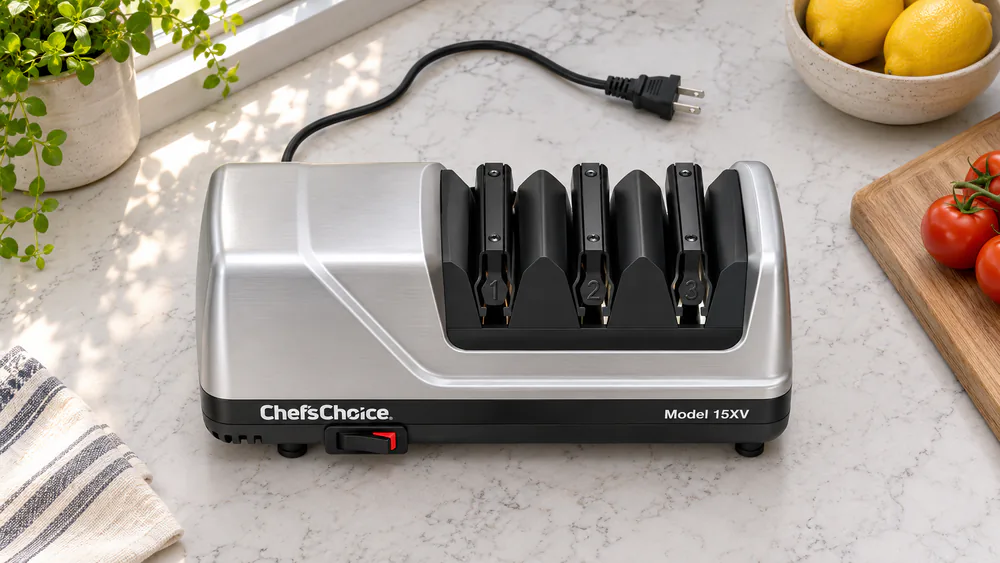
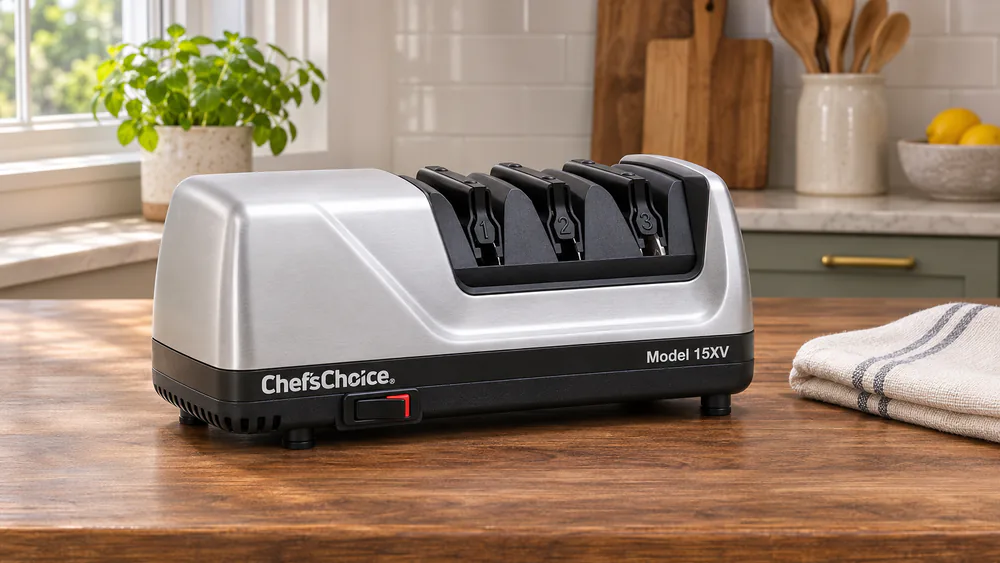
The machine has three pairs of slots, a simple on/off switch and a clean-out cover with a magnet underneath the base. Patented flexible spring guides hold each blade at the right angle, and no oil or water is needed.
Chef'sChoice Trizor XV EdgeSelect 15XV specs
Stages
3-stage (sharpen, hone, strop and polish)
Final angle
15-degree
Conversion
20-degree factory edge to 15-degree
Edge type
Trizor XV EdgeSelect (model 15XV)
Abrasive
100 percent diamond in Stages 1 and 2, flexible stropping disc in Stage 3
Knife types supported
Straight-edge kitchen knives, serrated knives (Stage 3 only), single-bevel knives with the one-sided method
Power
125 W, 120 V 60 Hz
Warranty
3-year limited
Weight
About 4 pounds
Dimensions
About 10 inches long
What the 15-Degree Conversion Does to Your Knives
Most German and American knives ship with a 20-degree edge per side. The Trizor XV grinds a steeper-cut, thinner edge at 15 degrees, which means less wedge behind the cutting line and easier slicing through tomatoes, onions and meat. For background on edge angles, see an overview of knife sharpening methods.
The maker's manual describes the major facets at 14 degrees, but the machine is sold and confirmed as a 15-degree system, so that is the number to plan around. The edge is also not a true triple bevel to the eye. Under a loupe we saw two visible facets, because the third stage polishes rather than cutting a distinct facet.
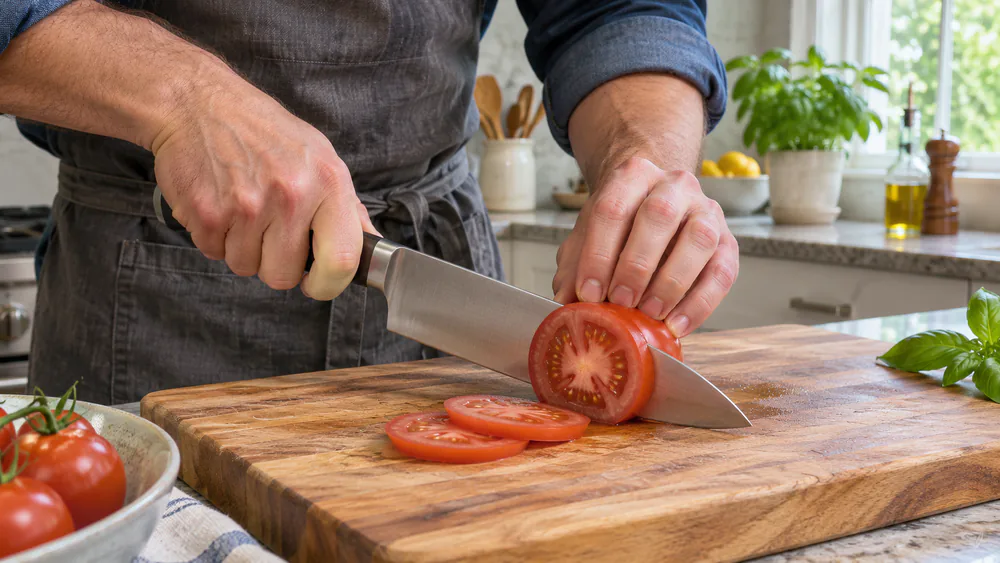
The payoff shows up in the kitchen. A stock 20-degree Wusthof chef's knife held a tomato-clean edge for about 14 days of cooking, versus about 7 days after a pull-through sharpener.
Stages 1 and 2 use diamond abrasives, Stage 3 is the flexible stropping disc.
Performance
Sharpness and Edge Quality
The edge shows a wide compound bevel, finer than most electrics make but not the mirror finish a belt machine gives. Long-owned Wusthof and Henckels knives came back sharper than store sharpening managed, slicing tomatoes without sawing.
Speed is a strength. A 20-degree stainless knife took about five minutes to re-edge on the first conversion, and a sandpaper-dulled knife reached a clean tendon-cutting edge in about six minutes and 32 strokes.
The edge after the first conversion.
The First Sharpening and the Learning Curve
The first session is the longest. A thin European or American blade may need up to 20 pairs of pulls in Stage 1 to re-angle, while a blade already near 15 degrees needs about 3 to 4 pairs. After that, the edge can be re-sharpened 3 or more times using only Stage 3.
The first attempt can leave a knife duller than before if the pressure or the pull is wrong. Technique fixes it quickly: pull steadily, keep the pressure light, and feel for the burr. Heavy pressure does not speed anything up. It eats the blade and rounds the tip.
Serrated and Japanese Knives
Serrated knives use Stage 3 only, with 5 to 10 pairs of alternating pulls. Running serrations through Stage 2 levels the scallops for no benefit. A Wusthof Classic bread knife responded well to Stage 3, but large-scallop serrations did not.
On a contemporary Asian blade only 1-2 pairs of alternating pulls are needed to develop a burr, so go gently. Double-bevel gyuto and santoku knives work well in the slots. Single-bevel knives such as yanagiba, usuba and deba do not belong in the two-sided slots. The one-sided method is needed, or the geometry is ruined.
Warning. Do not put ceramic knives, scissors, ax blades or any blade that does not fit freely in the slots into the Trizor XV. Single-bevel Japanese knives need the one-sided method, never the standard two-sided slots.
Metal Removal and Scratches
This is the machine's main trade-off. It removes more steel than most electric sharpeners, so a knife you sharpen weekly will wear faster than one you sharpen a few times a year. Full-bolster knives develop an unsightly recurve near the heel after repeated passes.
Scuffs and light scratches can also appear on the blade faces above the edge. The finish on full bolsters suffers most. If your knives are cosmetic heirlooms, that matters.
Design, Build and Noise
Once you get comfortable with the sharpening technique, the machine itself is straightforward to use. The base is stable and does not walk across the counter mid-pull. Setup takes minutes, and cleanup is wiping the slots. The housing looks and works like new after more than a year of use, and the diamond wheels showed no visible wear after ten months and 25 sessions.
It also handles long sessions. It ran 25 minutes continuously without pausing and stayed barely warm. The coarse stage is loud enough to plan around in a small kitchen.
Maintenance and Replacing the Stropping Stage
Beyond the diamond wheels, the part that wears is the stropping stage. The stropping discs are the consumable. The white discs pick up black residue first, and a clean, grease-free blade going in stretches their life to many months.
The diamond stages need no oil or water, and the magnet under the clean-out cover catches the swarf.
Who It's For
Given those trade-offs, it suits home cooks with German or American stainless knives who want a thinner, sharper edge with a short routine. It also suits anyone who has been paying for store sharpening and wants to do it at home in minutes.
Who Should Look Elsewhere
Skip it if you own mostly single-bevel Japanese knives, ceramic blades or scissors. Collectors who care about untouched blade faces and full-bolster finishes should also look elsewhere, as should anyone who wants a mirror polish. A whetstone setup is the better route for those knives and for cooks who enjoy the craft.
Pros and Cons
Pros
Converts 20-degree edges to a thinner 15-degree edge in about five minutes
3-stage diamond and stropping design with even facets
Stage 3 alone can refresh the edge 3 or more times
Stable base, easy cleanup, stayed barely warm over 25 minutes
Handles serrated knives through Stage 3
Cons
Removes more steel than most electric sharpeners
Can scratch blade faces and leave a recurve on full bolsters
Loud in the coarse stage
Not for ceramic knives, scissors or single-bevel knives without the one-sided method
The first attempt can leave a knife duller if technique is off
Value
Cost is the last question. The Trizor XV sits in the premium tier of the Chef'sChoice electric range. Whether it can pay for itself depends on what you do now. If you pay to have several knives professionally sharpened each year, owning this machine for years can quickly make financial sense, especially with its 3-year limited warranty. If you sharpen one knife twice a year, a cheaper option makes more sense.
How It Compares to Alternatives
The closest sibling is the Chef'sChoice EdgeSelect 120. It also uses three stages and diamond abrasives, but it keeps the 20-degree factory angle instead of converting to 15. That makes it the gentler choice for knives you do not want to re-angle, and a cheaper one than the Trizor XV.
Row
Trizor XV 15XV
EdgeSelect 120
Final angle
15-degree
20-degree
Stages
3-stage
3-stage
Abrasive
100 percent diamond (Stages 1 and 2), stropping Stage 3
100 percent diamond (Stages 1 and 2), stropping Stage 3
Converts 20 to 15
Yes
No
Knife types
Straight, serrated (Stage 3), single-bevel via one-sided method
Straight, serrated, sporting, pocket
Warranty
3-year
3-year
How We Rate It
We rate sharpeners on the edge they leave, how fast they get there, how much steel they take, and how easy they are to live with. The Trizor XV scores high on edge quality, speed and stability, and loses points on noise and technique sensitivity.
Frequently Asked Questions
What angle does the Trizor XV EdgeSelect sharpen to?
It converts 20-degree factory edges into 15-degree edges. The manual's triple-bevel description cites 14 degrees for the major facets, but the product is sold as a 15-degree system.
Can it sharpen serrated knives?
Yes, in Stage 3 only, with 5 to 10 pairs of alternating pulls. Skip Stage 2, and expect large-scallop serrations to respond poorly.
Is it a good first sharpener for a beginner?
It can be. The base stays put, setup takes minutes, and cleanup is wiping the slots. The first attempt can leave a knife duller if pressure or pull is off, but light pressure and a steady pull fix that quickly.
How often do I need the full sharpening?
After the first conversion, Stage 3 alone can refresh the edge 3 or more times, so the diamond stages are not needed every session.
How long do the stropping discs last?
They are the consumable part. A clean, grease-free blade going in stretches their life to many months, and the white discs pick up black residue first.
Is the 15XV the same as the Trizor XV?
Yes. 15XV is the model number, Trizor XV is the edge shape, and EdgeSelect is the three-stage system. It is one machine.
We recommend the Trizor XV for anyone with German or American stainless knives who wants a razor-sharp 15-degree edge in minutes. The machine was stable and easy to use, and it gave us fast, even results. It earns its place if you sharpen several knives a year, though it removes more steel than most electrics.
Converts 20-degree edges to 15-degree in minutes
Stable base and easy cleanup
Stage 3 refresh between full sharpenings
Handles serrated knives in Stage 3
Specifications
Stages
3-stage
Final angle
15-degree
Abrasive
100 percent diamond
Warranty
3-year limited
Key takeaway. If you would rather keep your knives' 20-degree angle, the EdgeSelect 120 is the gentler pick.