Helping you create a kitchen you love.

Knives & Cutlery

Best Whetstone Kit: What to Buy, Based on Hands-On Sharpening

As an Amazon Associate we earn from qualifying purchases. We may earn a commission from links on this page, at no extra cost to you. Learn more.

Best Whetstone Kit: What to Buy, Based on Hands-On Sharpening

If your knives are dull rather than damaged, a kit with two stones fixes it: one at 1000 grit to set the edge and one at 3000 to 6000 to refine it. The right kit also saves you from buying a flattening stone, an angle guide, and a base one at a time. Across the knife sharpeners we cover, whetstone kits are the most forgiving way to learn real sharpening.

We approach every kit the way we approach sharpening in our own kitchen: regular home prep, then the edge checked by feel and on paper, then the knife sharpened back on the stones. A stone that earns a place here has to hold up through that routine, with Japanese and Western blades alike.

Top picks at a glance

RankProductBest forGritsRatingBuy
1

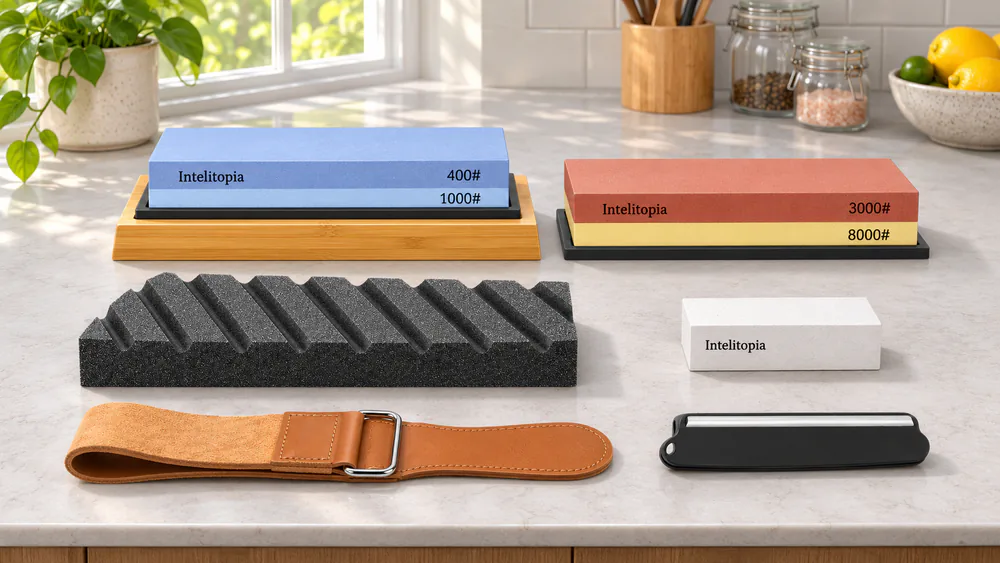
Intelitopia Complete Knife Sharpening Stone Set

Best Overall
Beginners who want everything in one box 400/1000 and 3000/8000 4.7 View on Amazon
2

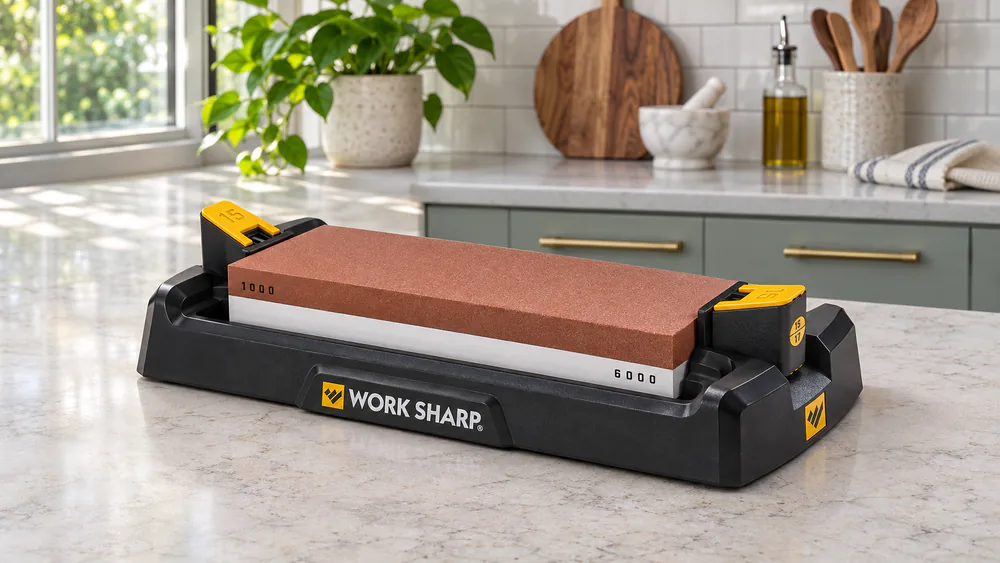
Work Sharp Benchtop Whetstone

Best Beginner Kit With an Angle Guide
First-timers who struggle to hold an angle 1000/6000 4.5 View on Amazon
3

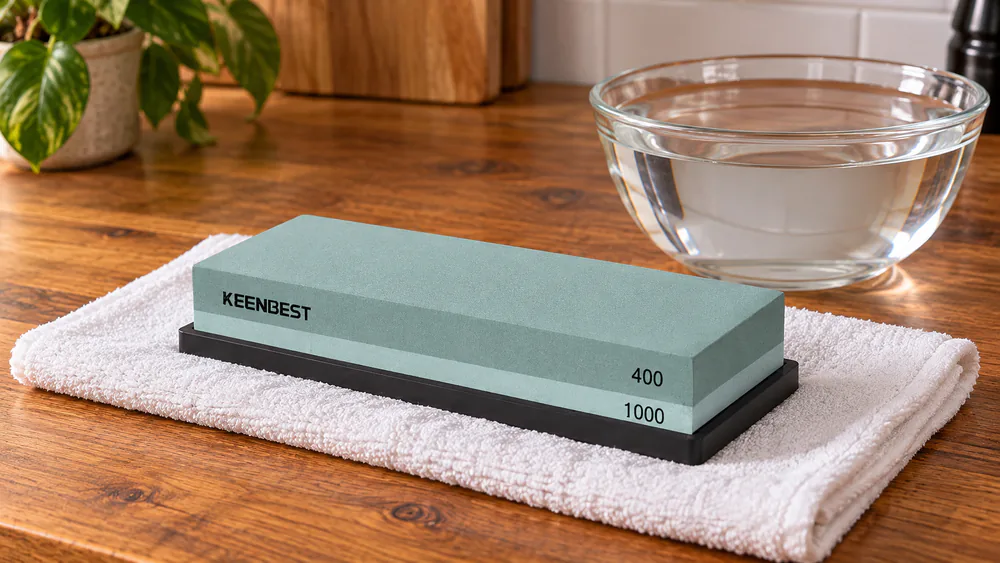
KEENBEST 400/1000 Whetstone Set

Best Budget
Cheap, coarse repair of dull knives 400/1000 4.3 View on Amazon
4

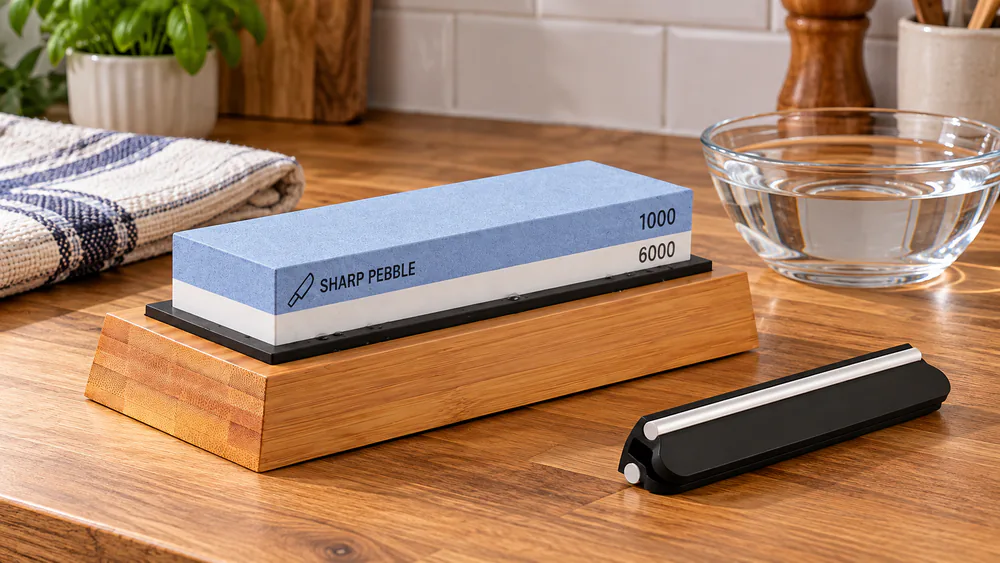
Sharp Pebble Whetstone Kit 1000/6000

Best Simple Two-Grit Kit
Small kitchen knives and light touch-ups 1000/6000 4.2 View on Amazon
5

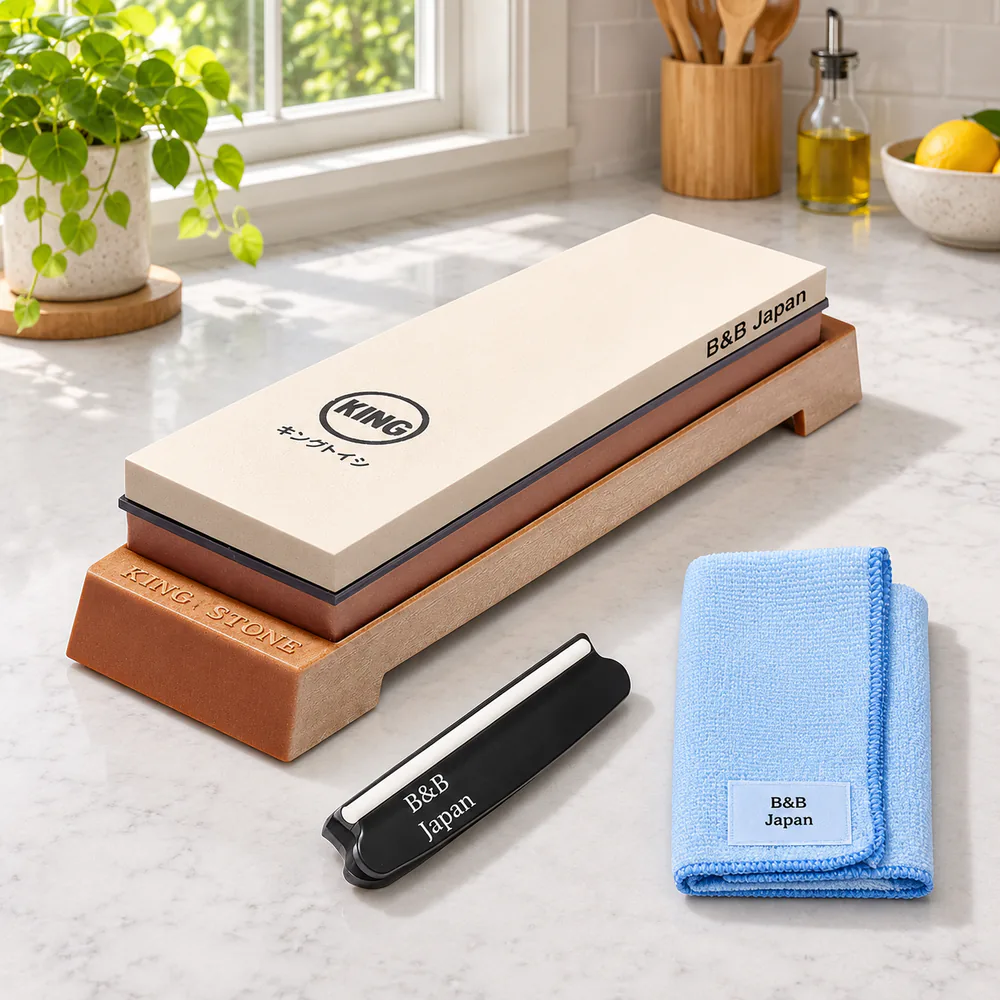
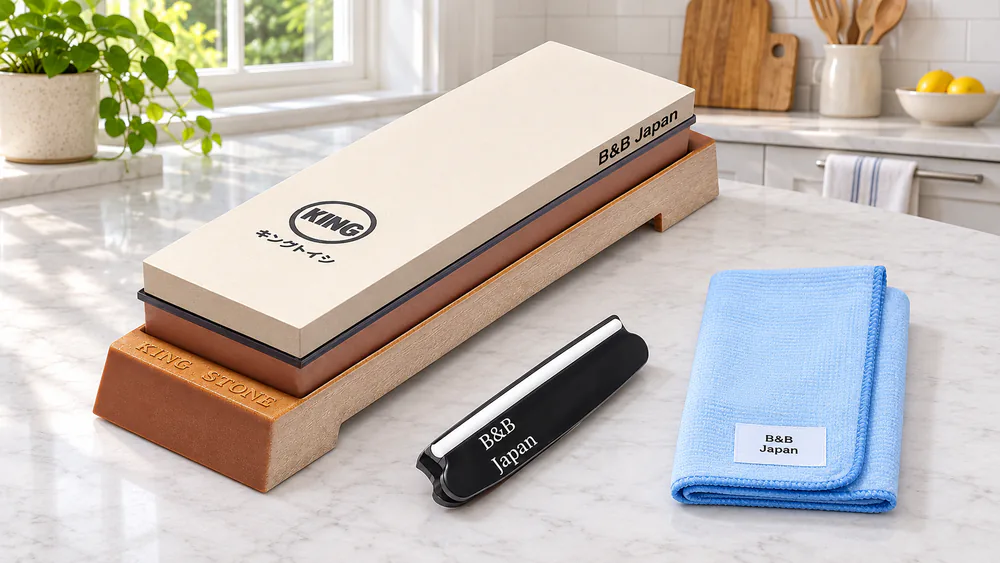
KING Whetstone Starter Set

Best Japanese-Made Kit
Traditional waterstone feel on a budget 1000/6000 4.1 View on Amazon
6

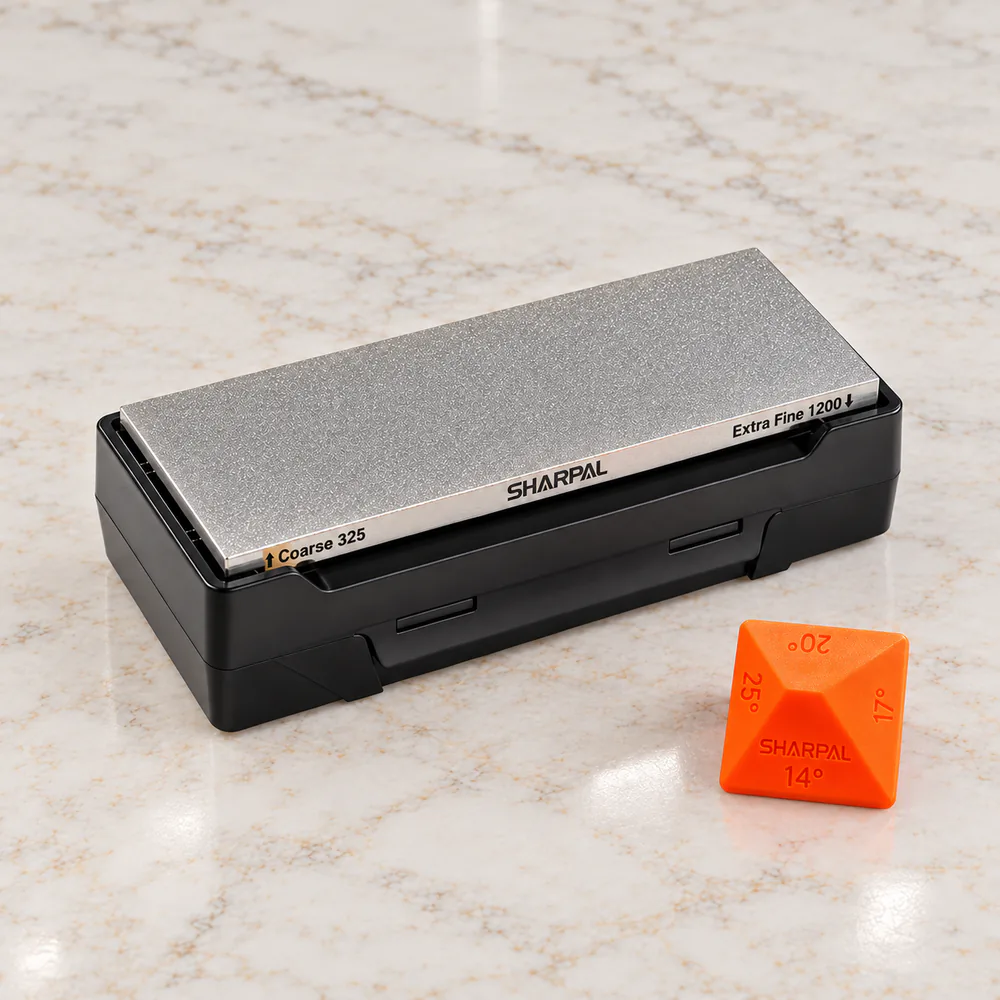
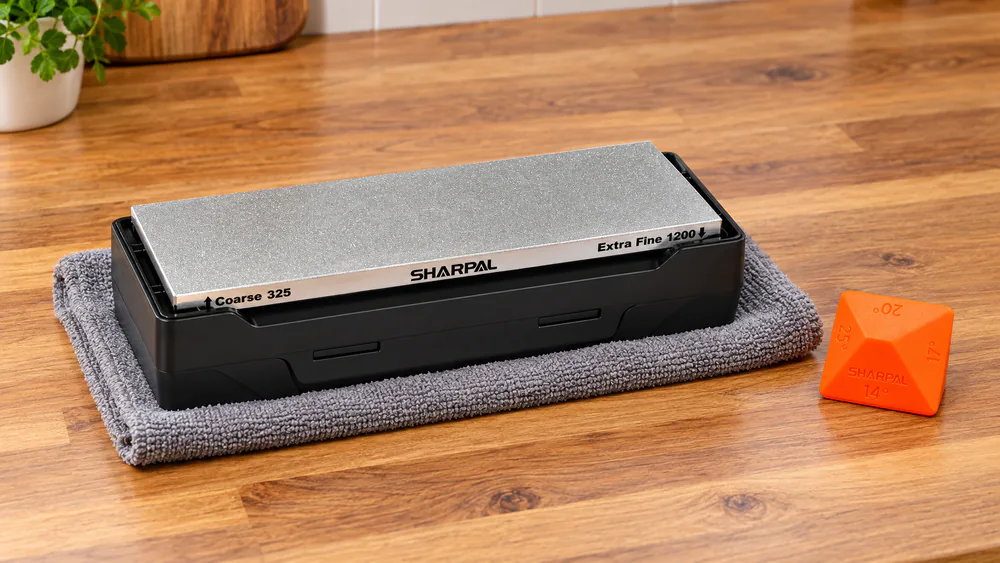
SHARPAL 162N Diamond Sharpening Stone

Best Diamond Alternative
Fast repair with no soaking 325/1200 4.0 View on Amazon
7

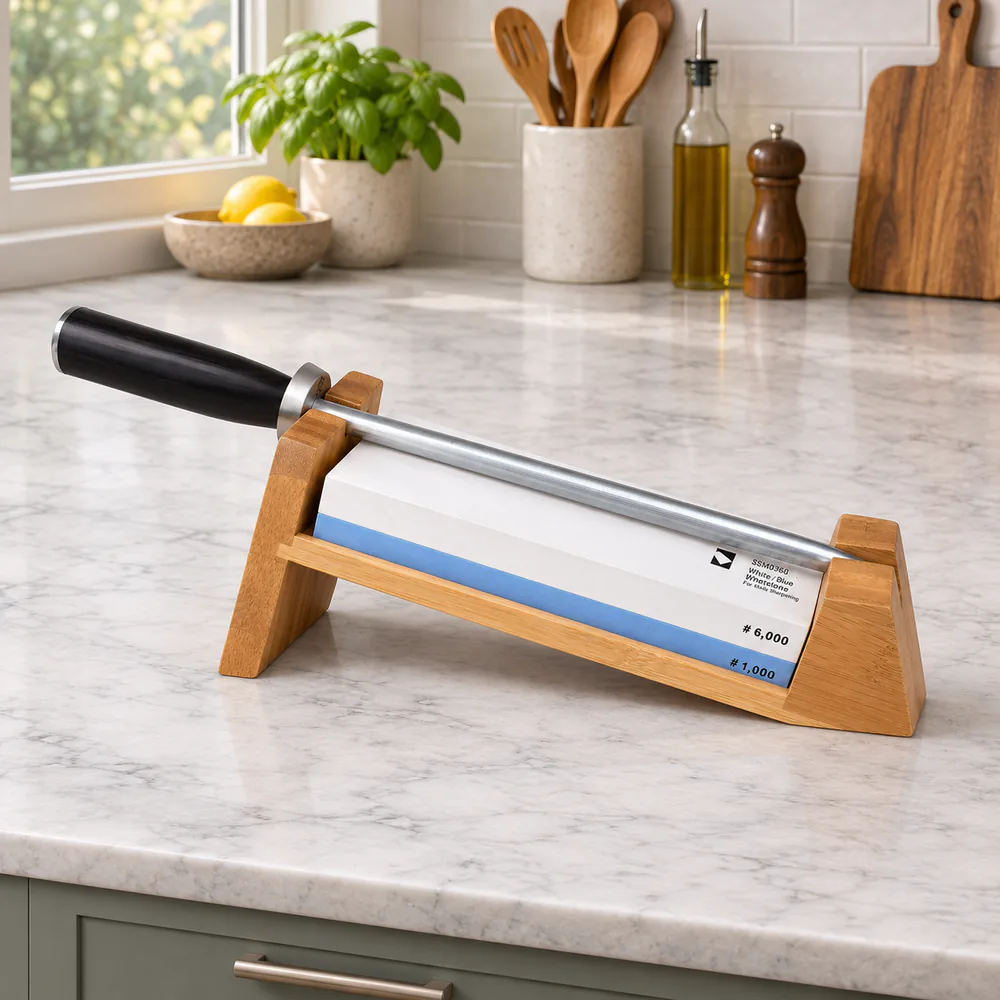
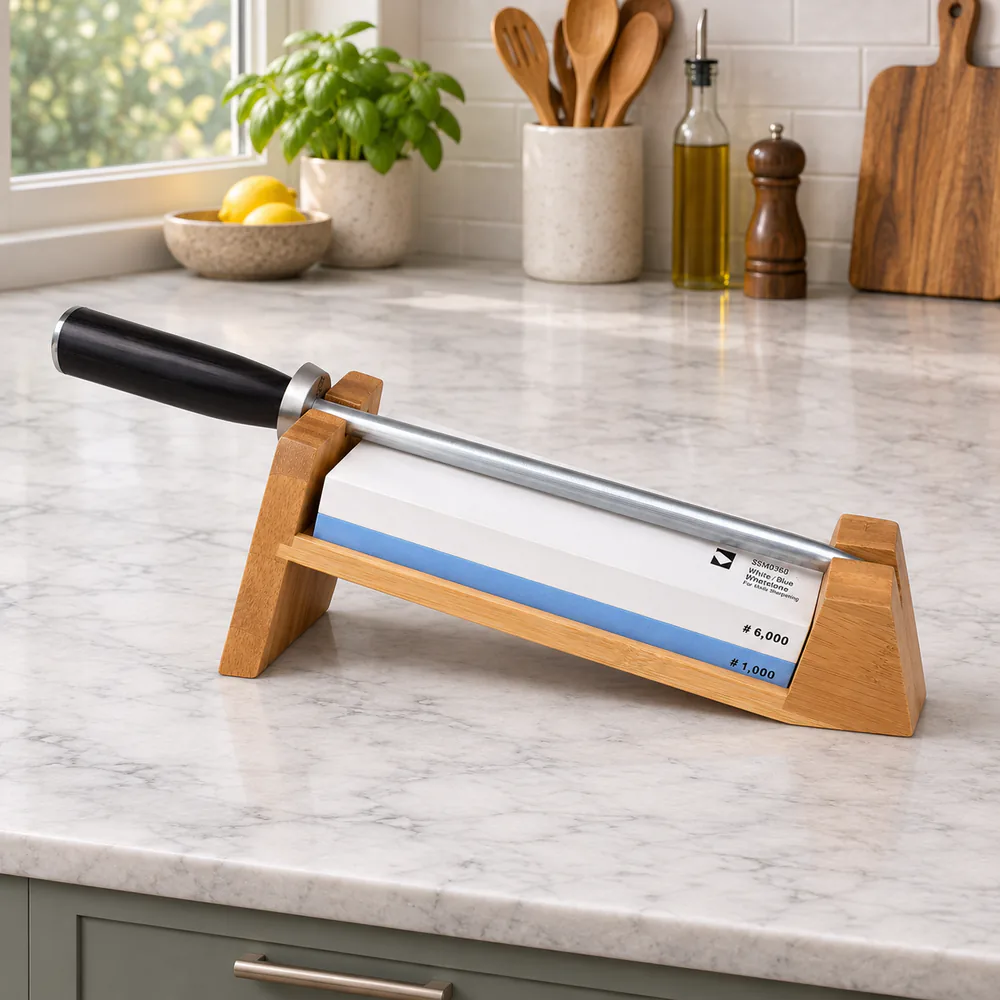
Shun 3-Piece Sharpening System

Best Premium Kit
Shun and other Japanese-geometry blades 1000/6000 ceramic 3.8 View on Amazon

We earn a commission if you make a purchase, at no additional cost to you.

See full comparison table

How we chose these kits

We judged every kit on four things: how quickly the coarse stone raised slurry and a burr, how well the fine stone finished the edge, whether the extras helped or sat in the box, and how the stones held up while we worked. We also weighed the grit pairing, because a kit that cannot repair a chipped edge or cannot polish one is only half a kit.

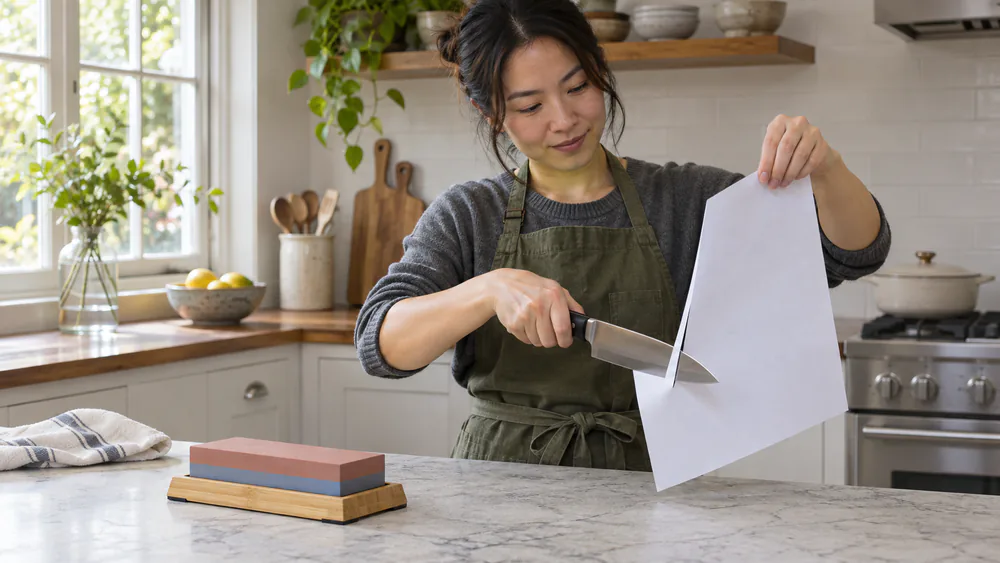
We checked each edge two ways: a push-cut through paper, and a light catch of the edge against a thumbnail. We also kept the knife in mind, because a Japanese single-bevel or hard-steel blade wants a shallower, steadier angle than a softer Western one. Those checks, plus how each stone behaved under the blade, drive the ratings below.

We sorted the field by the job each kit does best. Some kits suit a first-timer who needs an angle guide, some suit a cook with a chipped blade, and one suits a Japanese knife owner who wants a traditional stone. That is why the awards below differ.

A kitchen knife slicing a sheet of printer paper cleanly beside a two-sided whetstone on a bamboo base, used to check edge sharpness after sharpening
Slicing paper is a quick check of the edge after the finishing stone.

Whetstone kit comparison

The table covers the five kits we could compare feature for feature. The Shun system is reviewed separately below, since it uses a ceramic stone and a honing rod.

FeatureIntelitopiaWork Sharp BenchtopSharp PebbleKING starterSHARPAL 162N
Grits 400/1000 and 3000/8000 1000/6000 1000/6000 1000/6000 325/1200
Stone type Aluminum oxide waterstone Waterstone Corundum waterstone Japanese-made waterstone Electroplated diamond
Base or holder Bamboo base, rubber bases Built-in mess-reducing base with tray Bamboo base Plastic base, angle holder Case with non-slip base
Flattening stone Yes No No No Not needed
Angle guide Yes Yes, snap-in Yes Yes Yes, 14/17/20/25
Best for Complete beginner-to-enthusiast kit Guided angles Beginner with guide Japanese-made value Fast repair, no soaking
Our rating 4.7 4.5 4.2 4.1 4.0

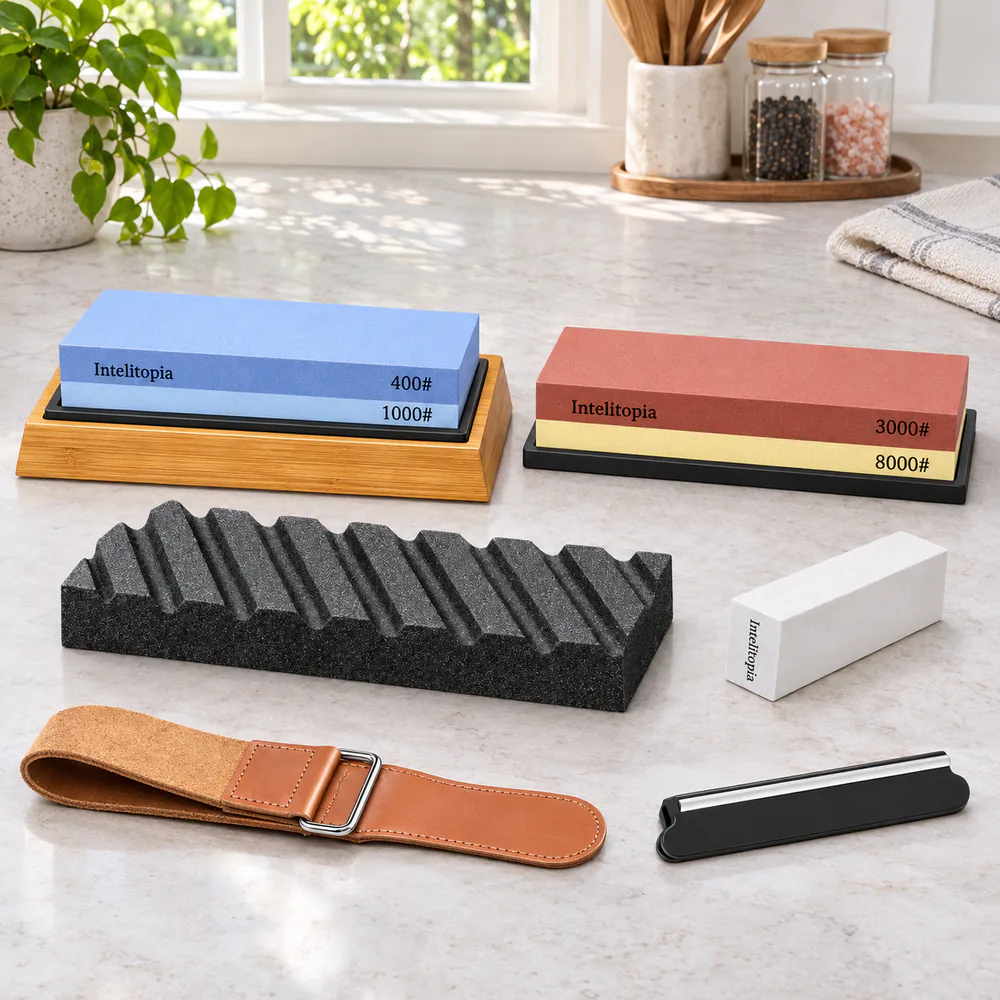
Best whetstone kit overall: Intelitopia Complete Knife Sharpening Stone Set

Intelitopia Complete Knife Sharpening Stone Set
1

Intelitopia Complete Knife Sharpening Stone Set

Best Overall
Check Price on Amazon
4.7/5

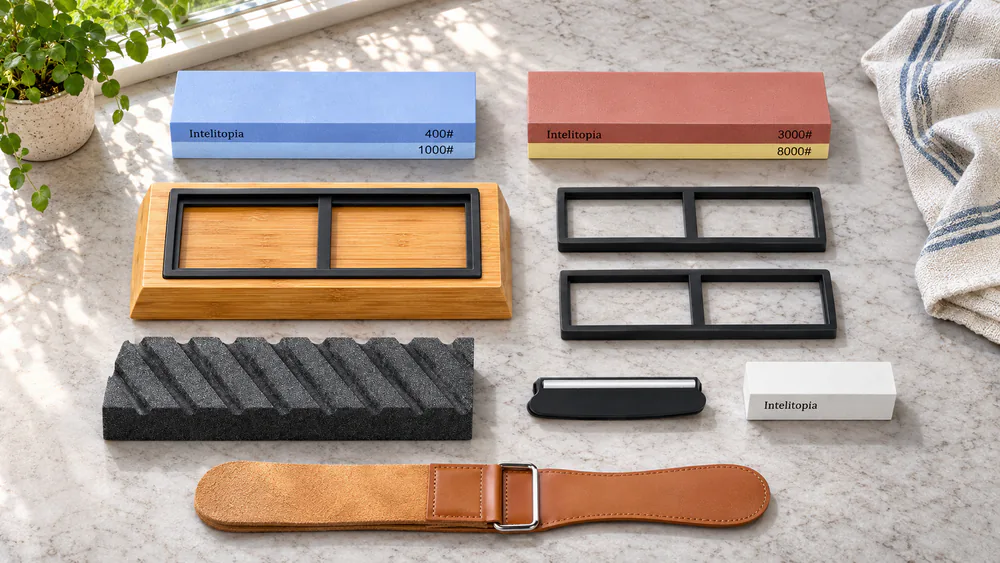
This is the kit we would hand to most home cooks. The 1000 stone raised slurry in about 15 strokes and a burr at about 60, then the 3000 stone cleared most of the dullness. After that, the knife sliced tomatoes paper-thin. It is the only kit in this roundup that pairs a repair-capable coarse stone with a true polishing stone, and it ships with the flattening stone you will need later.

  • Four working grits across two dual-sided stones
  • Angle guide and leather strop included
  • Coarse flattening stone and bamboo base included
  • Non-slip rubber bases for the stones

Specifications

Grits
400/1000 and 3000/8000
Stone type
Aluminum oxide (corundum)
Extras
Strop, flattening stone, angle guide, manual

Pros

  • Four grits cover repair, setting, refining, and polishing
  • Includes the flattening stone most kits leave out
  • Angle guide makes it easy for a first-timer
  • Works on fillet and boning knives as well as chef's knives

Cons

  • The printed instructions are thin, so plan to watch a video first
  • Aluminum oxide stones wear faster than premium Japanese stones

Who it suits and what is in the box

On a knife dulled to 930 g on the BESS scale, the 3000 stone brought the force down to 225 g, a 76% drop, and the strop trimmed it to 215 g. The finishing pair, 3000/8000, is what separates this kit from the plain 1000/6000 sets.

It suits anyone who wants to learn on one kit and grow into it. If you only own a couple of kitchen knives and never expect a chip, a simpler two-stone kit is enough.

Best beginner kit with an angle guide: Work Sharp Benchtop Whetstone

Work Sharp Benchtop Whetstone
2

Work Sharp Benchtop Whetstone

Best Beginner Kit With an Angle Guide
Check Price on Amazon
4.5/5

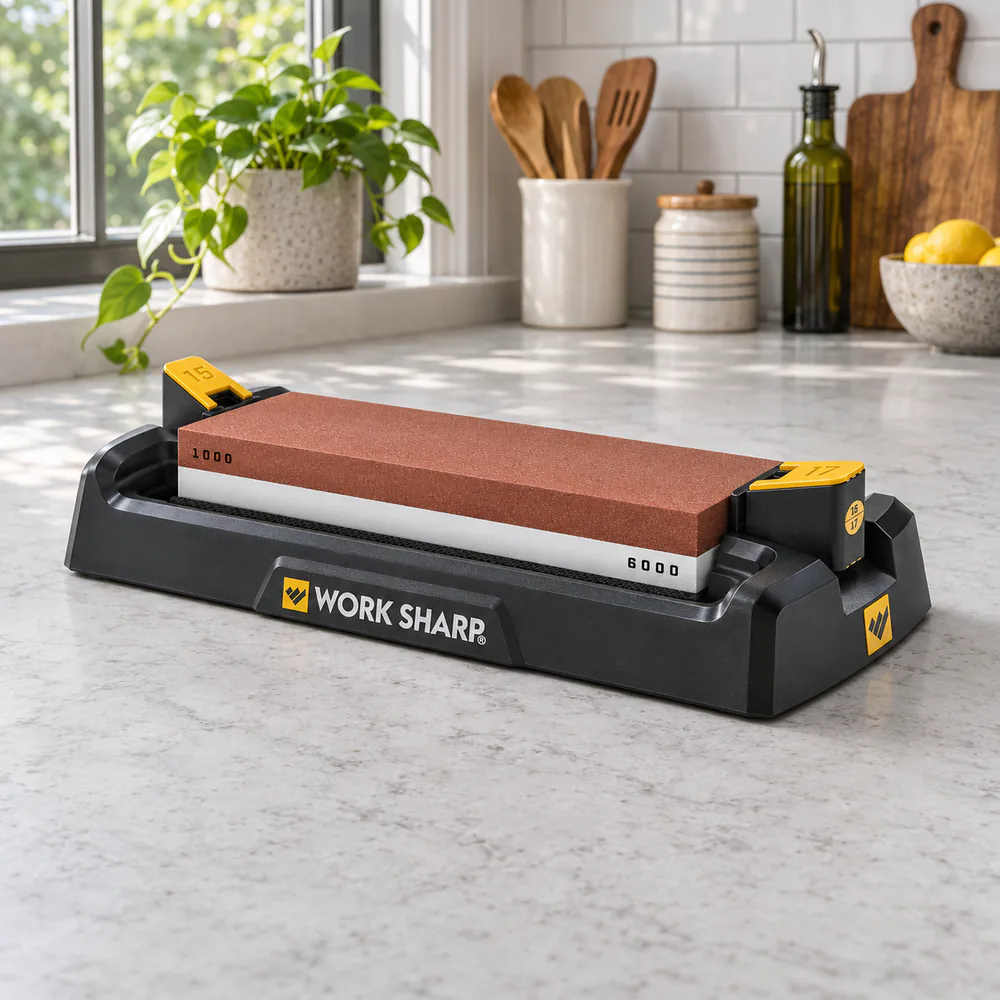
The Intelitopia offers four grits; the Work Sharp focuses on helping you hold a steady angle. The snap-in angle guides let a beginner hold 15 to 17 degrees consistently, which is the hardest habit to build by hand. On a very dull knife, the 1000 side set a new edge quickly before the 6000 side finished it, and the guide took the angle question off the table for the first few sessions.

  • Dual-sided 1000/6000 stone
  • Mess-reducing base with a water tray
  • Soak for 5 to 10 minutes until the bubbles stop

Specifications

Grits
1000/6000
Stone type
Waterstone
Guides
Snap-in, for the common kitchen angles

Pros

  • Guides remove the guesswork from holding the angle
  • The base and water tray keep the counter cleaner
  • The 1000 side sets a new edge fast on a very dull knife

Cons

  • No flattening stone included, so buy one before the stone dishes
  • No coarse stone for chips, since the lowest grit is 1000

The snap-in guides cover the shallow 15 to 17 degree angles that Japanese-style kitchen knives like, and the 5 to 10 minute soak is the only prep step before you start.

Best budget whetstone kit: KEENBEST 400/1000 Whetstone Set

KEENBEST 400/1000 Whetstone Set
3

KEENBEST 400/1000 Whetstone Set

Best Budget
Check Price on Amazon
4.3/5

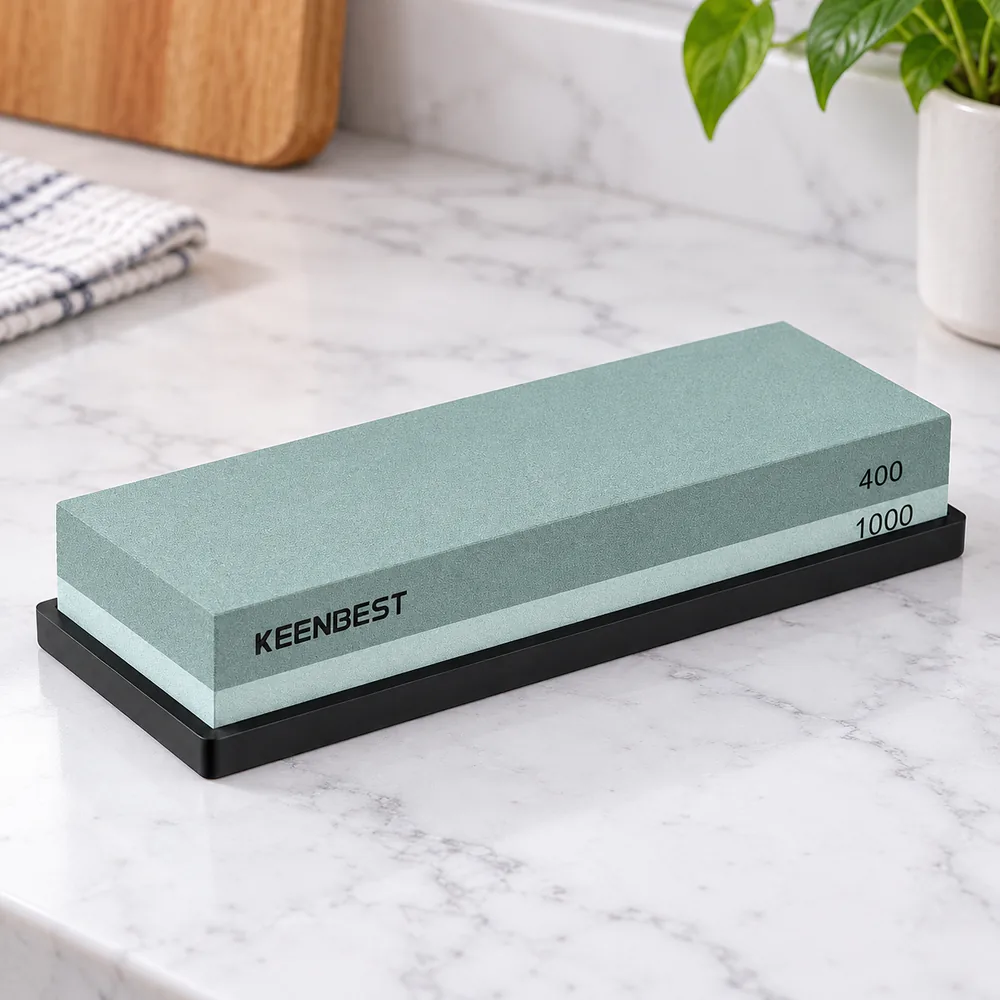
Step down from the Work Sharp and the KEENBEST is the bare-bones option. The stones brought dull knives back to factory sharpness, and that is a great value at the cheapest tier. The coarse side raised slurry within a few strokes, the way budget aluminum oxide stones usually do. The catch is durability. The stones feel brittle and vary in quality, so we would not expect them to survive a drop onto tile.

Specifications

Grits
400/1000
Stone size
7 x 2.2 x 1.1 inch, two stones
Prep
Soak 10-15 minutes

Pros

  • Cheapest tier in this roundup
  • The 400 grit repairs small chips and very dull edges
  • Quick to raise slurry

Cons

  • No fine polishing stone, so edges stay at a working level
  • Brittle stones that will not survive a drop
  • Durability is inconsistent from stone to stone

If you buy this kit, plan to add a finer stone later. The 400/1000 pairing sets and repairs an edge, but it will not give the polished feel of a 3000 or 6000 stone. Soak both stones for 10 to 15 minutes before use.

Best simple two-grit kit: Sharp Pebble Whetstone Kit 1000/6000

Sharp Pebble Whetstone Kit 1000/6000
4

Sharp Pebble Whetstone Kit 1000/6000

Best Simple Two-Grit Kit
Check Price on Amazon
4.2/5

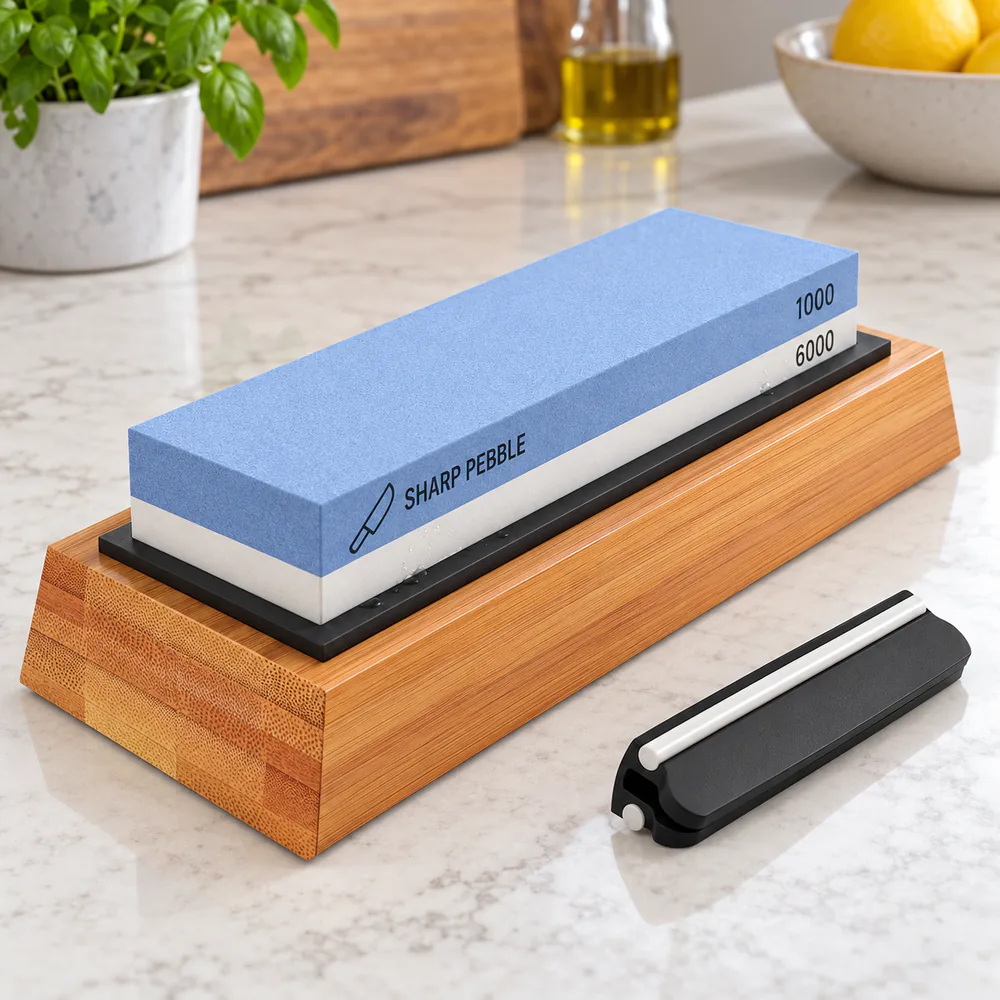
Where the KEENBEST is rough and cheap, the Sharp Pebble is the simplest kit here. The stone works well on kitchen knives and plane irons, and it is a good fit for smaller knives. It is a generic stone under a brand name, so you are paying for the kit and the bamboo base rather than a special abrasive. The dual-sided 1000/6000 stone covers routine sharpening, but a chipped blade needs a coarser stone first.

Specifications

Grits
1000/6000
Stone type
Corundum waterstone
Extras
Bamboo base, angle guide, ebook

Pros

  • Simple, easy-to-learn two-grit setup
  • Works well on small kitchen knives
  • Includes a guide and base

Cons

  • No coarse repair grit below 1000
  • No flattening stone confirmed in the kit
  • A narrow stone sits poorly under wide blades

Given its generic stone, we would choose the Sharp Pebble for light touch-ups on a small paring or utility knife, but not for repairing a chipped chef's knife. It suits a cook who wants a tidy, simple kit with a base and guide and does not mind adding a coarser stone later.

Best Japanese-made kit: KING Whetstone Starter Set

KING Whetstone Starter Set
5

KING Whetstone Starter Set

Best Japanese-Made Kit
Check Price on Amazon
4.1/5

The KING starter set was the only kit here whose stone developed cracks, and its partly Japanese instructions add another difficulty for beginners. The reward is the classic waterstone feel: it gave us ultra-sharp edges on Henckels chef's knives, and like any traditional waterstone it needs a soak.

Pros

  • Traditional waterstone feel from a Japanese maker
  • Produces ultra-sharp edges on kitchen knives
  • Angle holder helps a beginner

Cons

  • Cracks can appear in the stone
  • The softer bond dishes quickly and needs flattening
  • Instructions are partly in Japanese

The KING gave us ultra-sharp edges on Henckels chef's knives, but the softer bond dishes faster than harder stones, so plan to flatten it before every session. If you want the traditional stone and will tolerate that routine, it is a rewarding kit. If you want something that just works out of the box, pick the Intelitopia instead.

Best diamond alternative: SHARPAL 162N Diamond Sharpening Stone

SHARPAL 162N Diamond Sharpening Stone
6

SHARPAL 162N Diamond Sharpening Stone

Best Diamond Alternative
Check Price on Amazon
4.0/5

Skip the soak and the SHARPAL is the quickest route from a dull knife to a working edge. It cuts with no water at all and avoids dishing. On some plates, however, the diamond grit wears off quickly, so we treat this as a repair tool. It pairs a 325 coarse side with a 1200 extra-fine side on an 8 x 3 inch plate, and it comes with a 3 year commitment.

Specifications

Grits
325/1200
Plate size
8 x 3 inch
Warranty
3 year commitment

Pros

  • Cuts fast and never needs flattening
  • Large 3-inch width suits wide blades

Cons

  • On some plates the diamond grit wears off quickly
  • 1200 is not a true polishing grit

The integrated guide offers 14, 17, 20, and 25 degree angles, so you can match a Japanese or Western knife. Cut dry here, then finish on a 6000 stone from another kit if you want a polished edge.

Best premium kit: Shun 3-Piece Sharpening System

Shun 3-Piece Sharpening System
7

Shun 3-Piece Sharpening System

Best Premium Kit
Check Price on Amazon
3.8/5

Unlike the diamond plate, the Shun asks you to accept a weak spot: its 6000 side finishes less well than the same grit in other kits. The honing rod makes up for it, since 20 strokes on the rod brought the edge back strongly. The ceramic 1000/6000 stone sits in a bamboo stand that holds a 16 degree angle, which is why this splurge pick fits Japanese-geometry blades better than anything else.

Pros

  • The fixed-angle stand removes guesswork
  • The honing rod adds a quick touch-up step

Cons

  • Costs the most of any kit here
  • The 6000 side finishes weaker than other kits
  • Ceramic is fragile, and the angle suits only Japanese blades

Who should skip it: anyone with mostly Western knives, or anyone likely to drop a stone, since ceramic is fragile. For a Shun or a similar blade, the stand-and-rod routine is a tidy way to keep the edge going.

What grit do you need?

Grit is the number that decides what a stone does. Lower numbers cut metal fast and leave a rougher edge, while higher numbers cut slowly and leave a polished one. A kit gets useful when its stones cover both ends.

400 to 1000: repair and reset

A 1000/6000 stone covers most routine kitchen sharpening. A chipped blade needs a 400 or coarser stone first, which is why we rate the Intelitopia and KEENBEST kits for repair work. The 1000 side is the workhorse: it sets a new edge and raises a burr, and you will spend most of your time on it.

Tip. Do not skip the coarse stone because it feels rough. If a knife will not take an edge on the 1000 side after a patient session, drop to 400 and start over.

3000 to 6000: refine and polish

The fine stone removes the scratches from the coarse stone and leaves a smooth, bright edge. After the Intelitopia 3000 stone, the knife sliced tomatoes paper-thin. Some fine stones finish slowly, and a 5000 stone that is very fine can reward slow, methodical work more than a quick finish. For most home cooks, a 3000 to 6000 stone is the sweet spot.

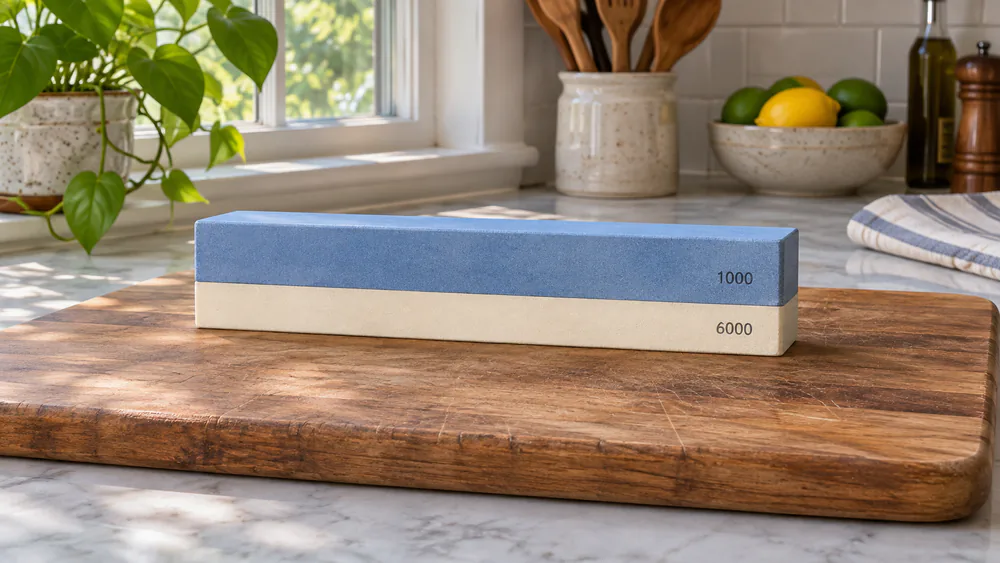
A dual-sided whetstone turned to show the coarse 1000 grit side beside the finer 6000 grit side on a wooden cutting board
The coarse side sets the edge, the fine side polishes it.

What a good whetstone kit should include

A good kit does more than bundle two stones. We look for a flattening stone, a stable base, an angle guide, and a grit pairing that matches the knives you own. The extras matter only if they help, and one kit we tried stuffed in several that went unused.

  • A flattening stone. A flattening stone refreshes a dished stone in a couple of minutes. Without one, the stone hollows and the angle drifts.
  • A stable base. The acacia base on one kit we tried slid around without a towel under it. Rubber feet or a tray fix that.
  • An angle guide. It teaches the angle until muscle memory takes over.
  • A useful grit pairing. A 1000/6000 pair suits most knives, and a 400 or coarser stone handles chips.
  • A stone wide enough for your blades. A stone 2.5 to 3 inches wide sits well under most blades, and thicker stones last longer.

Warning. Narrow stones sit poorly under wide blades such as a slicer or a deba. Check the stone width before you buy if you own either.

A complete whetstone kit laid out on a counter: two dual-sided stones, a bamboo base, an angle guide, a leather strop, and a flattening stone
The extras that earn their place: base, guide, strop, and flattening stone.

How to use a whetstone kit

The method is the same for every kit. Prepare the stone, set the angle, work the edge until a burr forms, then refine and finish. Most mistakes come from a wobbly stone or an angle that drifts.

Soak, set the angle, stroke, raise the burr, finish

Start with the stone. Traditional waterstones need a 10 to 20 minute soak, while ceramic splash-and-go stones need only a few seconds of water. A diamond plate needs none.

Set a steady angle next. Japanese edges are typically 15-16 degrees, and Western knives about 20. Use the guide for your first sessions, then try freehand once the motion feels natural.

Stroke the blade across the coarse stone with light, even pressure, and keep the same angle on every pass. When you feel a thin burr along the full length of the edge, flip the knife and repeat on the other side. Move to the fine stone, use lighter pressure, and finish with a few alternating strokes, then strop if the kit has one.

Here is a first-week plan that builds the habit without wearing out your knives:

  1. Day one: Practice the angle with the guide on an old knife, using water only.
  2. Days two and three: Raise a burr on the coarse stone of a cheap knife.
  3. Days four and five: Add the fine stone and test the edge on paper.
  4. Weekend: Sharpen the knife you actually use, and flatten the stone afterward.

Whetstone kit buying guide

Stone type, grit pairing, base, flattening

Stone type decides how you care for the kit. Traditional waterstones, like the KING, need a soak and dish faster. The Shun 1000/6000 stone must be soaked before use, according to the manufacturer; use it with water only. Diamond plates, like the SHARPAL, cut dry and stay flat. Waterstones give the most pleasant feedback, which is why most kits are built around them.

Grit pairing comes next. A kit with only 1000/6000 will not repair a chip, so add a coarser stone if your knives are in rough shape. A kit with 400/1000 will repair but not polish.

Base and flattening round it out. A stable base keeps the stone from sliding, and a flattening stone keeps the surface true. A stone that hollows will make the angle drift, so plan to flatten whenever the surface looks dished. If your kit lacks a flattening stone, a separate one is a smart add.

Knife type matters too. Japanese knives keep a thin, shallow edge that suits a fine finishing stone and a guide set near 15 or 16 degrees. Western knives are tougher and take a steeper angle of about 20 degrees, so a coarse stone and a sturdy base serve them well.

Finally, think about whetstones versus honing rods and pull-through sharpeners. A rod realigns an edge but removes no metal, and a pull-through grinds quickly with little control. A whetstone is the only one of the three that lets you set the angle and refine the edge.


Common mistakes

Most beginners make the same few mistakes. They skip the flattening stone, then wonder why the angle drifts. They buy a fine stone first, then find it will not repair anything. And they press too hard, which wears the stone and does not sharpen faster.

Another mistake is expecting a kit to fix a knife without practice. Ceramic stones are fragile, budget stones can chip in a drop, and the instructions in some kits are thin, so a quick video helps before your first session.

Frequently asked questions

What grit do I need to start?

A 1000/6000 combination stone covers most routine sharpening. Add a 400 or coarser stone if a knife is chipped or very dull.

Do I need a flattening stone?

Yes, eventually. A flattening stone refreshes a dished stone in a couple of minutes, and without one the stone hollows and the angle drifts. The Intelitopia kit includes one.

Should I soak the stone or use splash-and-go?

It depends on the stone. Traditional waterstones need a 10 to 20 minute soak, ceramic splash-and-go stones need only a few seconds of water, and diamond plates are used dry.

What angle should I hold?

Japanese knives are typically sharpened at 15-16 degrees and Western knives at about 20. An angle guide helps hold either.

How often should I sharpen?

Sharpen when the knife no longer slices a tomato or paper cleanly. A quick pass on the fine stone, or the strop, keeps the edge going between full sessions.

Whetstone vs honing rod or pull-through?

A honing rod only realigns the edge, and a pull-through removes metal with little control. A whetstone lets you set the angle and refine the edge.
How do I store and maintain stones?

Let waterstones dry fully before storing them, keep them away from drops, and flatten them when they look dished. A case or base keeps them stable.

Final verdict

For most kitchens, buy the Intelitopia set and flatten the stones whenever they dish. If you want a guided first month, the Work Sharp is the easier start, and the KEENBEST is the lowest-cost way in if you accept its brittle stones. Choose the KING for a Japanese-made stone, the SHARPAL for fast dry repair, and the Shun only if your knives are Japanese-geometry.

Read next

Ready to upgrade your kitchen?

Pick the kit that fits your knives and start keeping a sharp edge at home.