As an Amazon Associate we earn from qualifying purchases. We may earn a commission from links on this page, at no extra cost to you. Learn more.
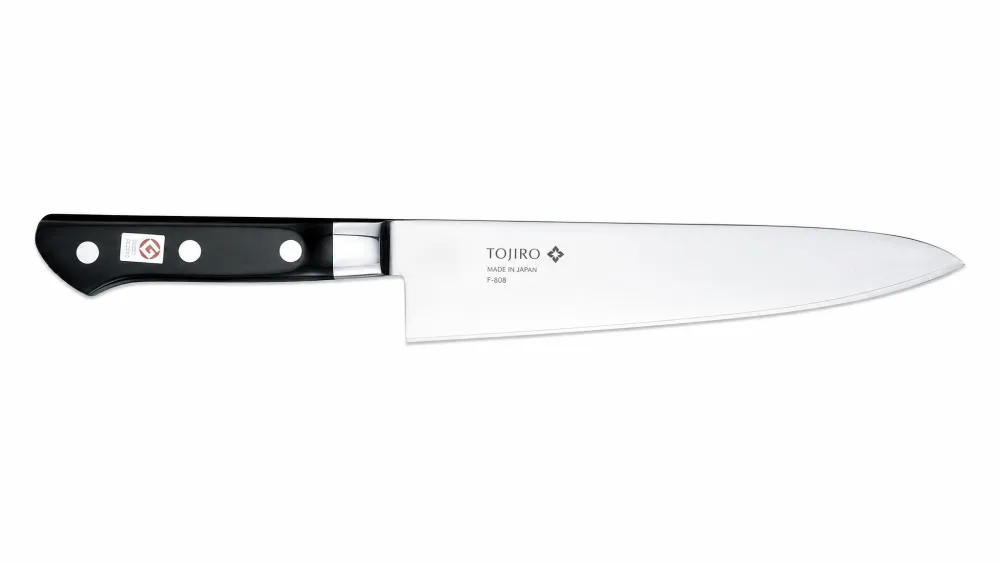
If you want one Tojiro chef knife for everyday cooking, buy the DP/Classic Gyuto 210 mm. It is the size that fits most boards and most hands, and in our kitchen it cut carrots and shallots cleanly with very little resistance. This guide explains how each Tojiro we looked at handled real prep and where each one falls short.
Tojiro chef knives at a glance
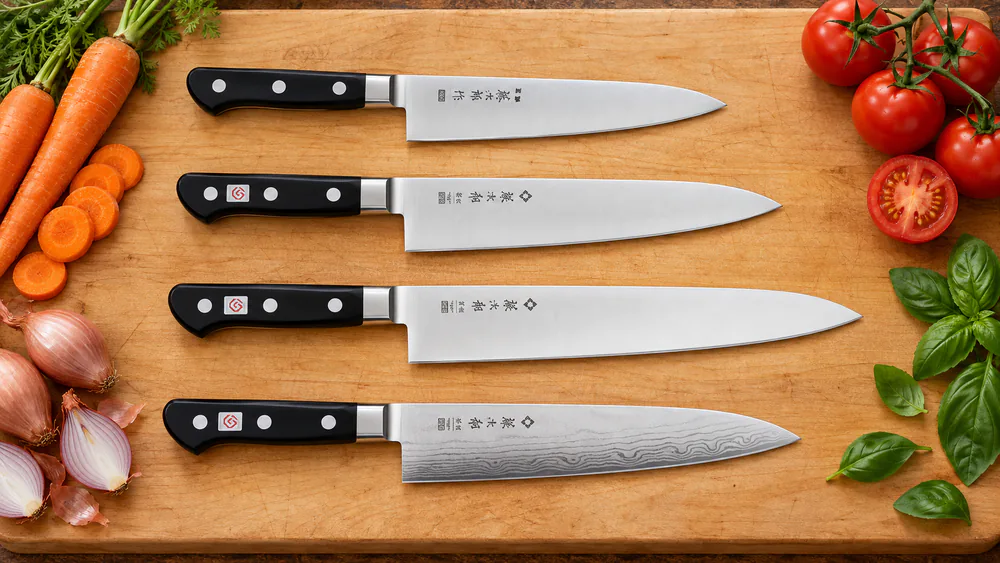
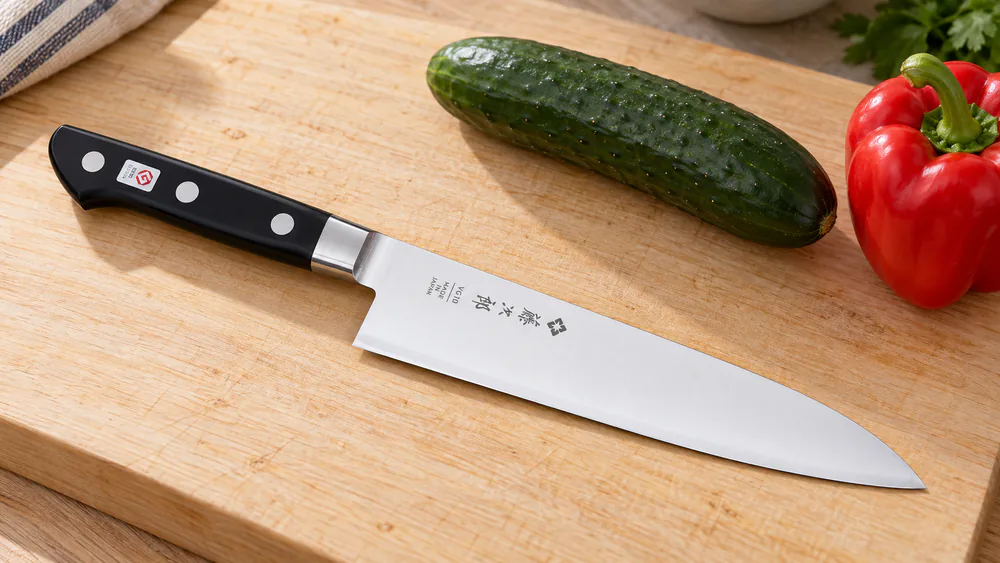
Tojiro makes a long list of knives, but the gyuto (the Japanese take on the Western chef knife) is the one most home cooks actually want. The plain DP/Classic models share the same recipe: a VG10 cutting core wrapped in stainless cladding, a full tang, three rivets, a metal bolster and a reinforced laminated handle. What changes from model to model is length, weight and how much board space you need. The table below puts the four picks side by side, and the sections that follow explain the trade-offs in plain terms.
If you already know you want the best all-rounder, jump to the 210 mm review. If you are still weighing sizes, the table and the buying guide will settle it faster than any single spec.
Criteria
DP/Classic 210 mm (F-808)
DP/Classic 180 mm (F-807)
DP/Classic 240 mm (F-809)
Damascus 210 mm (F-655)
Blade length
210 mm
180 mm
240 mm
210 mm
Steel and construction
VG10 core, plain stainless cladding
VG10 core, plain stainless cladding
VG10 core, plain stainless cladding
VG10 core, 37-layer patterned cladding
Handle
Reinforced laminate, full tang, rivets, bolster
Reinforced laminate, full tang, rivets, bolster
Reinforced laminate, full tang, rivets, bolster
Reinforced laminate, full tang, rivets, bolster
Edge
Even double bevel
50/50 double bevel
50/50 double bevel
Double bevel per the maker; confirm before buying
Best-fit task
Everyday vegetables and boneless proteins
Small boards and compact prep
Large cabbage and long slicing strokes
Everyday prep with a decorative finish
Main limitation
Heel corner and knuckle clearance
Shorter stroke, less batch reach
Needs more board space
Finish premium
Our rating
4.6
4.4
4.3
4.1
How We Tested These Tojiro Chef Knives
We rate each knife on the qualities that matter in a home kitchen: cutting soft and firm produce, slicing boneless meat, staying comfortable through long prep sessions, and taking a fresh edge on a stone. Tojiro tells you to wash the steel by hand and dry it straight away, so that is the care routine we assume.
We rate each knife against the same set of jobs: carrots and shallots for resistance, tomatoes and basil for edge keenness, boneless chicken and beef for slicing, and a thick onion for a vertical cut that punishes thick blade geometry. We also weigh how the handle sits in the hand, where the heel corner lands on the gripping finger, and how much room the blade needs on the board.
The star ratings in this guide are our own editorial judgments, built from those cutting jobs, grip comfort, fit to a real kitchen and how well each knife serves the cook it is meant for. They are not lab measurements, and we did not run timed trials or score edge retention to a number. Usage, boards, technique and sharpening all change how long an edge lasts, so we avoid promising a figure we cannot stand behind.
We have less evidence for the Damascus knife than for the other models. We lean on the manufacturer's construction details for it and say plainly where our hands-on notes stop. For anyone building out a wider Japanese knife drawer, our Japanese knife reviews cover the other brands we have worked with.
The produce we used to compare edge keenness and resistance.
Note. Tojiro now sells these knives as the Classic series, but the DP name is still on many listings. The model codes (F-807, F-808, F-809) are the reliable way to tell exactly which knife you are buying.
1. Tojiro DP/Classic Gyuto 210 mm: the everyday starting point
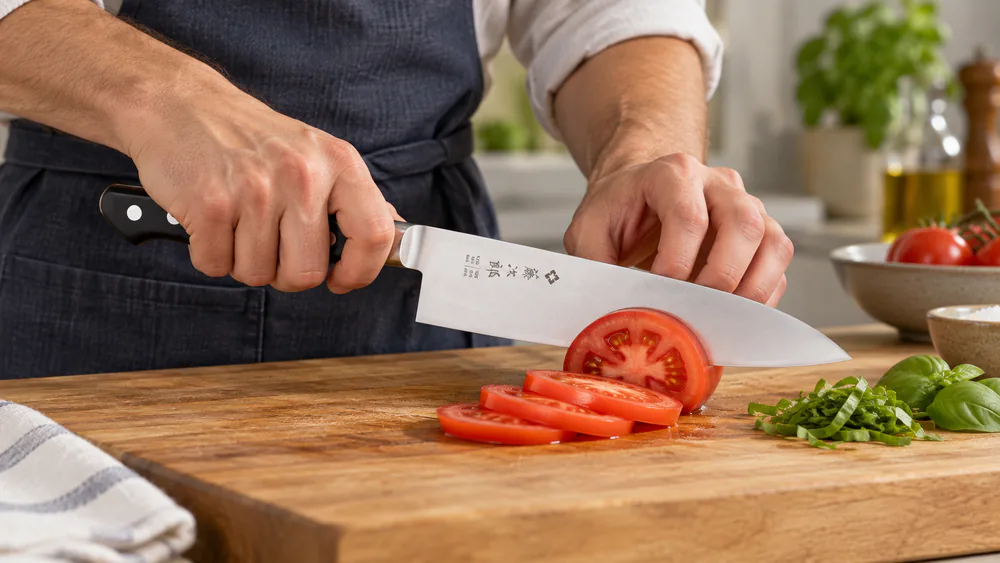
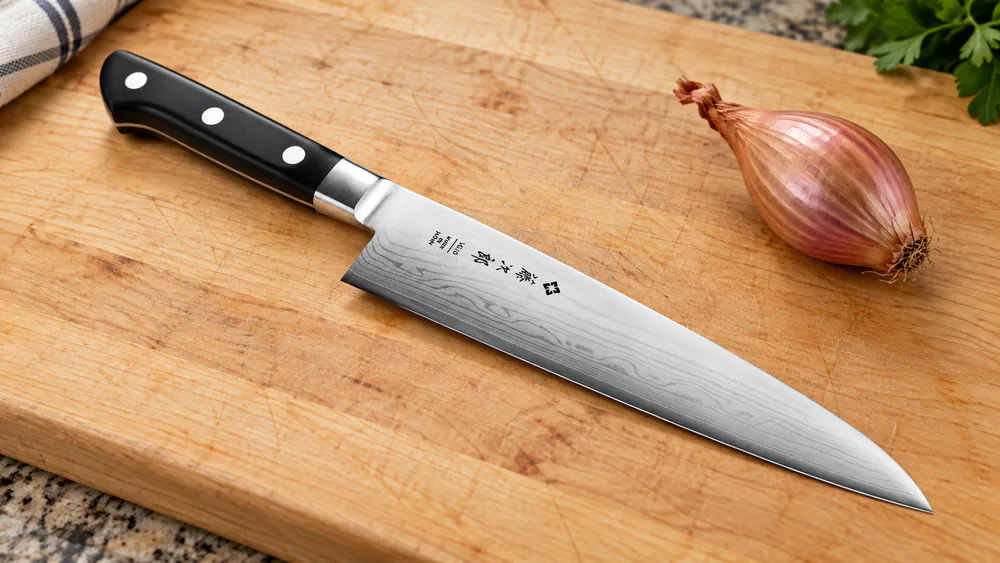
The 210 mm F-808 is the Tojiro we would buy again. It cut carrots and shallots cleanly with little resistance, sliced tomatoes without tearing, and made basil cuts that stayed bright instead of bruising. It sliced boneless chicken and beef easily, and it was thin enough to take steak down to delicate slices. The two things to watch are a heel corner that can catch the gripping finger and limited knuckle room for larger hands.
Clean, low-resistance cuts through carrots and shallots
Smooth tomato slices and tear-free basil
Easy slicing of boneless chicken and beef
Secure grip for small to medium hands
Specifications
Blade length
210 mm
Model
F-808
Steel
VG10 core with stainless cladding
Edge
Even double bevel
Handle
Reinforced laminate, full tang, three rivets, metal bolster
The 210 mm length is the sweet spot for a first Japanese-style chef knife. It is long enough to slice a roast or run through a head of romaine, yet short enough to move around a standard 18-inch board without bumping the backsplash. The handle is the familiar Western shape, so nothing about the grip will feel foreign if you are coming from a German or American knife.
Who the 210 mm blade suits
This is the knife for the cook who prepares most meals from scratch and wants one blade to do the lion's share of the work. If your weeknight routine is onions, peppers, carrots, herbs, and a protein or two, the F-808 covers all of it without asking you to change your technique.
It also suits the cook who is curious about Japanese steel but nervous about fragility. The VG10 core takes a keen edge, yet the stainless cladding means you are not dealing with the reactive, fussy surface of a carbon-steel blade. You still need to hand wash and dry it, but the routine is simple.
The 210 mm knife also makes sense if you share a kitchen. It is not so long that a smaller cook feels overwhelmed, and not so short that a taller cook feels cramped. The grip fit small to medium hands securely without feeling cumbersome, which is the range that covers most households.
Tomato skin and basil are quick tests of how keen a factory edge really is.
Strengths and trade-offs to consider
The strength of the F-808 is balance. The edge is keen enough for tomatoes and herbs, the profile is practical for both push cuts and slicing, and the blade keeps useful precision for thin fish and vegetable slices through regular cooking. For the money, it sits in the middle of this group, which feels right for what you get.
The trade-offs are real, and we want you to know them before you buy. A thick onion can meet extra resistance in a vertical cut, because the blade is not especially thin behind the edge. The handle edges can press into the palm over a long session, and the blade height leaves limited knuckle space if you have large hands. The exposed heel corner can catch the gripping finger, so grip placement matters more than it does on a more rounded handle.
Care matters too. The stainless cladding can still pick up scratches and stains. Minor edge chips can show up with extended use, particularly if you cut near bone or on a hard surface. Even the blade lettering can wear away over time while the knife stays perfectly serviceable. None of this is a dealbreaker, but none of it is hidden either.
The lifetime warranty is advertised, but coverage depends on the seller and region, and chips from misuse are not an established covered benefit. Confirm terms with the seller before you count on it.
2. Tojiro DP/Classic Gyuto 180 mm: for a compact workspace
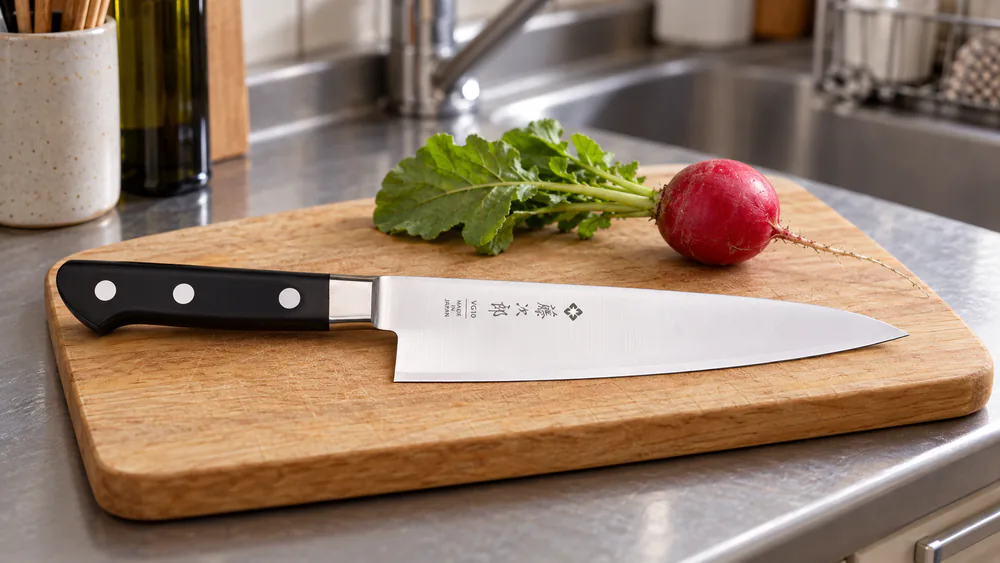
The 180 mm F-807 is the pick when space is the problem. It moved easily through cucumber, eggplant and bell pepper, felt convenient for a single radish, and worked comfortably where a compact line station limited blade movement. It also took a good fresh edge even when the factory sharpness felt underwhelming. The cost of the short blade is more strokes for long celery stems and batch herb mincing.
Easy movement through cucumber, eggplant and bell pepper
Comfortable in a tight workspace
Gentle front curve that allows modest rocking
Takes a good fresh edge on a stone
Specifications
Blade length
180 mm
Model
F-807
Total length
310 mm
Steel
VG10 core with stainless cladding
Edge
50/50 double bevel
A 180 mm gyuto is a different animal from a 210 mm one. Overall it measures 310 mm, which leaves room to work on a board where a longer knife would hang over the edge or collide with a mixing bowl.
When a shorter chef knife makes sense
Choose the 180 mm when your prep space is limited, when you cook mostly for one or two people, or when you simply prefer a knife that feels quick in the hand. It is a good fit for apartment kitchens, for cooks who work on a small board set across the sink, and for anyone who finds a 210 mm knife slightly intimidating.
The blade has a gentle front curve that permits modest rocking, and the handle butt and curved bolster help keep the grip secure. It balances near the bolster, so a forward pinch grip makes the handle feel a bit more prominent than you might expect. If you choke up on the blade, give yourself a few sessions to settle into it.
Small hands tend to like this knife most. It is also a sensible second knife for a cook who already owns a longer chef knife and wants something handy for a single shallot or a few strawberries. Note that the figures for this model can vary slightly between sources, and older listings describe a different core steel. The current model uses VG10, so match the model code before you buy.
What you give up in cutting length
The compromise is reach. A short edge covers fewer vegetables lined up together, so a pile of celery stems or a big batch of minced herbs takes more strokes than it would with a longer gyuto. It can still slice a tomato skin cleanly after a mixed vegetable session, which tells us the edge holds up, but the geometry of a short blade simply asks you to do more passes.
There is also a touch of blade flex during use. It is not alarming, and you only notice it on firmer ingredients, but it is worth knowing if you are used to a stiff German blade. Slicing larger proteins or a whole cabbage is not what this knife is for. If you do that often, step up to the 210 mm.
3. Tojiro DP/Classic Gyuto 240 mm: for larger prep jobs
The 240 mm F-809 gives you extra reach, and that helps when you are processing several heads of lettuce or a large cabbage. The edge stays useful in routine cooking, and the handle can feel comfortable through repeated prep. The price of that reach is space: it needs more room on the board and can feel cumbersome in a cramped kitchen. The finish is good without being perfectly smooth at every transition.
Long reach for lettuce, cabbage and big slicing jobs
Edge that stays useful in routine cooking
Handle that stays comfortable through repeated prep
50/50 double bevel for straightforward sharpening
Specifications
Blade length
240 mm
Model
F-809
Steel
VG10 core with stainless cladding
Edge
50/50 double bevel
Handle
Reinforced laminate, full tang, three rivets, metal bolster
The 240 mm gyuto is the long-blade option for cooks who have the counter to use it. It carries noticeably more heft than a lighter wa-style handle, and published weights vary, so treat any gram figure as approximate guidance and confirm the exact version before you buy.
Who benefits from the extra blade length
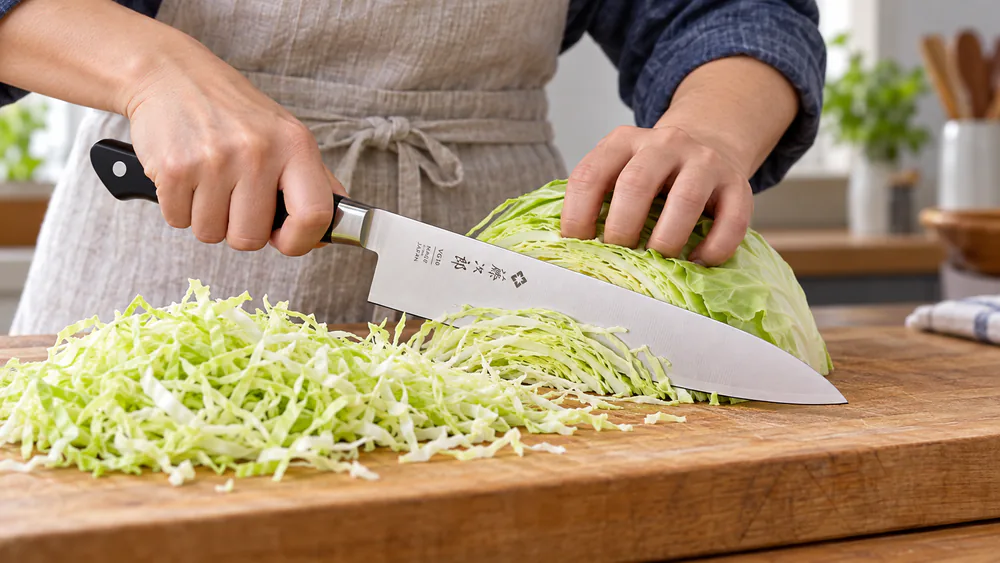
The longer blade pays off if you prep in volume. Shredding cabbage for slaw, breaking down several heads of lettuce, or slicing a large roast or melon are all jobs where a 240 mm edge saves strokes and gives you clean, single-pass cuts. Meal-preppers and cooks who host often tend to appreciate it.
It also suits cooks with large hands. The extra length of the handle assembly and the heft give you more to hold, and the knuckle clearance question we raised on the 210 mm feels less pressing here. If you already own a 210 mm and want a specialist for the big jobs, the 240 mm is a logical companion.
Keep in mind that our experience with this size is the thinnest of the three plain models. The notes we lean on say the same things in different ways: reach is the selling point, and space is the cost.
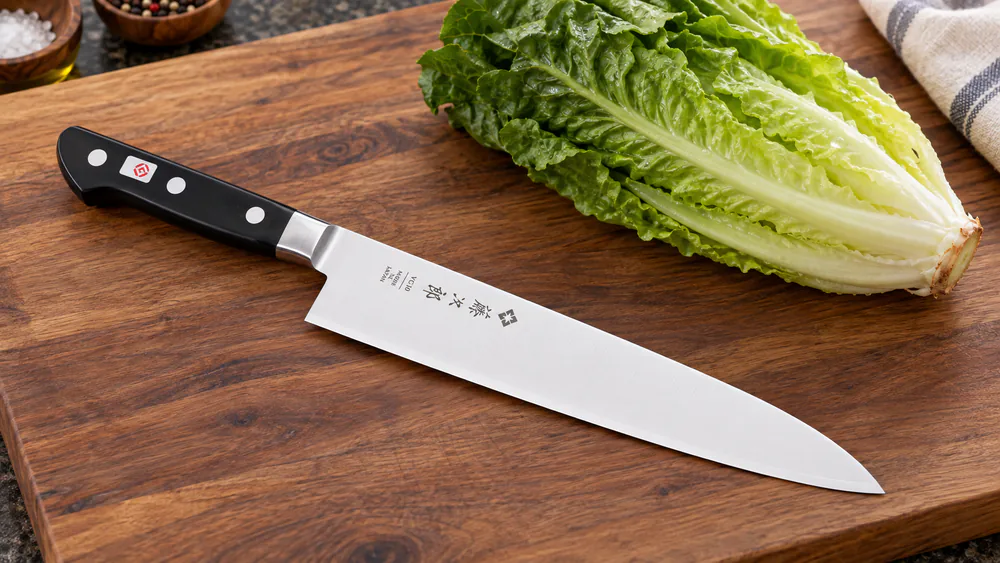
Long jobs like cabbage are where the extra blade length earns its place.
Board space, control and handling trade-offs
A 240 mm knife needs a board that can contain the swing of the blade, and it needs a counter with room behind it. In a cramped kitchen it can feel cumbersome, and control suffers when you are working on small items near the tip. If most of your cooking involves a single onion and a couple of carrots, the extra length is wasted.
The handle is the other consideration. The Western handle has real heft, and the transition from handle to tang can feel less refined than the cutting edge. The finish is good, but it is not perfect at every transition. These are small cosmetic points rather than functional faults, yet they are the kind of detail a careful buyer wants to know.
Storage matters too. With a total length of roughly 365 mm, this knife needs a long magnetic strip or a generous block slot. Overall dimensions vary slightly between published specifications and measured examples, so allow some clearance.
4. Tojiro DP Damascus Chef Knife: an alternative finish
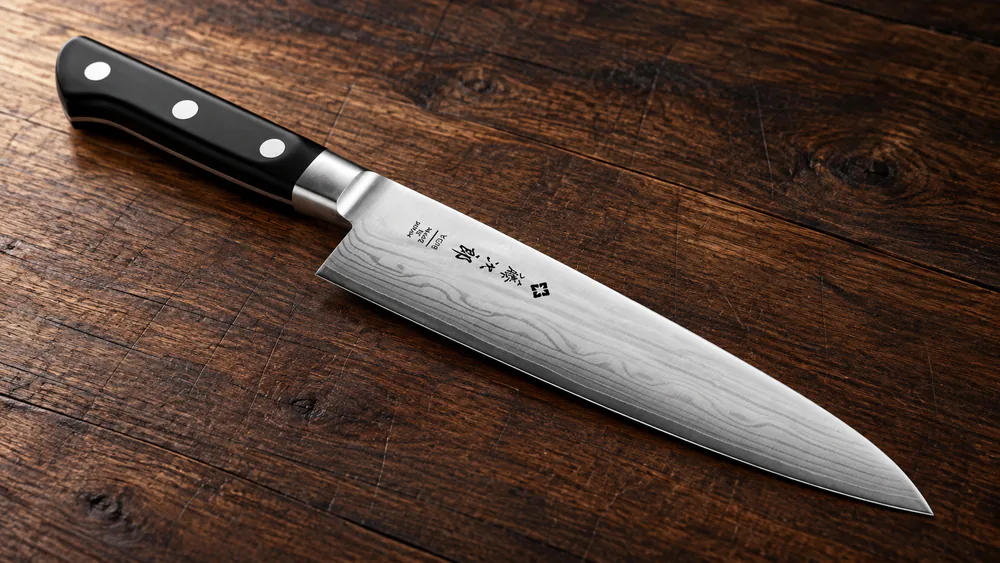
The F-655 shares the 210 mm size and VG10 core of the standard knife, then adds a 37-layer patterned cladding that gives the blade a more decorative look. Our hands-on notes on it are limited: the grip is comfortable and the keen edge can be refreshed by sharpening, though the contrast can look subtler in person than in promotional photographs.
Pros
37-layer patterned cladding over a VG10 core
Comfortable grip with a keen edge that sharpens back
Same familiar 210 mm size as our top pick
Cons
Costs more than the plain 210 mm for a cosmetic change
No proven edge-retention or food-release advantage
Small finish imperfections, such as handle molding, are possible
We could not confirm a reliable single-knife listing, so check the seller carefully
Where the 240 mm adds reach, the Damascus adds only a finish. It uses the same VG10 core and Western handle construction as the plain 210 mm, with a manufacturer-listed total length of 340 mm and patterned stainless cladding in 37 layers.
What changes compared with the standard DP/Classic
The pattern lives in the cladding, not the core. Specifications for hardness vary by region, from 58 to about 61 HRC across published sources, so we do not promise an exact figure.
Published weights also disagree, so we treat weight as approximate. The manufacturer describes the edge as a double bevel, although one retailer specification table contradicts that, so if bevel handedness matters to you, confirm the details with the seller before you buy.
In person, the contrast can look subtler than in promotional photographs, so expect an understated pattern. A small imperfection in the handle molding is also possible, which is worth a look when the knife arrives.
When the added cost is worth considering
The Damascus finish makes sense as a gift, or for a cook who wants a knife that looks as good on the counter as it performs on the board. It is a premium pick relative to the plain Classic models, and that premium buys appearance, not a proven gain in food release, edge retention or sharpening.
If you care about performance first, put that money toward a good sharpening stone or a second knife instead. If you love the look and the budget allows, the F-655 is a perfectly capable gyuto. One practical note: the button above opens a search rather than a single product page, so confirm the model code (F-655) and the 210 mm length before you add anything to your cart.
How to choose the right Tojiro chef knife
Choosing well comes down to four questions: how much board space you have, how you move the knife, how much care you will give the steel, and how the handle sits in your hand. The questions are simpler than the model numbers make them look.
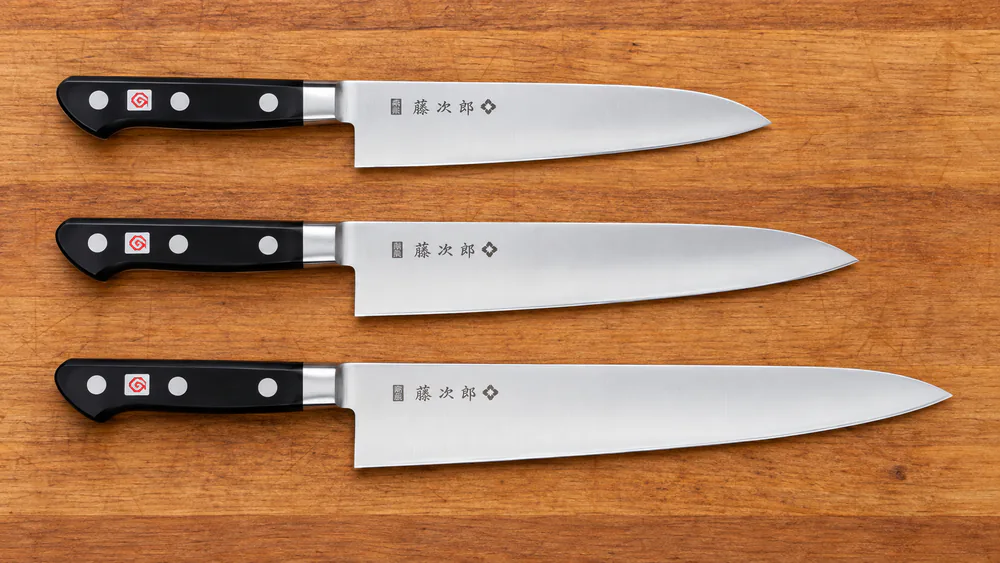
Board space, more than skill, usually decides the right length.
Choosing between 180 mm, 210 mm and 240 mm
Start with your board. A 210 mm knife works comfortably on a board around 18 inches wide, which describes most home setups. If your board is smaller than that, or your counter is crowded with appliances, the 180 mm will feel more natural. If you have a large butcher block and cook in volume, the 240 mm will reward you.
Then consider what you cut. Small, delicate jobs favor the shorter knife. Long, repetitive jobs like shredding cabbage or slicing several heads of lettuce favor the longer one. For the broad middle of everyday cooking, the 210 mm is hard to beat, which is why it leads this guide.
Finally, think about your hands. Larger hands often find the 210 mm blade height tight on the knuckles, while small hands tend to feel at ease on the 180 mm and 210 mm. If you can, hold the knife before you commit, or pick a seller with a clear return path.
Understanding DP, Classic and model names
The naming is the part that confuses most buyers. Classic is the renamed DP series for these model numbers, and the name change does not create a higher steel tier. When a listing says DP and another says Classic, check the model code. F-807 is the 180 mm, F-808 is the 210 mm and F-809 is the 240 mm.
Be cautious with older write-ups that claim the 210 mm sits in a separate tier with different steel. The manufacturer identifies the F-808 as a Classic model with a reinforced laminated handle, and it uses VG10 like the others. Handle terms also vary from listing to listing, with words like eco-wood, composite wood and reinforced laminate all in circulation. We use the manufacturer's term, reinforced laminated material, and we do not assume the handles are identical in composition across every model.
Comparing steel, blade geometry and handle comfort
On steel, all four picks share a VG10 cutting core with stainless cladding. That gives you a hard, keen, fairly low-maintenance edge, with hardness of about 60 HRC on the plain models. Hardness has a manufacturing tolerance, so treat 60 HRC as a guide, not a measured promise.
On geometry, the plain gyutos have an even double bevel, which is friendly for right- and left-handed cooks and easy to maintain. We cannot give precise thickness or blade-height comparisons across all four, because the figures are not comparable in the sources we trust. What we can say is that the blade is a practical, general-purpose shape rather than an ultra-thin laser.
On handle comfort, the Western laminated handle is neutral and secure, with a metal bolster that gives the knife a slightly forward balance. It is comfortable for most, apart from the palm pressure noted earlier.
Board space, not skill, usually decides the right Tojiro length.
When a santoku may suit you better
A gyuto adds pointed-tip work and slicing reach. A shorter, flatter santoku suits mostly straight chopping. If your cooking is dominated by chopping vegetables with an up-and-down motion and you rarely use the tip or slice long cuts of meat, a santoku can feel more natural and take up less space.
If you want one knife for the widest range of jobs, the gyuto is the more versatile choice. If you are torn, think about the last five meals you cooked and how you cut for them. For an overview of how the gyuto compares with other makers, you can browse our look at Global, Miyabi and Shun chef knives.
Pros
VG10 core takes a keen edge and sharpens back on a stone
Plain Classic models share a neutral, secure Western handle
Even double bevel keeps sharpening and left-handed use simple
Three sizes cover small boards through large prep jobs
Stainless cladding is far less fussy than carbon steel
Cons
Heel corner and handle edges can bother some grips
Minor edge chips and surface stains are possible with hard use
The 240 mm needs plenty of board and storage space
Model naming (DP versus Classic) is confusing across listings
Caring for a Tojiro chef knife
A VG10 knife is forgiving, but it is not indestructible. A few habits keep the edge keen and the cladding looking good, and none of them takes more than a minute.
Cleaning, drying and storage
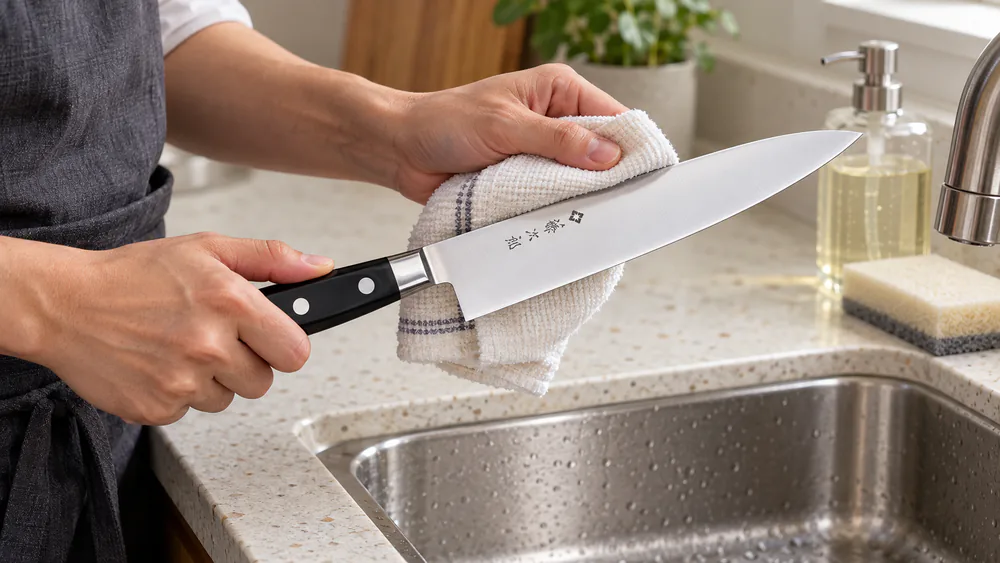
Wash the knife by hand with a soft sponge and mild dish detergent, rinse, and wipe it dry straight away. Remove salt and acidic food residue promptly, and never leave it soaking. Skip the dishwasher and avoid metal scourers, which scratch the cladding.
Because stainless surfaces can still acquire scratches and stains, a quick wipe after cutting onions, tomatoes or citrus is a good habit. Plain DP cladding can also hold onto wet potato and zucchini slices rather than releasing them immediately, so a wipe of the blade between batches keeps the work moving.
For storage, a magnetic strip, a block slot or a blade guard all work, as long as the knife is dry before it goes away. Allow clearance for the length of the model you choose, especially the 240 mm.
Sharpening and avoiding edge damage
Maintain the edge on water stones, and keep it away from bones, frozen food and hard crusts. Those are the common causes of the minor chips that can appear with extended use. Cut on wood or soft synthetic boards, not glass, stone or ceramic.
General sharpening guidance uses an angle of about 10 to 15 degrees to the stone, but that is not a verified factory angle for every model. Published factory angles differ from source to source, so the safest approach is to preserve the existing bevel. If you are unsure, start by matching what the knife already has, and make small adjustments rather than reprofiling.
The good news is that these knives sharpen back well. The 180 mm took a good fresh edge even when the factory sharpness felt underwhelming, and the Damascus knife's keen edge can be refreshed by sharpening. A light touch on the stone every few weeks will serve you better than a hard grind twice a year.
Frequently asked questions
Can you put a Tojiro chef knife in the dishwasher?
No. Hand wash with mild detergent and dry it straight away. Dishwasher heat, detergent and knocking against other items are hard on the edge and the handle, and the same goes for bones, frozen food and hard crusts.
Does the lifetime warranty cover a chipped edge?
Do not count on it. A lifetime warranty is advertised, but coverage depends on the seller, the region and the nature of the defect, and chips from misuse are not an established covered benefit. Ask the seller for the written terms before you buy.
Is the 180 mm F-807 carbon steel?
No. Some older listings describe a different core, but the current F-807 is a VG10 knife with stainless cladding. Matching the model code on the listing is the safest way to be sure.
What should you check if you are left-handed?
The plain Classic gyutos have an even double bevel and a neutral Western handle, so they work for left-handed cooks. Check how the grip feels in your hand and confirm the exact delivered model.
Final verdict: which Tojiro chef knife should you buy?
For a small set, the 210 mm and 180 mm pair covers nearly every job from a single shallot to a roast while needing less board space than a set with the 240 mm. Before you order any of them, check the model code (F-807, F-808 or F-809) on the listing, since DP and Classic names are used interchangeably.
Whichever size you choose, give it the care it asks for: hand wash, dry it, keep it off bones and frozen food, and learn to touch it up on a stone. Do that, and the knife will repay you for years of everyday cooking.