
Helping you create a kitchen you love.

Knives & Cutlery

Work Sharp Precision Adjust Review: Is the Guided Clamp Worth It?

As an Amazon Associate we earn from qualifying purchases. We may earn a commission from links on this page, at no extra cost to you. Learn more.

Work Sharp Precision Adjust Review: Is the Guided Clamp Worth It?

Holding a steady angle by hand is the hardest part of sharpening, and it is the problem a guided clamp promises to remove. We looked at whether the Precision Adjust delivers on that promise. This review covers the standard Precision Adjust; the Precision Adjust Elite is a separate, discontinued model that we compare later.

We judged it the way we judge any sharpener, by what it does to the edge: how a dull blade responds, how repeatable the setup is, and how much patience the clamp demands.

If you are still choosing between systems, our knife sharpener reviews cover the wider field.

Quick Verdict

The Precision Adjust earns a place on the counter for home cooks who want clean edges on kitchen knives without freehand skill.

Work Sharp Precision Adjust
1

Work Sharp Precision Adjust

Best Guided Sharpener for Beginners
Check Price on Amazon
4.1/5

A dull chef knife came back near factory sharpness on this system, and the clamp let us lift the blade out to check for a burr without losing the angle. Paper cuts still ripped slightly, and a leather strop made a clear improvement. We would use it for chef knives, santoku and utility knives, and skip it for steak knives and small paring blades.

  • Dial sets angles from 15-30 degrees in 1-degree steps
  • Diamond and ceramic stages on one rotating rod
  • Clamp holds tall kitchen blades repeatably

Specifications

Angle range
15-30 degrees per side
Abrasives
320 and 600 diamond, fine ceramic
Warranty
3-year
Weight
about 1.3 lb

Key takeaway. Take a photo with the clamp and angle scale in frame before you unclamp a knife. It lets you repeat the same setup next time without guessing.

Specs and What's in the Box

The kit is four pieces: a base, a sharpening chassis with the angle dial, a blade clamp, and a sharpening rod with the stones. The clamp and rod seat on magnets, and the clamp flips 180 degrees to switch sides. Assembled it measures 11.5 in long, 4.6 in wide and 6.8 in tall.

Work Sharp Precision Adjust specs
Angle range15-30 degrees per side
Dial increments1-degree
Stonescoarse 320 diamond, fine 600 diamond, fine ceramic
Weightabout 1.3 lb
Warranty3-year

An optional leather strop and extra grits are sold separately, and the standard kit has no serration rod.

How We Tested the Precision Adjust

Here is how we rate a guided sharpener. We score how a dull blade responds, judging each edge by feel and by how cleanly it slices paper. We score setup repeatability, meaning whether the dial and clamp can reproduce the same angle on the next session. We score how much patience the clamp demands, and how the system fits wide chef knives compared with narrow steak and paring blades.

How the Precision Adjust Works

Setup and the Angle Dial

The instructions are short and clear, and they are worth the two minutes it takes to read them before you start. Set the dial to the angle you want, seat the clamp, and the stones track that angle on every pass.

The dial makes it quick to set an angle once you know the knife's existing bevel. Coloring the edge with a marker and honing until the color wears evenly reveals it. One caution: the dial is a repeatable reference, not a measured angle, because the real angle shifts with blade height.

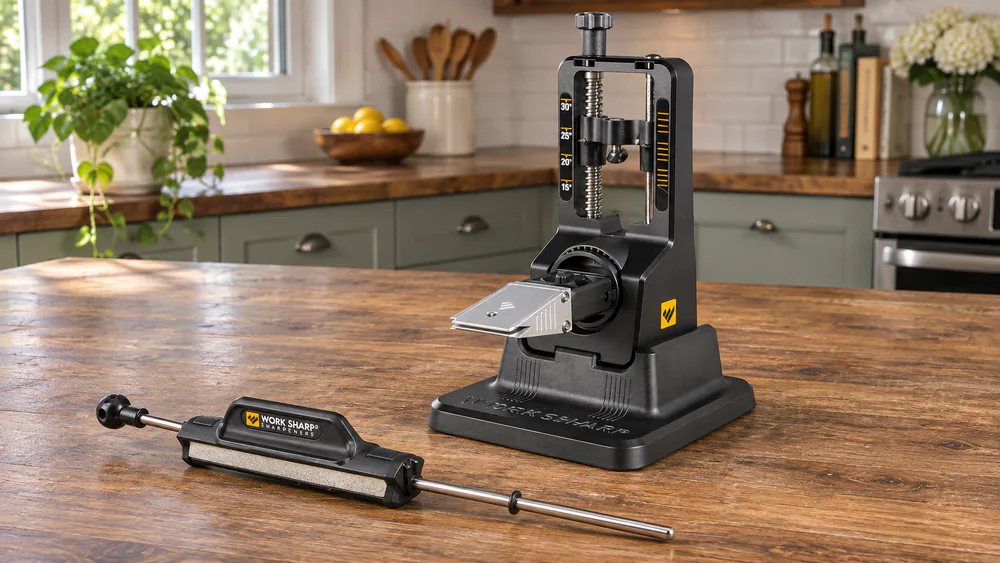
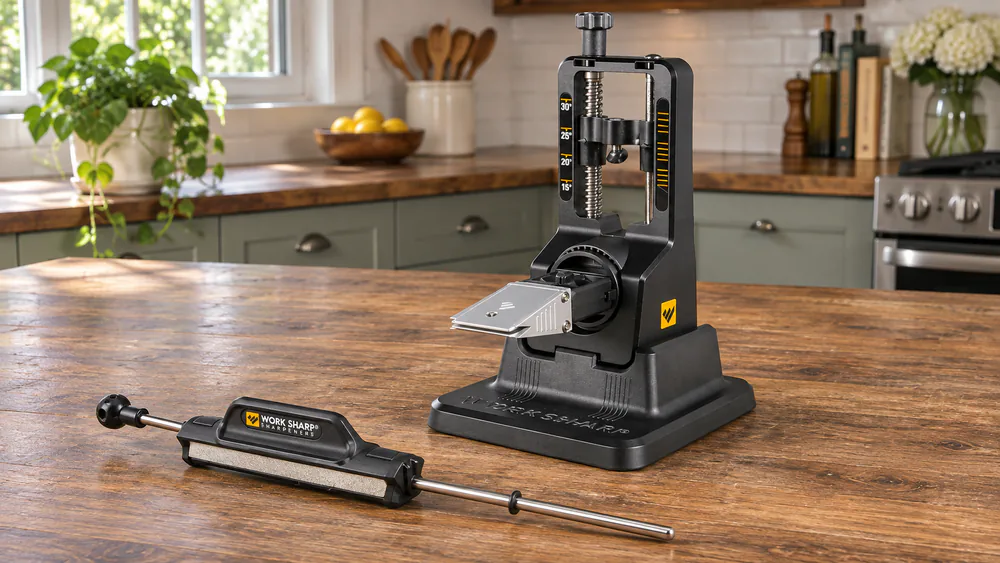
A Work Sharp Precision Adjust sharpener with an empty clamp, angle adjustment tower and abrasive rod beside the base
The empty clamp, angle adjustment tower and abrasive rod.

Sharpening Steps

Start with the coarse 320 diamond only if the edge is badly dull, and stroke until you raise a burr. Repeat the same strokes on the other side, move to the 600 diamond, then finish with about ten ceramic strokes per side. Stroke counts depend on how dull the knife is and the steel, so treat ten as a starting point.

Plan on about 10-15 minutes per knife. Lifting the clamp off its magnetic seat to flip it is better than rotating the whole unit, because you can inspect the edge as you do it.

Testing Results

Sharpening Ability

A dull Shun santoku went from about 722 g to about 208 g of cutting force in about 10 minutes using that sequence.

Most knives only need the fine diamond and ceramic. When edges are kept from getting very dull, the ceramic ends up doing most of the routine work. Reprofiling a badly changed edge with the 320 plate takes a long time, and a knife with an unknown angle needs patience before it will slice paper. Folder steels such as S30V and MagnaCut sharpen in few passes on the diamond plates.

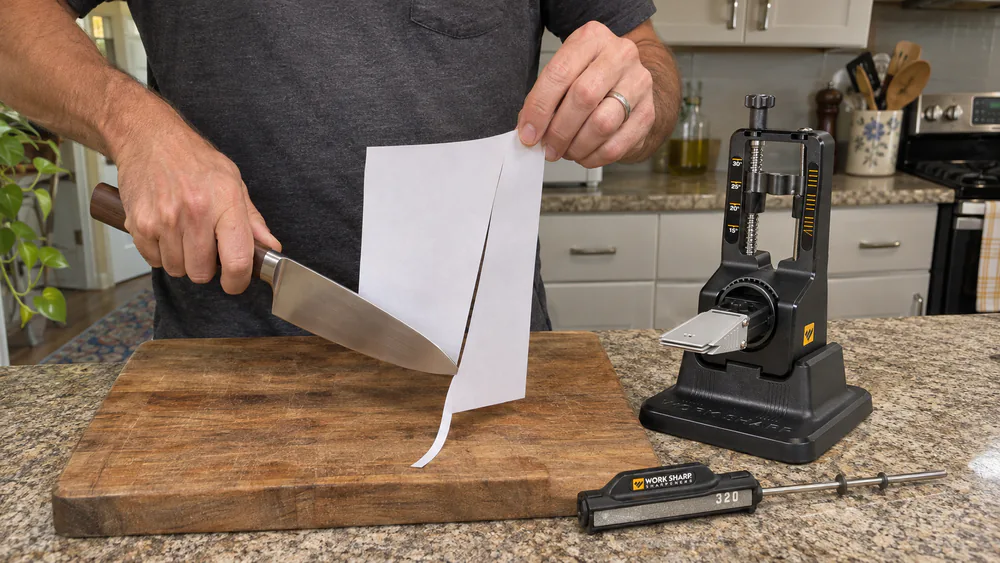
A freshly sharpened chef knife slicing a sheet of printer paper on a wooden board next to the Work Sharp Precision Adjust
Paper test after the ceramic finishing strokes.

Ease of Use

After a failed run with a Lansky, this clamped system gave clean, consistent edges without freehand skill. The knife holder flexes a little, but light pressure keeps that negligible.

Versatility and Knife Compatibility

The system works best with tall chef knives, whose blades give the stones room to clear the clamp even at very low angles. A 12-inch kitchen knife is doable with care. Cleavers and big nakiri sit awkwardly.

Narrow blades are the weak point. Steak knives and a trapper were too skinny for the V-clamp: either the clamp covers the edge or the grip loosens and the knife moves. Short-spine paring and fillet blades are very hard to sharpen at or below 20 degrees. Serrated blades are harder still and need the separate attachment.

Build Quality and Storage

The unit feels plasticky next to pricier guided systems but works well. The clamp is sturdy and repeatable, and the base is a little small and needs a steadying hand with larger knives. The four parts need reassembling for each session, and the kit takes up considerable storage space, though it does fit in a cabinet.

What It Does Badly

The strengths above come with trade-offs, and the clamp is where most of them show up. The flip-over clamp is fiddly. Releasing it takes force, and any knife longer than a small pocket knife means lifting the whole unit off the table to rotate it. The magnets are not strong, so the angle can drift if you rush.

On folders, the stone holder leaves a thin unsharpened strip, about 1/32 to 1/16 in, at the plunge grind. Dropped-edge kitchen knives and finger-choil knives are not affected, so this matters mostly for pocket knives.

Three grits is limiting. A thick or badly dull blade wants something coarser than 320, and enthusiasts want a finer finish than the ceramic.

How It Compares to Other Sharpeners

Vs the Precision Adjust Elite

The Elite is discontinued, and availability changes by seller. It offers the same 15-30 degree range and 3-year warranty, plus a longer grit ladder, a serration rod, a strop and a clamp stabilizer. If you find one, it fixes our grit complaint.

Vs Lansky and Whetstones

The Lansky Deluxe 5-Stone uses five hones and fixed guide angles at 17, 20, 25 and 30 degrees. It is cumbersome to set up, the clamp feels rough, and stones and rods need matching. With a strop, the Lansky still gets knives very sharp, but the Precision Adjust is easier to use and allows settings between those fixed angles.

A 1000/6000 whetstone removes the least steel and is fastest once learned, but it needs real practice to hold an angle. The clamp swaps skill for time.

Who Should Buy It

These trade-offs make it clear which cooks the system suits. Home cooks with chef knives, santoku and utility knives who want repeatable results are the target. Collectors of narrow steak knives, small parings and Japanese specialty blades should look at whetstones or a different guided system.

Frequently Asked Questions

Do I need a leather strop with it?

A strop is optional and sold separately. After a pre-dulled chef knife came back near factory sharpness, paper cuts still ripped slightly, and a leather strop made a clear improvement.

How long does the 320 plate take to reprofile a knife?

A long time. Reprofiling a badly changed edge with the 320 plate takes patience, and a knife with an unknown existing angle needs more of it before it will slice paper cleanly.

Do the diamond plates shed grit?

They can over time. Diamond plates are known to shed some grit as they wear, which is normal for plated abrasives.

Is alternating sides for the final edge slow?

It can be tedious. Shaping on the clamp and finishing with quick alternating strokes on a rod system is faster.

Bottom Line

If you want to close the gap on the standard kit, add a leather strop, or hunt for an Elite while stock lasts. If you already hold an angle on a 1000/6000 stone, keep your whetstones; this system is for people who have tried freehand and given up.

Pros

  • Dial sets 15-30 degrees in 1-degree steps
  • Clean, consistent edges without freehand skill
  • Clamp is sturdy and the knife lifts out to check the burr
  • 3-year warranty

Cons

  • Flip-over clamp is fiddly and the base small
  • Needs assembly each use and stores bulky
  • Narrow blades do not fit the V-clamp well
  • Only three grits, with no coarser or finer option
  • Leaves a thin unsharpened strip on folders

Read next

Ready to upgrade your kitchen?

Browse our tested buying guides and find the right gear for how you cook.