As an Amazon Associate we earn from qualifying purchases. We may earn a commission from links on this page, at no extra cost to you. Learn more.
A yanagiba is a long, thin, single-bevel slicer built to cut boneless raw fish in one smooth pull. The best yanagiba knife for you depends on three things: how much working space you have, how much care you will give the steel, and whether you cut right-handed. In this guide we cover four yanagibas that suit home sushi nights, from a compact stainless starter to a traditional carbon blade. Every pick here is a right-hand-oriented knife, and we flag where that matters. If you want to see how these fit into the wider category, browse our Japanese knife reviews.
Best Yanagiba Knives at a Glance
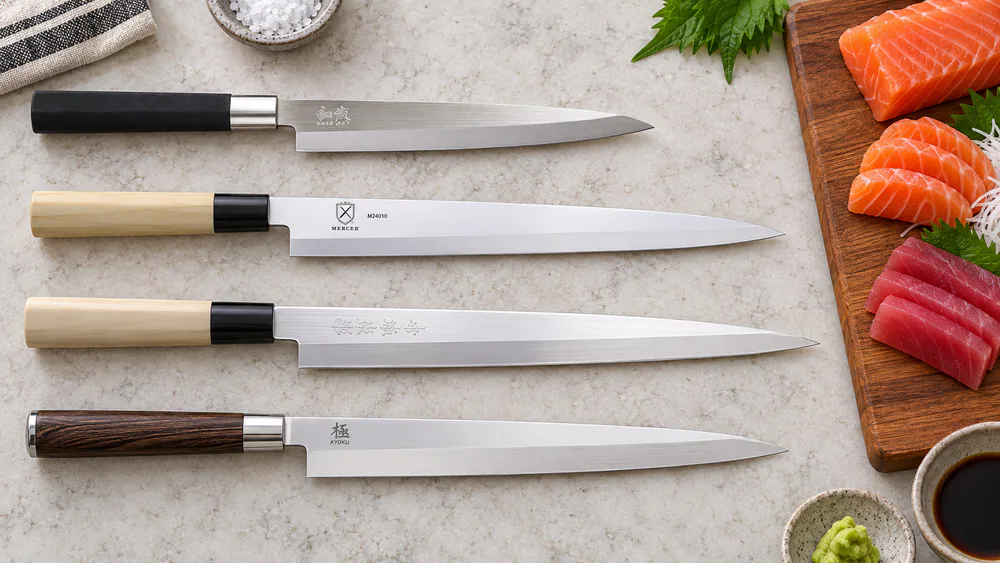
Four knives made our shortlist, and they split cleanly by buyer. The Kai Wasabi is the compact, low-maintenance starter. The Mercer is the budget sashimi slicer. The Yoshihiro is the traditional carbon-steel blade for people ready to maintain it. The KYOKU is a budget long slicer with specifications we could not fully pin down, so we treat it as a conditional alternative.
Product
Best for
Blade length
Steel
Bevel and handedness
Care burden
Kai Wasabi Black 6721Y
Compact home starter
210mm (8.25-inch model)
1K6 stainless
Single bevel, right-hand oriented
Low: hand wash and dry
Mercer Culinary Asian Collection M24010
Budget sashimi slicing
240mm (nominal 10-inch class)
High-carbon German steel, exact grade unverified
Asymmetric 6/15-degree edge, right-hand oriented
Moderate: keep the wooden handle dry
Yoshihiro Kasumi White Steel Magnolia
Traditional use and premium buyers
300mm
White Steel #2 over soft iron
Traditional single bevel, right-hand version
High: dry promptly and oil the blade
KYOKU Samurai
Budget long-slicer alternative
10.5-inch
Alloy unresolved
Unresolved: single-side versus per-side claims
Moderate: keep wood dry, inspect the edge
How We Tested These Yanagiba Knives
We judged each knife on its draw cut through fish, handle comfort during longer sessions, ease of care, factory edge and response to sharpening. A yanagiba should cut with a long pull and very little downward pressure, so we looked for blades that glided rather than dragged.
Across the group, we used salmon, tuna, fluke and sushi rolls to judge how each blade handled its intended cuts. We do not claim a fixed testing period for any of the four.
Our ratings are editorial scores for fit, finish, handling and care burden. They are not lab measurements, and we publish no edge-retention numbers or slice-thickness figures because we did not run a measured protocol. Where a spec has conflicting published figures, such as the KYOKU bevel and alloy, we say so rather than pick a side.
The four shortlisted yanagibas.
Our Yanagiba Knife Picks
Best All-Round Option for Home Cooks: Kai Wasabi Black 6721Y
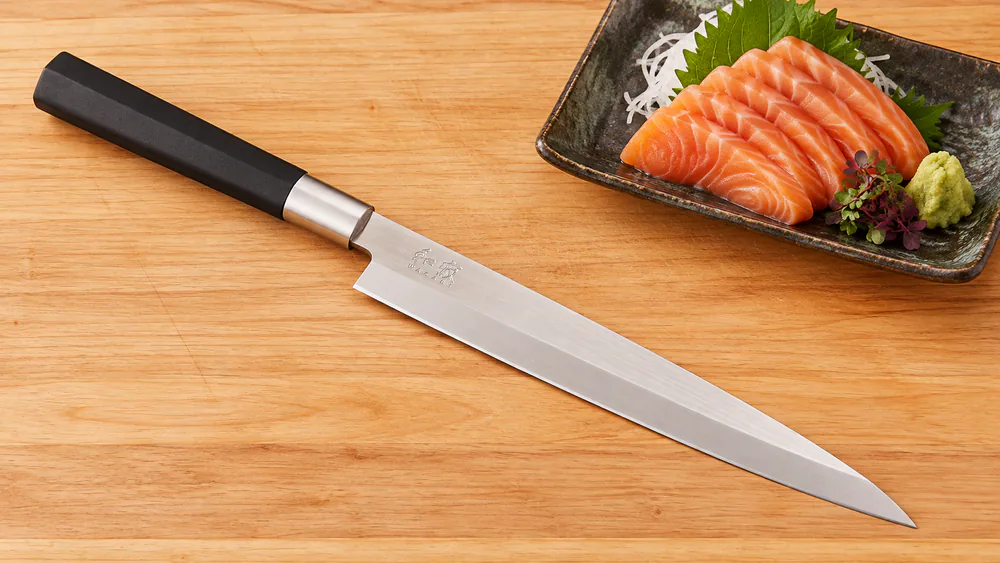
The Kai Wasabi is the yanagiba we would hand to most home cooks. The 1K6 stainless blade forgives a wet board and a slow cleanup, the polypropylene handle shrugs off water, and the short blade is easy to control on smaller portions. In our hands it cut assorted fish and sushi rolls cleanly for occasional sushi nights, and it needs less rinsing between rolls than a perforated nonstick sushi knife.
Pros
Stainless 1K6 steel with the lowest care burden of the four
Compact blade is easy to control on small portions and good for draw-cut practice
Water-resistant D-shaped synthetic handle
Limited lifetime warranty for the original owner, with eligibility depending on region and authorized seller
Cons
Short blade limits a full draw through a broad loin
Rough factory finish and a secondary bevel that needs sharpening work
No included sheath, so you need a separate edge protector
The trade is reach. At 210mm the blade cannot complete a full draw through a broad loin, so you will make a second pass on big cuts. The handle feels basic rather than luxurious, and the factory finish can be rough, with an oversized secondary bevel that takes extra work on the stones. The exposed edge also needs a separate protector for storage. Be careful with the model number: the 6721Y is the compact 8.25-inch knife, so do not buy it expecting 9 inches. Do not confuse it with the longer 6724Y.
The compact blade handles smaller portions with good control.
Best Budget Option: Mercer Culinary Asian Collection M24010
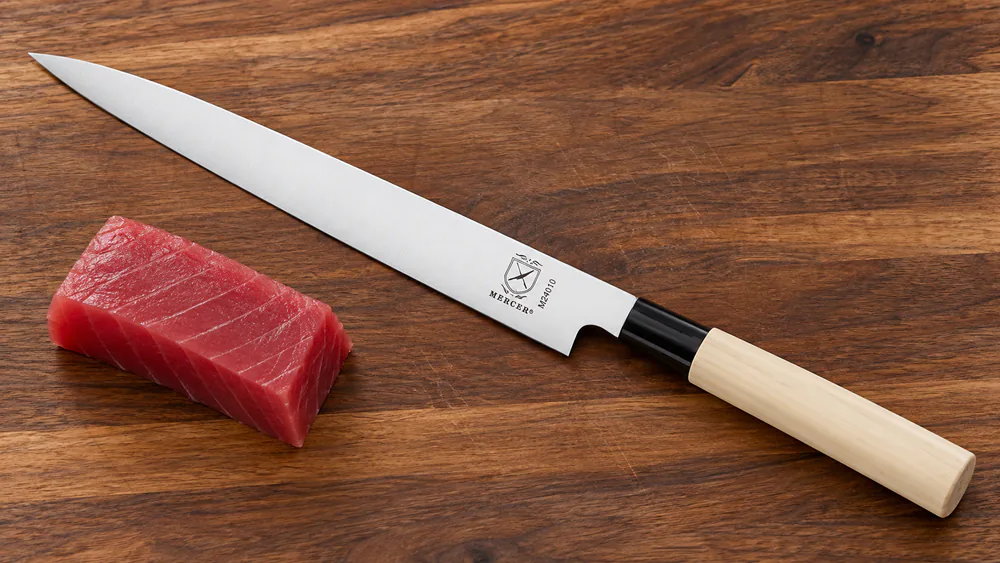
The Mercer gives you a longer 240mm blade at a budget tier, and the blade is the strong part of the package. We found it passed through a large tuna loin with very little downward pressure, which is exactly what you want from a sashimi slicer. The knife is sold in the nominal 10-inch class, but the manufacturer's measurement is 240mm, so treat the 10-inch label as a size class rather than an exact figure.
Pros
Long 240mm blade glides through tuna with little pressure
Taper-ground high-carbon German steel with a fine stone finish
Limited lifetime warranty
A separate left-handed model exists
Cons
Wooden handle can be rough and porous, and the ridge can bother your hand
Not a verified traditional yanagiba grind
Needs hand washing and full drying, with no soaking
Separate knife guard needed
The wooden handle is where Mercer saved money. It can feel porous and rough, with less attention to finishing than the blade; on some handles, a pronounced ridge presses uncomfortably into the palm. The handle favors a right-handed grip. A separate left-handed synthetic-handle version exists, but it is not this model. We also want to be clear about geometry: the edge is asymmetric, with a 6-degree angle on one side and 15 degrees on the other. That makes it a capable sashimi slicer, but we do not describe it as a traditional hollow-backed yanagiba.
Best Traditional Carbon Steel Option and Best Premium Option: Yoshihiro Kasumi White Steel Magnolia 300mm
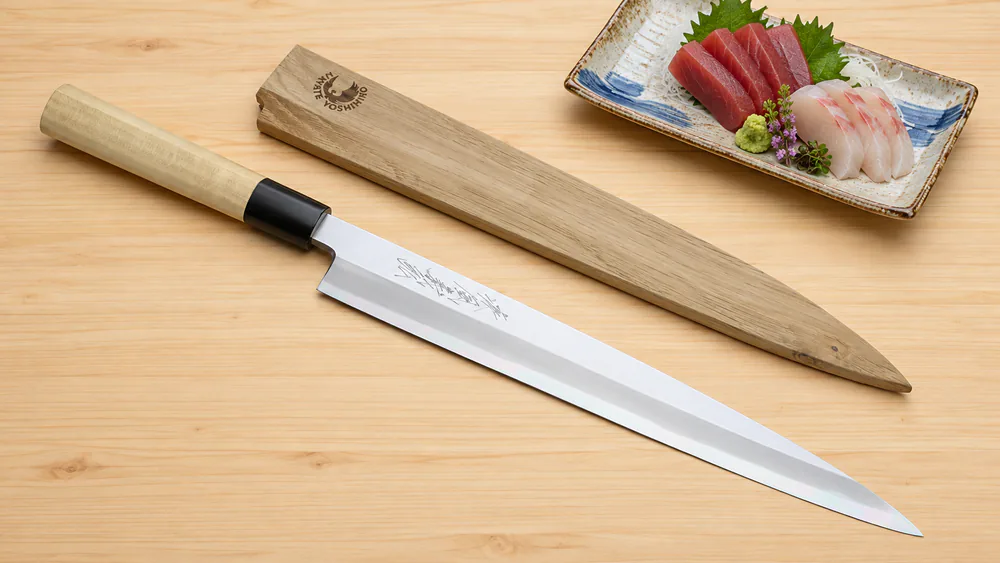
This is the knife for people who want the real thing. The 300mm blade is White Steel #2 carbon steel forged with soft iron, finished with a kasumi surface and a D-shaped magnolia handle with a buffalo-horn bolster. The construction is traditional single bevel, with a concave back and a flat perimeter, and a protective wooden saya comes in the box. We judge the long blade the smoothest of the four: it made clean cuts through fluke and firm tuna with little resistance and no dragging.
Pros
White Steel #2 takes a very keen edge
Long 300mm blade cuts tuna and white fish in one uninterrupted pull
True single-bevel construction with a wooden saya included
Handle and bolster feel traditional
Cons
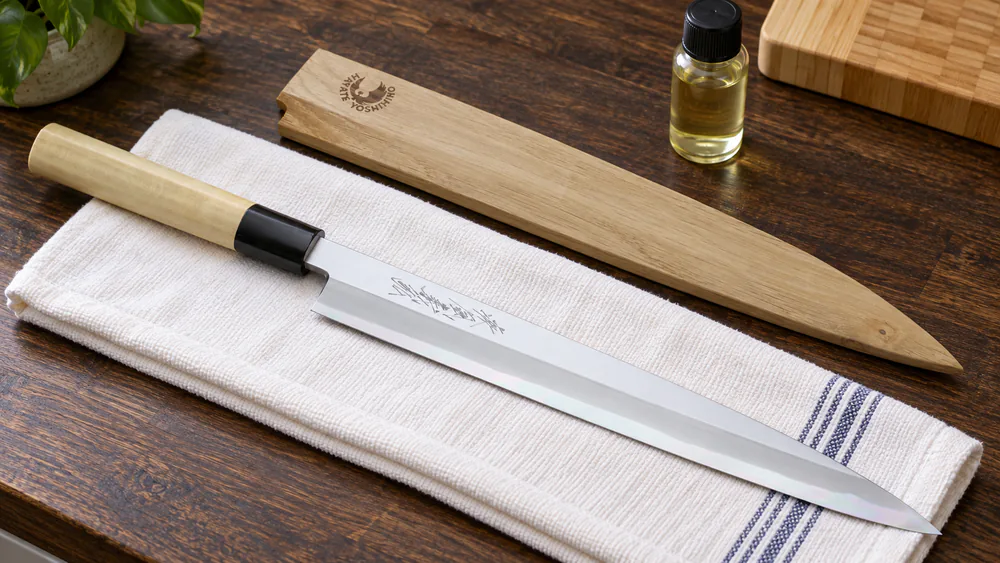
Reactive carbon steel needs prompt drying and oiling
Asymmetric edge has the steepest learning curve
Needs generous counter space
Premium tier and a right-handed-only version
Everything that makes it the best also makes it the most demanding. The Kasumi family takes a very keen edge, but learning to align its asymmetric blade takes more care than using a familiar double-bevel knife. The reactive steel can discolor after being left damp, so drying it before storage is part of the routine, along with a light coat of oil. A 300mm blade also needs clear working space behind the board for the hand and handle to finish the pull. The blade is rated at approximately 62 HRC. The version we feature is right-handed, and we did not verify a left-handed equivalent of this buy link. We also could not confirm a general warranty for this model.
Drying and oiling the carbon blade is part of the routine.
Best Long-Blade Budget Alternative: KYOKU Samurai 10.5-inch
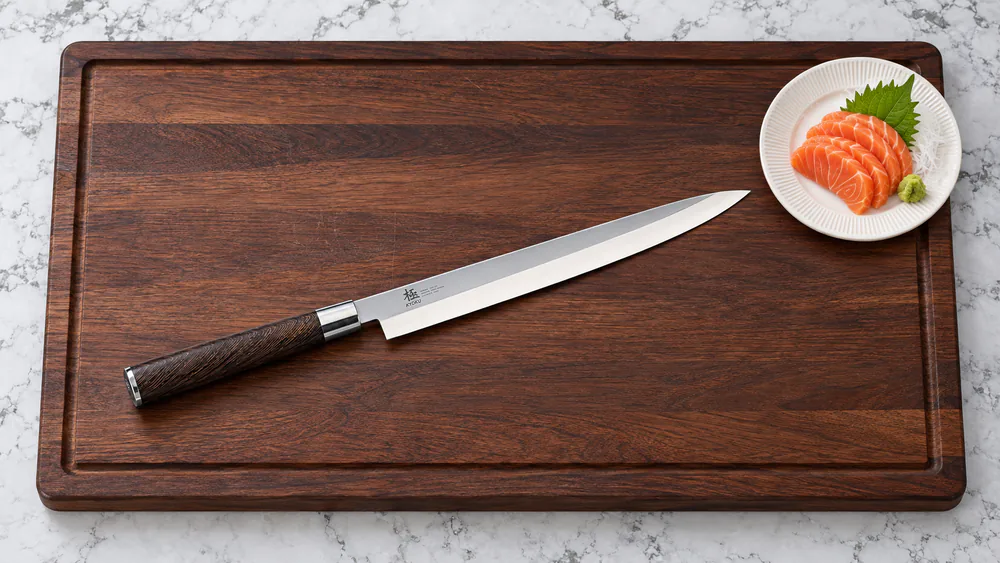
The KYOKU is the knife we recommend with the most caution. The 10.5-inch blade gives you a long slicing stroke without the reach of a large professional blade, and in our judgment it sliced salmon belly into clean sashimi and cut salmon rolls without snagging. It has noticeable heft, and that weight feels useful once a long pull through salmon begins. The wooden handle feels warm in the hand, and the sheath and storage case are welcome extras.
Pros
10.5-inch blade supports a long slicing stroke
Weight helps through salmon
Sheath and storage case included
Limited lifetime warranty with exclusions for misuse and wear
Cons
Bevel geometry and alloy are unresolved in the specifications
Edge alignment and handle fit can vary from knife to knife
Smooth handle gets slippery when wet
Needs regular touch-ups
The problems are consistency and clarity. The handle assembly can show gaps, proud metal fittings and excess adhesive even when the blade cuts well, and the edge can arrive with uneven alignment that disrupts slicing and needs corrective sharpening. Inspect the edge before any food use. The smooth handle can become slippery when wet, and the edge needs regular touch-ups. The published specifications also disagree. We cannot tell you whether the bevel is true single-side or per-side, so confirm the geometry before buying it for traditional single-bevel practice or for left-handed use. The steel is a corrosion-resistant alloy of unresolved grade, hardened to 56-58 HRC, and we will not promise a specific Japanese alloy. The limited lifetime warranty covers defects in household use for original US buyers from authorized sources.
How to Choose a Yanagiba Knife
Start with the cut you want to make. A yanagiba slices boneless fish in one long drawing stroke with minimal downward pressure, and every buying decision serves that stroke.
Single Bevel, Double Bevel, and Left-Handed Options
A traditional yanagiba is ground on one side only, with a hollowed back, so it is handed. A symmetrical-looking handle does not make the edge ambidextrous, and a left-handed knife has to be chosen explicitly rather than inferred from handle shape. All four of our picks are right-hand oriented. The Mercer has a separate left-handed model, but we did not verify a left-handed version of any buy link here, so lefties should search for an explicitly left-handed listing.
Double-bevel slicers are friendlier because the edge behaves like a familiar kitchen knife. They are also less specialized. That is the trade at the center of this guide.
Pros
A traditional yanagiba produces the cleanest sashimi surface and rewards good technique
Single-bevel edges respond well to proper stone sharpening
A specialist blade makes sense if you cut raw fish regularly
Cons
Handed construction rules out half of cooks unless you buy a left-handed model
Sharpening is a skill you must learn or outsource
A general slicer is more flexible if you only make sushi now and then
Blade Length: 210, 240, 270, or 300 mm
A 210mm blade is compact, and the Kai fits that class. The roughly 10-inch class means about 240mm, which is where the Mercer sits. A 270mm blade adds draw-cut reach, and 300mm, like the Yoshihiro, needs more clear working space. Match the length to the width of the fish and your counter, not to the idea that the longest blade is automatically best. The sweet spot for most home kitchens is 240mm.
Carbon Steel vs Stainless Steel
Carbon steel, like the Yoshihiro's White Steel #2, takes the keenest edge but reacts to moisture, so it must be washed and dried promptly and oiled for protection. Stainless, like the Kai's 1K6, is more forgiving and a better fit for a cook who does not want a care ritual. Stainless still benefits from prompt cleaning and drying.
Handle Comfort, Balance, and Storage
The handle decides how the knife feels in a long session. We found the Kai's synthetic handle basic but easy to live with, the Mercer's wooden handle rough in places, and the KYOKU's smooth wood slippery when wet. The Yoshihiro's magnolia handle with a horn bolster is the most traditional of the group. Plan for storage too. The Yoshihiro includes a saya and the KYOKU includes a sheath and case, while the Kai and Mercer need a separate edge protector.
What You Get at Different Budgets
Budget knives get you the shape and the long blade, but the compromises show up in handle finish, edge consistency and specification clarity. The mid-priced and premium end gets you steel and construction you can sharpen for years. The cheapest picks reward a buyer who checks the edge on arrival. The premium pick rewards a buyer who will maintain it.
Using and Caring for a Yanagiba
Making a Clean Draw Cut
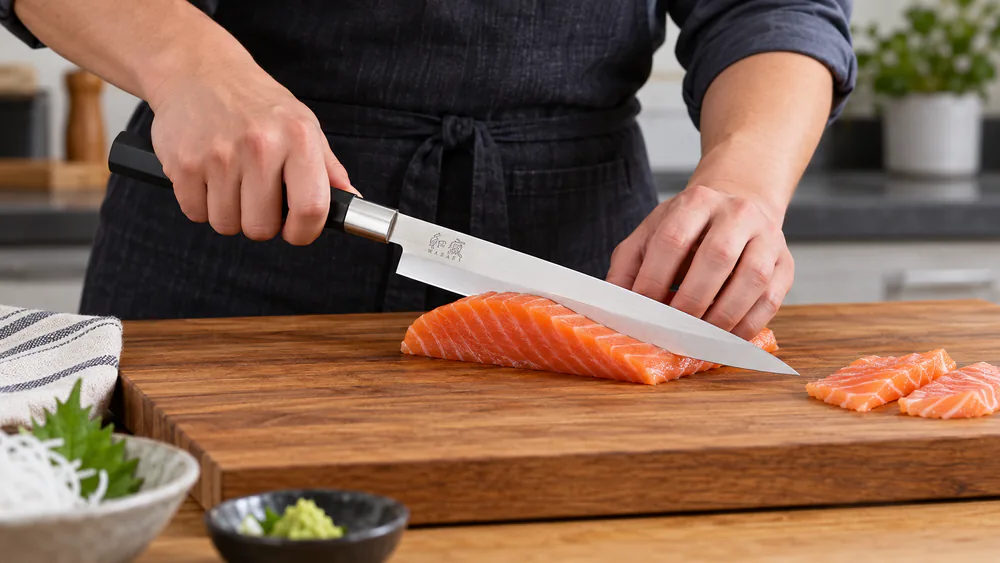
Place the heel of the blade on the fish, then pull the knife toward you in one long stroke, using the full length of the edge. Let the blade do the work. Leave room behind the board so your hand and the handle can complete the pull. This is why a 300mm knife demands more counter than a 210mm one.
Cleaning, Drying, and Storing the Blade
Hand wash with mild soap, rinse, and dry fully. Never use a dishwasher or leave the knife soaking, and avoid bones, frozen food and twisting through hard ingredients. Carbon steel needs extra attention to moisture and oxidation. Store the edge protected, in the saya, sheath or a separate guard.
Warning. A single-bevel knife is not ambidextrous. Check the handedness of a listing before you buy, and check any budget blade's edge for uneven alignment before it touches food.
Sharpening a Single-Bevel Edge
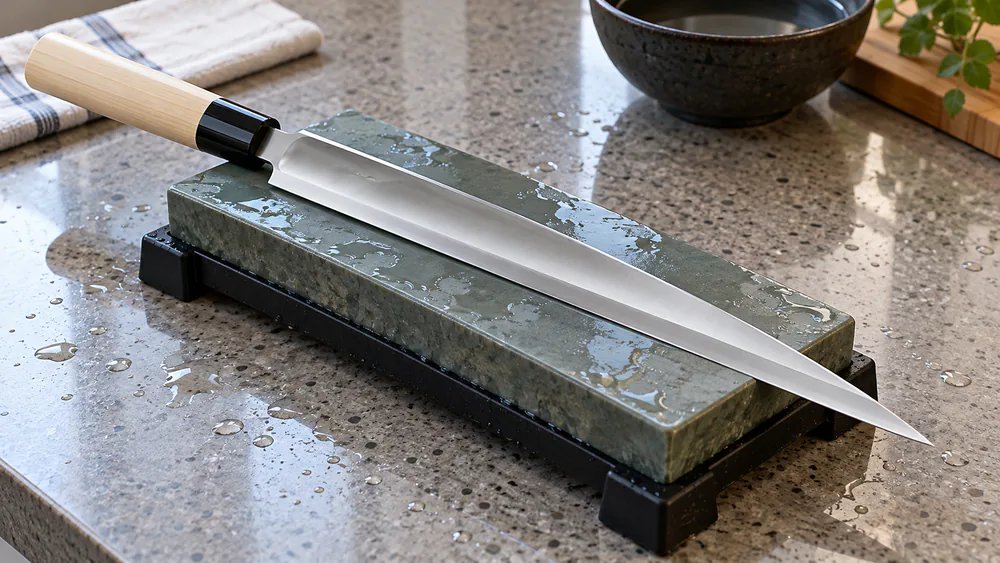
Traditional single-bevel sharpening includes conditioning the flat perimeter of the back, called uraoshi. It is not the same job as grinding an equal bevel onto both sides. Use water stones, and avoid honing rods. If you have never sharpened a single-bevel blade, seek instruction specific to that style or hand the knife to a qualified sharpener. The Kai's oversized secondary bevel and the KYOKU's occasional corrective sharpening are good reasons to plan for stones from day one.
Single-bevel sharpening includes the flat back, not just the bevel.
Yanagiba Knife FAQs
Yanagiba vs Sujihiki: Which Should You Buy?
The yanagiba is the specialist raw-fish slicer, usually single bevel and built for one clean pull through sashimi. The sujihiki is a more general double-bevel slicer that handles roasts and cooked meat as well as fish. Buy the yanagiba if sashimi is the point, and the sujihiki if you want one long slicer for everything.
Do you need a yanagiba to make sushi at home?
No. A sharp general kitchen knife can handle occasional home sushi, so a specialist blade is optional. A yanagiba is worth it if you slice raw fish regularly and want the cleanest cut.
Can a left-handed cook use a right-handed yanagiba?
Not comfortably. A traditional single-bevel edge is handed, and a symmetrical-looking handle does not make it ambidextrous, so a left-handed cook should buy an explicitly left-handed model.
Yanagiba vs deba: what is each knife for?
The deba is the heavier fish-breakdown knife for heads, bones and fillets. The yanagiba takes over once you have a clean boneless piece.
Can you use a yanagiba for foods other than fish?
You can slice boneless raw fish, rolls and soft proteins with the same pull cut. Keep it away from bones and frozen food, which can chip the edge.
Final Verdict: Which Yanagiba Should You Choose?
Pick by the kitchen you actually have. If you have limited counter space and no wish to oil a blade, the Kai is the safe choice. If you want a longer blade and are happy to tolerate a plain handle, the Mercer is the budget route. Choose the Yoshihiro only if you will learn single-bevel sharpening and have space for 300mm. Reach for the KYOKU last, and only after confirming the geometry and checking the edge on arrival.