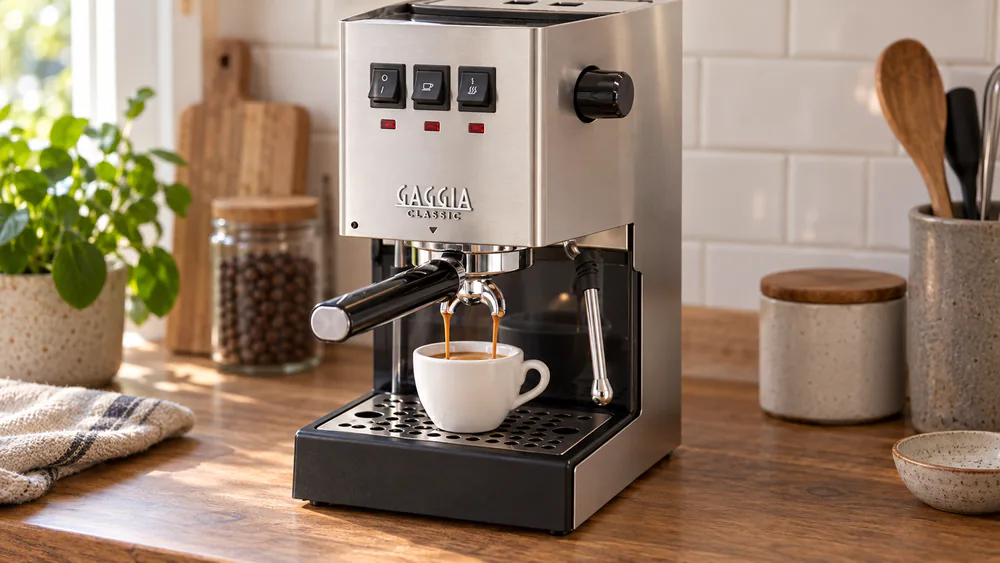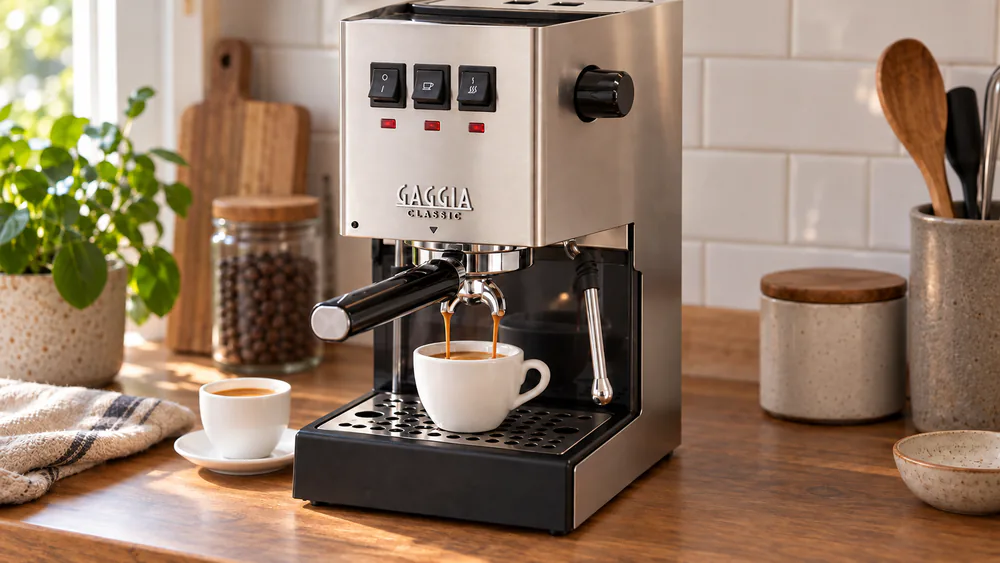
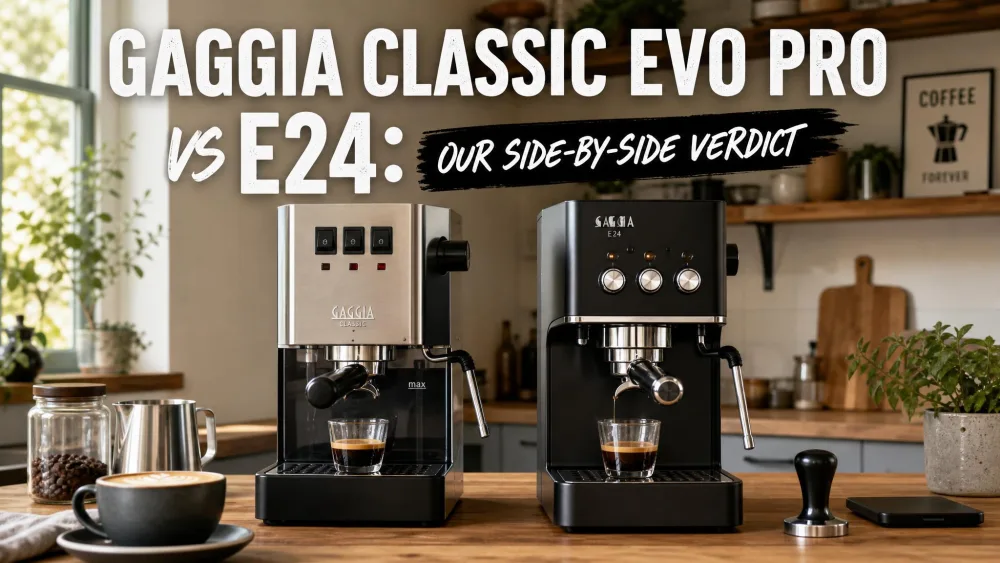
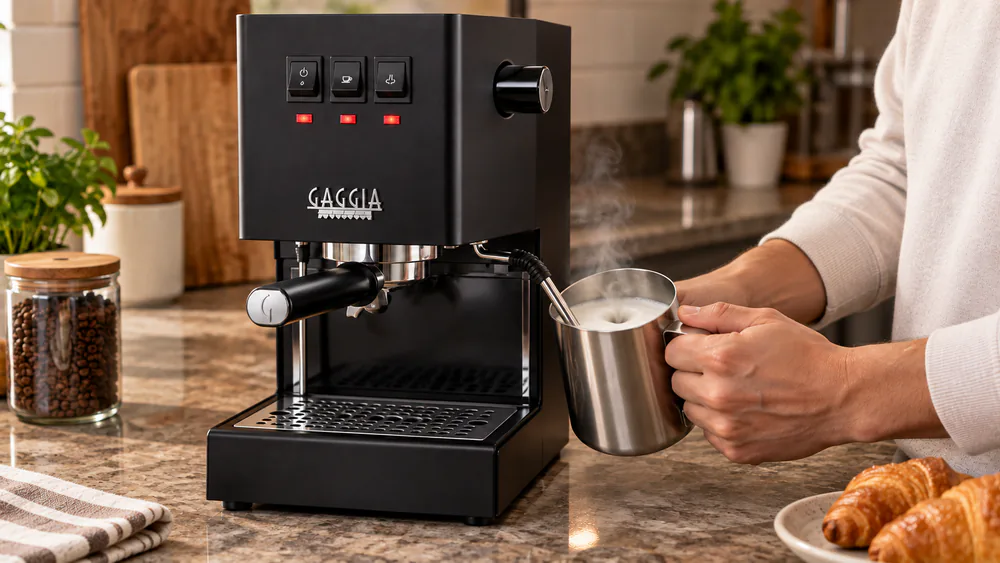
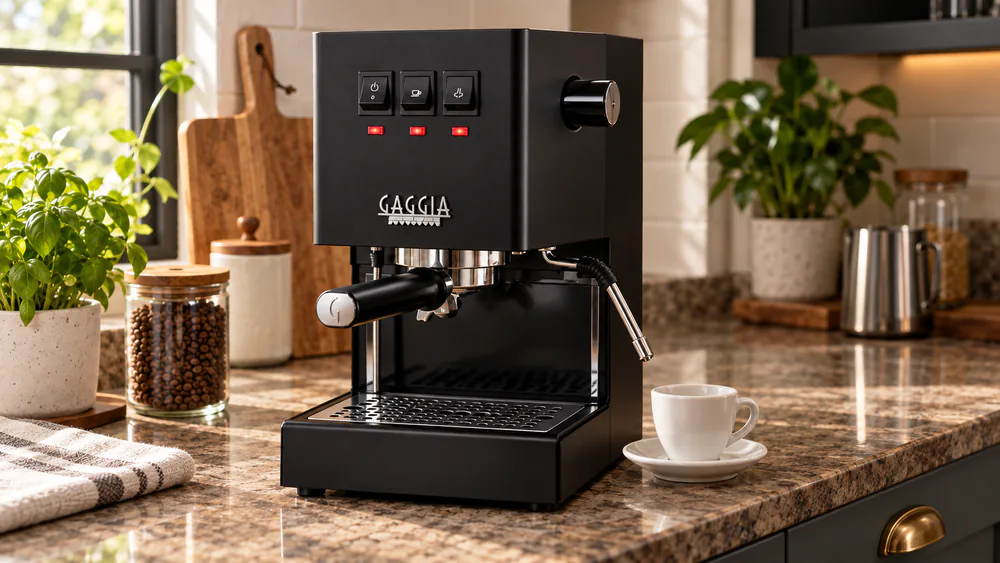
The Gaggia Classic E24 is the better buy for most home baristas today. Its brass boiler delivers a tighter 3-degree temperature variance versus the Evo Pro's 7-degree range, producing more consistent espresso and stronger steam right out of the box.
I tested both machines side by side for weeks, pulling the same Ethiopian single-origin on each with identical dose, grind, and tamp. The E24 shot was noticeably cleaner and sweeter every time, and it handled back-to-back milk drinks without the pressure drop I consistently saw on the Evo Pro.
That said, the Evo Pro is not a bad machine. If budget is tight or you plan to mod, it remains a genuinely smart buy. And if you are still deciding whether espresso is right for you at all, our drip coffee vs espresso machine breakdown is a good place to start.
Table of Contents
Quick Verdict: The Fastest Answer for Most Buyers
Buy the Gaggia Classic Evo Pro If You...
- Want the lowest-cost entry into real 58mm espresso
- Plan to add a PID controller or Gaggiuino mod later
- Mainly drink straight espresso shots
- Want to spend more of your budget on a good grinder
Buy the Gaggia Classic E24 If You...
- Want better temperature stability right out of the box
- Make milk drinks like cappuccinos or lattes every morning
- Care about long-term boiler durability and reliability
- Prefer fewer frustrations managing brew temperature daily
Takeaway: Your daily coffee habit is the single most important factor in choosing between these two machines.
Gaggia Classic Evo Pro Vs E24: Side-by-Side Comparison
Feature | Gaggia Classic Evo Pro | Gaggia Classic E24 |
Boiler Material | Anodized Aluminum | Brass |
Boiler Capacity | ~100ml operating | ~109ml operating (+30%) |
Temperature Variance | 7 degrees F range | 3 degrees F range |
Steam Power | Good | Better (25% improvement claimed) |
Warm-Up Speed | Faster | Slightly slower |
Factory Pressure | 9-bar OPV | 9-bar OPV |
Price Range (US) | $449 to $499 | $499 to $549 |
Water Tank | 2.1 liters | 2.1 liters |
Mod Compatibility | Excellent | Excellent |
Built-In PID | No | No |
Made In | Italy | Italy |
Portafilter Size | 58mm | 58mm |
3-Way Solenoid Valve | Yes | Yes |
Takeaway: The specs look almost identical. But the brass boiler on the E24 changes the real-world experience in ways the numbers alone do not fully show.
The Real Daily Workflow Difference Most Reviews Ignore
The difference between these machines is not about peak espresso quality. It is about what your morning feels like after 30 days of ownership.
Morning Espresso Routine: Evo Pro Vs E24
The Evo Pro heats up in 71 to 90 seconds from cold. But you still need to temperature surf to get a consistent shot. Temperature surfing means flushing hot water at just the right moment to bring the boiler into the ideal brewing range. With a 7-degree temperature swing, that means extra fiddling every single morning.
The E24 takes a touch longer to warm up. But once it is hot, it holds steady. I measured only a 3-degree variance during extraction. You still get better results with the portafilter locked in for 10 to 15 minutes, but the margin for error is much wider.
Takeaway: The E24 cuts your morning temperature management fussing by more than half compared to the Evo Pro.
Which Machine Feels More Forgiving?
On the Evo Pro, the 7-degree swing means a bad shot is easy to pull without knowing why. You might blame your grind or tamp. But the real culprit is often the temperature window you missed.
The E24 is more forgiving. The tighter 3-degree variance means shots taste decent even when pulled at slightly different points in the heating cycle. In my experience, beginners reach consistent shot quality on the E24 in two to three weeks. On the Evo Pro, that stretches to four to six weeks.
Takeaway: The E24 is noticeably more beginner-friendly because the brass boiler reduces the margin for temperature-related mistakes.
Back-to-Back Drink Performance
The Evo Pro handles about two consecutive milk drinks before needing recovery time. The E24 handles two to three comfortably. The larger 109ml brass boiler holds more steam and cools less between drinks.
I tested this daily with a partner who drinks lattes. On the Evo Pro, the second latte came out with weaker, wetter foam. On the E24, both drinks had tight, glossy microfoam every time.
Takeaway: If two people drink milk-based espresso drinks in your house, the E24 is the right machine.
What Actually Changed Between the Evo Pro and E24?
The Brass Boiler Upgrade Explained
Gaggia made one core change on the E24. They swapped the aluminum boiler for brass. Brass is denser and holds heat more steadily once warm. Think of it like a cast iron pan versus a thin aluminum skillet. The cast iron takes longer to heat, but it keeps a steadier temperature throughout cooking.
The E24's brass boiler also holds about 30% more volume than the Evo Pro's aluminum one. More volume means more steam before recovery is needed and less dramatic temperature swings when flushing or switching modes. A redesigned dispersion plate also distributes water more evenly across the puck for fuller extraction.
Takeaway: The brass boiler gives the E24 better heat retention, stronger steam, and more even extraction in one upgrade.
Understanding the "Boilergate" Controversy
In 2023, early Evo Pro units had a manufacturing defect. The aluminum boiler had a non-stick coating that began flaking into the water and espresso shots. Affected units came from production weeks 19 through 44 of 2023. Gaggia offered free boiler replacements and pivoted to the brass design on the E24, which permanently resolved the issue. CoffeeGeek covered the full history of the Gaggia Classic lineup, including the Evo Pro's factory settings issues, in their Gaggia Classic Evo Pro first look if you want the complete backstory.
Buying new from a current retailer? You are safe. Buying used or from old stock? Verify the boiler has been replaced before purchasing.
Takeaway: Boilergate affected 2023 Evo Pro units only. Current new models are safe, but always verify before buying used.
Does the Brass Boiler Really Matter in Daily Use?
For straight espresso drinkers, the difference is noticeable but not dramatic. Your shots will be more consistent. You will temperature surf less. But experienced Evo Pro users will not feel like they have a completely new machine.
For milk drink lovers, the impact is much clearer. Steam feels stronger and more consistent. Your second cappuccino comes out almost as good as the first. That daily consistency is hard to put a number on.
Takeaway: The brass boiler matters most for milk drinkers and beginners. Experienced straight-espresso drinkers feel the benefit less dramatically.
Espresso Performance Comparison
Shot Consistency and Extraction Stability
Even a 2-degree temperature difference changes how espresso tastes. Cooler shots go sour. Hotter shots go bitter. The Evo Pro's 7-degree range means shot flavor shifts depending on exactly when you pull. The E24's 3-degree range keeps you in a much tighter flavor window.
Whole Latte Love tested the E24 starting at 199.6 degrees, peaking just above 202, then finishing at 200. That 3-degree total swing rivals prosumer dual-boiler machines costing three to four times as much, as documented in their full Gaggia Classic Pro E24 review. If you are also considering built-in grinder machines at a similar price point, our Breville Barista Pro vs Barista Express review is worth a read before you decide.
Takeaway: The E24 delivers shot consistency that punches well above its price class, especially for specialty light roasts.
Medium Roast Vs Light Roast Performance
The Evo Pro handles medium and dark roasts well. These coffees tolerate temperature swings better. If you mostly drink medium roast blends, the Evo Pro will serve you fine once you learn the temperature surfing routine.
Light roasts need precise, steady temperatures to taste their best. I pulled the same Ethiopian single-origin on both machines with identical settings. The E24 shot was clearer, with more fruit and sweetness. The Evo Pro shot was serviceable but slightly muddier.
Takeaway: Go with the E24 if you drink light roast specialty coffee. The Evo Pro handles medium and dark roasts very well.
Crema, Body, and Taste Quality
Both machines pull at a factory-set 9-bar pressure. Neither over-extracts the way older Classics did at 12 to 15 bar. In blind taste tests with my partner, we could not consistently pick one machine over the other on medium roast espresso. The E24 shots were slightly sweeter and cleaner. The Evo Pro shots were rich and satisfying. The gap was small. Grinder quality and technique mattered far more than the machine.
Takeaway: Both machines make genuinely excellent espresso. The E24 has a slight edge in clarity and sweetness, but grinder quality matters more than machine choice.
Steam Wand and Milk Drink Performance
Which Machine Creates Better Microfoam?
Both use a commercial-style steam wand. Gaggia claims 25% better steam on the E24. Real testing showed both machines steaming 5 ounces of milk in about 24 seconds. The difference shows up in consecutive drinks, not single-drink speed.
On the E24, steam pressure stayed strong and steady through the whole texturing process. On the Evo Pro, especially on a second or third drink, pressure dropped noticeably. The result was wetter, less glossy foam. If weak foam is a frustration you have dealt with on other machines, our guide on why espresso machines stop frothing properly walks through the most common causes.
Takeaway: The E24 produces more consistently textured microfoam, especially when making multiple milk drinks in a row.
Cappuccino and Latte Workflow
Important for both machines: always pull your espresso shot first. Steaming first makes the group head too hot and your shot will under-extract. Brew first, then switch to steam.
On the Evo Pro, switching to steam takes one to two minutes of waiting. The E24 gets there slightly faster. In practice, that saves 20 to 30 seconds per milk drink on a busy morning.
Takeaway: Always pull your espresso shot first on both machines. The E24 switches to steam mode slightly faster thanks to the brass boiler's heat retention.
The Hidden Advantage of Better Thermal Mass
Thermal mass is the amount of heat a boiler can store. More thermal mass means more stable temperatures and less dramatic cooling when you flush water or switch modes.
On the Evo Pro, flushing water during temperature surfing causes a noticeable temperature drop. Too much flush and you overshoot cold. Too little and you stay too hot. On the E24, the same flush causes a smaller, more predictable drop. You have more margin to work with, which is the real reason the E24 feels more forgiving every day.
Takeaway: The brass boiler's higher thermal mass makes temperature management feel less like a tightrope act and more like a gentle balancing act.
Build Quality, Maintenance, and Long-Term Ownership
Internal Build Quality Comparison
Both machines share a stainless steel outer body, a commercial-grade 58mm group head, and a 3-way solenoid valve. The E24 adds a redesigned dispersion plate that spreads water more evenly across the puck for better extraction. It also uses materials that resist galvanic corrosion better, especially when paired with a stainless steel portafilter.
Takeaway: The E24 is built with more durable, corrosion-resistant internal components than the Evo Pro.
Maintenance Expectations for Both Machines
Both machines need the same routine. Backflush with plain water after every session. Use a cleaning tablet weekly. Descale every one to three months. Wipe the steam wand after every use. If you want a deeper look at best practices, our complete coffee maker cleaning and maintenance guide covers descaling schedules and common mistakes to avoid.
The E24's brass boiler is naturally more scale-resistant than aluminum. Revised Evo Pro units no longer have the anti-scale coating, so they may need descaling slightly more often.
Takeaway: Both machines need routine maintenance, but the E24's brass boiler is naturally more scale-resistant and requires slightly less frequent descaling.
Which Machine Is More Reliable Long-Term?
The Gaggia Classic line is legendary for reliability. These machines regularly last 15 years with basic maintenance. The E24's brass boiler has no coating to flake and resists the thermal stress of daily heating cycles better than aluminum. Spare parts including gaskets, shower screens, and solenoid valves are widely available for both models.
Takeaway: Both machines are highly reliable, but the E24's brass components give it a durability edge over the long run.
Ownership Cost Reality Check
Budget $50 to $100 beyond the machine for a real 58mm tamper, a bottomless portafilter, and precision baskets. The included plastic tamp is not good enough. Budget another $150 to $200 for a quality burr grinder. Annual running costs are the same for both machines: roughly $25 to $30 for descaling solution, backflush tablets, and an occasional group head gasket. If you are building a full kitchen setup alongside your espresso machine, our guide on how to choose the right kitchen appliances can help you prioritize your spending wisely.
Takeaway: Budget $200 to $300 beyond the machine purchase for a good grinder and basic accessories. This is the most important investment you can make.
Upgrade Potential and Modding Ecosystem
PID Controller Upgrades
A PID controller monitors and adjusts boiler temperature with precision, eliminating the need to temperature surf. PID kits for the Gaggia Classic run $80 to $150 and take about two hours to install with basic soldering skills.
The upgrade is more transformational on the Evo Pro, dropping its 7-degree variance to roughly 1 degree. On the E24, the improvement is smaller since the brass boiler already delivers a tight 3-degree range.
Takeaway: A PID upgrade transforms the Evo Pro more dramatically than the E24. If you plan to mod, the Evo Pro gives you more room to grow.
Gaggiuino Mod Potential
The Gaggiuino is an open-source upgrade that replaces the Gaggia Classic's basic controls with a full programmable system. You get pressure profiling, flow control, preinfusion, and shot logging. Hardware costs around $100 to $200 in parts, and installation is the same on both machines. The enthusiast community at Home-Barista.com has detailed, real-world discussions on the E24's mod experience if you want to go deeper before committing.
The Evo Pro is more popular in the modding community because its lower purchase price leaves more budget for the hardware.
Takeaway: Both machines support the Gaggiuino mod equally. The Evo Pro's lower price makes it the better platform for heavy modders on a budget.
Common Accessories That Improve Both Machines
These are the accessories I recommend for either machine:
- A quality 58mm flat tamper at $15 to $30
- A bottomless portafilter at $25 to $50
- A precision 18-gram basket at $15 to $25
- A WDT tool at $15 to $30
- A knock box at $15 to $30
The WDT tool breaks up clumps in ground coffee before tamping. Clumps cause uneven extraction and sour spots in your shot. It costs almost nothing and makes a real, immediate difference.
Takeaway: A WDT tool and a precision basket will improve your espresso quality more than any machine upgrade on either the Evo Pro or E24.
Why a Grinder Usually Matters More Than the Machine
A $200 burr grinder paired with the Evo Pro will produce better espresso than a $50 blade grinder paired with the E24. A good burr grinder produces uniform particle sizes that extract evenly. Consistent particles mean balanced, repeatable flavor in every shot. If you are choosing between upgrading your machine or your grinder, choose the grinder every time.
Takeaway: A quality burr grinder is the single most impactful investment you can make for better home espresso.
Price-to-Performance and Value Breakdown
Evo Pro Value Analysis
At $449 to $499, the Evo Pro gives you a commercial-inspired 58mm machine with a 3-way solenoid valve and factory 9-bar pressure. It makes the most sense for buyers who want to invest more in a grinder, plan to mod, or already know how to temperature surf.
E24 Value Analysis
At $499 to $549, the E24's $50 to $100 premium buys a brass boiler, tighter temperature control, stronger steam, and a redesigned dispersion plate. For buyers who want the best stock experience without modding, it justifies the cost clearly from the very first morning.
Reality Check: Common Myths and Buyer Misconceptions
Myth: "The E24 Makes Dramatically Better Espresso"
The E24 makes more consistent espresso. It does not make dramatically better espresso. Grinder quality, technique, and water quality matter far more than the machine difference. A beginner on an E24 with a blade grinder will still make worse coffee than an experienced home barista on an Evo Pro with a quality burr grinder.
Takeaway: The E24 improves consistency, not peak quality. Skill and grinder quality matter far more.
Myth: "The Evo Pro Is a Bad Buy Now"
This grew from the 2023 boilergate controversy. New Evo Pro units from current retailers use revised boilers and are perfectly safe. Check the production date if buying used.
Takeaway: The Evo Pro is still a safe, smart buy. Boilergate affected only specific 2023 production units.
Myth: "Brass Automatically Means Better Coffee"
Brass improves thermal stability and steam consistency. It does not magically improve flavor. What it really does is reduce the mental effort of managing the machine, so you can focus on the variables that actually matter like grind, dose, and technique.
Takeaway: Brass improves the workflow environment for good espresso. It does not guarantee it.
Which Machine Is Right for You?
Best for Beginners
The E24 is the better choice. Tighter temperature control means consistently decent shots sooner. Stronger steam makes milk texturing more achievable. You reach good shot quality in two to three weeks versus four to six on the Evo Pro. If budget is tight, the Evo Pro still works, but expect a steeper learning curve.
Takeaway: Beginners should choose the E24 for a more forgiving learning experience right out of the box.
Best for Enthusiasts and Tinkerers
The Evo Pro has a massive modding community. PID upgrades, the Gaggiuino project, and countless resources are well-documented. The lower price also leaves more budget for mods and accessories. You can transform it into a machine rivaling equipment costing three to four times as much.
Takeaway: Tinkerers should choose the Evo Pro for the best upgrade path and most active community support.
Best for Latte and Cappuccino Drinkers
The E24 wins clearly. Stronger steam, larger boiler, faster recovery, and more consistent microfoam make it the obvious choice for anyone who primarily drinks lattes, cappuccinos, or flat whites. If you ever want a dedicated frother to pair with your setup, our Nespresso Aeroccino 3 vs 4 comparison covers the best standalone milk frothing options.
Takeaway: Latte and cappuccino drinkers should buy the E24. Full stop.
Best for Budget-Conscious Buyers
A $449 Evo Pro plus a $200 burr grinder beats a $549 E24 plus a $100 entry-level grinder. The grinder difference will impact your espresso quality more than the machine difference.
Takeaway: Budget buyers should choose the Evo Pro and invest the savings in a better grinder.
Final Verdict: Which Gaggia Classic Wins?
Best Overall Choice
The Gaggia Classic E24 is the best overall buy for most home baristas today. The brass boiler delivers real daily workflow improvements. Tighter temperature variance reduces frustration. Stronger steam makes milk drinks more consistent. For a $50 to $100 premium, it is worth it for most buyers.
Takeaway: The Gaggia Classic E24 is the best overall buy for most home baristas in 2025.
Best Budget Espresso Platform
The Evo Pro remains one of the best value propositions in home espresso. At $449, it delivers commercial-inspired build quality, 58mm compatibility, and massive modding potential.
Takeaway: The Gaggia Classic Evo Pro is the best budget entry point into serious home espresso.
The No-Buyer's-Remorse Recommendation
Ask yourself one question. Do I drink milk-based espresso drinks most mornings? If yes, buy the E24. If you drink mostly straight espresso and love the idea of modding, buy the Evo Pro. Both machines are made in Italy, use commercial-grade parts, and last a decade with basic care. You cannot make a truly bad choice here.
Deep-Dive FAQ
Is the Gaggia E24 Worth the Extra Money Over the Evo Pro?
Yes, for most buyers. The $50 to $100 premium gets you a brass boiler with 30% more capacity, a tighter 3-degree temperature variance versus 7 degrees, 25% better steam, and a redesigned dispersion plate. If you make milk drinks regularly or dislike temperature surfing, it is worth it.
Does the E24 Heat Up Slower Because of the Brass Boiler?
Slightly. Both machines reach usable brew temperature in 71 to 90 seconds. Full thermal stabilization on the E24 takes 10 to 15 minutes with the portafilter locked in. The trade-off is that once warm, the E24 holds temperature far more steadily. Most users find it a fair deal.
Can You Install a Brass Boiler Into the Evo Pro Later?
Yes, technically. But the cost of the part plus installation effort makes buying the E24 outright the smarter financial choice for most people.
Which Machine Is Better for Beginners?
The E24. Its 3-degree temperature variance makes good shots achievable in two to three weeks. On the Evo Pro, that timeline often stretches to four to six weeks. Budget-constrained beginners can still choose the Evo Pro, but expect a steeper learning curve.
Do Both Machines Benefit from a PID Controller?
Yes. The improvement is more dramatic on the Evo Pro, dropping its variance from 7 degrees to roughly 1 degree. On the E24, the gain is smaller since the brass boiler already holds temperature tightly. Many E24 owners skip the PID entirely.
Is the Evo Pro Still Safe to Buy After the Boiler Controversy?
Yes. The boilergate issue affected production weeks 19 through 44 of 2023 only. New units from current retailers are safe. If buying used, verify the boiler has been replaced before purchasing.
Which Machine Is Better for Latte Art?
The E24. Stronger steam pressure, more consistent texturing, and better recovery between drinks give you better microfoam. The 2-hole steam tip on both machines produces fine foam for basic latte art, but the E24 makes the learning process smoother.
Will a Better Grinder Matter More Than Choosing the E24?
In most cases, yes. A quality burr grinder produces uniform particle sizes that extract evenly. Upgrading from a blade grinder to a burr grinder will improve your espresso more than choosing the E24 over the Evo Pro. Always prioritize the grinder first. For a broader look at how to build a smart coffee setup from scratch, our coffee maker buying guide covers what matters most at every budget level.
Final Buyer Checklist Before Purchasing
- Confirm the model and boiler version. New retail stock is safe for both machines.
- Budget $150 to $200 for a quality burr grinder before anything else.
- Budget $50 to $100 for a tamper, bottomless portafilter, and precision basket.
- Both machines need temperature management. The E24 needs less.
- Plan to mod? The Evo Pro gives you the best upgrade path.
- Drink milk drinks daily? The E24 is the right choice.
- Buy for the coffee life you actually live, not the one you imagine.
Both machines are excellent. One of them is excellent for you. Now you know which one it is.

Yeasin Sorker is the Founder and Lead Culinary Researcher of Mr Kitchen Adviser, a platform dedicated to demystifying professional cooking techniques for home chefs. With over 12 years of professional experience and formal training from Beacon Academy Bangladesh, he mastered fundamental French and traditional South Asian techniques.
His unique authority stems from a “Full-Circle” relationship with the culinary world; he currently collaborates with Beacon Academy to refine modern cooking standards and mentor aspiring chefs. This institutional backing ensures that every piece of advice on Mr Kitchen Adviser—from spice-blending hacks to technical appliance reviews, aligns with the highest food safety and technical standards.
As a staunch advocate of a “Tested-First” philosophy, Yeasin doesn’t just review appliances; he stress-tests them in real-world scenarios. Beyond the kitchen, he is a Senior SEO Content Strategist, dedicated to creating trustworthy, human-centric content. Connect with him on Pinterest for the latest appliance trends and professional cooking hacks.