
Kitchen Appliances
Breville Barista Pro vs Barista Express: Which Should You Buy?
As an Amazon Associate we earn from qualifying purchases. We may earn a commission from links on this page, at no extra cost to you. Learn more.
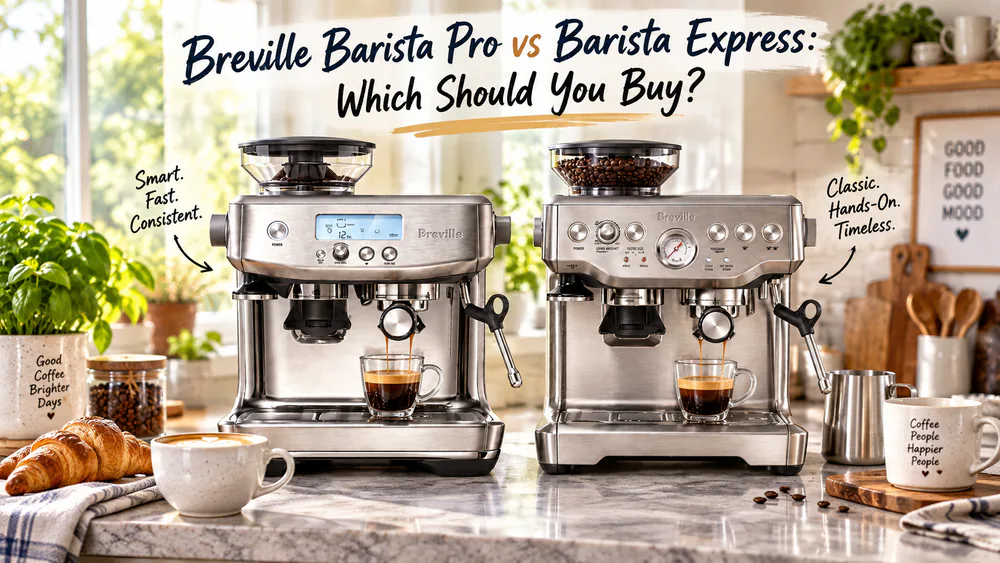
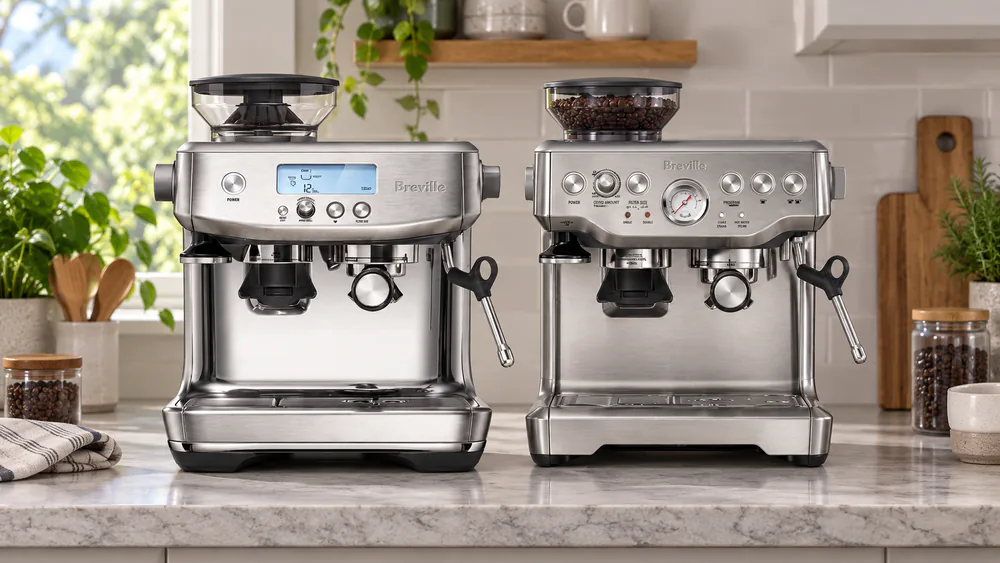
Choosing between the Breville Barista Pro and the Barista Express? We'd pick the Pro for most people, as long as the premium fits the budget. It heats faster, steams faster, and stays more consistent, while the Express makes the same espresso once dialed in and saves about $150 at list. The whole comparison comes down to how much that speed is worth to you.
Both machines work the same way on the outside. They share the 54 mm portafilter, the 15-bar Italian pump, the 67 oz water tank, and the built-in grinder idea. What separates them is the heating system, the grinder's precision, the interface, and the steam wand. We put both through months of daily use side by side, and this guide walks you through every difference that matters, plus the honest bottom line on value.
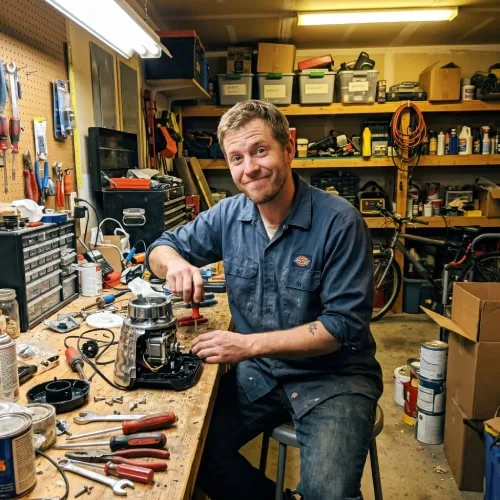
Our test kitchen has lived with the Express for years of daily use, and the Pro has sat on the counter for months, pulling back-to-back doubles through the morning rush. We timed heat-up and steam, weighed doses, tracked grind consistency and cleanup, and scored each machine on the same five things: heat-up, shot-to-shot consistency, steam, grinder, and build.
We bought both machines at retail with our own money, just as any shopper would; neither was a review sample or part of sponsored content. The Express is our long-term kitchen machine with five years of daily use and more than 3,500 extractions logged, and the Pro ran beside it for months of side-by-side daily use before this comparison was written.
Quick Answer
Here is the short version before the details. The Pro is the better machine, and the Express is the better deal. Both make the same quality espresso on the same 54 mm platform, so your budget and your tolerance for waiting decide it.
Key takeaway. We'd pick the Barista Pro for most people if the premium is affordable. It heats in 3 seconds, steams roughly twice as fast, and holds shot quality steady through the morning rush. If the budget is fixed, the Express is the smarter buy: same espresso quality for about $150 less, with a track record that runs past a decade.
Pros
- 3-second heat-up from the ThermoJet system
- Fast, steady steam from the 4-hole wand
- Consistent shots through back-to-back drinks
- 30 grind settings, Baratza burrs, and a shot timer
Cons
- About $150 more than the Express
- No tamper in the box
- Reliability questions we can't wave away
- Built-in grinder lags a good standalone unit
Pros
- About $150 less for the same espresso quality
- Pressure gauge teaches you to dial in
- Durability record that passes a decade
- Tamper, scoop, and cleaning kit included
Cons
- About 40 to 45 second warm-up
- Steam power fades as the boiler depletes
- Shots can drift toward bitterness back to back
- Single-hole wand textures slowly
Comparison Chart: Barista Pro vs Barista Express
The chart below is the fastest way to see the gap. Everything in it is verified against Breville's official pages and our own notes, and Breville's official comparison tells the same story.
Key specs side by side
| Feature | Barista Pro (BES878) | Barista Express (BES870) |
|---|---|---|
| US list price | $849.95 | $699.95 |
| Price premium | About $150 at list; $100 to $300 across sales | Baseline |
| Heating system | ThermoJet, 3 seconds to extraction temp | ThermoCoil, about 40 to 45 seconds real-world warm-up |
| Grind settings | 30 | 16 |
| Grinder burrs | Baratza European precision conical | Integrated conical burr, maker not named |
| Interface | LCD with shot timer, dial, and buttons | Analog dials and pressure gauge |
| Pre-infusion | Low-pressure, adjustable timing | Low-pressure, fixed at about 7 seconds |
| Steam wand | Manual, 4-hole tip | Manual, single-hole tip |
| Brew-to-steam switch | Near-instant | About 30 to 45 seconds |
| Water tank | 67 oz (2 L) | 67 oz (2 L) |
| Bean hopper | 1/2 lb | 1/2 lb |
| Portafilter | 54 mm stainless steel | 54 mm stainless steel |
| Pump | 15 bar Italian | 15 bar Italian |
| Extraction | 9 bar with low-pressure pre-infusion | 9 bar with low-pressure pre-infusion |
| Power | 1680W | 1600W |
| Dimensions (W x D x H) | 16.1 x 13.8 x 13.1 in | 15.9 x 13.1 x 12.4 in |
| Included tamper | No | Yes, integrated |
| Warranty | 2-year limited | 1-year limited |
| Noise | Loud grinder early in the morning | Loud grinder early in the morning |
| Value verdict | Speed and consistency for a premium | Best value at list, longest track record |
Key differences at a glance
- Heating: 3 seconds to extraction temp versus a 40 to 45 second warm-up, and only the Pro holds temperature steady through back-to-back shots.
- Grinder: 30 settings on Baratza burrs versus 16, with dose control within about half a gram versus your timing.
- Interface: LCD with shot timer and on-screen menus versus analog dials plus the pressure gauge teacher.
- Steam: a fast 4-hole wand with a near-instant brew-to-steam switch versus a single-hole wand with a 30 to 45 second wait.
What both machines share
- The same 54 mm stainless portafilter, with single and dual wall baskets in the box.
- The same 15-bar pump with low-pressure pre-infusion, then 9 bar extraction.
- The same 67 oz tank and 1/2 lb bean hopper.
- The same all-in-one idea: grinder, brewer, and steamer in one brushed stainless frame.
Heating System: ThermoJet vs ThermoCoil
The biggest spec difference hides inside the heating system, and it drives most of the others.
Heat-up time: 3 seconds vs 45 seconds
The Pro runs Breville's ThermoJet heating system, a high-powered coil with digital PID temperature control. It reaches optimum extraction temperature in 3 seconds from a cold start, and we have timed it at that figure again and again. The Express uses the ThermoCoil heating system, a PID-controlled tube that delivers water at exactly 200 degrees F. Breville publishes no official warm-up figure for it, and real-world measurements land around 40 to 45 seconds, with reports ranging from 30 to 50 seconds depending on the room and the method.
Here is what the spec sheet does not tell you. The 3-second claim matters less in a real morning than it sounds, because grinding and tamping take 30 seconds or more anyway, and the Express can grind while it warms. For a single morning cup, the practical gap shrinks to a minute or less. The Pro's speed shows up when you are pulling shot after shot or switching from brewing to steaming.
Temperature stability and shot consistency
The PID keeps both machines accurate, but the Pro holds that accuracy under load. The Express can overheat into bitterness on the second or third back-to-back shot, a drift we noticed most with quick weekday doubles. The Pro holds steady shot after shot, with the same temperature window every pull. If you make more than one drink at a time, this is the difference you will feel before you ever taste it.
Grinder Performance
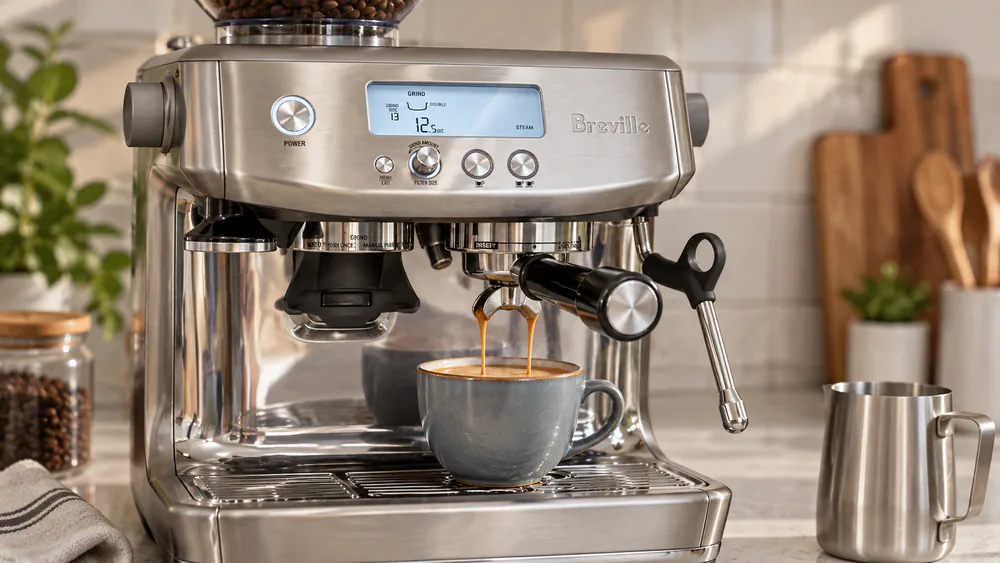
Both machines grind their own beans, and both prove that a built-in grinder is a compromise. The Pro's version is simply a better compromise.
30 settings vs 16 settings
The Pro offers 30 grind settings on hardened steel conical burrs supplied by Baratza, with dose control that lands each dose within about half a gram. The Express offers 16 settings on an unnamed conical burr set, and its dose consistency depends on how long you hold the grind lever. The Pro retains about 1.5 g of grounds versus 2 g on the Express, leaving fewer stale grounds to carry into the next dose.
Grind consistency and dial-in precision
The Pro's dose control is genuinely more consistent, and that shows up as fewer sink shots while you learn. Even so, the built-in grinder is the weakest part of both machines, and it is usually the first component to degrade, typically after three to five years of daily use. The lesson we keep relearning is that the built-in grinder is the part you outgrow first, usually about a year and a half in.
Maintenance matters here, too. Running rice through the burrs clears the oils that build up and restores performance, which Breville recommends itself. On the Pro, monthly to bimonthly cleaning pellets keep shots consistent.
Tip. Dial in by weight, not by timer. A scale that lands 18 to 20 g in the basket beats the built-in shot clock every time, a dosing funnel stops the mess, and a puck screen keeps the group head clean. Fresh beans are non-negotiable: stale beans pour flat, sour shots no matter how good the machine is.
User Interface and Ease of Use
LCD display vs analog dials and pressure gauge
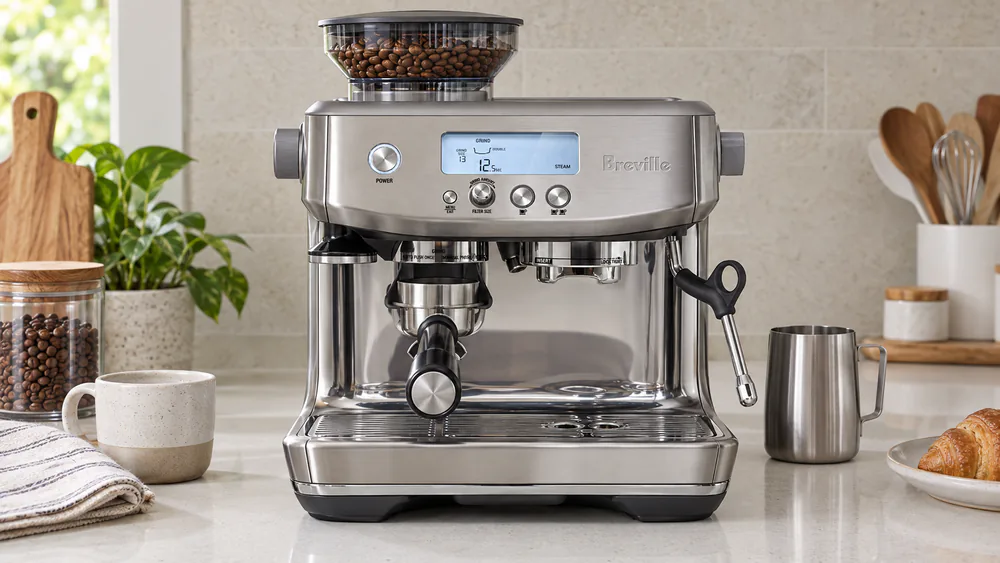
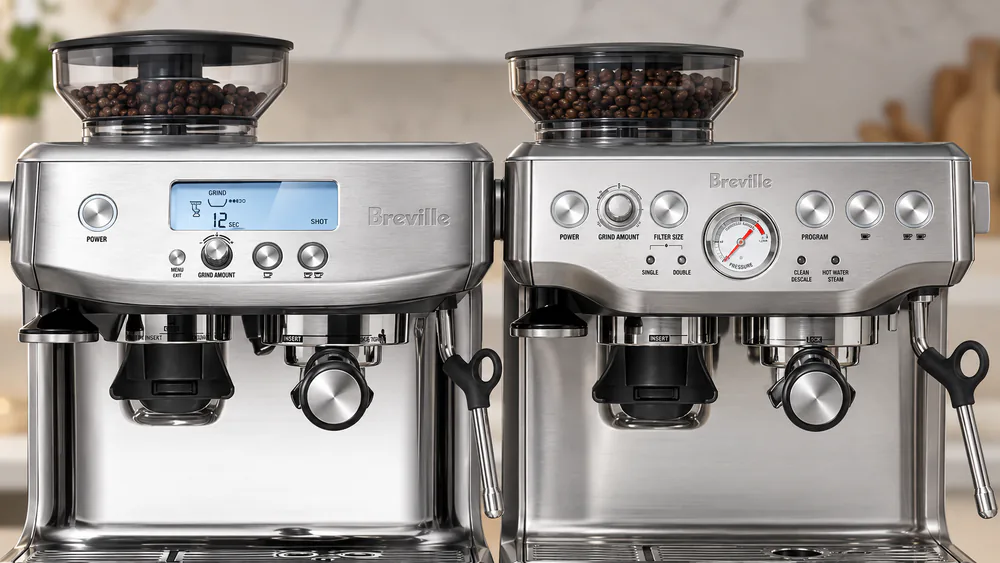
The Pro greets you with an LCD showing a shot timer, volumetric controls for one or two cups or manual pours, and grind and extraction progress animations. Everything sits behind one dial and a couple of buttons. The Express keeps it analog: physical dials, a clean-me light, and the famous pressure gauge.
The pressure gauge is the Express's best feature, because it is the best learning tool either machine has. It shows you when the grind is right: needle low means grind finer, needle past the range means grind coarser. Beginners who start on the Express learn faster because the gauge makes the invisible visible.
Learning curve for beginners and dialing in
Both machines will waste some beans while you learn, and fresh-roasted beans are required for good shots. That part is identical. The menus are not. The Pro's LCD walks you through rinse and descale cycles in plain text. On the Express, you dig out the manual for what feel like random button combinations.
First-time Pro buyers almost always order three add-ons with the machine:
- A dosing funnel, so the grinder stops spraying grounds everywhere.
- A puck screen, to keep the group head clean.
- A scale, because weighed 18 to 20 g doses beat the built-in shot timer for consistency.
For most beginners, the Pro's screen and shot timer make the daily routine gentler. The Express's gauge does more to teach extraction fundamentals.
Milk Frothing and Steam Power
Steam wand speed and microfoam
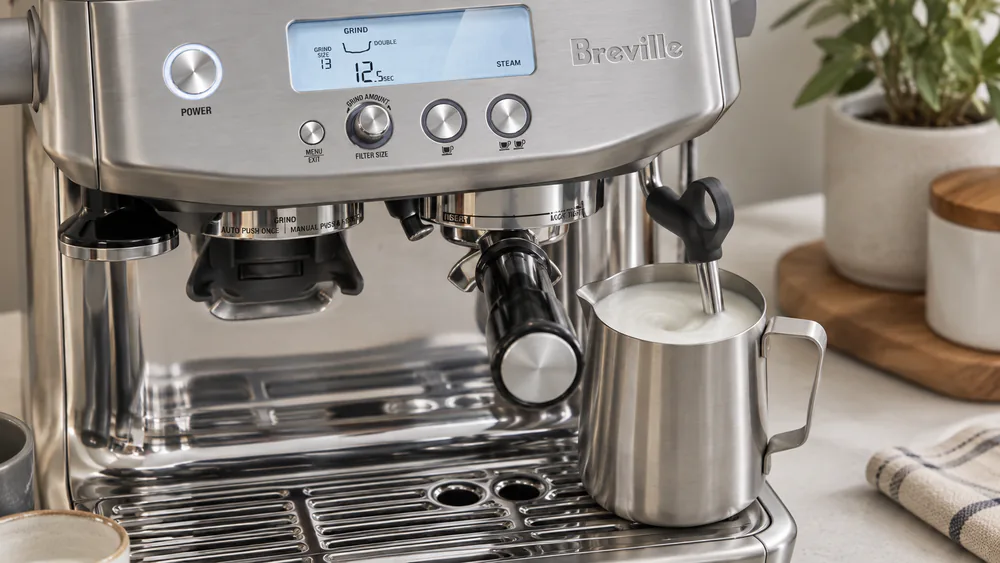
The Pro's manual steam wand ends in a 4-hole tip; the Express's is a single hole. The hole count is not the whole story, though. We ran a tip-swap test, putting identical tips on both machines, and the Pro still froths faster. The heating system is the speed driver, not the tip. For the same milk volume, the Pro textures in roughly half the time, and the Express can make the same silky microfoam, you just have to move faster. Its steam power fades as the boiler depletes, so you texture against a clock. The Pro holds steam pressure steady through the entire pitcher.
Latte-art potential and milk-drink routines
For milk drinkers, the schedule is the real difference. The Express waits about 30 to 45 seconds between brewing and steaming, and it cannot brew and steam at the same time. The Pro switches nearly instantly. The Express wand also has no no-burn sleeve, so it gets hot enough to scorch, and it demands a wipe after every pitcher. The Pro's faster, steadier steam makes latte art more forgiving for home baristas.
Tip. Let the Pro's wand purge for a second before you start texturing. It spits water for the first moments after power-on, and the first blast of steam is the strongest.
Espresso Quality and Brewing Performance
Shot-to-shot consistency and crema
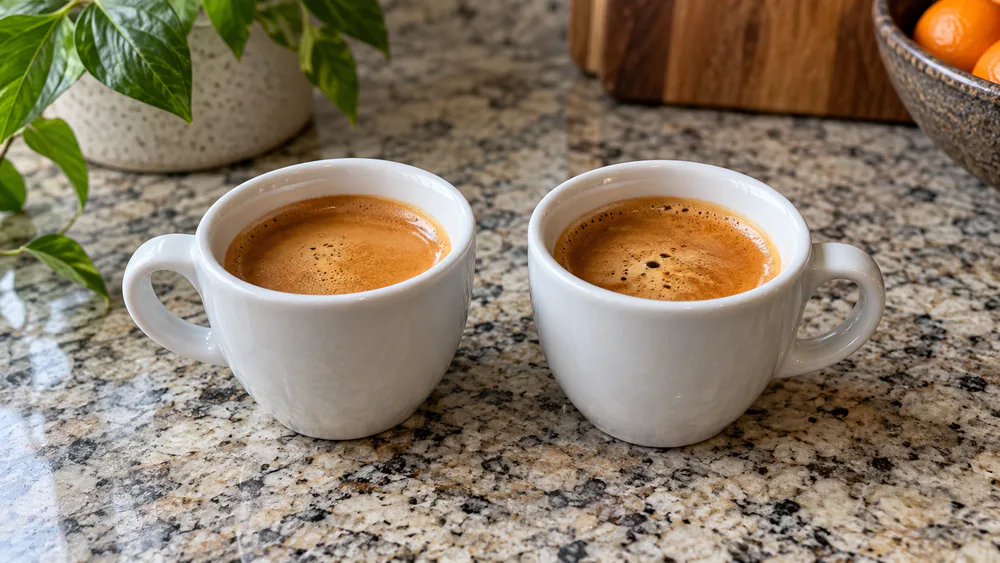
Here is the finding that decides the whole comparison: when both machines are dialed in, the espresso tastes equivalent. The real differences are speed, convenience, and shot-to-shot consistency, not raw extraction quality. Both machines meet the National Coffee Association's espresso standards: 20 to 30 seconds of contact time at a one-to-two coffee-to-espresso ratio, delivered reliably once dialed in. Dialed in, both pour balanced shots with the crema you expect from fresh beans in the shared 54 mm basket, so either machine can deliver café-quality shots.
The consistency gap is where they separate. Express shots can start sour and turn bitter over time as the machine drifts, while the Pro delivers more consistent, smoother, more balanced shots pull after pull. If you make one careful drink a day, you will barely notice. If you make two or three, the Pro earns its premium.
Pre-infusion and pump pressure
Both machines share the 15-bar Italian pump, the low-pressure pre-infusion, and the 9 bar extraction that follows. The Pro lets you program the pre-infusion time; the Express runs a fixed pre-infusion of about 7 seconds. Measured at the group, the Express peaks around 14 to 15 bar while the Pro peaks near 10, and in our cups the Pro's lower, steadier pressure produced smoother shots. The rated spec says 15 bar on both; the behavior at the basket differs.
Design and Build Quality
Barista Pro: materials, footprint, build
The Pro is a brushed stainless machine measuring 16.1 x 13.8 x 13.1 inches and pulling about 20 lb on the counter, with reported weights ranging from about 20 to 23 lb depending on the source. It draws 1680W. The build is solid, and its drip tray is easier to clean than older Brevilles, which our espresso routine appreciated. The water tank is on the small side and awkward to fill under a low cabinet, and the bean hopper is small, too. We have also seen the black finish wear off the body.
Reliability is the loudest negative in the Pro's file, and we are not going to wave it away. Some units have failed around the two-and-a-half-year mark, with out-of-warranty repairs running about $400. A few arrive dead on arrival with a looping beep on the first flush, and the 2-year limited warranty does not cover a 30-month failure.
Barista Express: materials, footprint, build
The Express measures 15.9 x 13.1 x 12.4 inches, draws 1600W, and wears the same brushed stainless face. Look closer and the top and lower sides are plastic, and we have seen the front panel paint chip. That is where the cost savings show. The durability is the machine's defining trait, though: daily-use units at 5, 8, and 10-plus years are common, and one we tracked ran 10.5 years before retirement. The 1-year limited warranty is thin for a machine built to run a decade, but the track record speaks.
The Express's signature mid-life failure is the solenoid valve: a loud buzzing plus water leaking from underneath, usually six months to a year in. The replacement part costs about $20, but the reassembly tends to leak at every tube, so most owners weigh that repair against a replacement. The portafilter o-rings and group gaskets also wear out, and those are user-replaceable for about $8 to $20.
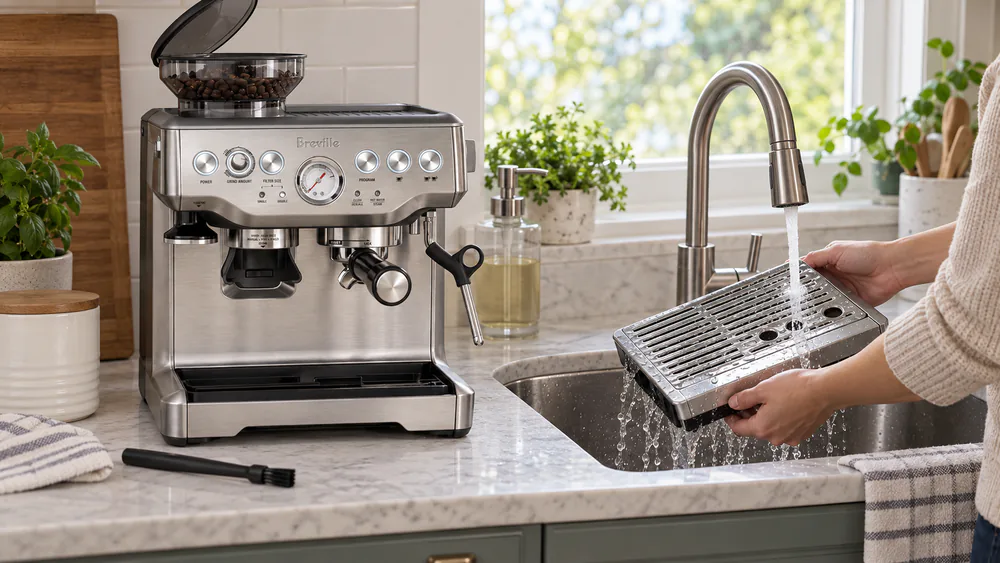
Maintenance, cleaning, and descaling (both)
The maintenance cadence that works for both machines is simple:
- Backflush weekly.
- Descale every 2 to 3 months.
- Clean the grinder every 2 to 4 weeks.
The Express drip tray fills fast from automatic purge cycles, and whole milk can clog the single-hole wand tip after about 10 cappuccinos until you clear it with the included needle.
Warning. Hear a loud buzz from the Express with water weeping underneath? That is the solenoid valve, the machine's most common mid-life failure. Catching it early keeps a roughly $20 part from taking the machine with it.
Note. These are not buy-it-for-life appliances. Expect roughly 5 years from either machine as a baseline, and many Express units run 10-plus years on regular maintenance. The descaling habit is the difference between those two numbers.
Price and Value
Barista Pro pricing
The Pro lists at $849.95. Street pricing moves week to week and dips during sale windows, and we have seen it hover near list and drop toward the $800 mark in seasonal sales.
Barista Express pricing
The Express lists at $699.95. It has been selling around $684.99 recently, with dips below list during sales, and color variants run slightly higher. Either way, it is the cheaper machine by a clear margin.
Is the upgrade worth it?
At list, the premium is about $150. Across sales and street prices, the gap has run anywhere from $100 to $300, and some older reviews quote $200 to $300 off stale prices from a cheaper era. Today, plan around $150.
What the premium buys is speed, steam, grinder precision, the LCD, and a 2-year warranty against the Express's 1-year. What it does not buy is better-tasting espresso, since both machines make equivalent shots when dialed in. For a family running 4 to 6 cups a day, the Breville Barista Express pays for itself in under a year versus coffee shop prices, which is why it has been the default first home espresso machine for more than a decade, and for a reason. The Breville Barista Pro asks about $150 more for mornings that run faster and steadier.
Which Should You Buy?
Choose the Barista Pro if...
- You make milk drinks daily and the morning rush is real.
- You brew back to back and want every shot to taste the same.
- You want the LCD, the shot timer, and the gentler daily routine.
- You appreciate 30 grind settings and a dose control that lands within about half a gram.
- The extra $150 at list fits the budget without a wince.
Choose the Barista Express if...
- The $150 premium competes with groceries, and value comes first.
- You mostly make straight shots, one or two drinks a day.
- You do not mind a 40 to 45 second warm-up while you grind and tamp.
- You want the pressure gauge as your teacher.
- A decade-long durability record matters more than the newest features.
The Third Option: Breville Bambino Plus
Bambino Plus with a separate grinder
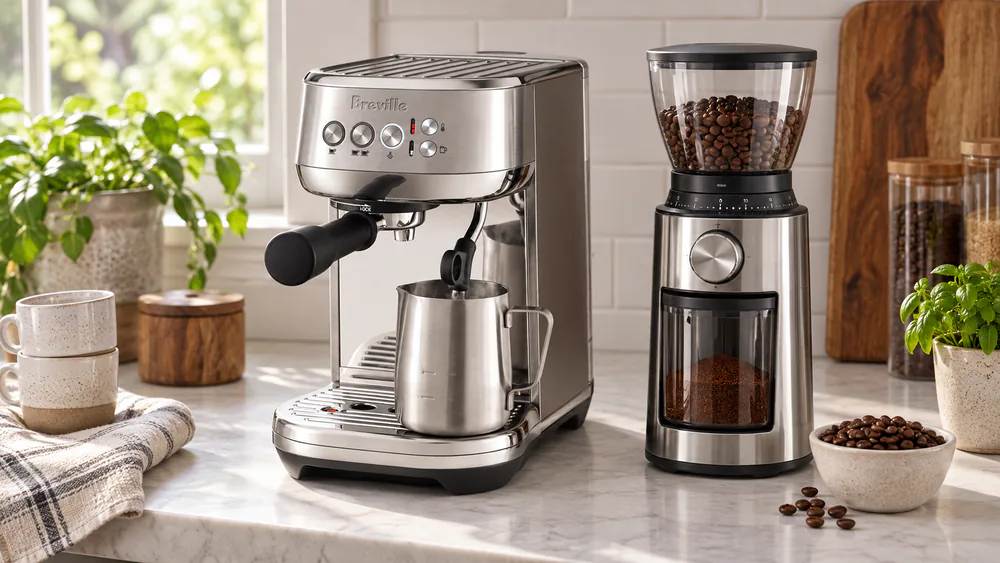
Here is the argument that has won us over in the long run: skip both built-in grinders and pair the Breville Bambino Plus with a separate burr grinder. The grinder matters more than the machine, and a good standalone burr grinder beats either built-in unit. The Bambino Plus lists at $499.95, heats in 3 seconds on the same ThermoJet system as the Pro, and steams automatically with 3 milk temperatures and 3 texture levels at 266 degrees F. Pair it with something like the Baratza Encore ESP at about $150 to $170, and the total lands near $650 to $700, though street prices for both move independently and often go on sale.
Who the third option fits
The Bambino Plus suits small counters, at 11.9 x 7.4 x 14.3 inches, and drinkers who want fast heat and automatic steam without learning latte art by hand. It shares the 54 mm portafilter, the 15-bar pump, and the ideal 18 g dose, and it runs 1560W with a 2-year warranty. It is not without flaws. The light frame can slide when you lock in the portafilter, whose seal needs a firm push until it loosens after a few months. Keep a towel nearby, too: the self-cleaning wand can spray leftover milk beyond its catch hole. We have also seen units fail early, which tempers the recommendation. The Express and the Pro feel more solidly built, which is why this third option is really a grinder recommendation in disguise.
Frequently Asked Questions
Is the Barista Pro worth the extra money over the Express?
For daily milk drinkers and anyone who brews back to back, yes: the premium buys heat-up speed, roughly twice the steam pace, and steadier shots. For budget-first buyers, no, because both machines make equivalent espresso when dialed in, and the Express has the longer track record.
What's the main difference between the two machines?
The heating system. The Pro's ThermoJet reaches extraction temperature in 3 seconds, while the Express's ThermoCoil takes about 40 to 45 seconds in real use. That gap drives most of the other differences: grind settings, interface, and steam speed.
Which machine makes better espresso?
When both are dialed in, they taste equivalent. The Pro stays more consistent shot after shot, while the Express can drift toward bitterness on back-to-back pulls. For a single careful drink a day, the gap is small.
Which is better for beginners?
Both have real learning curves and will waste some beans. The Express's pressure gauge teaches grind dialing directly, which many home baristas find invaluable. The Pro's LCD, shot timer, and on-screen menus make daily routines friendlier. Pick the interface you will live with.
Do they share the same brewing components?
Yes. Both use the 54 mm portafilter, the 15-bar pump, and the 67 oz tank, and both extract at 9 bar with low-pressure pre-infusion. The heating systems, grinders, and steam wands are what differ.
How long does each machine take to heat up?
The Pro reaches extraction temperature in about 3 seconds. The Express takes about 40 to 45 seconds in real-world use, with measurements ranging from 30 to 50 seconds depending on conditions. Grind and tamp while it warms and the wait barely registers.
Can I use pre-ground coffee with these machines?
Yes. Both machines ship four filter baskets: two single-wall and two dual-wall, each in 1-cup and 2-cup sizes. Both official instruction books say the dual-wall (pressurized) baskets are the ones to use with pre-ground coffee, while the single-wall baskets are for freshly ground whole beans. The pressurized design creates back pressure through a single small hole in the outer wall, which keeps the shot forgiving even when the grind, dose, or tamp is off, so you can start with store-ground beans and graduate to grinding fresh.
How do I clean and descale them?
Keep a cadence: backflush weekly, descale every 2 to 3 months, and clean the grinder every 2 to 4 weeks. The Pro runs rinse and descale cycles from its LCD menus; the Express needs the button combinations from the manual. Wipe the steam wand after every use and clear the tip with the included needle when milk clogs it.
Final Verdict
One more thing worth knowing before you buy, and it is the thing most guides miss. These are entry points, not stepping stones. Almost nobody upgrades from an Express to a Pro, because the jump between them is small compared with the jump to a separate grinder or a higher-tier machine. If you buy the Express and fall in love with espresso, your next step will not be the Pro.
The upgrade question also comes down to lifespan. The Express routinely stretches past 10 years on regular maintenance, and its repairs are cheaper when something does fail. Buy the Pro for the mornings it saves you. Buy the Express for the decade it gives you.
Key takeaway. Our bottom line: buy the Pro if the $150 premium is affordable and your mornings involve milk, speed, or more than one cup. Buy the Express if value comes first, and expect it to outlast the alternative. If the counter is small, the Bambino Plus with a separate grinder fixes the weakest part of both machines for about the same money as the Pro.
Read next
Ready to upgrade your kitchen?
Whichever machine fits your counter, our espresso guides help you dial in, keep it clean, and pull better shots at home.