
Appliances
How to Choose Kitchen Appliances: Complete Guide

As an Amazon Associate we earn from qualifying purchases. We may earn a commission from links on this page, at no extra cost to you. Learn more.
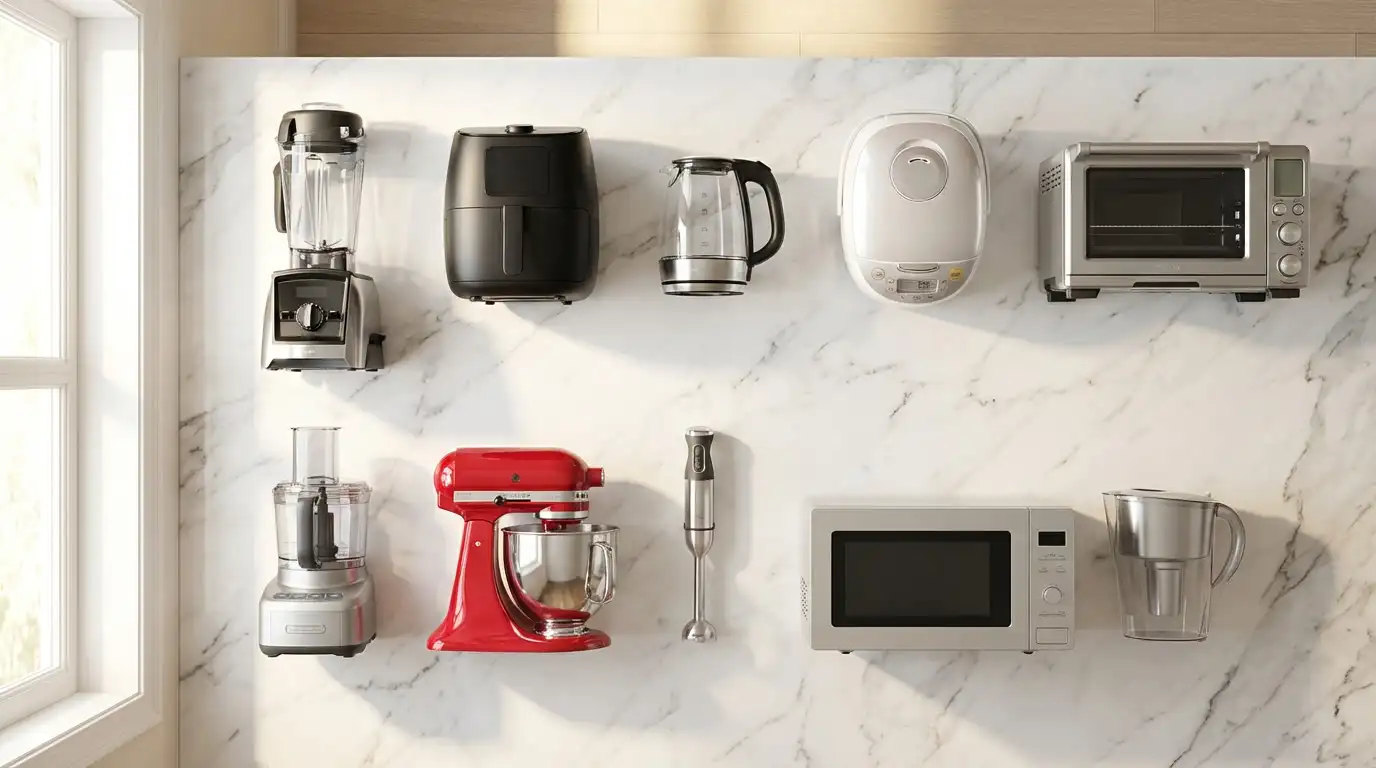
Picture paying $14,000 for a gorgeous new kitchen suite, then finding that the refrigerator door cannot open fully because it hits the island and the range hood is too powerful for the home's ventilation. The whole project has to be partially redone.
Choosing kitchen appliances is not just shopping. It is one of the biggest financial decisions a homeowner makes. The average kitchen remodel in the United States costs between $14,589 and $41,538. Your appliances are the foundation of that entire investment. Get them right and your kitchen works beautifully for a decade. Get them wrong and you are paying for mistakes for years. If you are still figuring out which appliances your kitchen actually needs, our guide to essential kitchen appliances every modern kitchen should have is a great place to start.
This guide gives you the full roadmap. No fluff. No filler. Just the strategy that actually works.
What Most Appliance Guides Get Dead Wrong
Here is the truth most websites will not tell you. The biggest appliance mistakes have nothing to do with brand comparisons. They happen before you even walk into a showroom.
Most guides start by asking which refrigerator to buy. We have found that is the exact wrong place to start. The physical footprint, the electrical capacity of your home, and your kitchen's ventilation system must come first. Everything else follows from those three things.
Key takeaway. Plan the space and infrastructure before you research a single product.
Pro Insight: The "Service Radius" Test Nobody Runs
One rule can save thousands of dollars. We call it the Service Radius Test. Before you finalize any appliance brand, call three local repair shops and ask one question: "Do you stock parts and service this brand?"
In markets outside major metro areas, fewer than 30 percent of independent technicians are certified to service Miele, Thermador, or Viking. A refrigerator that breaks down with no local service availability can sit unrepaired for 6 to 10 weeks while parts ship from overseas distributors.
This single test changes more appliance decisions than any spec sheet comparison. Run it before you spend a dollar.
Phase 1: Planning for the Physical Footprint and Kitchen Workflow
The Golden Triangle and Ergonomic Kitchen Layouts
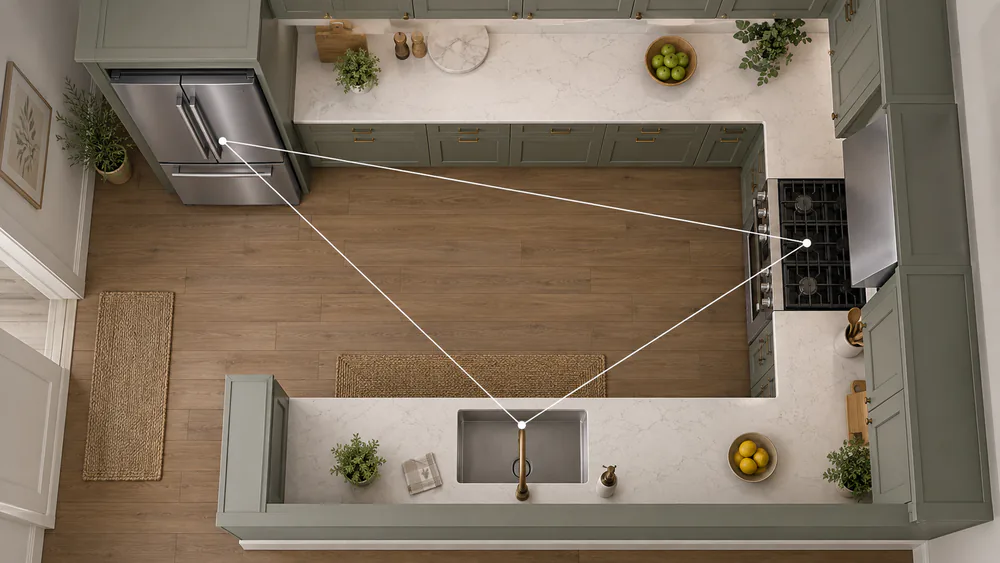
The triangle rule has been the backbone of smart kitchen design for decades. Your refrigerator, sink, and cooking surface form a triangle. When that triangle works well, cooking feels effortless. When it fails, every meal feels like a chore.
Space optimization starts here. Measure the distance between each point of your triangle. The total of all three sides should fall between 12 and 26 feet. Go smaller and you feel cramped. Go bigger and you are walking too much.
Kitchen workflow shapes which appliances you choose and how large they should be. A galley kitchen needs counter-depth appliances. An open-concept layout needs quiet ones. For a broader decision-making framework to pair with this guide, see our complete step-by-step guide to choosing the right kitchen appliances.
Key takeaway. Map your kitchen triangle before measuring for any appliance.
Measuring for Counter-Depth vs. Standard-Depth Refrigerators
This is the mistake we see most often. Standard-depth refrigerators run about 30 to 34 inches deep. Counter-depth models run 24 to 25 inches deep. The difference sounds small. It is not.
In a kitchen with an island or a narrow walkway, a standard-depth fridge can block traffic flow entirely. Counter-depth models align flush with your cabinets. They look cleaner and keep the path of travel open.
The trade-off is cubic feet. A standard-depth French door refrigerator gives you 22 to 28 cubic feet. A counter-depth version gives you 18 to 22 cubic feet. For a family of four, we recommend a minimum of 20 cubic feet. Keep that number in mind when you compare models.
- Measure your kitchen's depth from cabinet face to island or opposite wall
- Allow a minimum of 42 to 48 inches of clear walkway in any traffic zone
- Check door-swing clearance on both sides before choosing a configuration
Door-Swing Clearances and Path-of-Travel Audits
A refrigerator door needs 90 degrees of clearance to open fully. Most French door models need 36 to 42 inches of swing room. Check this against your island, adjacent cabinets, and any pantry doors nearby.
The path of travel is the space someone needs to walk past an appliance while another person uses it. The ADA standard recommends 36 inches minimum. In a busy household, 42 inches is far more comfortable. Measure both before you finalize any appliance choice.
Key takeaway. Swing clearance and walking room are non-negotiable. Measure both before you buy.
Key takeaway. Measure your walkway width first. It will decide the depth of your refrigerator for you.
Phase 2: Budgeting for Total Cost of Ownership
Decoding the "Hidden Invoice" in Appliance Installation
In our experience, the sticker price is only about 70 percent of what you will actually spend. The rest hides in delivery fees, installation labor, permits, and infrastructure upgrades.
Here are the hidden costs most buyers miss completely:
- Electrical panel upgrades: Induction cooktops require a 240V, 40 to 50 amp dedicated circuit. Many older American homes do not have this. The upgrade costs between $2,000 and $4,000.
- Make-up air systems: A high-performance range hood over 400 CFM may require a make-up air unit to comply with local building codes. That retrofit can run $5,000 to $10,000.
- Delivery and haul-away: Most retailers charge $50 to $200 per appliance for delivery and separate fees to remove old units.
- Permit fees: In many US jurisdictions, replacing a gas appliance or upgrading electrical service requires a permit. Budget $150 to $500 depending on your city.
The 2025 economic environment adds another layer. Early in 2025, brands like Bosch and Thermador raised prices by 5 to 10 percent to offset rising tariff and steel costs. Whirlpool made similar adjustments. These increases are not going away soon.
Key takeaway. Add 30 percent to your appliance budget to cover installation and infrastructure realities.
The 2025 Tariff Impact: Why Prices Are Shifting Now
The tariff environment in 2025 has created real price pressure across the appliance market. European brands like Bosch and Miele source components internationally. American brands like Whirlpool and Maytag use domestic steel that has also seen cost increases.
The smartest financial move right now is timing. February is historically the best month for appliance deals in the United States. This is what the industry calls the "Presidents Day Sweet Spot." Retailers are clearing out last year's models to make room for new September inventory. You can often find "New Old Stock" at 15 to 25 percent below original pricing.
Black Friday and the September to November new-model release season are your other two buying windows. If you purchase a model being replaced by a new version, you get a better-engineered product at a discount.
Key takeaway. Buy in February or November to get last year's model at a meaningful discount.
Bundle Savings vs. Mix-and-Match Strategy
Buying three or more appliances from one manufacturer can unlock 10 to 20 percent in direct rebates. Samsung SmartThings bundles and LG ThinQ suites both offer these incentives. Thermador is famous for its "free dishwasher" promotional bundle.
But we want to be honest with you. Bundles can also force you into a weak link. You might get an excellent range but a mediocre dishwasher just to qualify for the discount. In our experience, the best long-term strategy is what we call "Best of Breed." Match the best option in each category rather than forcing brand consistency.
The exception is if aesthetic cohesion matters deeply to you. A panel-ready suite from a single brand like Bosch or GE Profile looks unified and supports your kitchen's resale value.
Phase 3: Category-Specific Selection Criteria
Refrigeration: The 24/7 Energy Hub
Your refrigerator is the only appliance that runs every single minute of every day. That means reliability and energy efficiency matter more here than anywhere else.
The two technologies to understand are single evaporator and dual evaporator systems. Dual evaporators keep your fridge and freezer compartments separate. This prevents freezer odors from contaminating fresh food and maintains better humidity control. Sub-Zero has built its entire reputation on this technology.
Configuration options affect how you use the space daily:
- French door refrigerators are the most popular in the US. They offer wide shelf space and put the freezer at the bottom.
- Side-by-side models give you eye-level access to both sections but sacrifice wide shelf space.
- Column refrigerators from brands like Sub-Zero and Liebherr are the top choice for serious kitchen design. They are panel-ready and allow custom configurations.
Inverter linear compressor technology from LG is worth noting. It reduces energy use and runs quieter than traditional compressors. However, real-world repair data tells a complicated story. LG compressor failures after the warranty period have generated class action complaints. We always recommend verifying the service network in your area before buying.
Features like AI Fresh sensors and the Auto-Fill Pitcher are genuinely useful. The InstaView panel from LG and the internal LED staging from Sub-Zero both reduce the number of times you open the door. Every time you open a fridge door, it loses 30 percent of its cold air. These features actually save energy. If your refrigerator has a water dispenser, it is also worth reading up on the best inline water filters for refrigerators to protect water quality long-term.
Key takeaway. For a 10-year investment, choose a model with a dual evaporator and a certified local service network.
Compressor Technology: Single vs. Dual Systems
A single evaporator compressor serves both the fridge and freezer from one unit. It is cheaper to build and cheaper to repair. The downside is that air circulates between both compartments, which transfers odors and reduces humidity control for fresh produce.
A dual evaporator system runs two separate cooling circuits. Your fridge stays humid for produce. Your freezer stays dry to prevent ice crystals. Sub-Zero pioneered this in residential refrigerators and it remains their core engineering advantage. Liebherr uses the same principle in their BioFresh compartment technology.
Key takeaway. Dual evaporator systems protect food quality better. They are worth the price premium for serious home cooks.
Configuration Selection: French Door, Side-by-Side, and Columns
French door models are the best all-around choice for most American households. The wide upper compartment handles large platters and sheet pans easily. The bottom freezer drawer keeps frozen items organized without constant bending.
Side-by-side refrigerators work well for narrow kitchens where a full-width door swing is impossible. The trade-off is shelf width. A full-size pizza box will not fit in most side-by-side models. Column refrigerators from Sub-Zero and Liebherr are fully panel-ready and allow complete design flexibility. They are the gold standard for high-end kitchen design but require the largest budget.
Key takeaway. French door is the best default. Choose column refrigerators only if your budget and design goals demand it.
Cooking: The Induction vs. Gas Evolution
This is the question we get asked more than any other. Let us give you a straight answer.
Induction is the better technology for 2025 and beyond. Here is why. Induction coils heat the pan directly using a magnetic field. No heat escapes into the kitchen. Boiling water happens about 50 percent faster than on gas. The surface stays cool to the touch, which is a major safety win for homes with young children.
There is a bigger reason this matters right now. Research on indoor air quality has confirmed that gas combustion produces CO and NO2 gases. In modern, well-sealed American homes, these gases accumulate. Consumer Reports testing found that gas ranges can produce nitrogen dioxide levels that exceed safe limits set by international health organizations, a finding that has prompted serious scrutiny from the US Consumer Product Safety Commission. You can read their full investigation into whether your gas range is a health risk. Induction eliminates that risk entirely. California and other states are already moving to phase out new gas appliance installations.
ProBake Convection from LG and the convection fan systems in GE Profile and Wolf ranges represent the current performance standard for baking and roasting. These systems circulate hot air evenly and cut cooking times by 20 to 30 percent. If you are weighing whether a countertop convection option could supplement your main oven, our side-by-side air fryer vs convection oven test is worth reading before you decide.
For professional gas ranges, the BTU output matters most for wok cooking and high-heat searing. Wolf and BlueStar offer Precision Star Burners and Power Blast configurations that serious home chefs love. If you go this route, verify that your hood can handle the CFM load those burners require.
Dual-fuel ranges combine a gas cooktop with an electric convection oven. This is the best-of-both-worlds option if you are not ready to leave gas behind.
Key takeaway. Induction is the smart default for new kitchens. Dual-fuel is the best bridge if you prefer gas cooking.
Why Induction Is the 2026 Industry Standard for Safety and Speed
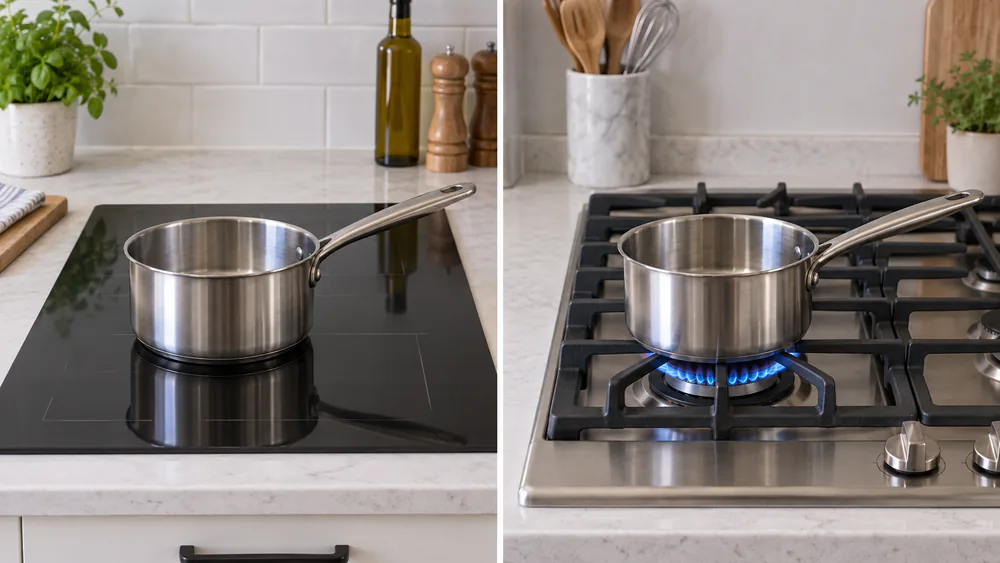
Induction cooktops use magnetic induction coils beneath a flat ceramic surface. The coil creates a magnetic field that heats the pan directly. The surface itself never gets hot. This means spilled food does not burn onto the glass and curious hands do not get burned.
Speed is the other headline. Induction boils water roughly 50 percent faster than gas. Temperature control is more precise than any burner technology available today. California, New York, and several other states are already restricting new gas appliance installations in residential buildings. Induction is not a trend. It is the direction the entire industry is moving.
Key takeaway. Induction is safer, faster, and cleaner than gas. It is the smart default for any new kitchen built in 2025 or later.
Professional Gas Ranges: When BTUs and Ventilation Matter Most
If you cook at high heat regularly, a professional gas range still has a role. Wolf and BlueStar offer Precision Star Burners that deliver 15,000 to 25,000 BTUs per burner. That output is ideal for wok cooking, rapid searing, and boiling large pasta pots quickly.
The critical detail most guides skip is ventilation math. A range producing 60,000 total BTUs needs a hood rated at a minimum of 600 CFM to clear combustion gases safely. Many homes require a make-up air system at that CFM level. Confirm your ventilation plan before you purchase any professional-grade range. Skipping this step is how a $10,000 range becomes a $20,000 project.
Key takeaway. Match your hood CFM rating to your range's total BTU output before you buy any professional gas appliance.
Dishwashing: The Silent Evolution
Dishwashers have become remarkably good. The gap between a budget model and a premium one has narrowed significantly. But one spec still matters enormously: dBA levels.
The 42 dB threshold is the number we use as our benchmark. Below 42 dB and the dishwasher is genuinely quiet in an open-concept home. Above 44 dB and you will hear it from the living room. Bosch holds the standard here. Their 500 and 800 series consistently test at 40 to 44 dB.
Miele and Bosch both use AquaStop systems that detect leaks and automatically shut off the water supply. This is not a luxury feature. It is basic water damage protection that every homeowner should want.
The third rack is a feature that genuinely changes how you use the dishwasher. It adds 30 percent more capacity for utensils, small lids, and flat items. KitchenAid and Bosch both do this well.
Soil sensors in premium dishwashers measure how dirty the water is and adjust the cycle length accordingly. This saves water and energy without any effort from you.
Key takeaway. Choose a dishwasher rated at 44 dB or lower with AquaStop and a third rack.
Phase 4: Reliability, Maintenance, and Real Red Flags
The "Smart" Debt: When Wi-Fi Features Become a Liability
We want to be honest with you about something that is rarely discussed in mainstream appliance guides. Smart features carry a hidden long-term risk. The refrigerator with a touchscreen interface and OTA updates that you buy today may have unsupported software in five years.
Reddit communities like r/Appliances and r/BuyItForLife have named this the "Death of Durability." The frustration is real. Samsung and LG refrigerators score well in lab tests. But their Wi-Fi diagnostics and smart home integration systems are tied to app ecosystems that change. When the software support ends, the "smart" features become liabilities, not assets.
Alexa Integration and SmartThings connectivity are genuinely useful when they work. But base your buying decision on the mechanical quality first. The smart features are a bonus. The same principle applies when choosing a coffee maker. Our coffee maker buying guide for 2026 covers exactly why smart features in that category can become a maintenance headache too. And if you are still deciding between brewing styles, our breakdown of drip coffee vs espresso helps you match the machine to how you actually drink coffee every morning.
Craft Ice from LG is a fun innovation. The Touchscreen Interface on Samsung's Family Hub refrigerator is visually impressive. Neither of these should be the reason you choose a refrigerator.
Key takeaway. Buy for mechanical quality first. Treat smart features as a bonus, not a reason to buy.
Brand Reliability Rankings: Expert Testing vs. Real-World Data
Here is the full picture of how major brands actually perform over time. Whether you are choosing a slide-in range or a freestanding model, a self-cleaning oven or one with an air fry mode built in, the brand tier you choose shapes your long-term experience more than any individual feature. If you are considering a dedicated countertop air frying appliance to complement your range, our hands-on Ninja Crispi review after two weeks of real testing gives you an honest picture of its strengths and limits. If you are specifically evaluating a standalone air fryer as part of your kitchen setup, our complete air fryer buying guide walks through what actually matters.
Luxury Tier (10+ year investment):
- Miele, Sub-Zero, Wolf: The highest mechanical longevity in the market. Miele dishwashers are rated for 20 years of use. Sub-Zero refrigerators dominate the luxury resale market. The trade-off is high upfront cost and limited local service in smaller cities.
Mid-Range Tier (Best balance of value and durability):
- Bosch, KitchenAid, GE Profile: Excellent performance at accessible price points. The Bosch 800 series dishwasher and the KitchenAid 36-inch slide-in range are two of our most consistent recommendations.
Mass Market Tier (Budget and tech-forward):
- LG, Samsung, Whirlpool, Frigidaire, Maytag: Strong performance in lab tests. Real-world longevity is inconsistent. Best suited for renters, short-term homeowners, or buyers who want cutting-edge smart features and plan to replace within 7 to 10 years.
Maytag and Whirlpool remain the most serviceable brands in rural America. Parts are widely available and most local technicians know them well. This is the "Service Range" point that almost no guide discusses. A Viking or Thermador range is a liability if no certified technician operates within 50 miles of your home.
Key takeaway. Call a local appliance repair shop before buying any premium European brand. Ask if they service it.
Phase 5: Future-Proofing for 2026 and Beyond
Sustainable Design and Energy Economics
Appliances now account for over 20 percent of home electric usage in the United States. The ENERGY STAR Most Efficient 2025 certification from the US Environmental Protection Agency is the threshold we use as a minimum requirement for any new purchase.
Heat pump dryers are the most underrated upgrade available right now. They use 50 percent less energy than traditional vented dryers. They also eliminate the need for external ductwork, which makes them ideal for urban apartments, condos, and ADUs. The freedom to install a dryer without an external vent can make daily life easier.
Alongside the indoor air quality benefit discussed earlier, induction also offers energy savings. Induction loses virtually no heat to the surrounding air. Gas and traditional electric cooktops waste 30 to 40 percent of their energy heating the kitchen rather than the food.
Key takeaway. ENERGY STAR certification is the minimum bar. Heat pump dryers and induction cooktops are the upgrades with the best long-term return.
Predictive Diagnostics and the Proactive Kitchen
The most exciting development in 2025 appliances is predictive maintenance technology. Several brands now offer systems that monitor performance 24/7. When something is trending toward failure, the system alerts you, and sometimes the service center, before you even notice a problem.
AI Fresh sensors in premium refrigerators study your door-opening patterns and pre-chill the interior before high-use periods. Independent testing suggests this extends food freshness by up to 40 percent.
Sensor-based water management in Miele and Bosch dishwashers adjusts water temperature and detergent volume automatically based on soil sensors. You load the machine and it figures out the rest.
These are not gimmicks. They represent real engineering progress that reduces waste and extends appliance lifespan. Regular maintenance is the other side of that coin. Whether it is descaling your coffee machine or cleaning your dishwasher filter, small habits protect your investment. Our guide on how to properly use and clean your coffee maker is a good example of the kind of upkeep routine that adds years to any appliance. And if a rice cooker is on your list, our ultimate rice cooker buying guide for 2026 applies the same reliability-first thinking to that category. Pressure cookers are another common addition to a modern kitchen. Our comparison of the Instant Pot Pro vs Duo breaks down the differences most buyers overlook before committing.
Your Final Decision: The Smart Buyer Checklist
You have done the research. Now here is the exact checklist to run before you make a final decision.
Before You Buy Anything:
- Measure your space including depth, height, door-swing clearance, and walkway width
- Check your home's electrical panel for 240V capacity if you plan to add induction
- Verify local ventilation requirements for any hood over 400 CFM
- Call a local repair shop to confirm they service the brands you are considering
Budget Check:
- Add 30 percent to your sticker price budget for installation and infrastructure
- Identify your buying window (February Presidents Day or November new-model season)
- Evaluate whether a bundle discount outweighs the risk of a weak-link appliance
Product Selection:
- Prioritize mechanical quality over smart features
- Match appliance depth to your kitchen's traffic flow requirements
- Choose a refrigerator with dual evaporators for better food preservation
- Select a dishwasher at 44 dB or lower if your kitchen is open-concept
- Verify the ENERGY STAR certification on every major appliance
Long-Term Confidence:
- For a 10-year kitchen, consider a "Best of Breed" approach across brand tiers
- Stainless steel and panel-ready finishes offer the best resale value
- Avoid making design decisions based on trends. Timeless aesthetic cohesion holds its value longer
Frequently Asked Questions
What is the most reliable brand of kitchen appliances for 2025?
Miele and Bosch lead in long-term reliability. Miele dishwashers and steam ovens set the benchmark for durability and premium engineering. Bosch, on the other hand, delivers an excellent balance between quality, performance, and mid-range pricing, making it a top choice for most households.
Should I buy appliances before or after my kitchen cabinets?
Always finalize your cabinet dimensions first. Cabinet depth, width, and layout directly determine which appliance sizes will fit properly. Buying appliances before designing cabinets often leads to costly adjustments, poor fit, or even replacements.
Is induction better than gas for a home cook?
Yes, for most home cooks, induction is the better option. It heats faster, offers precise temperature control, and eliminates indoor air pollution caused by gas combustion. The only scenario where gas may still be preferred is high-heat wok cooking, where open flame provides better control.
How much should I budget for a full suite of kitchen appliances?
A mid-range appliance suite, including a refrigerator, range, dishwasher, and microwave, typically costs between $5,000 and $10,000. For luxury brands like Sub-Zero, Wolf, and Miele, expect to spend between $25,000 and $60,000. Additionally, you should allocate around 30% extra for installation and setup.
Can I mix and match appliance brands in one kitchen?
Absolutely. The “best of breed” approach often delivers better long-term performance than sticking to a single brand package. You can select top-performing products in each category while maintaining a cohesive look by matching finishes, such as stainless steel or panel-ready designs. This same strategy applies to smaller countertop appliances as well.
What is the difference between counter-depth and built-in refrigerators?
Counter-depth refrigerators are designed to align flush with standard cabinetry (typically 24 to 25 inches deep), offering a streamlined look but less storage space. Built-in refrigerators are fully integrated into cabinetry, providing a seamless, custom appearance. However, built-in models are significantly more expensive and usually found in high-end kitchen designs.
The Bottom Line
Choosing kitchen appliances in 2025 is a strategic exercise. It is not a shopping trip.
The homeowners who get it right start with their space, plan for hidden infrastructure costs, and choose mechanical reliability over flashy features. They time their purchase for maximum savings. They verify their local service network before committing to a premium brand.
The ones who struggle ignore the physical footprint, skip the electrical audit, and buy based on a showroom demo.
You now have the complete roadmap. The information is here. The decision is yours.
Start with your measurements. Then build outward from there. Your kitchen will thank you for the next ten years.
Read next
Ready to upgrade your kitchen?
From weeknight dinners to the gear that makes them easier, our recipes and tested picks help you cook with more confidence.