As an Amazon Associate we earn from qualifying purchases. We may earn a commission from links on this page, at no extra cost to you. Learn more.
We ran both pans through the same gauntlet: high-heat sears, ungreased eggs, acidic sauces, oven transfers, and weeks of daily washing. The results were closer than the price tags suggested: about $87 for the three-piece Henckels Paradigm set at Costco, versus about $190 for a single 12-inch HexClad with lid.
This is a brand-level comparison. We ran the two hybrid lines, the Henckels Paradigm and the HexClad, through the same protocol: timed 2-cup boils, matched-burner induction races, chicken and steak sears, eggs with and without fat, and daily washing. Henckels' Granitium ceramic and Clad H3 stainless lines enter the comparison on the same measures.
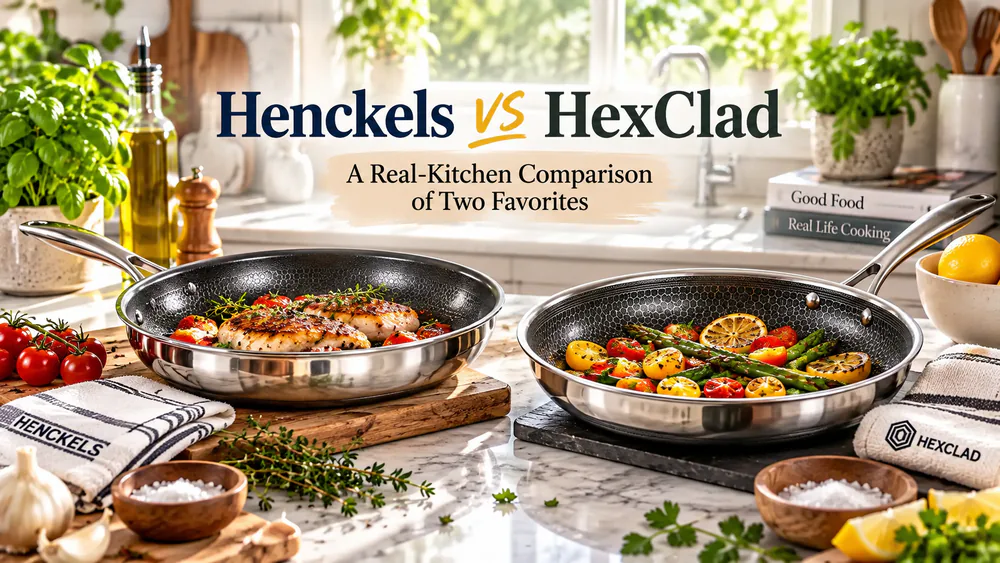
Henckels is the German brand with hybrid, ceramic, and stainless lines; HexClad is the direct-to-consumer hybrid with chef cred. Both put a laser-etched hex pattern over a nonstick base; the similarity ends there.
We bought both pans outright, no samples from either brand, which is how we keep the verdicts ours. Weeks of daily cooking and hand washing followed, long enough for the HexClad's release to settle into its stride. Acidic sauces simmered in the saucepans, where the walls gave a sauce room to roll; a sticky hoisin noodle sauce rinsed off after a short soak. Frittatas went burner to oven and back in both pans without a warp, and the handle lesson split by regime: cool on the stove, hot out of the oven, so a mitt comes out for the HexClad.
Quick Verdict: Henckels vs HexClad
Buy Henckels If You Want...
The budget hybrid: a three-piece Paradigm set for about half of one 12-inch HexClad's price
Ceramic nonstick from $40.43 for the Everlift 10-inch pan
Stainless from $79.95 with the Clad H3 two-pan set, plus PTFE-free options in the 2025 ceramic line
Buy HexClad If You Want...
The thickest hybrid build in this test: 3 mm tri-ply
A pan oven safe to 900F
The fastest induction boil we timed, about 5:30
The Bottom Line in 30 Seconds
Henckels wins the value argument; HexClad wins the build argument. Neither is a true no-fat nonstick, so both want a little butter or oil.
Key takeaway. Henckels covers more kitchens for less money: hybrid, ceramic, and stainless lines from $40.43 to about $330. HexClad is the premium-hybrid buy for cooks who run hot.
Henckels vs HexClad: Side-by-Side Comparison
Where the quick verdict gives the answer, this table shows the homework. Prices move week to week; these are the figures at the time of writing.
Core Specs and Pricing at a Glance
Feature
Henckels Hexagon (Paradigm)
HexClad
Henckels Granitium
Henckels Clad H3
Tramontina
Price (pan)
3-pc set about $87 at Costco; single pans from about $60
10-inch pan $149; 12-inch with lid $190
Everlift 10-inch pan $40.43
2-pc ceramic set $79.95
set-focused; 8-pc set $207.36
Price (set)
6-pc $269.95; 10-pc ceramic $329.95
6-pc fry pan set $389.99
Everlift 10-pc $199.99
10-pc ceramic $329.95
8-pc $207.36; 12-pc $299.99
Construction
tri-ply stainless, aluminum core, 2.4 mm, made in China
tri-ply, aluminum core, 3 mm
aluminum body, 99.9% pure on Capri Notte
tri-ply stainless, aluminum core
tri-ply 18/10 stainless, aluminum core, made in Brazil
Coating
steel hex peaks over nonstick inlay; PTFE or PTFE-free ceramic versions
Before the reviews, a map. Henckels sells three cookware families, and the hybrid line alone has worn three names. For the two-pan matchup only, see our earlier Henckels Hexagon vs HexClad comparison.
Henckels Hexagon (Paradigm): Hybrid Nonstick with the Hex Pattern
The hybrid line launched in 2024 and has been sold as Hexagon, HXagon (the Costco badge), and now Paradigm, the current name on the official Henckels Paradigm product page. It is 2.4 mm tri-ply stainless with raised steel hexagon peaks over a 3-layer nonstick inlay, in classic PTFE or 2025 PTFE-free ceramic versions. Amazon carries the ceramic versions; Costco and zwilling.com sell the classic PTFE set.
Henckels Granitium: Ceramic Nonstick
Granitium is Henckels' ceramic family: lightweight aluminum with a 3-layer ceramic-reinforced nonstick and stay-cool handles. Italian-made Everlift pans start at $40.43; the Capri sets are the Costco versions, and most Capri items skip induction.
Henckels Clad H3 and Other Lines: Stainless Steel and Beyond
Clad H3 is Henckels' tri-ply stainless line, mirror-polished 18/10 steel over an aluminum core, in plain stainless or Ceraforce ceramic. A two-pan start is $79.95, a 10-piece set $329.95, everything oven safe to 500F.
HexClad: One Hybrid Line, Many Sizes
HexClad is one hybrid line in nearly every shape: fry pans from 7 to 14 inches, woks, saute pans, pots, griddles, and sets. Every piece is 3 mm tri-ply with laser-etched stainless peaks over TerraBond ceramic valleys, and there is no budget HexClad within the brand.
Henckels Hexagon (Paradigm) Review: What We Love and What Could Be Better
Who should get it: cooks who want the hex-pattern hybrid experience for everyday meals and shop by value first. We would buy it for weeknight cooking before any other pan in this test, keeping a heavier pan on the rack for large-sear nights. The trade-offs sit below; none changes that call.
Pros
A three-piece set for less than half of one 12-inch HexClad's price
Released eggs cleanly with butter or oil in our tests
Thin 2.4 mm build loses heat fast when cold food goes in
Polished steel bottom stains and needs Bar Keepers Friend
Protruding rivets trap food and oil
Fry pan sets ship without lids, and none are sold separately
What We Love About the Henckels Hexagon
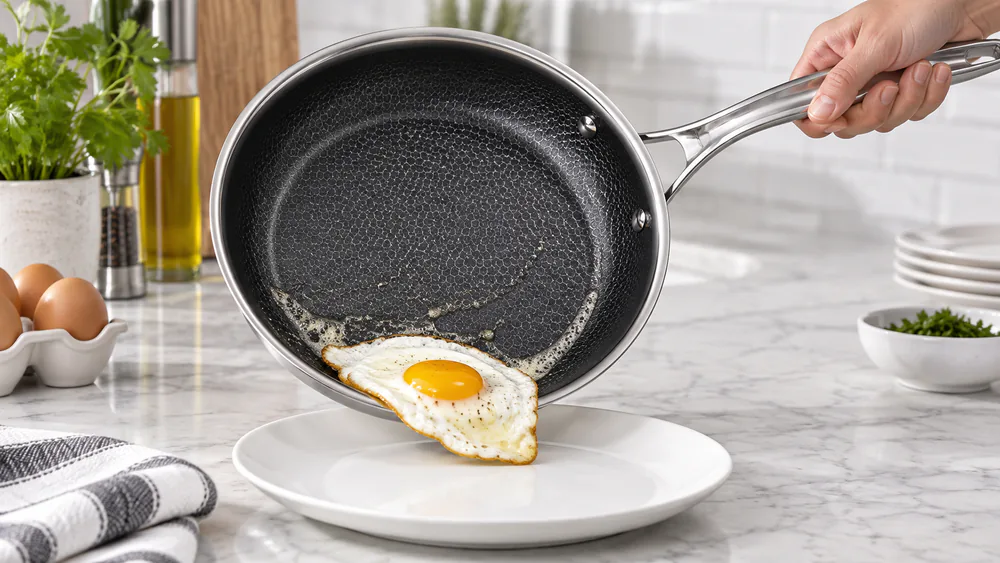
The omelet sold us. In a dry-pan test, the Paradigm released a no-oil omelet cleanly, and the HexClad's slid out with nothing left behind. Treat the surface as a release aid, not a no-fat promise, and the Paradigm delivers.
What Could Be Better (and Who Should Get It)
The Paradigm gives up its heat fast: drop in cold chicken breasts and the pan cools enough to dull the sear, so batch cooking means small batches and quick flips. Skip it if you sear large quantities nightly; for everyone else, it is the first hybrid to buy.
HexClad Review: What We Love and What Could Be Better
Where the Paradigm wins on price, the HexClad answers on build.
Who should get it: cooks who sear hot and heavy and run induction. The pan is built for that regime, and for that cook the premium is fair. Buy it for high-heat cooking; buy the Paradigm for everything else.
Pros
Thickest build in the test: 3 mm tri-ply, heavy but stable
Fastest induction boil in the test
Oven safe to 900F; coated exterior wipes clean
Lifetime warranty against defects plus a 30-day return guarantee
Cons
Not a true no-fat nonstick; ungreased eggs stuck in our test
A single 12-inch pan costs more than double the three-piece Paradigm set
Dishwasher cycles dull the finish over time
The long-term durability record is still mixed
What We Love About HexClad
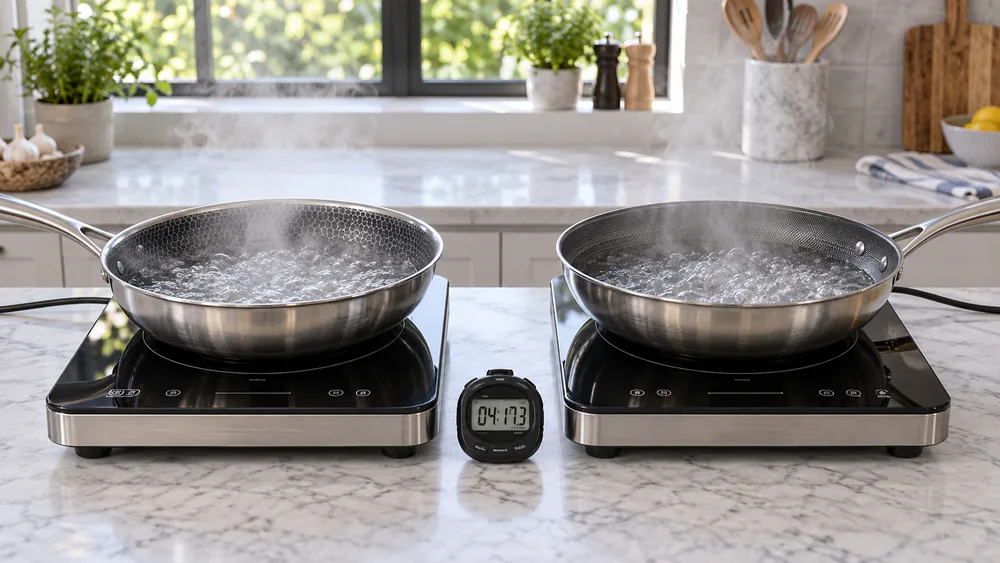
The induction race settled the build question: 2 cups each on matched burners, and the HexClad reached a rolling boil first. CNET called it the toughest nonstick it has tested, with release nearly as good as a traditional nonstick.
What Could Be Better (and Who Should Get It)
Eggs are the honest test for any nonstick, and the published record is blunt. America's Test Kitchen's 50-egg gauntlet failed the HexClad at the first stage, with the tester calling the performance shockingly bad and steering buyers to an OXO pan at roughly a quarter of the price. It is the sharpest verdict on this pan in print, and it is why the care guidance in the head-to-head section matters.
The HexClad held the heat for a golden crust when the Henckels could not.
Cooking Performance: Real Tests, Head to Head
Every number below comes from one protocol: matched burners, same food, same fat, same timing.
Egg and Delicate Food Test
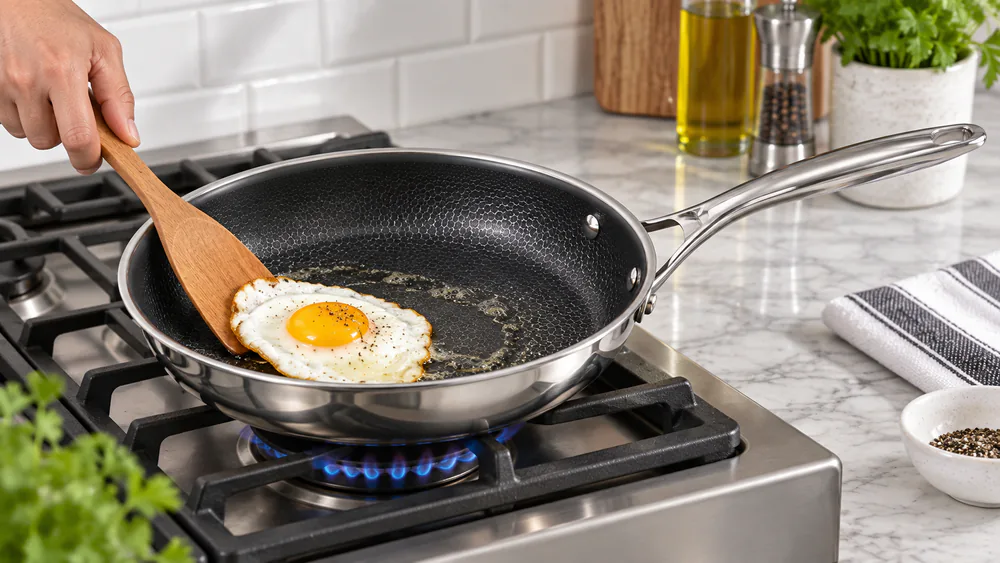
The bare-egg verdict sits in the quick view above; this entry adds what the reviews did not. A two to three minute oil-seasoning pass on low heat rebuilt release on both pans, and HexClad's own guidance recommends exactly that pass. Eggs that tore out of the box slid free after a canola-oil season; the Paradigm responds to the same pass.
Steak Searing Test
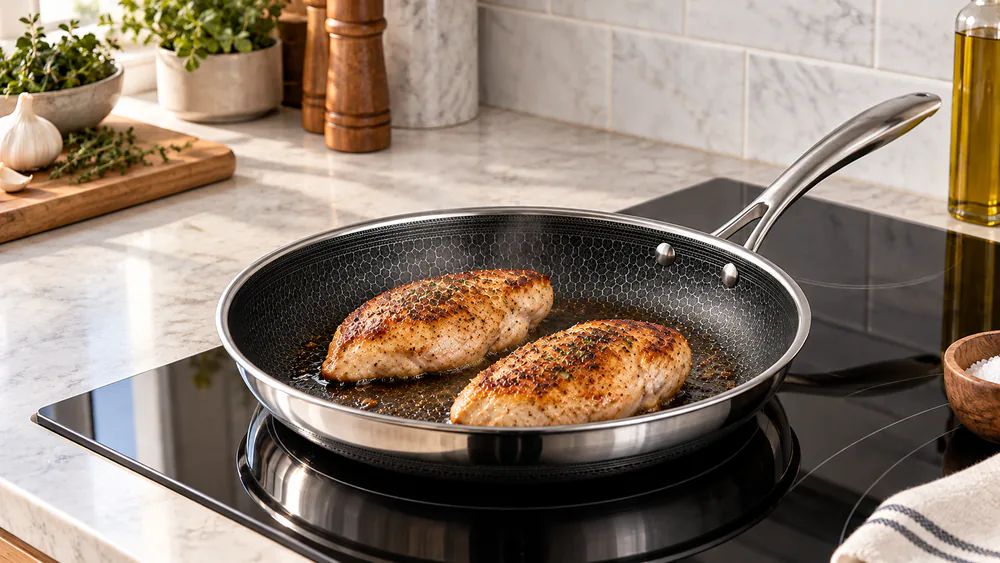
The HexClad pulled ahead here: chicken breasts seared to a golden crust the Henckels could not match, because the thinner Paradigm cooled fast when several cold breasts hit at once.
Heat Conduction and Distribution
Both are tri-ply with aluminum cores; the difference is about half a millimeter, 2.4 mm on the Paradigm, 3 mm on the HexClad. The Paradigm boils faster on gas and electric, 2:19 versus 2:30 for 2 cups, because there is less metal to heat.
Heat Retention
After boiling, the Paradigm fell to 113F within five minutes while the HexClad held 120F. Cold ingredients drain the Paradigm's heat and lighten the sear on a flipped burger.
Induction Cooktop Performance
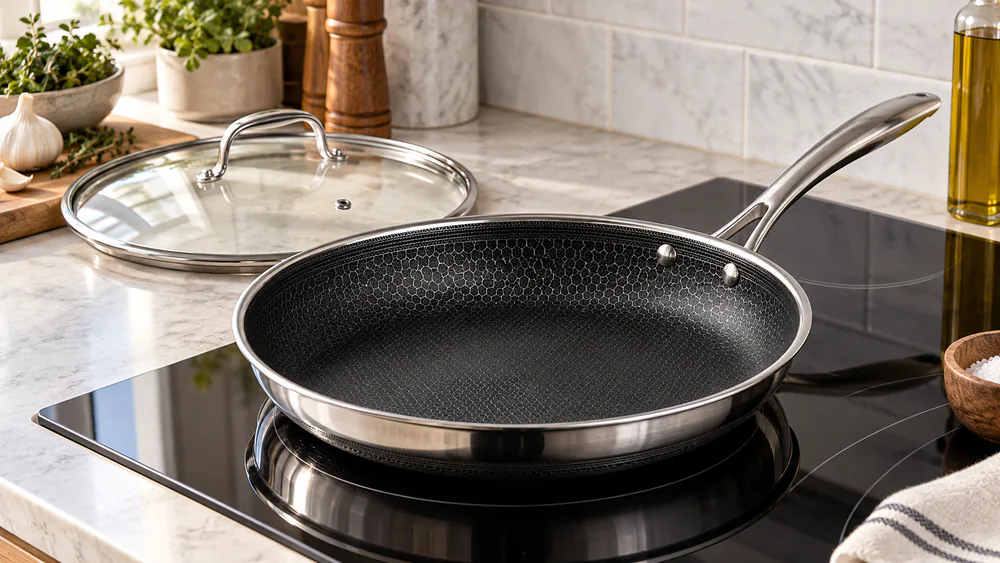
Both work on induction, and the HexClad won the race: a full boil at about 5:30 versus about 6:00 on matched burners. On gas and electric, the Paradigm's lighter build heats faster; on induction, the HexClad's weight wins.
The induction race: about 5:30 for the HexClad, about 6:00 for the Paradigm.
Design and Construction: Hexagon vs HexClad Hybrid
Under the hex pattern, these are two different amounts of steel.
Core Materials and Layer Engineering
Both are tri-ply: stainless layers around an aluminum core with a magnetic base. The Paradigm is 2.4 mm thick and made in China; the HexClad is 3 mm. That half-millimeter explains most of the gap: more mass, more even heat, and more weight in the hand, with the 12-inch HexClad running 3.4 to 4 pounds.
Cooking Surface: PTFE vs Ceramic vs Textured Stainless
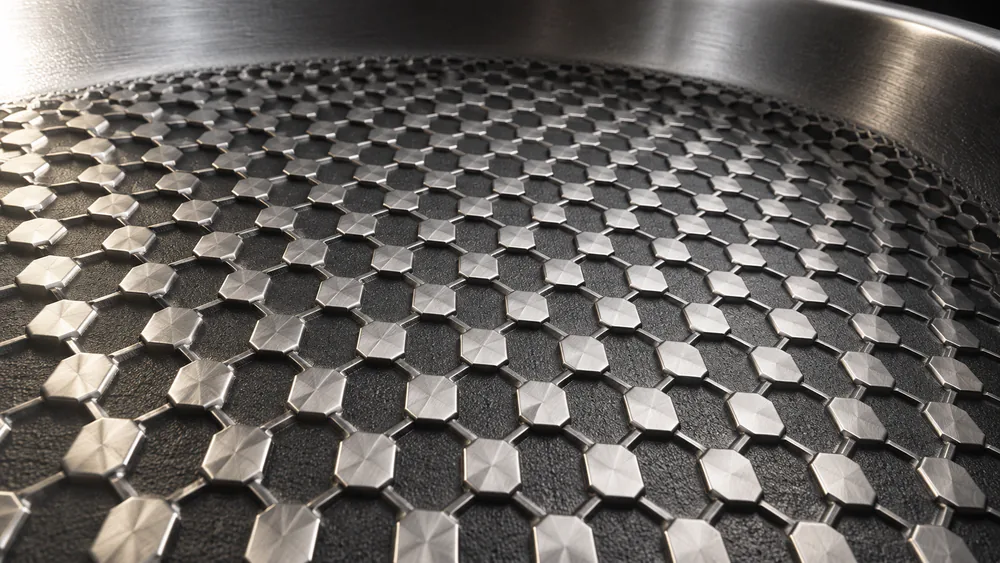
The hybrid idea: laser-etched stainless hex peaks hold nonstick valleys between them. The Paradigm pairs its peaks with a 3-layer inlay in PTFE or PTFE-free ceramic; the HexClad pairs its peaks with proprietary TerraBond ceramic, claimed PFAS-free and PTFE-free.
Handles, Rivets, and Build Quality
The Paradigm's long, angled handle rotates in its polished finish when you tilt the pan to pour, so plan on two hands, and its rivets protrude further than the HexClad's and trap oil. The HexClad's hollow handle runs cool on the stove but heats up in the oven; its flatter rivets wash out without a fight.
Induction and Oven Compatibility
Both hybrids work on every cooktop. Oven ratings split the difference: the Paradigm to 500F, the HexClad pan to 900F with glass lids to 400F. Most Capri Granitium items skip induction.
PTFE, Ceramic, and PFAS: The Safety Question
The coating question is where cookware marketing runs furthest ahead of the science.
What Each Coating Actually Is
The classic Paradigm set uses PTFE-based nonstick, the same family as Teflon; the 2025 Paradigm ceramic line is PTFE-free. Granitium is ceramic-reinforced, PFOA-free but PTFE-family, which is why Minnesota bars its sale. HexClad's current TerraBond coating is ceramic, claimed PFAS-free and PTFE-free; its pre-2023 pans used PTFE-based nonstick.
Are Henckels and HexClad Safe to Cook With?
The safety story is not settled science. The EPA tracks PFAS as a class of chemicals of growing concern, and cookware marketing has run ahead of the science. An independent safety analysis could not call HexClad non-toxic with confidence, because the TerraBond formula is proprietary and third-party detection limits are undisclosed; it advises medium heat and oil.
A 2023 class action over HexClad's PFAS-free marketing settled with a $2.5 million fund. HexClad denied wrongdoing and agreed to stop advertising its PTFE-family products as PFAS-free, PFOA-free, or non-toxic. The settlement covered purchases from February 1, 2022 through March 31, 2024, the claim deadline passed on November 14, 2025, and final approval came in February 2026. Current pans carry the TerraBond claim.
Warning. PTFE-family nonstick degrades above 500F, where the coating can release fumes. Keep PTFE pans below that line, never heat an empty pan, and cook at moderate heat. The HexClad's textured exterior also carries a low glass-cooktop scratch risk, so lift it rather than sliding it.
Nonstick Durability and Lifespan
Lifespan is the question neither brand's warranty answers.
How the Surfaces Age (and What Kills a Pan Early)
Neither hybrid has a ten-year record. The Paradigm launched in 2024, so its durability and warping resistance are unproven, and its 2.4 mm build is the thinner of the two. HexClad's longer record splits: years-in pans without scratches or damaged areas sit beside coating-failure reports. Ceramic nonstick coatings typically deliver 1 to 3 years before release declines.
Metal Utensils and Dishwasher Safety
Metal spoons and spatulas are safe on the steel peaks of both hybrids, but a knife or fork can punch through the nonstick valley between peaks. Both brands say dishwasher safe, with caveats: HexClad's own FAQ admits the dishwasher dulls the finish, and a Clad H3 ceramic coating has peeled in use. Hand washing is the reliable path.
Cleaning and Daily Maintenance
Daily upkeep separates these two pans more than any spec sheet.
Which Is Easier to Clean and Care For?
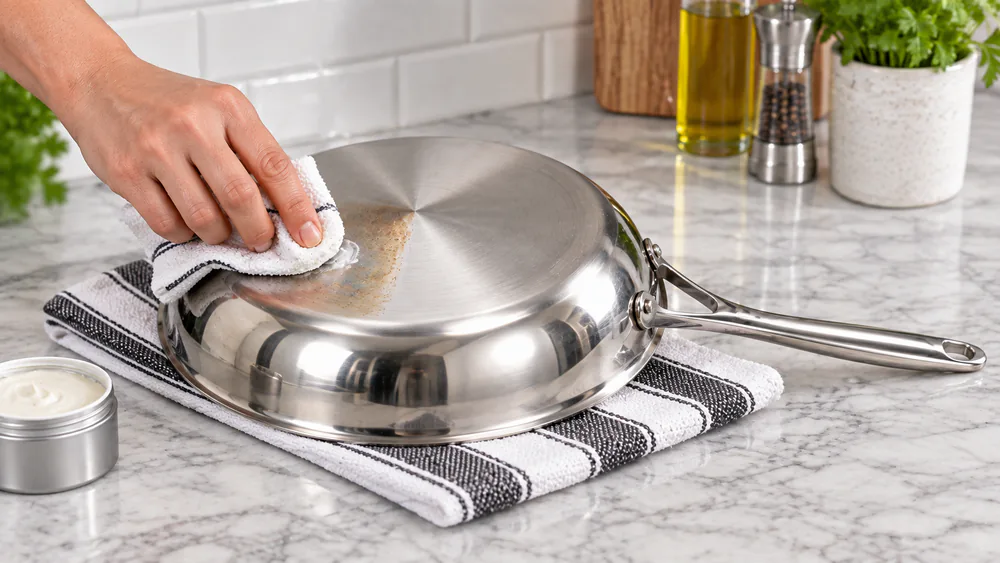
The HexClad wins the daily-cleanup test: its coated exterior wipes clean, while the Paradigm's polished steel bottom stains and needs Bar Keepers Friend to look right again. Inside, food comes off both pans the same way; the Paradigm just asks a few extra swipes around its rivets.
Price and Long-Term Value
If the cooking is close, the money decides.
Henckels Hexagon vs HexClad: The Price Gap
The price gap is the whole ballgame. A 12-inch HexClad with lid costs about $190, more than double the three-piece Paradigm set at about $87. A 10-inch HexClad runs $149, an Everlift Granitium pan $40.43, a Clad H3 two-pan start $79.95, the Paradigm 6-piece set about $269.95.
Henckels Granitium vs HexClad: Budget Ceramic vs Premium Hybrid
Granitium costs a fraction of HexClad's price and is the better budget choice for eggs and light cooking. The Everlift pans are very light, though our research includes a handle that failed within weeks beside a coating as good as day one after a year of gas-stove use. HexClad is the durability pick for high-heat cooks.
Total Cost of Ownership: Sets, Replacements, and Warranty
Both brands back their hybrids with a limited lifetime warranty against defects, and HexClad adds a 30-day return guarantee. Warranties cover defects, not wear, and coatings wear out: a $40.43 Granitium pan is cheap to replace, while a $190 HexClad replacement stings.
Warranty, Customer Service, and Brand Reputation
Both brands stand behind their hybrids on paper; the terms differ.
Henckels Warranty and Support
The hybrid line carries a limited lifetime warranty against defects for the original purchaser, per the official Henckels Paradigm product page. It is replacement only, with proof of purchase required; Granitium and Clad H3 carry the same terms.
HexClad Warranty and Support
HexClad's lifetime warranty covers manufacturer's defects, excludes commercial use, and adds a 30-day return guarantee. Support runs through chat and email, no store counter.
Best Alternatives If Neither Brand Is Right for You
If neither brand fits, these are the pans we would point you to.
Tramontina: The Budget Hybrid Contender
Tramontina keeps surfacing in this conversation. The Signature Tri-Ply Clad 8-piece set runs about $207.36: tri-ply 18/10 stainless, made in Brazil, NSF certified, oven safe to 500F. It is plain stainless, so it sears like stainless and sticks like stainless unless you preheat properly and use oil. The heating is even, the rivets are solid, and the heft is heavy but manageable.
Made In and All-Clad for Traditional Cooks
Traditional stainless shoppers have two strong answers: the All-Clad D3 12-inch pan with lid at about $149.95, made in the USA, and Made In's 12-inch 5-ply stainless pan at about $149, built in Italy. Both want the same preheat-and-oil technique, and both outlast any nonstick.
Final Verdict: Which Henckels Line Should You Buy?
Here is how we would spend our own money.
Best Hybrid on a Budget: Henckels Hexagon (Paradigm)
The value line of the hybrid world, from the Costco three-pan deal to the $329.95 10-piece ceramic set. It rewards small batches, quick flips, and moderate heat.
Best Premium Hybrid: HexClad
For high-heat cooks the premium is fair: 3 mm build, fastest induction boil in our test, easy-clean exterior. The six-piece set runs $389.99.
Best Ceramic Nonstick: Henckels Granitium
If eggs and light cooking are the job, Granitium is the value ceramic pick: Everlift pans from about $40.43, oven safe to 400F.
Best for Stainless Lovers: Henckels Clad H3
The stainless answer under the same brand: tri-ply, mirror-polished 18/10, oven safe to 500F, from $79.95 for a two-pan start. Zero nonstick chemistry and decades of searing.
Key takeaway. For most home cooks, the Henckels Paradigm is the line we would buy: it matched the HexClad's release and searing at about half the cost, and the ceramic versions answer the coating questions. Buy the HexClad if you cook hot and heavy; buy Granitium for budget eggs and light fare; buy Clad H3 for stainless that outlasts them all. We would not pay HexClad prices for Henckels results.
Frequently Asked Questions
Is Henckels Hexagon the same as Henckels Paradigm?
Is Henckels a good brand compared to HexClad?
Is HexClad worth the extra money?
Does food stick on HexClad pans?
Which lasts longer: Henckels or HexClad?
Can you use metal utensils on HexClad and Henckels pans?
Which brand is better for induction cooktops?
Is the HexClad class-action lawsuit something to worry about?
Is Henckels Hexagon the same as Henckels Paradigm?
Yes, one hybrid line, three names: Hexagon, HXagon (the Costco badge), and now Paradigm. A listing that does not say ceramic is the PTFE version.
Is Henckels a good brand compared to HexClad?
For most kitchens, yes. The Paradigm tracked the HexClad's everyday release in our tests, Granitium covers ceramic from about $40, and Clad H3 covers stainless from about $80.
Is HexClad worth the extra money?
For high-heat cooks, yes: the 3 mm build holds heat and runs to 900F. For everyone else, the Paradigm delivers similar everyday results for far less.
Does food stick on HexClad pans?
It can. America's Test Kitchen failed the HexClad at the first stage of its 50-egg nonstick test, with the tester calling the performance shockingly bad and steering buyers to an OXO pan at roughly a quarter of the price.
Which lasts longer: Henckels or HexClad?
Neither has a decade-long record, so the practical question is what kills a pan early. PTFE-family coatings degrade above 500F, dishwasher cycles dull both finishes, and moderate heat with hand washing is the longevity routine for either pan.
Can you use metal utensils on HexClad and Henckels pans?
Yes, on both, and that is the point of the raised hex peaks: they are stainless, so utensils slide over metal instead of digging into a coating. Treat hand washing as the reliable path even though both brands say dishwasher safe; a Clad H3 ceramic owner's coating peeled after machine use, and HexClad's care notes admit the machine dulls the finish.
Which brand is better for induction cooktops?
HexClad, in our timed race: the extra steel won the boil on induction, while on gas and electric the lighter Paradigm was quicker to heat. The sharper filter is the lineup: most Henckels Granitium items skip induction entirely.
Is the HexClad class-action lawsuit something to worry about?
Not for new buyers. The 2023 class action settled with a $2.5 million fund, HexClad denied wrongdoing, and the claim window closed in November 2025.