
Kitchen Appliances
Instant Pot Duo vs Duo Plus: What Is the Difference?

As an Amazon Associate we earn from qualifying purchases. We may earn a commission from links on this page, at no extra cost to you. Learn more.
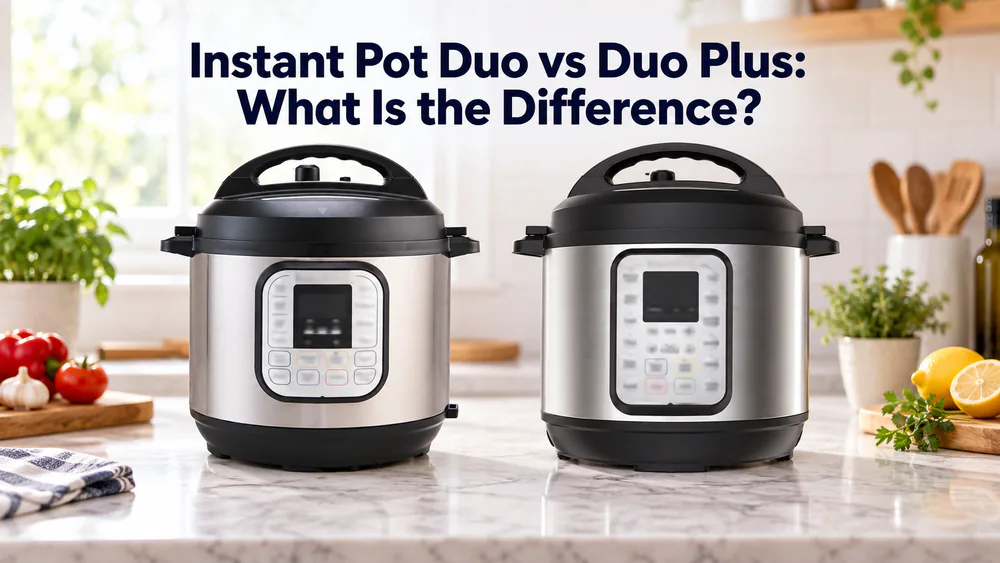
There are so many near-identical Instant Pots on the shelf that picking one can feel like a trick question. The Duo and the Duo Plus share a name, a shape, and most of a spec sheet, and the Plus costs meaningfully more. So the real question is simple: does that extra money buy you better dinners, or just a longer feature list? We batch-cook for a family of five most weeks, so we have run both hard, and the honest answer is clearer than the marketing makes it look. Here is exactly what changes when you step up, and who should actually do it.
Duo vs Duo Plus at a Glance (Spec Comparison Table)
If you only read one section, read this one. The two cookers line up almost row for row, and the differences cluster in the display, the program list, and the price.
| Feature | Duo | Duo Plus |
|---|---|---|
| Functions | 7-in-1, 13 one-touch programs | 9-in-1, 15 to 25 presets (adds Sterilize, Sous Vide, Cake, Egg) |
| Wattage | ~1,000 watts | ~1,000 watts |
| Inner pot | 6 qt 18/8 stainless, tri-ply | 6 qt 18/8 stainless, anti-spin tri-ply |
| Display / interface | LED with membrane buttons | Blue LCD with progress indicators |
| Steam release | Standard Easy-Release toggle | Quieter release on current generation |
| Available sizes | 3, 6, and 8 quart | 3, 6, and 8 quart |
| Price | ~$79 to $100 | ~$124 to $149 |
Notice how much of that table is identical. That overlap is the whole story, so let us start there before we talk about what the Plus adds.
What Is Actually the Same on Both
Under the lid, these are the same machine. Both run a 1,000 watts heating base, and both build to the same published working pressure of about 10.2 to 11.6 psi. Because the wattage and the pressure match, the cooking matches too. Rice, beans, and a Sunday pot roast come out the same in either pot, which means the Duo Plus buys you features, not better food.
The inner pot is shared ground as well. Both use a 6-quart 18/8 stainless steel insert with a tri-ply bottom, and both are sold in 3, 6, and 8 quart sizes if you want to size up or down. We have run the stainless pot through years of weekly batches, and it cleans up without staining, warping, or wearing the way nonstick inserts on rival cookers do. The pot handles let you stir and lift without heat gloves, which is a small thing you notice fast when you cook in volume.
The safety story is the same story too. Both carry over 10 safety mechanisms, including overheat protection and a lid lock, plus a detachable power cord, a dishwasher-safe lid and inner pot, an included stainless steam rack, and access to the app with 800+ recipes.
Note. Both cookers share the same 1,000 watts base, the same 6-quart stainless pot, and the same pressure range. If you buy the Duo Plus expecting your food to taste better, it will not. You are paying for extra programs and a nicer screen, not a stronger cook.
One shared quirk worth knowing before your first cook: the countdown timer only starts once the pot reaches full pressure, so a recipe's stated cook time is not the time from pressing start. Add the preheat and the release window when you plan dinner. Both models also have a genuine learning curve for a first-time pressure-cooker user, but it clicks within a few cooks.
What the Duo Plus Adds (and Whether It Matters)
The Duo Plus is a 9-in-1 to the Duo's 7-in-1. That gap is real, but it is narrower in daily life than the spec sheet suggests. Here is what you actually gain.
The 9-in-1 Functions: Sous Vide, Sterilize, Cake, Egg
The headline additions are sous vide and sterilize, plus cake and egg among the presets. Sous vide lets you hold a low, steady water temperature for tender chicken or eggs, and sterilize is handy for baby bottles or canning jars. Whether these matter is a personal call. In our meal-prep weeks we reach for sous vide once in a while and sterilize almost never, but if you already sous vide or sanitize bottles, having it built in is genuinely convenient.
We will be straight about the program count, because the listings are not. Some list the Duo Plus at 15 one-touch programs and others cite 25 presets on the current whisper-quiet generation. The number depends on which production run you buy, so treat "more presets" as the takeaway rather than a single figure. In practice, most cooks lean on the same handful of buttons no matter how many the panel shows.
The Blue LCD Display and Improved Controls
This is the upgrade you feel every day. The Duo Plus has a large blue backlit LCD that shows cooking time, temperature, and pressure with real-time status updates, and it is genuinely easy to read at a glance across the kitchen. The Duo's simpler LED panel tells you less. There is a durability angle too: the Duo's flat membrane buttons can feel less responsive over time, while the Duo Plus tactile buttons tend to stay crisp. If you cook often, the better screen and buttons are the most livable reason to step up.
Quieter Steam Release
Venting a full pot of steam is loud, and the Plus takes the edge off. The current whisper-quiet generation of the Duo Plus diffuses the venting hiss for a noticeably quieter release compared with the plain Duo's manual toggle vent. One caveat worth flagging: the older Duo Plus listing shows the same Easy-Release switch as the Duo, so the quiet release is a feature of the current generation, not every Duo Plus ever made. Check which version you are buying if quiet venting is the reason you want it.
The Instant Pot Duo: Overview
7-in-1 Functions and Core Specs
The Duo is the model that made Instant Pot a household name, and it earns the loyalty. It is a 7-in-1: pressure cook, slow cook, saute, steam, rice, yogurt, and keep warm, driven by 13 one-touch smart programs. The 1,000 watts base cooks up to 70% faster than slow cooking, and the 6-quart pot feeds up to 6 servings. The saute mode offers a few heat levels on current units, though owners describe the behavior a little differently across firmware, so expect to learn how your specific pot browns.
A couple of lived details. The keep-warm mode holds a finished meal for hours, so you can start it, leave, and come back to dinner still hot, which is the feature that saves our weeknights more than any preset. And the stainless pot will pick up faint discoloration after the first cook, where beans leave a ghost outline. That is normal and does not affect performance.
Who the Duo Is Best For
The Duo suits beginners, budget buyers, and anyone who mainly wants pressure cooking, slow cooking, rice, and yogurt without paying for extras. If your weekly rotation is soups, beans, shredded chicken, and grains, the Duo does every bit of that as well as the Plus does. It is also the lighter-feature, lower-cost pick if you are buying your first multi-cooker and are not sure how much you will use it.
Pros and Cons
Pros
- Cheaper, usually around $79 to $100
- Simpler panel that is easy for beginners
- Proven, long-running design owners trust for years
- Same 1,000 watts base and 6-quart stainless pot as the Plus, so identical cooking
Cons
- Lighter LED display shows less at a glance
- Membrane buttons can feel less responsive over time
- No sous vide or sterilize
- Louder manual steam release
The Instant Pot Duo Plus: Overview
The 9-in-1 Upgrade and What's New
The Duo Plus keeps the Duo's core and layers on top of it. It is a 9-in-1: pressure cook, slow cook, saute, sous vide, steam, sterilize, keep warm, rice, and yogurt, with a broader preset list. The visible upgrades are the blue LCD with time, temperature, and pressure indicators, the added sous vide and sterilize functions, and, on the current generation, the quieter steam release. The 6-quart stainless pot has an anti-spin tri-ply bottom and ships with two extra sealing rings, which is more useful than it sounds.
That spare ring matters because the lid gasket retains savory odors strongly after pressure cooking. A pot of chili can leave its smell in the ring, and a following batch of plain rice can pick it up. Keeping the spare ring for sweet or plain dishes solves it, and the Plus handing you extras out of the box is a small, welcome touch.
One honest limit we hit: on the Duo Plus, the saute mode struggles to stay hot enough to brown more than a medium onion or a small batch of cubed stew meat. Larger batches steam rather than sear, so brown in batches or finish in a skillet. It is bulky enough to take up meaningful counter or cabinet space, and it takes real time to build pressure before the cook time starts.
Who the Duo Plus Is Best For
The Duo Plus fits cooks who want the extra programs and the better interface, and who will actually use sous vide, sterilize, or the at-a-glance screen. If you cook most nights, sanitize bottles, or simply want the clearest display and quieter venting, the upgrade earns its place. Reliability is mostly strong, with some owners reporting eight-plus years of daily use, though a minority of units quit after several months, which is worth knowing at any price.
Pros and Cons
Pros
- Extra programs including sous vide, sterilize, cake, and egg
- Large blue LCD that is easy to read while cooking
- Quieter steam release on the current generation
- Ships with two spare sealing rings
Cons
- Higher price, usually around $124 to $149
- Saute struggles to sear larger batches
- Bulky footprint on the counter
- Extra functions go unused for many cooks
Head-to-Head: The Differences That Decide It
Cooking Performance and Power
This is the shortest section on purpose. Both run 1,000 watts and the same 10.2 to 11.6 psi, so the food is identical. When it comes to the actual eating, there is no winner here. Do not let a performance claim talk you into the Plus, because the Duo Plus buys features, not a better cook.
Ease of Use and Interface
Here the Plus pulls ahead. The blue LCD shows time, temperature, and pressure at a glance, and the tactile buttons stay crisp, while the Duo's LED and membrane panel tell you less and can dull over time. For a busy kitchen, the clearer feedback genuinely makes the pot easier to live with.
Safety and Noise
Safety is a tie: both carry over 10 mechanisms, overheat protection, and a lid lock. Noise is where the Plus edges in, since the current generation diffuses the venting hiss for a quieter release. If a screaming steam vent would wake a napping kid, that quiet counts for something, just confirm you are getting the current generation.
Capacity and Sizes Available
Another tie. Both use the 6-quart stainless pot and both come in 3, 6, and 8 quart sizes. Pick your size by household, not by model: 3 quart for one or two people, 6 quart for a family, 8 quart if you batch-cook the way we do. The choice between Duo and Duo Plus does not change what fits in the pot.
Price and Value
Price is the real decider. The Duo tends to run about $79 to $100, and the Duo Plus about $124 to $149, though street pricing moves week to week and by size. That gap of roughly $40 to $60 is the entire question. If the better screen, sous vide, sterilize, and quieter venting are worth it to you, the Plus is fair value. If not, the Duo cooks the same food for less.
Which Should You Buy? (Decision Rule)
Here is the rule we would give a friend. Match the pot to how you cook, then let price break the tie, because the food is identical either way.
Tip. Buy the Duo if you want the same cooking for less money and mostly pressure cook, slow cook, and make rice. Step up to the Duo Plus only if you will use sous vide or sterilize, or if the clearer blue LCD and quieter venting are worth the extra $40 to $60 to you.
Choose the Duo If...
You want the lowest price, you are new to pressure cooking, or your rotation is soups, beans, grains, yogurt, and shredded meats. You are not going to sous vide or sterilize, and a simpler panel does not bother you. The Duo gives you every core function and the same cook for less.
Choose the Duo Plus If...
You cook most nights and want the clearest display, you will actually use sous vide or sterilize, or a quieter steam release matters in your home. The spare sealing rings and tactile buttons are nice extras. If the interface and added programs earn their $40 to $60, the Plus is the one to get.
Frequently Asked Questions
What is the main difference between the Duo and Duo Plus?
The Duo Plus adds sous vide and sterilize functions, a blue LCD display with time, temperature, and pressure indicators, and a quieter steam release on the current generation. The base cooking is the same, since both share a 1,000 watts motor and a 6-quart stainless pot.
Is the Duo Plus worth the extra money?
It depends on your cooking. The food comes out the same, so you are paying roughly $40 to $60 more for the better screen, the extra programs, and quieter venting. If you will use sous vide or sterilize, or you want the clearer display, it is worth it. If not, the Duo is the smarter buy.
Do the Duo and Duo Plus cook the same?
Yes. Both run 1,000 watts and the same working pressure of about 10.2 to 11.6 psi, so rice, beans, and pot roast come out identically. The Duo Plus buys features, not better cooking.
Does the Duo Plus have sous vide and sterilize?
Yes. As a 9-in-1, the Duo Plus adds sous vide and sterilize over the Duo's 7-in-1 set, plus cake and egg among its presets.
Do both use the same inner pot and wattage?
Yes. Both use a 6-quart 18/8 stainless steel inner pot with a tri-ply bottom and a roughly 1,000 watts base, and both are sold in 3, 6, and 8 quart sizes.
Which is better for beginners?
The Duo. It is cheaper, its 7-in-1 layout with 13 programs covers everything a first-time cook needs, and its simpler panel is less to learn. You can always step up later once you know how you cook.
Should I get the Duo Plus or step up to the Pro?
If you want a bigger jump, the Pro adds more programs, a sturdier build, and a more refined interface than the Duo Plus. Choose the Duo Plus for the best value on the added functions and screen; choose the Pro only if you want the premium build and are willing to pay for it.
The Verdict
After running both through real meal-prep weeks, our take is straightforward. The Instant Pot Duo and Duo Plus cook the same food because they share the same base, pot, and pressure, so this is not a performance contest. It is a value question. The Duo is the smarter buy for most people, especially beginners and anyone watching the budget, since it does every core job for less. The Duo Plus is the one to get if you will genuinely use sous vide or sterilize, or if the clear blue LCD and quieter release are worth the extra $40 to $60 to you. Decide by how you cook, not by the longer feature list, and either pot will fit your cooking needs for years.
Read next
Find the multi-cooker that fits your kitchen
Browse our tested guides and comparisons to match the right cooker to how you actually cook.