
Recipes
Labouchere Sauce Recipe

As an Amazon Associate we earn from qualifying purchases. We may earn a commission from links on this page, at no extra cost to you. Learn more.

Labouchere sauce is a rich Creole cream sauce built on butter, garlic, heavy cream, and Worcestershire. The trouble is that almost no one publishes a reliable version. Search for it and you find three different sauces wearing the same name, plus a lot of guesswork about what the restaurant actually pours over its steak.
This is the version we cook. It is a faithful cream-sauce match rather than a cloned formula, tested in our own kitchen against a full week of weeknight steaks until it behaved the same way every time. We batch-cook for a family of five, so a sauce has to reheat without breaking and taste as good on night three as it did on night one. This one does.
Below you get the ingredient list, the four-step method, the fixes for a sauce that goes thin or splits, and honest notes on where the at-home version lands next to the restaurant's proprietary sauce.
Recipe Snapshot (Time, Yield, Difficulty at a Glance)
Labouchere sauce comes together in about the time it takes to rest a steak. There is no roux to babysit and no stock to reduce for an hour, just a quick aromatic base, a gentle cream reduction, and a cold-butter finish.
| Detail | At a glance |
|---|---|
| Prep time | 5 minutes |
| Cook time | 15 minutes |
| Total time | 20 minutes |
| Yield | About 1 cup (4 servings) |
| Difficulty | Easy to moderate |
| Best served over | Seared steak and angel hair pasta |
The only step that asks for attention is the finish, and even that is forgiving once you know the cue to watch for.
What Is Labouchere Sauce?
Labouchere sauce is the signature Creole cream sauce served over Steak Labouchere. Our home version uses a few ingredients: garlic cooked in butter, heavy cream simmered until it coats a spoon, and Worcestershire for savory flavor. A final swirl of cold butter brings the sauce together.
The name is worth a footnote. Labouchere reads as a play on the French la boucherie, which translates loosely as "butcher" sauce, a fitting label for something built to sit on a good cut of beef.
One honest caveat before you cook. There is no single published, authoritative recipe for this sauce, and accounts of what it contains genuinely conflict. Treat what follows as our tested cream-sauce version, not as the restaurant's official measures.
Origin: Copeland's of New Orleans and Steak Labouchere
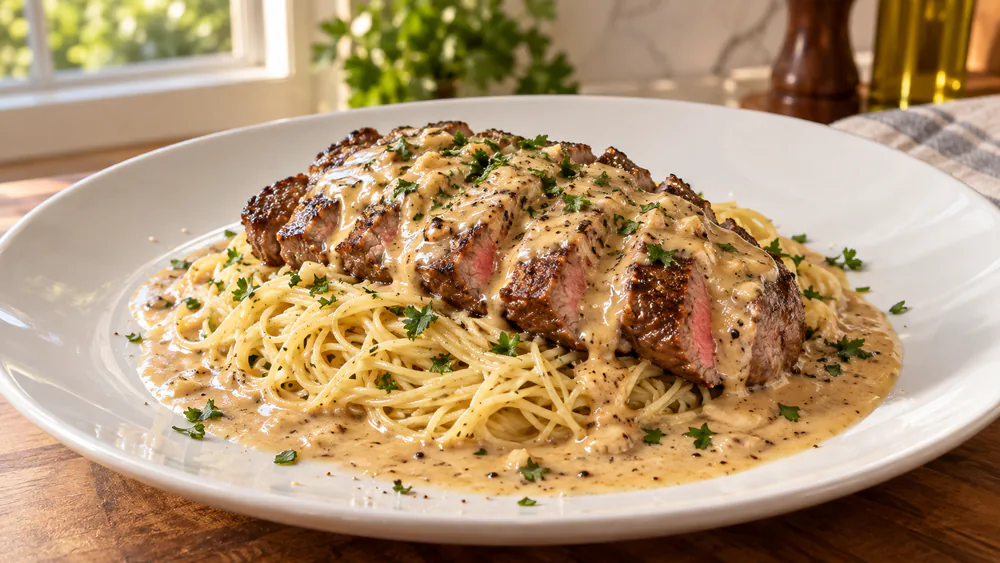
The sauce is tied to the New Orleans dining scene. It headlines Steak Labouchere, a dish of seared USDA Prime steak laid over angel hair pasta tossed in garlic butter and finished with the sauce, a plate that has anchored the same New Orleans-style Creole menu for decades.
Note. The restaurant chain behind the dish was founded in 1983 by Al Copeland, the same restaurateur who started Popeyes before opening a casual-dining chain built around New Orleans Creole cooking. You can read more about the New Orleans restaurant Copeland's and its founder.
Here is where the story gets murky, and we would rather be straight with you than pretend otherwise. A former cook has described the restaurant's actual Labouchere as a dark-roux sauce carrying mushrooms, duck stock, and wine, made at a central New Orleans facility and shipped to locations. That version is proprietary and undisclosed, so any at-home recipe is an approximation rather than the exact sauce. The good news is that the widely loved cream version tastes wonderful in its own right, which is why it is the one we develop here.
How It Differs From a Roux or Hollandaise
A classic Creole roux sauce starts with flour cooked in fat, which thickens the sauce into a gravy-style body and carries a toasted, nutty depth. Our Labouchere skips the flour entirely. The body comes from reducing heavy cream, so the texture stays silky and pourable rather than thick.
It is not a hollandaise either. Hollandaise is an egg-yolk emulsion that has to be coddled at low heat and splits the moment it overheats. Labouchere has no eggs. Its stability comes from cream and a final swirl of butter, which makes it far harder to ruin and far friendlier to reheat.
Ingredients
The whole point of this sauce is a short shopping list. Measurements here are our own tested amounts, tuned over a week of steaks, not restaurant specs.
For the Aromatic Base
- 3 tablespoons unsalted butter
- 4 cloves garlic, finely minced
- 2 tablespoons finely minced shallot (optional, for a rounder base)
For the Sauce Body
- 1 cup heavy cream
- 1 to 2 tablespoons Worcestershire sauce, added to taste
- 1/2 teaspoon Creole seasoning
- 1/4 teaspoon black pepper
- Pinch of salt, only after tasting
For Finishing and Serving
- 2 tablespoons cold unsalted butter, cut into small cubes
- 1 tablespoon chopped fresh parsley (optional)
- Cooked steak and angel hair pasta, to serve
Substitutions and Swaps
Cook long enough and you learn which swaps hold up. These do.
- No Creole seasoning? Use a blend of paprika, garlic powder, onion powder, cayenne, dried thyme, and oregano, or reach for a Cajun blend and go light on the added salt.
- No heavy cream? Half-and-half works but reduces thinner and can break more easily, so keep the heat lower and do not rush it.
- Worcestershire swap. A small splash of soy sauce plus a few drops of fish sauce gives a similar savory backbone, though Worcestershire is worth keeping on hand.
- Creole mustard. If you want to nod toward the roux "butcher sauce" style, a teaspoon of Creole mustard adds a tangy, grainy edge. Whole-grain mustard is the closest easy substitute.
Tools You'll Need
Nothing specialized here, which is part of the appeal.
- A wide skillet or saute pan (more surface area reduces cream faster)
- A whisk
- A sharp knife and cutting board for the garlic
- Measuring spoons and a liquid measuring cup
- A wooden spoon or silicone spatula
Step-by-Step Instructions
Read the four steps through once before you start. The sauce moves quickly at the end, and the finish rewards a cook who is not scrambling for the butter.
Step 1: Build the Garlic and Aromatic Base
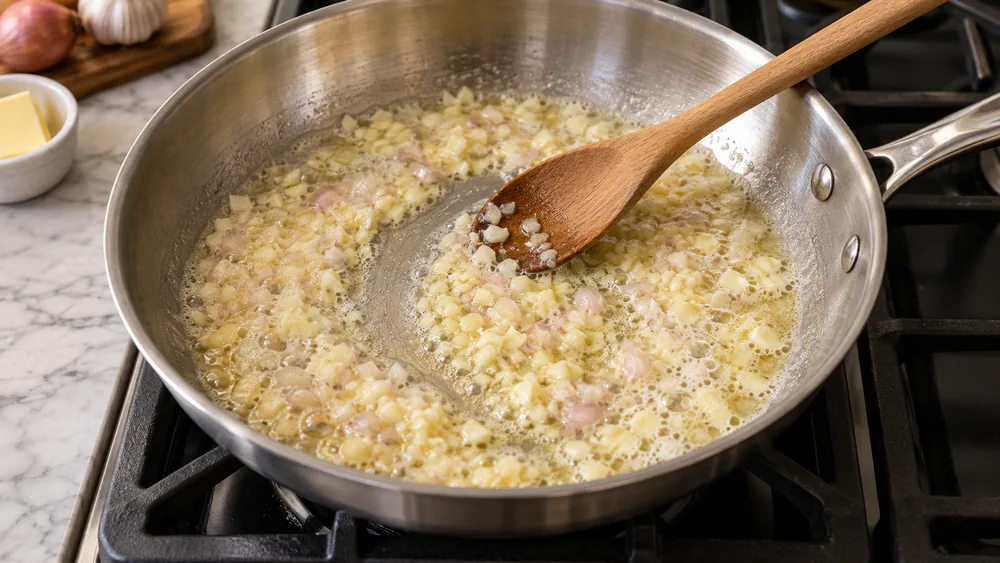
Melt the 3 tablespoons of butter in a wide skillet over medium-low heat. Add the minced garlic (and shallot, if using) and cook gently, stirring, just until fragrant, about 60 to 90 seconds.
Watch the garlic closely. In our kitchen this is the single easiest place to wreck the sauce: garlic browned even slightly turns the whole thing bitter, and no amount of cream buries that later. Cook it only until aromatic, never colored.
Step 2: Add Worcestershire and Spices
Pour in 1 tablespoon of the Worcestershire, then add the Creole seasoning and black pepper. Stir for about 30 seconds to bloom the spices in the butter.
Worcestershire does the heavy lifting on savoriness here. We add it a splash at a time and taste as we go, which keeps the sauce from tasting flat or one-note without tipping it into salty. Hold the second tablespoon until after the cream reduces, then decide.
Step 3: Add Heavy Cream and Reduce
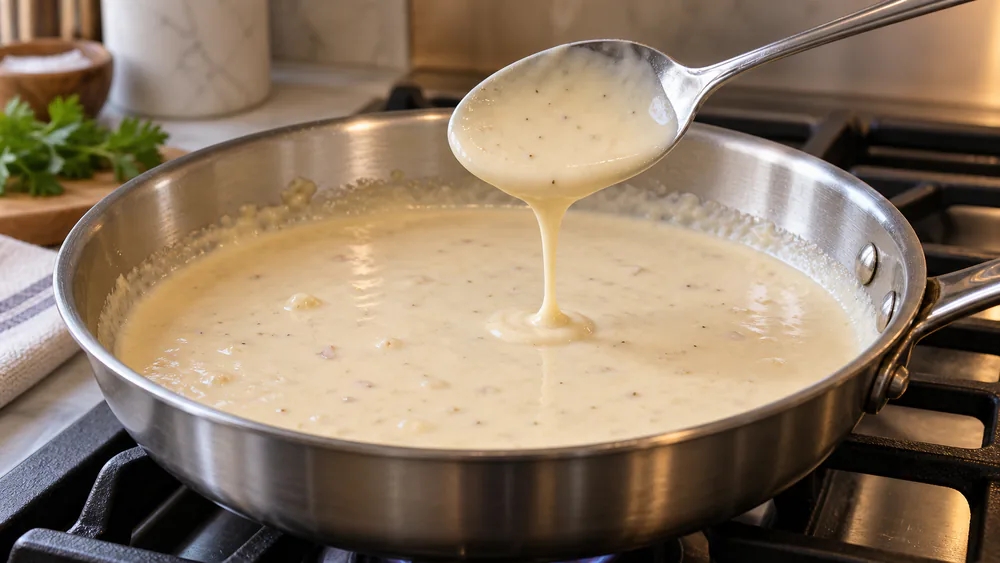
Pour in the 1 cup of heavy cream and bring it up to a bare simmer, not a rolling boil. Let it reduce gently, stirring now and then, until it coats the back of a spoon, roughly 6 to 10 minutes depending on your pan.
Warning. Do not rush the reduction over high heat. A cream reduction splits when it hits too hard a boil, leaving you with a greasy, grainy sauce instead of a silky one. Keep it at a lazy simmer and give it the time it needs.
Step 4: Finish With Cold Butter (Monter au Beurre)
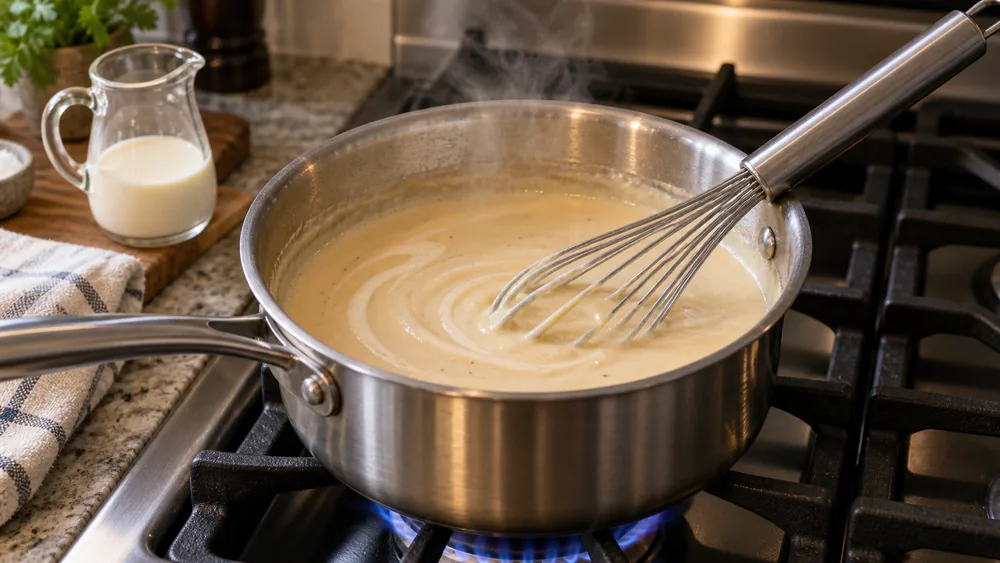
Pull the pan off the heat. Add the cold cubed butter a few pieces at a time, swirling or whisking constantly until each addition melts and disappears into the sauce before you add more.
This finish is the classic monter au beurre move, and it is what gives the sauce its gloss and stable body. If you want the technique behind it, here is the butter-emulsion technique behind cream sauces in more detail.
Tip. Swirl the finishing butter in off the heat, a little at a time. Dumping cold butter into a rippling-hot pan tends to make the sauce greasy or split, while adding it slowly off the burner keeps the emulsion tight and glossy.
Taste it now. Add the remaining Worcestershire if it needs more depth, salt only if it needs lift, and stir in the parsley. Spoon it over steak and angel hair while it is warm.
Pro Tips for a Restaurant-Quality Finish
A few simple habits give this home version a restaurant-quality finish.
- Reduce a touch further than you think. The sauce tightens as it cools, but it also loosens the moment it hits a hot steak. A sauce that coats the spoon firmly in the pan lands just right on the plate.
- Season the cream, not just the base. Tasting only after the reduction gives you the true salt level, since reducing concentrates everything already in the pan.
- Rest the steak, save the juices. Whatever pools under a resting steak is pure flavor. Stir a spoonful into the finished sauce.
The real test is not how the sauce looks in the pan, but whether it still pours glossy over a steak two minutes later.
How to Know Your Sauce Is Perfect (Doneness Cues)
Timers lie; your eyes do not. Watch for these cues instead of the clock.
- It coats the spoon. Draw a finger across the back of a coated spoon. If the line holds and does not immediately flood back, the body is right.
- It is glossy, not matte. A dull, matte surface means the emulsion is starting to break. A slight sheen means the butter is holding.
- It smells savory and round, not raw. Raw Worcestershire has a sharp bite that mellows as it cooks. When that edge softens, the flavor has come together.
- It pours in a ribbon. Too thin and it sheets off the spoon like milk; too thick and it clumps. You want a slow, even ribbon.
Troubleshooting: Fixing Thin, Thick, or Split Sauce
Every sauce misbehaves eventually. Here is how we rescue each one.
- Too thin. Return it to low heat and reduce a few minutes longer, or whisk in one more cube of cold butter off the heat to tighten the body. Do not add flour; it changes the character.
- Too thick. Whisk in a splash of warm cream or milk, a teaspoon at a time, until it loosens back to a ribbon.
- Split or greasy. This almost always means it boiled too hard or the butter went in over high heat. Pull it off the burner, add a tablespoon of cold cream, and whisk hard. A slow, off-heat whisk often re-emulsifies it. If it is truly broken, blend it briefly with an immersion blender.
- Bitter. Usually browned garlic. There is no fixing it after the fact, so next time cook the garlic only until fragrant.
Labouchere Sauce vs. Other New Orleans Sauces
Part of the confusion around this sauce is that a very different recipe circulates under a similar banner. It is worth seeing them side by side, because they are genuinely two sauces, not two names for one.
The Roux Version (Shallots, Creole Mustard, Consomme)
To try the roux-based "butcher sauce," start by cooking flour in butter. Add shallots, about a teaspoon of Creole mustard, a tablespoon of pickle juice or vinegar for tang, beef consomme for body, and a splash of sherry. You simmer it until it thickens into a gravy and spoon it over steak.
Pros
- Deeper, more savory-tangy flavor from mustard and sherry
- Holds and reheats like a gravy, forgiving for make-ahead
- No risk of a cream reduction breaking
Cons
- More ingredients and a longer cook
- Roux can scorch if the heat runs high
- Heavier on the plate than the silky cream version
Best Dishes to Serve It With
The sauce was built for steak, and that is still where it shines. But it is more flexible than its origin suggests.
- Steak and angel hair pasta. The original pairing. Sear your steak, toss thin pasta in garlic butter, and pool the sauce underneath and over the top.
- Blackened chicken or pork. The cream tames the spice on anything blackened, which is a very New Orleans move.
- Seared salmon or shrimp. A lighter protein under a rich sauce makes a fast, elegant dinner.
- Roasted vegetables or mashed potatoes. Spoon leftovers over roasted mushrooms or potatoes; the sauce does not know it was meant for beef.
Nutrition Breakdown (Per Serving)
These numbers are our own estimate for a roughly quarter-cup serving of sauce alone, based on the ingredients above, not a verified lab analysis. Your amounts will shift the totals, and the steak and pasta are counted separately.
| Calories | about 280 |
|---|---|
| Total fat | about 29 g |
| Saturated fat | about 18 g |
| Carbohydrates | about 3 g |
| Protein | about 2 g |
| Sodium | about 180 mg |
Storage and Reheating
Cream sauces are fussier to store than gravies, so a little care pays off.
Cool the sauce, then refrigerate it in an airtight container for up to three days. It will thicken and even set slightly when cold; that is normal.
The reheating method matters more than anything. Warm it low and slow in a small pan, whisking in a splash of cream or milk as it loosens. Microwaving it hard, or reheating a batch straight from frozen, tends to break the emulsion and leave an oily film that no amount of stirring fully fixes. For that reason we do not recommend freezing this sauce; make it fresh or keep it a few days in the fridge.
Frequently Asked Questions
What is Labouchere sauce?
In its home-kitchen form it is a Creole cream sauce made from butter, garlic, heavy cream, and Worcestershire, served over steak. There is no single published official recipe, so most versions, including ours, are faithful approximations rather than an exact clone.
What does Labouchere sauce taste like?
Rich, buttery, and savory, with a garlicky backbone and the deep umami of Worcestershire rounded out by cream. It reads as luxurious rather than spicy, though a Creole seasoning gives it a gentle warmth.
Is Labouchere the same as Copeland's butcher sauce?
They overlap but differ. The name plays on the French "butcher" sauce, and a separate roux-based "butcher sauce" does circulate, made with shallots, Creole mustard, pickle juice, beef consomme, and sherry. The popular at-home Labouchere is the lighter cream version in this recipe.
What can I substitute for Creole mustard?
Whole-grain mustard is the closest easy stand-in, giving you a similar grainy texture and tang. A little Dijon works too, though it is smoother and sharper, so use slightly less.
How do I store and reheat it?
Refrigerate it airtight for up to three days and reheat it low and slow, whisking in a splash of cream or milk. Avoid hard microwaving or freezing, both of which break the emulsion and leave an oily film.
What do you serve Labouchere sauce with?
Classically, seared steak over garlic-butter angel hair pasta. It also suits blackened chicken or pork, seared salmon or shrimp, and even roasted vegetables or mashed potatoes.
Final Thoughts
Labouchere sauce earns its reputation the moment it hits a hot steak: glossy, savory, and far easier than a sauce this rich has any right to be. Cook the garlic gently, reduce the cream without rushing it, and finish with cold butter off the heat, and it comes together the same way every time.
Just hold onto one expectation. The restaurant's own sauce is factory-made and proprietary, so home cooks chasing an exact match never quite land it. The practical goal, and the one this recipe delivers, is a faithful cream-sauce version good enough that you stop missing the original.
Read next
Ready to upgrade your kitchen?
Get more tested recipes and honest kitchen guides delivered straight to your inbox.