Helping you create a kitchen you love.

Knives & Cutlery

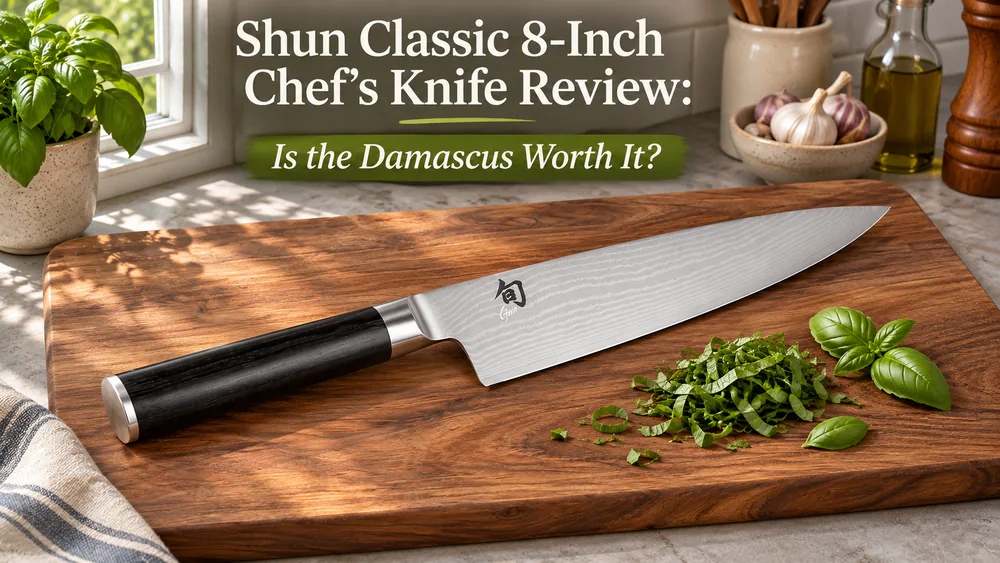
Shun Classic 8-Inch Chef's Knife Review: Is the Damascus Worth It?

As an Amazon Associate we earn from qualifying purchases. We may earn a commission from links on this page, at no extra cost to you. Learn more.

Shun Classic 8-Inch Chef's Knife Review: Is the Damascus Worth It?

The Shun Classic 8-inch is a thin, light chef's knife with a VG-MAX core, 68 layers of Damascus cladding and a D-shaped Pakkawood handle. We rate it 4.5 out of 5. It is a slicer and a fine-work knife first, and it is not a rough-use workhorse.

If you are weighing it against the heavier German knives, our Japanese knife reviews show where this blade fits in the wider style.

Our Verdict

The Damascus pattern is beautiful, but it adds looks and very little cutting benefit. What earns the knife its place is the thin, hard VG-MAX blade and the way it glides through food. If you slice, dice and trim more than you chop through bones and dense roots, it is a joy to use.

Key takeaway. Rating: 4.5 out of 5. Buy the Shun Classic if you want a light, razor-sharp slicer and you will hand wash it. Skip it if you rock-chop hard, toss knives in the sink, or want a blade you can revive with a few passes on a steel.

How We Tested the Shun Classic

We judged the Shun the way working kitchens judge a knife: how the edge feels out of the box, how it behaves on fine work and heavy prep, how the handle feels as the session goes on, and how it sharpens back. We also ran it against a Wüsthof Classic, since that is the knife most shoppers cross-shop with it.

We used it for fine brunoise, herb chiffonade, straight downward cuts through butternut squash, and breaking down a chicken. We also checked the edge after sessions, because a small chip can appear after weeks of hard use, and the edge needed little honing early on.

Specs at a Glance

Shun Classic 8-Inch Chef's Knife (DM0706) specs
Blade length8-inch
SteelVG-MAX core with 68 layers of Damascus cladding
Hardness60-61 HRC claimed by the maker
Edge angle16-degree per side (double bevel)
HandleD-shaped Pakkawood, right-handed (a reversed left-handed model, DM0706L, exists)
Weightabout 7 ounces
Spine thickness1.92 mm
OriginHandcrafted in Japan
WarrantyLimited lifetime against manufacturing defects, plus free sharpening

The HRC figure is the maker's claim, and it refers to the Rockwell hardness scale for steel. Measured values vary by test method and sample, so treat 60-61 HRC as the maker's number, not a verified reading. For comparison, the Wüsthof Classic is tempered to 58 HRC.

First Impressions, Build and Handle

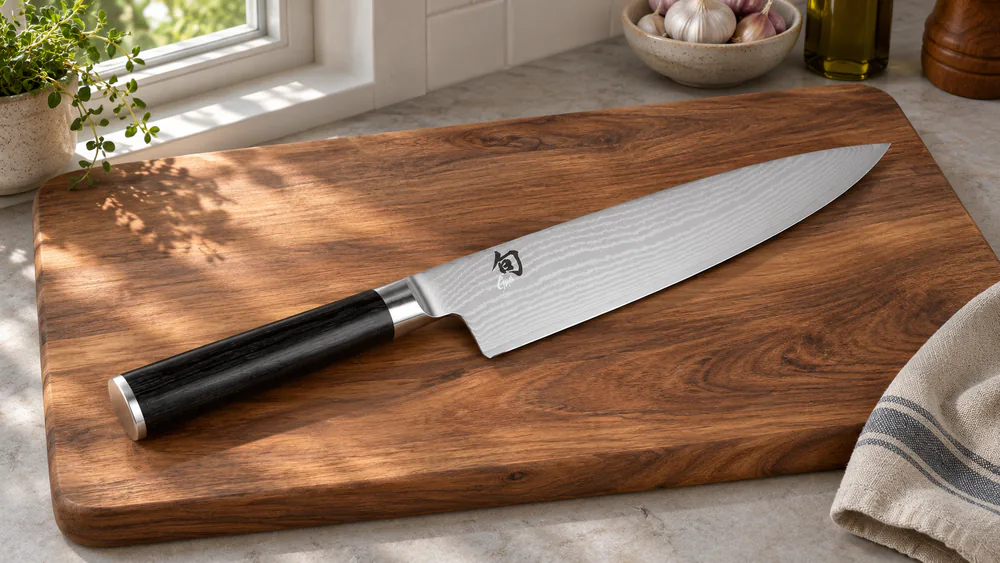
The knife looks like a piece of jewelry. The rippled Damascus finish and polished blade make it the kind of knife that gets left on the counter. It is also noticeably lighter and slimmer than a German chef's knife, with a spine of just 1.92 mm against the Wüsthof's 2.60 mm.

Blade and VG-MAX Steel

The blade follows the gyuto lineage of traditional Japanese kitchen knife styles and construction: thin, hard and ground to a keen angle. The 16-degree edge is steeper than the 14-degree angle on the Wüsthof, yet the thin spine means it still slips through food with little drag.

The steel is easy to sharpen, but corrosion resistance is mediocre. We found rust spots appear when the knife is left wet, and careful hand drying avoids them. The Damascus rippling also lets sticky food such as garlic cling to the blade now and then.

The short half bolster leaves the heel free, so the whole edge can reach a stone.

D-Shaped Handle and Balance

The Pakkawood handle stays secure when wet or greasy. Balance sits near the joint between handle and blade, so the knife feels light and nimble but still has enough heft for harder jobs.

The D-shape is molded for right-handers. Even so, left-handed users do not notice the curve getting in the way, and the handle is comfortable in either hand. One real downside: the handle is relatively large for smaller hands.


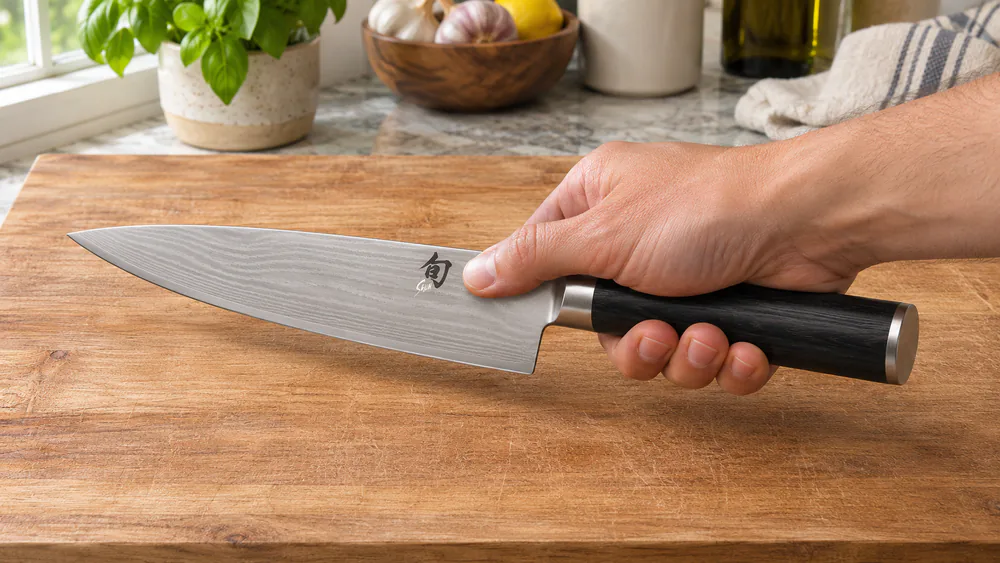
A cook's right hand in a pinch grip on the Shun Classic 8-inch chef's knife, showing the D-shaped Pakkawood handle and the Damascus blade
The D-shaped handle in a pinch grip.

How It Cuts

The short version: this knife shines in push and pull slicing, and it is happiest when you let the blade do the work.

Slicing and Push Cuts

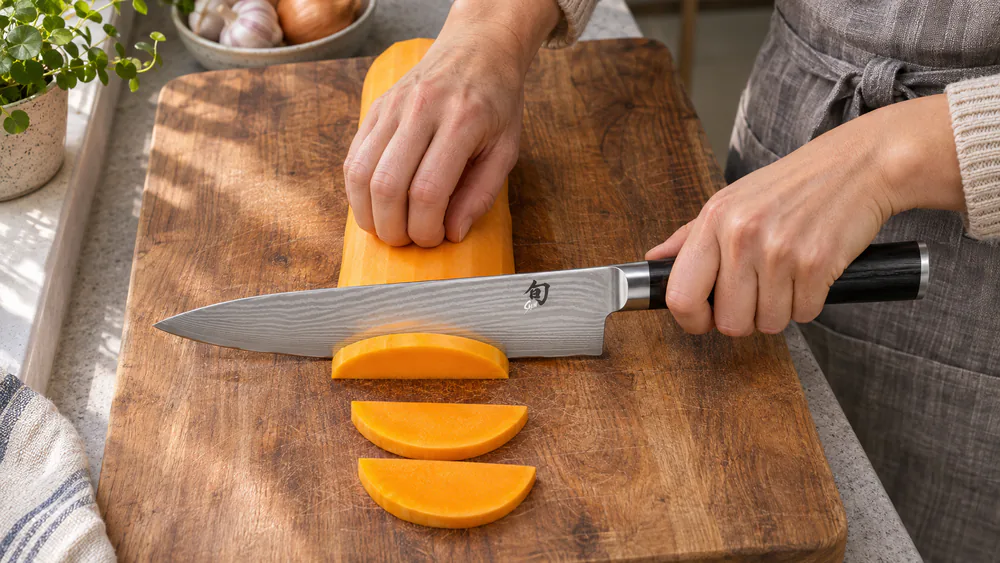
The thin blade glides through butternut squash with straight downward pressure. Twisting the blade in dense squash is a different story, and that is how you risk a chip.

Rock-chopping feels awkward on the flat-ish thin blade and puts the tip at risk. Next to a Wüsthof it feels like a sports car versus a pickup truck. Use a push or pull stroke and the knife is at its best.

Fine Work and Herbs

Fine brunoise and herb chiffonade are easy and confidence-building on this knife. Breaking down a chicken and trimming steak gristle are also handled well. Because the blade is light and thinner than European competitors, our hand did not tire during a long prep session.

Heavy Prep and Edge Retention

The edge holds through a lot of cutting. A small chip showed up after weeks of hard use, though it did not affect normal cutting. The very hard steel can chip under heavy-handed use; the central trade-off is greater sharpness and edge life with less forgiveness.

The Shun Classic 8-inch chef's knife slicing through a halved butternut squash on a wooden cutting board with straight downward pressure

Care and Sharpening

Because the same hard steel that slices so cleanly is brittle, care matters as much as technique. Hand wash only, and dry it right away. It will chip if it is tossed in the sink or used on hard items, so treat it as delicate and use it slowly.

Warning. Skip bones, frozen food and twisting cuts in dense produce. The warranty excludes misuse such as prying, bones and frozen items, and the thin tip bends more readily than a German knife's.

When it dulls, a honing steel does little on this hard steel. It needs a whetstone, while a few passes on a honing steel can revive a Wüsthof's softer edge. The good news is that Shun offers free sharpening, and the details are in the FAQ below.

Tip. Left-handed or on the fence about the handle? Hold the knife in a pinch grip before you decide. And keep a whetstone, not just a steel, if you plan to own a Shun for years.

Shun Classic vs Wüsthof Classic and Other Alternatives

The Wüsthof Classic is the obvious rival. It is tougher and more forgiving, and it needs touching up about once a month with daily use. It is noticeably heavier than the Shun, with a full bolster and a triple-riveted synthetic handle, and it suits rock-chopping and rougher work better.

The Victorinox Fibrox Pro is the value pick. It is sharp, light and grippy, though it will not hold an edge as long as the Shun. The Global G-2 is the closest in spirit: a one-piece steel knife, very light and razor sharp, though we have no verified specs for it here.

ProductShun ClassicWüsthof ClassicVictorinox Fibrox ProGlobal G-2
Steel VG-MAX, 68-layer Damascus X50CrMoV15 Stainless (stamped) Stainless, one piece
Hardness 60-61 HRC claimed 58 HRC About 56 HRC Not verified
Edge angle 16-degree 14-degree Not verified Not verified
Weight About 7 oz Noticeably heavier Lighter than Wüsthof Very light
Handle D-shaped Pakkawood Triple-riveted synthetic, full bolster TPE Fibrox Dimpled steel
Balance Light, near the joint Heavier, blade-forward Light Very light
Care Hand wash Hand wash Dishwasher-safe materials Hand wash advised
Best for Slicing and fine work Rock-chopping, rougher use Value, daily use Modern, hygienic Japanese style

Pros, Cons and Who Should Buy

Shun Classic 8-Inch Chef's Knife
1

Shun Classic 8-Inch Chef's Knife

Best Slicer
Check Price on Amazon
4.5/5

The Shun Classic is our pick for slicing and fine work.

  • Our rating: 4.5 out of 5
  • Best for slicing, push cuts and fine work
  • Made for right-handers, with a left-handed version

Specifications

Blade
8-inch VG-MAX
Handle
D-shaped Pakkawood
Weight
about 7 ounces
Made in
Japan

Pros

  • Razor-sharp edge that holds through a lot of cutting
  • Light and thin, so the hand does not tire
  • Excellent for slicing, brunoise and herbs
  • Steel is easy to sharpen on a whetstone
  • Free lifetime sharpening from the maker

Cons

  • Brittle with heavy-handed use and can chip
  • Awkward for rock-chopping
  • Hand wash only, and it can rust if left wet
  • Honing steel does little once it dulls
  • Handle is large for smaller hands

Frequently Asked Questions

What does the free sharpening cover, and who pays shipping?

Shun sharpens at 16 degrees for free and includes microchip repair. Large chips and cracks are excluded, and you pay to ship the knife to them.

Who is covered by the limited lifetime warranty?

It covers manufacturing defects for the original owner, and it applies to knives bought from authorized dealers. Misuse such as prying, bones and frozen food is excluded, and a return fee applies.

Is the left-handed DM0706L worth buying?

The standard D-shape is molded for right-handers, and the mirrored DM0706L exists for that reason. The left-handed testers we know found the standard handle no problem, so it matters only if you want the matching shape.

Where is the Shun Classic made?

It is handcrafted in Japan.

Final Verdict

The comparison table shows why the best choice depends on the tasks you do most. For rough use, buy the Wüsthof Classic: it is tougher, more forgiving and easy to revive. For daily value, the Victorinox Fibrox Pro is sharp, light and grippy, and it costs less than the others here.

Read next

Ready to upgrade your kitchen?

Browse our tested buying guides and find the right tools for the way you cook.