
Kitchen Appliances
Vintage Glass Juicers: A Guide to Identifying and Buying Them

As an Amazon Associate we earn from qualifying purchases. We may earn a commission from links on this page, at no extra cost to you. Learn more.
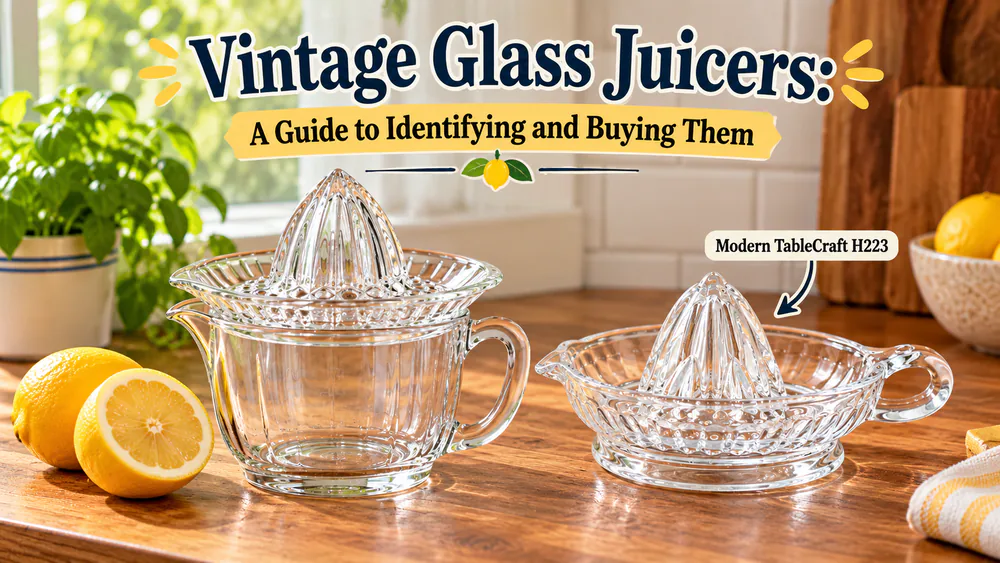
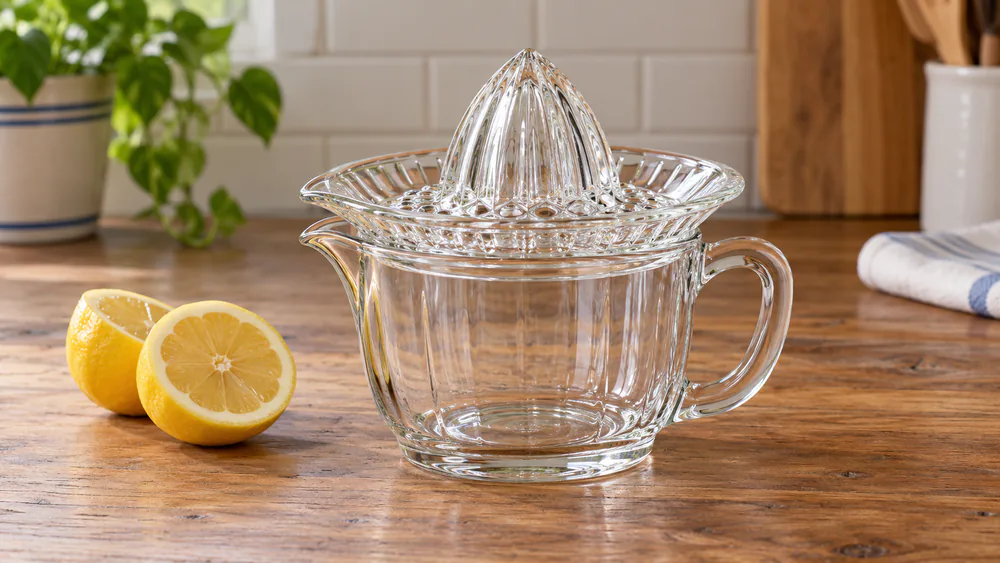
A vintage glass juicer is an older citrus reamer made of pressed or molded glass, usually a ribbed cone that you twist a halved lemon or orange over. Some are one piece; others sit on a separate catcher, such as a measuring pitcher. In our family kitchen, the modern glass reamers we have handled share one appeal: the open design is easy to see, easy to hand wash, and has no narrow slots to clog. If you want to browse more hand tools, start with our juicer reviews.
What to Look for in a Vintage Glass Juicer
Decide first whether you want a piece to squeeze fruit or a piece to display. That choice shapes everything else, because old glass of unknown origin is a better shelf object than a kitchen tool. Reamers come in plain, decorative, and advertising or souvenir shapes.
One-Piece Reamers and Juicers with Separate Catchers
A one-piece reamer is simpler to inspect, store, and wash. A set with a separate reamer above a pitcher has more parts to check. Look at both pieces, and do not assume a matching-looking top belongs to its catcher. Ask whether the two seat together properly.
Handles, Pour Spouts and Seed Strainers
In use, a handle helps steady the bowl while you press and twist the fruit. A spout makes pouring easier. Many open glass reamers have no strainer, so seeds end up in the juice and you need a separate strainer for seed-free pouring. Treat a handle or spout as a weak point on old glass.
How to Identify a Vintage Glass Juicer
Identifying a glass juicer means weighing several clues together. Appearance alone never proves age, maker, or food safety.
Maker's Marks, Patterns and Shape
Check the base and body under good light for lettering, marks, and registration details. A missing mark does not rule out an older piece. Compare the whole shape with documented pattern records instead of relying on one embossed word. As one example, Corning's museum dates a Thatcher Manufacturing Company orange reamer to 1930-1940. That record describes one documented object in opaque white glass with Sunkist branding. It does not cover every Sunkist-marked piece you will find.
Clear and Colored Glass: What Appearance Can Tell You
Clear, pink, green, and opaque glass turn up across different production histories. Use color to narrow a comparison, not to settle maker, age, or suitability for food.
Vintage Originals and Modern Reproductions
Old shapes can stay in production, and later pieces can come from original molds. Matching a silhouette or an embossed mark cannot authenticate a production date.
| Observable feature | Possible interpretation | Verification needed |
|---|---|---|
| Embossed brand and manufacturer text | A lead toward the maker | Match the full inscription and shape to a museum or pattern record |
| Mold seams | Pressed or molded construction | Production history; seams alone do not date a piece |
| Clear or colored glass | Narrows the possible variants | Documented color and mold combinations; color is not proof |
| Familiar old-fashioned shape | Original, later production, or reproduction | Compare handle, base, marks, and production records |
| Separate reamer and catcher | A multipart set | Correct fit, completeness, and a matching documented form |
Check Condition Before You Buy
Inspect for damage before anything else, and before any cleaning. Examine the cone, rim, spout, handle joints, and the edges where separate parts seat together.
- Cracks or chips on the reamer cone and rim
- Fragile decoration that is worn or flaking
- Handle joints and spout, where stress concentrates
- Adhesive traces, filled losses, or overpainting that hint at repairs
- Missing or mismatched parts
Persistent cloudiness, a milky surface, or iridescence can signal deterioration, and scrubbing will not bring clarity back. Repaired glass belongs on display, not in food or drink service.
What Determines a Vintage Glass Juicer's Value?
A piece's value depends on its model or pattern, color, condition, and completeness; shipping also affects the total cost. Compare completed sales for closely matched pieces rather than treating an asking price as evidence. A listed price may also differ from the offer a seller accepted. We do not quote price ranges here, because we have no matched sold-piece data to support them.
Where to Buy Vintage Glass Juicers
Marketplaces, antique dealers, estate sales, flea markets, and thrift stores all carry old reamers. When buying online, ask for enough photos to inspect the details you cannot check in person.
Before you buy, request:
- A full view, the underside, and any marks
- A close-up of the cone, rim, and spout
- The handle joints and measurements
- Every separate piece, plus any repairs and how the item will be packed
If you want a juicer to use on fruit this week, a new one removes the guesswork about old glass. The TableCraft H223 is a modern clear-glass reamer with vintage-inspired facets. It is not vintage. It measures 8.5 x 6 x 3.25 inches with a 6-inch diameter, and it has an integrated handle, collecting bowl, and pouring spout. The manufacturer lists a small 6 oz reservoir and permits dishwasher cleaning for this model only. In our kitchen the handle steadied the bowl while we pressed and twisted, and the glass body felt substantial but still needs protection from drops. It collects seeds with the juice, so plan to pick them out or pour through a strainer.
Using, Cleaning and Displaying a Vintage Glass Juicer
Each fruit half takes wrist movement and pressure to juice, so larger batches require more effort with a manual glass reamer.
What to Verify Before Using Old Glass with Food
An unidentified glass juicer has no established food-contact suitability. That depends on the particular glass, its decoration, its condition, and any repairs, and appearance cannot tell you those things. Lead crystal can be hard to tell from other glass, and acidic drinks left in contact for longer increase lead transfer. No color, stamp, or glow test settles the question, so keep an unidentified piece for display.
Care and Storage for Your Particular Piece
For robust, undamaged glass, use lukewarm water and a little dish soap in a padded basin, and skip the dishwasher for older glass. Support the piece from underneath, not by its handle or spout. Cushion it in storage and avoid sudden temperature changes. For a damaged, decorated, or cloudy piece, ask a conservator before you wash it.
Before You Choose a Vintage Glass Juicer
- Decide whether the piece is for display or for squeezing fruit.
- Confirm the reamer and catcher belong together.
- Inspect the cone, rim, spout, and handle joints for chips, cracks, and repairs.
- Ask for marks, underside photos, and measurements.
- Compare sold examples, not asking prices.
- Treat unidentified glass as display-only.
Read next
Before You Choose a Vintage Glass Juicer
Explore more buying guides to find tools that fit your kitchen.