
Knives & Cutlery
What Is a Nakiri Knife Used For? A Practical Guide for Home Cooks

As an Amazon Associate we earn from qualifying purchases. We may earn a commission from links on this page, at no extra cost to you. Learn more.
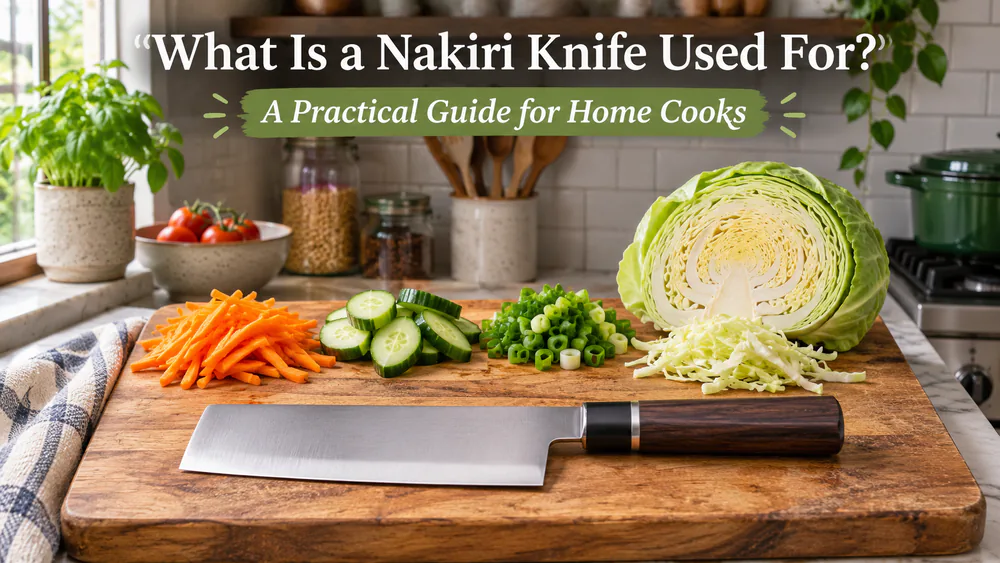
A nakiri is a Japanese vegetable knife with a tall, flat-edged, square-tipped blade. It is used for chopping, slicing, and shredding vegetables, herbs, and soft fruit, and it does that job better than almost any other knife in the block.
Our work with Japanese knives and sharpening stones has shown us where nakiri blades tend to chip and what causes the damage. This guide covers what the knife does well, what it should never touch, and how to decide whether one belongs in your kitchen.
What Is a Nakiri Knife?
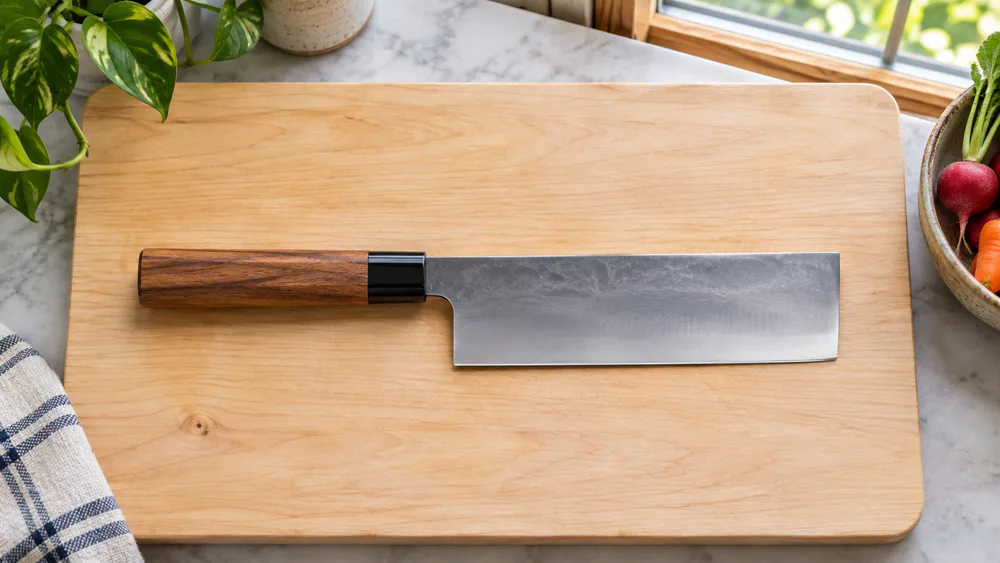
A nakiri is a double-bevel Japanese kitchen knife made for produce. The blade is a tall rectangle, the spine runs nearly parallel to the edge, and the tip is squared off instead of pointed.
It looks like a small cleaver, but it behaves nothing like one. A cleaver is a thick wedge built to go through bone. A nakiri is thin, light, and made to slice.
What "Nakiri" Means
The name 菜切り means "vegetable cutter." Na refers to greens or vegetables, and kiri means cutting. The name tells you the whole job description.
Because the edge is sharpened on both sides, a nakiri suits right-handed and left-handed cooks alike. Regional styles vary a little. Tokyo-style blades have a squared tip, while Osaka-style blades have a sheep's-foot drop at the tip.
What Is a Nakiri Knife Used For?
Think of it as the produce specialist. If a food grows in the ground or on a plant and has no bone, a nakiri is a good tool for it.
Everyday Vegetable Prep
Onions, shallots, carrots, celery, cabbage, lettuce, peppers, cucumbers, daikon, eggplant, and zucchini all suit a nakiri. Leafy greens do too.
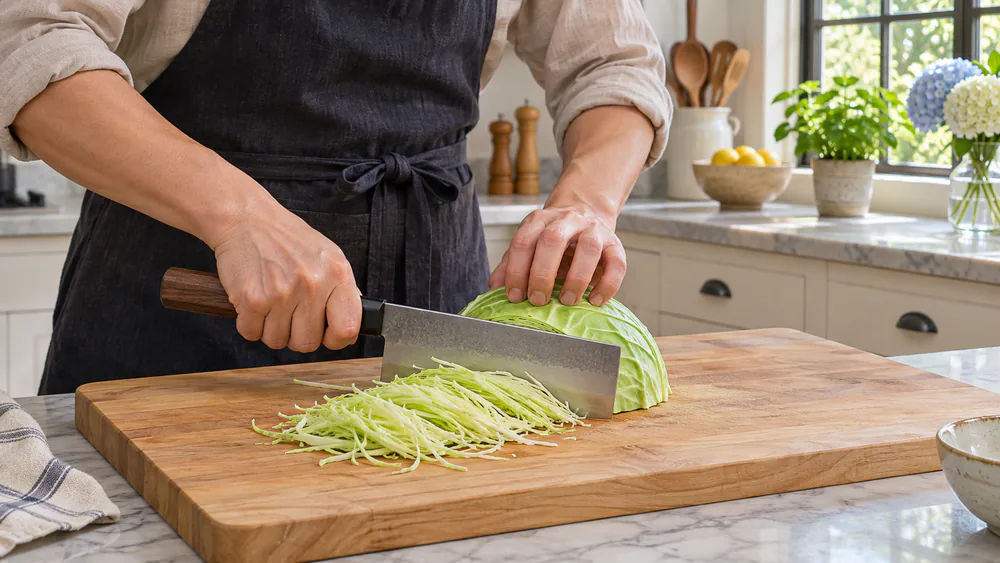
Cabbage shows the difference fastest. With a flat down stroke it falls into fine, separate ribbons. You do not get the half-attached accordion strands at the bottom that a curved blade often leaves on cabbage, peppers, and onions.
The blade also feels lighter than its cleaver-like looks suggest. It is slightly nose-heavy, yet it handles big prep jobs, like a pile of onions or a large cabbage, without much effort.
Precision Cuts (Julienne, Thin Slices, Dice)
The flat edge makes uniform cuts easy. Julienne, batonnet, brunoise, and paper-thin sheets of cucumber or daikon all come out even because the whole edge meets the board at once.
The tall blade helps here too. Your guide-hand knuckles can rest against the tall blade, while a steady chopping rhythm reduces wrist fatigue during long prep sessions.
Herbs, Fruit, and Boneless Foods
Herbs, apples, and other soft fruit work well. So does tofu. Boneless meat is possible, but it is not where the knife shines, and the lack of a point makes trimming awkward.
Tip. A nakiri works best as a second knife beside a gyuto or santoku. Let it take over the heavy produce prep and leave the meat and trimming to the pointed knife.
What a Nakiri Cannot Do
The thin, hard grind that makes a nakiri glide through a carrot is the same thing that makes it fragile. Know the limits before you start.
Bones and frozen food are out. Contact with either chips the thin edge on the spot, and a chicken thigh bone is enough to do it. Hard winter squash, such as kabocha or butternut, is the classic way to chip a nakiri, because the flat profile gives you no rocking leverage to muscle through.
Skip these jobs too:
- Opening shells or cans
- Twisting or prying
- Cutting on glass, stone, or ceramic
- Detailed work such as fine garlic mincing or shallot dicing, which is fiddlier without a point
Warning. Never use a nakiri on bone, frozen blocks, or hard squash. The edge is thin and hard, so it chips instead of bending, and a chip means a trip to the stones.
Nakiri Blade Design and Why It Works
Every feature of the blade serves one goal: clean, full-contact cuts through produce.
Tall Rectangular Blade
The blade stands roughly 5 cm tall at the heel, though height varies by maker and model. That height protects your knuckles and gives you room to scoop. The tall flat side doubles as a bench scraper for carrying diced onion to the pan.
Flat Edge and Blunt Tip
The edge has no belly. A 240 mm gyuto has only about 100-120 mm of flat section for a rock chop, while a 165-180 mm nakiri has full contact with the board along its entire length. Each stroke cuts all the way through, which is why nothing stays half attached.
The blunt tip is the trade-off. You give up the point for precision work, and a gyuto or santoku still handles meat and trimming better.
Thin Grind and Steel Choices
Stainless steels such as VG10, AUS10, and ginsan are low fuss and a safe first choice. Carbon steel, such as Blue #2, takes a finer edge but rusts and patinas, so it needs drying right after use. A hammered tsuchime finish helps release potato slices and other dense foods.
How to Use a Nakiri Knife
Technique matters more with a nakiri than with a curved knife, because the blade will not forgive a rocking habit.
Pinch Grip and Claw Guide Hand
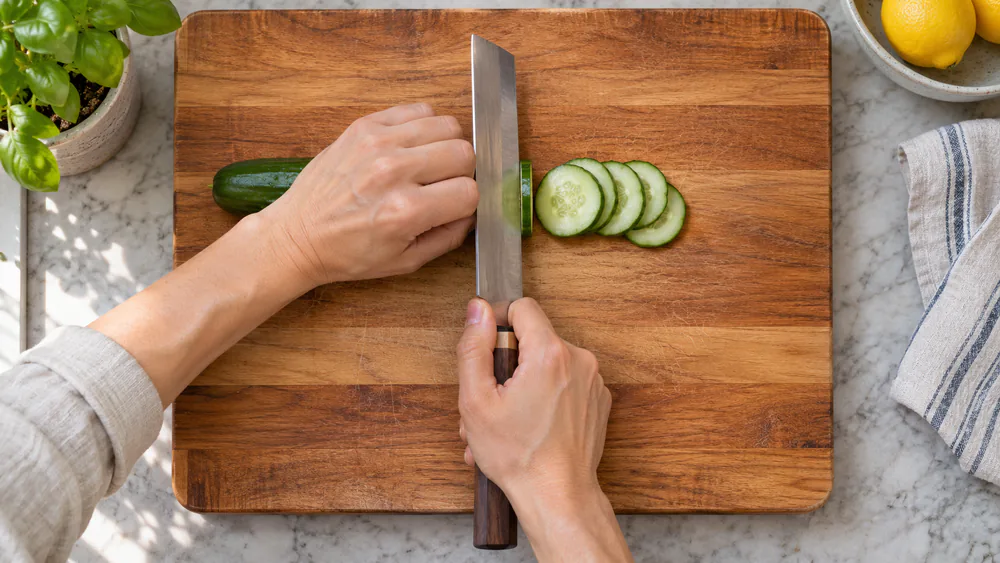
Pinch the blade just above the heel with your thumb and index finger, and wrap the other fingers around the handle. Curl your guide hand into a claw with the knuckles resting against the flat of the blade. The tall blade makes that wall easy to find.
Push Cut, Chop, and Slice
Use a push cut, called oshi-giri, to slice: press the edge forward and down through the food. For a tap chop, called tataki-giri, lift the knife and drop it straight down, letting the edge meet the board fully.
Do not rock it. After a few days of practice the rocking habit fades, and sliding the blade forward or back works better on a nakiri anyway.
Moving Food Without Dulling the Edge
Use the flat of the blade or the spine to scoop food, never the edge. Dragging the edge flat across the board is one of the fastest ways to dull it. Turn the knife over, and carry the onions to the pan on the side of the blade.
Nakiri vs Santoku
Next to the santoku, the nearest everyday rival, the nakiri looks very different. A santoku has a slightly curved, sheep's-foot blade that drops to a point-like tip. It is shorter in height and works for meat, fish, and vegetables alike.
The santoku is the better single knife. The nakiri is the better vegetable knife, thanks to full board contact and a taller blade. If you cook mostly produce, the nakiri wins. If you want one knife for everything, buy the santoku.
Nakiri vs Chef's Knife
A chef's knife differs more from a nakiri than a santoku does: it has a curved belly for rocking, a pointed tip and usually an 8 to 10 inch blade. It does everything reasonably well.
On vegetables, though, the rocking motion can leave cuts partly joined at the bottom. The nakiri cuts clean through, and it is shorter and lighter, which suits small boards. It cannot replace a chef's knife for meat, but it can take over the produce.
Nakiri vs Usuba
The usuba is the professional cousin. It is a single-bevel (sharpened on one side only), tall rectangular knife used for katsuramuki, the continuous peeling of vegetables into thin sheets, and for decorative cuts. The best ones have a hollow on the flat side.
An usuba is heavier than a nakiri, harder to sharpen, and demands skill. The nakiri is the home-cook counterpart: the same idea with a double bevel that forgives more mistakes.
How All Four Knives Compare
Here is how all four compare.
| Feature | Nakiri | Santoku | Chef's knife | Usuba |
|---|---|---|---|---|
| Blade shape | Tall rectangle | Shorter, slight curve, sheep's foot | Curved belly, long | Tall rectangle, thicker spine |
| Tip | Squared or rounded, no point | Rounded, drops to near-point | Pointed | Squared |
| Best tasks | Vegetables, herbs, fruit, julienne | Mixed veg, meat, fish | Everything | Pro veg work, katsuramuki |
| Weaknesses | Bone, frozen food, hard squash, meat trimming | Less full board contact | Partial cuts on veg when rocking | Skill-heavy, hard to sharpen |
| Rocking ability | None, push and tap | Limited | Designed for it | None |
| Bevel | Double | Double | Double | Single |
| Skill level | All levels | All levels | All levels | Professional |
What Size Nakiri Should You Buy?
The most common length is 165 mm, and the usual range runs from 150 to 180 mm, or about 6 to 7 inches. For most home cooks, 165 to 180 mm is the sweet spot.
Pick 165 mm for smaller boards and quick weeknight prep. Choose 180 mm if you regularly cut cabbage, big daikon, or bulk prep, since the extra length adds reach.
Tip. Hold the knife over your cutting board before you buy. The blade should fit the board with room for your guide hand, since a tall flat knife on a cramped board is awkward.
How to Choose a Nakiri Knife
Three things decide whether a nakiri suits you: steel, handle, and how much you want to spend.
Steel and Maintenance
Stainless is the low-worry choice for a first nakiri. Carbon sharpens finer but wants immediate drying. Be honest about your habits. If you leave knives in the sink, choose stainless.
Handle and Balance
A nakiri balances forward, with more steel toward the front than a similar-size santoku or gyuto. Handles come in two styles: a Japanese wa handle, which is octagonal, and a Western handle. Wa handles are light and slim. Western handles feel familiar if you are used to a chef's knife. Hold both if you can.
Budget
Nakiri span every tier, from budget stainless models to premium hand-forged carbon blades. A budget stainless nakiri is plenty for learning the shape. Spend more only once you know you like the knife and are ready to sharpen carbon steel properly.
Caring for and Sharpening a Nakiri
Hand-wash the blade and dry it right away. Never put it in the dishwasher, and store it in a sheath, a block, or on a magnetic strip so the edge does not knock against other tools.
Sharpen when the edge needs more pressure than it used to, slips on tomato or pepper skins, or crushes herbs instead of slicing them. A whetstone is the best tool for the job. Spread your strokes along the whole edge. Uneven strokes can leave a hollow section that stops the edge from meeting the board flat, and that undoes the nakiri's biggest advantage.
Common Mistakes to Avoid
Most damage we see comes from a short list of habits.
- Rocking the blade. A nakiri has no belly, so rocking makes the cut uneven. Push and tap instead.
- Cutting squash or bone. Chips follow almost every time.
- Scraping with the edge. Use the spine or flat side to move food.
- Cutting on hard surfaces. Glass, stone, and ceramic boards ruin a fine edge fast. Wood or soft synthetic boards are the safer choice.
- Using it as a pry bar or can opener. Thin steel snaps.
- Skipping the dry-off. This matters most on carbon steel.
Frequently Asked Questions
Can a nakiri cut meat?
Boneless meat is possible, but it is not ideal. The blunt tip makes trimming awkward, and bone or a frozen block will chip the edge. Use a santoku or gyuto for meat and fish.
Is a nakiri good for beginners?
Yes. It is easy to control, the tall blade guards your knuckles, and the double bevel is simple to sharpen. A stainless model is the friendliest start.
Can you rock a nakiri?
No. The edge is flat, so use a push cut or a tap chop and slide the blade forward or back. Rocking feels natural at first but fades within a few days.
How often should a nakiri be sharpened?
Sharpen when the edge needs more pressure, slips on skins, or crushes herbs. That depends on how often you cook, so judge by feel instead of a calendar.
Is a nakiri better than a santoku?
For vegetables, yes. For general use, no. The santoku handles meat and fish too, which is why many cooks keep both.
Conclusion
A nakiri is a vegetable specialist. It gives you full board contact, clean cuts through cabbage and onions, and a safe wall for your guide hand. To protect the blade, avoid bone, frozen food and hard squash, and use it without rocking.
For cooks who prep a lot of produce, it is a worthwhile second knife beside a gyuto or santoku. Start with a stainless 165 to 180 mm model, learn the push cut, and keep it sharp on a whetstone.
Read next
Ready to upgrade your kitchen?
Browse our buying guides to find the right knife for the way you cook.