
Knives & Cutlery
What Is VG10 Steel? Properties, Comparisons, and Kitchen Knife Care
As an Amazon Associate we earn from qualifying purchases. We may earn a commission from links on this page, at no extra cost to you. Learn more.
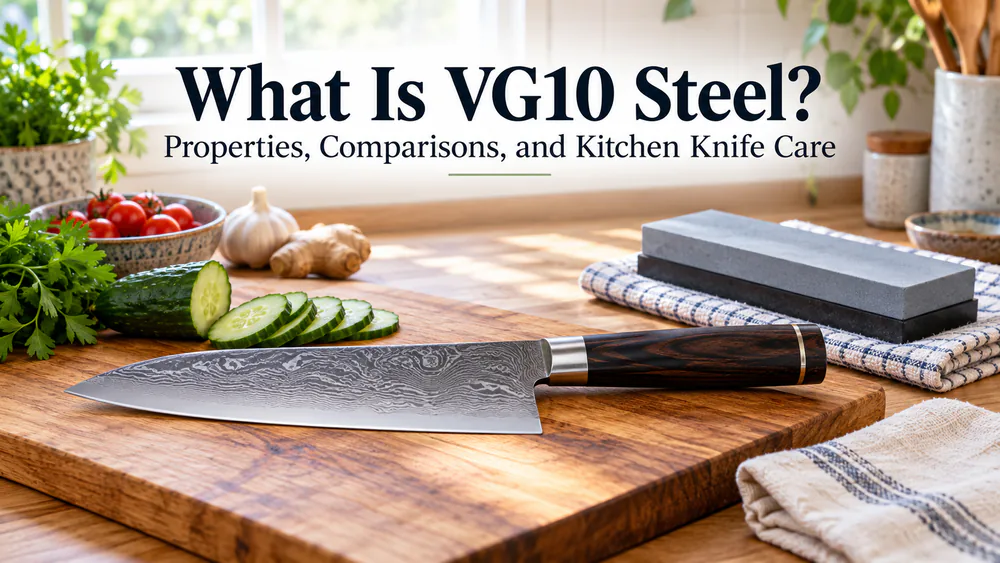
What Is VG10 Steel?
VG10 is a Japanese stainless blade steel made by Takefu Special Steel. It is a high-carbon, chromium-rich alloy built for wear-resistant cutting edges, and it shows up most often as the hard core of kitchen knives. In practice that means a thin edge that slices vegetables, fish and boneless meat cleanly and holds up well, as long as you treat it with some care.
The tradeoff is simple. VG10 is not a tough, forgiving steel for bones and frozen food, and it takes a bit more effort on a stone than softer German stainless. Below we cover what the alloy is made of, how it behaves at the cutting board, how it compares with AUS-10 and SG2, and how we would look after a VG10 knife. If you keep seeing VG10 in the specifications for Japanese knives, this guide explains what the name tells you and what you still need to check.
VG10 Steel Composition and Hardness
The producer lists representative figures for VG10 by mass: 1.00% carbon, 15.00% chromium and 1.00% molybdenum. Vanadium is about 0.25% and cobalt about 1.55% in the detailed composition table, though older summaries round these to 0.2% and 1.5%. Treat all of these as representative material figures, not a guarantee for any individual blade.
| Carbon | 1.00% |
|---|---|
| Chromium | 15.00% |
| Molybdenum | 1.00% |
| Vanadium | about 0.25% |
| Cobalt | about 1.55% (rounded to 1.5% in some descriptions) |
What the Alloying Elements Do
Each element has a job. Carbon is what lets the steel harden enough to take and hold a fine edge. Chromium is the stainless part: it supports corrosion resistance, and chromium-rich carbides add wear resistance. Vanadium refines the grain structure, and the carbides it helps form also contribute to wear resistance.
If "carbides" is a new word, think of them as tiny hard particles spread through the softer steel. They resist abrasion, which is why a well-made VG10 edge keeps cutting through a lot of vegetables before it needs attention.
Why Heat Treatment and Blade Geometry Matter
The alloy name does not fix a knife's hardness. Heat treatment does, and each maker sets its own. Shun, for example, specifies 60-61 HRC for its VG10 knives, but another brand can land elsewhere. Always read the finished knife's specification, not just the steel name.
Hardness also is not the same as toughness. Hardness describes resistance to denting and wear. Toughness describes resistance to chipping and breaking. Edge geometry also affects cutting performance: a thin, acute edge cuts beautifully but sacrifices some resistance to damage, whatever the steel.
How VG10 Performs in Kitchen Knives
VG10 earns its reputation on controlled, precise work. We would not judge it on a spec sheet alone, so here is what the actual knives show.
Sharpness and Edge Retention
The VG10-cored Tojiro DP slices both soft and firm vegetables cleanly with its thin edge, and its petty knife is a good fit for fine dicing while the gyuto handles slicing and mincing comfortably. That matches what the alloy promises: a keen edge that stays keen through ordinary prep.
There is no universal number of weeks or meals before VG10 needs sharpening. Judge the edge, not the calendar. When honing no longer brings back the bite on a tomato skin, it is time for a stone.
Toughness and Chipping
This is the steel's weak side. VG10 at typical kitchen hardness resists wear well but does not forgive twisting, prying, bone or frozen food. Hard impacts can chip a thin edge, and ceramic or metal contact adds repair work later.
Warning. Skip bone, frozen food, glass and stone cutting surfaces, and never twist a blade that is trapped in a cut. These are the habits that chip VG10 edges, and they are the ones the knife makers warn against too.
Corrosion Resistance
With roughly 15% chromium, VG10 resists rust well, but stainless is not rustproof. Moisture left on the blade can still cause spotting. Wash it, dry it promptly, and do not leave it soaking in the sink.
We also see cosmetic wear on VG10 Damascus-style knives. The Tojiro DP's soft outer cladding picks up scratches even while the cutting core remains useful. That is cladding wear, not a sign the core steel has failed.
Ease of Sharpening
VG10 sharpens on a standard waterstone, and a thin edge comes back readily. It is not as quick as softer German stainless, though. Restoring the Tojiro DP takes more work than sharpening softer knives, and repairing chips takes longer still. Hardness is part of the reason: more resistant steel removes more slowly.
Pros
- Keen, thin edge that cuts vegetables, fish and boneless meat cleanly
- Chromium-rich, so corrosion resistance is good with basic care
- Wear-resistant carbides keep the edge usable through regular prep
- Sharpens on a standard waterstone
Cons
- Not forgiving of bone, frozen food, twisting or hard impacts
- Takes more sharpening effort than softer stainless, especially after chips
- Hardness depends on the maker, so the steel name alone tells you little
- Soft outer cladding on Damascus-style knives scratches easily
VG10 vs Other Kitchen Knife Steels
Comparing steels cleanly is harder than it looks, because finished-knife results depend on heat treatment and geometry. We therefore compare tendencies, not rankings.
| Criterion | VG10 | AUS-10 | SG2 |
|---|---|---|---|
| Corrosion resistance | Stainless; dry after washing | Stainless; dry after washing | Stainless; comparable to VG10 in the cited test |
| Edge retention vs toughness | Wear-resistant slicing edge; avoid lateral stress | Kanso example tolerates daily work but can roll; no universal alloy ranking | Higher predicted wear resistance; not inherently less tough than VG10 |
| Sharpening effort | Waterstone-friendly; repairs can take work | Maintain the finished knife's bevel; no verified matched effort ranking | Thin examples sharpen readily; geometry affects effort |
| Suitable kitchen use | Controlled vegetable, fish and boneless meat prep | Everyday slicing and prep; knife geometry matters | Fine slicing with careful handling of thin edges |
| Hardness | Maker-dependent; Shun example 60-61 HRC | Use the specific maker's specification | Maker-dependent; Shun example 61-62 HRC |
AUS-10 is a Japanese high-carbon stainless steel with corrosion resistance, wear resistance and a fine edge. In the Shun Kanso, the edge can roll and dull under hard use while staying serviceable for daily prep. The same knife starts tomato slices cleanly, but its blade can wedge and push carrot pieces apart during julienne cuts. Blade geometry matters as much as the steel here, and no matched test proves AUS-10 tougher or easier to sharpen than VG10.
SG2 is a powder-metallurgy steel from the same producer, with a fine, uniform structure. Metallurgical analysis predicts better slicing wear resistance than VG10, with similar corrosion resistance and similar toughness at matched hardness. That prediction is an estimate, not a measured kitchen lifetime. A thin SG2 edge can sharpen back readily on a waterstone, so powder steel does not automatically mean a hard knife to sharpen. Small chips still can develop in a very thin factory edge, even on a soft board.
VG-MAX is a separate Shun formulation with more chromium and vanadium than VG10. It is not a synonym for VG10, and we would not assume it behaves identically.
How to Care for and Sharpen a VG10 Knife
Good habits matter more here than any special product. The routine is short and it protects a thin edge.
Cleaning, Storage, and Cutting Habits
Hand wash with gentle soap, rinse, and dry right away. Store the knife with the edge protected, in a block, on a magnetic strip with care, or in a sheath. Cut on wood or soft plastic boards, not glass, stone or ceramic.
Sharpening and Honing
A whetstone restores a worn edge by removing metal. Follow the maker's bevel instructions, and sharpen when honing no longer restores cutting performance. Honing is lighter maintenance that realigns a rolled edge.
Do not apply a universal ban on steel honing rods to every VG10 knife. Some makers instruct light use of their own honing steel, others recommend a ceramic or fine stone. Follow the guidance for your specific knife, use light controlled pressure, and keep the angle consistent.
Who Should Choose a VG10 Kitchen Knife?
VG10 suits cooks who value a thin, clean-cutting edge and are willing to be careful. It is a good fit for vegetables, herbs, fish and boneless meat, and for anyone who already owns or plans to buy a whetstone.
It is a poor match for a household that hacks through bones, tosses knives in the dishwasher, or wants a blade that shrugs off abuse. Those cooks are better served by a softer, tougher stainless that tolerates rough handling. Buyers who want a still harder, finer edge and can handle thin geometry may look at SG2 instead.
VG10 Steel FAQs
Is VG10 stainless or rustproof?
VG10 is stainless thanks to its chromium content, but no stainless steel is rustproof. Moisture left on the blade can still cause spots, so wash and dry it rather than letting it soak.
Does VG10 chip easily?
It can, mostly when it is twisted, used on bone or frozen food, or struck against hard surfaces. Thin edges are the most vulnerable, so cutting technique and board choice matter as much as the steel.
Is VG10 hard to sharpen?
Not especially. It sharpens on a standard waterstone, though it takes more work than softer knives, and chip repair takes longer. Match the maker's bevel and use light pressure.
What does VG10 Damascus mean?
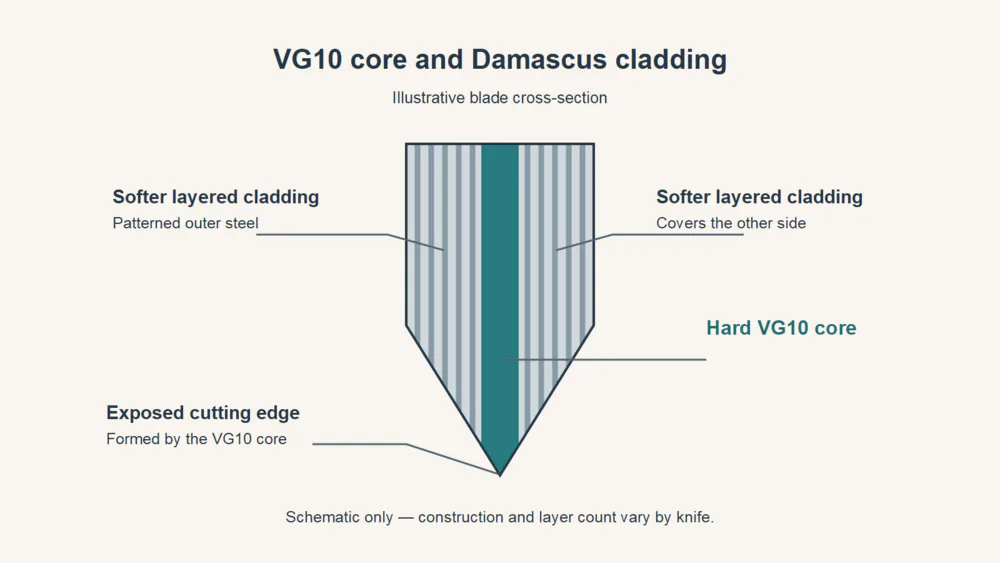
Damascus describes the construction or pattern, not a different alloy. In a VG10-cored Damascus-clad knife, the exposed VG10 core forms the cutting edge and the patterned layers cover its sides. The layer count does not by itself tell you how long the edge lasts.
Do all VG10 knives have the same hardness?
No. Hardness depends on the maker's heat treatment. Shun specifies 60-61 HRC for its VG10 knives, but another brand may differ, so check the finished knife's specification.
Final Verdict: Is VG10 a Good Choice?
Yes, for the right cook. VG10 gives you a keen, stainless edge that handles everyday vegetable, fish and boneless meat prep and sharpens on a normal waterstone. Its limits are chipping under rough use and a bit more sharpening effort than softer steels. Before buying, check the maker's hardness specification and the edge geometry; together, they tell you more about the finished knife than the steel name alone.
Read next
Final Verdict: Is VG10 a Good Choice?
Explore our buying guides for more help choosing and caring for your kitchen knives.