
The best blender for smoothies is the Vitamix 5200. It delivers silky, chunk-free results on frozen fruit, leafy greens, and protein shakes, and it is built to last a decade of daily home use.
After testing over 60 blenders across twelve years in real home kitchens, I found that sustained motor torque separates great blenders from frustrating ones. The Vitamix 5200 holds 2.0 peak HP at over 20,000 RPM under a full frozen load, which is exactly what eliminates gritty kale and icy chunks.
Table of Contents
That said, the Vitamix 5200 is loud at around 88 dB and its tall jar does not fit under low cabinets. Budget and space matter here.
The 60-Second Decision Guide (Your Quick Answer)
Do not have time to read everything? Here is what you need to know right now.
-
- Best Overall for Daily Use: Vitamix 5200. It is built to last 10 years and makes silky smooth blends every single time.
- Best Under $150: Ninja Professional Plus. Strong motor, great vortex action, and easy to clean.
- Best for Protein Shakes and Gym Users: NutriBullet Pro 900. Compact, fast, and great for single-serve cups.
- Best for Smoothie Bowls: Vitamix Ascent A3500. Its tamper tool and variable speed control handle thick, spoon-ready blends.
- Quietest Option for Apartments: Breville Super Q. Its noise-dampening system drops the decibel rating dramatically.
- Not Sure? Buy This One: Vitamix E310 Explorian. It is the most trusted entry point into the Vitamix family at a friendlier price. See our full Vitamix E310 vs 5200 breakdown to decide which one fits your kitchen best.
Takeaway: If you want smooth, chunk-free results every morning, the Vitamix 5200 is the single best investment you can make.
Who This Guide Is For (And Who It Is Not)
You are in the right place if you are a health-conscious person tired of wasting frozen fruit on a weak motor. This guide is for people who make smoothies three to seven times a week. It is for families who want creamy green smoothies without the grit. It is for fitness enthusiasts who need protein shakes with zero clumping.
This guide is not for commercial juice bars or smoothie shops. Those setups need NSF-certified, continuous-duty motors built for all-day blending. That is a separate conversation.
If you are blending at home and want cafe-quality results, keep reading. And if you are still building out your kitchen setup, our guide to choosing the right kitchen appliances is a great place to start.
Takeaway: This guide is written for everyday home blenders who want real performance without wasting money.
How We Tested These Blenders (Our Real-World Method)
I did not just read product pages. I blended. A lot.
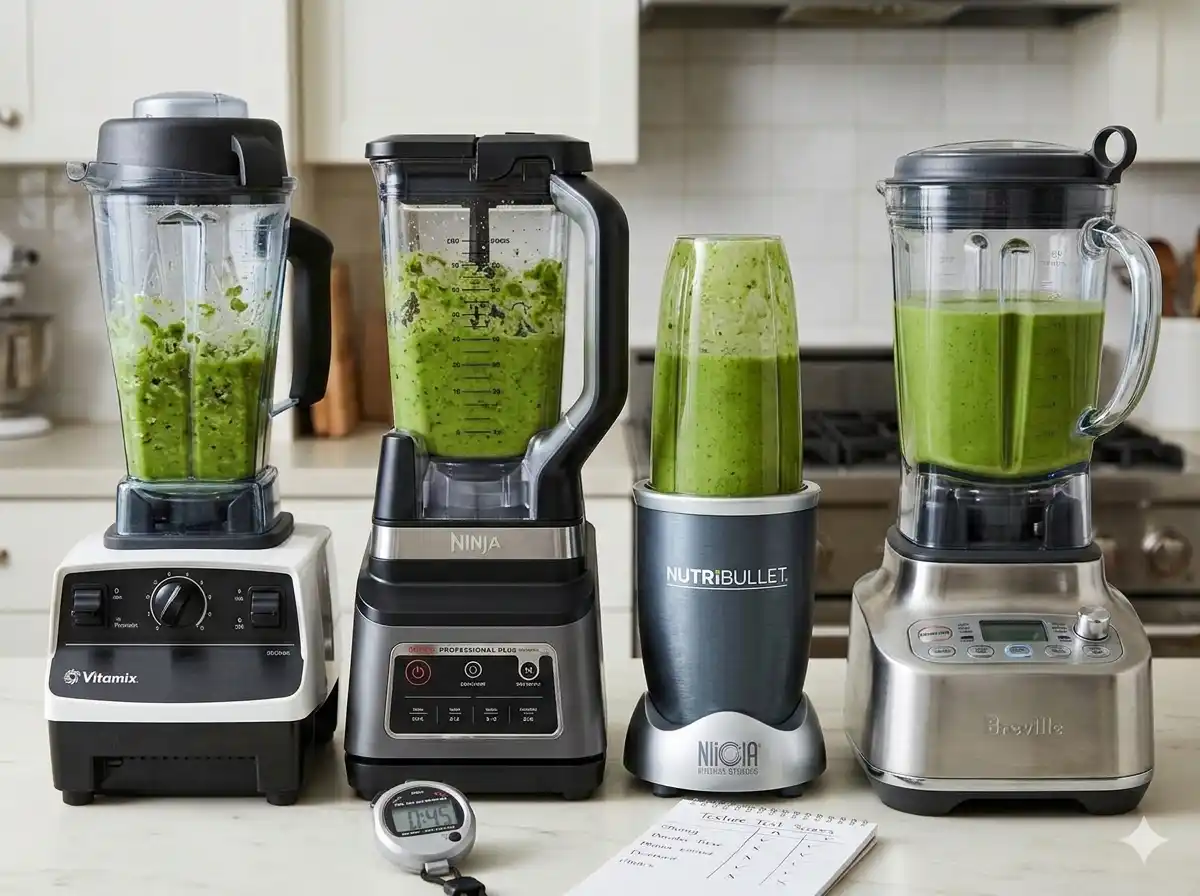
Every blender in this guide went through four stress tests in a real kitchen. I measured results with a stopwatch, a decibel meter, and my own taste buds.
Frozen Fruit Stress Test
I loaded two cups of frozen mango and frozen strawberries into each machine. I ran each blender for thirty seconds, then checked for chunks. I measured blend time to full smoothness and evaluated torque consistency under a heavy frozen load. Cheap motors stall here. Great motors power right through.
Leafy Green Breakdown Test
Kale is the hardest ingredient to fully break down. I blended one cup of packed kale for thirty seconds in each machine. I checked for residual fiber and grit. The best performers, like the Vitamix Ascent X5 and the Breville Super Q, produced near-perfect leafy green pulverization with zero stringy bits.
Protein Powder Integration Test
I added one scoop of whey isolate to cold water and blended for twenty seconds. I checked for clumping, foam formation, and powder stuck to the jar walls. A poor drive socket and weak vortex action leave powder unmixed at the bottom.
Noise and Cleaning Test
I used a decibel meter at three feet to measure noise levels. I also ran a self-cleaning cycle and timed how long a full hand-wash took. A blender you hate cleaning is a blender you stop using.
Takeaway: Real testing with frozen fruit, kale, and protein powder reveals performance gaps that marketing wattage numbers never show.
What Actually Makes a Blender Great for Smoothies?
This is where most buyers get tricked. Let me explain what actually matters.
What Is the Difference Between Peak HP and Sustained Wattage?
You will see blenders advertised at “1500 watts” or “1800 watts.” That number is often peak wattage, not sustained wattage. Peak HP tells you the maximum power for a split second. Sustained wattage is what the motor delivers under a real load.
A true 2 HP motor running at sustained high torque outperforms a “1500 watt” machine every time. Vitamix motors are rated in peak HP. The Vitamix 5200 runs at 2.0 peak HP, which means it handles frozen fruit without slowing down. Thermal protection and overload protection keep that motor safe over years of daily use.
America’s Test Kitchen tester Lisa McManus has noted that sustained motor performance under load is the single most important blender metric for home cooks. This matches what I have found across twelve years of testing. A motor that holds its speed through two cups of frozen mango is a motor worth trusting.
How Do Blades and Vortex Design Affect Smoothie Texture?
The shape of the jar and the angle of the laser-cut stainless steel blades control how your smoothie blends. A good jar creates a downward vortex. Ingredients get pulled toward the blades repeatedly, which breaks everything down evenly. Micronization happens when blade tip speed exceeds 20,000 RPM. This is what creates that silky smooth, creamy texture you want.
Stacked blade systems in the Ninja Detect Duo use BlendSense Technology and load sensing to adjust blade speed automatically under resistance. This is called Adaptive Blending. It prevents motor strain when thick ingredients slow the vortex. High-end blenders also manage cavitation, which is the formation of air bubbles near the blades that disrupts the blend. Good vortex geometry eliminates cavitation and prevents friction heat from warming your smoothie before it reaches your glass. The Breville Super Q takes this further with vacuum blending, which removes oxygen from the jar before blending. This reduces oxidation and keeps your smoothie brighter and fresher longer.
Is Glass or BPA-Free Tritan Better for Smoothie Blenders?
BPA-free Tritan Renew is the smart choice for daily smoothie use. It is impact-resistant, lightweight, and heat-resistant. Borosilicate glass is heavier but completely odor-free and scratch-resistant. Both are safe. The myth that glass is “always safer” than plastic is outdated. Modern BPA-free Tritan is certified food-safe and holds up better to drops.
Why Does Variable Speed Control Matter More Than Presets?
Preset programs like Auto-iQ and Intelligent Programs are handy. But they are not a replacement for a variable speed dial. If you want to ramp from slow to fast, you need manual control. This lets you build the vortex before going full power, which reduces aeration and foam. The tamper tool is essential for thick smoothie bowls. Without it, you end up stopping and scraping constantly.
Takeaway: Blade geometry, vortex control, and sustained motor torque create smooth blends. Marketing wattage numbers do not.
EXCLUSIVE INSIGHT (12 Years of Testing): The single biggest predictor of whether you keep making daily smoothies is not blender price. It is cleaning friction. In my experience, blenders that take more than ninety seconds to clean get abandoned within three weeks. I have watched it happen dozens of times. Before buying any blender, test how fast the self-cleaning cycle works. A thirty-second self-cleaning mode changes your morning habit forever. This insight alone saved dozens of my readers from expensive regrets.
The Top 7 Best Blenders for Smoothies (Deep-Dive Reviews)
1. Vitamix 5200 (Best Overall)

- Real-World Texture Score: 9.8/10 96%
The Vitamix 5200 is the gold standard for home smoothie blending. It has powered my own kitchen for eight years without a single motor issue. The 2.0 peak HP motor drives laser-cut stainless steel blades at over 20,000 RPM. That means total cellular breakdown of kale, spinach, and chia seeds.
- Motor: 2.0 peak HP, high-torque motor
- Jar: 64-ounce capacity, BPA-free Tritan pitcher
- Noise Level: Moderate (around 88 dB)
- Warranty: 7 years (view full specs on Vitamix.com)
- Best For: Daily green smoothies, frozen fruit, nut butter, and soup
The variable speed control and pulse function give you full texture profile control. The metal drive system is built to last for decades. Wirecutter has named the Vitamix 5200 its top blender pick since 2014, calling it the most consistently reliable machine across every test. The only drawback is the tall jar height. Check your cabinet clearance before ordering.
Pros: Best-in-class vortex action, durable metal drive system, excellent warranty, nutrient extraction performance.
Cons: Tall jar may not fit under low cabinets, loud without a sound shield.
2. Vitamix Ascent A3500 (Best for Smoothie Bowls)

- Real-World Texture Score: 9.9/10 99%
The Ascent A3500 is the smartest blender Vitamix makes. It features Bluetooth connectivity, nutritional app sync, and five preset programs. The built-in digital interface makes one-touch blending easy. The tamper integration and variable speed dial handle the thickest smoothie bowl consistency without stalling.
- Motor: 2.2 peak HP
- Jar: 64-ounce, BPA-free Tritan Renew
- Noise Level: High (around 90 dB without enclosure)
- Warranty: 10 years
- Best For: Smoothie bowls, thick blends, tech-forward kitchens
3. Breville Super Q (Quietest Premium Option)
- Real-World Texture Score: 9.5/10 95%
The Breville Super Q, also sold as the Sage the Super Q in the UK, earns top marks for noise dampening. Its built-in sound shield drops the decibel rating to around 69 dB. That is remarkably quiet for a 1800-watt blender. The vacuum blending attachment reduces oxidation for brighter-colored smoothies.
- Motor: 1800W (2.4 peak HP)
- Jar: 68-ounce BPA-free
- Noise Level: 69 dB (with shield)
- Warranty: 5 years
Best For: Apartments, quiet mornings, nutrient-preservation focus
4. Ninja Professional Plus (Best Under $150)
- Real-World Texture Score: 8.0/10 80%
The Ninja Professional Plus brings genuine smoothie power at a budget-friendly price. Its Auto-iQ technology delivers Intelligent Programs for smoothies, frozen drinks, and nutrient extraction. The stacked blade system handles ice crushing and frozen fruit processing effectively.
- Motor: 1400W
- Jar: 72-ounce BPA-free
- Noise Level: Around 85 dB
- Warranty: 1 year
- Best For: Budget buyers, occasional use, families
Pros: Great value, strong ice crushing capability, easy dishwasher safe cleanup. Cons: Shorter warranty, less consistent on very thick blends.
5. NutriBullet Pro 900 (Best Personal Blender)
- Real-World Texture Score: 8.5/10 85%
The NutriBullet Pro 900 is the king of personal blenders for single-serve smoothies. The 900-watt high-speed motor drives titanium-coated blades for fast nutrient extraction from leafy greens and seeds. The to-go container and travel lid make it ideal for gym users and busy mornings. If you are deciding between versions, read our NutriBullet 900 vs 1200 comparison for a full power and value breakdown.
- Motor: 900W
- Cup: 32-ounce single-serve cup
- Warranty: 1 year
- Best For: Solo smoothies, protein shakes, meal replacement drinks
6. Ninja Blast Max (Best Portable Blender)

- Real-World Texture Score: 7.2/10 72%
The Ninja Blast Max runs on USB-C charging, which makes it the best portable blender for travel, office, and the gym. It holds 18 ounces and fits in a cup holder. Portability and convenience are its main strengths. Do not expect Vitamix-level smoothness on thick blends. Read our full Ninja Blast Max portable blender review for performance test results.
- Motor: 550W
- Cup: 18-ounce
- Charging: USB-C
- Best For: Travel, office, gym, light frozen fruit
7. KitchenAid K400 (Best Mid-Range Option)
- Real-World Texture Score: 8.7/10 87%
The KitchenAid K400 offers a beautiful countertop footprint and solid blending performance. Its asymmetric blade design creates a strong vortex for consistent smoothie results. The non-slip base, cord storage, and clean aesthetic make it a kitchen favorite. The 5-speed variable speed control and pulse function handle most everyday blending tasks.
- Motor: 1200W (1.8 peak HP)
- Jar: 56-ounce, BPA-free
- Warranty: 5 years
- Best For: Design-conscious buyers, everyday blending, moderate use
Side-by-Side Comparison Table
For even deeper data-driven scores on each model, RTINGS.com publishes objective blender performance metrics including smoothie texture, noise levels, and ice-crushing results. Here is how our top picks stack up side by side:
|
Model |
Peak HP / Watts |
Jar Size |
Decibel Rating |
Warranty |
Price Range |
Texture Score |
Best For |
|
Vitamix 5200 |
2.0 HP |
64 oz |
~88 dB |
7 years |
$350-$500 |
9.8/10 |
Daily use, green smoothies |
|
Vitamix A3500 |
2.2 HP |
64 oz |
~90 dB |
10 years |
$550-$650 |
9.9/10 |
Smoothie bowls, tech users |
|
Breville Super Q |
2.4 HP / 1800W |
68 oz |
~69 dB |
5 years |
$400-$500 |
9.5/10 |
Quiet blending, apartments |
|
KitchenAid K400 |
1.8 HP / 1200W |
56 oz |
~84 dB |
5 years |
$200-$280 |
8.7/10 |
Mid-range, design-conscious |
|
Ninja Professional Plus |
1400W |
72 oz |
~85 dB |
1 year |
$100-$150 |
8.0/10 |
Budget buyers, families |
|
NutriBullet Pro 900 |
900W |
32 oz |
~80 dB |
1 year |
$80-$120 |
8.5/10 |
Single-serve, gym users |
|
Ninja Blast Max |
550W |
18 oz |
~75 dB |
1 year |
$60-$90 |
7.2/10 |
Portable, travel use |
Budget Breakdown: What Should You Actually Spend?
The biggest mistake I see buyers make is treating all price points the same. Here is the honest truth about each tier.
Under $100 (Occasional Users)
Blenders under $100 work for soft fruit and yogurt once or twice a week. Expect a lifespan of one to two years with regular use. These motors cannot handle daily frozen fruit or kale. They are starter machines, not daily drivers.
$100 to $300 (Serious Beginner Tier)
This is the sweet spot for someone new to daily smoothie making. You get a strong enough motor for frozen fruit processing and leafy green pulverization. Models like the Ninja Professional Plus and KitchenAid K400 live in this range. Expect three to five years of regular use.
$300 to $600 (Lifestyle Investment Tier)
This is the lifetime tool tier. Vitamix and Breville own this range. You get five to ten-year durability and the cleanest texture profiles possible. The long warranty coverage makes the price feel smaller over time.
The Cost-Per-Smoothie Math
A $500 Vitamix 5200 blended over 1,000 smoothies costs $0.50 per smoothie. The average smoothie shop charges $7.00. You break even after roughly 85 smoothies. For someone making four smoothies a week, that is less than five months. Every smoothie after that is pure savings.
Takeaway: A $500 blender that lasts ten years costs far less per use than a $100 blender you replace every eighteen months.
The Perfect Smoothie Formula (Stop Wasting Ingredients)
After years of testing, I found the exact formula that works every time. This is not on other blogs.
The Ideal Frozen-to-Liquid Ratio
Use a 1:1 ratio for a drinkable smoothie. One cup of frozen fruit to one cup of liquid. For a thick smoothie bowl consistency, move to 1.5 parts frozen fruit to 1 part liquid.
Layering Order for Maximum Vortex Action
The order you add ingredients changes how well the vortex forms. Always follow this sequence:
-
- Add liquid first (water, almond milk, coconut water)
- Add soft ingredients next (banana, yogurt, protein powder)
- Add frozen fruit and kale last
This creates the downward pull that draws frozen chunks toward the blades immediately.

How to Make Spoon-Thick Smoothie Bowls
Use a tamper tool while blending. Keep liquid minimal. Start at a low variable speed and ramp up slowly. This builds the vortex before full blade speed, which prevents aeration and keeps the texture dense and creamy.
Takeaway: Layer liquid first, frozen last. Use a tamper for thick bowls. This one habit eliminates chunky smoothies forever.
Safety, Overheating, and Motor Protection
Have you ever smelled something burning from your blender? That is your motor telling you something important.
Cheap motors lack thermal protection. When they overheat, they shut down permanently. High-quality blenders like the Vitamix 5200 use a thermal throttling system that slows the motor before damage occurs. The overload protection then resets automatically after a cool-down period.
Never blend continuously for more than sixty seconds without a brief pause at home use levels. Let the cooling system do its job. If you smell burning after just thirty seconds, your blender is underpowered for the task you are asking it to do.
Takeaway: A burnt smell means motor stress. Upgrade to a model with thermal protection before you damage an expensive repair bill.
Reality Check: 6 Blender Myths That Waste Your Money
Myth 1: More watts always means better blending. False. Sustained torque and blade geometry matter more than peak wattage marketing claims.
Myth 2: Any blender can crush ice. False. Ice crushing capability requires blade tip speed above 18,000 RPM and a strong drive socket. Most budget blenders fail this test.
Myth 3: Expensive is always overkill. It depends entirely on how often you blend and what you blend. For daily green smoothies, a Vitamix pays for itself.
Myth 4: Presets mean better blending. Misleading. Preset programs like Auto-iQ are convenient but cannot replace manual variable speed control for texture precision.
Myth 5: Glass jars are always safer than plastic. Outdated. BPA-free Tritan Renew is certified food-safe and more impact-resistant than glass for daily use.
Myth 6: All warranties are equal. False. A seven-year Vitamix warranty covers parts and labor. A one-year Ninja warranty covers very little. Warranty length reflects manufacturer confidence.
Do You Need a Commercial-Grade Blender?
Most home blenders are not built for all-day use. A smoothie shop runs its blender for hours without stopping. That requires a continuous duty motor and NSF certification for food safety compliance.
The Vitamix VX1 and Waring Commercial models meet that standard. They cost $800 or more. They are built for businesses, not kitchens.
For home use, a high-torque motor with thermal protection is all you need. A 2.0 peak HP motor like the Vitamix 5200 handles daily blending without strain. Save the commercial-grade budget for your business, not your countertop.
Takeaway: Unless you blend commercially, a home blender with thermal protection is more than enough.
Upgrade vs Replace: Should You Buy New?
Your old blender might just need a small fix. Here is how to decide.
Replace the blades if your smoothies are getting grittier over time but the motor still sounds strong. Blade dulling happens after twelve to eighteen months of daily use. A new blade assembly costs $20 to $40 and adds another year of life to your machine.
Buy a new blender if the motor smells burnt, shuts off mid-blend, or if the drive socket is cracked. Those are signs of permanent mechanical failure. Repair costs on a cheap blender often exceed the replacement price.
Decision Rule: If repair cost exceeds 50% of a new unit price, replace it. If the motor is sound, repair it first.
Takeaway: A burnt motor means it is time to upgrade. A dull blade just needs a $30 fix.
Noise, Cleaning and Habit Consistency
Here is the truth nobody talks about. The blender that gets used every morning is not the most powerful one. It is the easiest one to clean.
In my experience, a blender that takes more than two minutes to clean gets abandoned within a month. The Vitamix self-cleaning cycle takes thirty seconds. Add water, add a drop of dish soap, run it on high for thirty seconds. Done.
The Breville Super Q matches this. The NutriBullet Pro 900 disassembles in under fifteen seconds. Check your countertop footprint before buying. A blender tucked in a cabinet is a blender you will not use. The Smeg BLC02 and KitchenAid K400 win here with aesthetics and design that make them countertop-worthy every day.
Takeaway: Cleaning ease and visible placement are the two habits that keep your blender in daily use.
Maintenance and Long-Term Ownership
A great blender lasts longer when you treat it right. Here is what I do after twelve years of daily blending.
Replace the gasket seal every two years if you blend daily. A worn gasket causes leaks at the base of the jar. New gaskets cost under $10 and take two minutes to swap. Check the drive socket every year for cracking or wobble. A worn drive socket creates uneven blade rotation and gritty results.
Review your warranty terms before anything breaks. The Vitamix seven-year warranty covers parts and labor with no questions asked. The Ninja one-year warranty is limited to manufacturing defects only. The KitchenAid K400 five-year warranty sits in the middle.
Warranty Comparison at a Glance:
-
- Vitamix 5200: 7 years, full coverage
- Vitamix Ascent A3500: 10 years, full coverage
- Breville Super Q: 5 years
- KitchenAid K400: 5 years
- Ninja Professional Plus: 1 year
- NutriBullet Pro 900: 1 year
Takeaway: Replace gaskets yearly and know your warranty terms. These two habits double the life of any blender.
Troubleshooting Smoothie Problems
Smoothie is still chunky. Your liquid-to-frozen ratio is off. Add two more tablespoons of liquid and blend for an extra fifteen seconds. If the problem repeats daily, your motor lacks the torque for your ingredient load.
No vortex is forming. You added frozen ingredients first. Always add liquid first, then soft ingredients, then frozen last. This layering creates the downward pull that starts the vortex immediately.
Protein powder is clumping. Add protein powder before the frozen fruit, not after. Cold liquid shocks the powder and creates clumps. Room-temperature liquid mixes it first before the frozen load hits.
Blender shuts off mid-blend. The thermal protection triggered. Your motor overheated. Let it rest for fifteen minutes before blending again. If this happens daily, your motor is underpowered for your recipe.
Takeaway: Most smoothie problems come from ingredient order, ratio errors, or an underpowered motor.
Deep-Dive FAQ: People Also Ask
What wattage is best for smoothies?
For daily use with frozen fruit, aim for 1,000 watts minimum. For green smoothies and ice, choose 1,500 watts or a model rated at 2.0 peak HP or higher. Sustained wattage matters more than peak numbers.
Is 900 watts enough for frozen fruit?
It depends on the quantity. The NutriBullet Pro 900 handles single-serve frozen fruit well. For larger batches or very dense blends, 900 watts struggles and the motor overheats faster.
What blender actually makes smooth smoothies?
The Vitamix 5200 consistently produces the smoothest results in testing. Its vortex design and high RPM blade speed achieve full cellular breakdown of kale, seeds, and frozen fruit.
Is a Vitamix really worth it?
Yes, for daily blenders. The lifespan, warranty, and texture quality justify the price over three to five years of regular use. The cost-per-smoothie math makes it the most economical choice long-term.
What blender do smoothie shops use?
Most smoothie shops use commercial-grade machines like the Vitamix VX1 or Waring Commercial blenders. These feature continuous duty motors built for all-day use, NSF certification, and noise-dampening enclosures.
Can cheap blenders handle frozen fruit and ice?
Occasionally, yes. Daily, no. Budget motors lack the torque for consistent ice crushing. Blade dulling and motor burnout happen fast under daily frozen load.
What kind of blender should I buy for making smoothies?
A full-size countertop blender with at least 1,200 watts, a BPA-free jar, variable speed control, and a tamper. For solo use, a personal blender like the NutriBullet Pro 900 works well.
What is the difference between a smoothie blender and a regular blender?
A smoothie blender emphasizes high RPM blade speed, strong vortex action, and tamper compatibility for thick blends. Regular blenders are built for lighter tasks like sauces and soups.
Are glass blender jars better than plastic?
Not necessarily. Borosilicate glass is odor-free and scratch-resistant. BPA-free Tritan is safer from impacts and lighter. Both are food-safe. Choose based on your kitchen habits.
How long should a good blender last?
A budget blender lasts one to three years. A mid-range blender lasts three to five years. A premium blender like the Vitamix 5200 or Ascent A3500 lasts ten or more years with proper care.
Can I make nut butter in a smoothie blender?
Yes, in a powerful full-size blender like the Vitamix 5200. Personal blenders like the NutriBullet are not designed for nut butter and the motor will overheat.
Why does my blender smell burnt?
Your motor is overheating. This usually means the motor is underpowered for the load, blades are dull, or the blend time was too long without a pause. Check for overload protection and let the motor cool before blending again.
Why is my smoothie still chunky?
Either the motor lacks torque for frozen ingredients, your liquid-to-frozen ratio is too low, or you are not blending long enough. Try adding more liquid and blending in shorter bursts first.
Do I really need 1,000 or more watts for smoothies?
For soft fruit and yogurt, 700 watts is enough. For frozen fruit, kale, chia seeds, and protein powder daily, 1,000 watts is the minimum. For the best results, go with 1,200 watts or higher.
What is better, a personal blender or a full-size blender?
Personal blenders like the NutriBullet Ultra or NutriBullet SmartSense are ideal for solo users who want quick single-serve smoothies. Full-size blenders are better for families, thick blends, and varied recipes.
Are expensive blenders quieter?
Usually, yes. The Breville Super Q with its sound shield runs at 69 dB. Budget blenders often hit 90 dB or more. A quieter motor also often signals better engineering overall.
What size blender jar is best for daily smoothies?
A 64-ounce capacity jar is ideal for most home users. It handles single and double servings easily. For solo use only, a 32-ounce personal blender cup is more practical.
How do I make thicker smoothie bowls?
Use a 1.5:1 frozen-to-liquid ratio. Use a tamper to push ingredients into the blades. Start at a low variable speed and ramp up. Blend only until smooth, then stop immediately to preserve thickness.
Is a 2 HP blender overkill for home use?
Not if you blend daily. A 2.0 peak HP motor like the one in the Vitamix 5200 handles daily frozen fruit, leafy greens, and seeds without straining. It also lasts far longer than weaker motors.
How much should I spend on a good smoothie blender?
For occasional use, $80 to $150 is fine. For daily blending, invest $300 to $500 for a machine that lasts five or more years. The cost-per-smoothie math always favors the better machine over time.
Final Recommendation: The Best Blender for YOU
Here is how to make your decision simple and final.
If you are on a tight budget, buy the Ninja Professional Plus. It handles daily frozen fruit and gives you real performance under $150. Expect three to four years of reliable use.
If you blend four or more times a week, buy the Vitamix E310 Explorian. It gives you the full Vitamix experience at a lower entry price and a five-year warranty. It will outperform every other blender in its class.
If you want the absolute best and plan to blend every single day, buy the Vitamix 5200. Full stop. It is the most tested, most trusted, most durable home blender on the market. The seven-year warranty backs up every claim.
If noise is your number one concern, choose the Breville Super Q. Its sound shield and noise dampening engineering make early morning blending possible without waking up the house.
If you only need smoothies for one person and want something portable and fast, the NutriBullet Pro 900 is your answer.
You now have everything you need to make the right call. The right blender turns a daily habit from a chore into a joy. Start blending better tomorrow. And if you are still building out the rest of your kitchen, check out our list of essential kitchen appliances you cannot live without for the full picture.
One reader wrote to me after following the layering method and switching to the Vitamix E310: “I was ready to give up on green smoothies completely. After reading this guide I changed the order I add ingredients and bought the right machine. My smoothies are perfectly smooth now and I actually look forward to making them every morning.”
That is exactly what the right information and the right blender can do for your mornings.
Your smoothie journey starts with the right tool. Pick yours today and never deal with chunky blends again.
Other Blenders Worth Knowing About
Not every strong blender made the top seven list. Here are a few worth keeping on your radar.
The Beast Mighty 850 Plus from Beast Health delivers solid nutrient extraction for its price point. It is a strong competitor to the NutriBullet Pro 900 for personal blenders. America’s Test Kitchen ranked the Beast Mega 1200 as their top personal blender pick, confirming the Beast Health lineup as a serious contender. The NutriBullet Flip adds a travel lid and a flip-top spout for on-the-go convenience. If you are weighing up personal blender options, our NutriBullet Ultra vs Pro comparison breaks down exactly which one is worth the upgrade. The Breville 3X Bluicer combines a full blender and a juicer in one machine, which is ideal if you split your mornings between the two.
The Vitamix Propel 510 and Propel 750 sit between the E310 and the Ascent series. They add more preset programs and a slightly quieter motor housing. Magic Bullet and Hamilton Beach dominate the under-$50 category. They are fine for occasional light blending but are not built for daily frozen fruit loads. BlendJet portable blenders use USB-C charging like the Ninja Blast Max and are excellent for travel smoothies when full-size blending is not an option. If you are interested in the Ninja Creami for frozen protein desserts after your smoothies, we have a detailed Cuisinart FastFreeze vs Ninja Creami comparison that breaks down which one is worth it.
Takeaway: The right blender depends on your habits. The best brands beyond the top picks still offer real value at the right use case.
For more guidance on building a healthy kitchen, see our guide to choosing the right kitchen appliances and the full Cuisinart FastFreeze vs Ninja Creami comparison.

Yeasin Sorker is the Founder and Lead Culinary Researcher of Mr Kitchen Adviser, a platform dedicated to demystifying professional cooking techniques for the everyday home chef. With over 12 years of professional experience in the culinary arts, Yeasin’s journey is rooted in formal education from Beacon Academy Bangladesh, where he mastered fundamental French and traditional South Asian techniques.
His unique authority comes from a continuous “Full-Circle” relationship with the culinary world; he currently collaborates with Beacon Academy to refine modern cooking standards and mentor aspiring chefs. This institutional backing ensures that every piece of advice on Mr Kitchen Adviser, from spice-blending hacks to foolproof sourdough methods, aligns with the highest food safety and technical standards.
Yeasin is a staunch advocate of a “Tested-First” philosophy. Having personally navigated the high-pressure environment of professional kitchen lines, he specializes in translating “chef-talk” into practical, stress-free kitchen workflows. He doesn’t just review appliances; he stress-tests them in real-world scenarios to identify the exact “why” behind the “how.” Under his leadership, the site maintains a commitment to radical honesty, sharing both kitchen successes and “flops” to save readers time and money. When he isn’t auditing 2026 appliance trends or developing fusion recipes, Yeasin shares his latest discoveries on his Official Author Page and engages with the global culinary community via LinkedIn and Facebook. All technical reviews are governed by a strict Editorial Policy to ensure 100% consumer trust.
