Helping you create a kitchen you love.

Kitchen Appliances

Breville Barista Express Review 2026: Pros, Cons & Verdict

As an Amazon Associate we earn from qualifying purchases. We may earn a commission from links on this page, at no extra cost to you. Learn more.

Breville Barista Express Review 2026: Pros, Cons & Verdict

The Breville Barista Express has been one of the world's best-selling home espresso machines for years, and it has been the number-one selling espresso machine in North America for nearly a decade. That is a long run for any appliance, especially as Breville's own lineup has grown around it with the faster Barista Pro and the compact Bambino Plus. So the fair question in 2026 is the obvious one: is the Express still worth buying, or has it been left behind?

We tested the BES870XL the way its owners use it: weeks of daily espresso making in our test kitchen, pulling back-to-back shots across the grind dial, timing milk steaming, and logging how the machine behaved as the weeks went on. We tracked its long-term record too, because this is a machine people keep for years.

The short version: the Express is still the best all-in-one starter machine for most beginners, with two real compromises, its built-in grinder and its steam wand.

Quick Verdict: Who Should Buy the Barista Express

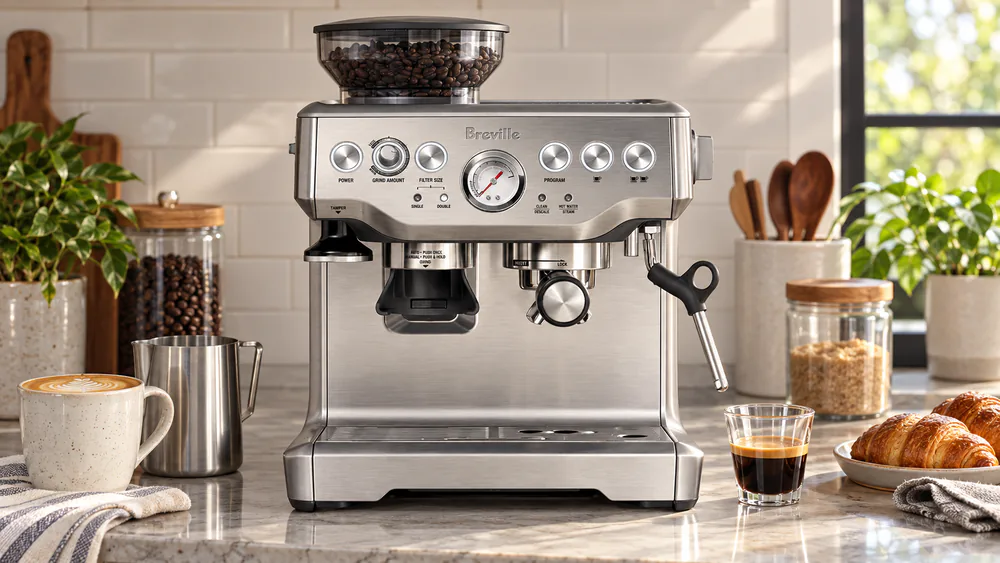
The Barista Express at a Glance

Breville Barista Express (BES870XL)
1

Breville Barista Express (BES870XL)

Best All-in-One Starter Machine
Check Price on Amazon
4.4/5

The Barista Express wins because it puts the whole espresso workflow in one box: grind, dose, tamp, pull, and steam, with no second appliance on the counter. It is a true semi-automatic, so the machine handles pressure and temperature while you learn the craft, and our shots improved noticeably over the first weeks as the grind got dialed in.

  • Integrated conical burr grinder, 16 settings, inner burr calibration
  • 54 mm portafilter with four single and dual wall baskets
  • 15-bar pump delivering about 9 bars
  • Pressure gauge, Razor trimming tool, and magnetic tamper dock

Specifications

Type
Semi-automatic with integrated grinder
Heat-up
Under a minute (about 45 seconds measured)
Water tank
67 oz
Warranty
1-year limited

The trade-offs are real, and they are all in the cons column. None of them stops the Express from being the machine we hand most beginners.
Pros and Cons

Pros

  • All-in-one: grinder, brewer, and steam wand in one box
  • Café-level shot quality once the grind is dialed in
  • Gauge and pre-infusion teach extraction fundamentals
  • Consumables and replacement parts are cheap and tool-free

Cons

  • Grinder dose consistency wanders shot to shot
  • Steam wand is slow and weak even by single-boiler standards
  • 30 to 45 second wait between brew and steam
  • 1-year warranty, shorter than the Pro and Bambino Plus

Key takeaway. The bottom line: the Barista Express is still the best all-in-one starter machine for beginners in 2026, and speed-first buyers should look at the Barista Pro. Our rating: 4.4 out of 5.

What Is the Breville Barista Express? Overview & Specs

The BES870XL is a semi-automatic espresso machine with a built-in conical burr grinder, PID-controlled Thermocoil heating, and a 54 mm portafilter. The current edition ships with the same core feature set as the original: grind dial, dose control, pressure gauge, and manual steam wand. Full specifications are listed on Breville's official site.

Key Specifications

Breville Barista Express BES870XL specifications
TypeSemi-automatic espresso machine with integrated grinder
GrinderIntegrated conical burr, 16 settings, inner burr calibration
Portafilter54 mm stainless steel, single and dual wall baskets
Pump15-bar Italian pump, about 9 bars delivered at extraction
Brew temperaturePID-regulated 200 degrees F
Water tank67 oz removable, charcoal filter included
Heat-up timeUnder a minute to brew temperature (about 45 seconds measured)
Power1600W
Dimensions15.9 x 13.1 x 12.4 in
WeightAbout 23 lb
Warranty1-year limited
Breville Barista Express (BES870XL)
1

Breville Barista Express (BES870XL)

Our Scorecard
Check Price on Amazon
4.4/5 4.4 Good

Here is how the BES870XL scored. Shot quality leads at 4.5 out of 5: once dialed in, shots land at café level, with PID holding brew temperature near 200 degrees F within a 2-degree swing across consecutive shots. Ease of use matches at 4.5, because the gauge, pre-infusion, and tamper dock teach the workflow. Maintenance scores 4.0, with tool-free consumables and a strict descaling habit. The built-in grinder and the steam wand both land at 3.5, the machine's two weakest categories, and the cons list below says why.

Pros

  • The gauge and pre-infusion make it the best teacher in its class
  • One box handles the entire workflow

Cons

  • Grinder dose wanders and the 16 steps are coarse
  • Slow steam and a 30 to 45 second brew-to-steam wait
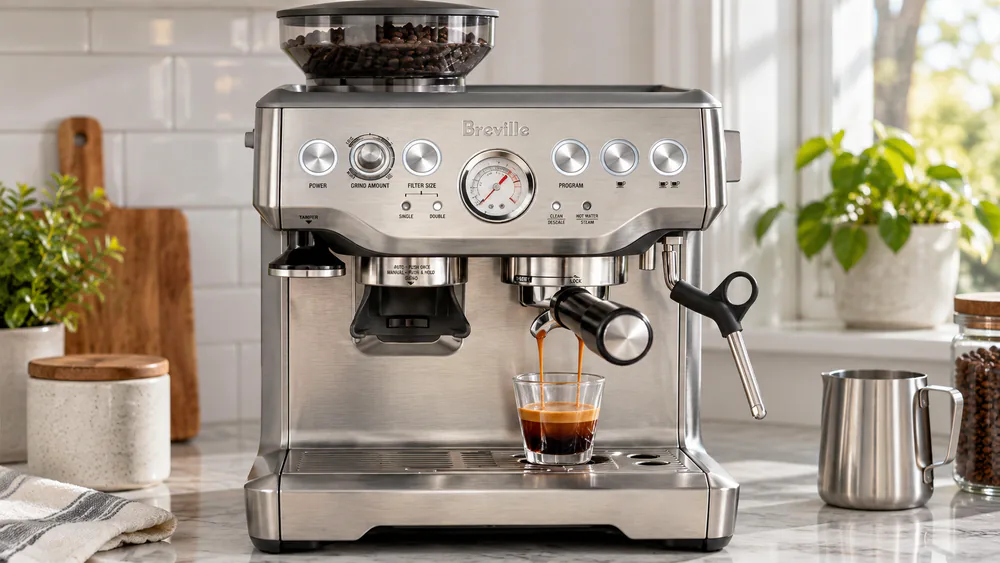
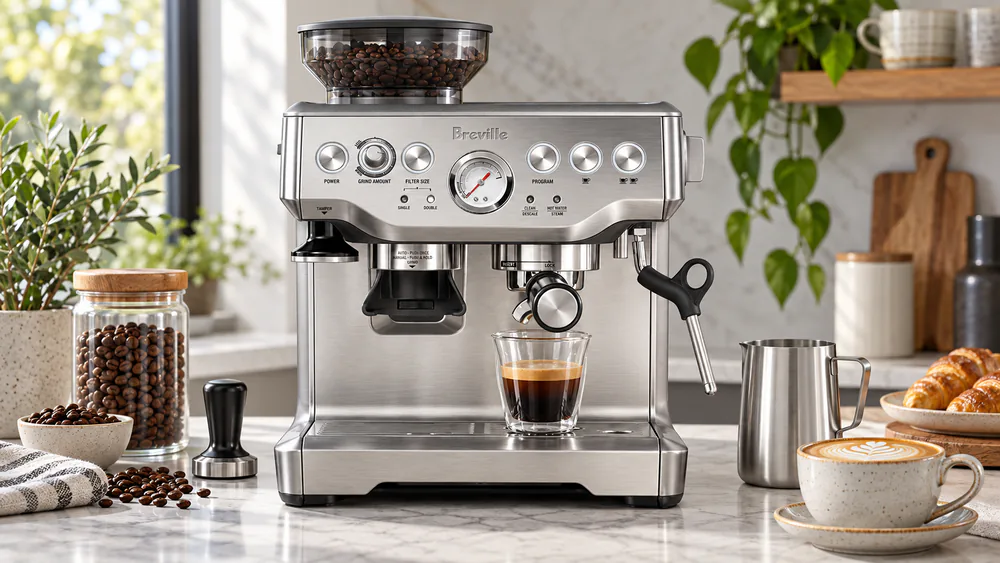
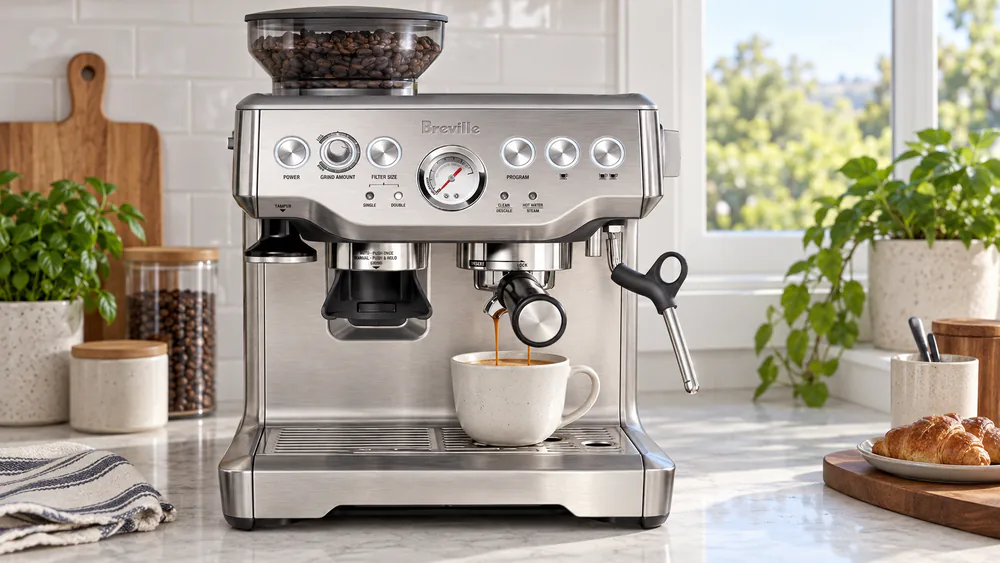
A Breville Barista Express BES870XL pouring a double shot into a ceramic cup, the pressure gauge needle sitting in the middle of the extraction.
The pressure gauge reads live through the whole shot.

Who It's For

The Express is built for the first-time espresso buyer who wants one machine on the counter and is willing to learn. It teaches rather than automates, and the pressure gauge shows you how you are doing.

Design and Build Quality

The brushed stainless steel body sits on a 15.9 x 13.1 x 12.4 inch footprint and weighs about 23 pounds, heavy enough to stay planted while you lock in the portafilter. The layout is logical from day one: grinder on top, portafilter in front, steam wand to the side, and a magnetic dock for the tamper.

The details are built around daily use: the Razor tool trims the basket level in one pass, the drip tray's red float rises as it fills, and backflush and descale lights track maintenance. Under the hood, a ThermoCoil heating system with PID holds brew temperature at 200 degrees F. It is loud in use, with a rattling character while it runs, which is just part of owning this machine.

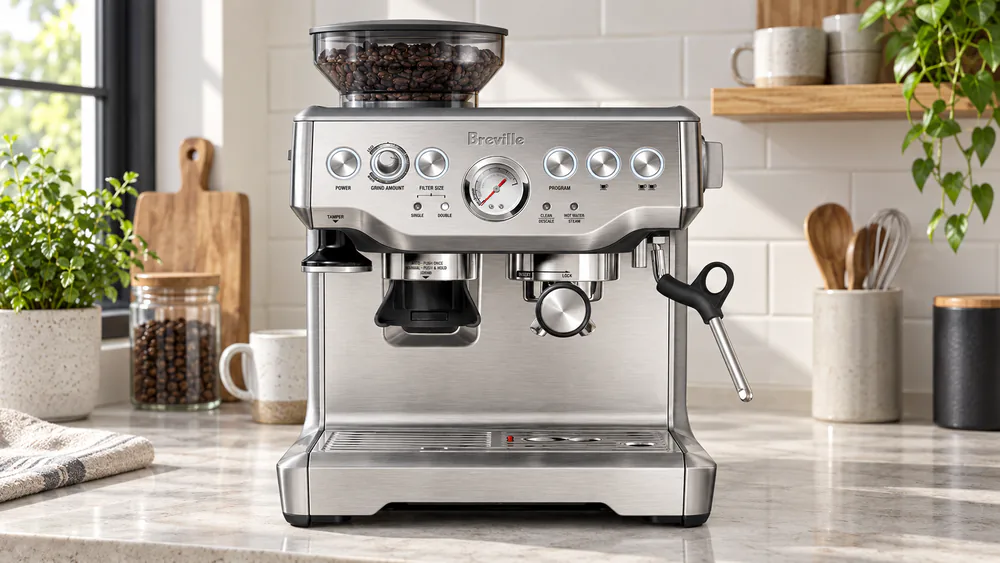
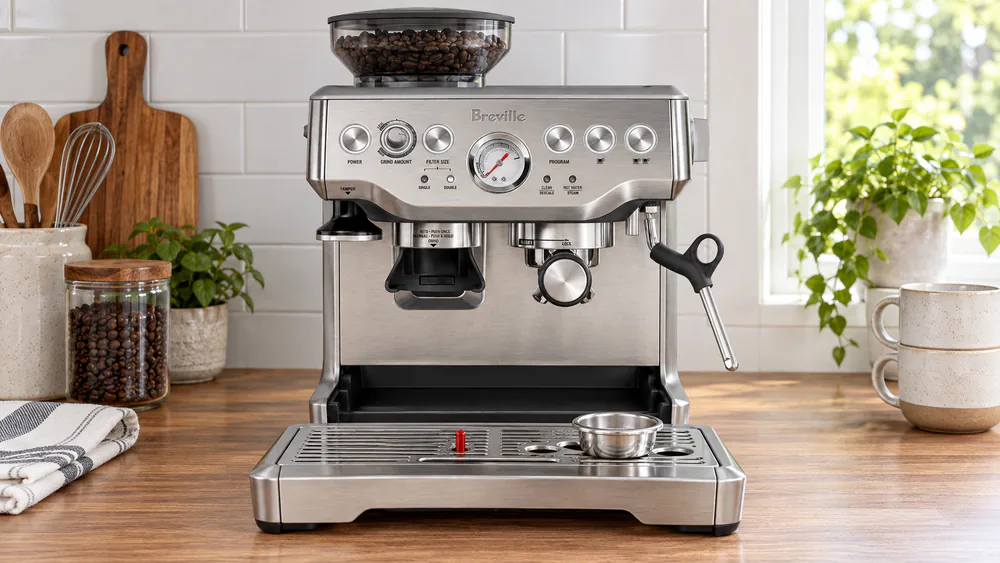
Front view of the Breville Barista Express BES870XL in brushed stainless steel, showing the pressure gauge, portafilter, and drip tray with the red fill float.

The Built-in Grinder: Convenience With Compromises

The built-in grinder is the Express's signature feature and its most debated one, the machine's long-running sweet spot between convenience and compromise. It removes the hurdle most first-time buyers trip on: grinding fresh beans.

Grinder Strengths

The integrated conical burr grinder grinds straight into the portafilter with a dose-control switch, a 16-step grind dial, and an inner burr adjustment for fine calibration. The 1/2-lb hopper holds a week of daily shots, and the Dosing Funnel and Razor tool keep the counter clean and the basket level. Fresh grind on demand beats any pre-ground bag.

Grinder Limitations

The compromises show up in consistency. Dose wanders shot to shot, and the chute retains roughly 1.2 g of grounds, so stale grounds sit in the path after a day idle and a weekly purge helps. The 16 steps are coarse next to the 30 on the Barista Pro, and beans occasionally bridge in the hopper, leaving the grinder spinning with nothing feeding through. The grinder is the part most likely to fail first, plastic chute and hopper parts cracking after years of heavy use, which is why many owners eventually add a standalone grinder.

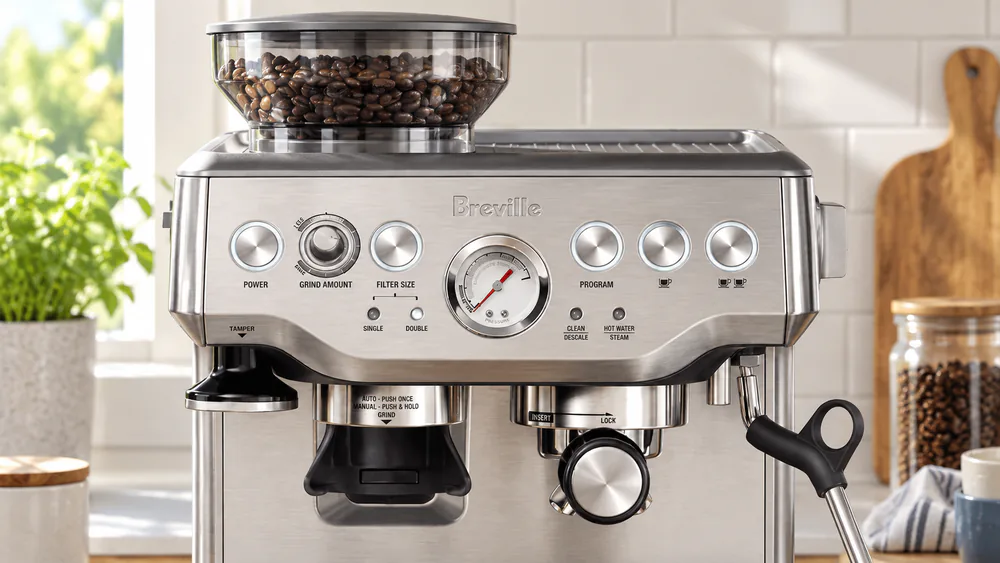
Close-up of the Breville Barista Express bean hopper and 16-step grind dial, beans feeding into the integrated conical burr grinder.

Espresso Performance: Shot Quality and the Learning Curve

Shot quality is where the Express earns its reputation. New users should expect a real learning curve: shots improve noticeably over the first weeks as the grind gets dialed in, and the ceiling is café level. The 15-bar Italian pump delivers about 9 bars at the puck, in line with SCA equipment standards, and low-pressure pre-infusion rescued slightly uneven tamps in our testing.

Pressure Gauge and Pre-Infusion

The front analogue gauge is the Express's best teaching tool, and neither the Bambino Plus nor the Gaggia Classic Pro has one. It shows extraction pressure through the whole shot, so you see when a grind is too fine or too coarse, and pre-infusion wets the puck evenly before ramping to full pressure, which forgives uneven tamps.

The Breville Barista Express pressure gauge during a shot, the needle in the espresso range while a double shot runs into the cup.

Steam Wand and Milk Texturing

The honest summary of steam on the Express is that it is slow. Steaming 6 oz of milk to 140 degrees F takes 50 to 60 seconds with the single-hole tip, and switching from brew to steam costs a 30 to 45 second wait; a five-second wand purge speeds the transition. The pause is fine for one or two drinks and a rhythm problem for a round of guests.

The slow steam is not all bad: novices get more time to learn microfoam before the milk overheats, which is exactly the stage this machine is built for. The wand gets hot enough to scorch milk residue, so wipe it with a wet towel after every use.

Note. Pull all of your shots first, then steam for the whole round, and you skip the brew-to-steam pause per drink.

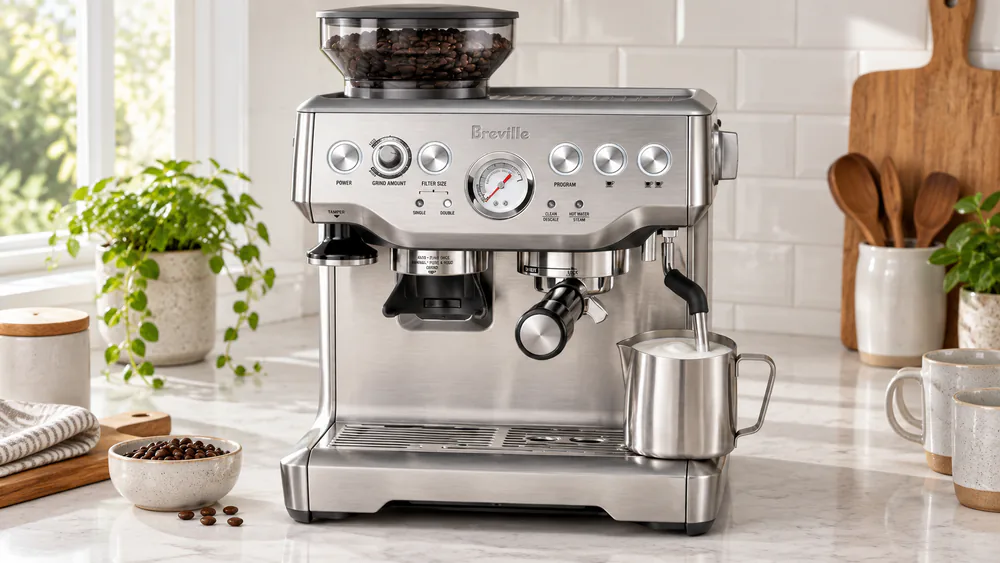
The Breville Barista Express single-hole steam wand angled into a stainless steel milk jug, microfoam forming on the surface.

Daily Workflow and Ease of Use

The Express is a grind-to-cup machine: dose the beans, lock in the portafilter, and pull. The workflow becomes second nature after the first weeks, and the 54 mm portafilter is easier to fill than a commercial 58 mm. The mess is the machine's bad habit: stray grinds end up in the drip tray and mix with water into sludge, and the tray fills fast because the three-way solenoid vents into it after every shot. The red float catches it before a spill, but plan on emptying the tray every few days.

Cleaning, Descaling, and Maintenance

Maintenance is straightforward and non-negotiable. The consumables, group-head gasket, shower screen, and water filter, pop out without tools, and the machine tracks the rest with backflush and descale lights. Descale every 2 to 3 months with filtered water to protect the pump and thermocoil lines, change the water filter every 60 uses or about every 2 months, and wipe and purge the steam wand after every use.

Warning. Skipped descaling is the most common cause of an early death for this machine. Treat the descale indicator as a deadline, not a suggestion.

The Breville Barista Express drip tray pulled out for emptying, the red fill float visibly risen, portafilter basket drying on the grid.

Barista Express vs. the Competition

The Express no longer competes only with other brands: Breville now sells two siblings around it, the Barista Pro and the Bambino Plus, and the Gaggia Classic Pro keeps its own following. If the whole lineup has you confused, our Breville Barista Pro vs Touch comparison sorts the upper-tier models.

ProductPriceGrinderHeat-up timeSteam powerWorkflowBest for
Breville Barista Express $684.99 Built-in conical burr, 16 settings Under a minute (about 45 s) Single-hole wand, 50-60 s for 6 oz milk All-in-one, grind to cup; 30-45 s between brew and steam Beginners who want one box on the counter
Breville Barista Pro $849.95 Built-in conical burr, 30 settings, Baratza burrs About 3 seconds (ThermoJet) Manual wand, about 10 s for 6 oz milk All-in-one, fastest workflow, LCD timer Daily latte drinkers who value speed
Breville Bambino Plus $499.95 None, needs a separate grinder About 3 seconds (ThermoJet) Automatic wand, 266 degree F steam, 3 temps and 3 textures Compact, no grinder, auto steam Small kitchens with a separate grinder
Gaggia Classic Pro (E24) $451.21 None, needs a separate grinder Around 3 to 5 minutes Commercial 2-hole wand, enough for two cappuccinos Manual single boiler, hobbyist routine, backflushing required Espresso purists who like to tinker

vs. Breville Barista Pro

The Pro is the Express with the wait removed. ThermoJet heating reaches brew temperature in about 3 seconds from cold, versus about 45 seconds on the Express, and the steam transition takes about 11 seconds after a shot instead of a 30 to 45 second wait. It adds 30 grind settings with Baratza burrs, an LCD with a shot timer, and a 2-year warranty. For the daily difference, see our Breville Barista Pro vs Barista Express comparison.

vs. Breville Bambino Plus

The Bambino Plus is the Express without the grinder and without the wait. It heats in about 3 seconds, steams automatically with three temperatures and three texture levels, and costs about $499.95, but it has no built-in grinder, so you need your own grinder, and it is light enough to slide when you lock in the portafilter. If you already own a grinder, the Bambino Plus is the better buy; if you want one box, the Express wins.

vs. Gaggia Classic Pro

The Gaggia Classic Pro is the hobbyist alternative at about $451.21, with no grinder, a 58 mm commercial portafilter, and a 3 to 5 minute heat-up. The current E24 generation uses a brass boiler, the fix for the earlier Evo Pro whose coated aluminum boiler flaked into the water. It demands more of you, manual steam, backflushing, and a steeper learning curve. The Express is easier to live with daily; the Gaggia is easier to love if you like to tinker.

Common Problems and How to Fix Them

Most Express problems have known causes and cheap fixes. Dose wanders, so purge the grinder weekly. Beans bridge in the hopper, and a gentle tap breaks the bridge. Stray grinds turn to sludge in the drip tray, so use the included dosing funnel and empty the tray when the float rises, and wet-towel the steam wand after every use.

After years of daily use, the grinder's plastic chute and hopper parts can crack or clog, and the automatic volume shut-off can fail on very old units. A burned-out solenoid is a $20 part and a straightforward repair, though leaking o-rings can end one before it starts. A minority of units fail within the first week, which is what the retailer return window is for.

Tip. Purge the grinder weekly by grinding about a gram of beans through before your first shot. It clears the stale grounds and steadies the dose.

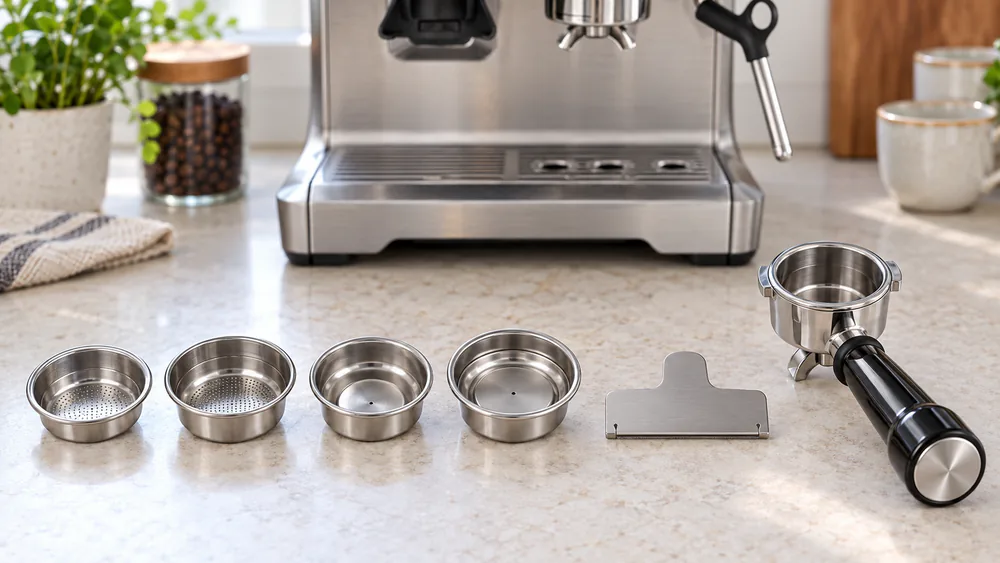
The four Breville Barista Express baskets side by side, single wall and dual wall in 1-cup and 2-cup sizes, with the Razor dose trimming tool.

Long-Term Reliability: After 500+ Shots

The 500-plus-shots framing undersells the Express. Our five-year unit logged more than 3,500 extractions with zero rust and remarkably little burr wear, and most daily-use machines run 6 to 8 years, with some crossing a decade. The build holds up; the compromises age. The stepped grinder is the long-term bottleneck, and the workaround was holding the grind setting and adjusting dose by plus or minus 0.5 g.

Failures cluster in the grinder assembly, and skipped descaling is the most common cause of an early death. We also saw the long tail: a 2015-vintage unit lost its automatic volume shut-off after about nine years of daily use, and a six-year unit lost its solenoid mid-shot, a $20 part that should have been an easy fix until leaking o-rings ended the repair. The machine is repairable by design, and parts are cheap and easy to find.

Price and Value: Is It Worth the Money?

The Express lists at $699.95 and typically sells for about $684.99, though street pricing moves week to week. It regularly drops to around $500 on Prime Day and Black Friday, with good deals running 20 to 30 percent off list, so it pays to wait for a sale. Even at full price it undercuts the Barista Pro by about $150, and the built-in grinder saves you the $150 to $300 a separate one would cost. Check the current price on Amazon to see where it sits today.

Who Should Buy It (and Who Shouldn't)

Buy the Barista Express if this is your first espresso machine, if you want the whole workflow in one box, and if you are willing to spend a few weeks learning. It suits people who make one or two milk drinks a day and enjoy the ritual.

Skip it if your mornings are a race, because the Pro heats and steams much faster. Skip it if you already own a grinder, because the Bambino Plus gives the same shot quality for less, with automatic milk. Skip it if you regularly make espresso for a crowd, because the single boiler slows every round, and skip it if you want push-button convenience, because the Express is a teacher, not an automaton.

Tips for Getting the Best Shots

Dialing in is the whole game with this machine. Start near the middle of the 16-step dial, pull a double shot, and adjust one step at a time based on timing: too fast means grind finer, too slow means coarser. Let the machine warm 10 to 15 minutes for the most consistent shots, purge the grinder weekly, and give the steam wand a five-second purge when you switch from brew. Start with the dual wall baskets for pre-ground coffee, then swap to single wall once the grind is dialed in.

Tip. Once shot timing is close, stop stepping the grind dial and adjust dose by plus or minus 0.5 g instead. The 16 steps are too coarse for small changes.

What Real Owners Say: Reddit and Customer Feedback

The long-term record we tracked for this review is a story about maintenance more than design. Units that get wiped, purged, and descaled run for years; units that skip it die young. We agree that the grinder and the steam wand are the weak points, and we push back on calling the Express a bad machine. It has clear trade-offs and an exceptional teaching record, which is not the same thing.

Skipped maintenance kills more of these machines than any design flaw, and the fix is a five-minute habit.

Frequently Asked Questions

Can you use pre-ground coffee with the Barista Express?

Yes, with the dual wall (pressurized) baskets in the box. They pressurize pre-ground coffee so it extracts properly; the single wall baskets are for fresh grind once you dial in.

Is the Barista Express good for beginners?

Yes, if you are ready to learn, and the first weeks are where that learning happens. Expect to practice three moves: dosing the basket consistently, tamping it level, and watching the gauge while the shot runs. Pre-infusion forgives a slightly uneven tamp, which is exactly the forgiveness a first-time buyer needs.

Does the 1-year warranty matter?

Less than the sticker suggests. It covers defects, but the parts that actually fail on this machine, grinder components and o-rings, wear out after years of use, long after the warranty ends. The failure window a warranty would catch is the first week, and the retailer return period already covers that. From there, the maintenance habit matters more than the warranty term.

What descaling solution should you use?

Use a food-safe descaler made for espresso machines, liquid or tablet, and skip household vinegar, which is hard on thermocoil elements and leaves a smell in the lines. After the cycle, flush the tank with fresh water, then run the steam wand briefly to clear its tip.

Barista Express or Barista Pro: which is better?

The Pro heats up in about 3 seconds instead of under a minute, adds 30 grind settings, steams faster, and carries a 2-year warranty, at roughly $165 more. Shot quality is comparable, so the Pro is for speed and the Express for price and learning.

Can the Barista Express make regular coffee?

Not directly. The Express is an espresso machine, not a drip brewer, so a plain cup of drip coffee is off the menu. Pull a double shot and top it with hot water for an americano, and you have a mug-sized drink.

Final Verdict: Is It Still Worth It in 2026?

Yes, with the conditions spelled out. The Express is still the best all-in-one starter machine in 2026 for the buyer who wants to learn espresso from a machine that teaches, and who will use it daily. What we would do differently: budget for the day you outgrow the built-in grinder, since a separate grinder is the standard upgrade path. Who it loses to: the Barista Pro if your mornings cannot spare 45 seconds of heat-up and a minute of steaming, and the Bambino Plus if you already own a grinder. See today's price on Amazon if you are ready to buy. For everyone else, the Express remains worth it in 2026.

Read next

Ready to upgrade your kitchen?

Browse more tested reviews and buying guides, or get our latest picks straight to your inbox.