
Helping you create a kitchen you love.

Knives & Cutlery

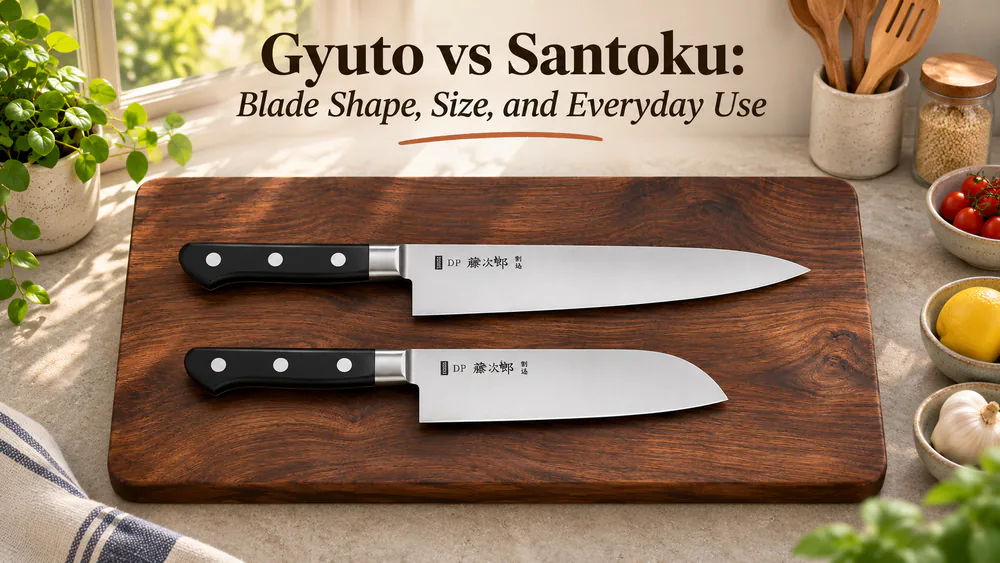
Gyuto vs Santoku: Blade Shape, Size, and Everyday Use

As an Amazon Associate we earn from qualifying purchases. We may earn a commission from links on this page, at no extra cost to you. Learn more.

Gyuto vs Santoku: Blade Shape, Size, and Everyday Use

A gyuto is the Japanese take on the Western chef's knife: a longer blade with a curved belly and a sharp, pointed tip. A santoku is the compact home-kitchen all-rounder: a shorter, flatter blade with a rounded-down tip and a tall heel. Both are thin, sharp, and a joy to cut with.

The real difference is how each one moves through food. In our kitchen, we rock and slice with the gyuto and use straight chops and push cuts with the santoku; that difference in technique largely determines which we choose.

Quick Answer: Gyuto or Santoku at a Glance

If you want one knife for a small board and mostly vegetables, buy the santoku. If you cook a lot of meat and fish, or you like a rocking motion, buy the gyuto. Either one is a fine all-purpose workhorse for a home cook.

Here is the short version. A santoku usually runs 165-180mm, while the most common gyuto is about 210mm. That extra length gives a 210mm gyuto roughly 25% more usable cutting edge than a 165mm santoku, and the pointed tip opens up fine work the santoku cannot do.

The santoku is easier to learn, while the gyuto offers more room to develop your technique.

Tip. Sizing tip: match about a 210mm gyuto to a 165-180mm santoku. If this is your first Japanese knife, start with the santoku unless you already own a large board and cook big cuts of meat.

What Is a Gyuto?

Gyuto means "cow sword." It is the Western-style chef's knife as Japan adopted it in the Meiji era, in the late 19th century, then refined with thinner steel and a sharper edge.

Shape and Length

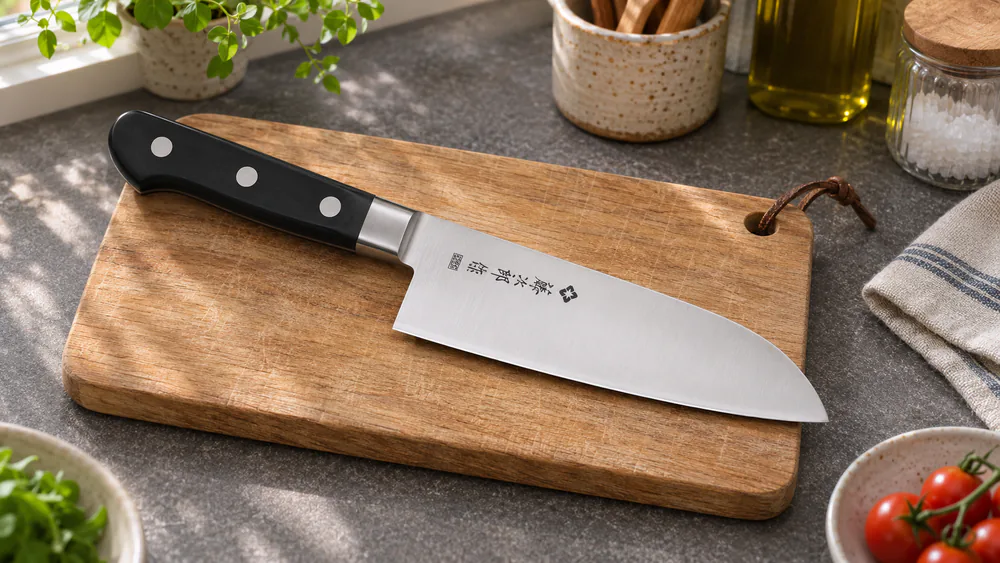
The belly is the curved part of the edge toward the front. On a gyuto it rises into a sharp, narrow tip, which makes the knife built for a rock chop. Gyuto come in many sizes. Eight inches (about 200mm) is the most common, and a line like the Tojiro Classic runs from 180mm to 330mm.

Modern gyuto are usually double-bevel, ground evenly on both sides, so right- and left-handed cooks are equally comfortable.

Best Uses

The gyuto's belly suits rock chopping herbs, garlic, and shallots, with the tip staying on the board. The pointed tip does the fine work a santoku cannot: scoring fish skin, trimming silverskin in one pass, and piercing a roast to cut slits for garlic. The long blade also reaches across a large cabbage, a dense pumpkin, or a beef loin.

Both knives are thin, hard, double-bevel, and all-purpose. Our Japanese knife reviews cover other shapes if you want to look further afield.

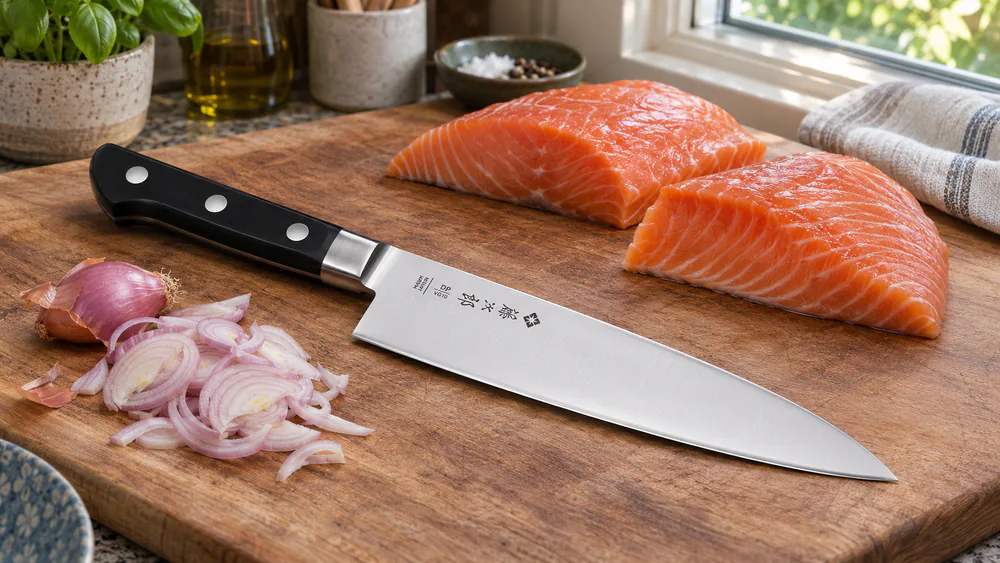
A Tojiro DP gyuto 210mm lying on a wooden cutting board beside sliced shallots and a halved salmon fillet, pointed tip toward the camera
Tojiro DP Gyuto 210mm
1

Tojiro DP Gyuto 210mm

Our Gyuto Pick
Check Price on Amazon

The Tojiro DP gyuto came out of the box extremely sharp, far keener than a typical German block knife, and it passed our paper test straight away. At 210mm it feels comfortable and well balanced rather than heavy, so it is an easy first step up from a smaller knife. The edge dulls with hard use but comes back with a honing steel at home, though a few minor chips can show up if you are rough with it. The cladding is soft, so use the soft side of a sponge when cleaning, because a green abrasive pad scratches the sides.

Pros

  • VG10 core clad in 13-chrome stainless, in a three-layer San Mai build
  • Arrives paper-slicing sharp
  • Balanced at just under 200 grams, with about 45 mm of heel height
  • Pointed tip for fish, trimming, and roast work

Cons

  • Soft cladding scratches easily
  • Hard use can chip the edge
  • Needs a full-size board

What Is a Santoku?

Santoku means "three virtues," usually read as chopping, dicing, and mincing, or as meat, fish, and vegetables. It appeared in 1940s Japan as a home-kitchen all-rounder, pairing a flat edge like a nakiri's with a lowered tip for meat.

Shape and Length

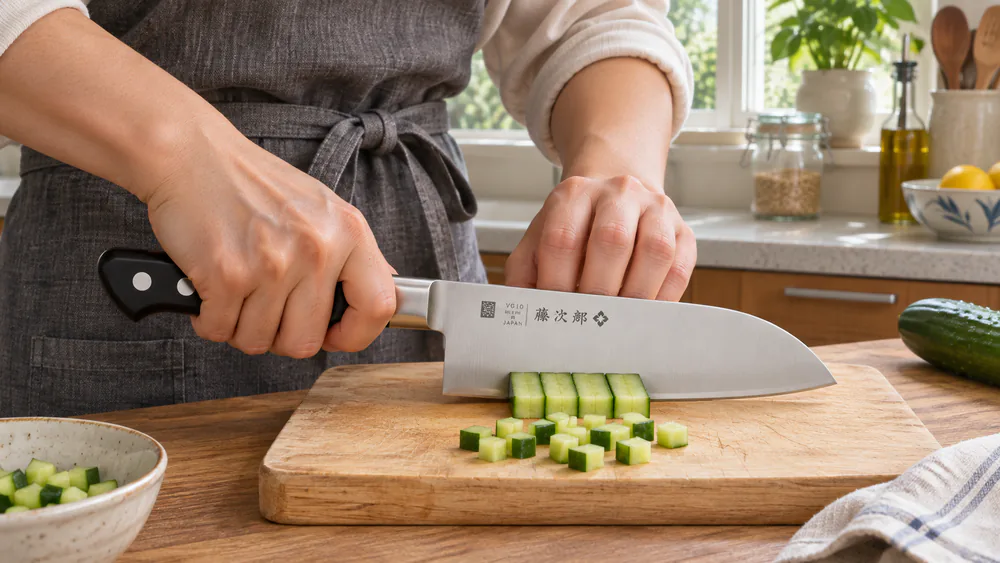
The santoku has a flat edge and a downturned sheepsfoot tip, a rounded spine that curves down to meet the edge. It is taller at the heel than its length suggests, which gives your knuckles generous clearance over the board. Santoku usually run 165-180mm, and examples like the Tojiro at 170mm, the MAC at 165mm, and the Shun at 7 inches all sit in that range.

A nakiri is a close cousin, a flat rectangular vegetable knife of about 160mm to 170mm.

Best Uses

The flat edge meets the board along its whole length, so push cuts go all the way through with no thin strings of skin left behind, unlike the accordion effect of a curved blade. It suits straight chops and push cuts on onions and cucumbers. The wide flat face also scoops chopped food from board to pan.

A santoku feels approachable if you are used to smaller Western knives, because the lowered tip keeps up-and-down chopping natural. Its limit is reach: a 165mm blade runs out of room on a large cabbage, dense pumpkin, or long beef loin.

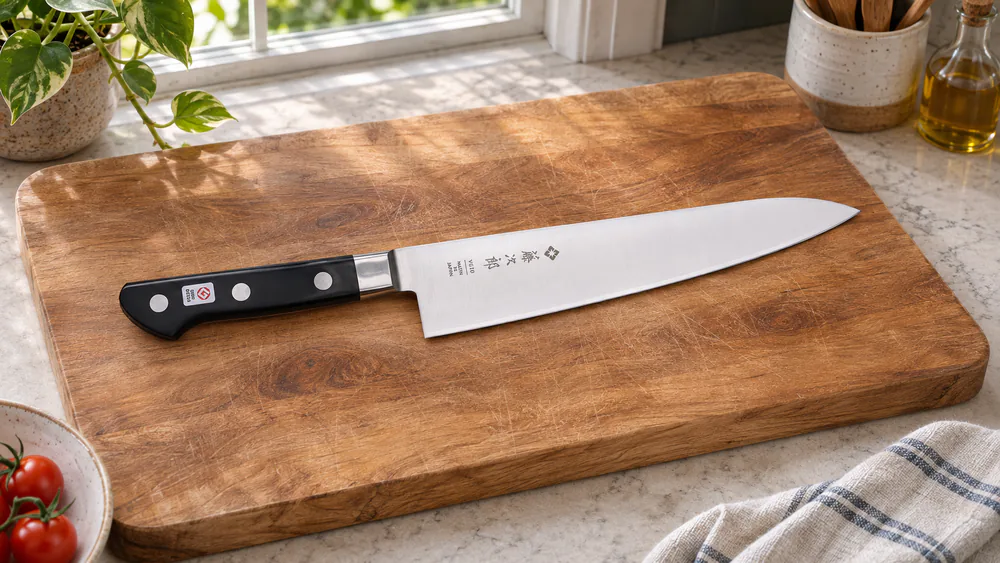
A Tojiro DP santoku 170mm dicing a cucumber on a small cutting board, flat edge meeting the board along its full length
Tojiro DP Santoku 170mm
2

Tojiro DP Santoku 170mm

Our Santoku Pick
Check Price on Amazon

The Tojiro DP santoku arrived razor sharp and sliced tomatoes cleanly, and the flush handle sat comfortably through a pile of diced vegetables. The edge does not hold as long as harder carbon steels, but being stainless it stays clean and sharpens easily on a whetstone, which makes it a forgiving first stone-sharpening project. The blade is stiff, built for fast dicing, and it shrugs off careless handling. One care point: left wet, it can start to spot with rust within a couple of months, so dry it after washing.

Pros

  • 170mm blade with a flat edge and downturned tip
  • Cobalt alloy core with 13-chrome stainless sides
  • Around 190 grams, with a heel in the mid-40s millimeters
  • Even double-bevel edge for left- and right-handed cooks
  • Forgiving to sharpen on a whetstone

Cons

  • Edge does not last as long as harder steels
  • Can spot with rust if left wet
  • Too short for large cabbages and roasts

Gyuto vs Santoku: Side-by-Side Comparison

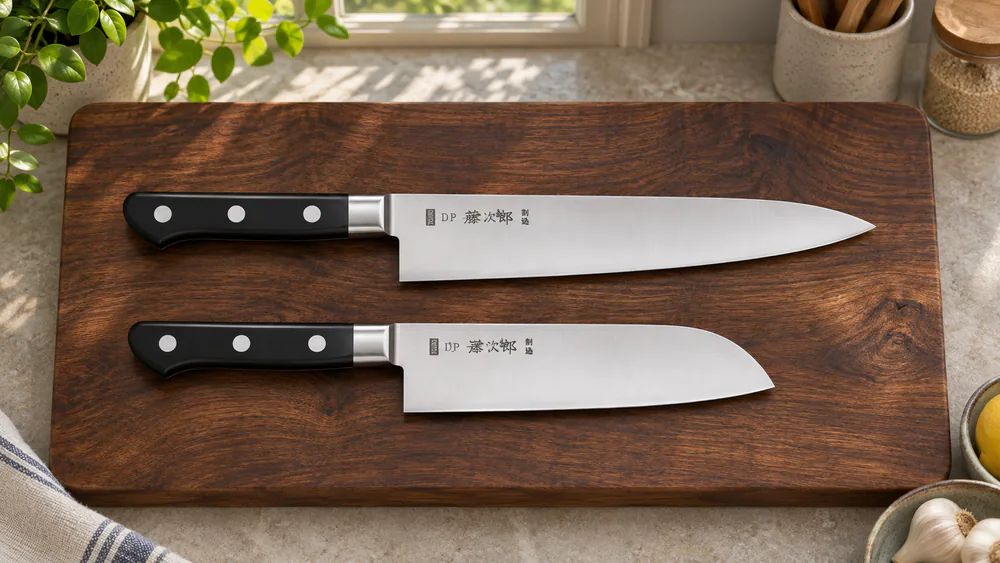
A Tojiro DP gyuto and a Tojiro DP santoku laid side by side on a dark board, showing the gyuto's curved belly and pointed tip against the santoku's flat edge and rounded tip
FeatureGyutoSantoku
Blade lengthAbout 210mm (180mm and up)165-180mm
ProfilePronounced curved bellyFlat edge, slight curve
TipPointed, sharpSheepsfoot, rounded down
HeightAbout 45 mm at the heel (Tojiro DP)Mid-40s mm at the heel, taller for its length
WeightJust under 200 grams (Tojiro DP)Around 190 grams (Tojiro DP)
Steel and price tierVG10 core (Tojiro DP); mid to premiumCobalt alloy core (Tojiro DP); budget to mid
Best tasksRock chop, slicing proteins, tip workPush cut, straight chop, vegetables
Learning curveSteeperGentler
Small-kitchen fitNeeds a full-size boardFits small boards and hands

Key Differences

Blade Shape and Profile

The gyuto curves upward to a pointed tip. The santoku runs flat and drops to a rounded tip. That one change in the profile is what drives every other difference in use.

Blade Length and Weight

A 210mm gyuto simply covers more board. The Tojiro DP gyuto weighs just under 200 grams, and the Tojiro DP santoku around 190 grams, so in this pairing the gap is tiny. Weight depends on handle and construction as much as knife type.

A 240mm gyuto, by contrast, feels clumsy on a small apartment cutting board. Pick the length your counter can actually hold.

Cutting Technique: Rock Chop vs Push Cut

A rock chop pivots the blade on its tip, rolling the belly through food, and it suits herbs and aromatics. A push cut drives the blade forward and down in one motion, and the santoku's flat edge does it cleanly. With the santoku, the board does half the work because the whole edge lands at once.

The gyuto asks for a little practice, but it pays you back with versatility.

Steel, Sharpness and Maintenance

Both of our Tojiro picks are stainless and sharpen readily on a whetstone. The gyuto has a VG10 core, while the santoku uses a cobalt alloy core, and both are clad in softer 13-chrome stainless. Neither needs more than drying after washing and a gentle sponge.

Price

The gyuto generally sits in the mid-range to premium tier, while the santoku runs budget to mid-range, because a longer blade means more steel and more cost. At comparable quality, expect to pay less for the santoku. That is why gyuto knives usually cost more, and the Tojiro DP gyuto is the cheapest way we know into a proper VG10 gyuto.

Which Knife Is Better for Vegetables, Meat, and Beginners?

Vegetables and Small Prep

The santoku wins here. Its flat edge, tall heel, and wide face make quick work of onions, cucumbers, and tomatoes, and the knuckle clearance keeps your hand comfortable. Granton-edge santoku, with small hollow ovals along the blade, release thin slices more easily. A gyuto handles vegetables well too, especially herbs, but it takes more board.

Meat and Fish

The gyuto wins. The long blade slices roasts and loins in fewer strokes, and the tip handles trimming and scoring. A santoku lacks reach on larger cuts.

Beginners and Small Kitchens

For beginners, the santoku is the friendlier knife. It is shorter, the profile is simple, and it fits small boards and small hands. It is also a forgiving first stone-sharpening project, since you can keep improving on it. A gyuto is not hard, but the longer blade and rocking technique mean a steeper learning curve.

When to Choose a Gyuto, and When to Choose a Santoku

Choose a gyuto if you cook a lot of meat and fish, you have a full-size board, and you enjoy rock chopping and tip work. Choose a santoku if you live in a small kitchen, prep mostly vegetables, or want the easiest path into Japanese knives.

If you are still torn, our chef knife vs santoku comparison walks through the same decision against the Western chef's knife.

Can You Own Both?

Yes, and many home cooks do. The two knives cover different jobs. Use the santoku for fast vegetable prep and the gyuto for proteins and big produce.

If you can only buy one now, add the other later.

Frequently Asked Questions

Is a santoku or gyuto better for beginners?

The santoku. It is shorter, it fits small boards, and the lowered tip keeps up-and-down chopping natural. A gyuto is a fine first knife if you already have a large board and want to learn rock chopping.

Can a gyuto do everything a santoku can?

Nearly. A gyuto chops, slices, and dices well, but its curve is less suited to clean push cuts, and it needs more board space. A santoku is easier to control in a tight kitchen.

What size gyuto equals a santoku?

A 210mm gyuto is the usual match for a 165-180mm santoku. Published length ranges vary by maker, so treat these as typical sizes rather than hard limits.

Why are gyuto knives usually more expensive?

A longer blade uses more steel, and gyuto often sit in the mid to premium tier, while santoku run budget to mid-range. Entry-level options like the Tojiro DP show you can get a proper gyuto without paying for a premium line.

Final Verdict

Key takeaway. Buy the santoku if you have a small board, prep mostly vegetables, or want the gentlest start. Buy the gyuto if you cook a lot of meat and fish, have a full-size board, and want the longest reach and a useful tip.

For a modest kitchen, the Tojiro DP santoku is the straightforward choice. With room to spread out, the Tojiro DP gyuto gives you more blade for everyday cooking.

Read next

Ready to upgrade your kitchen?

Pick the blade that fits your board and your cooking, and enjoy every cut.