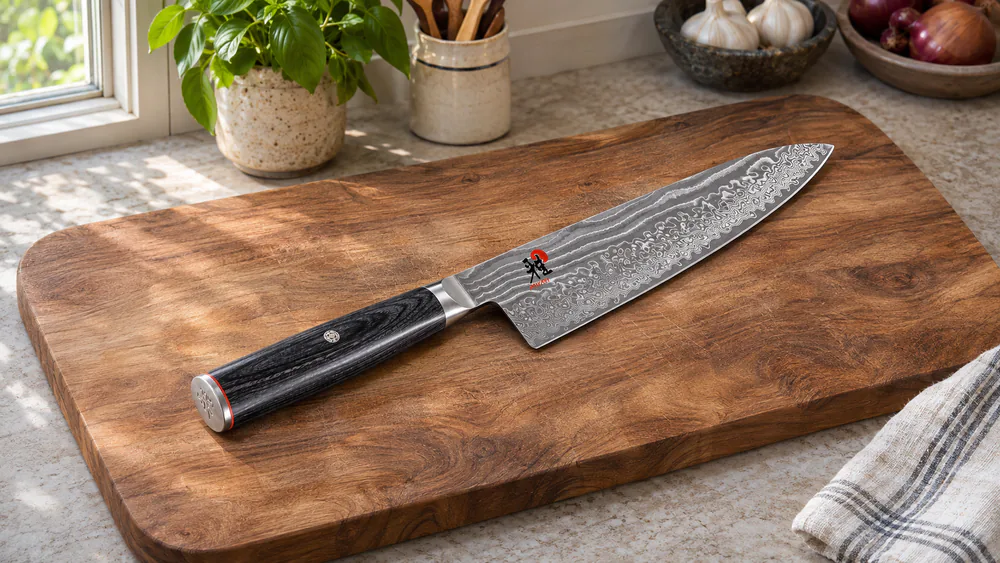
The factory edge slides through a tomato with almost no pressure, and the blade is light, quick and well balanced. Bottom line: a 4.4 for cooks who sharpen on stones.
Helping you create a kitchen you love.

Knives & Cutlery

As an Amazon Associate we earn from qualifying purchases. We may earn a commission from links on this page, at no extra cost to you. Learn more.
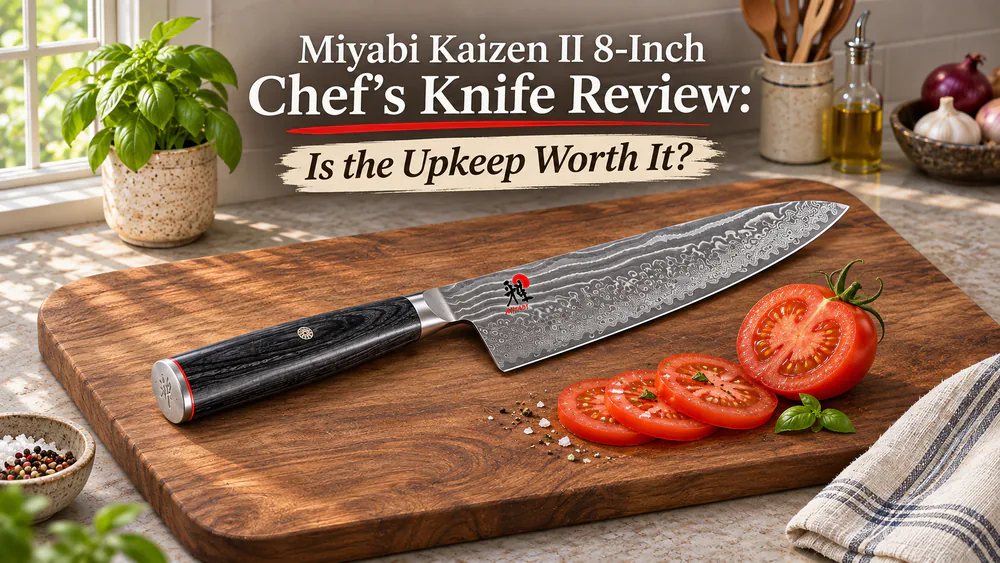
The Miyabi Kaizen II 8-inch is a Seki-made chef's knife with an FC61 steel core and a hand-honed, very acute edge. It rewards a cook who sharpens on stones and punishes one who does not.
Among the Japanese knives we cover, it is one of the sharpest you can buy off the shelf. That sharpness comes with a hard, brittle edge, so the real question is whether you will keep up with the care it needs.
Key takeaway. Quick verdict: we rate the Kaizen II 4.4 out of 5. It is a real step up in cutting feel for a cook who owns whetstones and respects the edge. It is a poor first knife, and a Shun Classic or Global G-2 is the safer buy if you cannot sharpen yet.
We judge a chef's knife the way a working kitchen does: how keen the edge is out of the box, how long it stays keen in daily use, how the handle feels once the prep list gets long, and how easily the steel comes back on a home sharpener.
We kept the Kaizen II in regular prep rather than treating it as a showpiece, because the Damascus finish and the edge only prove themselves over a stretch of ordinary cutting.
Every judgment below is ours, and the scores follow those four tests. We compared the Kaizen II against the Shun Classic, Tojiro DP and Global G-2 because those are the knives a shopper actually weighs it against.
The model we reviewed is 34681-203, the FC61 version, not the original Kaizen with a VG10 core.
| Model | 34681-203 |
|---|---|
| Steel | FC61 fine-carbide steel core |
| Cladding | 48 layers of stainless Damascus |
| Hardness | 61 HRC (maker range 60 to 62) |
| Blade length | 8-inch (200 mm) |
| Weight | Light for its size |
| Handle | Black pakkawood, D-shaped |
| Edge angle | 9.5 to 12 degrees per side |
| Origin | Handcrafted in Seki, Japan |
| Warranty | Check the maker's current terms |
The core is FC61, a fine-carbide steel (a steel with small, evenly spread hard particles that help it take and keep a fine edge). It is wrapped in 48 layers of stainless Damascus cladding and double ice-hardened with the FRIODUR process for corrosion resistance and edge durability.
The hardness is about 61 on the Rockwell scale; this explanation of how the Rockwell hardness scale is measured covers the test, which records how deeply a standard point presses into the steel. Harder steel holds an edge longer but chips more easily.
The blade is 8 inches, a standard gyuto length. Its thin, light design reflects the Japanese kitchen knife styles and construction discussed in this overview. The handle is black pakkawood (resin-stabilized wood) in a D shape with a mosaic pin, red spacer and a thicker, rounded bolster.
The Kaizen II stands out for its appearance as well as its specifications. The dark, acid-etched Damascus face is the knife's calling card, and it holds up. After weeks of daily use the finish stays good, with little scratching on the dark face.
The factory edge slides through a tomato with almost no pressure, and the blade is light, quick and well balanced. Bottom line: a 4.4 for cooks who sharpen on stones.
The finish is only half the story, so here is how the blade cuts.
Out of the box, this is the keenest knife we handle straight from the packaging. Tomatoes, onions and herbs part with almost no pressure.
The edge stays keen through a week of heavy meal prep without needing a rod every few minutes. That is the payoff for the hard steel. The cost is that the very acute, very hard edge chips instead of rolling if it meets bone, a twist through squash, frozen food or a tile floor. A chip like that has to be ground back on a stone, and a rod will not fix it.
The D-handle fills a larger palm with a warm feel, and the balance point sits right at the pinch grip. The blade feels light and quick, which takes some adjusting if you are used to heavy German blades. Left-handers should know the ridge sits wrong for them, since the handle is built for the right hand.
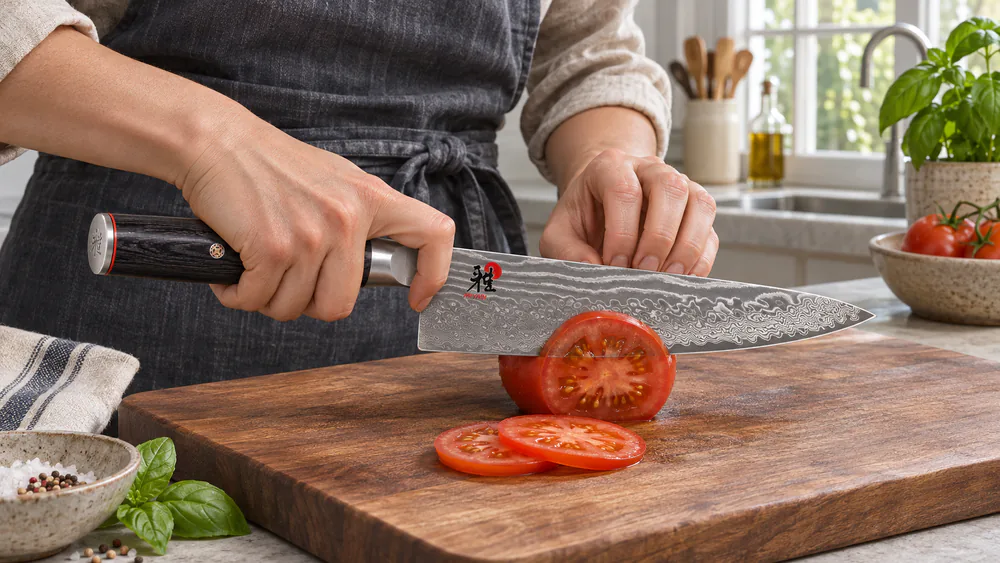
Because that edge chips so readily, care matters more here than on most knives. Hand wash and dry it at once, cut on a wood or plastic board, and keep it out of the dishwasher. Never twist the blade, and never cut bone or frozen food.
Warning. Do not sharpen it freehand at a comfortable 15 degrees. That quietly erases the geometry you paid for. Use a whetstone at a low angle, and skip any coarse, grooved honing rod.
Learning to sharpen on a stone is the real price of ownership here.
Buy it if you already sharpen on stones, cut mostly vegetables, fish and boneless meat, and want a light knife that feels like a step up. It is worth the money for that cook.
Skip it if it will be your first good knife. A cook who cannot yet sharpen a hard Japanese edge will chip it and be unable to fix it, and a dull Miyabi cuts worse than a sharp Tojiro. Left-handers and anyone who cuts through bone should also look elsewhere.
| Knife | Steel | Hardness | Handle | Upkeep |
|---|---|---|---|---|
| Miyabi Kaizen II | FC61 core, 48-layer cladding | 61 HRC | Black pakkawood D | High, stone sharpening |
| Shun Classic | VG-MAX core, 68-layer cladding | Not published | Pakkawood D | Moderate to high |
| Tojiro DP | Hard stainless core, plain cladding | Unconfirmed | Composite | Moderate |
| Global G-2 | Molybdenum/vanadium stainless, one piece | Softer, more forgiving | Seamless steel | Forgiving |
The Tojiro DP (a 210 mm gyuto) gives the same class of hard core and a decent but average factory grind at a budget tier. The Tojiro needs sharpening to reach its best, and it is the smarter buy if you care more about value than a Damascus finish.
The Global G-2 holds its cut after months of regular use, is light and well balanced, and cleans easily thanks to its seamless steel handle. It carries a lifetime warranty against defects and breakage.
The Shun Classic is also light, thin and easy to use, with a VG-MAX core and a 16-degree edge. The Kaizen II cuts finer with its 9.5 to 12 degrees per side, but the Shun is less fragile. It still chips if neglected and needs hand care after every use, so choose it if you want a Japanese look with a bit more tolerance. Our Shun Classic review covers it in full.
Yes, for a cook who sharpens on stones and wants the keenest edge in a light knife. It is a premium pick, so if you will not maintain it, a Global G-2 gives you more years of easy use for less trouble.
It is possible but awkward. The D-handle is built for the right hand, so the ridge sits wrong in a left palm, and a symmetrical handle such as the Global G-2's seamless steel one suits left-handers better.
The Shun Classic is the less fragile of the two, with a 16-degree edge against the Kaizen II's 9.5 to 12 degrees per side. It still chips if neglected, but it forgives more.
A rod will not repair a chip, and a coarse, grooved one damages the fine edge. Treat the stone as the only real maintenance tool.
If the Kaizen II's upkeep still gives you pause, the Tojiro DP is the cheaper hard-steel step to take first. It lets you learn stone sharpening on a less costly blade before you move up to a Miyabi.
Browse our buying guides to find the right knife for the way you cook.