
Knives
Santoku Knife Uses: What to Cut and How to Cut It

As an Amazon Associate we earn from qualifying purchases. We may earn a commission from links on this page, at no extra cost to you. Learn more.
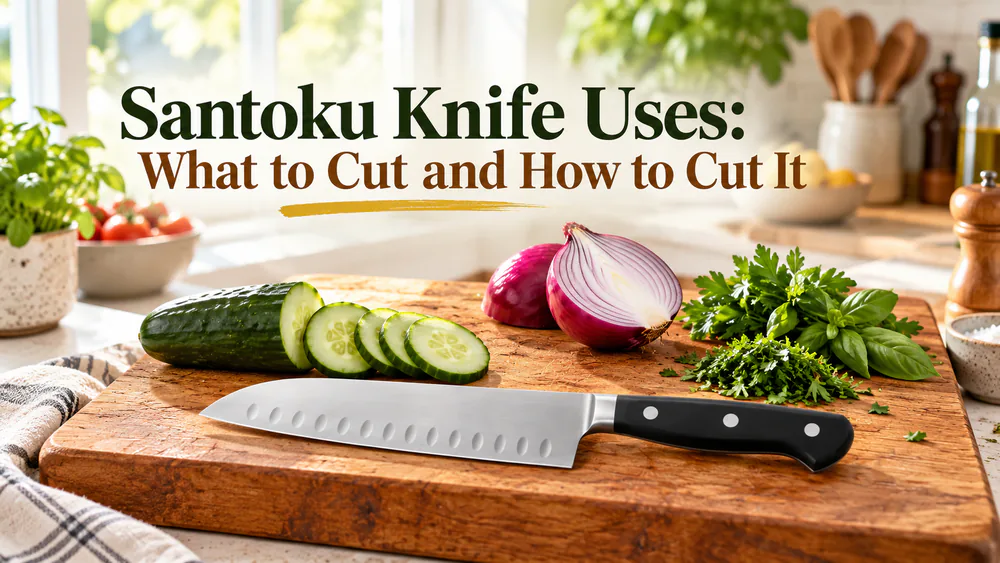
A santoku is a general-purpose Japanese-style kitchen knife built for slicing and dicing vegetables and fruit, portioning boneless meat, preparing fish fillets, and mincing herbs and garlic. It shines in controlled, everyday chopping with a forward-and-down push cut. It is not the right tool for bones, frozen blocks, or crusty bread, and we will show you what to reach for instead.
What Is a Santoku Knife?
Santoku is a Japanese knife style, and the name is usually translated as "three virtues." Even that translation has two common readings. Some cooks take it to mean meat, fish, and vegetables, while others take it to mean slicing, dicing, and chopping. Neither list defines the term on its own; both describe a knife that handles a wide range of everyday tasks.
The shape explains why. A santoku has a broad blade, a relatively flat cutting edge, and a spine that curves down toward the tip. That profile keeps the edge close to the board for clean, controlled cuts. Some blades are plain, and others are fluted with shallow dimples along the face.
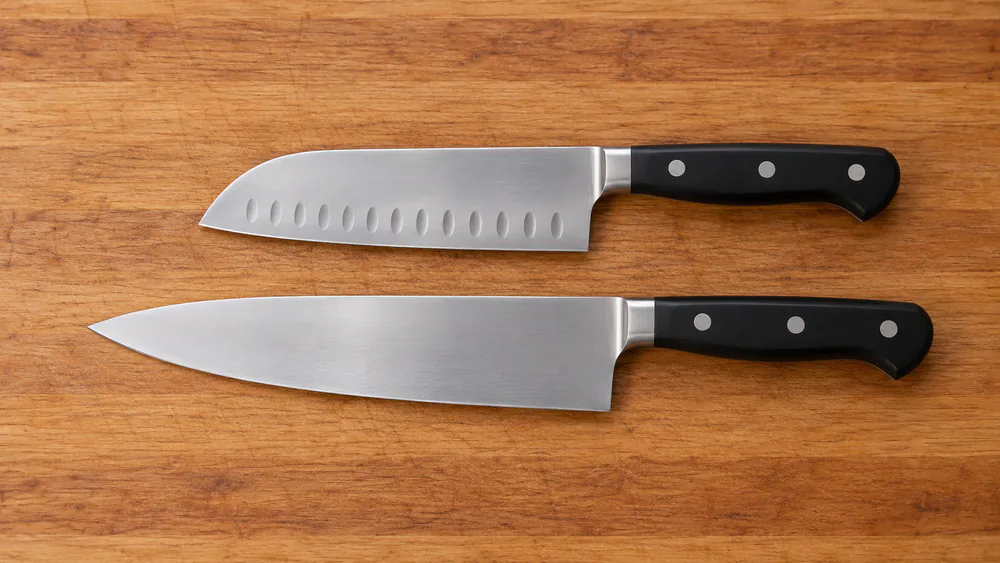
Around 17 cm is a common santoku blade length for everyday preparation, though it is not a required size. Bevel geometry varies by knife; the santoku name alone does not tell you how the edge is ground. Many everyday santokus have a double bevel, so we check the actual blade before we ever touch a stone. If you want to see how the wider family behaves, our Japanese knife reviews cover the steels and edge shapes in more depth.
Everyday Uses for a Santoku Knife
Think of a santoku as the knife for the first hour of dinner prep. Most of what lands on the board is vegetables, fruit, a portion of boneless protein, and a handful of aromatics, and that is exactly the work its shape favors.
Slicing and Dicing Vegetables and Fruit
This is the santoku's home turf. The flat edge meets the board along most of its length, so a single push cut finishes the slice instead of leaving a little uncut skin at the end. Onions, peppers, cucumbers, apples, and zucchini all go quickly.
Dense produce is where a thin, sharp blade proves itself. In testing, a thin santoku sliced raw potato cleanly, while a thicker blade dragged through onions and took extra effort to pull back out between slices. A sharp edge alone does not guarantee easy cutting, so blade thickness matters as much as sharpness.
Expect some sticking. Moist, thick produce can grip the blade even when the edge feels sharp, and thin slices can stick and stack against the broad face. Dimples are meant to help with food release, but ingredients and technique affect the result, and a smooth blade can do the same prep.
Cutting Boneless Meat and Fish
A santoku portions boneless chicken, pork, and sliced beef well, and it handles prepared fish fillets for cutting into portions or cubes. The working length of the blade sets the limit. Trim a fillet into servings, dice a boneless thigh for stir-fry, or cut a steak against the grain, and a santoku does it comfortably.
When the meat contains bone, choose a knife suited to that task. Following ribs or breaking down a whole fish belongs to a fillet knife, and separating meat from bone belongs to a boning knife.
Mincing Garlic and Herbs
A short santoku feels nimble for garlic, shallots, and herbs, and a smaller blade leaves useful knuckle clearance above the board. A thin, sharp edge can mince delicate herbs without bruising them into a paste. Keep the tip down, use the guide hand to hold the herbs in a tight pile, and work the blade through in short, controlled strokes.
Santoku vs. Chef's Knife: Which Should You Use?
Both knives are multipurpose, and comparable sizes overlap substantially in everyday jobs. The real differences are the blade profile and how you move the knife.
| Criterion/task | Santoku | Chef's knife |
|---|---|---|
| Blade profile and cutting motion | Usually flatter, with a downturned tip; controlled push cuts; rocking depends on the belly curve | Usually more curved toward the tip; supports rocking and slicing; geometry varies |
| Routine vegetable prep | Slicing, dicing, and mincing with compact control | Slicing, dicing, and mincing; longer models give more reach |
| Boneless meat and fish prep | Portions boneless meat and prepared fillets within the blade's working length | Similar tasks; longer models may suit larger portions |
| Tasks where another knife is more suitable | Bread (serrated knife), peeling (paring knife), whole-fish filleting (fillet knife); avoid bones and frozen blocks | The same specialist limits; a chef's knife is not automatically a bone cleaver or freezer knife |
When to Reach for a Santoku
We pick a santoku when the job is a pile of vegetables, a few boneless portions, or fine mincing where we want the tip close to the board. Its compact handling also suits cooks with smaller hands or small counters.
When a Chef's Knife or Another Knife Fits Better
A longer chef's knife offers more working length for large ingredients and roasts, and its curved belly supports a rocking motion through a pile of herbs. For loaves, use a serrated bread knife. For peeling and detail work, use a paring knife.
How Does a Santoku Compare with a Nakiri?
A nakiri is a straight-edged vegetable knife that slices and dices produce with a down-and-forward push cut. Its rectangular look does not make it a bone cleaver. A nakiri puts vegetables first, while a santoku adds an all-purpose profile that also covers boneless proteins. Both reward the same controlled push-cutting habit.
How to Use a Santoku Knife
Technique matters more than the knife name. A good grip and an unhurried stroke do most of the work.
Set Up Your Board and Grip
Put a damp towel under the board so it cannot slide. Wood is a useful default cutting surface. Suitable plastic depends on the knife maker's guidance, and glass, stone, and ceramic boards should be avoided because they wear an edge quickly.
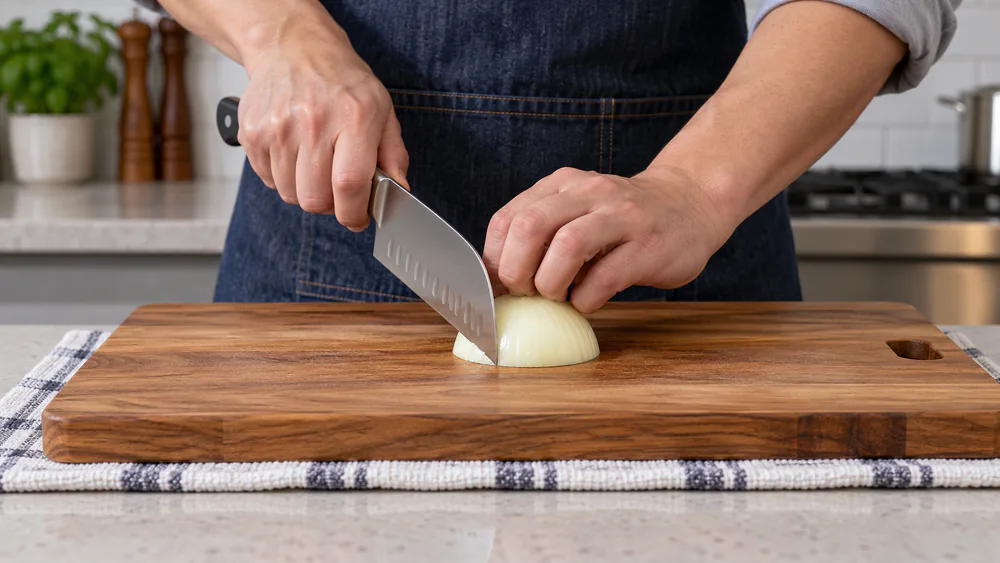
Pinch the blade near the handle between your thumb and curled forefinger, then wrap the remaining fingers around the handle. Curl the fingertips of your guide hand inward so your knuckles guide the blade and your fingertips stay tucked away.
Make Controlled Push Cuts
Use a forward-and-down slicing stroke, then recover the blade back to the start. Work slowly enough to control the edge, and avoid forceful vertical pounding. A flatter santoku favors this push cut, while a more curved section allows only limited rocking.
Here is how that plays out on the board. We found a thin, sharp santoku like the MAC Superior minces delicate herbs cleanly and slices dense potato without fuss. Watch for moist, thick produce gripping the broad blade and thin slices stacking against it; a quick wipe between batches helps keep cuts moving smoothly.
What Should You Avoid Cutting with a Santoku?
A fine slicing edge is not meant for everything, and the failure is usually a chipped or rolled edge rather than an instant break. Steer clear of these tasks.
- Bones and joints: use a boning knife around them, never through them.
- Frozen blocks: thaw first, or use a knife designed for it.
- Resistant winter squash and tough rinds: choose a knife made for that work.
- Whole-fish breakdown: a fillet knife follows the ribs better.
- Bread: a serrated knife saws through crust without crushing the loaf.
Warning. If the blade lodges in something hard, do not twist it sideways. Rock it straight back out, because side pressure is how thin edges chip.
How to Care for a Santoku Knife
Hand-wash gently, dry promptly, and avoid soaking. Prompt drying matters: a blade left wet can discolor, as one we tested did. Store the knife in a guard, a block, or a dedicated tray rather than loose in a drawer where the edge knocks against other tools.
Sharpening depends on the knife. Match the method to the manufacturer's edge geometry and the knife's condition, since there is no universal santoku angle or calendar interval. Steel, bevel, board, and how much you cook all change how often it needs attention. Check whether your blade is double bevel before you start, and follow the maker's instructions.
Also watch the handle. During long prep sessions, angular metal corners at the bolster can rub your hand, while smoother transitions are more comfortable to hold.
Is a Santoku Right for Your Kitchen?
If most of your cooking is vegetables, boneless proteins, and fine mincing, a santoku is a strong everyday choice. Balanced handling and controlled straight cuts can suit beginners, though preference and hand fit still matter, so hold a few before you commit. If you roast large cuts, break down poultry, or work through lots of squash, pair it with a longer chef's knife and a few specialists. When you are ready to shop, start with our guide to the best santoku knives.
Frequently Asked Questions
Can You Rock Chop with a Santoku Knife?
A little, depending on the knife. A flatter santoku favors push cuts, while a curved section allows limited rocking. Do not force a flat blade through a large rocking arc, and use a push cut for the cleanest slices.
What Size Santoku Knife Is Best for Home Cooking?
Around 17 cm is a common blade length for everyday preparation, but it is not a required size. A shorter blade feels nimble for garlic and shallots, while a longer one gives more reach for larger vegetables.
What Are the Dimples on a Santoku Blade For?
Dimples, sometimes called a Granton edge, are intended to improve food release. Ingredients and cutting technique affect the result, and a smooth blade can perform the same prep tasks.
Read next
Is a Santoku Right for Your Kitchen?
Explore our buying guides to find a knife that fits your everyday prep.