
An air fryer is a compact countertop appliance that uses rapid air circulation technology to cook food with 70 to 80 percent less oil than traditional deep frying. It works like a high-powered convection oven, creating crispy results without submerging food in grease, making it ideal for health-conscious home cooks seeking lower-calorie fried foods.
I have spent 12 years testing kitchen appliances and have evaluated dozens of air fryer models across every price point. During that time, I learned that wattage matters more than most buyers realize. Models with 1400 to 1600 watts deliver consistently crispy results and even heat distribution, while underpowered units struggle with thicker cuts of meat. For families, a 6 to 8 quart capacity handles four to six servings in one batch, eliminating the frustration of cooking in multiple rounds. These technical details come from real-world use, not spec sheets.
Air fryers are not perfect. They have limited cooking capacity compared to full-size ovens, and quality models range from $100 to $500. But for most households wanting healthier meals without sacrificing texture, the benefits outweigh the limitations. If you're also looking to upgrade other appliances, my guide on how to choose the right kitchen appliances can help you make smart decisions across the board.

What Is an Air Fryer (and Air Fryer Oven)?
An air fryer is a compact countertop appliance that cooks food with hot air circulation. Think of it as a small, powerful convection oven that sits on your kitchen counter.
Here is how it works. The air fryer uses rapid air technology to blast hot air around your food. A built-in fan moves the air super fast. This creates a crispy outer layer without dunking food in oil. The result? Food that tastes fried but is way healthier.
There are two main types you need to know about.
Basket air fryer: This is the classic style. You pull out a drawer. Inside is a fry-style grill basket. You put your food in. You set the time and temperature. You walk away. When it beeps, your meal is ready. Perfect for quick cooking and everyday use.
Oven-style air fryer: This looks like a small toaster oven. It has racks or trays instead of a basket. It can handle bigger items. You can cook multiple dishes at once. Some models even have a rotisserie function or dehydrator mode. Great for families who need more cooking space.
Both use the same hot air circulation technology. The difference is size and versatility. A basket-style air fryer is best for singles or couples. An oven-style air fryer works better for larger families.
I have used both types for years. The basket style is faster for small batches. The oven style gives me more room when I cook for guests.
The Technology Behind Air Frying
Air fryers rely on convection cooking. Hot air moves in a tight circle around your food. This rapid air technology cooks food evenly on all sides. The heat distribution is what makes food crispy without deep frying.
A digital air fryer lets you control temperature down to the degree. An analog air fryer uses simple dials. Both work well. The digital touch control just gives you more precision.
Most models heat up to 400 degrees Fahrenheit. Some go even higher. The adjustable thermostat lets you dial in the perfect heat for each recipe.
Why You Need an Air Fryer: The Health (and Convenience) Benefits
Let me be honest with you. I was skeptical at first. Could hot air really replace deep frying? The answer shocked me.
Air fryers cut oil usage by 70 to 80 percent compared to traditional deep fryers. That means fewer calories. Less fat. No trans fats from reused oil.
In my experience, this is the game changer. A batch of fries in a deep fryer needs cups of oil. The same fries in an air fryer? Maybe a teaspoon or two. Sometimes none at all.
Health Benefits You Can Actually Feel
Oil-free cooking (or nearly oil-free): You use barely any oil. Your food still gets crispy. This is low-fat cooking at its best.
Calorie reduction: Less oil means fewer calories per serving. I have seen people drop hundreds of calories from their weekly meals just by switching to air frying.
Nutrient retention: Because you cook fast with less oil, vitamins stay in your food. Vegetables keep their color and crunch.
Reduced harmful compounds: Research shows that air frying can reduce acrylamide formation by up to 90% compared to deep frying. Acrylamide is a chemical that forms during high-heat cooking and has been studied for potential health concerns.
No oil splatter: Deep frying makes a mess. Hot oil pops everywhere. Air frying is clean. No splatter. No grease on your stovetop.
Healthier family meals: I can make chicken wings, fries, and vegetables without feeling guilty. My kids love the crispy texture. I love knowing they are eating better.
One of my readers told me this. "I lost 15 pounds in three months just by using my air fryer instead of my deep fryer. I didn't change what I ate. I just changed how I cooked it." That is the power of healthy frying.
Studies have shown that air frying produces less harmful compounds like acrylamide and polycyclic aromatic hydrocarbons compared to deep frying. This makes it a healthier choice for people who love crispy food.
Convenience That Saves Time
Air fryers are fast. Really fast. The heating element warms a small cooking space in seconds. No waiting for oil to heat up. No babysitting a pan.
Here is what I do every morning. I pull out the drawer. I toss in some breakfast potatoes. I set the timer for 12 minutes. I go make coffee. When I come back, breakfast is ready. That is everyday cooking made simple.
Quick cooking: Most meals take 10 to 20 minutes. Frozen foods cook even faster.
Even cooking: The fan moves air constantly. Every piece of food gets the same crispy finish.
Auto shut-off: The timer turns off the heat when done. You can't burn dinner if you forget about it.
Minimal cleanup: Most baskets are dishwasher-safe. The nonstick coating wipes clean in seconds.
Keep-warm modes: Some models hold food at the perfect eating temperature for up to 30 minutes. Great when family members eat at different times.
Air fryers also help with odor control. Deep frying leaves your house smelling like grease for hours. Air frying? Barely any smell at all.
Another benefit? Research from the National Institutes of Health found that air frying produced significantly lower levels of harmful compounds like Benzo[a]pyrene compared to oven cooking. This is especially true when cooking without added oil.
Key Factors to Consider When Buying
Buying an air fryer can feel overwhelming. I have tested dozens of models. Here is what really matters.
Capacity and Size
This is the number one thing people get wrong. They buy too small. Then they get frustrated.
Air fryer capacity is measured in quarts or liters. Here is my rule of thumb based on 12 years of experience.
Small air fryer (0.5 to 2 liters or 1 to 2 quarts): Good for one person. Perfect for small snack portions. Not enough for a family meal.
Medium air fryer (3 to 5 quarts): Works for two people. You can cook a chicken breast and some veggies at the same time.
Large air fryer (6 to 8 quarts): This is the family-size air fryer. Feeds four to six people easily. You can fit a whole chicken in some models. If you're deciding between different Ninja capacities, my Ninja AF140 vs AF181 comparison breaks down the differences.
Dual basket air fryer: This has two separate cooking spaces. You can cook fries in one side and wings in the other. Both finish at the same time. Amazing for meal prep.
I tell everyone this. Go bigger than you think you need. A compact air fryer saves counter space. But a large capacity air fryer saves your sanity when you are cooking for guests.
One Reddit user put it perfectly. "Go bigger than you think. 5.8 quart minimum. You will thank me later." I could not agree more.
Basket Size and Cooking Space
Check the basket size before you buy. Some air fryers look big on the outside. But the actual cooking space is small.
Look for a model where the basket is wide and shallow. Tall, narrow baskets make it hard to get even heat distribution. Food stacks up. The bottom burns. The top stays soggy.
Also think about countertop space. Measure your counter before you order. Some oven-style air fryers are huge. They take up as much room as a microwave.
Wattage and Power Consumption
Wattage tells you how powerful the air fryer is. More watts mean faster cooking and better crisping performance.
Low wattage (800 to 1200 watts): Budget models. Slower cooking. Can struggle with thick cuts of meat.
Medium wattage (1400 to 1600 watts): The sweet spot. Fast enough for daily use. Still energy efficient.
High wattage (1700+ watts): Premium models. Lightning-fast cooking. Best heat distribution. Perfect for large batches.
Higher wattage also means better temperature control accuracy. The air fryer hits your target temp faster and holds it steady.
Do not worry too much about power consumption. Air fryers use less energy than a full-size oven. They heat a small space quickly. My electric bill actually went down when I started using mine more.
Basket vs. Oven-Style
This choice depends on what you cook most often.
Basket-style air fryer: Best for quick meals. Fries, wings, nuggets, veggies. Easy to clean. Takes up less countertop size. Usually cheaper. Great for apartment-friendly cooking.
Oven-style air fryer: More versatile. You can bake, roast, toast, and air fry. Some have a grill rack or rotisserie attachment. Better for cooking multiple items at once. Good for families. For a detailed comparison of two popular oven-style models, see my Ninja SP201 vs SP101 guide.
I own both. I grab the basket air fryer for weeknight dinners. I use the oven-style air fryer when I host parties.
Dual-basket air fryer: This is my current favorite. Brands like Ninja Dual Zone AF300 let you cook two foods at different temps. Everything finishes together. This is a multi-function air fryer at its best. If you want to learn more about Ninja's popular models, check out my detailed Ninja Air Fryer Pro 4-in-1 review.
Some newer models even have a glass bowl air fryer design. You can see your food as it cooks. Cool feature but not necessary.
Price Ranges and Value
Air fryers range from $50 to $500. Here is what you get at each price point.
Budget air fryer ($50 to $100): Basic manual controls. Smaller cooking capacity. Fewer presets. Still works fine for simple meals. Brands like GoWISE USA 1700-Watt Air Fryer and Chefman TurboFry are solid choices here.
Mid-range ($100 to $200): Digital controls. Better build quality. Dishwasher-safe parts. Preset cooking programs. This is where you find trusted manufacturers like Cosori Pro LE and Instant Vortex Plus.
Premium air fryer ($200 to $500): Top-tier features. Smart air fryer with app connectivity. Rotisserie function. Dehydrator mode. Multiple racks. Long-term reliability. Models like Philips Airfryer XXL, Ninja Foodi 8-in-1, and Breville Smart Oven Air dominate this range.
My advice? Spend between $100 and $200. You get the best value for money. The features actually matter. The warranty support is decent. Customer reviews are strong.
Do not cheap out. A $40 air fryer from an unknown brand will break in six months. Do not overspend either. A $500 model won't cook your fries any better than a $150 Cosori.
Other Features Worth Your Attention
Cooking presets: One-touch programs for fries, chicken, fish, veggies. Handy for beginners. Not essential once you learn the basics.
Preheat function: Some models need preheating. Others do not. I prefer models that preheat automatically. Saves a step.
Dishwasher-safe basket: Non-negotiable for me. Hand-washing a greasy basket every day gets old fast.
Cool-touch handle: Safety matters. You do not want to burn your hand pulling out hot food.
LED display: Makes it easy to see the time and temp at a glance.
Noise level: Cheaper models can be loud. Premium ones run quieter. Check customer reviews if noise bothers you.
BPA-free materials: Look for this if you care about chemical safety. Most good brands use BPA-free plastics now.
Grease management: Some models have a tray under the basket to catch drips. Makes cleanup even easier.
Shake reminder: A few models beep halfway through to remind you to shake the basket. Helpful for frozen foods.
What Can You Cook in an Air Fryer?
This is where air fryers really shine. You can cook way more than fries.
Everyday Foods
Fries: Obviously. Crispy on the outside. Fluffy inside. Use fresh potatoes or frozen fries. Both work great.
Chicken wings: These come out perfect. Crispy skin. Juicy meat. No grease puddle.
Vegetables: Broccoli, Brussels sprouts, cauliflower, carrots. Air frying brings out natural sweetness. My kids actually eat their veggies now.
Frozen foods: Nuggets, fish sticks, mozzarella sticks, tater tots. Cook straight from the freezer. No defrosting needed.
Snacks: Chips, popcorn shrimp, onion rings. Great for game day.
Advanced Cooking
Baking in air fryer: Yes, you can bake. Muffins, cookies, small cakes. Use a baking pan that fits in the basket.
Reheating leftovers: This is a hidden superpower. Leftover pizza? Air fry it. Tastes fresh again. Way better than a microwave.
Chicken and meat cooking: Whole chicken, pork chops, steak, salmon. The air fryer locks in juices while crisping the outside.
Meal prep: Cook proteins and veggies for the week. Store in containers. Reheat in the air fryer when ready to eat.
Dehydrator mode: Some models dry fruit, make jerky, or create veggie chips.
I have a huge range of free recipes bookmarked online. From beginner-friendly meals to gourmet experiments. You will never run out of ideas.
One reader told me she uses her air fryer for breakfast, lunch, and dinner. "I barely touch my oven anymore. The air fryer does it all." If you're also looking for other small kitchen appliances to complement your air fryer, like a powerful blender for smoothies and meal prep, check out my NutriBullet Ultra vs Pro comparison.
How to Use an Air Fryer: Step-by-Step for Beginners
Let me walk you through the basics. This is how I teach everyone who asks.
Safety First
Before you cook anything, read the manual. I know it is boring. But every model is slightly different.
Overheat protection: Most air fryers have this. The unit shuts off if it gets too hot. Still, do not leave it running unattended for long periods.
Cool-touch handle: Always use it. The basket is scorching hot inside.
Ventilation: Give your air fryer space. Keep it at least four inches away from walls. Hot air needs to escape.
Food safety temperatures: The USDA recommends using a food thermometer to ensure food reaches safe internal temperatures. Fish should hit 145°F. Poultry needs 165°F. Whole cuts of beef, pork, and lamb are safe at 145°F with a three-minute rest time.
BPA-free materials: Most brands use safe plastics. But double-check if you have concerns.
Basic Operation and Tips
Here is my daily routine with a basket air fryer.
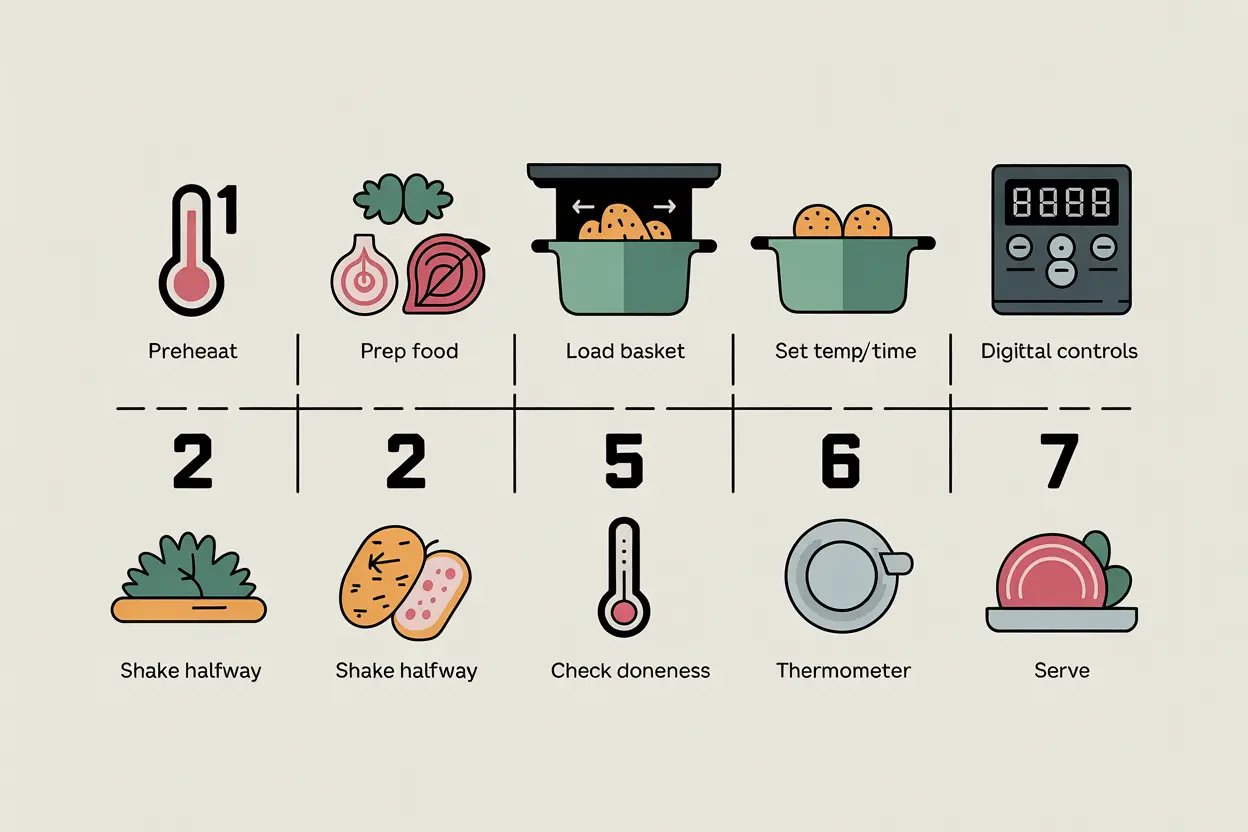
Step 1: Preheat (if needed): Some models need a preheat. Others do not. Check your manual. Usually three to five minutes at your cooking temp.
Step 2: Prep your food: Toss food with a tiny bit of oil. This helps with crisping. Or skip the oil entirely for oil-free cooking.
Step 3: Load the basket: Do not overcrowd. Leave space between pieces. Air needs to flow around each item for even cooking.
Step 4: Set time and temperature: Most foods cook at 350 to 400 degrees. Start with the preset programs if you have them. Adjust as needed.
Step 5: Shake or flip halfway: This is the secret to perfect results. Open the drawer. Shake the basket or flip larger items. Close it. Keep cooking. This ensures crisping performance on all sides.
Step 6: Check doneness: Use a meat thermometer for proteins. Peek at veggies to see if they are golden brown.
Step 7: Serve immediately: Food tastes best right out of the air fryer. The longer it sits, the softer it gets.
How to Preheat an Air Fryer
If your model requires preheating, here is how.
Set the temperature to your cooking temp. Run it empty for three to five minutes. Some digital air fryers have a preheat button. Just press it and wait.
Preheating helps with cooking consistency. Especially for foods that need a quick sear like steak or fish.
Reheating and Common Mistakes
Reheating food in air fryer: This is where air fryers beat microwaves. Set it to 300 to 350 degrees. Heat for three to five minutes. Check and add time if needed. Pizza, fried chicken, and fries come back to life.
Common air fryer mistakes:
- Overcrowding the basket: Biggest mistake. Food steams instead of crisps. Always leave space.
- Skipping oil entirely: A little oil helps. Even just a spray. You are not deep frying. But a light coat makes food golden.
- Not shaking or flipping: You must move food around. Otherwise, one side burns. The other stays pale.
- Ignoring preheating: Some recipes need it. Skipping this step leads to uneven results.
- Using the wrong temperature: Too high? Food burns outside and stays raw inside. Too low? Food dries out. Follow recipes until you get the hang of it.
Cleaning and Maintenance
This is easy. I promise.
After every use: Let the air fryer cool down. Pull out the basket and tray. Wash with warm soapy water. Or toss in the dishwasher if it is dishwasher-safe parts.
Nonstick coating care: Use soft sponges. No metal scrubbers. You will scratch the coating.
Wipe the inside: Use a damp cloth to wipe the inside chamber. Crumbs and grease can build up.
Deep clean monthly: Soak the basket in hot soapy water for 10 minutes. Scrub gently. Wipe down the heating element with a damp cloth.
Grease management: Empty the drip tray every few uses. This prevents smoke and bad smells.
Proper cleaning extends the long-term use of your air fryer. My Philips has lasted eight years because I take care of it.
Final Thoughts: Is an Air Fryer Right for You?
After 12 years of testing, I can say this with confidence. An air fryer is worth buying for most people.
If you want healthier meals without sacrificing taste, buy one. If you are short on time, buy one. If you have kids who love crispy food, buy one.
You do not need a fancy model. A simple Cosori or Instant Pot air fryer will change how you cook. Start with a mid-range model. Learn the basics. Then decide if you want to upgrade.
Here is my final checklist:
- Pick a size that fits your family. Go bigger than you think.
- Choose a wattage of at least 1400 watts for good performance.
- Spend $100 to $200 for the best value.
- Look for dishwasher-safe parts and a cool-touch handle.
- Start with simple foods. Fries, wings, veggies.
- Clean it after every use.
The air fryer sitting on my counter has cooked thousands of meals. It has saved me time. It has helped my family eat healthier. It has made weeknight dinners effortless.
An air fryer is just one piece of an efficient kitchen. If you're building out your cooking space, check out my guide to essential kitchen appliances you can't live without to complete your setup.
You deserve that too.
If you found this guide helpful, try one of my beginner-friendly air fryer recipes next. You will love how easy it is to make crispy, delicious food with almost no oil.
Happy air frying.
Frequently Asked Questions
What size air fryer should I buy for a family?
For a family of four to six people, choose a large air fryer with at least 6 to 8 quarts of capacity. This gives you enough cooking space to make a full meal in one batch. Smaller families can use a 3 to 5 quart model.
Is an air fryer worth buying?
Yes. Air fryers cut oil usage by 70 to 80 percent compared to deep frying. They cook food faster than ovens. They are easy to clean. If you want healthier fried food without the mess, an air fryer is absolutely worth it.
What is the difference between an air fryer and air fryer oven?
A basket air fryer has a pull-out drawer with a fry basket. It is great for quick meals. An oven-style air fryer looks like a toaster oven with racks. It offers more cooking space and can bake, roast, and toast. Both use the same hot air circulation technology.
How much oil do you use in an air fryer?
You can use zero oil for many foods. For best results, use one to two teaspoons or a quick spray of oil. This helps food crisp up without adding many calories.
Can you put foil in an air fryer?
Yes, but use it carefully. Do not cover the entire basket. Air needs to flow around food. Use small pieces of foil to line the bottom or wrap certain foods. Never let foil touch the heating element.
What can you not cook in an air fryer?
Avoid wet batters. They drip through the basket. Skip foods with very high water content like lettuce. Large roasts that do not fit in the basket also do not work well. Stick to foods that crisp up or cook quickly.
How do I preheat an air fryer?
Set your air fryer to your cooking temperature. Run it empty for three to five minutes. Some digital models have a preheat button. Preheating helps with even cooking and better crisping.
Are air fryers healthy?
Yes. Air fryers use 70 to 80 percent less oil than deep fryers. This cuts calories and fat from your meals. You can enjoy crispy food with fewer health risks. Just remember to eat balanced meals overall.
What wattage is best for air fryer?
Look for at least 1400 to 1600 watts for good performance. Higher wattage means faster cooking and better heat distribution. Budget models with 800 to 1200 watts work but cook slower.
How to clean an air fryer?
Let it cool down first. Remove the basket and tray. Wash with warm soapy water or put in the dishwasher if safe. Wipe the inside with a damp cloth. Clean the drip tray regularly to prevent smoke.
Best air fryer for beginners?
The Cosori Pro LE and Instant Vortex Plus are great starter models. They have simple controls. They come with preset cooking programs. They are affordable and reliable. Perfect for learning the basics.
Do air fryers use a lot of electricity?
No. Air fryers are energy efficient. They heat a small space quickly. They use less power than a full-size oven. Most people see lower electric bills when they use their air fryer more.
Can you bake in an air fryer?
Yes. Use a small baking pan that fits inside the basket or oven-style air fryer. You can make muffins, cookies, and small cakes. Just adjust the temperature and time based on your recipe.
How to reheat food in air fryer?
Set the air fryer to 300 to 350 degrees. Place your leftovers in the basket. Heat for three to five minutes. Check and add time if needed. This method makes food crispy again unlike microwaves.
What are the disadvantages of air fryers?
Air fryers have small cooking capacity compared to ovens. You cannot cook large batches at once. Some models are noisy. They take up countertop space. But for most people, the benefits far outweigh these drawbacks.
Basket vs drawer air fryer?
These terms mean the same thing. Both refer to the basket-style air fryer with a pull-out drawer. Some people call the whole unit a drawer. Others call just the insert a basket. Either way, it is the classic air fryer design.
How long do air fryers last?
With proper care, a good air fryer lasts five to ten years. Clean it regularly. Do not scratch the nonstick coating. Choose a model with a solid warranty. Brands like Philips, Ninja, and Cosori are known for long-term reliability.
Air fryer vs toaster oven?
Air fryers focus on rapid air circulation for crispy food. Toaster ovens are more versatile for baking and toasting but do not crisp as well. Some toaster ovens now have an air fry setting. These give you both functions in one appliance.
Best foods to cook in air fryer?
Fries, chicken wings, vegetables, frozen snacks, fish, and reheated leftovers all cook beautifully. Anything that benefits from a crispy outside and moist inside works great.
Do I need special pans for air fryer?
No, but they help. Use oven-safe pans that fit your basket size. Silicone, metal, and ceramic pans work fine. Just make sure they do not block airflow. Some air fryers come with accessories like baking pans and grill racks.

Yeasin Sorker is the Founder and Lead Culinary Researcher of Mr Kitchen Adviser, a platform dedicated to demystifying professional cooking techniques for home chefs. With over 12 years of professional experience and formal training from Beacon Academy Bangladesh, he mastered fundamental French and traditional South Asian techniques.
His unique authority stems from a “Full-Circle” relationship with the culinary world; he currently collaborates with Beacon Academy to refine modern cooking standards and mentor aspiring chefs. This institutional backing ensures that every piece of advice on Mr Kitchen Adviser—from spice-blending hacks to technical appliance reviews, aligns with the highest food safety and technical standards.
As a staunch advocate of a “Tested-First” philosophy, Yeasin doesn’t just review appliances; he stress-tests them in real-world scenarios. Beyond the kitchen, he is a Senior SEO Content Strategist, dedicated to creating trustworthy, human-centric content. Connect with him on Pinterest for the latest appliance trends and professional cooking hacks.