As an Amazon Associate we earn from qualifying purchases. We may earn a commission from links on this page, at no extra cost to you. Learn more.
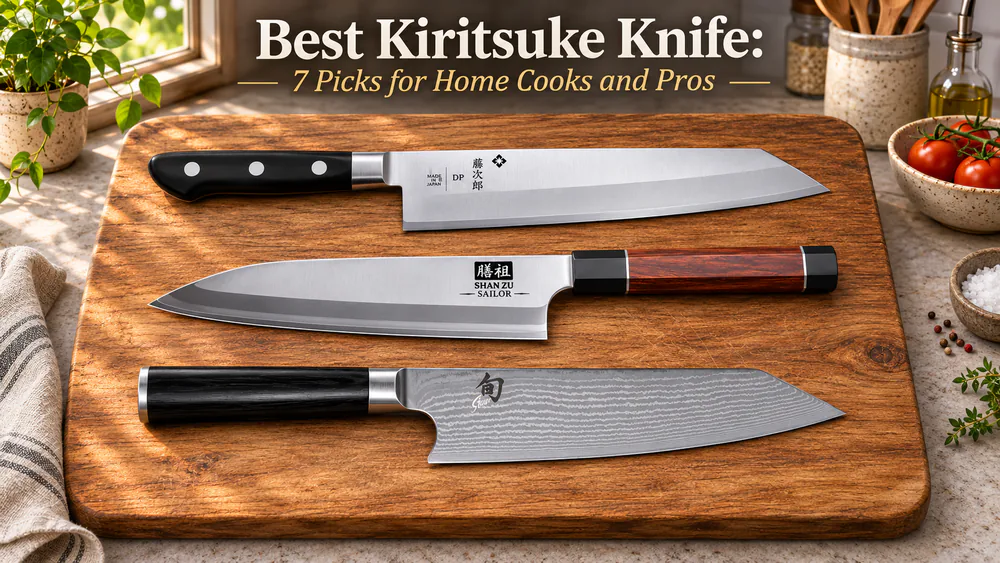
Most people searching for a kiritsuke want a double-bevel, k-tip gyuto, not the single-bevel original that Japanese head chefs carried. The two are very different knives, and the shop floor is full of imitations of both. From the sharpening bench, our honest advice is to start with a double-bevel k-tip unless you already sharpen on whetstones. Our top pick is the Tojiro Classic 210mm, and our Japanese knife reviews cover the wider family if you want to compare it with other styles.
We put all seven through regular home prep at the sharpening bench and the cutting board, checking each edge by feel and on paper before sharpening it back on stones.
Quick Answer: Best Kiritsuke Knives at a Glance
Rank
Product
Best for
Length
Rating
Buy
1
Tojiro Classic Kiritsuke 210mm (F-796)
Best Overall
Home cooks who want a sharp, sturdy double-bevel k-tip
The word kiritsuke covers two quite different knives. Pick the wrong one and you will either fight your knife every night or end up with a plain chef knife wearing a fancy name.
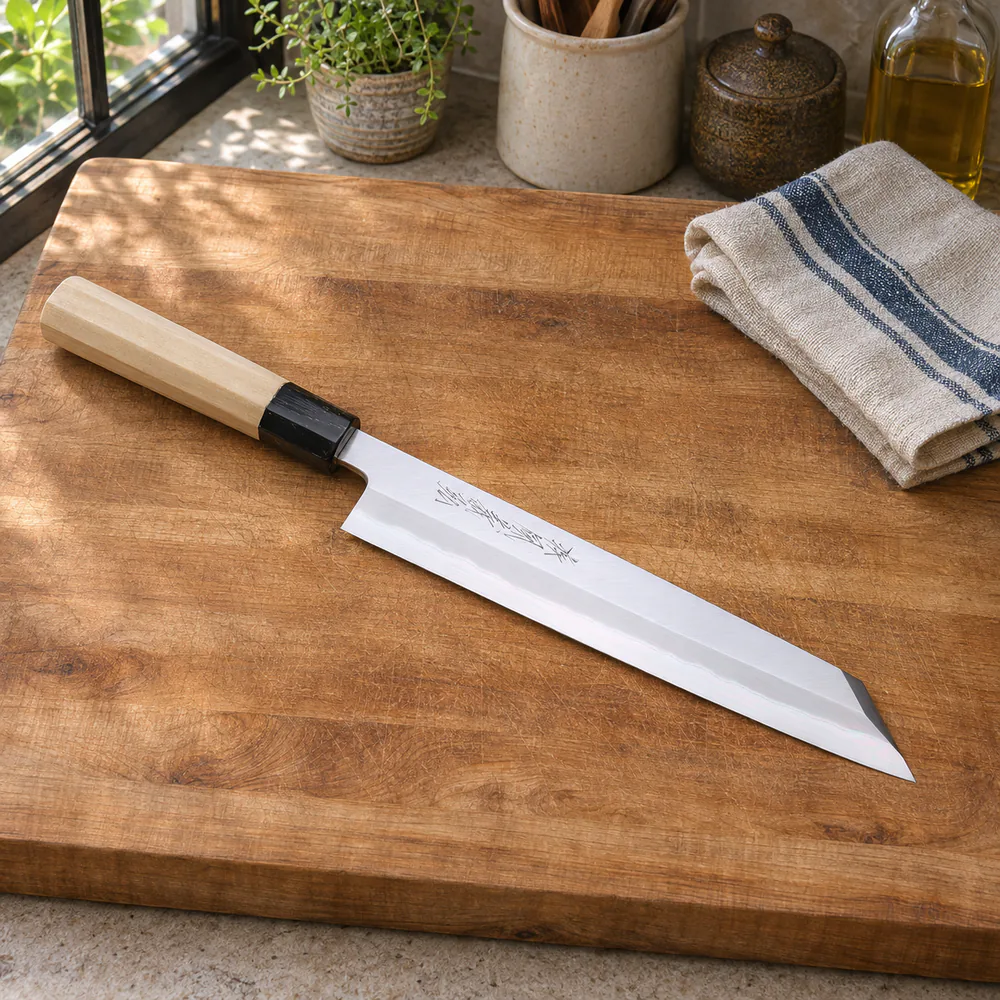
Traditional Single-Bevel Kiritsuke
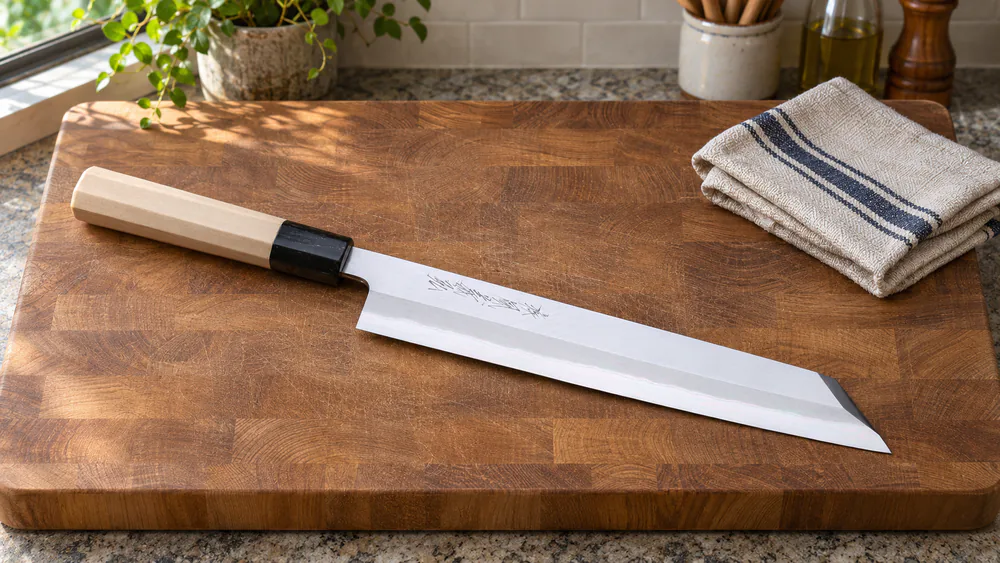
The original kiritsuke is a single-bevel, flat-profiled blade with an angled tip. It started as a hybrid of the yanagiba and the usuba, and it was historically carried by head chefs. Because only one side is ground, the knife steers food slightly to one side, and it needs one-sided sharpening on stones. It also chips if you rock it or hit hard ingredients with it. It is a beautiful tool for slicing fish and cutting vegetables, but it asks a lot of a home cook.
Double-Bevel Kiritsuke Gyuto (K-Tip)
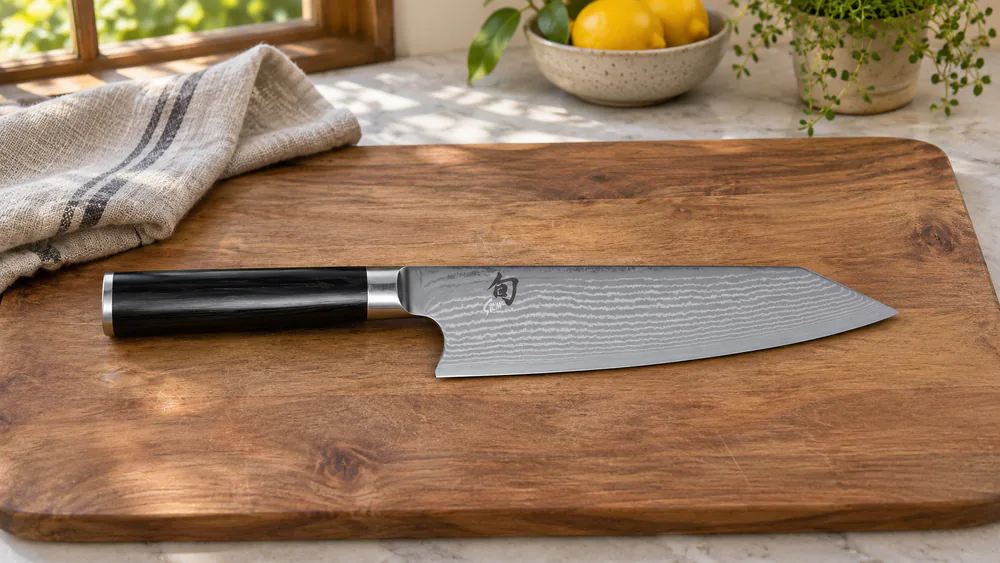
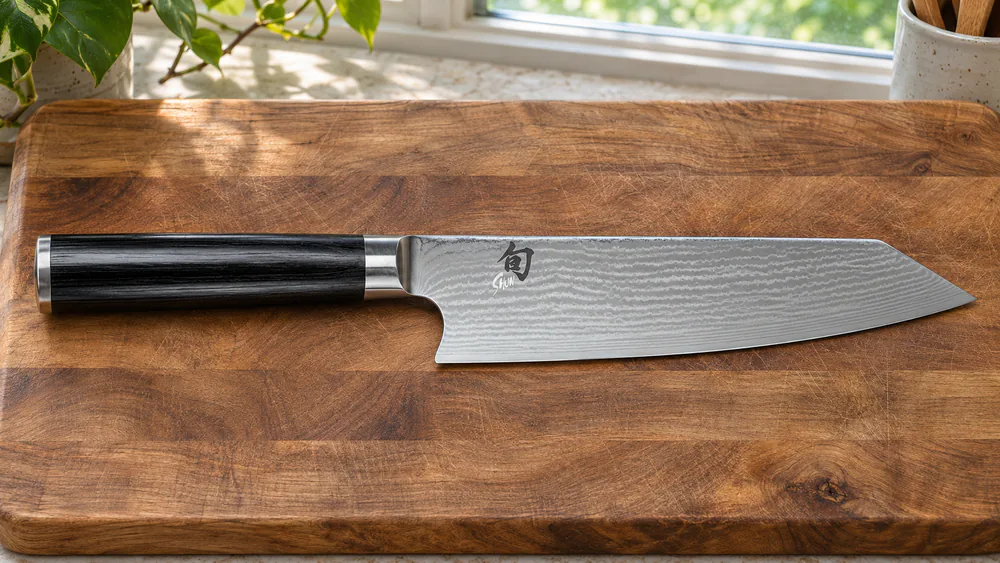
What most buyers actually want is the modern double-bevel k-tip, often called a kiritsuke gyuto. It keeps the flat-ish profile and the angled tip, but it is ground evenly on both sides like any Western or Japanese chef knife. It cuts straight, it sharpens like a normal knife, and it works for lefties and righties alike. Six of our seven picks are this style. Sizes run from about 190mm to 300mm, with 240mm the classic length.
Warning. The market is saturated with imitation "Japanese steel" kiritsuke from makers outside Japan, and many knives sold under the name are really bunka or gyuto shapes. A true kiritsuke has the flat profile and the angled tip. Be wary of listings that lean on the name and say little about the steel or the grind.
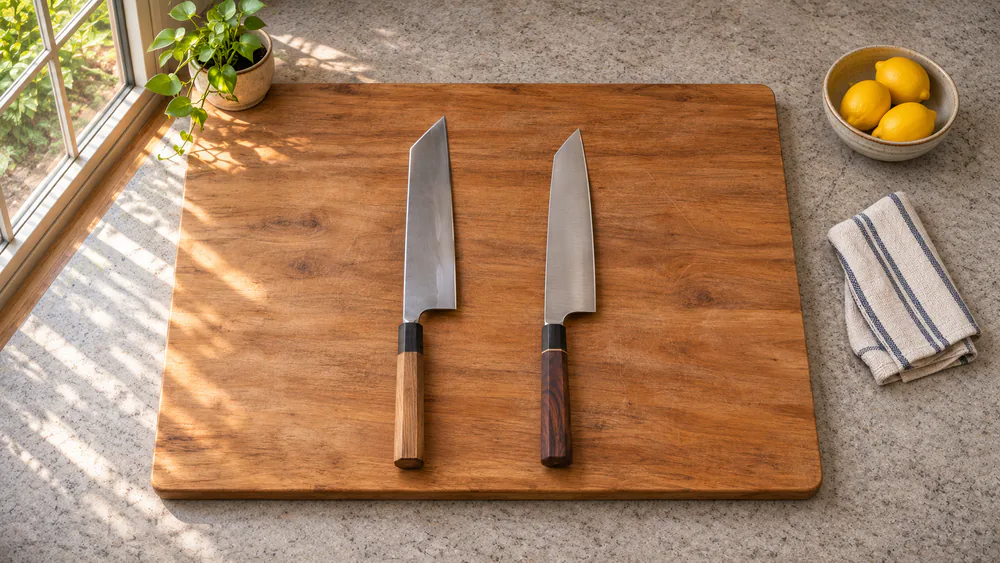
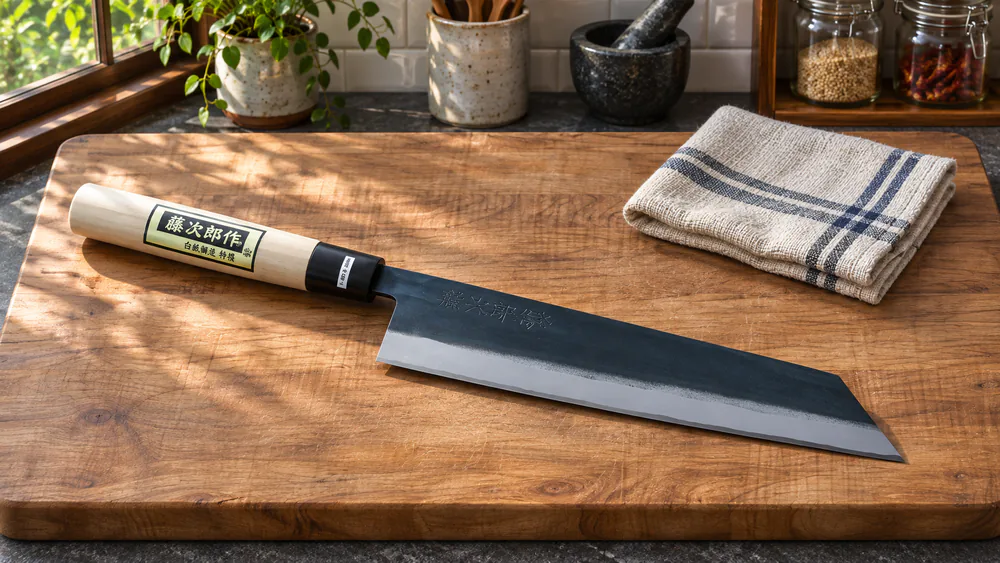
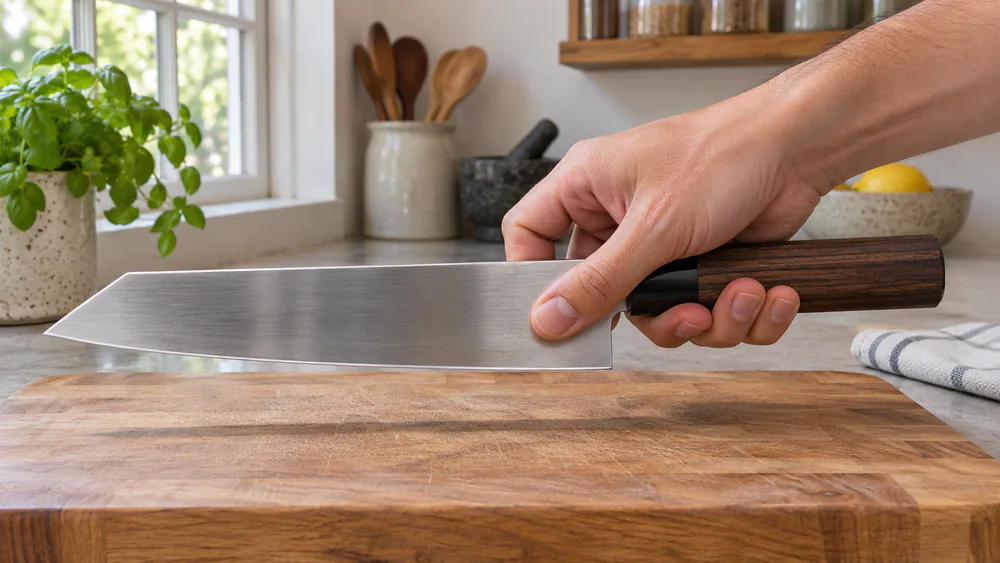
Single-bevel on the left, double-bevel k-tip on the right.
How We Tested These Kiritsuke Knives
We judged these knives the way we judge any blade, from the sharpening bench. Each one went into regular home prep: onions, carrots, herbs, chicken, and thin slices of fish and tomato. We checked the edge by feel and on paper as we went, then sharpened each knife back on whetstones to see how willingly the steel returns to a fine edge.
Thin slices of fish and tomato revealed the precision of the Tojiro and SHAN ZU; cutting boneless meat and vegetables showed how the Shun 8-inch and the heavier, blade-forward knives balanced. Back on the stones, the Shirogami returned to a keen edge easily, while the harder VG-MAX and 62 HRC edges asked for a lighter touch.
We scored on five things: out-of-the-box sharpness, balance and handle comfort, how the edge held up, how easy it was to sharpen, and how forgiving the knife was of normal kitchen mistakes. We also gave extra weight to how honest the knife is about its shape. A kiritsuke that is really a bunka gets marked down.
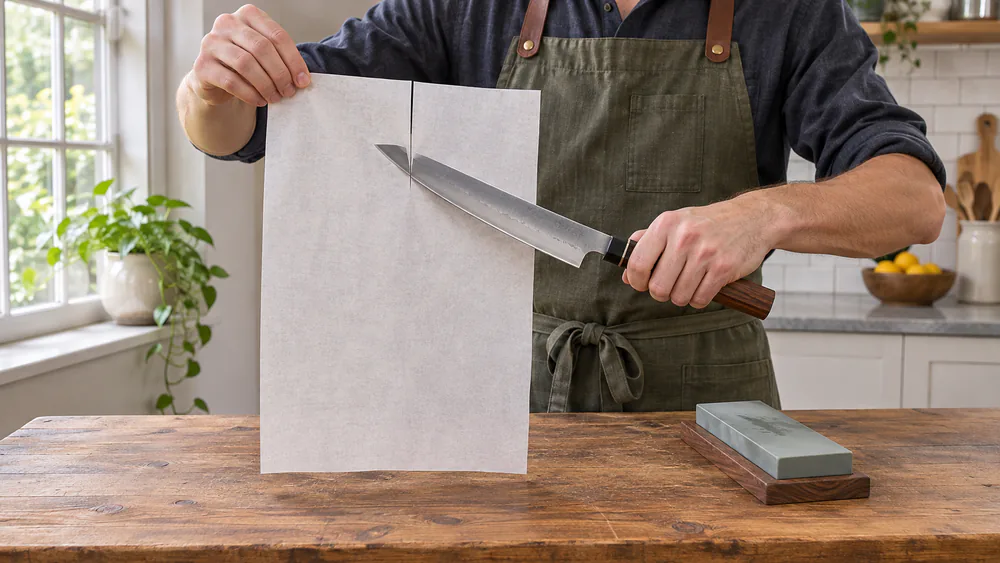
We check each edge on paper before and after sharpening.
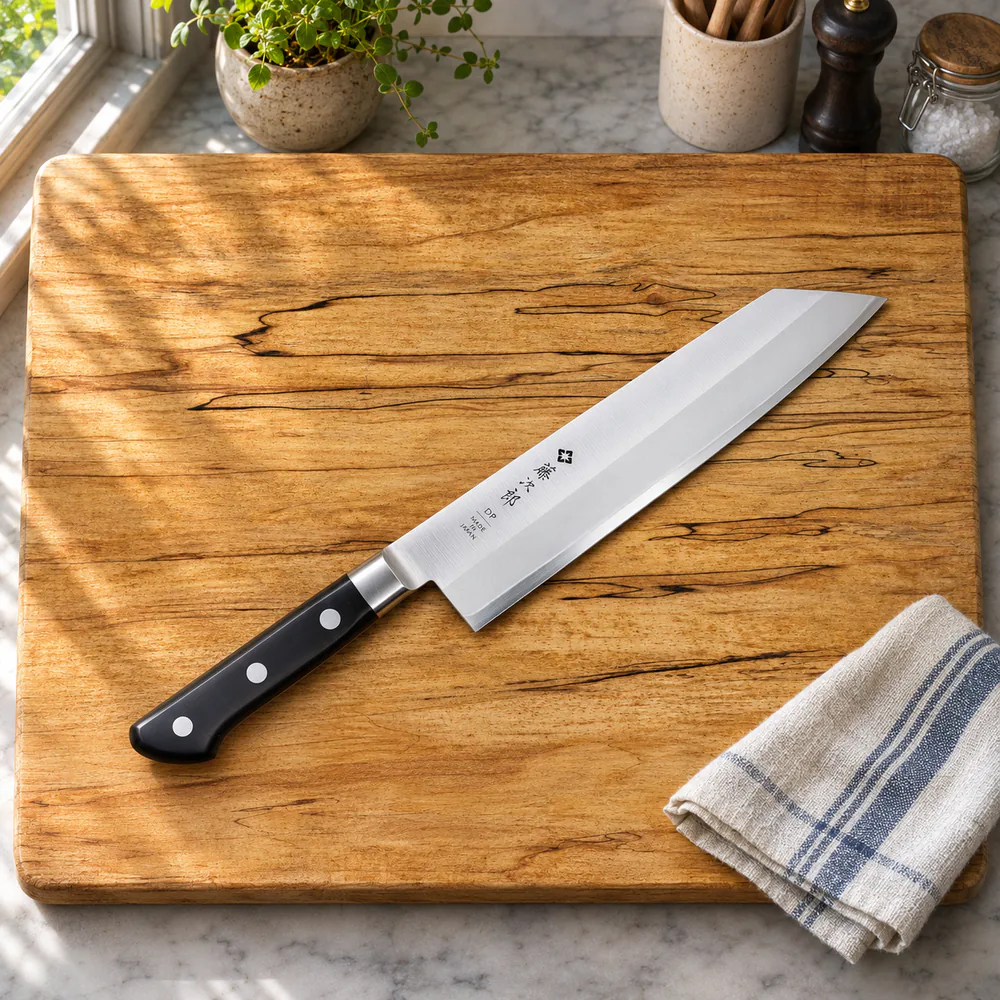
1. Tojiro Classic Kiritsuke 210mm (F-796) - Best Overall
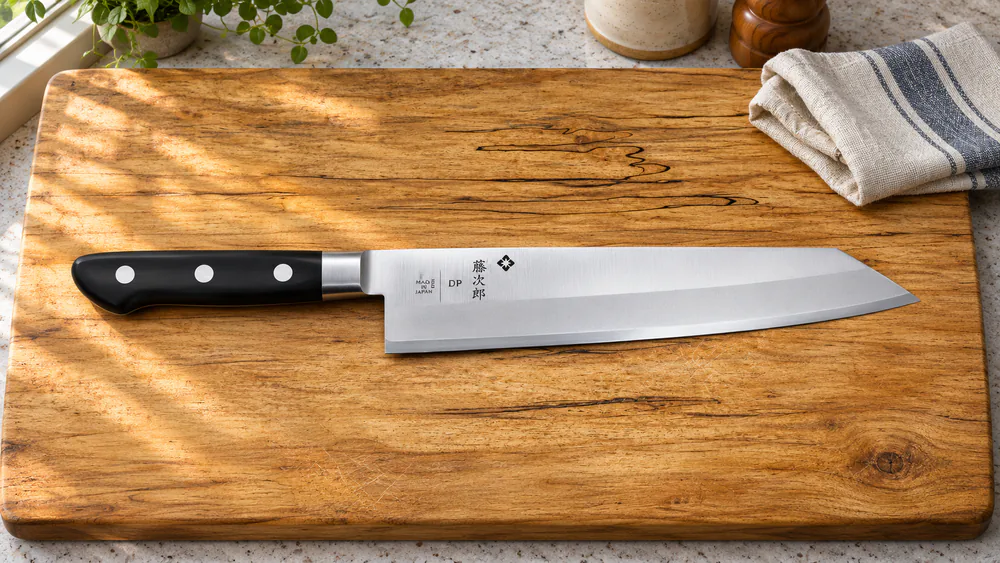
This is the knife we would buy again. At the board, it cut precise, thin slices of fish and vegetables and stayed sharp through the rest of our home prep. The 210mm blade has a VG10 core wrapped in 13-chrome stainless, and it feels startlingly sharp if you are moving over from German knives, so handle it carefully the first few days. A honing rod is enough to keep it serviceable, which makes it the sweet spot for one knife that handles most of a week's cooking.
Pros
VG10 core at 60 HRC gives a razor-sharp, fine edge
Even double bevel, so it cuts straight and sharpens like a normal knife
Black micarta handle with a full tang and three rivets feels solid
Light at 202 g, with a 210mm blade that suits compact boards
Cons
Minor edge chips can appear, especially after a drop
Hard steel is not meant for bone or frozen food
Who It Suits and Who Should Skip It
It suits cooks who want the k-tip look and a dependable workhorse without learning single-bevel sharpening. The 202 g weight and 210mm length make it easy to control. Skip it if you want a heavier blade with real heft for chopping, or if you want the traditional one-sided edge.
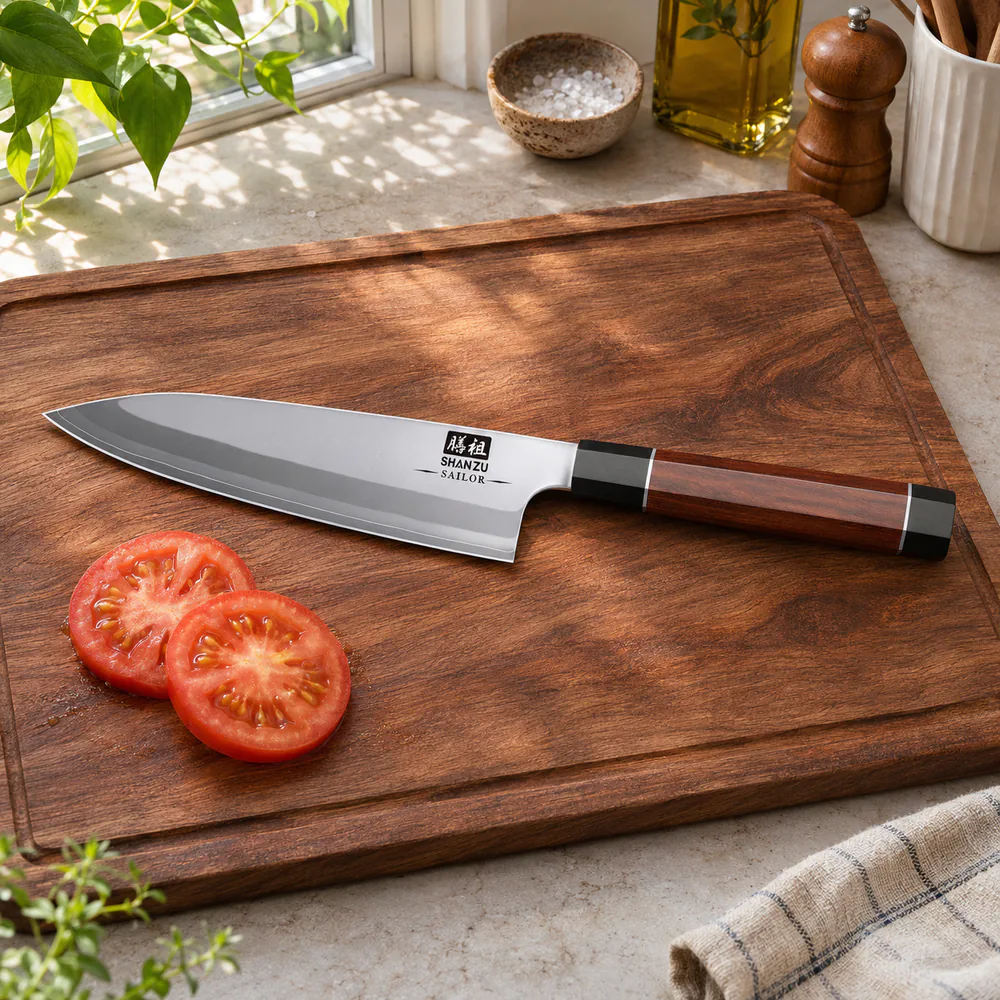
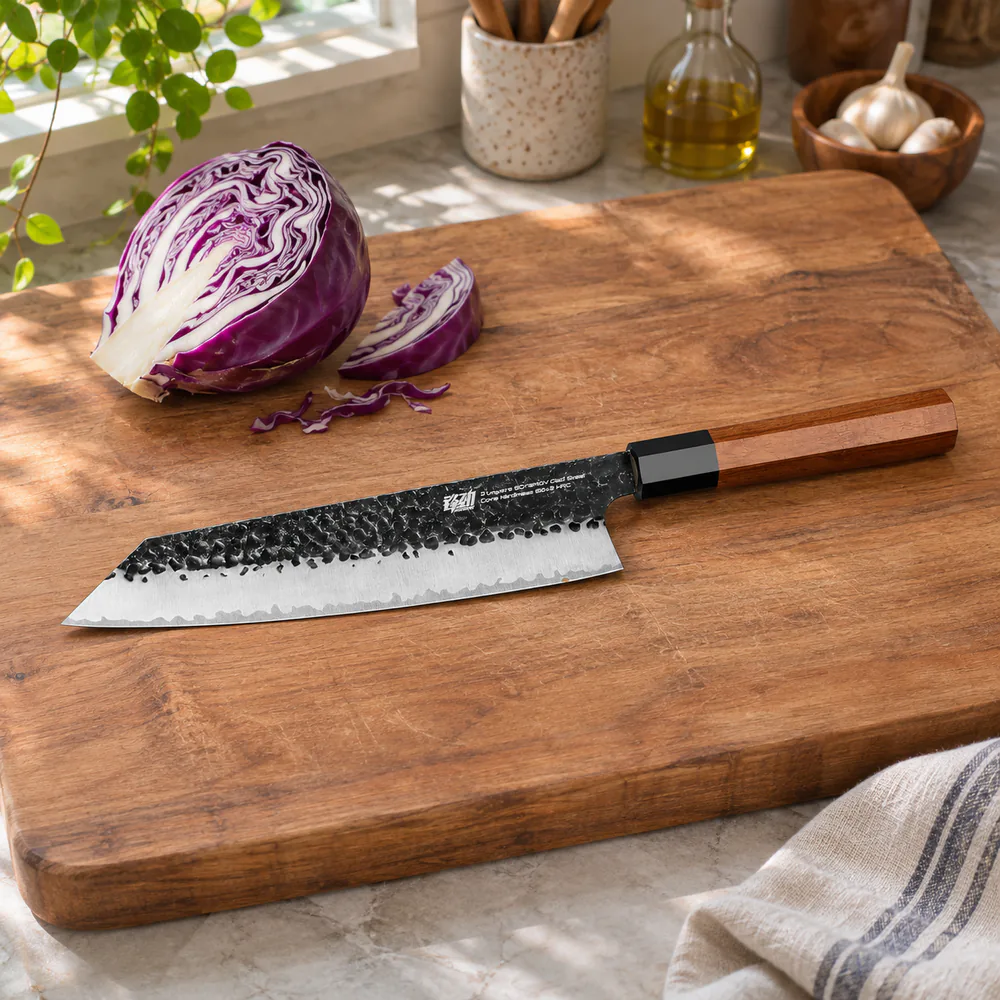
2. SHAN ZU 8" Kiritsuke-Style Chef Knife - Best Budget Pick
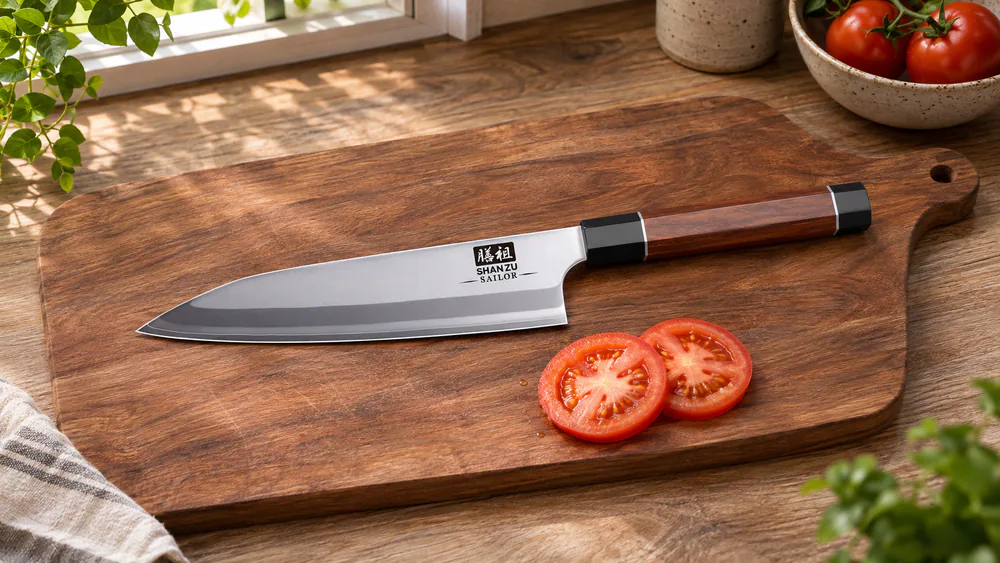
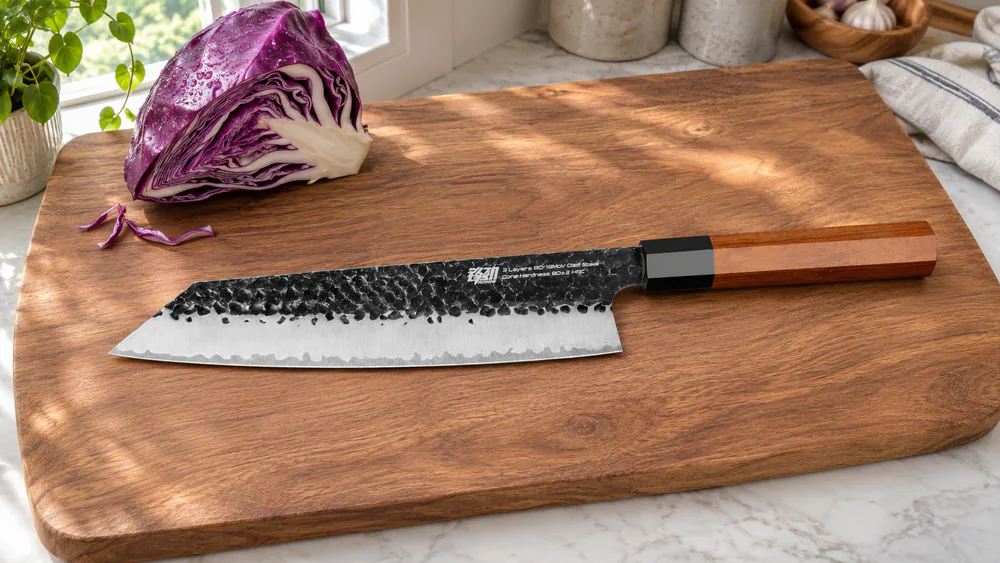
Where the Tojiro earns its place through steady manners, the SHAN ZU surprised us with sheer bite for the money. We drew it through a soft tomato and the slices came off paper-thin, and it then glided through vegetables and meat without fuss. It is a 9-layer 10Cr15MoV blade hardened to 62 HRC with a 12-degree angle, and the matte finish and sandalwood handle look more expensive than the knife is.
Pros
62 HRC edge is razor-sharp out of the box
Thin 12-degree angle slices tomatoes and vegetables cleanly
Octagonal sandalwood handle is comfortable for most grips
The lowest cost of the seven picks
Cons
Hard, thin edge can chip under abuse
Fit and finish cannot match the Japanese-made picks
Who It Suits and Who Should Skip It
It suits anyone who wants to find out whether a kiritsuke shape fits their cutting style before spending more. Skip it if you tend to cut through bone, twist the blade in a cut, or want a knife you will pass down.
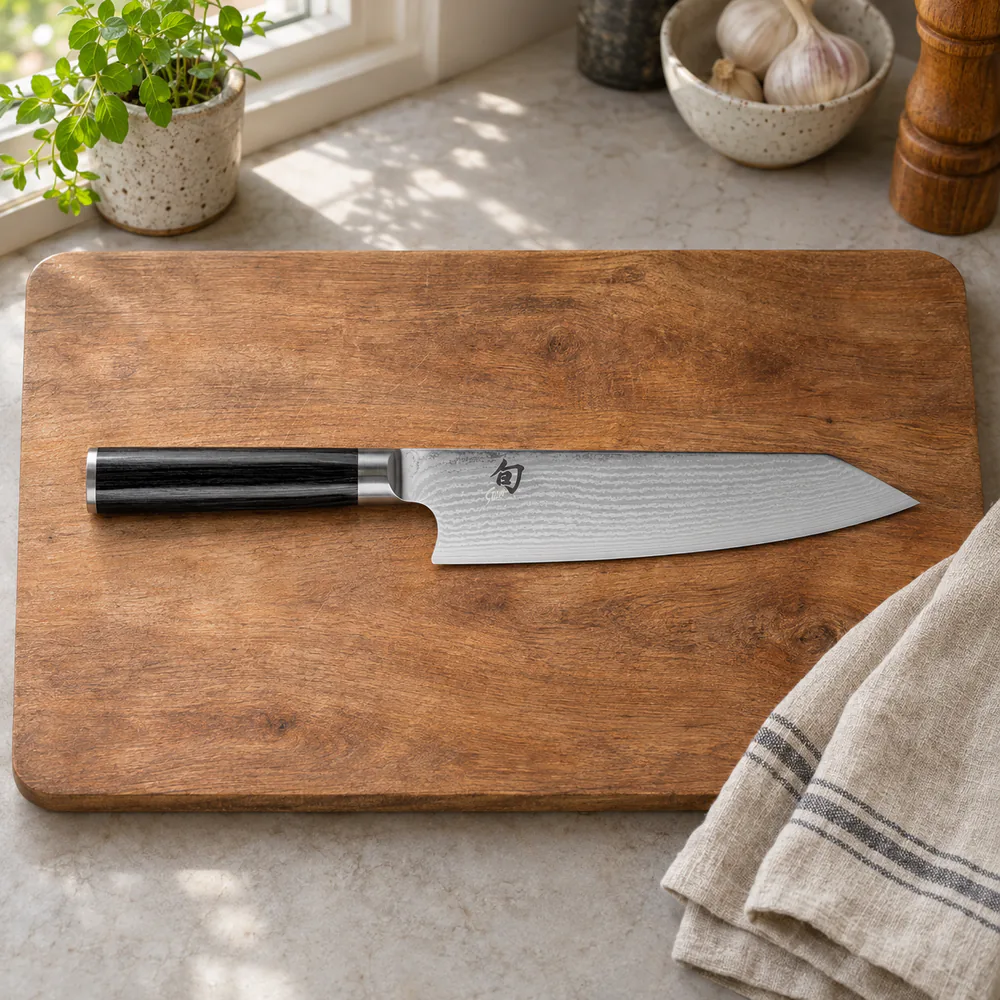
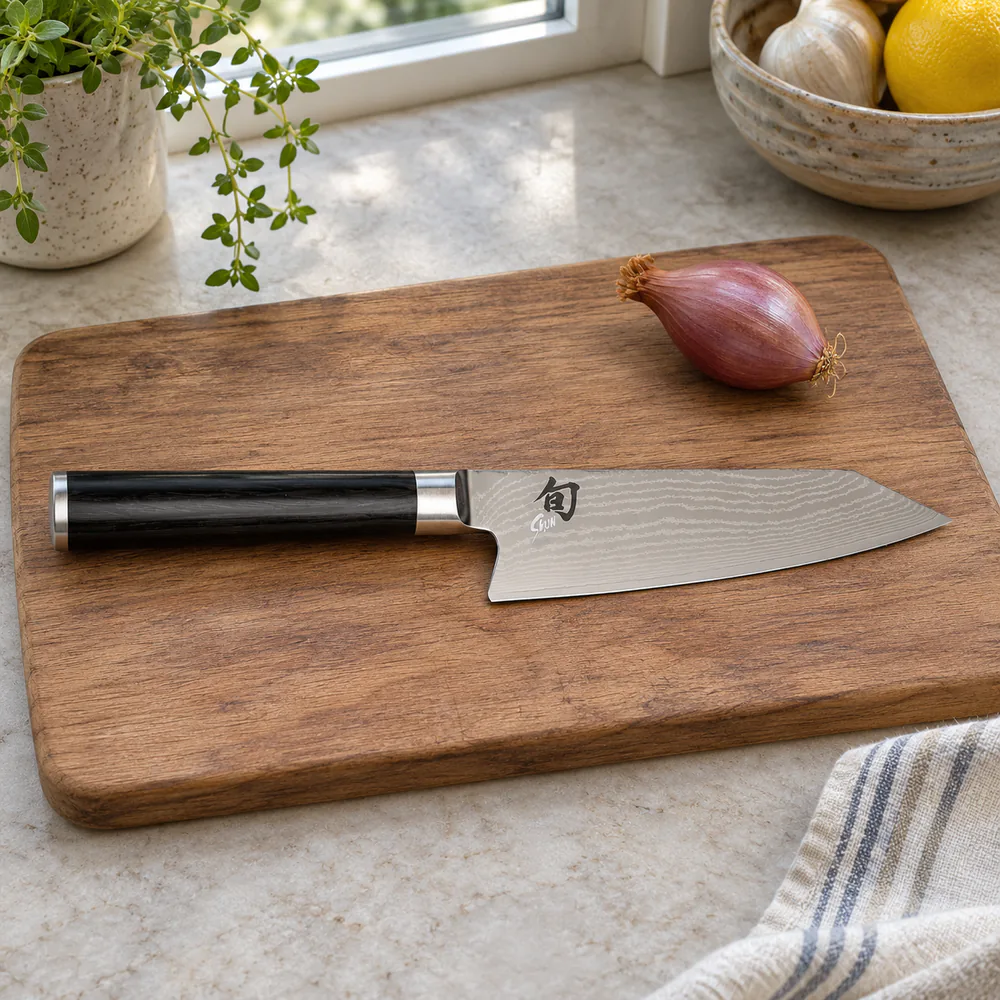
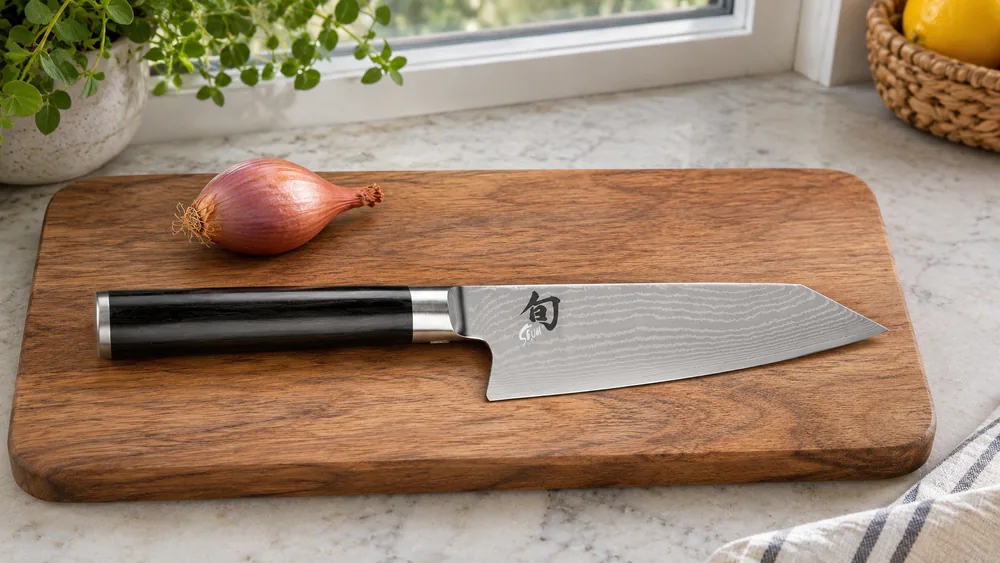
Step up from the budget blade and the 8-inch Shun is the one we reach for when balance matters most. In the hand it feels closer to a 6-inch chef knife, with the handle weight matching the blade, and it filleted meat and chopped vegetables equally well. A VG-MAX core sits inside 68 layers of Damascus cladding, with a 16-degree edge and a D-shaped Pakkawood handle that suits left and right hands. Cut cleanly and hone gently, since the hard edge dislikes bone and twisting.
Pros
Balanced and light for its size, with a handle that matches the blade
68 layers of Damascus over a VG-MAX core look striking
D-shaped Pakkawood handle works for left and right hands
Handcrafted in Japan, with free sharpening and honing from the maker
Cons
Hard edge can chip or crack on bone or if twisted
One of the pricier picks here
Who It Suits and Who Should Skip It
It suits cooks who want a refined, agile knife that feels shorter than it measures. If you prefer something heavier, the Dalstrong Shogun 8.5-inch is the alternative: AUS-10V steel in 67-layer Damascus, a G10 handle, and a sheath. It feels heavy in the hand with a blade-forward balance, and it slices meat, vegetables and watermelon with ease while holding its edge a long time. Skip the Shun if you want a hefty chopper.
4. Yoshihiro Single-Bevel Kiritsuke - Best Single-Bevel Traditional
Unlike the three double-bevel picks above, the Yoshihiro needs a different technique: avoid rocking, sharpen its single bevel, and account for its tendency to steer to one side. It is the true article, and it is not for beginners. Yoshihiro sells single-bevel yanagi-kiritsuke in several steels, including White Steel #2 at about 62 HRC and SG-2 at around 270mm, with wa handles. Specific models and sizes sell out and rotate, so judge the style rather than one listing. In return, a well-sharpened edge is a joy for slicing fish and vegetables.
Pros
Authentic single-bevel profile with an angled tip
White Steel #2 takes a keen edge on stones
Wa handle keeps the knife light and nimble in the hand
A knife you can grow into as your sharpening improves
Cons
Demands one-sided sharpening skill
Steers food to one side, and chips if rocked
Models and sizes rotate, and it is the priciest style here
Who It Suits and Who Should Skip It
It suits sharpeners and fish-slicing fans who already own a whetstone and want the original shape. Skip it if you want one knife that does everything, if you are left-handed and have not found a left-handed version, or if you have never sharpened a single-bevel knife.
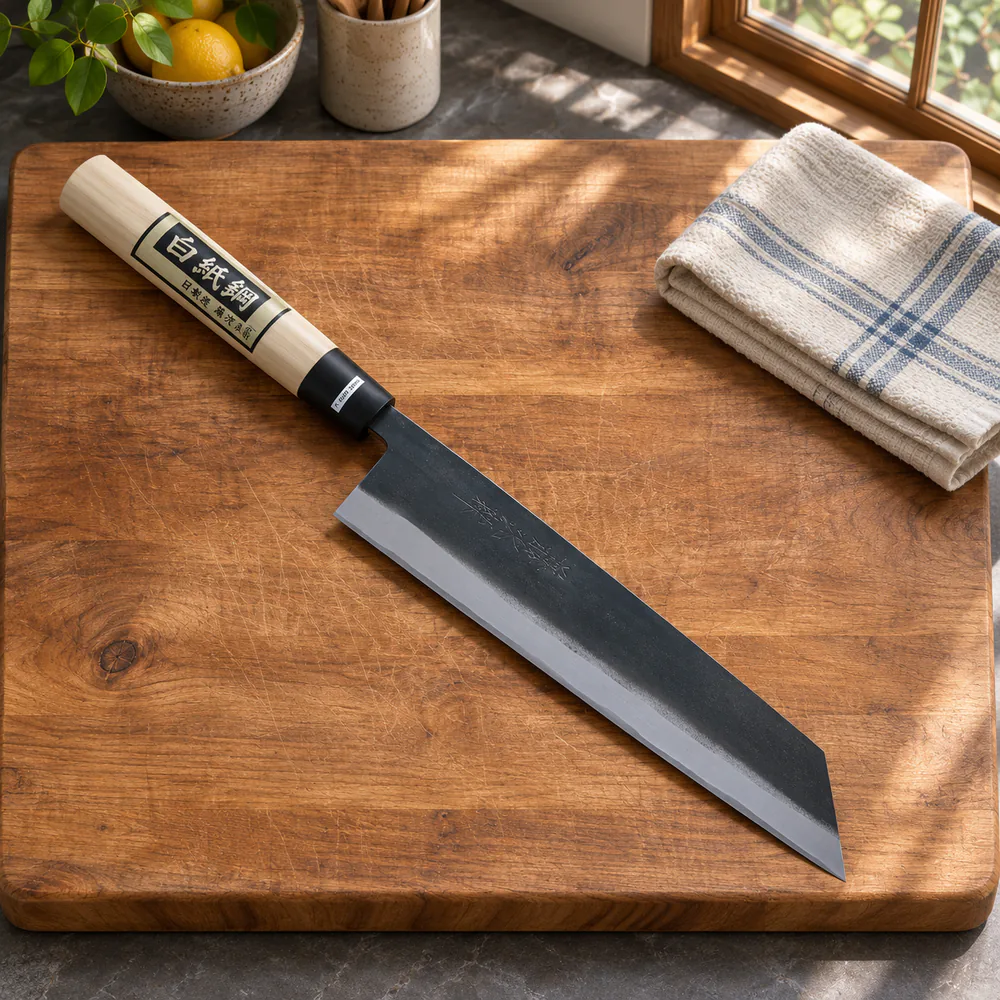
5. Tojiro Shirogami Kiritsuke 240mm - Best Carbon Steel
Where the Tojiro forgives a wet sink, the Shirogami does not: the blade discolors, patinas and rusts unless you wipe it dry after use. That is the trade for what the sharpener in us loves. On the stones it took a very keen edge fairly easily, and the core is Shirogami (White) #2 carbon steel in a san mai build with soft iron cladding, at about 60-62 HRC. At 240mm it has the classic feel of a kiritsuke, and the flat profile gets the length it needs to work well.
Pros
Shirogami #2 sharpens easily and takes a very keen edge
Classic 240mm length with a double-edged, even grind
Soft iron cladding is forgiving to sharpen
Patina develops character with use
Cons
Discolors, patinas and rusts unless wiped dry after use
Needs a longer board than the 210mm pick
Who It Suits and Who Should Skip It
It suits cooks who enjoy caring for a tool and own at least a medium stone. Skip it if your knives tend to sit wet in the sink or the dish rack.
6. FINDKING Dynasty 9" Kiritsuke - Best Longer Blade
Reach is what the FINDKING adds over the Shirogami's classic length. The 9 inch blade, about 229mm, is 9Cr18MoV high carbon stainless with a hammered surface and an African rosewood octagonal handle. It is blade-heavy with a light handle, which helped with slicing and chopping, and it suits cooks with big boards who will dry it right away and keep it off bones and frozen food. We rate it lower than the rest because of the rust and snapping risks listed below.
Shrink the Shun and you get the 6-inch (150mm), with the same VG-MAX core, 68 layers of Damascus, 16-degree edge and Pakkawood handle as its bigger sibling. This light, nimble knife suits small kitchens and small hands, or serves as a second blade for trimming, peeling and slicing small items. Skip it if it will be your only knife, since it is too short for anything big, which is why it sits at the bottom of the ranking.
Pros
Light and agile for small boards and detail work
Same sharp VG-MAX edge as the 8-inch
Pakkawood handle is comfortable and ambidextrous
Fits small kitchens and drawers
Cons
Too short for large produce or roasts
Costs more than its size suggests
Kiritsuke Comparison Table
Knife
Length
Steel
HRC
Handle
Bevel
Weight
Best for
Rating
Tojiro Classic F-796
210mm
VG10
60
Micarta
Double
202 g
Best overall
4.7
SHAN ZU 8"
8 inch
10Cr15MoV
62
Red sandalwood
Double
Not published
Budget
4.3
Shun Classic 8"
8-inch
VG-MAX
About 60-61
Pakkawood
Double
Light for size
Premium
4.6
Yoshihiro single-bevel
About 270mm (varies)
White #2 or SG-2
About 62
Wa
Single
Not published
Traditional
4.2
Tojiro Shirogami
240mm
Shirogami
About 60-62
Magnolia wa
Double
Not published
Carbon steel
4.4
FINDKING 9"
9 inch
9Cr18MoV
Not stated
African rosewood
Double
Blade-heavy
Longer blade
3.9
Shun Classic 6"
6-inch
VG-MAX
About 60-61
Pakkawood
Double
Light
Compact
4.1
How to Choose a Kiritsuke Knife
Four things decide whether a kiritsuke suits you: the bevel, the steel, the length, and how the handle balances against the blade. Get these right and the rest is details.
Single vs Double Bevel
Choose double bevel unless you already sharpen on stones. A double bevel cuts straight, sharpens like any chef knife, and suits both hands. A single bevel is sharper in theory and brilliant at slicing, but it steers food to one side and demands one-sided sharpening. If you are unsure, you want the double bevel.
Steel Type and Hardness
Hard Japanese steels like VG10 and VG-MAX hold a fine edge but can chip if twisted or used on bone. Carbon steels such as Shirogami sharpen easily and take a keen edge, but they patina and rust unless you wipe them dry. Be careful with labels. A "carbon steel" title does not guarantee true carbon steel, and the SYOKAMI knife titled that way is German high-carbon stainless around 56 HRC. The Kimura is a bunka shape in high-carbon molybdenum stainless at 57 HRC. Both are fine knives, but neither is a classic kiritsuke.
A hard edge cuts beautifully and forgives nothing: the steel decides how you must treat the knife.
Blade Length
Around 200mm to 210mm suits compact kitchens, while 240mm gives the classic feel. The flat profile needs length to work, and the blade should fit within about two-thirds of your board. A 270mm or 300mm single-bevel only makes sense with plenty of board space.
Handle and Balance
A blade-heavy knife like the FINDKING or Dalstrong feels purposeful for slicing, while a handle-weighted knife like the Shun feels nimble. Pinch the blade at the heel and see where it tips. Wa handles keep weight forward, and Western handles like micarta add handle weight. Try both if you can.
Tip. Hold the knife at the pinch point and see whether it tips forward, backward or sits level. Level suits most cooks; forward suits chopping and slicing; backward suits detail work.
How to Use and Care for a Kiritsuke
What It Cuts Best
A kiritsuke slices through boneless proteins, fish, long vegetables and herbs with a long, drawing stroke. Its flat profile makes it a strong push-cutter and a good choice for thin slices of raw fish and tomatoes. Keep it off bones, frozen food and hard squash, and avoid twisting it in the cut.
Sharpening and Maintenance
Hone VG10 and VG-MAX lightly and often, and use stones when the edge fades. Carbon steels need wiping dry after every use, and they sharpen more willingly on stones. For a single bevel, sharpen mainly the bevel side and remove only a light burr from the back. Our guide to professional knife sharpeners covers the next step if you want powered help, though we still prefer stones for these blades. Hand wash every one of these knives and dry it immediately.
Kiritsuke vs Gyuto vs Santoku
A gyuto is the Japanese chef knife with a curved belly for rocking. A kiritsuke gyuto adds a flatter profile and an angled tip, which makes it better for push-cuts and fine slicing, though less suited to rock-chopping herbs. A santoku is shorter, with a rounded tip and a flat edge, and it suits cooks who like a compact all-purpose knife. If you want one knife for everything, a gyuto is the safer pick, and a kiritsuke gyuto gives you the same job with a sharper look. For a full block, see our Japanese knife sets and chef knife sets.
Frequently Asked Questions
Is a kiritsuke good for beginners?
A double-bevel k-tip like the Tojiro Classic 210mm is fine for beginners. A true single-bevel is not, because it needs one-sided sharpening and steers food to one side.
What is a kiritsuke used for?
It slices boneless meat, fish and vegetables and handles most chef-knife work. The flat profile and angled tip favor push-cuts, thin slices and precise cuts over rocking.
What length should I buy?
Around 200mm to 210mm suits compact kitchens, and 240mm gives the classic feel. Make sure the blade fits within about two-thirds of your board.
Is a kiritsuke a chef's knife?
A double-bevel kiritsuke gyuto is, in practice, a chef knife with a flatter profile and an angled tip. A traditional single-bevel is a more specialized slicing and vegetable knife.
Why is it called a head chef's knife?
The kiritsuke was historically carried by head chefs in Japanese kitchens, which is where the nickname comes from. It combined the work of the yanagiba and the usuba in one blade.
Can left-handed cooks use a kiritsuke?
Double-bevel models like the Shun Classic, with its D-shaped Pakkawood handle, work in either hand. Traditional single-bevels are ground for right-handed use unless sold as a left-handed version.
Final Verdict
Buy the Tojiro Classic 210mm if you want one dependable k-tip and do not want to think about it. If your budget is tight, the SHAN ZU is a fair way to test the shape, and if you cherish balance and finish, the Shun Classic 8-inch is the one to try. Reach for the Shirogami only if you will wipe it dry, and save the single-bevel for when your stones are ready.