
Helping you create a kitchen you love.

Knives & Cutlery

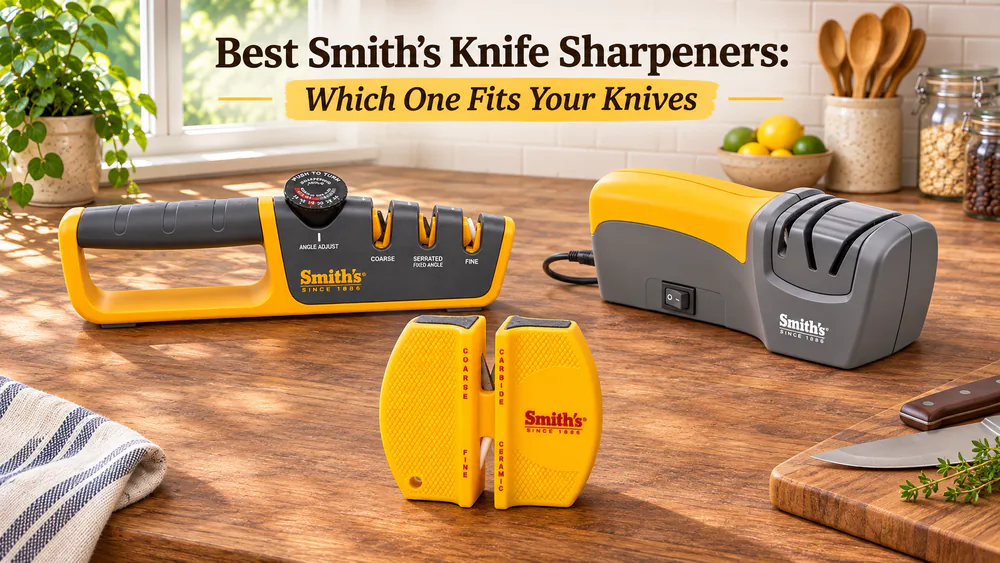
Best Smith's Knife Sharpeners: Which One Fits Your Knives

As an Amazon Associate we earn from qualifying purchases. We may earn a commission from links on this page, at no extra cost to you. Learn more.

Best Smith's Knife Sharpeners: Which One Fits Your Knives

Anyone who has run a whetstone sharpening service at a Japanese knife counter learns one thing quickly: the word "sharpener" covers a huge range of tools. Smith's makes this especially true. The company has sold sharpeners since 1886, starting as an Arkansas stone company, and today its lineup spans four different mechanisms: pull-through, guided system, electric, and stones. A "Smith's sharpener" can mean a 1-ounce keychain gadget or a three-stone bench kit, and the right one depends on your knives and your patience.

If you want to see how the pull-through, guided and stone styles compare across brands, start with our knife sharpener reviews. Below, we stay with Smith's and sort its eight most relevant models by who they suit.

Our top picks at a glance

RankProductBest forTypeRatingBuy
1

Smith's 50264 Adjustable Manual Knife Sharpener

Best Overall
Most home kitchens Adjustable pull-through 4.5 View on Amazon
2

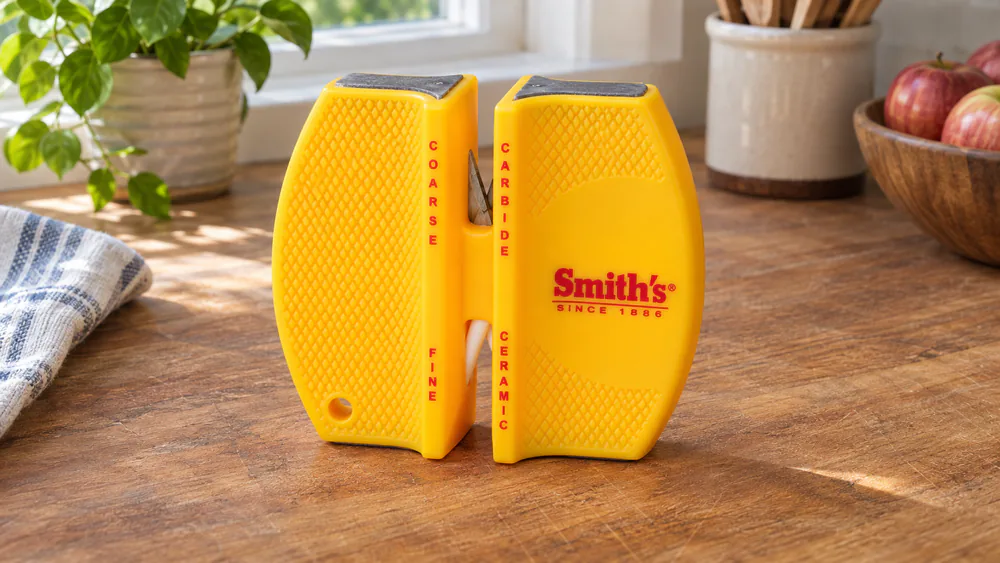
Smith's CCKS 2-Step Knife Sharpener

Best Budget
Beginners and drawers Preset pull-through 4.2 View on Amazon
3

Smith's Edge Pro Compact Electric 50005

Best Electric
Hands-off sharpening Electric wheel plus ceramic slot 3.8 View on Amazon
4

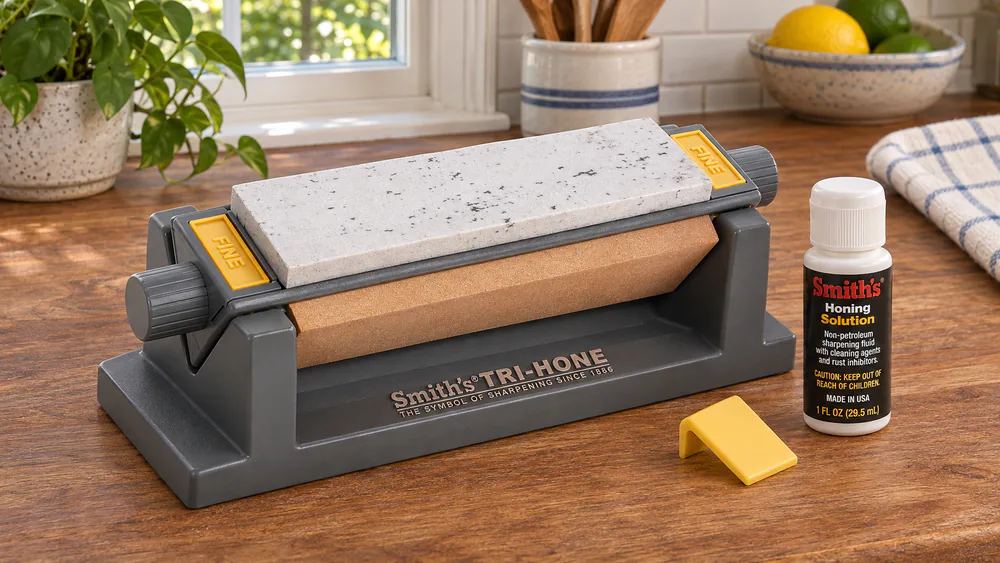
Smith's TRI-6 Three-Stone Sharpening System

Best for Control
Learning stone sharpening Three stones with angle guide 4.3 View on Amazon
5

Smith's DCS4 Diamond Combination Stone

Best Diamond Stone
Quick touch-ups 4-inch diamond stone 4.1 View on Amazon
6

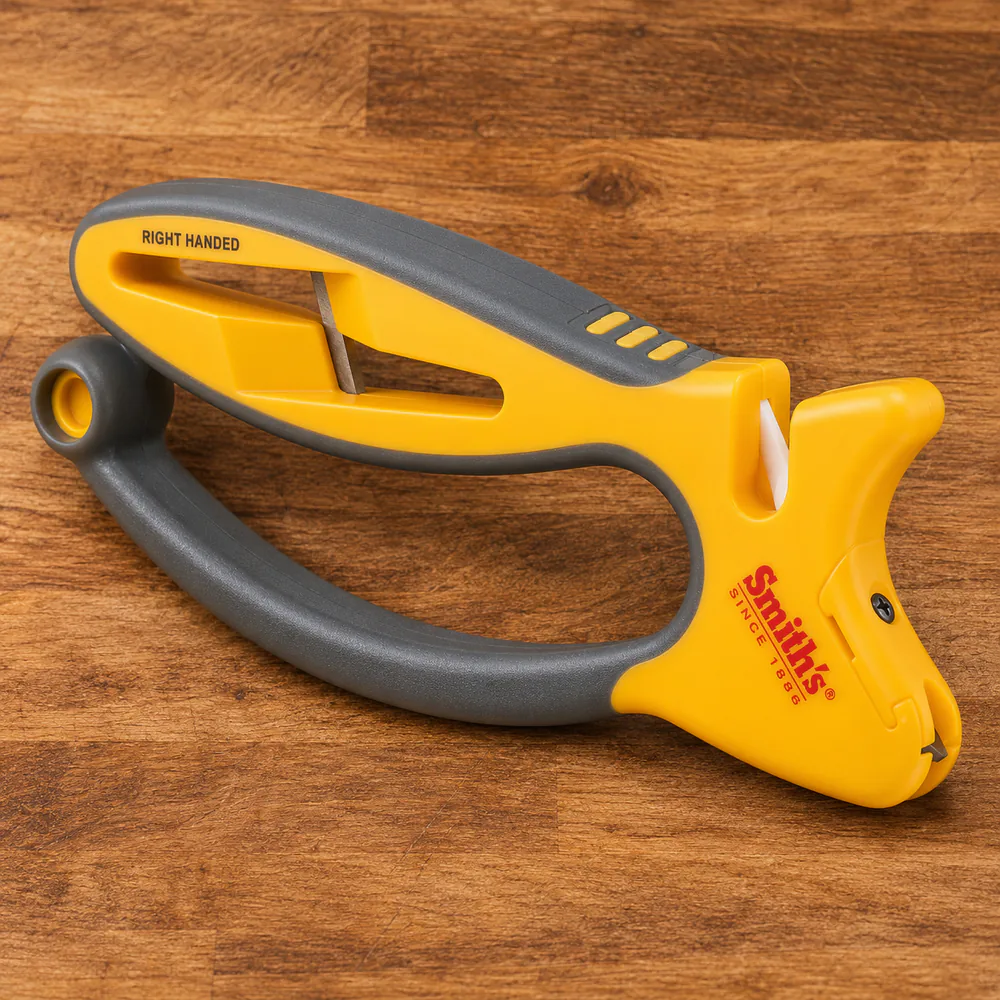
Smith's Jiffy-Pro Handheld Sharpener

Best Handheld
Knives and scissors Handheld pull-through 3.7 View on Amazon
7

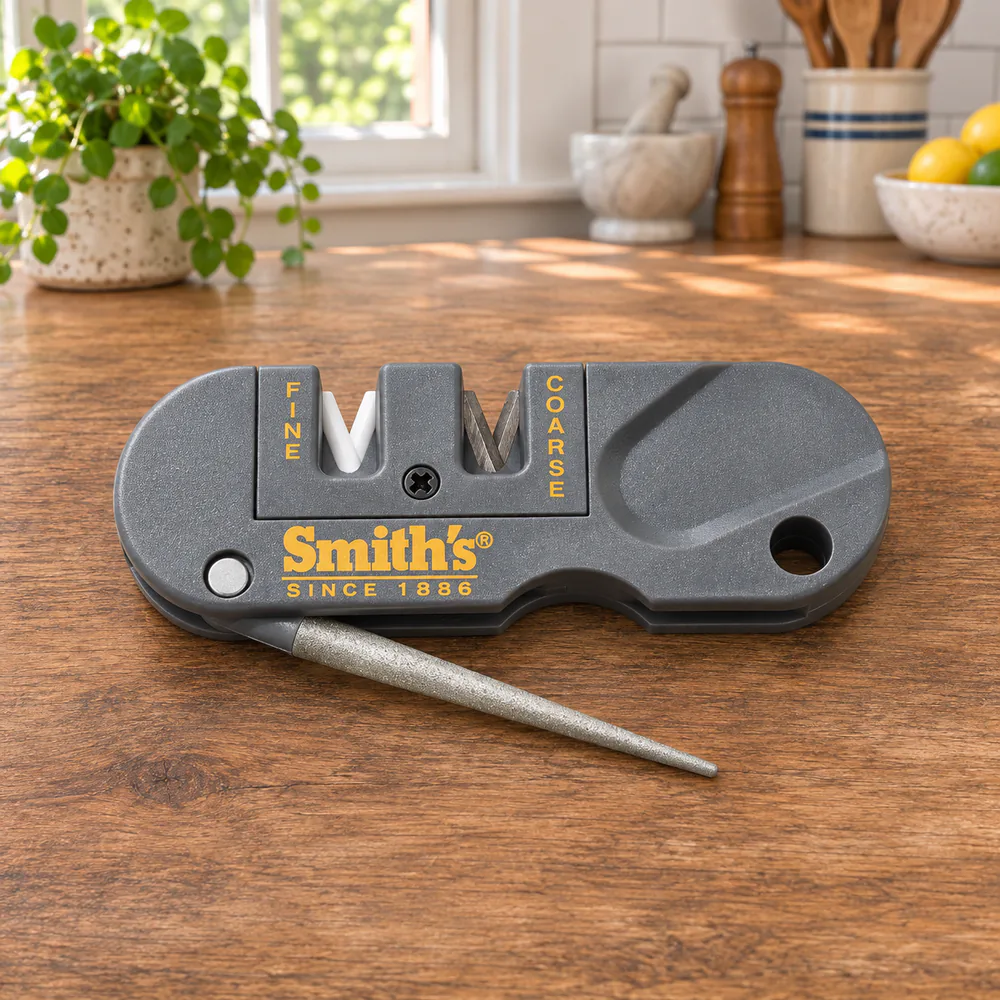
Smith's PP1 Pocket Pal

Best Pocket Option
Keychain carry 3.5 inches, 1 ounce 3.9 View on Amazon
8

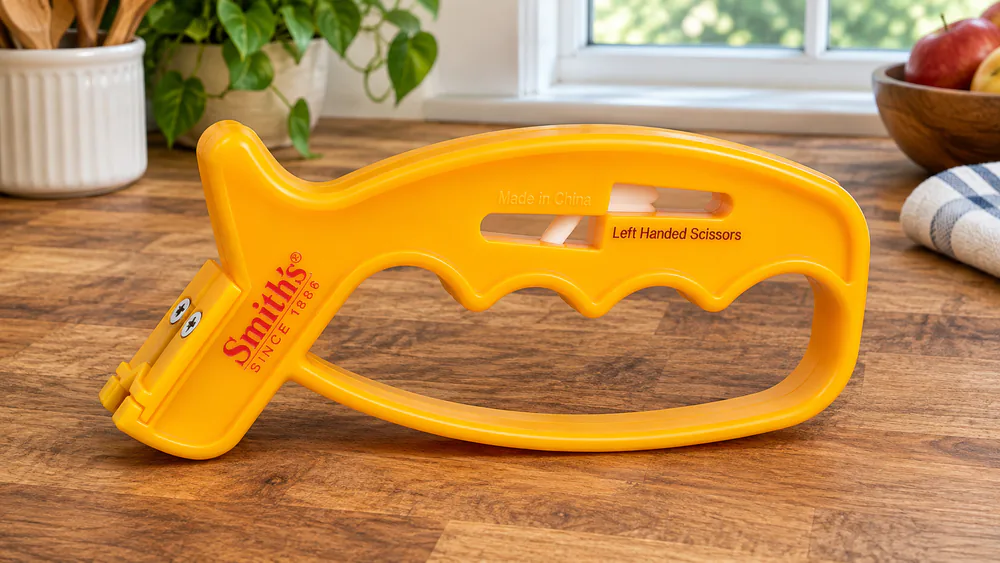
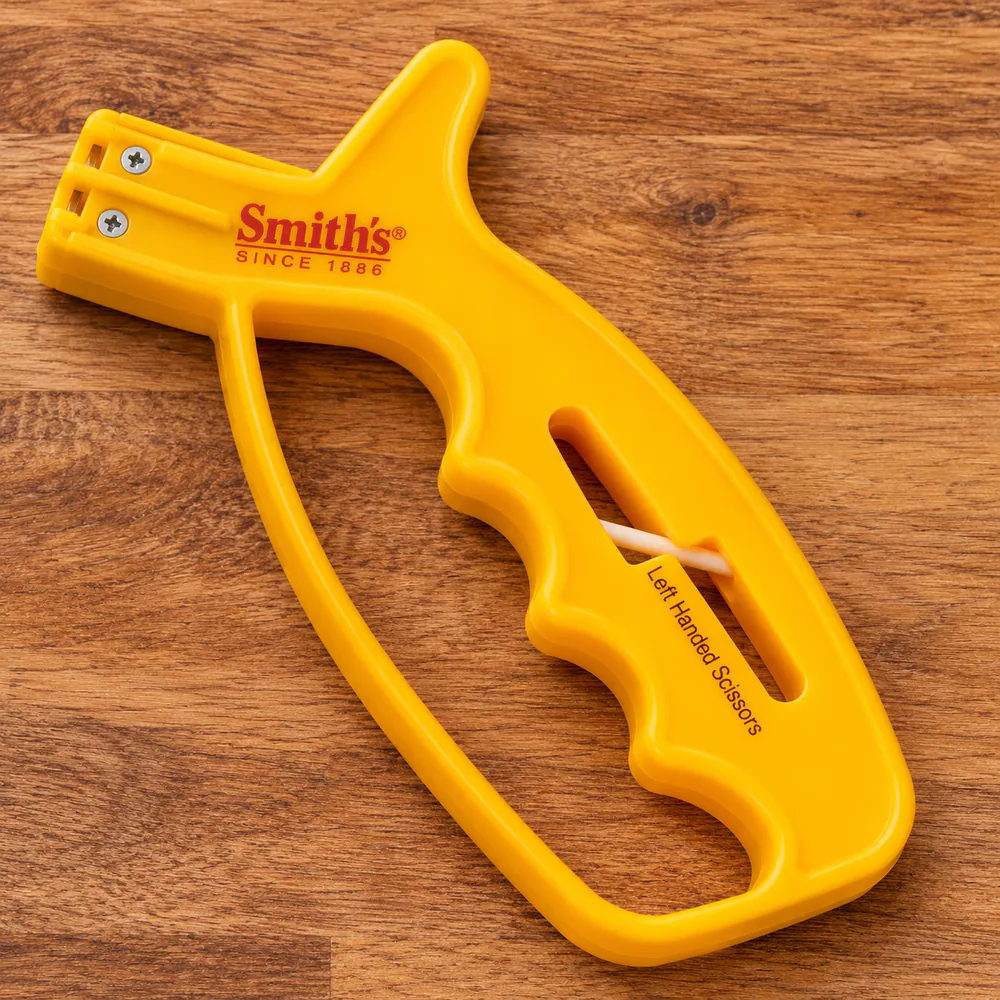
Smith's 10-Sec JIFF-S Knife & Scissors Sharpener

Best for Scissors
A drawer of knives and shears Pull-through with scissor rod 3.8 View on Amazon

We earn a commission if you make a purchase, at no additional cost to you.

See full comparison table

How We Tested These Smith's Sharpeners

We rate each sharpener by what it does to the edge: how sharp it leaves a knife, how much effort and technique it demands, and how it copes with knives of different hardness.

We scored each model on five things: edge quality, how forgiving it is for a beginner, angle control, build and durability, and how well it matches the job its label promises. Ratings in this article are ours and reflect those five criteria, not a marketplace star count.

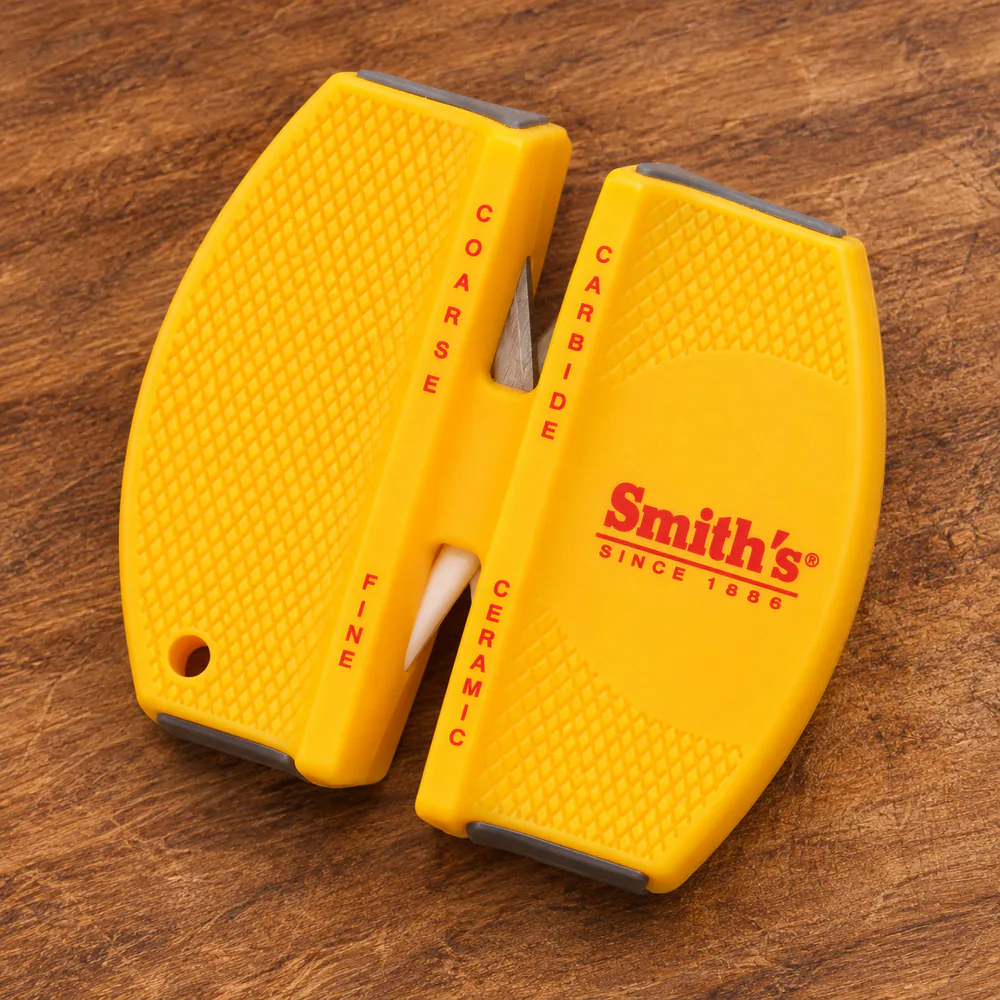
A yellow Smith's CCKS two-step sharpener resting on a wooden counter
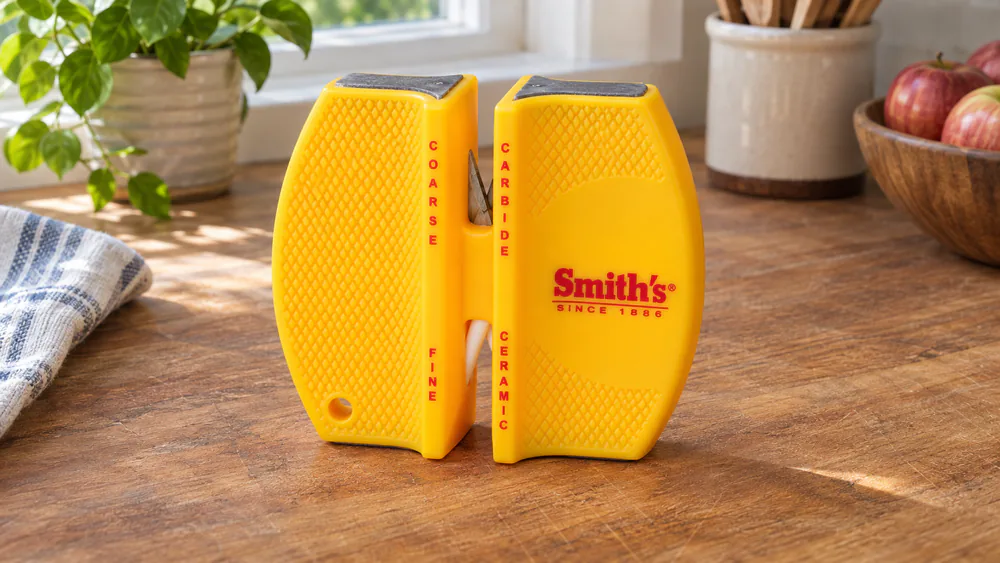
The Smith's CCKS is the compact two-step option in this comparison.

Note. Smith's sells more than eight sharpeners. We picked the models that make sense for kitchen knives and basic scissors, which is why bigger bench systems and outdoor-only gadgets are not here.

The Best Smith's Knife Sharpeners

Each pick below gets a rating, a plain verdict, and a short list of strengths and weak spots. Use the use-case label first, then read the verdict to confirm it fits your knives.

Smith's 50264 Adjustable Manual Knife Sharpener
1

Smith's 50264 Adjustable Manual Knife Sharpener

Best Overall
Check Price on Amazon
4.5/5

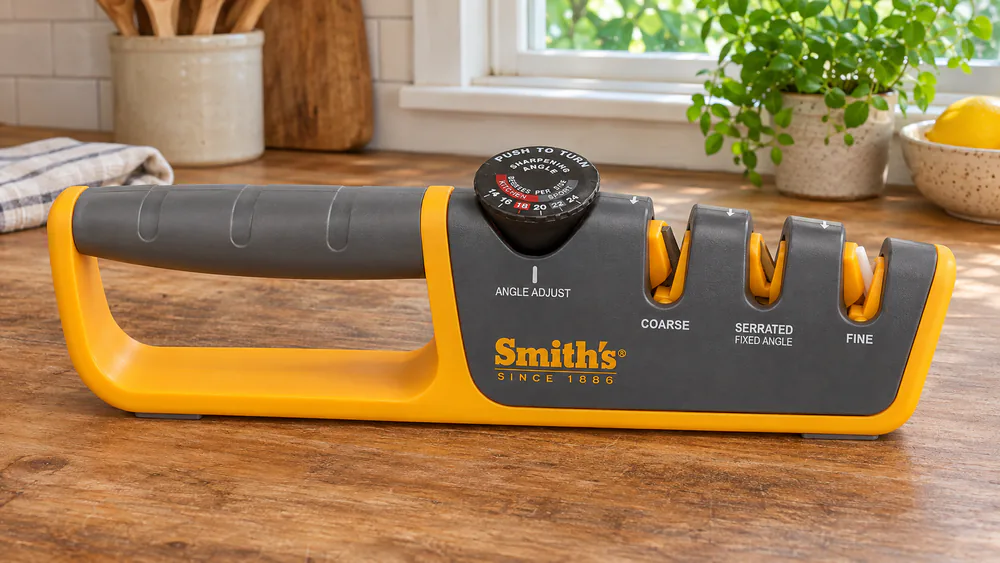
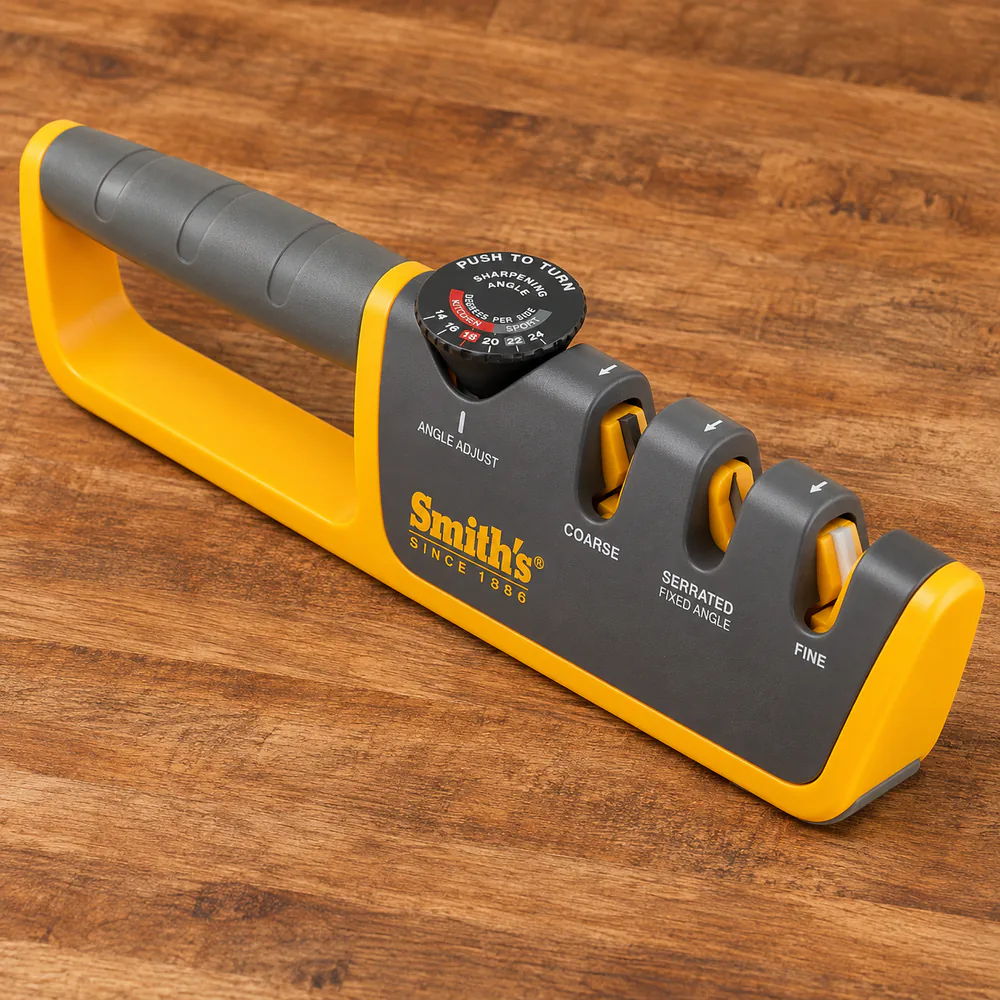
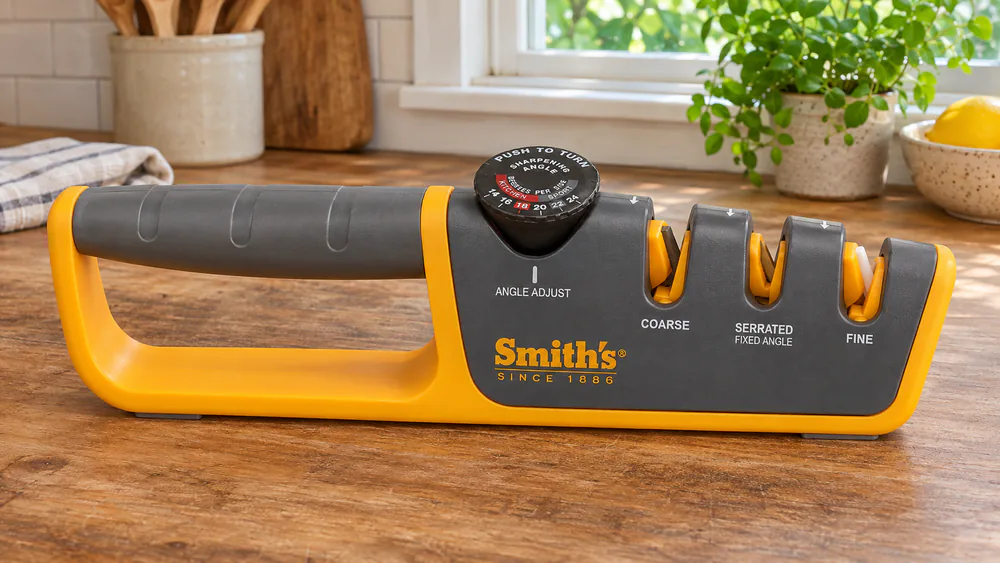
The 50264 is the Smith's we would hand to most home cooks. It is fast, it puts an edge on a dull knife with little effort, and the angle knob is the real reason to choose it. Six settings from 14 to 24 degrees mean you can match a thinner kitchen knife instead of grinding every blade to one factory angle.

Pros

  • Six angle settings from 14 to 24 degrees, set by turning a knob
  • Fast and easy for a dull knife, with almost no learning curve
  • Replaceable carbide and ceramic components
  • Soft grip handle and non-slip base

Cons

  • Knob and working section can break after a drop
  • Struggles with very hard steel or damaged edges
  • Serrated slot is fixed, not adjustable

It is a 2-stage pull-through: a coarse carbide slot to set the edge and a fine ceramic slot to refine it, plus a fixed-angle serrated slot. The carbide and ceramic parts are replaceable, which is a nice touch on a tool that will see regular use. The serrated slot does not adjust, so treat it as a bonus rather than a bread knife solution.

One caveat is not in the list below: the carbide slot sets an edge faster than it refines one, so a badly rolled blade still needs a bench system afterward.
Smith's CCKS 2-Step Knife Sharpener
2

Smith's CCKS 2-Step Knife Sharpener

Best Budget
Check Price on Amazon
4.2/5

The CCKS uses a preset angle rather than the adjustable angle of the 50264, which makes it simple to learn. The angle is preset, you make a few pulls, and you are done. It is the cheapest sharpener in the Smith's lineup, and for a basic stainless kitchen knife that has gone dull it does the job without any fuss.

Pros

  • Cheapest in the lineup and truly beginner friendly
  • A very dull edge comes back fast in the carbide slot
  • Compact, light, and easy to store
  • Non-slip rubber feet and damp-cloth cleanup

Cons

  • No serrated tool
  • Preset angle with no adjustment
  • Not suited to hard or thin steel

The coarse stage uses crossed tungsten carbide blades. The fine stage uses crossed ceramic rods, and the ceramic side polishes well. Measuring 2.33 x 2.71 inches and weighing under 2 ounces, it fits in a drawer or backpack for quick touch-ups and even floats in water.

The limit is the missing serrated option. A bread knife needs a different Smith's pick from this list, and the preset angle means you cannot tune it for thinner blades. We would not point a Japanese knife at it.

Smith's Edge Pro Compact Electric 50005
3

Smith's Edge Pro Compact Electric 50005

Best Electric
Check Price on Amazon
3.8/5

Where the first two picks are manual, the Edge Pro Compact is the electric entry, and we would only recommend it if you really want a motor.

Pros

  • Electric wheel does the heavy lifting
  • Manual ceramic slot works unplugged as a quick hone
  • 3-year limited warranty for non-commercial use
  • Mid-priced for an electric

Cons

  • Only two stages, no extra finishing stage
  • Availability varies by retailer
  • Less control than a guided or stone system

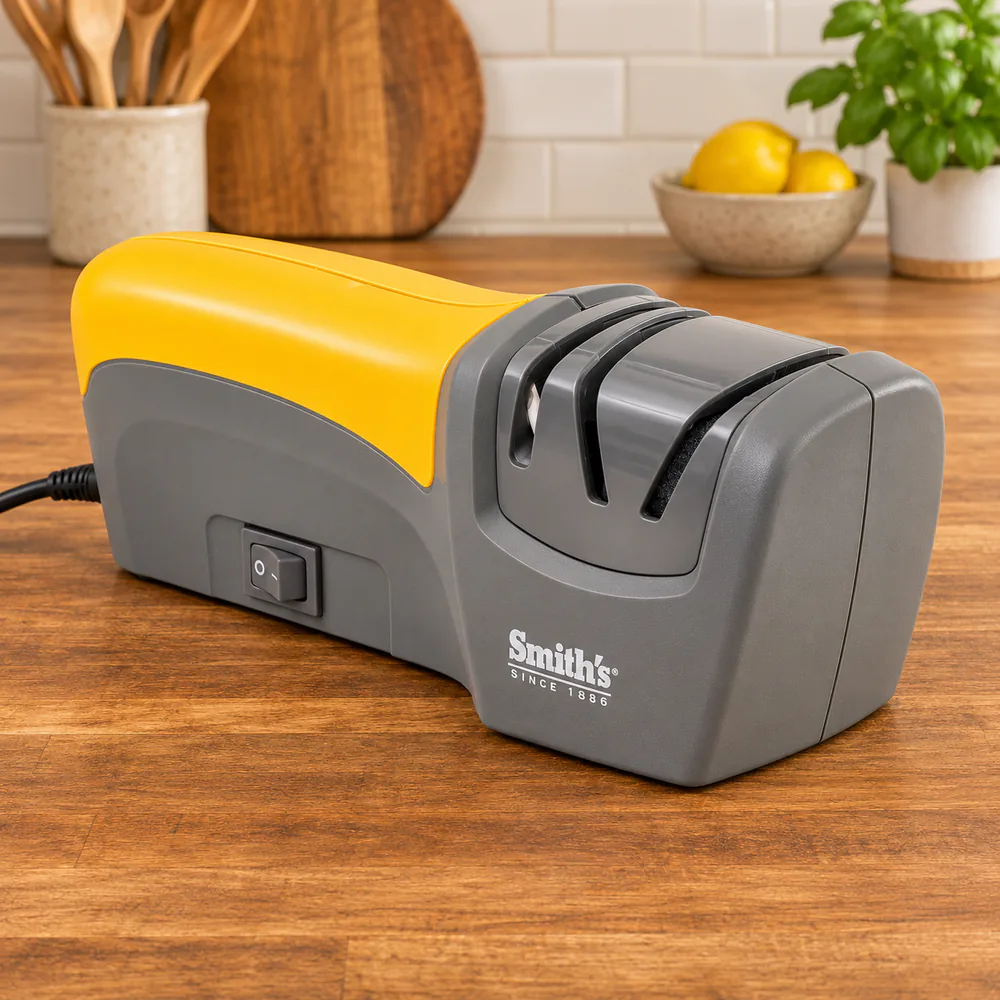
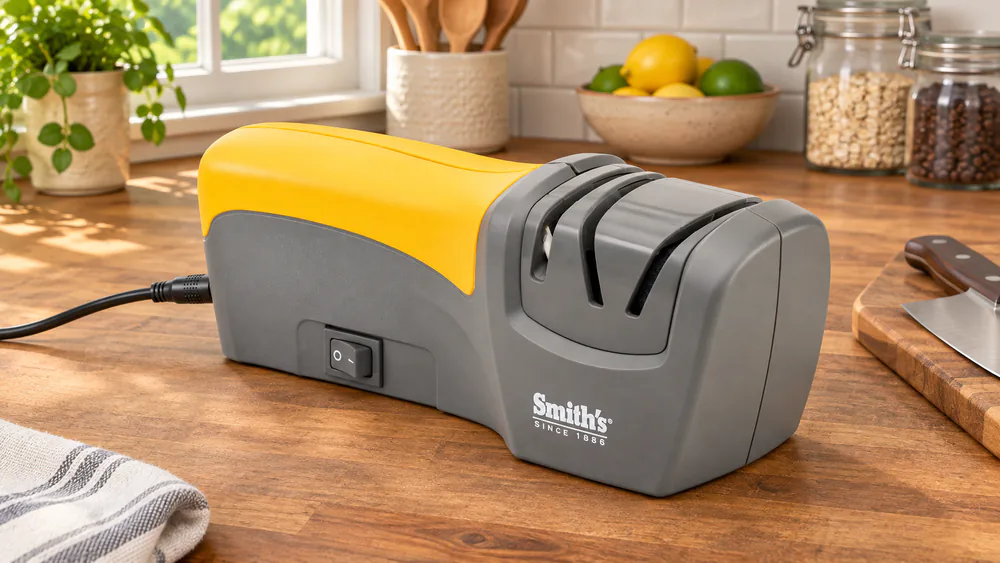
It is a 2-stage design: an electric wheel for sharpening, and a manual crossed-ceramic-rod slot for final honing that works unplugged. Two limits keep it at third. It has only two stages, with no third finishing stage like you get on some other brands' electrics, which we cover in our Chef'sChoice and Work Sharp guides. And stock varies by retailer and changes over time, so check availability before you plan around it. It carries a 3-year limited warranty for non-commercial use, which is reassuring for a motorized tool.

Smith's TRI-6 Three-Stone Sharpening System
4

Smith's TRI-6 Three-Stone Sharpening System

Best for Control
Check Price on Amazon
4.3/5

Moving from pull-throughs to stones, the TRI-6 is the Smith's we would suggest to anyone who wants to learn sharpening properly. It is the only model here where the edge you get depends on how you use it, and that is a feature, not a flaw.

Pros

  • Three grits from coarse to fine in one base
  • Angle guide makes stone sharpening easy to learn
  • Non-skid base and oil-catching trough
  • Better control than any pull-through here

Cons

  • Slower than pull-throughs and electrics
  • Not ideal for long chef's knives
  • Needs more technique and time

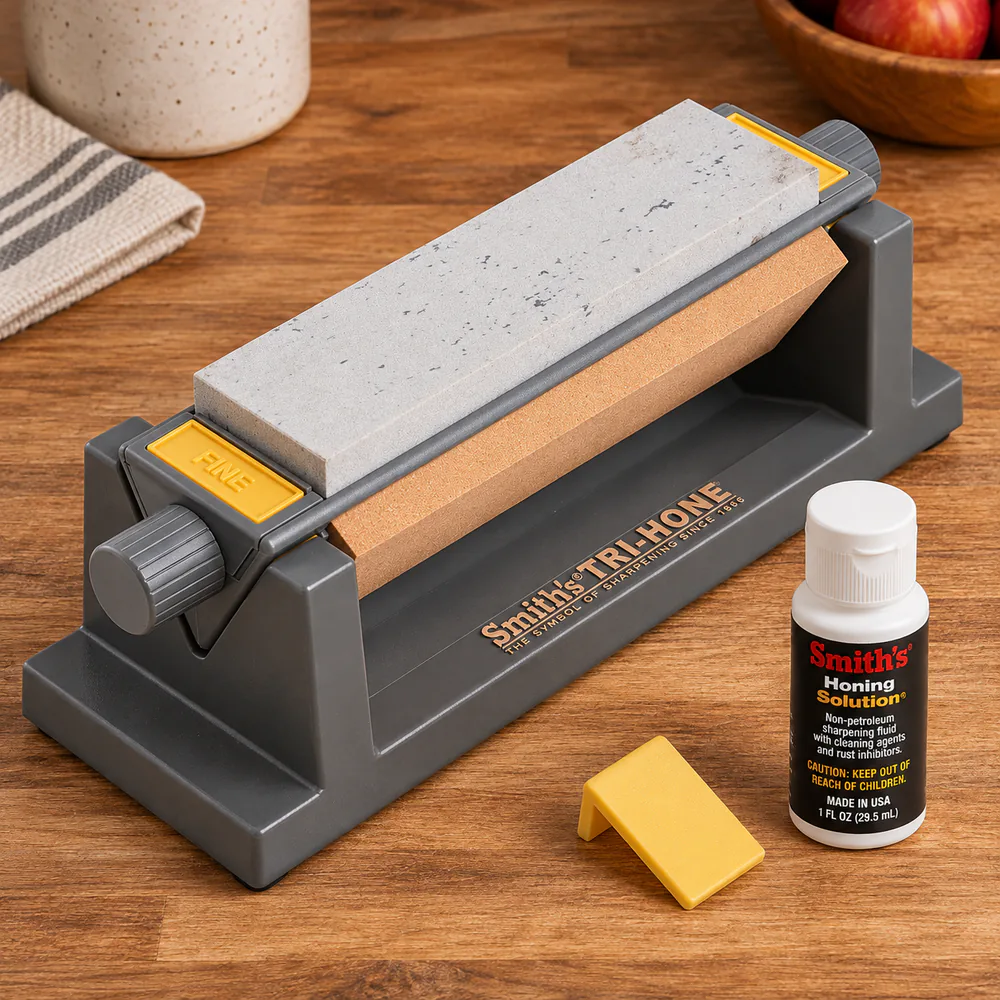
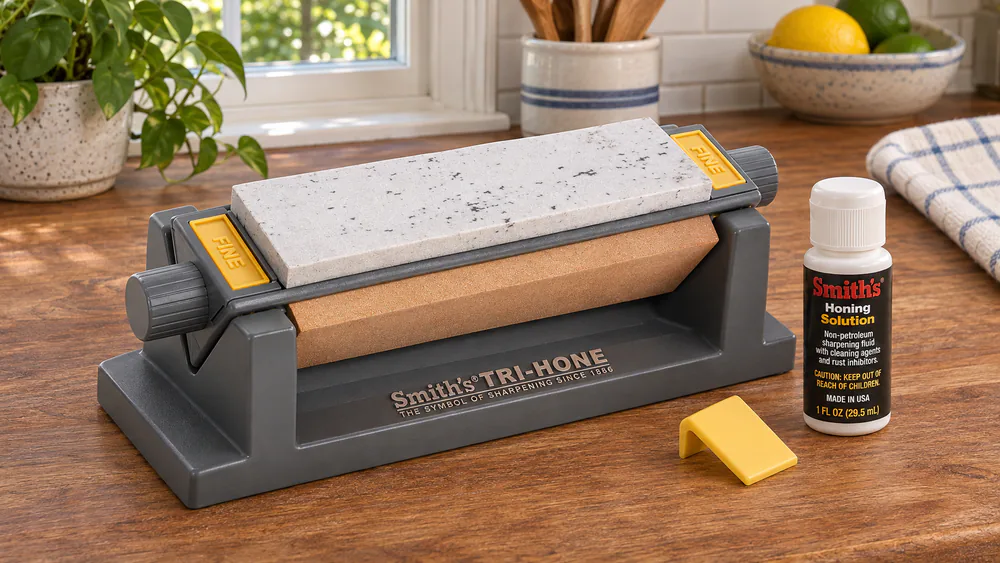
The kit holds three stones: a 300-grit coarse synthetic, an 800-grit medium synthetic, and a 1,000-grit fine Arkansas, each 6 by 1.63 inches. They sit in a non-skid base with a V trough that catches oil, and the kit includes one angle guide and 1 ounce of honing solution. The angle guide makes learning stone sharpening simple.

The stones are large enough for most knives, but the kit is not ideal for long chef's knives. It takes more time and attention than any pull-through, and a freehand Arkansas stone cuts slower than diamond or an electric wheel, so a chipped edge takes longer to reset.

Smith's DCS4 Diamond Combination Stone
5

Smith's DCS4 Diamond Combination Stone

Best Diamond Stone
Check Price on Amazon
4.1/5

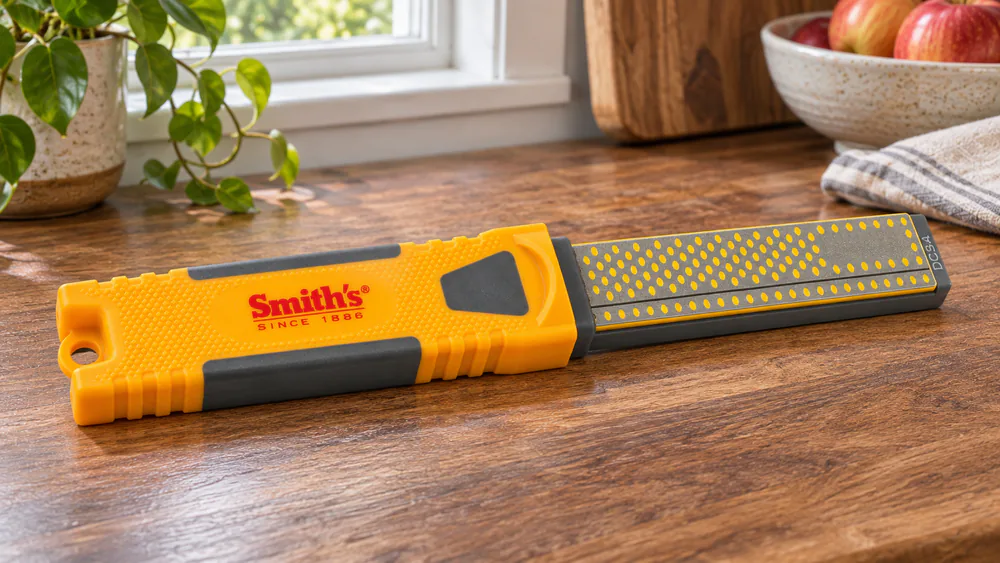
Where the TRI-6 is a full bench kit, the DCS4 is a tuner, not a rebuilder. It has lived in packs for over a decade as a simple touch-up tool, and its handle sheaths the diamond plates. It is fast, taking a couple of minutes per knife, and it works on stainless blades.

Pros

  • Fast, a couple of minutes per knife
  • Works on stainless and hard modern steels
  • Handle stores and protects the diamond plates
  • Small enough for a pocket or tackle box

Cons

  • Will not reprofile an edge or fix chips
  • Needs technique and a flat surface
  • Handle and stone durability is mixed

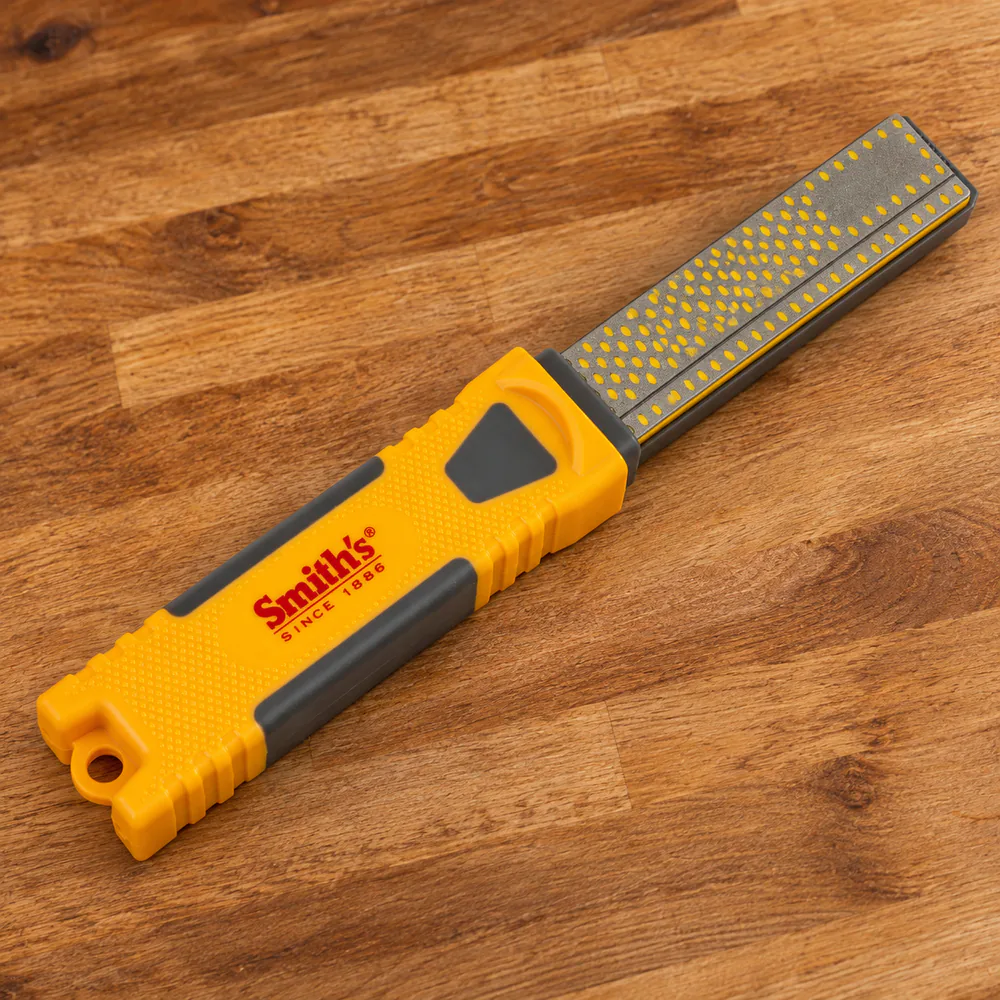
It is a 4-inch double-sided diamond stone, coarse and fine, in a rubber-grip handle that stores the stone. The monocrystalline diamond has an interrupted surface that collects swarf, and there is a micro-tool pad and groove for fish hooks.

It tunes an edge but will not reprofile one or fix chips, so it will not rescue a neglected knife. A diamond stone is quick on high-carbide steels but needs a flat surface and some technique. Durability of the handle and stone is mixed.

Smith's Jiffy-Pro Handheld Sharpener
6

Smith's Jiffy-Pro Handheld Sharpener

Best Handheld
Check Price on Amazon
3.7/5

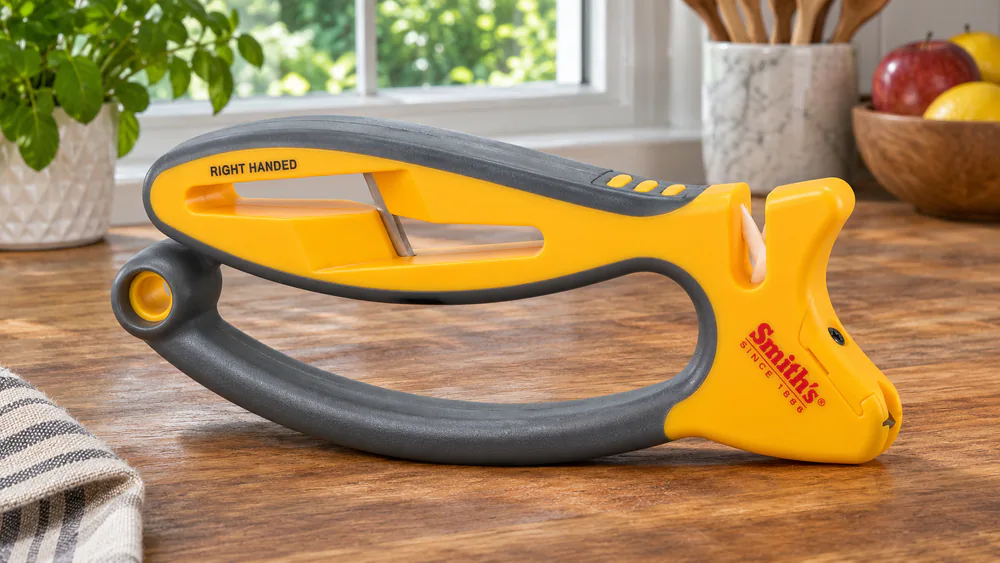
Compared with the DCS4, the Jiffy-Pro feels awkward for the first few uses, then restores moderately dull knives and scissors quickly. The larger handle and full-length finger and thumb guard add control compared with the Pocket Pal, which makes it more comfortable than the other pocket-sized options.

Pros

  • Large handle and full-length guard add control
  • Built-in scissor sharpener for either hand
  • Fits game and fishing shears
  • Budget handheld

Cons

  • Some units fail after very little use
  • Awkward for the first few uses
  • Preset angle only

It pairs crossed carbide blades with ceramic rods, and a built-in scissor sharpener works for right and left-handed scissors. Enlarged slots even fit game and fishing shears.

The weak point is durability: some units fail after very little use. That is why it sits sixth despite being a handy design. If you need a handheld for the knife drawer and scissors, it is worth a look, but we would choose the JIFF-S or the 50264 first.

Smith's PP1 Pocket Pal
7

Smith's PP1 Pocket Pal

Best Pocket Option
Check Price on Amazon
3.9/5

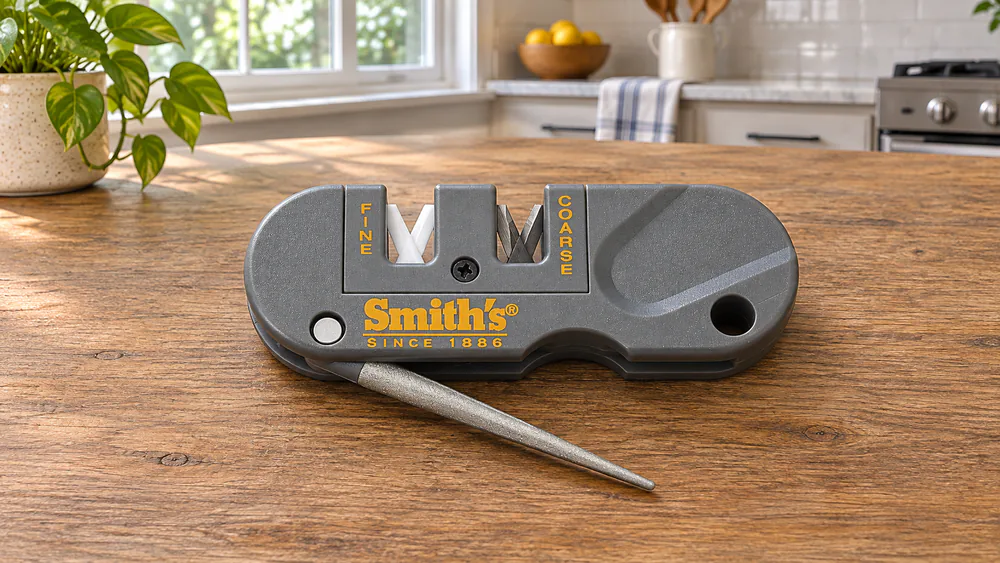
Smaller than the Jiffy-Pro, the Pocket Pal clips to a keychain without bulk, and its fold-out diamond rod handles serrations and small hooks that flat slots cannot reach. At 3.5 inches long and 1 ounce, it is the smallest sharpener here, and it is the right answer for a pocket knife, not a chef's knife.

Pros

  • Tiny and light enough for a keychain
  • Fold-out diamond rod works on serrations and hooks
  • Reversible, replaceable stones
  • Ceramic slot handles serrated or straight edges

Cons

  • Does not give as fine an edge as a flat stone
  • Carbide slot is for straight edges only
  • Costs more than the CCKS for a narrower job

The coarse carbide slot is for straight edges only. The fine ceramic slot takes serrated or straight edges. The stones are reversible and replaceable, which extends its life.

Pocket pull-throughs like this rarely put on as fine an edge as a flat stone, and that is true here. For a kitchen it is a backup, useful for a quick touch-up or a serrated paring knife. It also costs noticeably more than the CCKS, so do not buy it for a kitchen drawer when the CCKS or 50264 does more.

Smith's 10-Sec JIFF-S Knife & Scissors Sharpener
8

Smith's 10-Sec JIFF-S Knife & Scissors Sharpener

Best for Scissors
Check Price on Amazon
3.8/5

Where the Pocket Pal is a backup, the JIFF-S does a good job on kitchen knives and scissors, and it handles a whole drawer in under five minutes. It feels safer in the hand with its plastic guard, which matters when you are sharpening a stack of knives in one sitting.

Pros

  • Handles knives and scissors with one tool
  • Plastic guard feels safer
  • Reversible, replaceable carbide blades
  • Budget price tier

Cons

  • Straight-edge knife slot only
  • Preset angle, no adjustment
  • Basic edge compared with stones

The knife slot is a V with two crossed carbide blades at a preset angle, for straight-edge blades only. A floating ceramic rod in the handle sharpens right and left-handed scissors. The carbide blades are reversible and replaceable.

As a knife sharpener it is basic: a preset angle and no serrated slot. As a drawer tool that also handles kitchen shears, it earns its place.

A Smith's TRI-6 three-stone system on a kitchen counter with its honing solution and angle guide
The TRI-6 represents the stone-based option in the Smith's range.

Smith's Knife Sharpeners Compared

The table shows how the eight picks differ in mechanism, angle, abrasive and skill level. The mechanism and angle columns matter most, because they tell you what the tool can and cannot do for your knives.

ModelMechanismAngleAbrasiveBest forSkill levelRating
50264 Adjustable Pull-through, adjustable 14-24 degrees Carbide, ceramic Most home kitchens Beginner 4.5
CCKS 2-Step Pull-through Preset Carbide, ceramic Budget, drawers Beginner 4.2
Edge Pro 50005 Electric plus manual slot Preset Electric wheel, ceramic rods Hands-off sharpening Beginner 3.8
TRI-6 Stones with angle guide Guide 300/800 synthetic, 1,000 Arkansas Control, learning Intermediate 4.3
DCS4 Diamond stone Freehand Diamond Touch-ups Intermediate 4.1
Jiffy-Pro Pull-through plus scissors Preset Carbide, ceramic Knives and scissors Beginner 3.7
PP1 Pocket Pal Pull-through plus rod Preset Carbide, ceramic, diamond rod Pocket carry Beginner 3.9
JIFF-S Pull-through plus scissors Preset Carbide, ceramic rod (scissors) Knives and shears Beginner 3.8

Which Smith's Sharpener Type Is Right for You

Smith's sells four mechanisms, and choosing among them matters more than choosing among models. Pick the type first, then the model.

Pull-Through vs Stones vs Electric

Pull-throughs are fast and need almost no skill. You drag the knife through a slot, and the carbide and ceramic do the rest. The tradeoff is that carbide pull-throughs remove more metal than needed and offer little angle control. They are fine for beginners and touch-ups, but not for Japanese 15-degree edges or hard steels.

Stones and diamond plates are slower and ask for technique, but they give you control. A guided kit like the TRI-6 removes most of the guesswork, and a freehand stone like the DCS4 rewards practice. If you care about the edge, this is the type to grow into.

Electric sharpeners, like the Edge Pro, trade control for speed. A motor does the grinding, and you simply guide the knife. They suit cooks who want a sharp knife with minimal effort.

Tip. Light pressure and slow, even pulls beat force every time. Pressing hard on a carbide slot removes more steel than you need and shortens the life of your knife.

Sharpening Angles for Kitchen Knives

Angle matters because it decides how thin the edge is. Most Western kitchen knives are ground at a wider angle than Japanese knives, which are typically thinner and sharpened around 15 degrees. The 50264 spans 14 to 24 degrees, which covers both worlds. Smith's precision kit angle guide offers 20, 25, 30 and 35 degrees, with a V-Lock vise that holds the knife at a fixed angle.

Most of the other pull-throughs use a preset angle. That is fine if your knife matches it, but it is a poor match for thin blades.

Grit and Abrasive Types (Carbide, Ceramic, Diamond)

Carbide cuts fast and sets an edge, but it is aggressive. Ceramic is gentler and refines the edge, which is why the better pull-throughs pair a coarse carbide slot with a fine ceramic slot. Diamond cuts quickly on hard modern steels and does not wear down as stone does, but it needs a flat surface and technique.

The stones in the TRI-6 are an older style: a coarse 300-grit synthetic, a medium 800-grit synthetic, and a fine 1,000-grit Arkansas. Use them in that order to move from setting the edge to refining it.

How to Use and Maintain Your Smith's Sharpener

A few habits make any of these tools work better and last longer.

On a pull-through, set the sharpener on a stable surface and hold it down with a non-slip base. Draw the knife through the coarse slot with light pressure, heel to tip, and count your strokes. With a very dull knife on the CCKS, 3 to 4 strokes in the carbide slot is the guide. Finish in the ceramic slot with a couple of lighter pulls.

On stones, keep the angle guide in place and let the stone do the cutting. Add honing solution to the TRI-6 as you go, and wipe off the oil and swarf afterward so the surface stays clean. On the DCS4, rinse the diamond and let it dry before sheathing it in the handle.

Clean carbide and ceramic parts with a damp cloth. Several models have replaceable or reversible carbide blades and ceramic rods; when sharpening stops improving the edge, replace or reverse those parts instead of discarding the tool. Store pocket models away from the keys and coins that will chip them.

A Smith's 50264 adjustable manual sharpener resting on a kitchen counter, with its angle dial and three sharpening slots visible
The Smith's 50264 angle dial and sharpening slots.

Knives a Smith's Sharpener Is Not Right For

Having sorted the types, here is where all of them fall short: Smith's sharpeners are built for everyday kitchen steel. They are a poor match for a few kinds of knives.

Warning. Do not use a carbide pull-through on a thin, hard Japanese knife. These tools remove more metal than needed and offer little angle control, and a single heavy session can ruin a fine edge.

Hard or damaged edges are the first problem. A few passes can leave a very hard or already damaged edge still dull, and a badly rolled blade needs a bench system afterward. Chipped edges are the second: the DCS4 will not fix chips, and a freehand stone takes longer to reset them.
Serrated knives are a mixed case. The CCKS has no serrated option, and the 50264 only has a fixed-angle serrated slot. For bread knives, the Pocket Pal's diamond rod is the better fit.

Very long chef's knives are a poor fit for the TRI-6, whose stones are not ideal for them. If your best knife is a long, thin, hard gyuto, a proper whetstone setup and a shop that sharpens by hand will serve it better than anything in this list.

A Smith's sharpener is a great tool for a dull knife and a poor one for a fine knife.

Frequently Asked Questions

What is the best Smith's sharpener for a beginner?

The CCKS 2-Step is the easiest, since the angle is preset and a few pulls are all it takes. If you want a bit more flexibility, the 50264 lets you choose an angle but is just as simple to use.

Can a Smith's sharpener handle serrated knives?

Partly. The 50264 has a fixed-angle serrated slot, and the Pocket Pal's fold-out diamond rod works on serrations. The CCKS and JIFF-S do not have a serrated option.

Is ceramic, diamond or carbide better?

They do different jobs. Carbide sets an edge fast, ceramic refines it, and diamond is quick on hard steels but needs technique. The best pull-throughs pair carbide and ceramic.

How often should I sharpen my kitchen knives?

Sharpen when a knife stops slicing paper or a tomato cleanly. Between sharpenings, light use of a ceramic slot can keep an edge fresh, but avoid heavy carbide use more than you need.

Are pull-through sharpeners bad for knives?

They are not bad, but they are blunt tools. Carbide pull-throughs remove more metal than needed and offer little angle control, which is fine for budget knives and quick touch-ups but not for fine blades.

Can I sharpen Japanese or 15-degree knives with a Smith's?

We would use the 50264 at its lowest 14-degree setting only for softer, forgiving blades. For a hard Japanese knife, stones or a guided system are a safer choice than any pull-through.

How do I use the Smith's guided system?

Mount the knife in the V-Lock vise at the angle you want, then work through the coarse, medium and fine stones with the angle guide, moving from the 300-grit to the 1,000-grit Arkansas stone. Take your time and keep the pressure light.

Final Verdict

The 50264 is our overall pick because it brings the angle knob and speed together in a tool anyone can use. Choose the CCKS for basic sharpening at the lowest price, or the TRI-6 to learn stone sharpening. Treat the Pocket Pal, Jiffy-Pro and JIFF-S as specialists for pockets, scissors and drawers, and skip the Smith's lineup entirely for a fine Japanese blade.

Read next

Ready to upgrade your kitchen?

Pick the sharpener that fits your knives, then keep every edge in shape.