As an Amazon Associate we earn from qualifying purchases. We may earn a commission from links on this page, at no extra cost to you. Learn more.
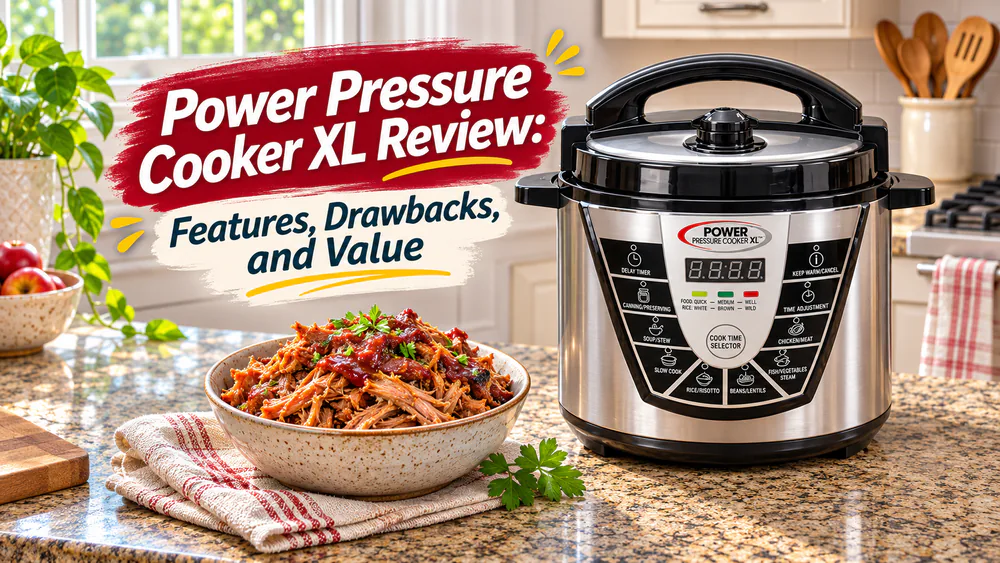
The Power Pressure Cooker XL is an electric multicooker that pressure cooks, slow cooks, steams, and keeps dinner warm in one countertop pot. It was built for the cook who wants a pot roast or a pot of beans without standing over the stove.
For a family kitchen the question is simple: does it get a full dinner on the table without adding a pile of fiddly parts to wash? We looked at the 6-quart PPC770 as our reference model, and the answer is a qualified yes, with a few quirks worth knowing before you buy. It is one of the more approachable options in our pressure cooker reviews, though not the easiest.
Our verdict rests on practical family concerns: how the pork came out, how long dinner really took, and how much work it took to wash the pot and lid.
Power Pressure Cooker XL at a Glance
Before the details, a note on how we judge a cooker like this. We judge it the way a busy family would, and we score it on cooking results, size, noise, cleanup, and whether it is safe to have in a house full of kids.
Our scores reflect the tasks that decide whether a cooker earns counter space: browning pork before pressure cooking, waiting for dinner, washing the coated pot, and handling the lid liner and gasket.
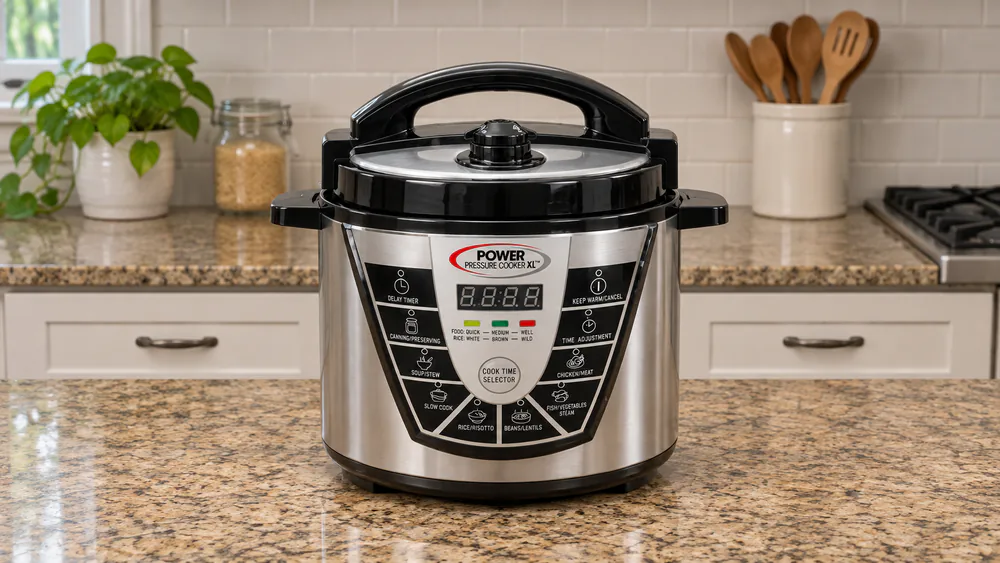
The model we anchor on is the PPC770, a 6-quart cooker rated at 1000W. The same family also came in 8-quart and 10-quart variants, so check the exact model before you shop for parts or manuals.
Picture the pork test that tells you the most about this cooker. We browned the meat in the pot first, locked the lid, and let the countdown run. The meat came out moist and pulled apart with a fork, but the number on the display was only part of the wait, because pressure had to build before the countdown began and release afterward. The cooker delivers good results, but its countdown can give a misleading impression of when dinner will be ready.
Browns and pressure cooks in the same pot
Removable cord makes it easier to put away
Coated pot releases food easily
Presets for meat, soup, beans, rice, and steaming
Specifications
Capacity
6-quart
Power
1000W
Standard pressure
7.2 psi
Slow cook range
2-12 hours
Sizes, Controls, and Cooking Functions
The cooker groups its presets by food rather than by technique. You get meat and chicken, soup and stew, beans and lentils, rice and risotto, and a fish, vegetable, and steam setting. Slow cook, canning, delay start, and keep warm round it out.
Choosing Between the 6-, 8-, and 10-Quart Models
The 6-quart PPC770 suits most households of three to five. A bigger family cooking for seven will want to look at the 8-quart or 10-quart variants, since a pressure cooker should never be filled past its MAX line.
Foods that expand, such as rice and beans, need about half the pot left empty as headroom. That cuts the usable capacity more than people expect, and it is the main reason we lean toward a larger pot for a big household.
Do not assume the wattage or measurements of one size carry over to another. We could not confirm the exact dimensions of the PPC770, so measure your cabinet clearance against the manual for the specific model you own or plan to buy.
Preset Buttons and Manual Adjustments
Here is where the XL shows its age. On the earlier panels, the preset sets the cooking time, and to get a shorter time you start with a shorter preset and add minutes. When a recipe needs a short cook, that workflow is awkward.
Browning is the other quirk. The original PPC770 panel has no dedicated sauté button, and later panels differ, so check the exact model and panel before you follow browning instructions. On the earlier 8-quart panel we looked at, there was also no ready-to-brown signal, which makes it harder to judge when to add the meat.
Tip. Write down your model number and panel layout before you hunt for a recipe or a manual. Browning and timing steps change from one panel generation to the next.
Cooking Performance and Everyday Use
A pressure cooker lives or dies on the Tuesday-night test: can it turn a tough cut or a bag of dry beans into dinner without drama? Mostly, yes, with one honest warning about the clock.
Meat, Rice, Beans, and One-Pot Meals
Meat is the strongest suit, as the review above describes. Ordinary pressure recipes also gave satisfactory eggs, and we did not need to stretch the recipe time to make up for the lower working pressure of 7.2 psi.
The preset names do not translate directly from other cookers. When you adapt a recipe, match the cook time, the liquid, and the release method rather than the button label.
For rice and beans, the manual gives dedicated presets, but we cannot promise a particular texture on the PPC770 beyond what those presets offer. Add liquid carefully and respect that half-pot headroom.
Browning, Slow Cooking, and Total Cooking Time
The manual notes that pressure buildup and release both come on top of the countdown you see on the display, and that matters when hungry kids are circling the kitchen. Plan on adding a good chunk of time before anything lands on the table. The slow-cook setting runs from 2-12 hours, which covers a day-long stew or a short afternoon braise.
Safety Features and Canning Claims
With the cooking results covered, the next question for a family kitchen is safety. The manual lists a lid interlock, pressure and temperature sensing, backup venting, a clog-resistant design, a spring-loaded release, and a thermal cut-off. Those are the right protections for a countertop cooker.
The manual also says children must not operate it. In a family kitchen that matters, so we treat the steam valve as an adult job.
Lid Locking and Pressure Release
Release the pressure completely before you open the lid. Keep your skin away from escaping steam, and use a utensil to move the hot valve rather than your fingers. If the lid will not turn, the pressure is not gone yet, so wait.
What to Verify About the Canning Setting
The machine has a canning button, and older material promotes preserving jars with it. Treat that button with caution.
Warning. A canning button does not make home canning safe. Current guidance says not to use USDA pressure-canning processes in an electric multicooker. Learn why heat penetration in low-acid foods is the real test of safety.
A sealed jar and a pressurized pot do not prove the food reached a safe temperature all the way through. Skip the canning button: it is not a validated preserving method.
Cleaning, Durability, and Replacement Parts
After dinner, the work of cleaning an appliance can determine whether a family keeps using it or stores it in the garage. The XL is workable but not effortless.
Inner-Pot Coating and Cleanup
The coated pot releases food easily, but metal utensils can scratch the finish, so stick to wood or silicone utensils. Coating wear and peeling are the durability concern to watch, and if you buy an older unit, inspect the pot first.
The manual points to hand washing the pot, the lid, and the separate gasket. Dishwasher guidance differs between versions, so follow the instructions for the exact unit. Keep the valves clear and wipe the base.
Sealing Rings, Valves, and Model Compatibility
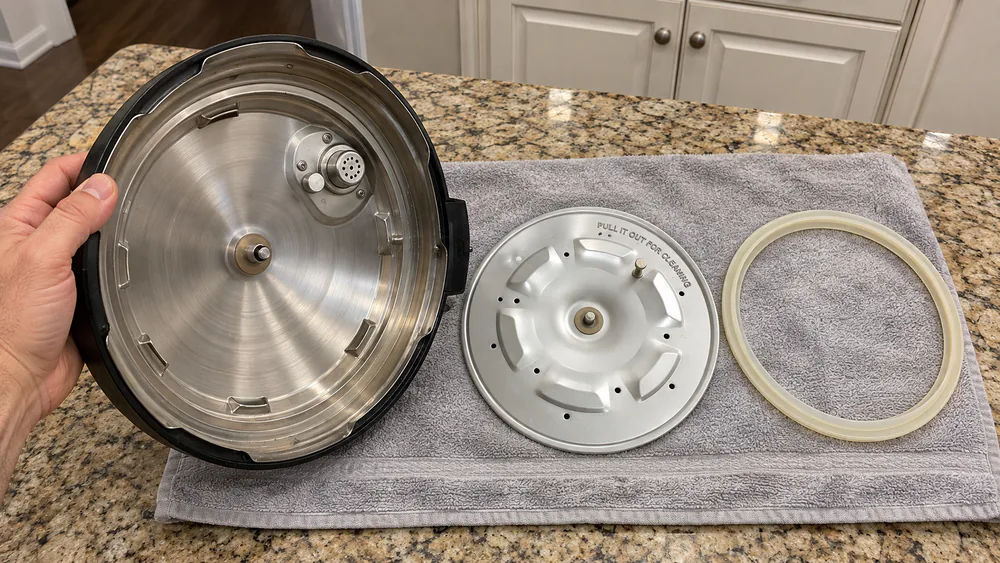
The lid liner and gasket need their own attention at cleanup, and the liner has to go back with its pull tab visible. That small detail is easy to miss when you are rushing through dishes after dinner.
Match the full model number, capacity, and manual before ordering a gasket, valve, or pot. Similar dimensions alone do not prove a part fits. We could not confirm current stock from the original manufacturer, so verify support before you count on a replacement.
The archived PPC770 manual lists a 60-day warranty for the original purchaser with proof. Coverage depends on the unit, the seller, and the purchase terms, so confirm it before you buy.
The liner and gasket need separate attention at cleanup.
Power Pressure Cooker XL vs. Instant Pot
The obvious rival is the Instant Pot Duo 7-in-1 6-quart. It matches the XL on capacity and rated power, and it takes a different approach to the controls and the pot.
Criterion
Power Pressure Cooker XL PPC770 6-quart
Instant Pot Duo 7-in-1 6-quart
Capacity
6-quart
6-quart
Rated power
1000W
1000W
Inner pot
Coated nonstick
18/8 stainless steel, tri-ply bottom
Browning
Earlier panel uses a pressure preset with the lid off; verify your panel
Dedicated sauté function
Timing workflow
Choose a preset and add time
Manual pressure timing available
Yogurt
Not on the documented PPC770 panel
Yogurt function
Cleaning
Hand washing is the conservative guidance
Pot and lid dishwasher-safe; gasket still needs attention
Canning
Canning button present; do not apply USDA canning processes
Do not apply USDA canning processes
Warranty
Archived 60-day terms; confirm actual coverage
1-year limited, conditions apply
Controls, Cooking Pot, and Everyday Convenience
The Duo's buttons can feel intimidating at first, but setting a manual pressure time becomes the simple everyday routine. That is the exact workflow the earlier XL panels make clumsy.
The stainless pot is the other difference. The Duo's light steel insert is manageable at the sink, though the gasket and lid recesses add cleaning work, and odors can linger. Its sealing ring can hold curry aromas that carry into plain rice, so neutral dishes benefit from careful ring cleaning. The round pot also feels cramped when you stir a full roast-and-vegetable meal.
On results, the Duo cooks rice tender without making it mushy, and brown rice cooks well. A long stew preset can push meat past the texture you want, and slow-cooked pot roast can stay chewy even when moist.
Availability, Support, and Overall Value
The Duo is easy to find, and its warranty is a clear 1-year limited term. The XL is a historical favorite, but we could not verify current stock, current support, or a clean warranty story, which counts against it as a purchase today.
If you want the simplest everyday routine and the easiest cleanup, the Duo is the safer buy. If you find a PPC770 and want a cooker that browns and pulls pork apart well, it is still a capable pot.
Pros and Cons
Pros
Browned pork came out moist and tender
Eggs cooked satisfactorily with ordinary pressure recipes
Coated pot releases food easily
Removable cord makes storage easier
Full safety feature set, including lid interlock and thermal cut-off
Slow cook range of 2-12 hours
Cons
Displayed time is a poor dinner-ready estimate
Earlier panels have no dedicated sauté button or ready-to-brown signal
Short cooks are awkward on earlier panels
Coating can wear or peel, and metal utensils scratch it
Lid liner and gasket need separate cleanup
Canning button should not be trusted for preserving
Current stock, parts, and warranty are hard to verify
What to Check Before Buying
Start with the model. Confirm the capacity, the panel generation, and whether the unit has a dedicated sauté button, because that one detail changes how you cook.
If the cooker is used, inspect the pot for scratches, peeling, or wear. Check that the gasket, liner, and valves are present and undamaged, and stop using any damaged part.
Look at the warranty on your listing. The archived terms are short, and seller terms vary. Also see our guides to the best pressure cookers and how to use a pressure cooker if you want to compare options or learn the basics first.
Key takeaway. The XL fits a cook who is willing to hand wash and learn its panel. Everyone else should look at the Duo.
Frequently Asked Questions
Do the older 8-quart panels match the PPC770 manual?
Not necessarily. Panel layouts differ between sizes and generations, so use the PPC770 manual only for the 6-quart model and find the matching manual for any other size.
What should you do if the lid will not turn?
Leave it alone. The pressure is not gone yet, so let the cooker cool and release completely before you try again, and keep your skin away from any escaping steam.
Can you fill the pot to the top for rice and beans?
No. Expanding foods need about half the pot left empty, so fill to half or less and never go past the MAX line.
What should you check if it will not build pressure?
Cool it, depressurize it, then check the liquid level, the lid seal, the gasket placement, and the float-valve assembly. Stop using any damaged part.
Final Verdict: Is the Power Pressure Cooker XL Worth It?
What the review above could not settle is whether you should buy one at all today. We could not verify current stock, parts, or a clean warranty, so a new buyer is better served by the Duo, which is easy to find and carries a clear 1-year limited warranty. If you do track down a PPC770, treat it like a used appliance: confirm the panel generation, inspect the pot coating, and check that the gasket, liner, and valves are all present before you cook anything.