Helping you create a kitchen you love.

Knives & Cutlery

Best Knife Sharpening Kits for Home Cooks: Whetstone, Guided and Pull-Through

As an Amazon Associate we earn from qualifying purchases. We may earn a commission from links on this page, at no extra cost to you. Learn more.

Best Knife Sharpening Kits for Home Cooks: Whetstone, Guided and Pull-Through

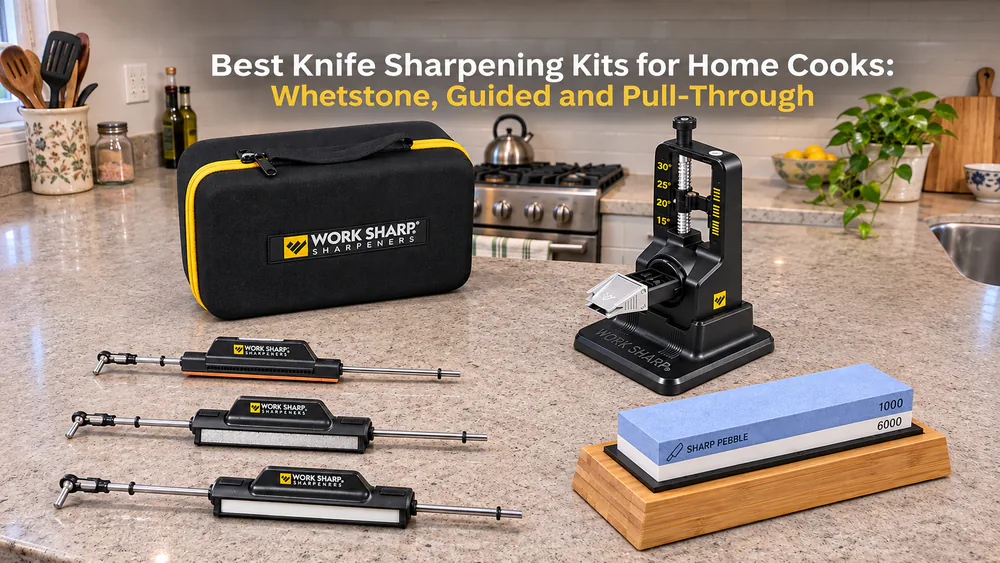
We judged whetstone, guided and pull-through kits on grit range, angle control and how steadily each one holds a knife, with a clean paper slice and a tomato skin as our benchmarks for a truly sharp edge. Our top pick is the Work Sharp Precision Adjust, because it gives a repeatable edge on the first attempt. If you want a wider look at the category, see our knife sharpener reviews.

The hardest cases for any kit are Japanese 15-degree chef's knives and serrated bread knives, because those blades expose a weak angle guide or a limited abrasive range faster than anything else.

Quick Picks

RankProductBest forTypeRatingBuy
1

Work Sharp Precision Adjust

Best Overall Kit
First-time sharpeners Guided clamp, 15 to 30 degrees 4.7 View on Amazon
2

Work Sharp Precision Adjust Elite

Best Guided System
Japanese and fine-edge knives Guided clamp, 15 to 30 degrees 4.6 View on Amazon
3

Sharp Pebble 1000/6000 Whetstone

Best Whetstone Kit
Learning freehand sharpening Dual-grit whetstone 4.4 View on Amazon
4

Lansky Deluxe 5-Stone

Best Budget Kit
Tight budgets and Western knives Five hones, four angle presets 4.3 View on Amazon
5

SHARPAL 162N Diamond Stone

Best Diamond Stone Kit
Fast dry sharpening 325/1200 diamond, built-in guide 4.2 View on Amazon
6

Tumbler Original Rolling Knife Sharpener

Best Rolling Kit
Large knives, quick maintenance Magnetic 15 and 20 degree 4.1 View on Amazon
7

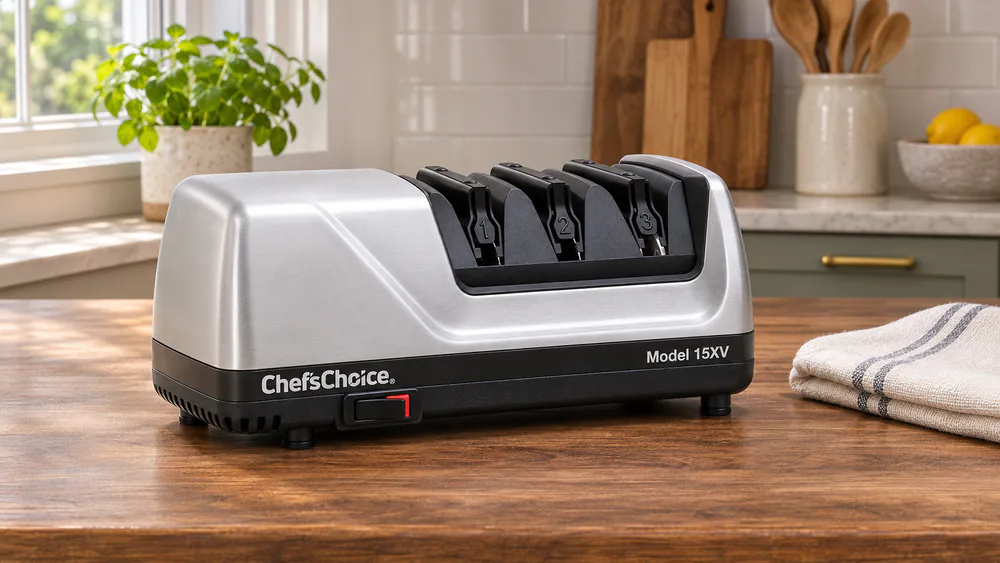
Chef'sChoice 15XV EdgeSelect

Best Electric Option
Bread knives and neglected blades 3-stage electric 4.0 View on Amazon
8

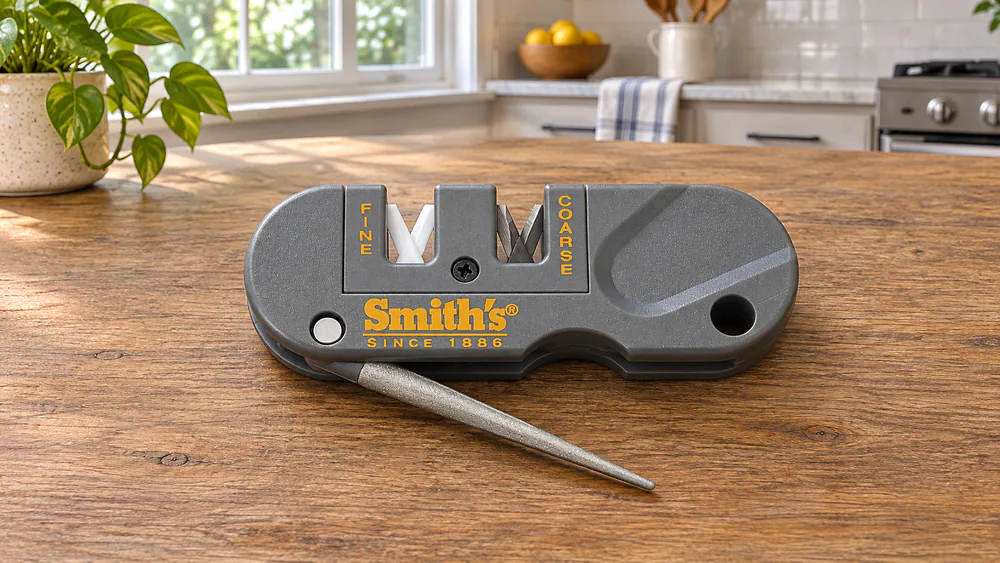
Smith's PP1 Pocket Pal

Best Pocket Kit
Travel and quick touch-ups 1 ounce, pocket-sized 3.8 View on Amazon

We earn a commission if you make a purchase, at no additional cost to you.

See full comparison table

How We Tested and Chose These Kits

Here is how we score a kit against what a working kitchen needs from it. Does it hold the knife and the angle steady, and is the holder stable enough that a slip is not a worry? Does it cover coarse repair work through fine polish, and can it handle a thin Japanese 15-degree edge and a serrated bread knife as well as a Western chef's knife?

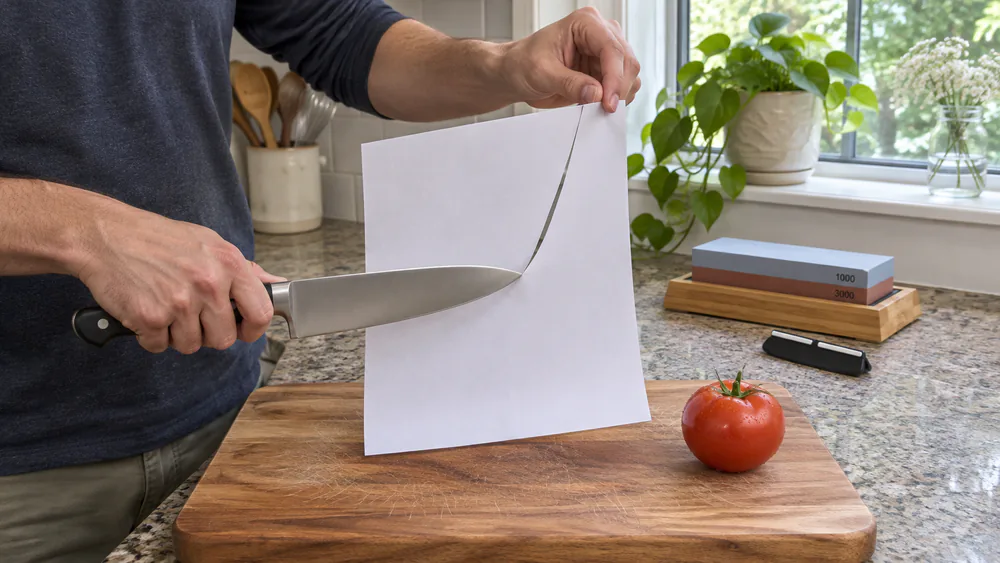
We use a clean slice through printer paper to judge edge evenness and tomato skin to judge sharpness: a dull edge skids across the skin, while a keen one bites straight in. Grit range, angle control and holder stability decide the score, and the edge benchmarks tell us whether a kit delivers on them.

Japanese 15-degree knives were the case that separated the kits. The Elite and the 15XV held that thin angle, while the Lansky's 17-degree minimum thickened it. Serrated bread knives were the other dividing line: the 15XV polished them without rounding the teeth, while the Tumbler and other rolling sharpeners cannot handle serrated blades. On a Japanese-angle chef's knife, the Elite brought a blade that struggled with tomato skin back to slicing it cleanly.

A chef's knife slicing cleanly through a sheet of printer paper beside a ripe tomato on a wooden board, with a sharpening kit in the background
A clean paper slice and a bite into tomato skin are the two benchmarks we hold every edge to.

The Best Knife Sharpening Kits

Work Sharp Precision Adjust
1

Work Sharp Precision Adjust

Best Overall Kit
Check Price on Amazon
4.7/5

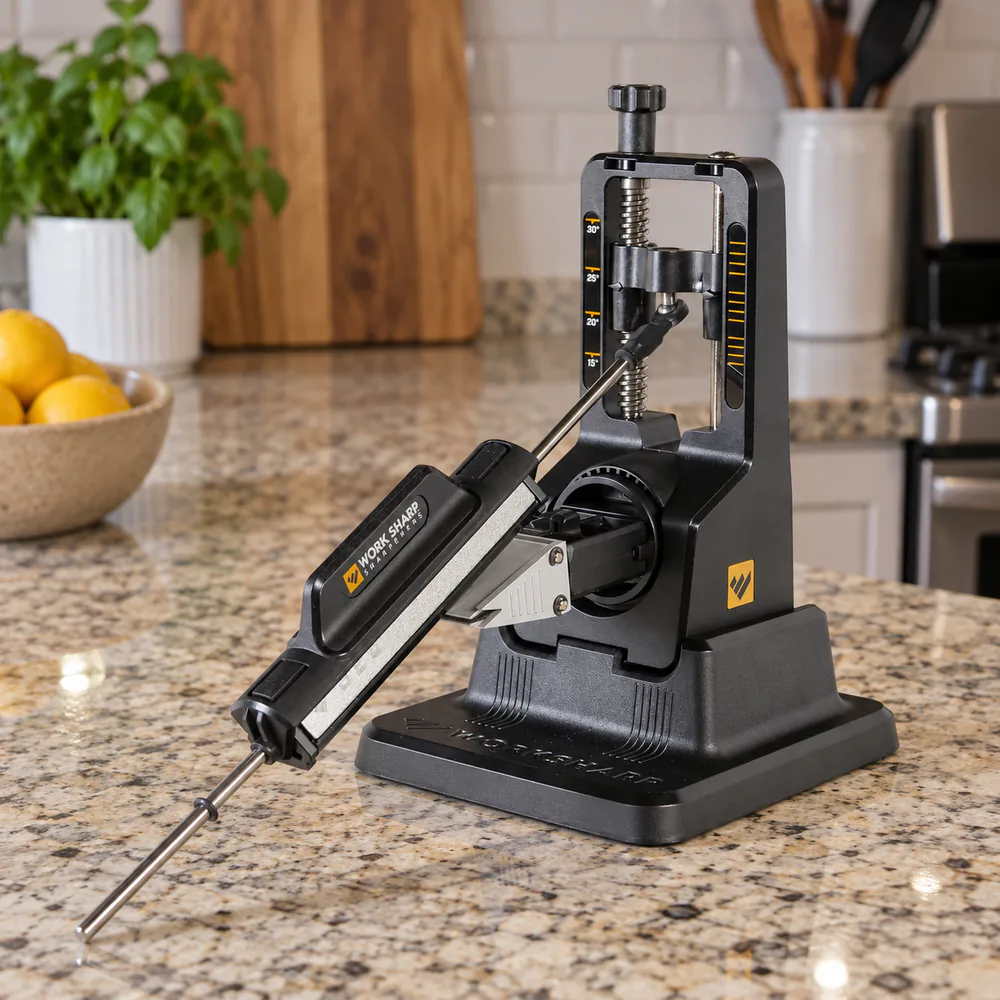
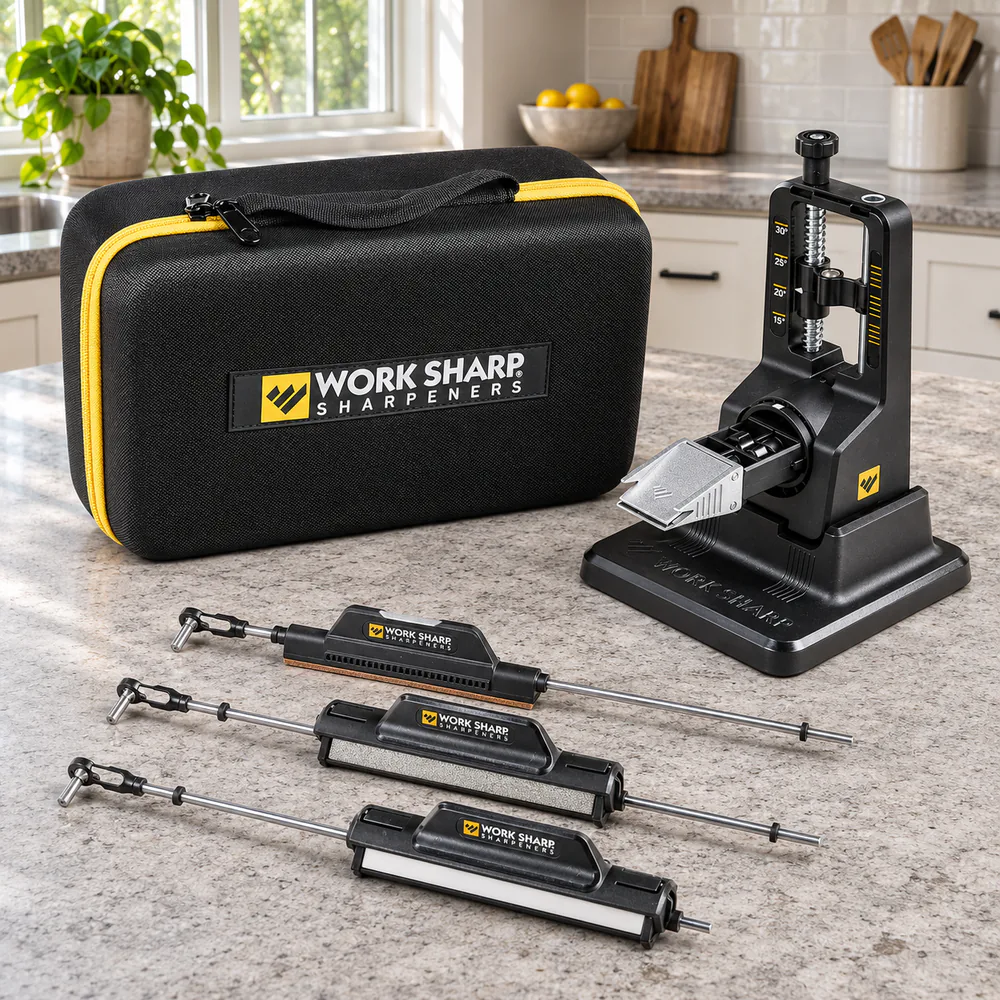
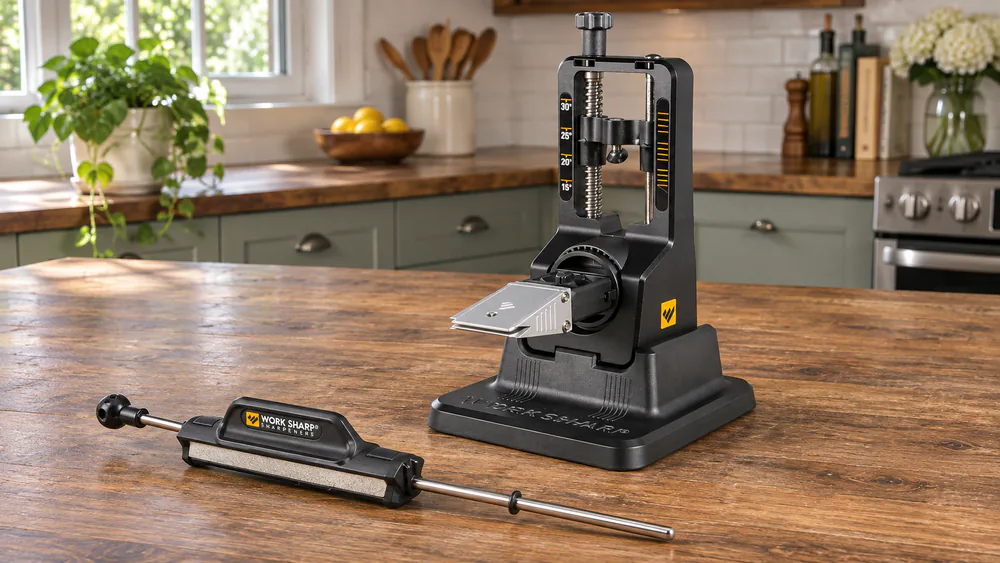
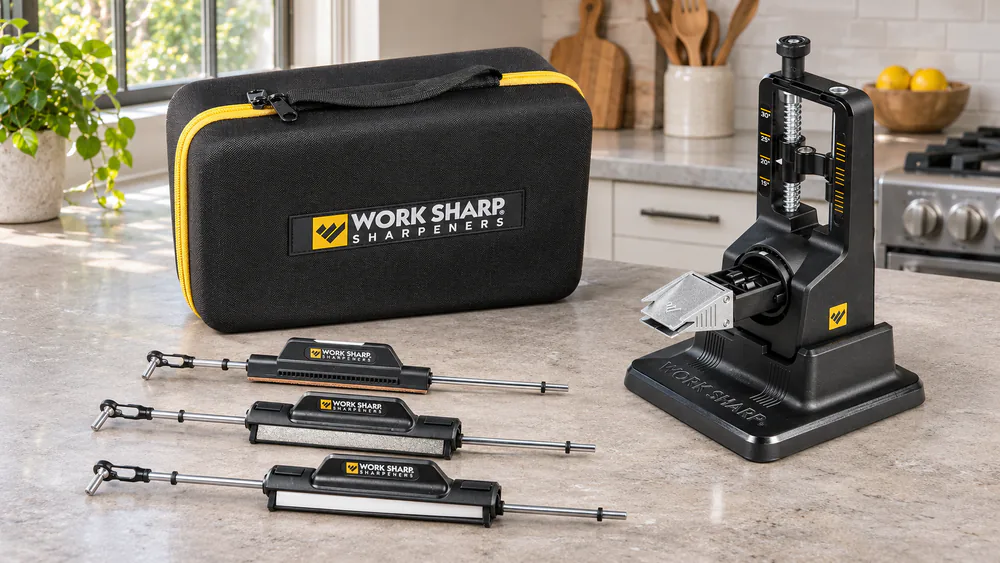
The Precision Adjust gives a repeatable edge on the first attempt, and that is why it is our top pick. Lock the blade in the clamp, choose an angle and use the three abrasives in order. The system requires less hand skill than a bare whetstone, so beginners can get a sharp edge without a long learning curve. When we locked in a knife, picked an angle and ran the three abrasives in order, the first attempt gave us a repeatable edge, with no practice runs needed.

Pros

  • Repeatable results from the first session
  • 15 to 30 degree range in 1-degree steps
  • Tri-Brasive rod covers coarse, fine and ceramic work
  • 3-year warranty

Cons

  • Plastic body flexes slightly
  • No strop in the base kit, so the final polish is limited

The 15-30 degree angle scale moves in 1-degree steps, which covers Japanese and Western knives alike. We treat the scale as a rough benchmark because blade width shifts the real angle, so note your setting and keep it the same from session to session. The rotating Tri-Brasive rod packs coarse and fine diamond plus fine ceramic into one piece, so you never swap stones mid-job.

The trade-offs are modest: the plastic body flexes slightly under pressure, and with no strop in the base kit the final polish stops short of what leather can add. For most home cooks who want sharp knives without a hobby, this is the kit to buy.
A Work Sharp Precision Adjust sharpener with an empty clamp and its abrasive rod resting beside the base
Work Sharp Precision Adjust Elite
2

Work Sharp Precision Adjust Elite

Best Guided System
Check Price on Amazon
4.6/5

Step up from the standard model and you reach the Elite, the guided system we would choose if the knives in your block include fine Japanese steel. It keeps the same 15-30 degree clamp range and includes 220, 320, 400, 600 and 800-grit diamond abrasives, fine ceramic and a leather strop. On a Japanese 15-degree knife that struggled with tomato skin, the Elite brought the blade back to slicing it cleanly, which is the rescue that earned it this spot.

Pros

  • Finer diamond plates for a keener edge
  • Rescued a dull Japanese 15-degree knife
  • Feels solid and consistent
  • Extra rods for finishing and serrations

Cons

  • Costs noticeably more than the standard model

It also feels more solid and consistent than cheaper clamp sharpeners that fade within a year, and its finishing tools include fine ceramic, a leather strop and a ceramic rod for serrations. The Elite includes two Tri-Brasive assemblies, a leather-strop assembly with a ceramic serration rod, and a carrying case.

The extra stones only matter if you plan to chase a finer edge, so if your knives are mostly sturdy German or American chef's knives, the standard model is enough.

Sharp Pebble 1000/6000 Whetstone
3

Sharp Pebble 1000/6000 Whetstone

Best Whetstone Kit
Check Price on Amazon
4.4/5

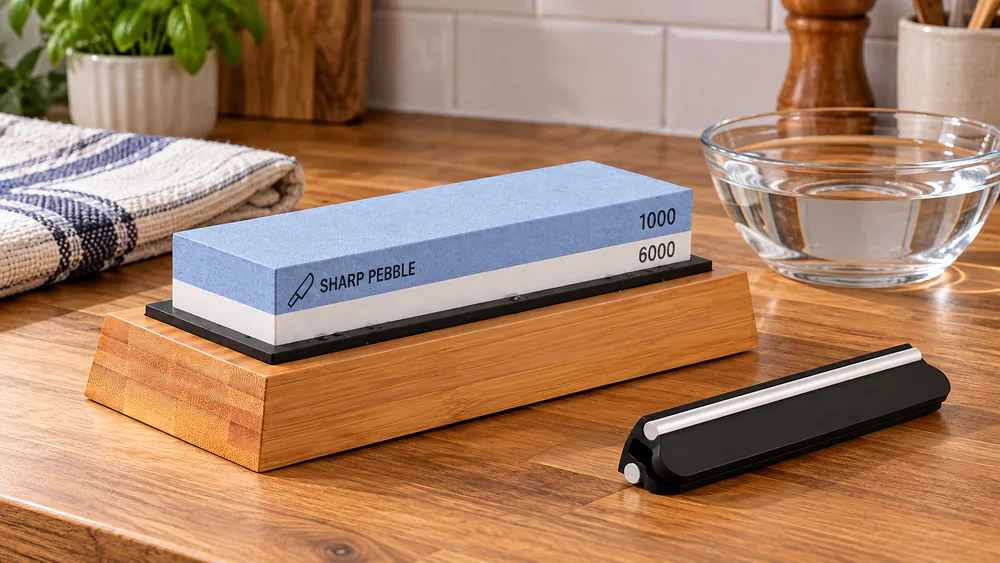
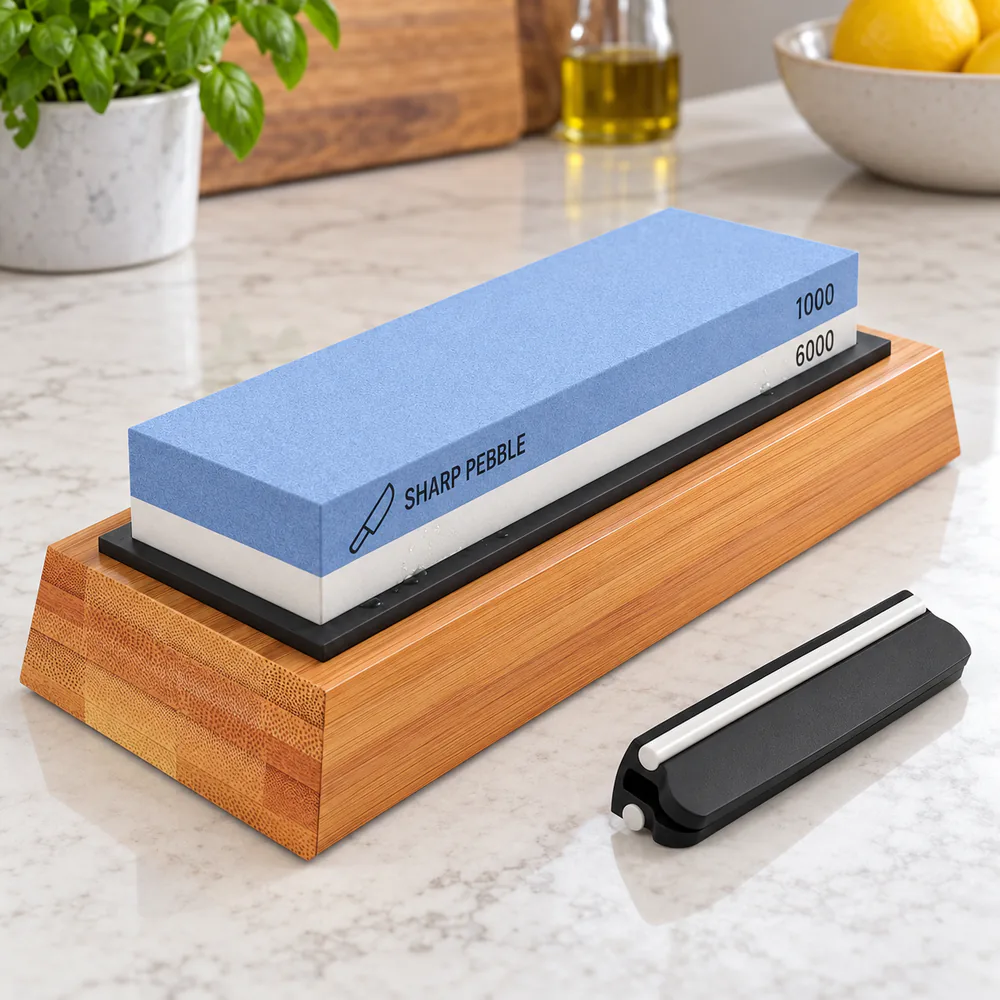
Dropping the clamp and the hardware that comes with it, the Sharp Pebble is the whetstone kit to start with. Its dual-grit 1000/6000 stone sharpens on one side and polishes on the other, and we found that the slurry has to be cleared as it builds while the angle takes real practice to hold.

Pros

  • Dual-grit stone sharpens and polishes
  • Steady bamboo base with rubber feet
  • Rewards practice with a fine edge
  • Great value

Cons

  • About a 10-minute soak before use
  • Guide fixes 20 degrees only
  • Takes practice to hold the angle

The base does a lot of the work, since the silicone-gasketed bamboo tray and rubber feet keep the stone steady and lift it above knuckle-scraping height. On butcher block the base slid, but on granite it gripped, so we would set it on a damp towel or a stone counter.

The kit includes an angle guide, but it fixes a single 20-degree angle, so it will not suit 15-degree Japanese edges. Learn to hold your own angle and a whetstone rewards you with a very fine edge for the least money. It is not the fastest route, and it will not rescue a badly chipped blade.

Lansky Deluxe 5-Stone
4

Lansky Deluxe 5-Stone

Best Budget Kit
Check Price on Amazon
4.3/5

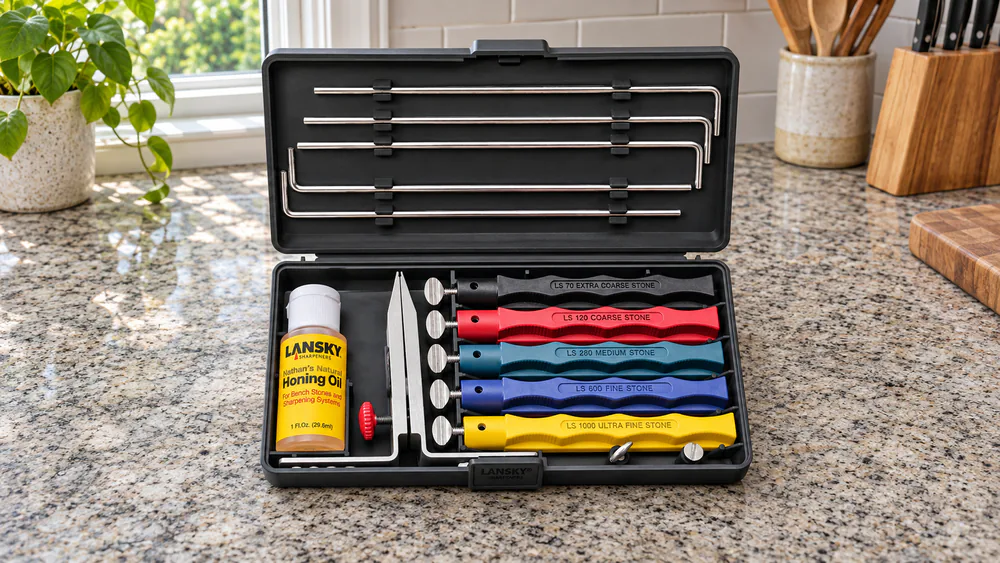
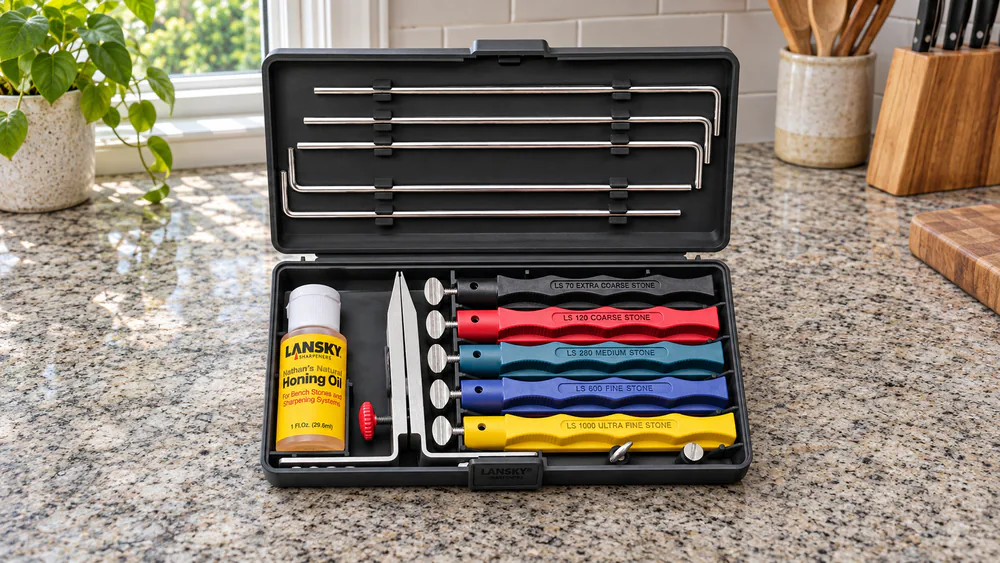
Moving to a guided clamp at a lower tier, the Lansky is the best budget kit here and the most complete one on the list. The 5-stone set runs from 70 extra coarse to 1000 ultra fine, and it ships with honing oil, a clamp and a case. The angle presets are 17, 20, 25 and 30 degrees, enough for most Western knives.

Pros

  • Five hones from 70 to 1000 grit
  • Honing oil, clamp and case included
  • Four angle presets
  • Scalpel-level edges with a strop added

Cons

  • Clamp is cramped on tall chef's knives
  • 17-degree minimum thickens Japanese edges
  • Oil is messier than water

Adjusting the thumbscrews and guide rods takes patience. We found that marking each rod to identify its matching stone saves confusion later. A stand makes the whole system far steadier, though the coarsest stone wears first.

The clamp is cramped on tall 8-inch chef's knives, and its 17-degree minimum thickens Japanese edges. Still, it delivers an excellent finish for the price; following the finest stone with a leather strop and compound takes the edge to scalpel level.

SHARPAL 162N Diamond Stone
5

SHARPAL 162N Diamond Stone

Best Diamond Stone Kit
Check Price on Amazon
4.2/5

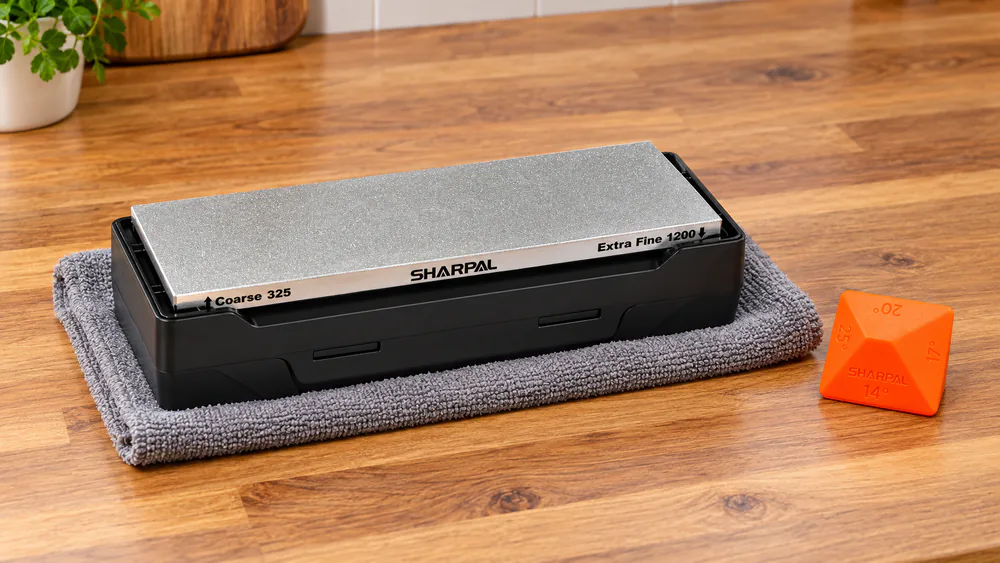
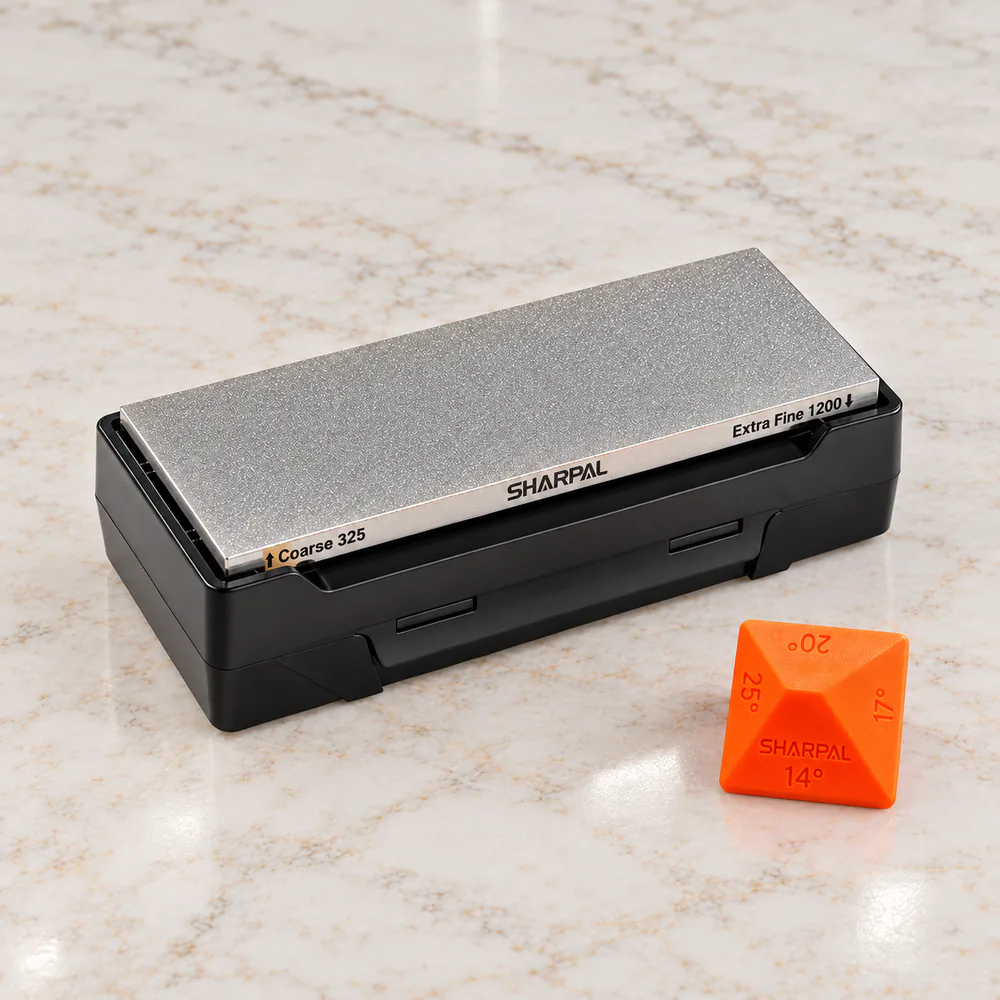
For cooks who would rather skip water altogether, the SHARPAL is the quickest way to put an edge on a knife without a bucket of water. It pairs a coarse 325 side with an extra-fine 1200 side on an 8 by 3 inch diamond plate. It cuts dry without dishing the way soft stones can.

Pros

  • Cuts dry with no soaking or dishing
  • 14, 17, 20 and 25 degree guide
  • 325/1200 diamond covers repair and finish
  • 3-year warranty

Cons

  • Case lid is a poor holder
  • A slip is a real cut risk without a stone holder

An integrated guide offers 14, 17, 20 and 25 degree angles, and the 14-degree setting is a rare find for sharp Japanese blades. The non-slip case base is a nice touch.

Our one firm warning is the holder. We ran the stone dry with no soaking and it never dished, but the case lid was a poor holder, and a slip is a real cut risk, so use a proper stone holder. Add one and this becomes a fine pick for cooks who want speed.

Tumbler Original Rolling Knife Sharpener
6

Tumbler Original Rolling Knife Sharpener

Best Rolling Kit
Check Price on Amazon
4.1/5

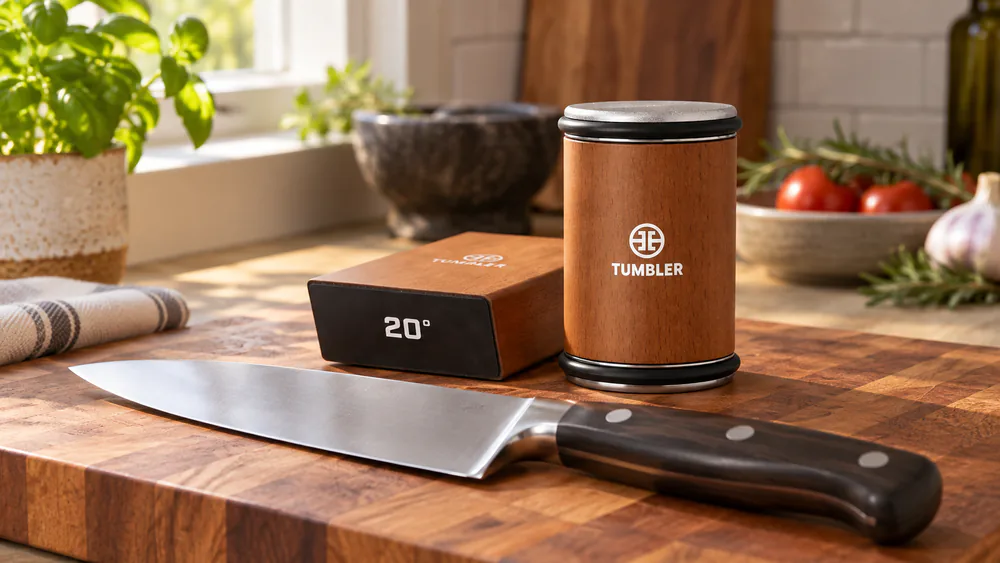
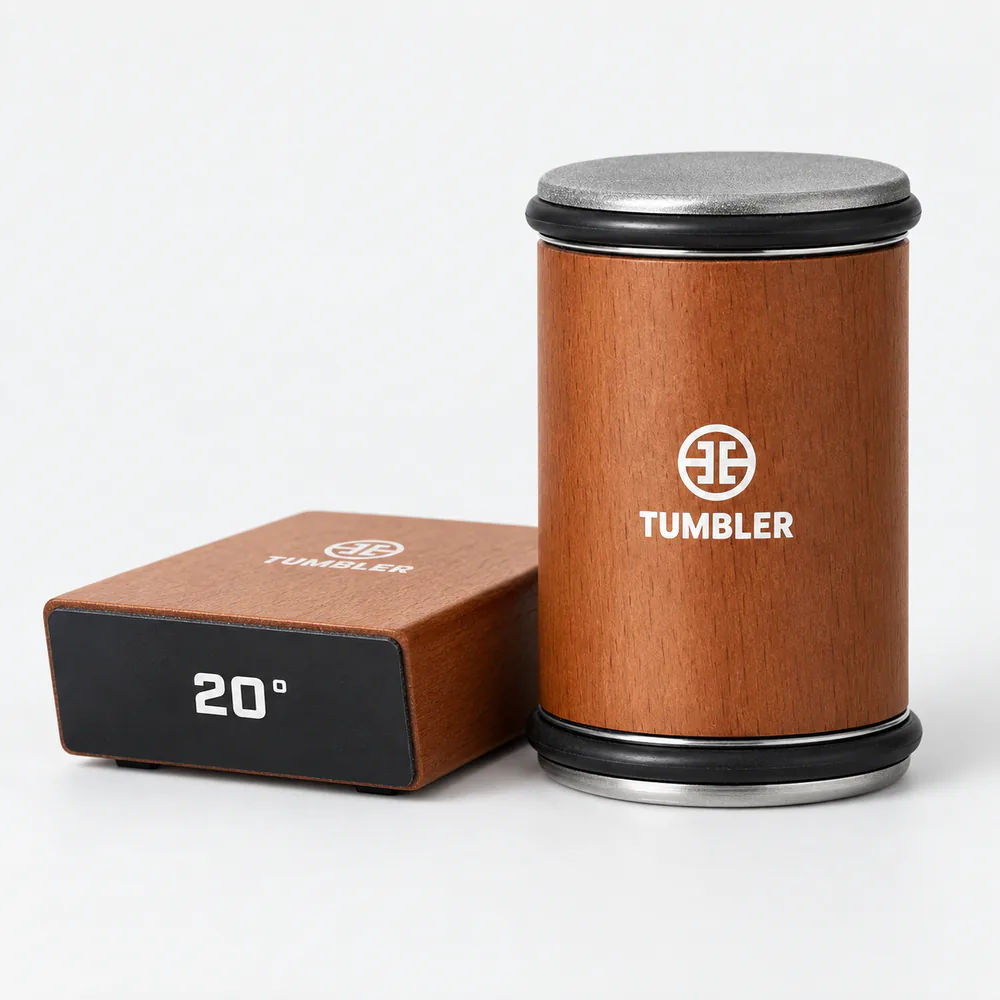
If angles are the part that worries you, the Tumbler is the most approachable rolling sharpener. You set the knife on a magnetic block at a fixed 15 or 20 degrees, then roll the diamond-plated disc down the edge, finishing with the stainless helix honing disc. There is no angle to hold, so it is quick and tidy.

Pros

  • Fixed magnetic 15 and 20 degree supports
  • Quick and tidy roll-to-sharpen use
  • Works well on large knives

Cons

  • Block rides too tall for small paring and steak knives
  • Very dull blades need a more aggressive tool first
  • No serrated knives

On our large knives it worked well, which is what it suits best. The magnetic block rides too tall for small steak or paring knives, so we could not seat the small blades from the drawer. Very dull blades need a more aggressive sharpener first, and it does not handle serrated knives.

The Work Sharp rolling sharpener we also tried brought a solid edge back quickly on the knives we ran through it, with four angle options, though its ceramic honing disc wears first. We could not source that one as a buy entry, so the Tumbler is our rolling pick. Treat it as a maintenance tool for big knives.

Chef'sChoice 15XV EdgeSelect
7

Chef'sChoice 15XV EdgeSelect

Best Electric Option
Check Price on Amazon
4.0/5

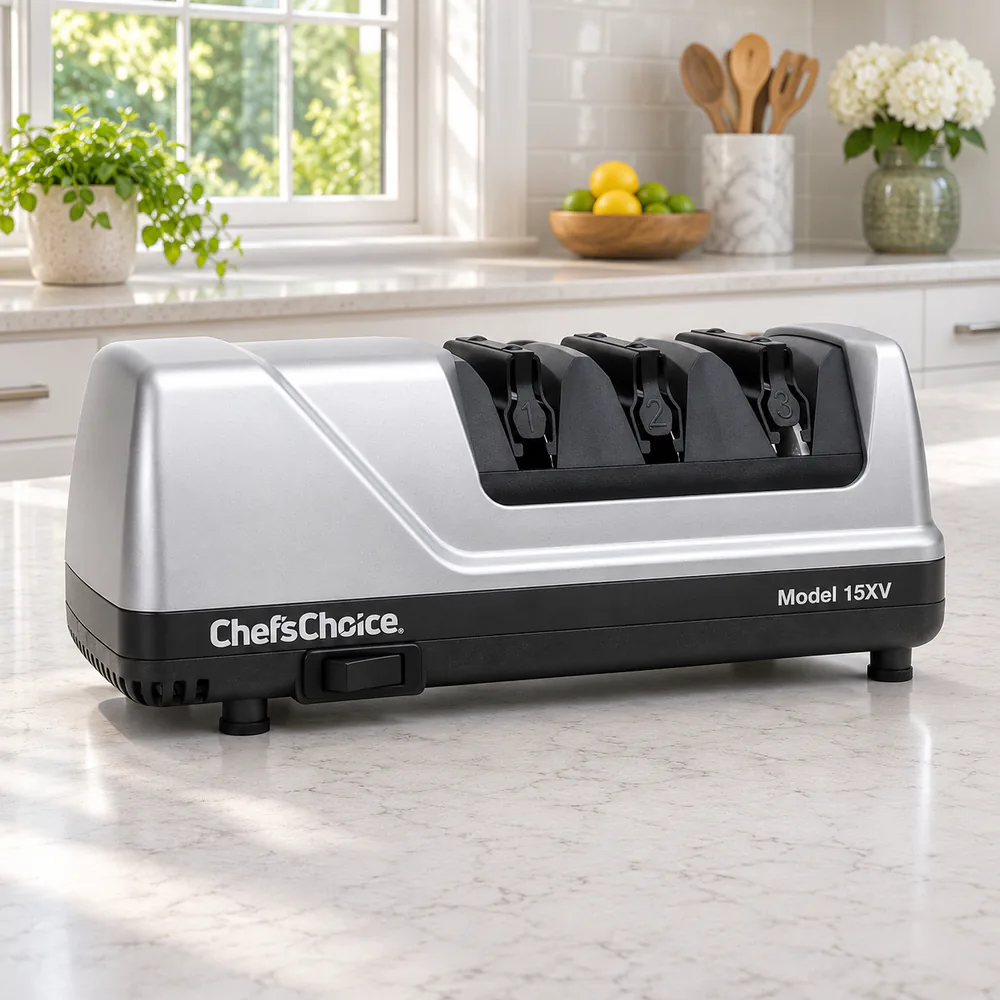
The 15XV is the electric option for people who want sharp knives without learning angles. Its 3-stage EdgeSelect design runs two diamond stages plus a flexible stropping stage, and it converts 20-degree factory edges to 15-degree Trizor XV edges. Springs guide a steady 15-degree angle.

Pros

  • Springs guide a steady 15-degree angle
  • Handles serrated bread knives well
  • Converts factory edges to thinner, cleaner-cutting ones
  • 3-year limited warranty

Cons

  • Discs cannot be replaced
  • Thins edges, so it is wrong for reprofiling
  • First attempt can leave a knife duller

We ran over a dozen neglected knives through it, and the converted knives cut noticeably cleaner while stage three polished serrated bread knives without rounding the teeth. Our first attempt left a knife duller than it started, and the technique only settled after a little practice.

Know the limits. The abrasive discs cannot be replaced, and the machine thins edges, so it is the wrong choice for reprofiling. It is also a one-job machine that suits Western-style blades best.

Smith's PP1 Pocket Pal
8

Smith's PP1 Pocket Pal

Best Pocket Kit
Check Price on Amazon
3.8/5

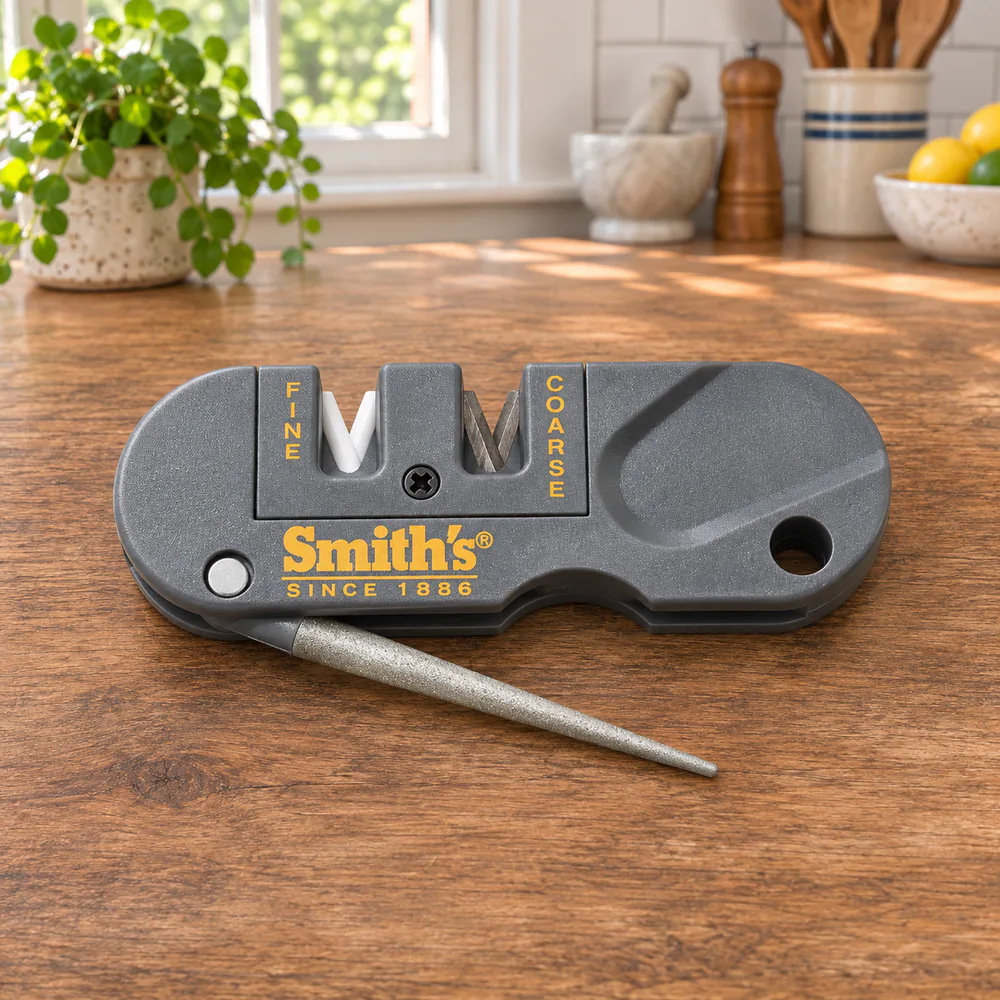
At the far end of the range, the Pocket Pal is the sharpener to toss in a camping bag or a drawer, not the main kit for a kitchen. It is 3.5 inches long and weighs 1 ounce, with a lanyard hole. A preset carbide slot handles coarse work on straight edges only, ceramic slots fine-tune, and a fold-out diamond rod reaches serrations and hooks.

Pros

  • Pocket-sized at 1 ounce
  • Diamond rod reaches serrations
  • Replaceable stones

Cons

  • Carbide slot is for straight edges only
  • No match for a full kit on a big chef's knife

The stones are replaceable, which helps it last. Use it for quick touch-ups and keep a real kit for kitchen work.

Knife Sharpening Kits Compared

KitGrit rangeAngle guide or holderAbrasive typeIncluded extrasBest forRating
Work Sharp Precision Adjust Coarse and fine diamond plus ceramic Clamp, 15 to 30 degrees Diamond and ceramic Strop not included Beginners 4.7
Work Sharp Precision Adjust Elite 220/320/400/600/800 diamond, fine ceramic and leather Clamp, 15 to 30 degrees Diamond and ceramic Leather strop, ceramic serration rod and carrying case Japanese knives 4.6
Sharp Pebble 1000/6000 1000 and 6000 20-degree guide Aluminum oxide Bamboo base Freehand learners 4.4
Lansky Deluxe 5-Stone 70 to 1000 Clamp, 17/20/25/30 Aluminum oxide and ceramic Honing oil, case Budget buyers 4.3
SHARPAL 162N 325 and 1200 Guide, 14/17/20/25 Diamond Storage case Fast dry sharpening 4.2
Tumbler Original Diamond plus helix hone Magnetic, 15 and 20 Diamond and steel None Large knives 4.1
Chef'sChoice 15XV Two diamond stages plus strop Spring guides, 15 Diamond None Bread knives 4.0
Smith's PP1 Carbide, ceramic, diamond rod Preset slots Carbide, ceramic, diamond Lanyard Travel 3.8

What a Knife Sharpening Kit Should Include

A good kit gets you from a dull knife to a keen one without a second shopping trip. Three parts matter most: the abrasives, the angle control, and the extras that finish the job.

Grits and Abrasives

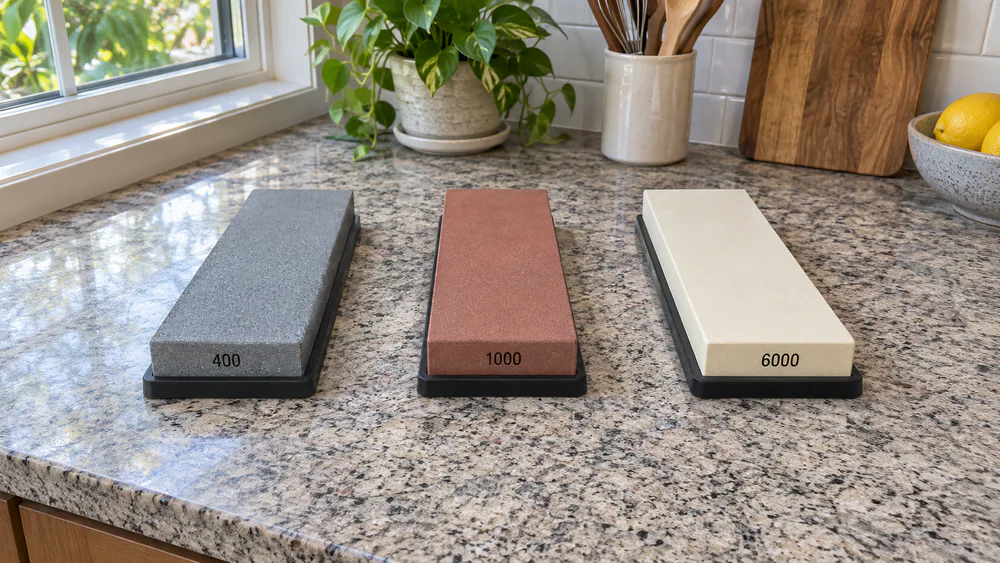
Grit numbers tell you how aggressive a stone is. Coarse stones, roughly 120 to 400 grit, repair chips and dull edges. Medium stones, 600 to 1500, refine the edge. Fine stones, 3000 to 8000, polish it. A kit should cover at least a coarse and a fine stage, and a medium stage is a bonus.

Abrasive type changes how you work. Diamond cuts dry and stays flat. Aluminum-oxide stones, like the Sharp Pebble, need water but feel gentle on the steel. Ceramic finishes well.

Three sharpening stones laid side by side on a counter from coarse to fine, each labelled with its grit number

Angle Guides and Holders

Angle control is where beginners lose their edge. Western kitchen knives sit near 20 degrees per side, while Japanese knives are closer to 15. A kit that locks the angle, like the Precision Adjust clamp or the SHARPAL guide, saves weeks of practice. A kit that fixes a single angle only suits knives that match it.

Check the holder, too. A stone that slides is a safety problem, which is why the Sharp Pebble base and the SHARPAL warning earned space in our notes. For the angle itself, see our guide to the best knife sharpening angle.

Warning. Never trust a slippery stone or a flimsy lid as a holder. Use a base with rubber feet or a proper stone holder, and keep your fingers behind the edge.

Strops, Honing Rods and Extras

A leather strop with compound turns a good edge into a polished one. We saw that with the Lansky, where a strop after the finest stone took edges to scalpel level. A honing rod keeps an edge aligned between sharpenings, but most kits do not include one. A flattening stone matters only if you buy soft whetstones that dish over time.

A kit is only as good as the angle it helps you hold. Grit gets the headlines, but angle control wins the edge.

Which Type of Kit Is Right for You?

The right kit depends on how much practice you want to put in and what is in your knife block.

Whetstone Kits

Whetstones give a very fine edge for the least money, but they demand a steady hand and a learning curve. They suit cooks who enjoy the craft. The Sharp Pebble is our pick here.

Guided Angle Systems

Guided systems hold the knife and angle for you. The Precision Adjust, Elite and Lansky all work this way. They are the best route for beginners, and a clamp-based system also makes it easy to repeat a setting.

Rolling Sharpeners

Rolling sharpeners like the Tumbler are the fastest and least fiddly. They suit large knives best and cannot save very dull blades.

Electric and Pull-Through

The 15XV is the electric pick, with springs that guide a 15-degree angle. It is quick and good for bread knives, but it thins edges and is not for reprofiling.

Pros

  • Guided kits deliver repeatable angles for beginners
  • Whetstones reward practice with a very fine edge
  • Electric and rolling tools save time

Cons

  • Guided kits cost more than a basic stone
  • Whetstones have a steep learning curve
  • Electric and rolling tools give you less control

If you are weighing several systems, our knife sharpening system roundup goes deeper, and our knife sharpening technique guide covers hand skills.

Sharpening vs. Honing: What to Add After the Kit

Sharpening removes steel to create a new edge. Honing realigns the edge you already have, and it does not remove much metal. A sharpening kit handles the first job. A honing rod handles the second, and most kits do not include one.

Sharpen when your knife stops slicing a tomato skin. Hone between sharpenings to keep the knife sharp longer. If you buy only one extra, make it a ceramic or steel rod. A leather strop is the next best add-on.

Frequently Asked Questions

How often should I sharpen my kitchen knives?

Most home cooks need a full sharpening every few months, depending on use. Hone weekly, and sharpen when a knife skids on a tomato skin.

What is the best grit for a sharpening kit?

A coarse stone around 400 for repair, a medium around 1000 for everyday sharpening, and a fine 3000 to 6000 for polish. A 1000/6000 dual-grit stone covers most of that.

Does a sharpening kit include a honing rod?

Usually not. Most kits cover sharpening only, so buy a honing rod separately.

Should I use water or oil on a sharpening stone?

Follow the stone. Aluminum-oxide whetstones like the Sharp Pebble use water, the Lansky system uses honing oil, and diamond stones such as the SHARPAL cut dry.

Can I sharpen serrated knives with a kit?

Some kits can. The Chef'sChoice 15XV polishes bread knives, the Smith's PP1 has a diamond rod for serrations, and the Tumbler cannot sharpen serrated blades.

Is a guided system better than a whetstone?

For beginners, yes. A guided system holds the angle for you. A whetstone can give a very fine edge once you have the skill.

Final Verdict

Beyond the top pick, two other kits are worth a mention. If you own Japanese knives and want the finest finish, step up to the Precision Adjust Elite. If you are on a tight budget, the Lansky Deluxe 5-Stone gives you five hones and a clamp, and a strop will take it further.

We would skip the Smith's PP1 as a main kit, and the Tumbler if your drawer is full of small paring knives. For everything else, the Work Sharp Precision Adjust is the kit we would buy again.

Read next

Ready to bring your knives back to life?

Pick the kit that fits your knives and your patience, then keep every blade keen.