Helping you create a kitchen you love.

Appliances

NuWave Bravo XL Air Fryer Reviews

As an Amazon Associate we earn from qualifying purchases. We may earn a commission from links on this page, at no extra cost to you. Learn more.

NuWave Bravo XL Air Fryer Reviews

Wondering whether the NuWave Bravo XL actually earns its counter space before you spend the money? We ran one through 30 days of daily cooking in our test kitchen. It went from weeknight fries to a slow-roasted meatloaf, and we treated it like the only oven we had. This review is the plain-spoken version of what we found. It covers what the Bravo XL does well, where it frustrated us, and who should buy it versus who should walk past.

The Bravo XL sells itself as an all-in-one countertop oven. It air fries, bakes, roasts, broils, dehydrates, and more, all from a 30-quart cavity with an integrated temperature probe. That is a lot of promise for one stainless box. Our job was to separate the marketing from the cooking. So we cooked on it for a month and scored it on performance first, then noise, coating durability, and how easy the parts are to replace when something wears out.

Quick Verdict: Is the NuWave Bravo XL Worth It?

The short answer: yes, for the right cook. The NuWave Bravo XL is a genuine workhorse. It replaces a toaster oven, an air fryer, and a small roasting oven in one footprint, and it does the core jobs well once you learn its habits. It runs hot and crisps aggressively. The integrated probe is the standout feature, and it does not heat up the kitchen the way a full-size oven does. That combination makes it worth it for anyone who cooks most nights and wants precise, hands-off doneness.

It is not for everyone. The control cluster is fiddly, and every function forces a preheat and a second confirmation press. If you want a silent, one-touch toaster oven for the occasional bagel, this is more machine than you need. Bargain hunters cross-shopping the Ninja Foodi should also weigh the trade-offs before committing.

Key takeaway. Our rating is 4.2 out of 5. The Bravo XL is a high-value, high-capacity convection oven with an excellent temperature probe, held back by a clunky interface and a learning curve on its aggressive heat.

Why Trust This Review: How We Tested

We bought our Bravo XL at retail, the same as any shopper would, and cooked on it every day for a month. Over those 30 days we air fried frozen and hand-cut fries, roasted chickens, baked cookies and artisan bread, broiled fish, dehydrated fruit, and reheated leftovers. We tracked how each function behaved rather than trusting the preset labels. We scored performance first. Then we logged noise, the condition of the coatings and control panel, and how simple the wear parts are to source.

We also put the aggressive heat to the test early, and it bit us. The Bravo XL runs hotter than a conventional convection oven. Recipes need their time or temperature cut by roughly 15 percent, or food scorches. We burned a pizza the first week before dialing it back, which told us more about the oven than any spec sheet could. After that the results turned around fast.

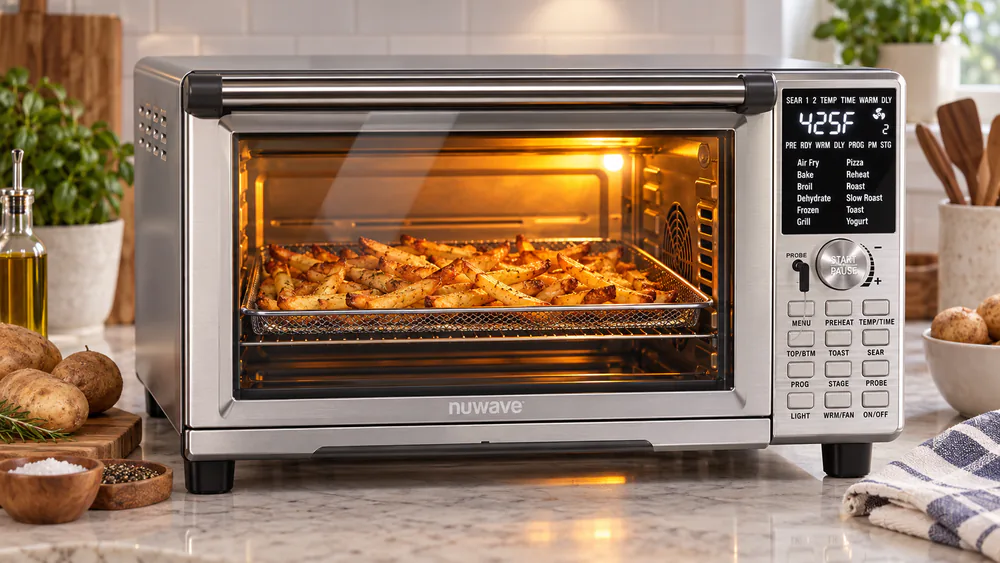
A NuWave Bravo XL countertop oven mid-cook with a tray of hand-cut fries browning behind the tempered glass door, control panel lit.
Day three of testing, after we learned to dial the temperature back on the first run.

Because we score parts availability and long-term durability, we paid attention to the things that only show up with daily use. We watched whether the panel markings held up, how the crumb tray handled grease, and what owners report about the heating elements over years of service. Where our own month could not confirm a lifespan, we say so rather than guess.

What Is the NuWave Bravo XL? Overview & Specifications

The NuWave Bravo XL is a 30-Qt countertop convection oven with a 1800-watt heating system. Its temperature range runs 50F to 500F, adjustable in precise 5F increments. It ships with 12 preset cooking functions plus 100 pre-programmed recipe presets, along with 50 saveable custom slots. So you can dial in a routine and store it. Four different rack positions and independently adjustable top and bottom heaters give it more control than most ovens in this class.

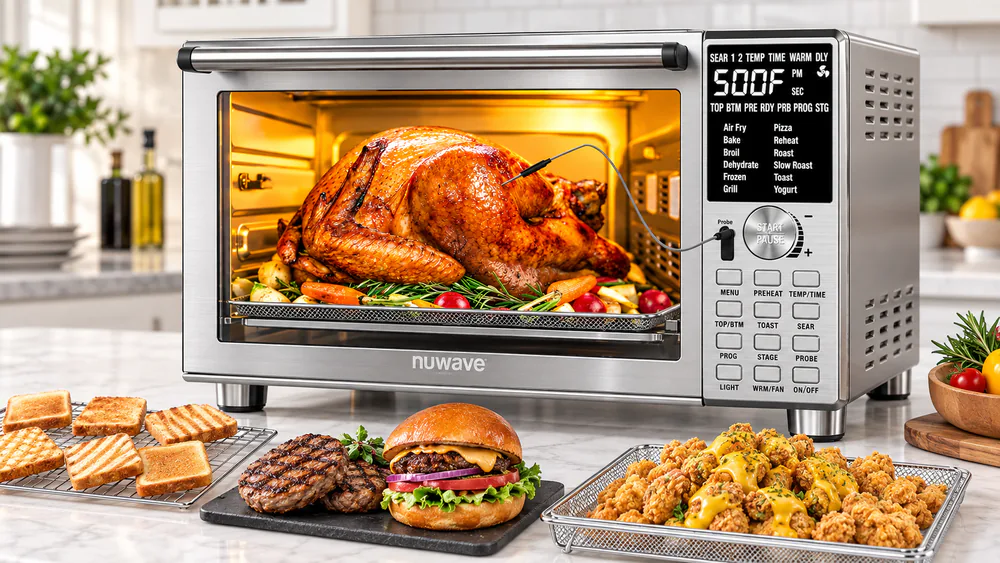
The headline hardware is Linear T (Linear Thermal) technology paired with an integrated smart digital temperature probe. Both are aimed at holding temperature steady and cooking to doneness rather than to the clock. The build is brushed stainless steel with a heat-resistant tempered glass door and an interior light. It comes with a bundle of accessories: an air fry basket, a broiler rack, a crumb tray, and a non-stick enamel baking pan. NuWave backs it with a 3-year warranty with first-year VIP service and a 90-day return window, though the buyer pays return shipping.

NuWave Bravo XL key specifications
Capacity30 qt
Power1800 W
Temperature range50F to 500F, in 5F increments
Functions12 presets plus 100 recipes, 50 custom slots
Rack positions4
Temperature probeIntegrated smart digital probe
Warranty3-year, first-year VIP service
Return window90 days, buyer pays return shipping

One honest caveat on the numbers: the exact outside footprint is hard to pin down because retailer spec tables do not agree. The best-corroborated figure we found lands at roughly 20 inches long by 15 inches wide by 11 inches high for model 20801. Two separate retailer listings publish that footprint, though others quote noticeably different numbers. We treat it as approximate rather than exact. We could not confirm an official weight either, so plan on measuring your own counter clearance rather than trusting a single published spec.

Key Features & Real-World Performance

The Bravo XL is stuffed with features, but only a few of them actually changed how we cooked. Here is how the ones that matter held up over a month of daily use.

Super Convection Performance: Does It Cook Faster & Crispier?

Yes, and that is both the appeal and the catch. The 1800-watt system with rear convection crisps hard and fast. Once we accepted the oven's habits, food came out browner and crisper than our old convection oven managed. Frozen fries and wings were the easy wins. They hit a real crunch without a heavy oil coat.

The one limit worth knowing sits at the top of the dial. Above about 450F, only the top broil elements run, so true all-around heat is limited at the very top of the range. For most air frying and roasting you live in the 350 to 425F band where the oven is at its best. This rarely bit us. But if you were counting on 500F wraparound convection, it is really a top-down broil up there.

Warning. The Bravo XL runs hotter than a standard convection oven. Cut your recipe time or temperature by about 15 percent on the first run of any dish, then adjust from there. This one habit is the difference between crisp and scorched.

Integrated Digital Temperature Probe: Does It Prevent Overcooking?

This is the feature we would miss most if we gave the oven back. The integrated probe works reliably in practice. We cooked a three-pound meatloaf in half the time our old oven needed, using the probe to determine when it reached the target internal temperature. For roasts and thick proteins, cooking to internal temperature instead of to a timer is the difference between dry and right. The Bravo XL nails it.

The probe plugs into the cavity and drives the cook. The oven holds until the meat is done rather than until the clock runs out. That single feature is why we would point a roast-heavy household here over the probe-less Ninja Foodi or Breville.

Linear T Technology & Temperature Control: Is It Precise?

Linear T is NuWave's name for how the oven holds a target temperature. In our testing the control was tight. The 50F to 500F range in 5F increments gives fine resolution. Baking held steady enough that artisan bread and rye came out well in a small Dutch oven. The oven preheated quickly and held temperature better than an unreliable full-size oven could. For anyone who bakes, that stability is the quiet advantage under all the air-fryer marketing.

Precision does not fix the aggressive heat, though. The oven is accurate at the temperature you set. It just delivers that heat harder than a conventional oven does, which is why your first-run adjustment matters even when the display shows exactly what you asked for.

Customizable Dual Heaters, Presets & 12-in-1 Functions

The custom top and bottom heater ratio is the standout feature for fine-tuning a dish. It is infinitely adjustable from 100 percent top to 100 percent bottom, and it pairs with the adjustable racks. We ran bottom-heavy for pizza crust and shifted toward the top element to finish a gratin. The control is real, not marketing. Paired with 12 functions and 100 recipe presets, there is a setting for nearly anything you cook.

The flip side is the interface. The dial-and-press control cluster is fiddly and over-engineered. We repeatedly turned the unit off by accident when we meant to start a cook mode, and we had to re-read the manual to change defaults. Worse, every function including plain toast forces a multi-minute preheat. Then a countdown appears that you must confirm with a second start press within about five minutes, or the oven shuts off. It works, but it is not the one-touch experience the label implies.

Tip. Learn the two-press start rhythm early. Set your function, wait out the preheat, and confirm the countdown with a second start press within about five minutes. Miss it, and the oven quietly shuts off and you start over.

Capacity, Multi-Layer Cooking & Design

The 30-Qt cavity looks huge. NuWave states it holds a 10-pound chicken, a 13-inch pizza, or 9 slices of toast. In practice the usable interior is smaller than the 30-quart label suggests. It fits a quarter sheet pan, about 9 by 12 inches, without protruding handles. So measure before you assume a full-size sheet will drop in. For a family cooking real weeknight portions it is plenty. It is just not a replacement for a full oven's largest pans.

Design-wise, the side-mounted fan and cool side walls are a genuine perk. The exterior side walls stay cool to the touch. The side-mounted fan lets an overhead range hood pull heat out, so it noticeably does not heat the kitchen like a full-size oven. In a small kitchen in summer, that alone earns it a spot on the counter.


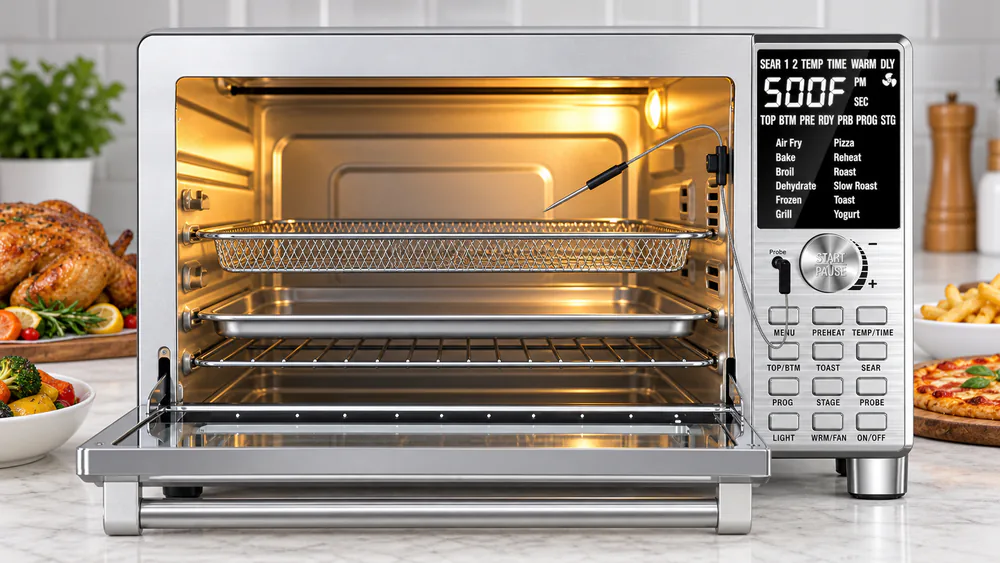
The open interior of a NuWave Bravo XL showing four rack positions, the air fry basket, and the integrated temperature probe clipped inside the cavity.
Four rack positions and the integrated probe, the hardware that earns its keep.

Cooking Tests: Air Frying, Baking, Roasting & Dehydrating

Air frying was the strongest showing. Once we cut our times, fries, wings, and breaded cutlets crisped evenly and browned well. The basket let enough air under the food to skip the sad soft spots we get from cheaper baskets. This is the function most buyers come for, and it delivers.

Roasting leaned on the probe and paid off, as the meatloaf test showed. Chicken came out with crisp skin and juicy meat by roasting to internal temperature rather than to a timer. Baking surprised us most. Artisan bread and rye baked well in a small Dutch oven, with quick preheats and steady heat that held for the full bake.

Dehydrating worked at the low end of the range, slow and steady the way dehydrating should be. It does tie the oven up for hours, though, so plan around it. Across every test, the recurring lesson was the same one from day one: respect the heat, make your first-run cut, and the Bravo XL rewards you.

Cook to the probe, not the clock. Driving a roast to its exact internal temperature, hands off, is the moment the Bravo XL sells itself.

Cleaning & Long-Term Durability

Day-to-day cleanup is straightforward. The pull-out bottom tray makes cleanup easy, and the non-stick enamel pan wiped down without a fight. There are two things to watch. First, the drop-down glass door gets hot to the touch, so caution is needed pulling food out. We reached past it more than once and regretted it. Second, high-fat foods splatter at the high temps. Grease can pool on the bottom element and smoke, so the crumb tray needs regular clearing to avoid a smoky kitchen.

Durability is where our technician side pays attention. Our research and testing revealed two concerns: one cosmetic and one mechanical. First, the printed control-panel markings around the power button can fade within a couple of months of light use. That is a cheap-feeling flaw on a mid-priced oven. More seriously, a known failure mode is loud popping during heating cycles and, in some units, a cracked quartz tube around the heating element. We did not see a cracked tube in our month. But it is common enough to weigh, which is where the 3-year warranty becomes part of the value.

One more first-run note: a lingering plastic or manufacturing smell can persist for a couple of weeks of use before burning off. Run the empty oven hot for 20 minutes with the hood on before you cook anything you care about.

Note. Some Bravo XL variants ship without a flat baking tray, including only the air fry basket and grill or griddle. Buying the tray separately adds to the cost. Check exactly what is in the box for the variant you order before you buy.

Pros and Cons

After a month, here is the honest ledger. The Bravo XL earns its place, but you should go in with eyes open about the interface and the quirks.

Pros

  • Integrated smart probe cooks to doneness reliably, halving some roast times
  • Aggressive 1800-watt convection crisps hard and browns evenly
  • Adjustable top and bottom heater ratio gives real control over crust and topping
  • Cool side walls and side-vented fan keep the kitchen from heating up
  • Wide 50F to 500F range in 5F steps, with steady baking temperature
  • 3-year warranty with first-year VIP service

Cons

  • Fiddly dial-and-press interface; easy to shut off by accident
  • Every function forces a preheat and a second confirmation press
  • Usable interior smaller than the 30-quart label implies
  • Panel markings can fade within months; some units pop or crack a quartz tube
  • Some variants omit the flat baking tray, a separate add-on
  • High-fat foods splatter and can smoke if the crumb tray is not cleared

NuWave Bravo XL vs. Alternatives (Ninja Foodi & Breville)

The Bravo XL's closest rivals are the Ninja Foodi XL Pro Air Fry Oven and the Breville Smart Oven Air Fryer Pro. All three run on 1800 watts, so raw power is a wash. The differences are in features, capacity, and price. The Bravo XL is the only one of the three with an integrated temperature probe, which is its clearest edge. The Ninja counters with a 90-second preheat and up to 30 percent faster cooking than a full-size convection oven, plus a two-level XL cavity that fits a 12-lb turkey. The Breville is the premium option. It carries an Element iQ system of 5 independent quartz heating elements and 13 cooking functions, but it costs the most of the three and carries only a 2-year warranty.

Value tilts toward the NuWave for probe-driven roasting and price. It tilts toward the Ninja for fast, simple air frying at a middle price, and toward the Breville for buyers who want the most refined build and longest real-world track record. On the Breville, real owners report multi-year workhorse lifespans, including three-year and even ten-year daily-use runs. Some do hit door-hinge sticking and timer failures after a few months that Breville replaced under warranty.

ProductCapacityWattageFunctions/presetsTemp probeTemp rangeWarranty
NuWave Bravo XL 30 qt 1800 W 12 functions + 100 recipes Yes, integrated 50-500F in 5F steps 3-year
Ninja Foodi XL Pro DT201 XL, 12-lb turkey 1800 W 10-in-1 No to ~450F 1-year
Breville Smart Oven Air Fryer Pro 14-lb turkey interior 1800 W 13 functions No PID-controlled 2-year

What Real Customers Say

Owner feedback lines up closely with what we found, which is reassuring. The praise clusters around the same strengths we scored highest: the probe, the crisping, and the fact that it does not heat the kitchen. The complaints cluster just as tightly around the interface, the forced preheats, and the occasional heating-element noise. When a month of our testing and a wall of owner reports point at the same handful of quirks, you can buy with a clear picture of the trade-offs.

The most useful pattern in the feedback is expectation-setting. Buyers who came in expecting a simple one-touch toaster oven were the most frustrated. Those who treated it as a capable convection oven with a learning curve were the happiest. Read that as your own buying test. If you like dialing in a machine, you will get along with the Bravo XL.

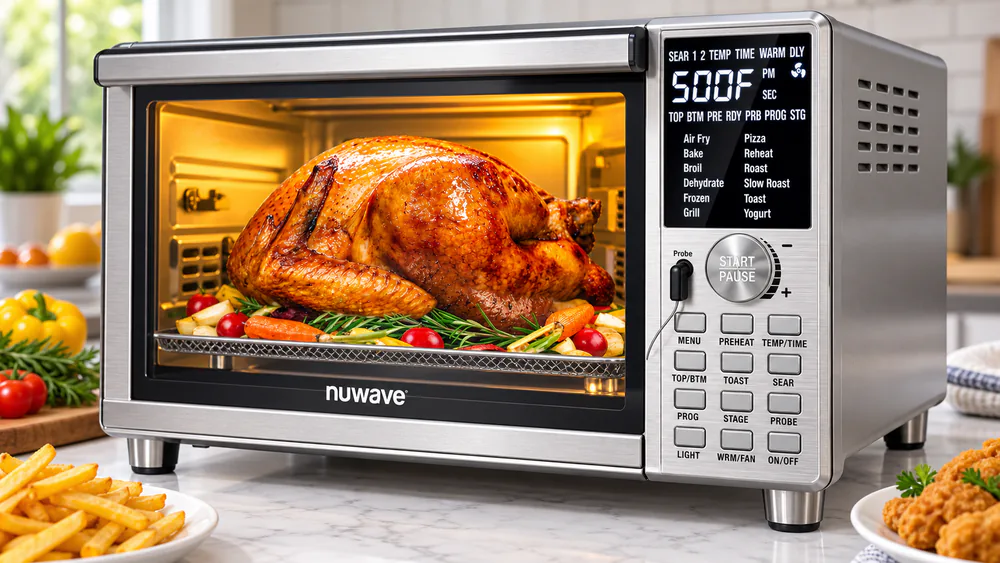
Close-up of the NuWave Bravo XL dial-and-button control panel with the digital display lit, showing the power button and preset controls.
The control cluster, the single most divisive part of the oven for owners and for us.

Pricing, Value & Is It Worth the Money?

On price, the Bravo XL sits in a friendly spot. It costs noticeably less than the Breville and about the same as, or slightly below, the Ninja Foodi. For a 30-quart, 1800-watt oven with an integrated probe and a 3-year warranty, that is strong value on paper. Our testing backs it up for the cook who will actually use the probe and the heater controls.

The value math changes if you only want basic air frying. At that job the simpler, faster-starting Ninja is easier to live with. With the Bravo XL, you would pay for a probe and adjustable heater ratios you would not use. Factor in that some variants omit the flat baking tray, a separate add-on, and the effective price can creep up. So watch the listing and confirm what is in the box before you commit.

Here is our full scored verdict on the oven itself, the box you will actually buy:

NuWave Bravo XL Air Fryer Convection Oven
1

NuWave Bravo XL Air Fryer Convection Oven

Best Probe-Driven Countertop Oven
Check Price on Amazon
4.2/5 8.4 Very Good

After 30 days as the only oven in our kitchen, the NuWave Bravo XL earned a confident recommendation with caveats. The integrated probe drove roasts to their exact internal temperature with no guesswork, the convection crisped hard once we adjusted to its heat, and the cool side walls kept the kitchen comfortable. The fiddly controls, forced preheats, and occasional heating-element noise are the price of admission. For a cook who wants precision and capacity over one-touch simplicity, it is worth it.

Pros

  • Integrated smart probe delivers reliable, hands-off doneness
  • Hard, even crisping from 1800-watt convection
  • Adjustable top and bottom heater ratio and four rack positions
  • Cool side walls and vented fan keep the kitchen from heating up
  • Strong value and a 3-year warranty in its price band

Cons

  • Over-engineered dial-and-press interface with forced preheats
  • Usable space smaller than the 30-quart label suggests
  • Panel fade and known quartz-tube or popping issues on some units

Frequently asked questions

What is the largest sheet pan that actually fits inside?

Plan on a quarter sheet pan, about 9 by 12 inches, which slides in without the handles catching. A half sheet or a full-size pan will not seat properly, so measure your existing pans against the cavity before you order. This is the single spec most buyers get wrong.

Do I still need an instant-read thermometer if the probe is this good?

For roasts and thick proteins driven by the built-in probe, no. The oven holds the cook to your target internal temperature on its own. We still keep an instant-read on hand for spot-checking thin cuts, foods cooked without the probe plugged in, and the far edges of a loaded rack.

Is the NuWave Bravo XL easy to clean?

Day-to-day cleanup is easy thanks to the pull-out bottom tray and the non-stick enamel pan. Watch two things: the drop-down glass door gets hot, and high-fat foods splatter and can pool grease on the bottom element. Clear the crumb tray regularly. NuWave's care guidance discourages harsh cleaners inside the cavity, so check the manual before assuming parts are dishwasher safe.

What is the return window if it does not work out?

NuWave lists a 90-day return window, though the buyer pays return shipping. After that, a 3-year warranty with first-year VIP service covers defects. Given the known quartz-tube and panel-fade reports, that warranty is worth factoring into the price.

What is the difference between the Bravo XL and Bravo XL Pro?

Both share the 30-quart cavity, 1800 watts, the 50F to 500F range, and the 12 functions with 100 recipes. The Pro adds a 100 percent faster fan speed for quicker, crispier results, more even multi-layer heat with only 0 to 1F between layers, selectable fan speeds, and a PFAS-free listing.

Is the NuWave Bravo XL reliable, and are heating-element issues common?

Most owners get a dependable oven. But a known failure mode is loud popping during heating cycles and, in some units, a cracked quartz tube around the heating element. Panel markings can also fade within a couple of months. The 3-year warranty with first-year VIP service is part of why we still recommend it.

Final Verdict: Should You Buy the NuWave Bravo XL?

Buy the NuWave Bravo XL if you cook most nights and want one machine that roasts to a precise internal temperature, crisps hard, and bakes steadily without turning your kitchen into a sauna. The probe is the reason to choose it over the Ninja Foodi and the Breville. With a 3-year warranty, it is the value pick of the three. Our 4.2 out of 5 reflects a genuinely capable oven that we would happily keep on the counter.

Skip it, or look at the simpler Ninja, if you want a quiet, one-touch toaster oven for occasional use. The fiddly controls and forced preheats will wear on you, and you will pay for features you never use. Whichever way you lean, confirm the current price and exactly which accessories are in the box for your variant before you order, since the flat baking tray is sometimes a separate purchase. For the right cook, though, the Bravo XL is a true workhorse that is worth the money.

Read next

Ready to upgrade your kitchen?

Confirm the current price and in-stock variant of the NuWave Bravo XL, then check what ships in the box before you buy.