
Helping you create a kitchen you love.

Knives & Cutlery

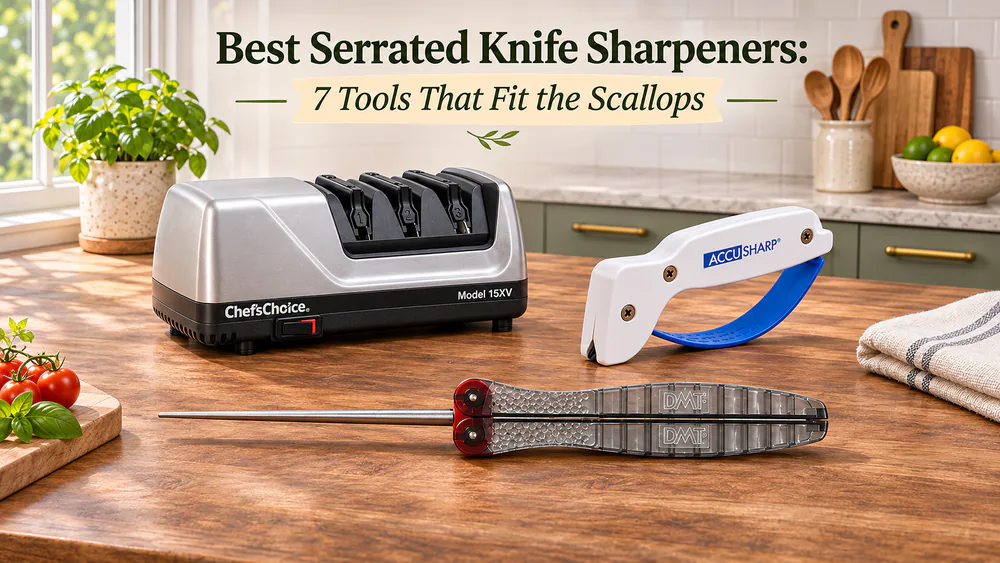
Best Serrated Knife Sharpeners: 7 Tools That Fit the Scallops

As an Amazon Associate we earn from qualifying purchases. We may earn a commission from links on this page, at no extra cost to you. Learn more.

Best Serrated Knife Sharpeners: 7 Tools That Fit the Scallops

A serrated knife needs a tool that fits inside each scallop, and that means a tapered diamond rod, a ceramic hone, or a machine whose maker documents a serrated procedure. Our top pick is the Chef'sChoice 15XV EdgeSelect, with the DMT Diafold Serrated close behind for anyone who wants a simple manual tool.

We judged each sharpener on how well it fits the scallops, how easy it is to use, and what it does to the edge, the same way we judge every tool in our knife sharpener reviews. Most sharpeners on the market only handle straight edges, so the fit question decides almost everything here.

Quick Picks: Our Top 3 Serrated Knife Sharpeners

RankProductBest forTypeRatingBuy
1

Chef'sChoice 15XV EdgeSelect

Best Overall
Mixed knife drawers that include a serrated bread knife Electric, 3-stage 4.7 View on Amazon
2

DMT Diafold Serrated

Best Manual Diamond Rod
Cooks who want the right geometry by hand Tapered diamond rod 4.6 View on Amazon
3

AccuSharp Knife Sharpener

Best Budget
Dull supermarket knives and quick touch-ups Pull-through carbide 4.2 View on Amazon

We earn a commission if you make a purchase, at no additional cost to you.

See full comparison table

Best Overall: Chef'sChoice 15XV EdgeSelect

It is the one electric machine here whose maker documents a serrated procedure, and it handles the rest of the knife block too.

Best Manual Diamond Rod: DMT Diafold Serrated

A 4-inch cone that tapers from 1/4 inch to 1/16 inch fills big and small scallops on the same blade.

Best Budget: AccuSharp Knife Sharpener

A hand-held pull-through that brings dull knives back with no angle to hold. It is a straight-and-serrated model, not a tapered rod, so it suits rough work rather than fine edges.

All 7 Serrated Knife Sharpeners at a Glance

ProductTypeRod or cone diameterSerrated only or straight + serratedEase of useBest forOur rating
Chef'sChoice 15XV EdgeSelect Electric, 3-stage n/a Straight + serrated Very easy once the pull settles Whole knife block 4.7
DMT Diafold Serrated Tapered diamond rod 1/4 to 1/16 inch taper Serrated + straight Moderate, hand work Bread knives and steak knives 4.6
AccuSharp Knife Sharpener Pull-through carbide n/a Straight + serrated Very easy Quick budget touch-ups 4.2
Orange Ninja 4-Stage Sharpener Single-slot, four-setting pull-through n/a Straight + serrated setting Easy One tool for mixed knives 4.0
Work Sharp Knife & Tool Sharpener Mk.2 Electric belt system n/a Straight, serrated with belts Moderate, guided Enthusiasts with many tools 4.4
Lansky Folding Diamond Tapered Rod Tapered diamond rod Tapered, size unpublished Serrated + straight Moderate, hand work Pocket and travel use 4.1
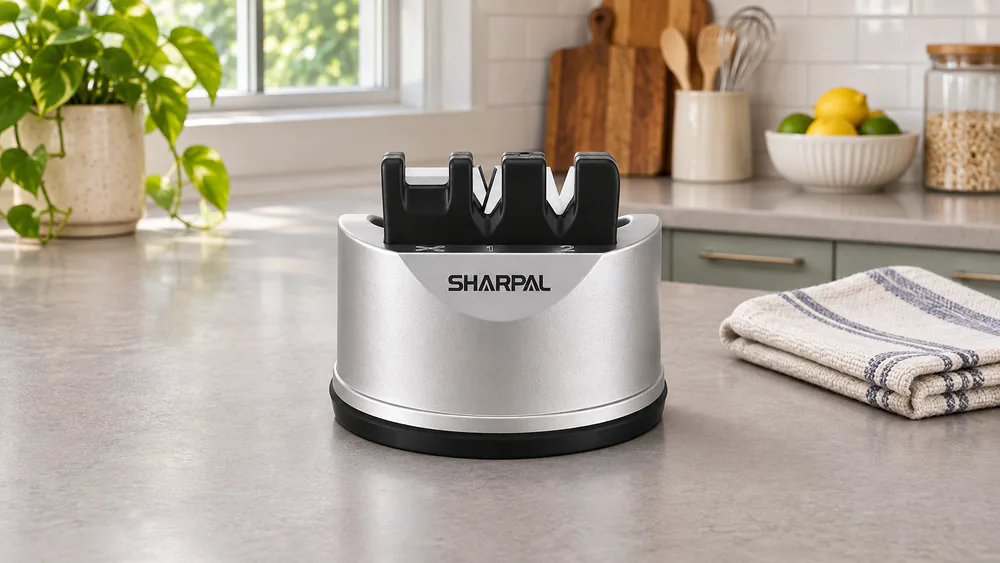
SHARPAL 191H Pull-through n/a Straight, serrated and scissors Easy Straight kitchen knives and shears 3.5

How We Rate These Sharpeners

Before the reviews, a word on the scoring. We rate each sharpener on three things: fit to the scallops, ease of use, and what it does to the edge. Fit counts for the most because a tool that cannot enter the gullet cannot sharpen them.

The scale is simple. A tool that fills each gullet scores high, a tool with a fixed slot scores middling, and a tool that never reaches the gullets scores low. Ease of use covers how much angle control you need and how much time the job takes. Edge quality covers how clean the result is and whether the tool leaves a burr or flattens the scallops.

Where a maker does not publish a grit, taper or slot size, we say so and rate conservatively. The 15XV remains our first pick, but the Lansky and SHARPAL rankings need editorial reassessment in light of their published grit and serrated-use instructions.

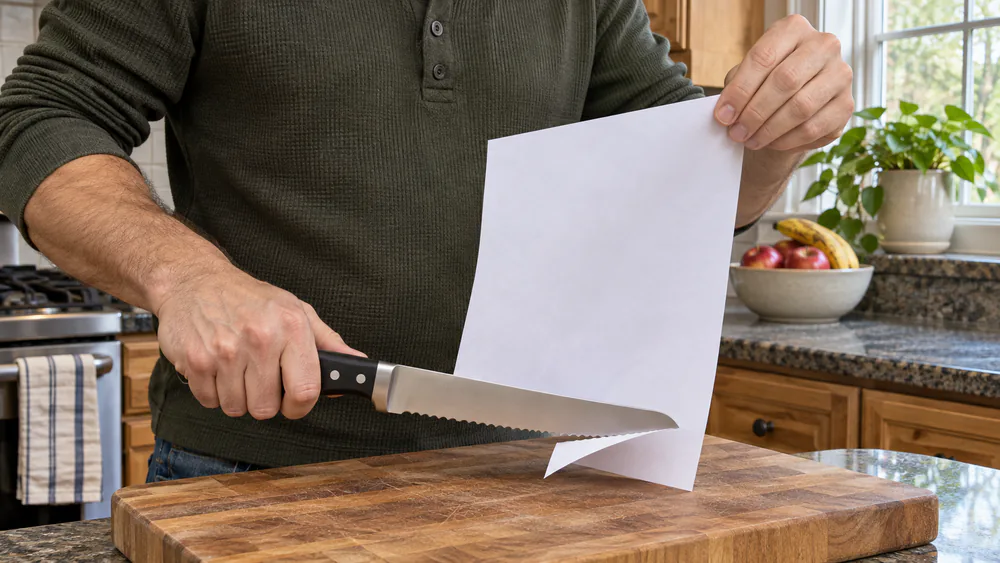
A serrated bread knife being drawn across a sheet of paper on a wooden board to check the edge after sharpening
A paper test shows whether the points are biting again.

1. Chef'sChoice 15XV EdgeSelect: Best Electric for Serrated Knives

Chef'sChoice 15XV EdgeSelect
1

Chef'sChoice 15XV EdgeSelect

Best Overall
Check Price on Amazon
4.7/5

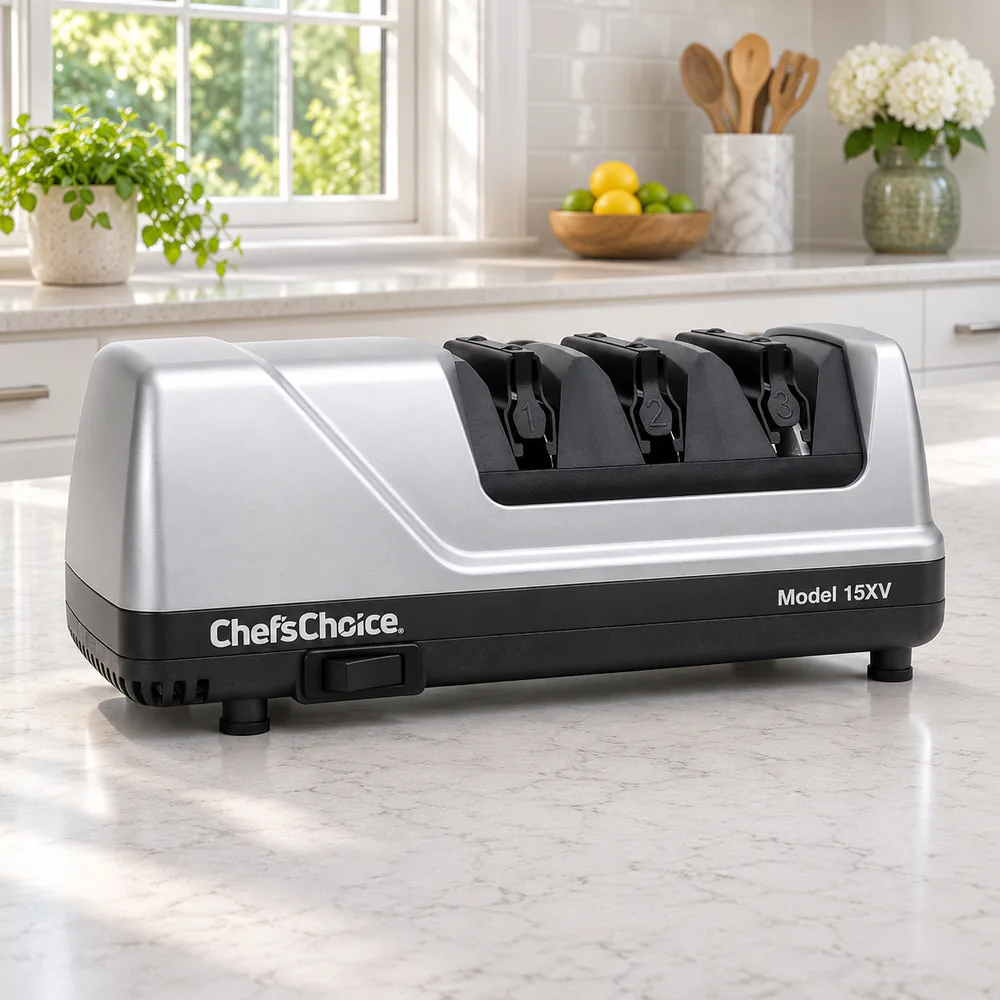
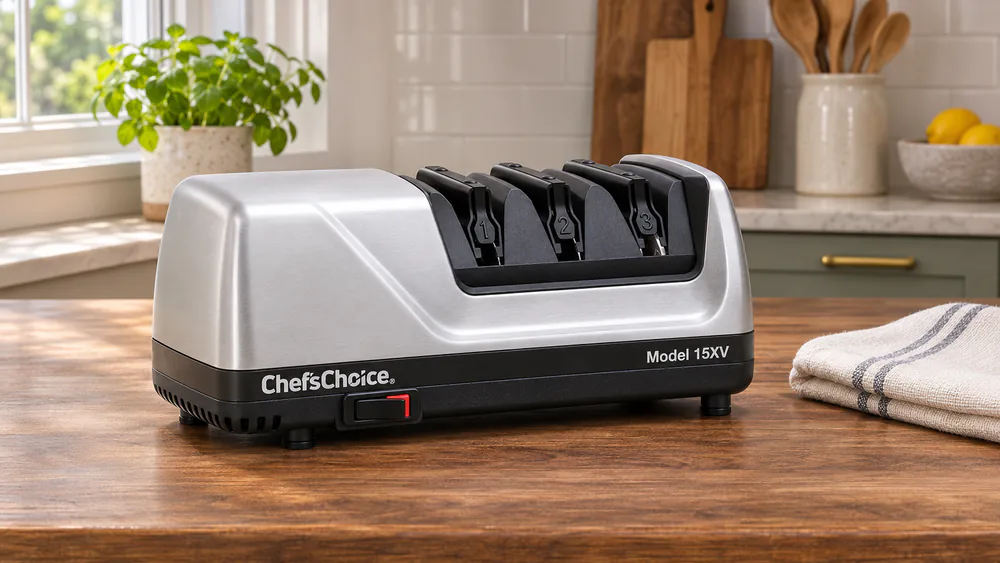
The 15XV is the electric sharpener we would buy for a household that owns a serrated bread knife alongside everything else. It is a 3-stage machine that converts 20-degree factory edges to a 15-degree edge, and its maker documents a serrated routine: use only Stage 3 with five to ten pairs of alternating pulls. Most electric sharpeners with fixed geometry flatten scallops, and this is the exception that makes it our top pick. Once the pull settled, the knives we ran through it came out cutting paper-thin, and a first sharpening took about a minute.

Pros

  • Documented serrated procedure from the maker
  • Turns 20-degree factory edges into 15-degree edges that cut paper-thin
  • About 1 minute for a first sharpening and about 10 seconds to resharpen
  • 3-year limited warranty

Cons

  • Knife-only machine, so scissors and tools are out
  • Big footprint at about 10 x 4.25 x 4.25 inches
  • Early attempts can leave a knife duller until the pull technique settles
Which serrations it handles

The flexible polishing stage is gentle enough that it works on the common bread knife and steak knife patterns, where the scallops are shallow and the points are still intact. Stages 1 and 2 are 100-percent diamond abrasive, and you should keep those for the straight edges in the drawer. The same machine then handles the paring knife and the chef's knife, which is why it earns the top rank here. If you already own other Chef'sChoice gear, our Chef'sChoice sharpener roundup goes deeper on the rest of the line.

What it will not fix

The pull technique takes a few passes to settle. On our first attempts we pulled a knife through, tested it on paper, and found it duller than when it went in. We slowed the pulls down, kept the pressure even, and the next knives came back with a clean, paper-slicing edge. Edge life under heavy use is the open question after a first sharpening, so plan on touching up as the knife loses bite. A badly damaged serrated knife with missing points is beyond any pull-through routine.

2. DMT Diafold Serrated: Best Dedicated Diamond Tapered Rod

DMT Diafold Serrated
2

DMT Diafold Serrated

Best Manual Diamond Rod
Check Price on Amazon
4.6/5

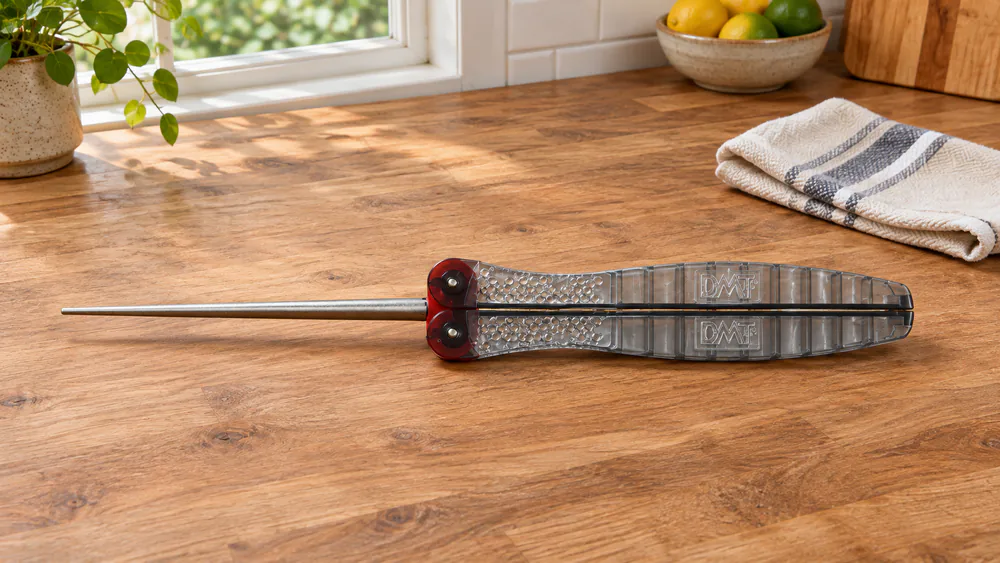
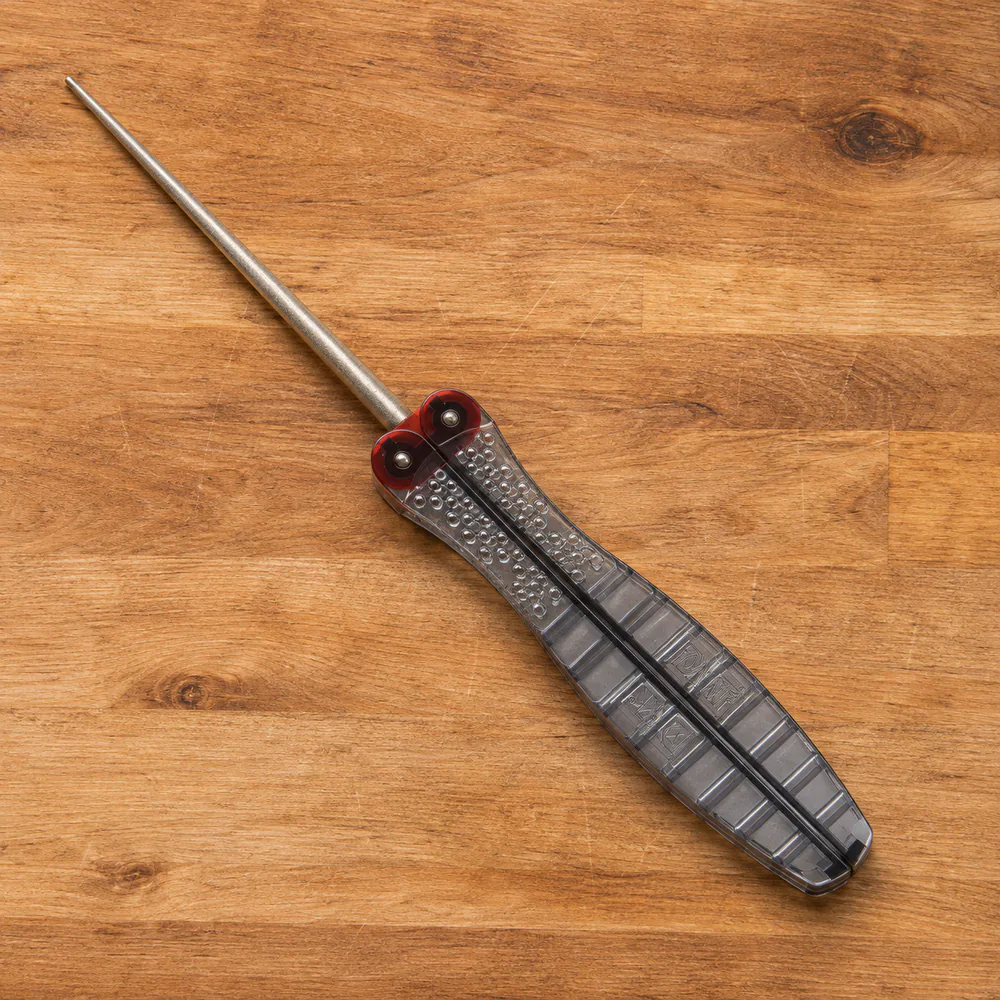
The Diafold is the tool that matches the problem most directly. Its 4-inch cone tapers from 1/4 inch to 1/16 inch, so one tool fits large and small scallops on the same blade. The Fine grade is 25 micron, or 600 mesh, and the diamond cuts fast, so it suits maintenance rather than rebuilding a wrecked edge. We scored it just behind the 15XV only because working a 9-inch bread knife with roughly 30 gullets is a methodical few minutes of work, not a quick pass.

Pros

  • Tapered cone fits scallops of different sizes
  • 600 mesh Fine diamond cuts quickly and works dry or with water
  • Folding handles enclose the diamond, so bare abrasive stays out of the drawer
  • Also works on gut hooks and as a conical file
  • Made in the USA

Cons

  • Slow, methodical work on long bread knives
  • Fast-cutting diamond punishes heavy-handed strokes
  • Fine grade only, so it will not rebuild a badly damaged edge

Which serrations it handles

Because of the taper, it handles nearly every scalloped pattern, from the wide gullets on a bread knife to the tighter ones on a steak knife. The tool is 9 1/2 inches open and 5 inches closed. Use water or work dry, but skip oil. DMT also sells Coarse (325 mesh) and Extra-Fine (1200 mesh) grades if you want a faster cut or a finer finish, though Fine is the right one to buy first.

What it will not fix

It does not replace a stone or a machine for your straight-edged knives, since the cone is built for gullets. It also needs time and attention, because the work is done one scallop at a time. If you own a long bread knife and hate slow jobs, the 15XV above will feel more relaxed.

3. AccuSharp Knife Sharpener: Best Budget Pick

AccuSharp Knife Sharpener
3

AccuSharp Knife Sharpener

Best Budget
Check Price on Amazon
4.2/5

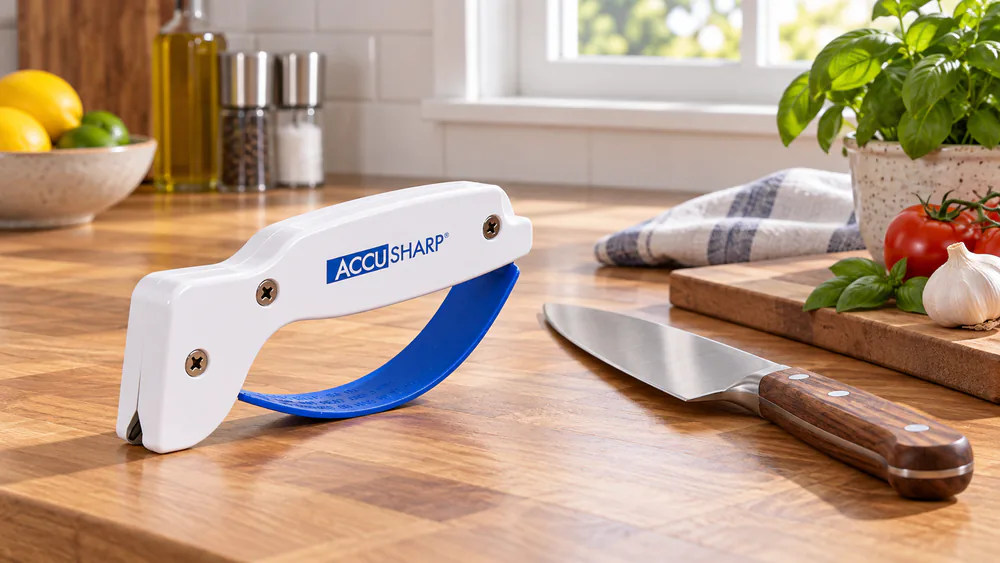
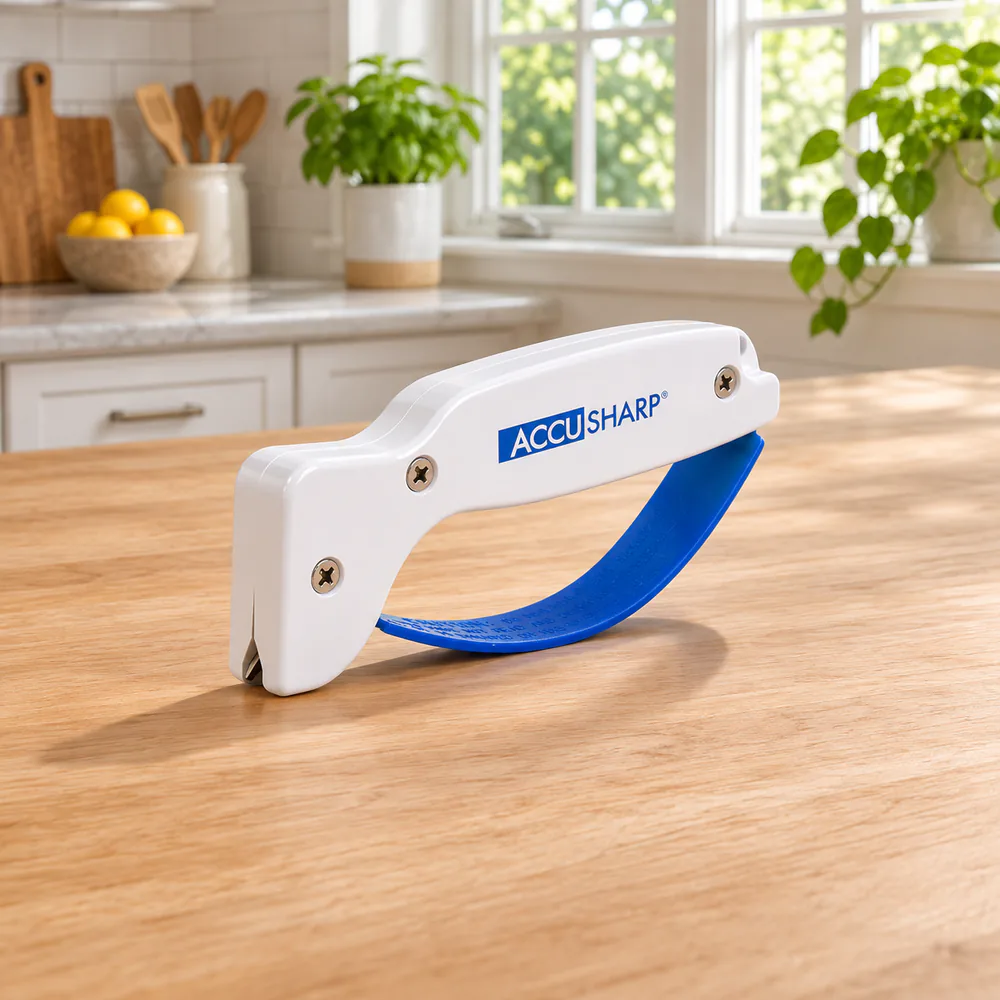
The AccuSharp uses diamond-honed tungsten carbide blades to restore dull knives at the lowest price here, but its hand-held pull-through design cannot reach inside each gullet as the DMT does. We want to be clear about what it is: this is the standard straight-and-serrated model, not a tapered rod. When we ran dull supermarket knives through it, a few pulls brought each one back to usefully sharp, with no angle to hold and nothing to practice. Most blades are done in around 10 seconds.

Pros

  • Gets most blades sharp in around 10 seconds
  • No angle to hold, and it is ambidextrous
  • Full-length finger guard
  • Washes with soap and water or in the dishwasher
  • Budget-friendly

Cons

  • Not a fine-edge tool for good knives
  • Not a tapered rod, so it will not fill each scallop
  • Bulky for small scissors and pruners

What it cannot do

It cannot follow each gullet, so it will not leave the fine, clean edge a tapered diamond cone does, and we would keep it away from expensive blades. It is sold for straight and serrated knives and suits cheap bread knives and steak knives where a rough, quick edge is the goal. Think of it as a rescue tool, not a precision one.

4. Orange Ninja 4-Stage Sharpener: Best Multi-Purpose Pull-Through

Orange Ninja 4-Stage Sharpener
4

Orange Ninja 4-Stage Sharpener

Best Multi-Purpose Pull-Through
Check Price on Amazon
4.0/5

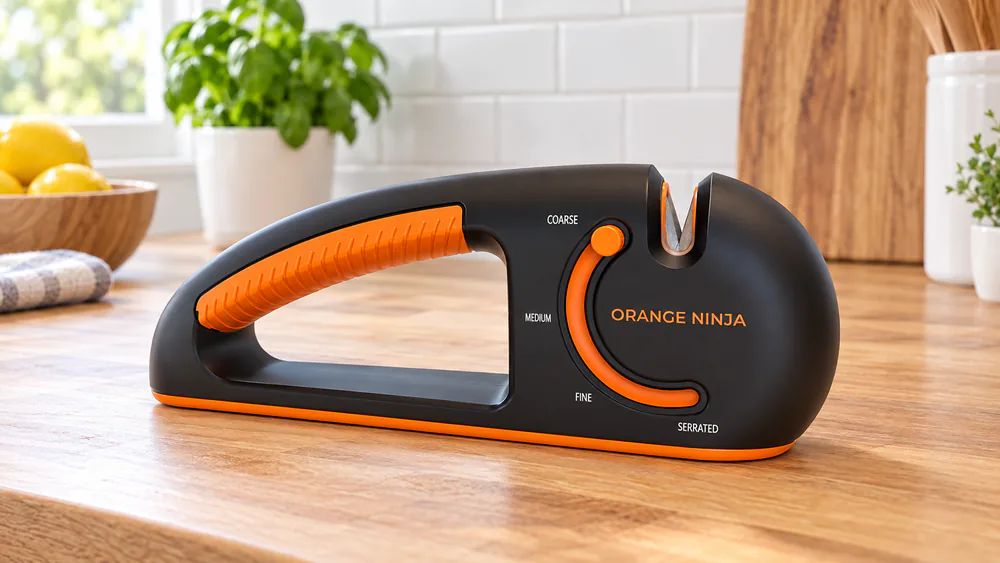
Where the AccuSharp has one carbide path, the Orange Ninja has one slot with four selector settings: coarse, medium, fine and serrated, in an ABS plastic body with an ergonomic, ambidextrous handle. The serrated setting is the reason it is on this list. The maker publishes no grit and no slot dimension, so we rate it as a convenient everyday tool and not a precision one. Use the coarse setting first on a dull straight-edge knife, finish on fine, and select serrated for the bread knife.

Pros

  • Dedicated serrated setting
  • Four selector settings cover coarse, medium, fine and serrated work
  • Ergonomic handle works for left or right hands
  • Budget-friendly

Cons

  • No published grit or slot dimension
  • Plastic body feels less durable than the metal tools here
  • Slot geometry is fixed, so it cannot adapt to unusual scallop sizes

Why the fixed slot limits it

The serrated setting is intended for common bread and steak knives, but its fixed geometry and unpublished dimensions leave the fit on very wide or shallow scallops uncertain. A knife with large gullets may only get its points touched. If you own several shapes of serrated blade, a tapered rod is the safer choice, and the plastic body makes this a drawer tool rather than a workshop piece. Brand fans can compare it against our Ninja sharpener guide for more on the line.

5. Work Sharp Knife & Tool Sharpener Mk.2: Best Bench System for Mixed Tools

Work Sharp Knife & Tool Sharpener Mk.2
5

Work Sharp Knife & Tool Sharpener Mk.2

Best Bench System
Check Price on Amazon
4.4/5

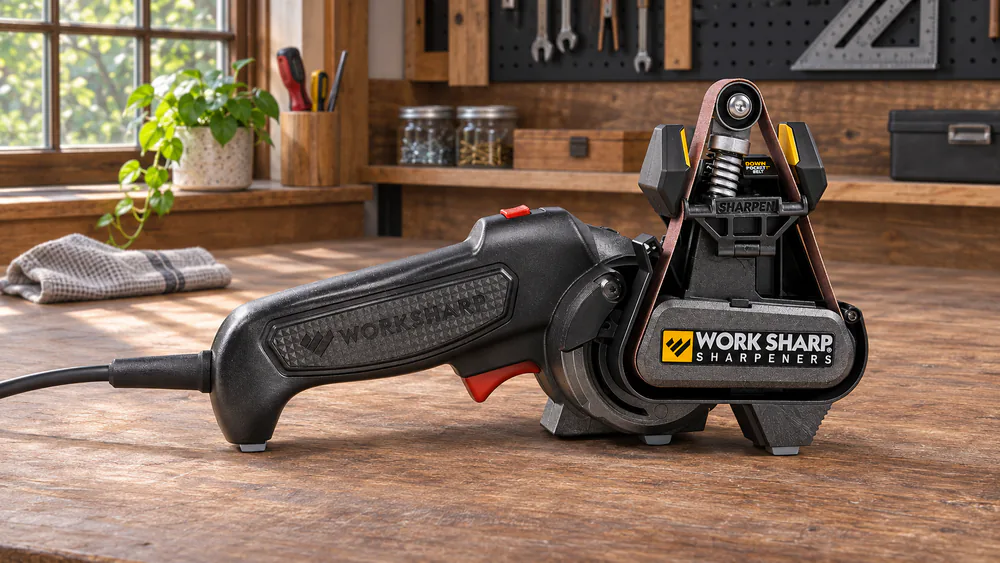
Where the Orange Ninja is a drawer tool, the Mk.2 is a bench system: a two-speed belt sharpener with an edge guide that supports the knife all the way to the tip. We took knives to paper-slicing sharpness on it, and the angle guides gave repeatable results with less guesswork than stones. The belts that come in the box are a starter set, and we would buy extra packs before the second or third knife. Going finer than paper-slicing needs a ceramic stone and strop afterward. The maker says the flexible belts can sharpen serrated knives, but that is a bonus rather than the headline. It sits in the splurge tier and is overkill if bread knives are your only worry.

Pros

  • Angle guides give repeatable results
  • Two-speed motor and flexible abrasive belts
  • Edge guide supports the knife to the tip
  • 3-year warranty, built in Ashland, Oregon
  • Replaceable guards and belts

Cons

  • Costs the most of the seven
  • Included belts are a starter set, so extra packs are worth buying
  • Serrated work needs the right belts and care
  • Going finer than paper-slicing needs a ceramic stone and strop

Why it is overkill here

It is built for straight edges first. We treat the maker's serrated claim as a possibility for patient users with the right belts, not a promise. A bench machine also takes space and money. If your sole concern is a serrated bread knife, the DMT cone solves it with far less fuss. If you already own other Work Sharp gear, see our Work Sharp sharpener roundup too.

6. Lansky Folding Diamond Tapered Rod: Best Pocket Option

Lansky Folding Diamond Tapered Rod
6

Lansky Folding Diamond Tapered Rod

Best Pocket Option
Check Price on Amazon
4.1/5

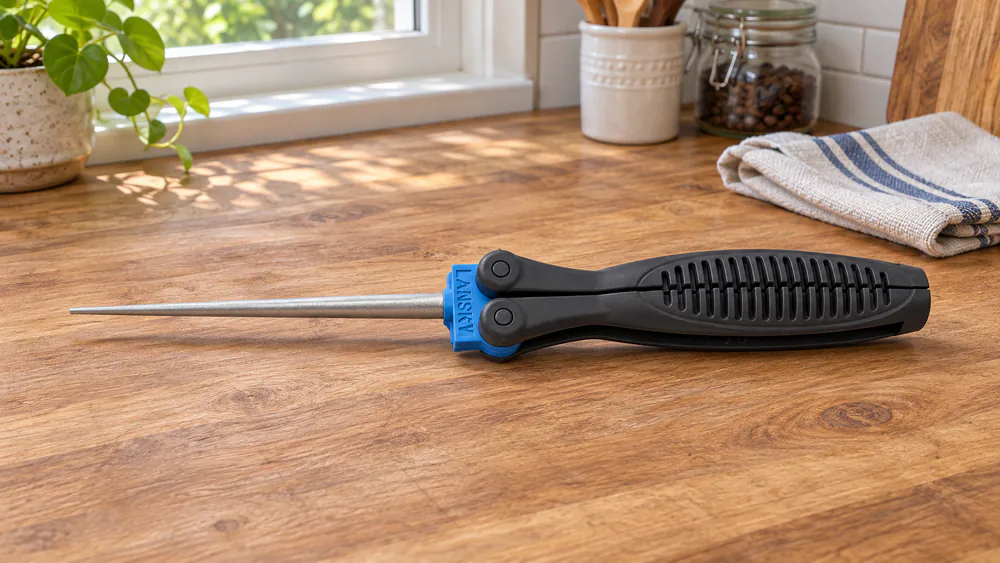
Where the Mk.2 needs a bench, the Lansky is the same idea as the DMT in a lighter and cheaper package: a folding handle around a tapered diamond cone. Lansky publishes a Fine, 600-grit rating for the TR-600; its sixth-place ranking needs reassessment because the earlier rationale incorrectly treated the grit as unpublished. Like the DMT, it should reach most bread knife patterns. Expect light maintenance from this Fine, 600-grit pocket tool, and start with light strokes on a few scallops to judge how quickly it cuts.

Pros

  • Tapered diamond cone fits scallops of different sizes
  • Folding handle for a pocket or knife roll
  • Cheaper than the DMT
  • Works on serrated and straight edges

Cons

  • Fine/600 grit only; no grit selection
  • No published taper dimensions
  • Less proven than the DMT for fine bread knife work

7. SHARPAL 191H Knife and Scissors Sharpener: Best Multi-Tool

SHARPAL 191H
7

SHARPAL 191H

Best Multi-Tool
Check Price on Amazon
3.5/5

Where the Lansky follows each gullet, the SHARPAL 191H is a 3-stage pull-through (tungsten carbide, ceramic and a scissors carbide stage) with a suction base that steadies it on the counter. SHARPAL instructs users to sharpen serrated knives in the No. 2 ceramic slot; the last-place ranking needs reassessment because the earlier rationale overlooked those instructions. If your drawer holds plain kitchen knives and a pair of shears, it is a sensible budget tool. For serrated knives, follow the ceramic-slot instructions rather than using the coarse carbide slot; the maker does not specify compatible scallop dimensions.

Pros

  • 3-stage design covers knives and scissors
  • Suction base steadies the tool
  • 3-year after-sale commitment
  • Budget-friendly

Cons

  • Serrated use requires the ceramic slot
  • Fit on scallops not stated
  • Better as a straight-edge and scissors tool

Why Serrated Knives Need a Different Sharpener

A serrated knife has a row of scallops, and each scallop is a tiny curved gullet with a pointed tooth between them. A flat stone only touches the tooth points. A cylindrical rod bridges across the gullets and grinds the tips, and the taper is what lets one tool fit big and small scallops on the same blade.

That is also why most fixed-geometry electric sharpeners flatten scallops. They are designed for a straight bevel, and a bread knife is not one. The 15XV is the exception because its maker documents a serrated procedure.

Serrated knives stay sharp longer than straight blades because the points do the cutting and the gullets stay out of contact with the board. That is why most people sharpen them far less often than a chef's knife.

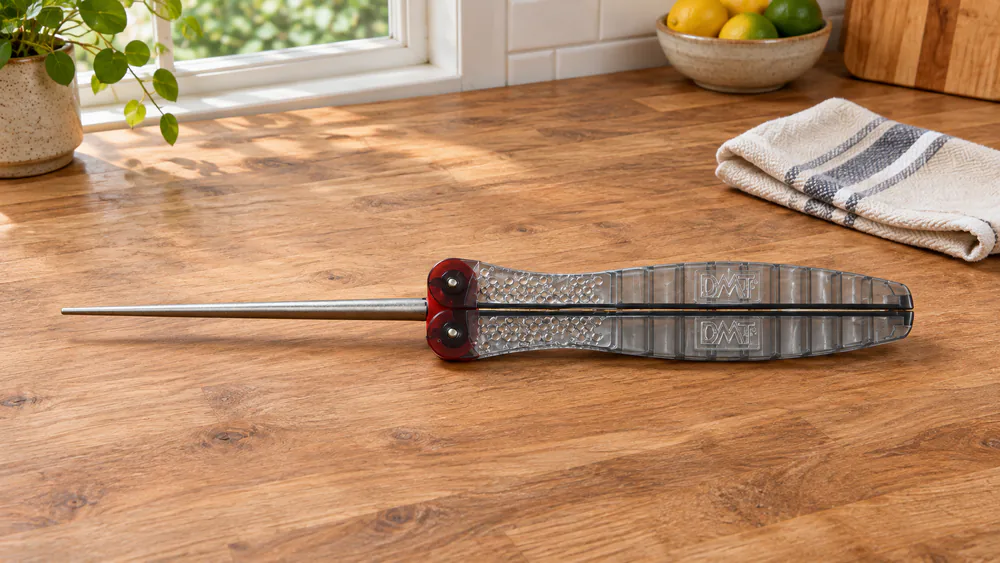
A DMT Diafold serrated-knife sharpener resting on a wooden counter with its tapered rod unfolded
The DMT Diafold has a tapered rod for reaching individual serrations.

How to Choose a Serrated Knife Sharpener

Start with the knives you own. Serrated blades vary a lot in scallop size, and one sharpener rarely suits every pattern. The next three subsections cover the type, the fit and the budget.

Tapered rods vs electric vs ceramic hones

A tapered diamond rod, such as the DMT or the Lansky, is the most direct fit, cuts quickly, and costs little. Its downside is time, since a long bread knife takes a few minutes of methodical work.

An electric machine suits you if you also own straight knives. Only the 15XV documents a serrated routine, so we recommend it over other machines for mixed blocks. A ceramic hone sharpens more slowly and finishes finer. Diamond cuts fast, so Fine grit suits maintenance, and a ceramic option makes sense if you only touch up.

Tip. Use light strokes on the first few scallops and check the edge before you commit to the rest. Diamond cuts fast, and it is easier to add a stroke than to take metal back.

Matching the tool to your serration size

Large scallops on a bread knife suit nearly every tool here. Small, tight scallops on steak knives need a cone with a narrow tip, such as the DMT's 1/16 inch end. Where a maker publishes no taper, as with the Lansky, we treat the fit as unproven.

Budget and who it suits

If you own a single bread knife, the DMT is the best value in plain terms. If you own a full knife block, the 15XV earns its place. For rough work on cheap knives, the AccuSharp and the Orange Ninja are the budget choices, and the Mk.2 is for enthusiasts who also sharpen tools.

On a serrated knife, fit to the scallops matters more than speed or power.

How to Sharpen a Serrated Knife Step by Step

These steps work for a tapered rod such as the Diafold. For a full walkthrough with photos, see how to sharpen a serrated knife at home, gullet by gullet.

  1. Pick the cone width that sits snugly in the first scallop without wedging.
  2. Find the beveled side of the blade. Most serrations are beveled on one face only.
  3. Seat the cone in the gullet and match the existing angle.
  4. Push the cone through the scallop with light, even strokes, moving from the narrow to the wide end.
  5. Repeat for each scallop. On a long bread knife, plan on a few minutes.
  6. Deburr the flat side with one light pass.
  7. Test on a tomato or a loaf of crusty bread.

For electric and pull-through sharpeners, the process is simpler. On the 15XV, use Stage 3 only, with five to ten pairs of alternating pulls. For general technique, see how to use a knife sharpener.

What Not to Use on a Serrated Blade

Warning. Do not run a serrated knife through the coarse stages of an electric sharpener, a flat bench stone, or a carbide-only slot. These tools hit the tooth points and flatten the scallops.

A flat stone sharpens the tips of the teeth and nothing else. A coarse electric stage removes far more metal than a serrated edge can spare. Carbide slots can grab scallops, so follow each tool's serrated instructions; the SHARPAL 191H uses its ceramic slot for this task. A round honing steel is no better, for the reason covered above.

Frequently Asked Questions

Can you use a ceramic hone on a serrated knife?

Yes, if it is a tapered or small-diameter ceramic rod that sits in the scallop. Ceramic cuts more gently than diamond, so expect to make several light strokes per scallop and check the edge as you go. A flat ceramic bench stone or a wide round hone will only polish the tooth points.

How often should you sharpen a serrated knife?

Only when it starts crushing crusts and tomato skins instead of cutting them. For a bread knife in a household kitchen, that can be a year or more between sessions.

Can a serrated knife be sharpened more than a handful of times?

Generally, yes. You remove only a sliver of metal from the beveled side each time, so a bread knife that gets sharpened sparingly will usually outlast many sessions. The practical limit is the teeth, not the blade length.

How can you tell the points are too worn to save?

Run a fingertip lightly along the edge. If the teeth feel rounded and smooth rather than pointed, or several neighboring points are chipped away, sharpening will not bring the bite back.

What scallop count tells you to replace the knife instead of sharpening it?

There is no magic number, but a cheap blade with only a few shallow scallops, or one where a run of adjacent scallops has worn flat, is usually cheaper to replace. A bread knife with deep, evenly spaced scallops is worth the time.

Is it worth sharpening a cheap bread knife?

Usually, yes. A budget serrated knife responds well to a quick pass with a cone or a pull-through. If the points are broken or missing, replacing it makes more sense.

Final Verdict

Choose the Chef'sChoice 15XV for a mixed knife drawer, or the DMT Diafold Serrated if you only need to sharpen a bread knife. If money is tight, the AccuSharp handles dull supermarket knives, though it will not give a fine edge. Use the SHARPAL's ceramic slot for serrated work, and treat the Mk.2 as a bench system for people who sharpen many tools. Check the notes under each pick before you buy, since the right tool is the one that fits your scallops.

Read next

Ready to upgrade your kitchen?

Browse our buying guides to find the right tool for every knife in your drawer.