As an Amazon Associate we earn from qualifying purchases. We may earn a commission from links on this page, at no extra cost to you. Learn more.
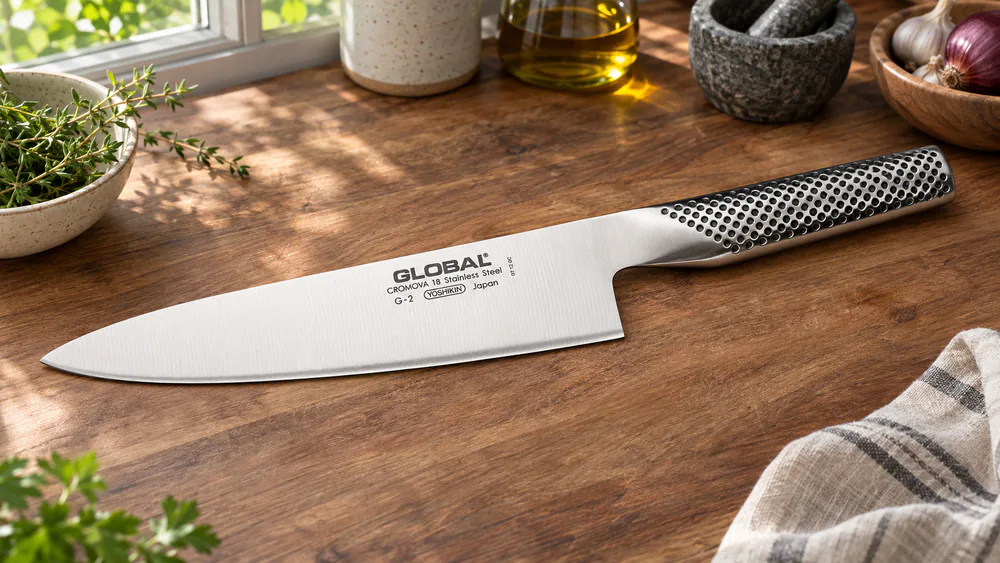
The Global Classic G-2 is a stamped, all-steel, Japanese-made chef's knife that weighs far less than the German knives most of us grew up with. It is the right knife for cooks who want a light, nimble blade and don't mind a little extra care. It is the wrong one if you lean on a heavy blade to power through squash. In our Japanese knife reviews, it is the lightest 8-inch blade we keep reaching for.
Quick Verdict
Key takeaway. We rate the Global Classic G-2 4.2 out of 5. Our full verdict sits in the review box just below.
The G-2 is very light and nimble, and the sand-filled handle puts the balance point slightly toward the handle so the blade never dives forward. The knife glides through onions without crushing them, and long prep sessions cause little wrist fatigue. The catches, which we cover below, are real but manageable for a cook who wants agility more than heft.
Lifetime warranty against defects and breakage
No bolster, so the choil is fully exposed
Made in Niigata, Japan, by Yoshikin
Specifications
Steel
CROMOVA 18
Hardness
56 to 58 HRC
Handle
Hollow steel, sand-filled
Origin
Niigata, Japan
How We Tested the Global Classic
We used the G-2 for a month of heavy prep. In that time the edge rolled slightly after about a week and came back on a strop, and the steel handle slipped in one very wet session. We score every knife on edge retention, handle comfort and how easily its sharpness can be restored.
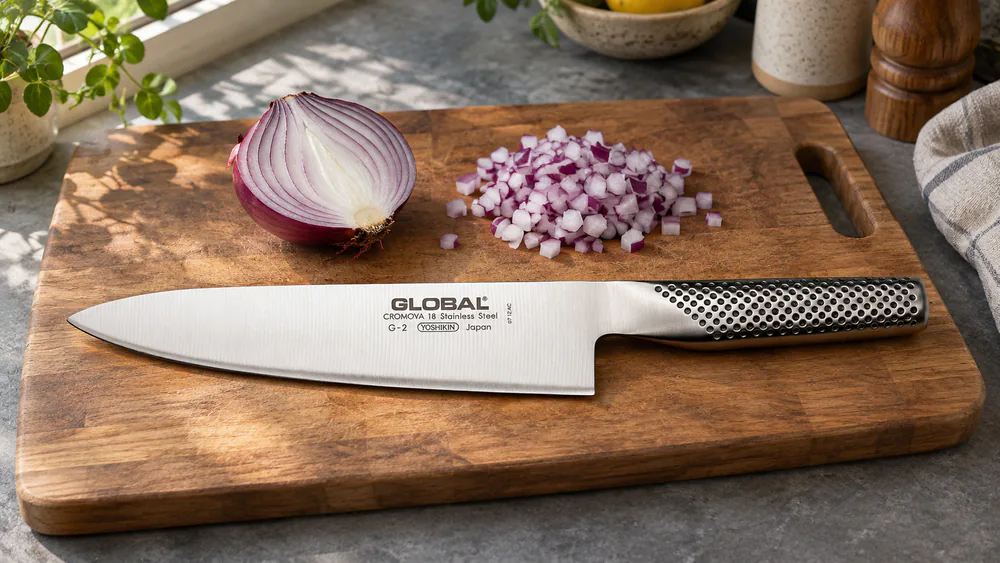
In our kitchen the G-2 handled the everyday jobs: onions, tomatoes, herbs, garlic, fish and boneless proteins. Onions sliced without crushing, and tomatoes finished without a snap at the end of the cut.
That month produced no chipping and no loosening at the join between handle and blade. Everything below comes from that hands-on use.
Hollow stainless steel with dimples, filled with sand
Construction
Stamped, no bolster, convex grind, double bevel
Origin
Niigata, Japan
Warranty
Lifetime warranty against defects and breakage
The G-2 is the model code for the 8-inch Classic chef's knife, so you will see it sold as the Global Classic, the Global G-2, or both at once. Komin Yamada designed the line in 1985, and Yoshikin (Yoshida Metal Industry) still builds it in Niigata. The blade, handle and end cap are welded and polished into one seamless piece.
Weight deserves a caveat. We use 5.9 oz as our working figure, but published weights run from about 5.5 oz to well above 7 oz depending on how and what was weighed. Either way, it is much lighter than a forged German knife.
Pros and Cons
Pros
Very light and agile, with little wrist fatigue
Convex grind separates food instead of wedging
Seamless handle with no seam to trap food
Soft steel resists chipping
Full pinch grip with an exposed choil
Lifetime warranty
Cons
Needs frequent stropping to stay sharp
Hard to sharpen well on a stone
Handle turns slippery when wet
Thin handle can cause blisters over a full day
Not dishwasher safe
Too light for heavy cutting
Who Should Buy the Global Classic G-2
Buy it if you cook mostly vegetables, herbs, fish and boneless proteins. Buy it if you have small hands or sore wrists and want a knife that does not tire you. It also suits anyone who likes a pinch grip and a blade that does its own work.
It works as a one-knife kitchen. The gentle belly rocks through herbs and garlic, draws through fish and soft proteins, and slices sourdough without fuss.
Who Should Look Elsewhere
Look elsewhere if you want a heavy knife that powers through dense squash and thick cuts. The light blade gives you no weight to lean on, so those jobs take more effort than they do with a German knife. Skip it too if you want to toss knives in the dishwasher, or if you refuse to learn any sharpening at all.
If you are shopping across brands, our Best Global Chef Knife guide covers the rest of the lineup.
Blade and CROMOVA 18 Steel
The blade is the starting point for understanding how the G-2 performs. It is thin, stamped, and ground to a convex edge. CROMOVA 18 is a stainless steel built from chromium, molybdenum and vanadium, and at 56 to 58 HRC it is softer than many Japanese knives. That softness shapes everything about how the knife behaves, for better and worse.
Sharpness Out of the Box
Out of the box the G-2 is razor-sharp. The convex grind separates food rather than wedging it apart. Carrots part cleanly, and tomato slices finish without a felt snap at the end of the cut.
Onions slice without crushing, which means fewer tears. The edge stays sharp enough to cut paper for light home cooks.
Edge Retention and Sharpening
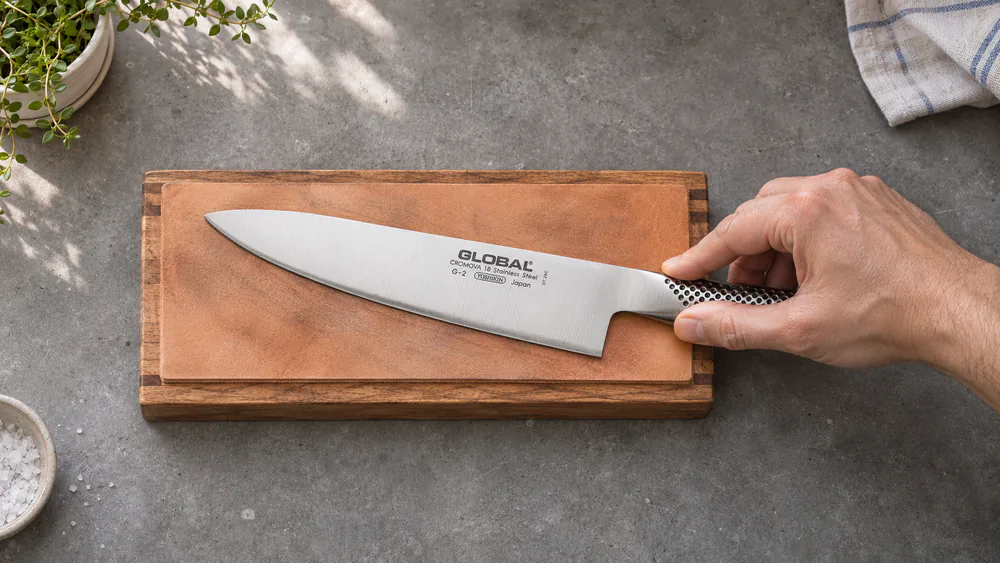
Edge retention is moderate, which is what you would expect from soft steel. After about a week of heavy use the edge showed small rolls and a change when cutting paper. Most of that came back on a strop, and kitchen performance changed little.
Our routine is simple: strop monthly and sharpen about once a year for home cooking. Heavier users should strop more often.
Tip. Strop lightly to bring back the edge between sharpenings.
Sharpening is the real chore. The soft steel, convex grind and large carbides are hard to bring to a refined edge on a stone, and pull-through sharpeners do poorly. The factory angle is quoted at 15 degrees per side, but the convex grind means the real angle varies along the bevel. If you do not want to learn stones, a sharpening service is the easier route, and our Knife Aid mail-in sharpening review shows how one works.
A quick strop brought back most of the edge after heavy use.
The Hollow Steel Handle, Weight and Balance
That soft steel also shapes the handle story, and the handle is the most polarizing thing about this knife. It looks odd, but it feels more comfortable than it looks.
The Dimpled Steel Handle
The hollow handle is filled with sand to set the balance, then welded to the blade and polished smooth. The dimples add grip. In normal use they work well, and the seamless build leaves no gap for food.
Wet hands are another story. In a very wet session with constant rinsing and wiping, the steel handle turned slippery even after wiping. The dimples help dry hands, not wet ones.
Pinch Grip and Comfort
With no bolster, the choil is fully exposed, and the slim handle sits naturally in a pinch grip. The sand-filled handle puts the balance point slightly toward the handle, so the knife does not dive forward.
Over a full day of slicing and dicing, though, the thin steel handle can cause blisters. If you prep for hours at a time, that matters more than the weight.
Performance by Task
Chopping Vegetables
The G-2 performs especially well when chopping vegetables. The light blade swings quickly, and the convex edge slides through carrots, celery and onions with little resistance.
Mincing Herbs
The gentle belly rocks through herbs and garlic with a smooth, easy motion. There is no hammering and very little bruising.
Slicing Meat and Fish
The blade draws cleanly through fish and soft proteins. It handles boneless chicken and sourdough slicing well, and it copes with fish bones too. For more picks aimed at proteins, see our guide to the Best Knife for Cutting Meat.
What It Should Not Cut
Keep it away from frozen food, hard bones and anything you would be tempted to pry. The one reliable way to wreck this knife is to use it as a lever. Prying frozen lamb chops apart is how a knife of this kind loses its tip.
Heavy cuts through dense squash or thick meat also take more effort than with a heavier German knife.
Build Quality and Durability
Task performance is one thing, but a knife also has to last, and the stamped, seamless build holds up well. After a month of heavy use we saw no chipping and no loosening at the handle-to-blade join. The soft steel resists chips better than harder Japanese steels, which is a real advantage for a busy home kitchen.
A knife of this build can take years of use, with once-a-year sharpening and the odd mistake, provided you avoid prying. The lifetime warranty against defects and breakage adds confidence.
Beware counterfeits. Fake Global knives circulate on auction sites, and a very low price or knife-roll packaging is a warning sign.
Cleaning and Maintenance
Warning. The Global Classic is not dishwasher safe. Global recommends hand washing, and we agree.
Wash it by hand with warm water and mild soap, then dry it right away. Food and moisture can lodge in the dimples of the handle, so a quick towel pass after rinsing matters. Store it in a block, on a magnetic strip, or in a sheath so the thin edge never knocks against other metal.
Is It Worth the Price?
It sits in the premium tier for an 8-inch chef's knife, well above a budget workhorse like the Victorinox and below the splurge Japanese options. We think it justifies that price for cooks who value a light, agile knife with seamless construction, and the lifetime warranty adds reassurance. If you mainly want something sturdy that you can neglect, you will get more value elsewhere.
Global Classic vs Other 8-Inch Chef's Knives
Knife
Weight
Handle
Edge angle
Dishwasher
Origin
Global Classic G-2
about 5.9 oz
Hollow steel, sand-filled
15 degrees per side
No, hand wash
Niigata, Japan
Wusthof Classic
8.5 oz
Forged, with bolster
14 degrees per side
See maker
Germany
Victorinox Fibrox Pro
See maker
TPE non-slip
See maker
Dishwasher-safe materials
Switzerland
Global Classic vs Wusthof Classic
The Wusthof Classic weighs about 8.5 oz, forged with a bolster, and has a 14-degree edge per side. It has the heft the Global lacks, so it powers through dense produce more easily. The Global is the more agile of the two and the better choice for wrists and herbs.
Global Classic vs MAC MTH-80
The MAC is another Japanese 8-inch contender with a hollow-edge blade, and we cover it in our MAC Professional 8-Inch Hollow Edge Chef's Knife Review. It pairs a 2.5mm blade and stainless bolster with a black Pakkawood handle, weighs just under 7 oz, and ships with an edge of about 15 degrees per side.
Global Classic vs Victorinox Fibrox Pro
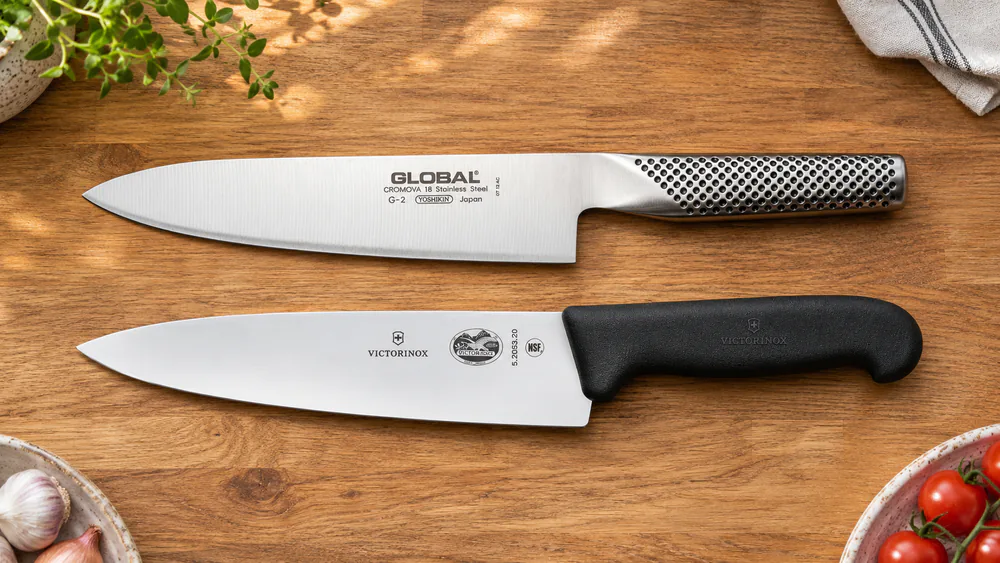
The Victorinox Fibrox Pro is the budget alternative. It has a TPE non-slip handle, dishwasher-safe materials, Swiss construction and a lifetime warranty against defects. The grip stays secure when wet, which is exactly where the Global's steel handle struggles. If you want an easy, forgiving knife, it is the better value, though it lacks the Global's light, seamless feel.
Steel handle versus TPE handle: the clearest difference between the two.
Frequently Asked Questions
Is the Global Classic dishwasher safe?
No. Global recommends hand washing. Dry it right away, because moisture can lodge in the handle dimples.
Is the Global Classic good for beginners?
Yes for handling, since it is light and easy to control. The catch is sharpening: stones are difficult on this steel, so plan on stropping or a sharpening service.
Why is the handle filled with sand?
The sand sets the balance point. It lets Global keep the hollow steel handle light while shifting weight slightly toward the handle so the knife does not dive forward.
Where is the Global Classic made?
In Niigata, Japan, by Yoshikin (Yoshida Metal Industry).
How often should I sharpen it?
For home cooking, strop about monthly and sharpen about once a year. Heavier use calls for stropping more often.
Are the G-2 and the Global Classic the same knife?
Yes. G-2 is the model code for the 8-inch Classic chef's knife, sold as the Global Classic G-2.
Final Verdict
Our plan for a new G-2 owner is simple: buy a leather strop on day one, and pair the knife with a good professional knife sharpener or a mail-in service for the yearly sharpening. If that sounds like too much upkeep, take the Victorinox Fibrox Pro. If you want German heft instead of agility, the Wusthof Classic is the better match.