
Helping you create a kitchen you love.

Knives & Cutlery

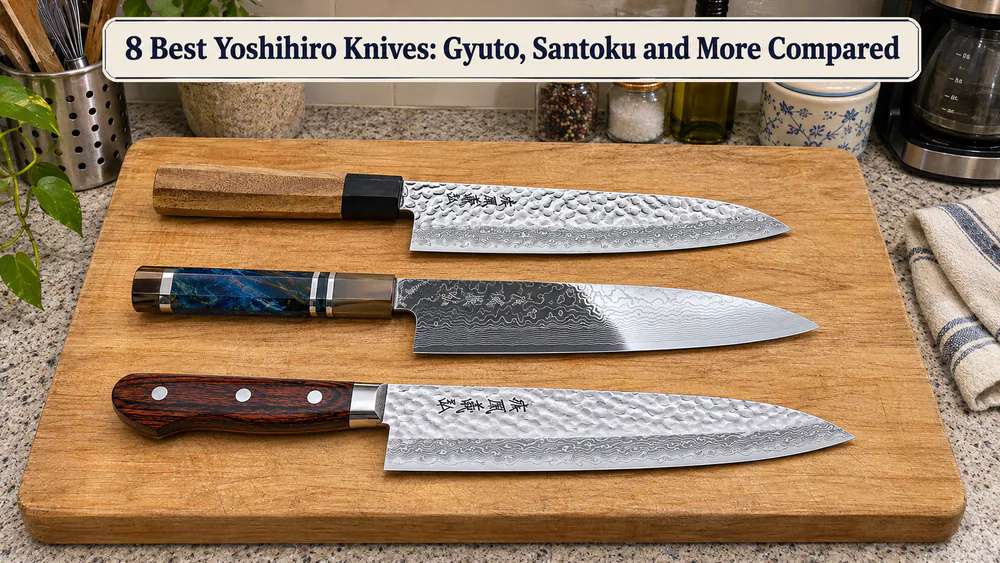
8 Best Yoshihiro Knives: Gyuto, Santoku and More Compared

As an Amazon Associate we earn from qualifying purchases. We may earn a commission from links on this page, at no extra cost to you. Learn more.

8 Best Yoshihiro Knives: Gyuto, Santoku and More Compared

The first time a Yoshihiro gyuto touched our cutting board, it went through a ripe tomato with no pressure at all. The 46-layer model arrived razor-sharp out of the box, and that first clean slice told us why people fall for this brand. Since then we have put the range to work on real prep jobs, from long slicers to a tiny petty knife.

This guide covers eight Yoshihiro knives: three gyutos, a santoku, a nakiri, a sujihiki and a kiritsuke, plus a small petty. If you are weighing the wider field, our Japanese knife reviews put these blades in context. Below we explain which one we would buy first, which steel suits which cook, and where each knife struggles.

Our Top 3 Yoshihiro Picks at a Glance

RankProductBest forSteelRatingBuy
1

Yoshihiro VG10 46-Layer Hammered Damascus Gyuto

Best Overall
Home cooks who want a razor-sharp all-rounder VG10, 46 layers 4.8 View on Amazon
2

Yoshihiro SG2 Damascus Gyuto 210mm (Ocean Blue)

Best Premium Upgrade
Cooks who sharpen on stones and want longer edge life SG2 powder steel 4.6
3

Yoshihiro VG10 16-Layer Hammered Damascus Gyuto

Best Value
Anyone who wants a Western handle and the lowest gyuto cost VG10, 16 layers 4.5 View on Amazon

We earn a commission if you make a purchase, at no additional cost to you.

See full comparison table

Yoshihiro Chef Knives Compared

Our Top 3 Yoshihiro Picks at a Glance

All eight picks sit in one table, so you can compare steel, layers, length and handle at a glance.

ModelSteelLayersLengthHandleOur ratingBest for
VG10 46-Layer GyutoVG-10468.25-inch (210mm)Wa, octagonal4.8Best overall
SG2 GyutoSG2 powder steelDamascus cladding8.25-inch (210mm)Octagonal ocean blue, triple rings4.6Premium upgrade
VG10 16-Layer GyutoVG-10168.25-inch (210mm)Western mahogany4.5Best value
VG10 16-Layer SantokuVG-10167-inch (180mm)Western mahogany4.5Daily cooking
VG10 NakiriVG-10166.5-inch (165mm)Western mahogany4.4Vegetables
VG10 46-Layer SujihikiVG-10469.5-inch (240mm)Wa, octagonal4.3Slicing meat and fish
Kurouchi KiritsukeBlue #2 carbonStainless clad8.25-inch (210mm)Octagonal ebony4.2Carbon steel fans
VG10 Petty Utility KnifeVG-10163.2-inch (80mm)Western4.1Budget pick

How We Tested These Yoshihiro Knives

We judged each knife the way a working kitchen does. How does the edge feel on the first cut? How does it hold up through a pile of prep? How does the handle feel when your hands are wet and tired? And how easily does the steel come back on a stone?

We put the knives to work on the prep jobs they are built for: tomatoes, peppers, onions, carrots and cabbage for the gyutos and the nakiri, roasts and whole salmon for the sujihiki, and a full day of from-scratch cooking for the 16-layer gyuto. Our scoring covered five things. Out-of-the-box sharpness came first, then edge retention, then balance and handle comfort. Fourth was how forgiving the blade is with real-world cutting, and last was the care it demands. We also weighed where each blade chips, rolls or needs attention, because that tells you more than a spec sheet does.

One note on method. Every knife here is a thin Japanese blade, so we cut on wood and soft synthetic boards only. We kept bones, frozen food and hard squash stems away from the VG-10 and SG2 edges, which is how the brand itself tells you to treat them.

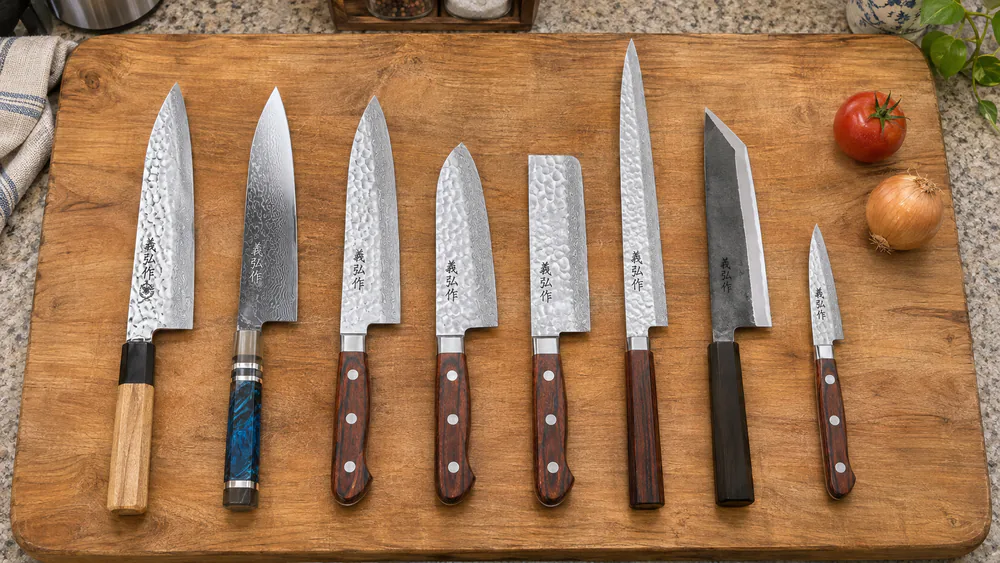
Eight Yoshihiro knives laid in a row on a wooden prep board, from the long sujihiki to the small petty, with a tomato and an onion beside them
The eight models compared in this guide.

The Reviews

Each pick below gets a verdict, a look at the blade geometry and a note on who should buy it. We ranked them by how well they serve the widest group of home cooks, not by price.

1. Yoshihiro VG10 46-Layer Hammered Damascus Gyuto: Best Overall

Yoshihiro VG10 46-Layer Hammered Damascus Gyuto
1

Yoshihiro VG10 46-Layer Hammered Damascus Gyuto

Best Overall
Check Price on Amazon
4.8/5

This is the Yoshihiro we would buy first. It arrived razor-sharp out of the box and sliced tomato with no pressure, and the balance suited butchery, slicing and chopping alike. It earns the top spot because it does the most jobs well, with a fine edge that feels like a real step up.

Pros

  • Razor-sharp edge out of the box
  • Balances well for slicing, chopping and butchery
  • Wa handle stays grippy with messy hands
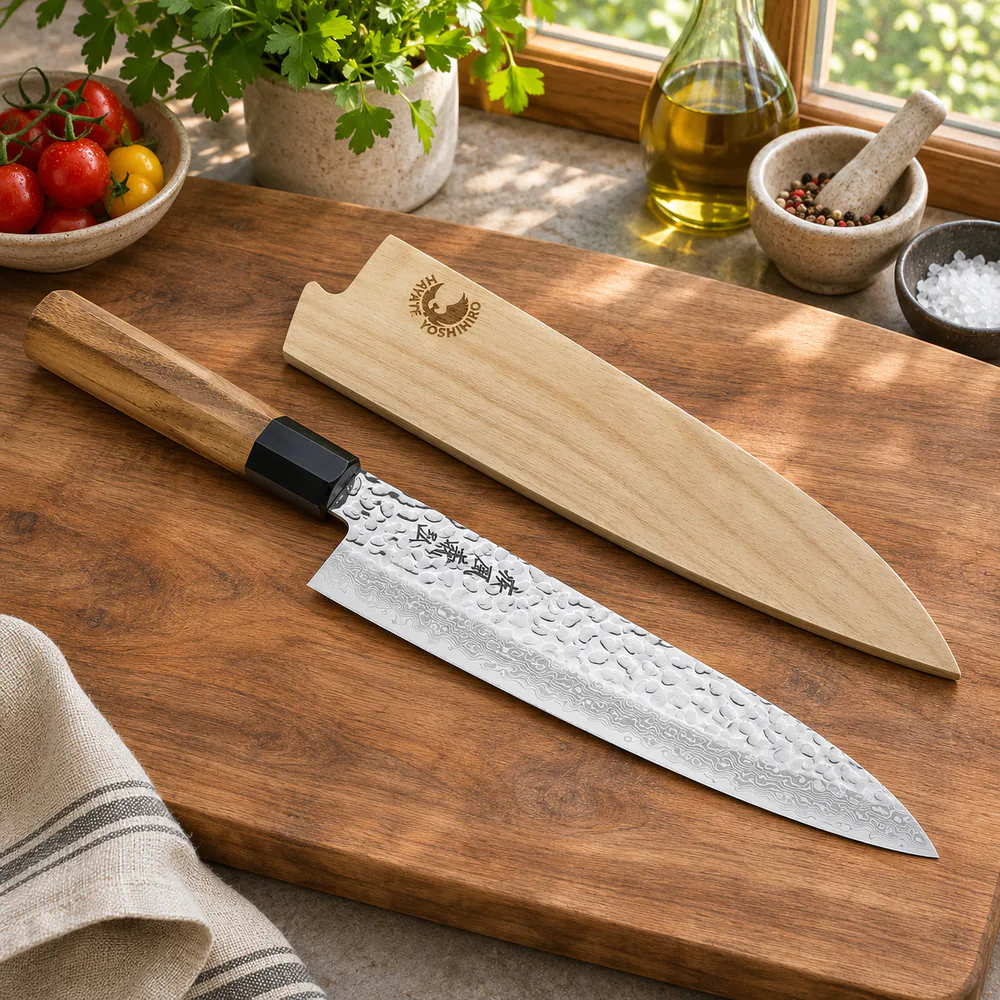
  • Magnolia saya included for storage

Cons

  • The bevel is lopsided, roughly an 80/20 grind, so sharpening has a learning curve
  • Thin edge can chip on bones and frozen food

The wa handle is smooth with a light texture, and it stayed grippy when our hands were messy. The knife feels about two ounces lighter than a German forged chef knife, and the switch to a fine Japanese edge took very little adjusting.
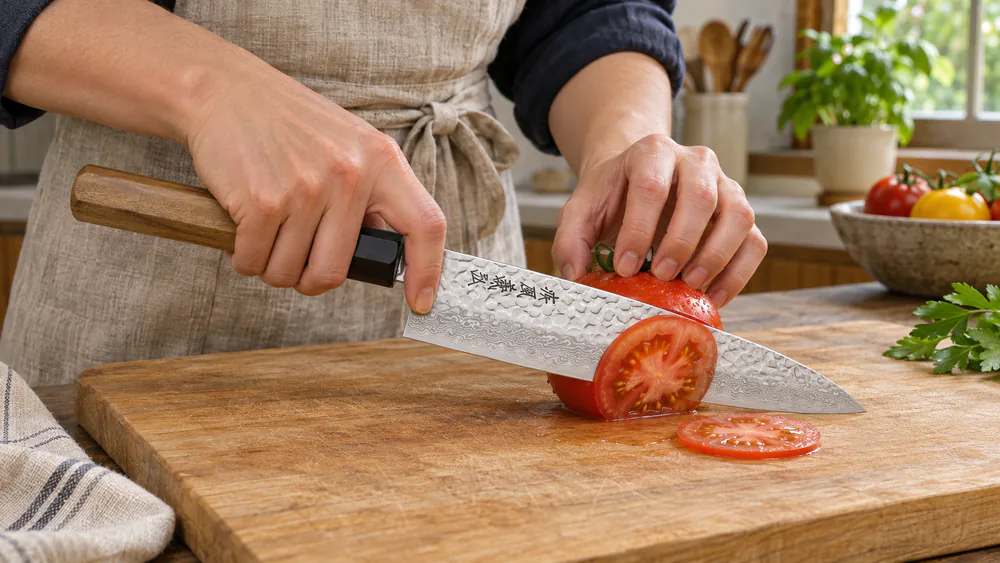
A Yoshihiro 46-layer hammered Damascus gyuto slicing a ripe tomato on a wooden board, the wa handle gripped in a pinch hold
The first cut: a tomato with no downward pressure.

Specs and Blade Geometry

The blade pairs a VG10 core with 46 layers of hammered Damascus. It is rated at HRC 60, which is the Rockwell hardness scale for steel. German chef knives sit at about 56-58, so this blade is noticeably harder, and that is why it takes a finer edge and holds it longer.

The standard length is 8.25-inch (210mm), with 7-inch and 9.5-inch versions also sold. The handle is an octagonal wa handle, in ambrosia, rosewood or ebony variants. Wa means Japanese-style, a lighter handle that shifts the balance point forward.

The lopsided grind is worth a mention. Because the bevel is asymmetric, the first sharpening session takes some care. About 20 minutes on a whetstone made ours sharper than the factory edge.

Who Should Buy It

Buy this if you want one Japanese knife that handles nearly everything. It suits cooks who already like a fine edge, or who are moving up from a German blade and want something lighter and sharper. It is a mid-priced knife, and it is the one we would hand to a friend who asked where to start.

Skip it if you chop through chicken bones or frozen blocks. A thicker, softer blade serves that work better.

2. Yoshihiro SG2 Damascus Gyuto 210mm (Ocean Blue): Best Premium Upgrade

Yoshihiro SG2 Damascus Gyuto 210mm (Ocean Blue)
2

Yoshihiro SG2 Damascus Gyuto 210mm (Ocean Blue)

Best Premium Upgrade
4.6/5

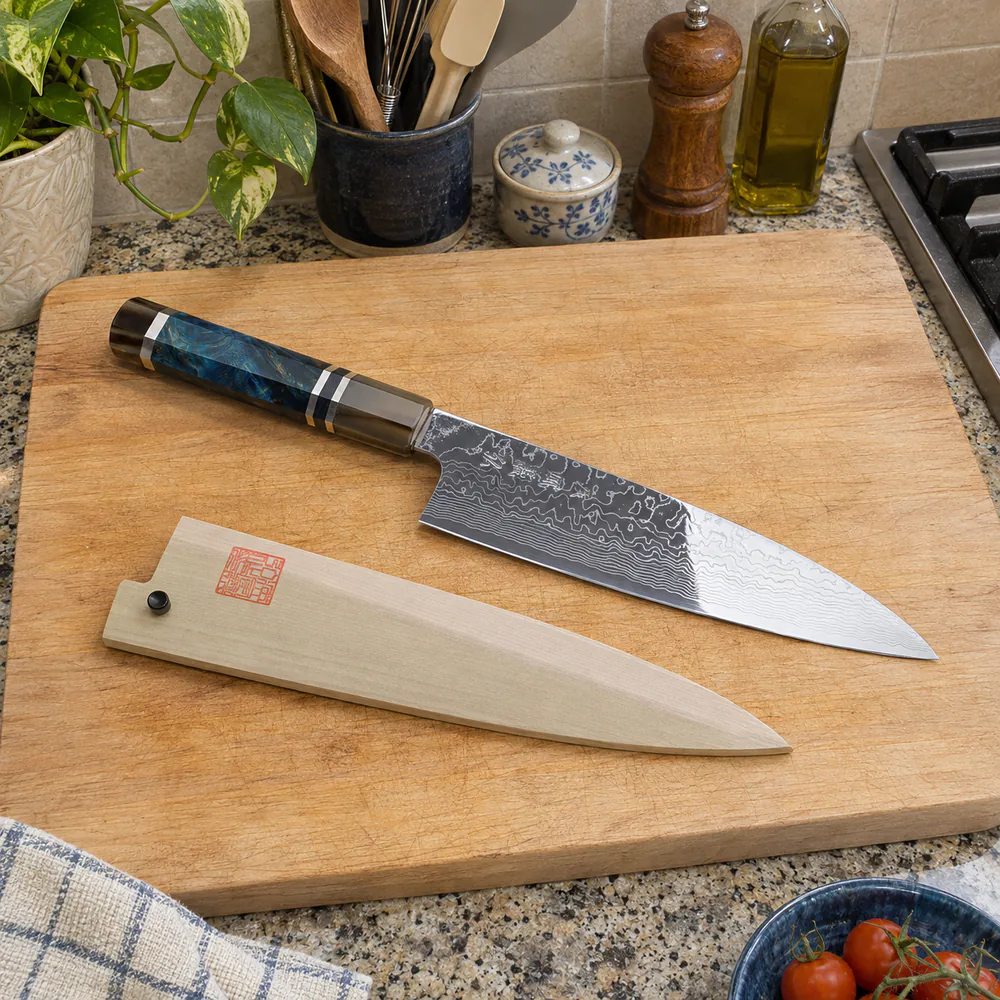
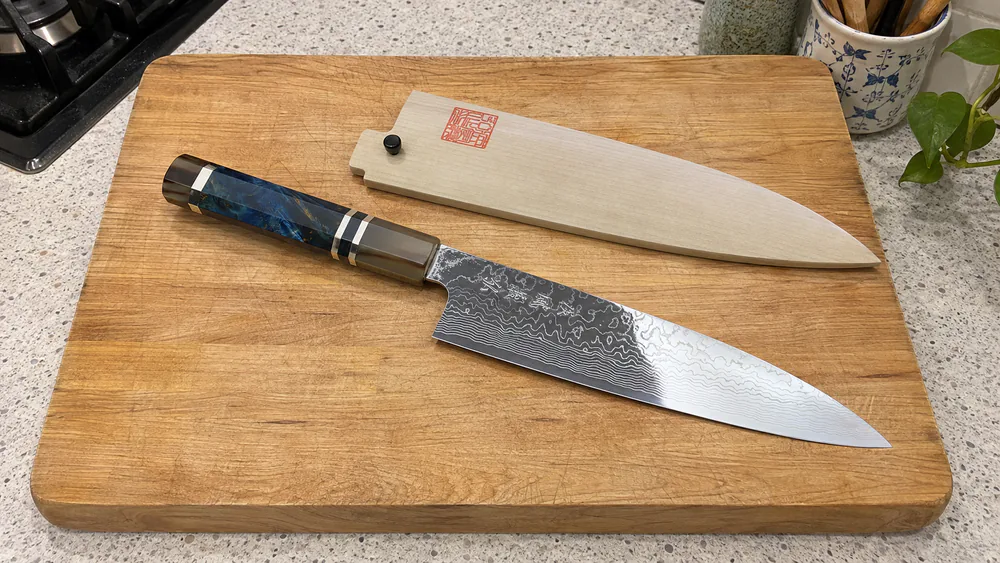
The selected SG2 Damascus gyuto is the 210mm ocean-blue model, SGSMGY210OBMS. Yoshihiro specifies a 64-65 HRC powdered-steel core and positions it for long edge life; we have not established a hands-on test of this exact version.

Pros

  • Thin gyuto profile for general kitchen prep
  • Powdered-steel core designed for long edge life
  • Finer polish than the VG10 blades

Cons

  • Chips more readily on bones and hard shells
  • Costs more than the VG10 gyutos
  • Hard edge requires careful use and stone sharpening

That performance comes with a trade-off. The same hardness means the edge chips more readily on bone and hard shells, so the knife rewards careful hands.

Specs and Blade Geometry

SG2 is a powder-metallurgy stainless steel. In plain terms, the steel is made from fine powder, which gives smaller, more uniform carbides, the hard particles that hold an edge. That structure allows a finer polish and a higher hardness than VG-10.

Yoshihiro lists this model at 64-65 HRC, with a 210mm Damascus-clad blade, an octagonal ocean-blue handle with triple rings and a magnolia saya. The selected SKU is SGSMGY210OBMS.

SG2 vs VG10: Is the Upgrade Worth It

For most home cooks, the answer is no. A VG10 knife at HRC 60 is already sharp, easier to sharpen and more forgiving of the odd hard cut. The SG2 upgrade pays off when you sharpen on stones regularly, cut mostly soft foods and want to touch up the edge less often.

If you sometimes hit a bone or a frozen item by accident, stay with VG10. A chipped SG2 edge takes longer to repair than a rolled VG10 one. We would also not pay the premium for a first Japanese knife.

3. Yoshihiro VG10 16-Layer Hammered Damascus Gyuto: Best Value

Yoshihiro VG10 16-Layer Hammered Damascus Gyuto
3

Yoshihiro VG10 16-Layer Hammered Damascus Gyuto

Best Value
Check Price on Amazon
4.5/5

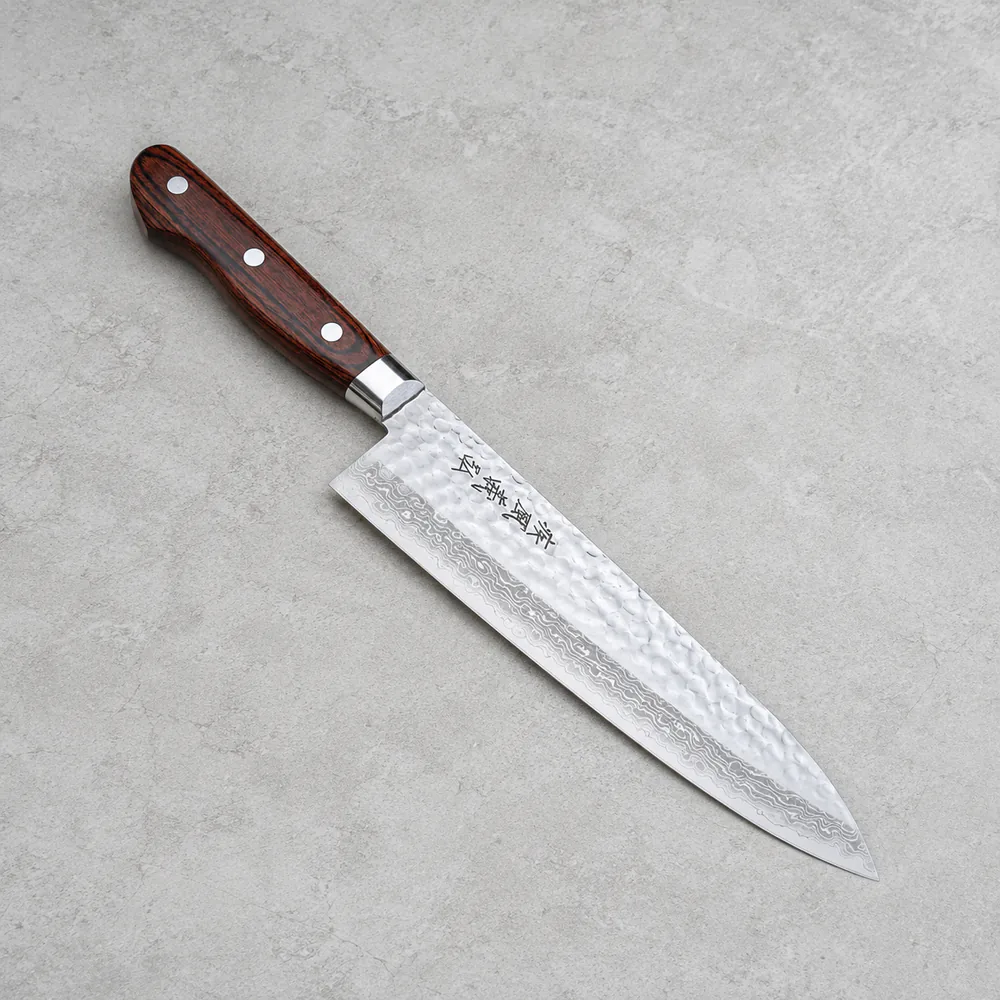
The 16-layer gyuto delivers the same cutting performance with fewer layers, making it the sensible buy for most kitchens. It cuts sushi, meats and vegetables daily without rusting, and it handles a full home prep routine. Out of the box it was sharper than a Wusthof Ikon and passed the paper test with ease.

Pros

  • Sharper out of the box than a Wusthof Ikon
  • Holds a razor edge through a full day of cooking
  • Western handle sits level and needs less upkeep
  • The lowest cost of the gyutos here

Cons

  • Fewer layers and a plainer look than the 46-layer model
  • Needs whetstone care to stay at its best
  • No saya included

After a full day of from-scratch cooking, it still held a razor edge. The Western mahogany handle centers the weight at the heel, so the knife sits level on the board. Our only complaints were cosmetic, such as the placement of the logo.

Specs and Blade Geometry

This knife uses a VG10 core with 16 layers of hammered Damascus. It is rated at HRC 60, with the same 8.25-inch (210mm) blade length as the top pick, and 7-inch and 9.5-inch sizes also exist. The handle is a Western full-tang mahogany one, and there is no saya.

The factory edge sits at roughly 15 degrees per side. We would call the weight moderate, a touch heavier than the wa-handled version because of the Western handle.

Who Should Buy It

Buy this if you want the Yoshihiro edge without paying for extra layers or a wa handle. The Damascus pattern is mostly cosmetic. The cutting steel is the same VG10 core as the pricier gyuto.

It also suits cooks who prefer a handle that feels familiar. If you have been using a German knife, the Western grip makes the move to Japanese steel much smoother.

4. Yoshihiro VG10 16-Layer Santoku: Best for Daily Cooking

Yoshihiro VG10 16-Layer Santoku
4

Yoshihiro VG10 16-Layer Santoku

Best for Daily Cooking
Check Price on Amazon
4.5/5

Where the gyuto gives you reach, the santoku gives you control. Its short, wide blade suits a small board, and the hammered texture is designed to reduce food sticking. For weeknight dinners it is a natural alternative to a gyuto.

Pros

  • Short, controlled blade for small boards
  • Hammered texture reduces food sticking
  • Western full-tang handle, NSF certified
  • Slices, dices and minces cleanly

Cons

  • Less reach than a gyuto for large roasts or big melons
  • Flatter profile gives less rocking motion

The VG10 core takes a sharp edge, and the blade slices, dices and minces, which is what santoku means in Japanese: three virtues.

Specs and Blade Geometry

This is a 7-inch (180mm) blade with a VG10 core and 16-layer hammered Damascus cladding. The handle is a Western full-tang mahogany handle that is NSF certified. The blade is shorter and flatter than a gyuto, with a gentler curve toward the tip.

Santoku vs Gyuto for Daily Cooking

The santoku is shorter, flatter and easier to control. The gyuto is longer, curved and better for rocking cuts and large ingredients. If your board is small, or you cook for one or two, the santoku is the more comfortable daily knife.

If you often break down roasts, cut large cabbages or want a rocking chop, choose the gyuto. The extra length does real work. The santoku suits cooks who value control over reach.

5. Yoshihiro VG10 Nakiri: Best for Vegetables

Yoshihiro VG10 Nakiri
5

Yoshihiro VG10 Nakiri

Best for Vegetables
Check Price on Amazon
4.4/5

Move from the gyuto's curve to the nakiri's flat edge and the job narrows to vegetables. The flat profile gives clean push cuts through onions, carrots and cabbage, and it produced wafer-thin slices. Every cut lands on the board along its full length, so nothing is left half-cut.

Pros

  • Clean push cuts through onions, carrots and cabbage
  • Flat edge touches the board the full length
  • Wafer-thin slices with little effort

Cons

  • No tip, so it cannot pierce squash or break down poultry
  • A specialist: it does not replace a gyuto

The trade-off is the squared tip. With no point, it cannot pierce squash skin or break down poultry, so it works best as a partner to another knife.

Specs and Blade Geometry

The nakiri is a 6.5-inch (165mm) blade with a VG10 core and 16-layer hammered Damascus. A 46-layer rosewood version is also sold. The line is rated at about HRC 60, and the model is a double bevel with a flat edge. Treat the hardness as a series rating, because it is not printed on this model's page. The handle is Western mahogany with a full tang.

The tested 16-layer version has the Western handle.

Who Should Buy It

Buy the nakiri if vegetables are the heart of your cooking. It suits cooks who eat plenty of salads, stir-fries and slaws. Pair it with a gyuto or a santoku for proteins. If you only want one knife, this is not it.

6. Yoshihiro VG10 Sujihiki Slicer: Best for Slicing Meat and Fish

Yoshihiro VG10 46-Layer Sujihiki Slicer
6

Yoshihiro VG10 46-Layer Sujihiki Slicer

Best for Slicing Meat and Fish
Check Price on Amazon
4.3/5

The long sujihiki excels at slicing rather than the chopping tasks suited to a nakiri. Its long, light blade rewarded a patient stroke: we drew it through brisket, roast and whole salmon in a single pull.

Pros

  • Single-pull slices through roast, brisket and salmon
  • Long, light blade
  • Saya included

Cons

  • The thin edge can deflect or chip on raw brisket connective tissue
  • A specialist most cooks use only occasionally

It is also a specialist. Most home cooks will pull it out only for roasts, turkey or whole fish, and a gyuto covers everyday protein just fine.

Specs and Blade Geometry

The sujihiki measures 9.5-inch (240mm) with a VG10 core and 46-layer hammered Damascus. A magnolia or oak saya comes with it.

The blade is slim, with little curve. That shape suits long, smooth strokes rather than rocking cuts. We reserved it for finished proteins and fish, because the thin edge can deflect or chip on raw brisket connective tissue.

Who Should Buy It

Buy this if you carve roasts, slice a holiday turkey or break down whole fish at home. It is a second or third knife. If you cook mostly weeknight meals, a gyuto will do the same work and more.

7. Yoshihiro Blue #2 Kurouchi Kiritsuke 210mm (Ebony): Best Carbon Steel Pick

Yoshihiro Blue #2 Kurouchi Kiritsuke 210mm (Ebony)
7

Yoshihiro Blue #2 Kurouchi Kiritsuke 210mm (Ebony)

Best Carbon Steel Pick
4.2/5

After a run of stainless blades, the kurouchi kiritsuke is the one for cooks who love carbon steel. It takes an extremely keen edge and is easy to sharpen. The trade-off is that it rusts if left wet, and the stainless cladding protects the faces, not the exposed edge.

Pros

  • Extremely keen edge, easy to bring back on a stone
  • Stainless cladding protects the blade faces
  • Striking black kurouchi finish

Cons

  • Exposed carbon edge rusts if left wet
  • Needs drying right away and occasional oil
  • Exposed carbon edge still needs rust care

Dry it right away after every task. A grey patina is normal and harmless, and this is a knife for people who enjoy looking after their tools.

Specs and Blade Geometry

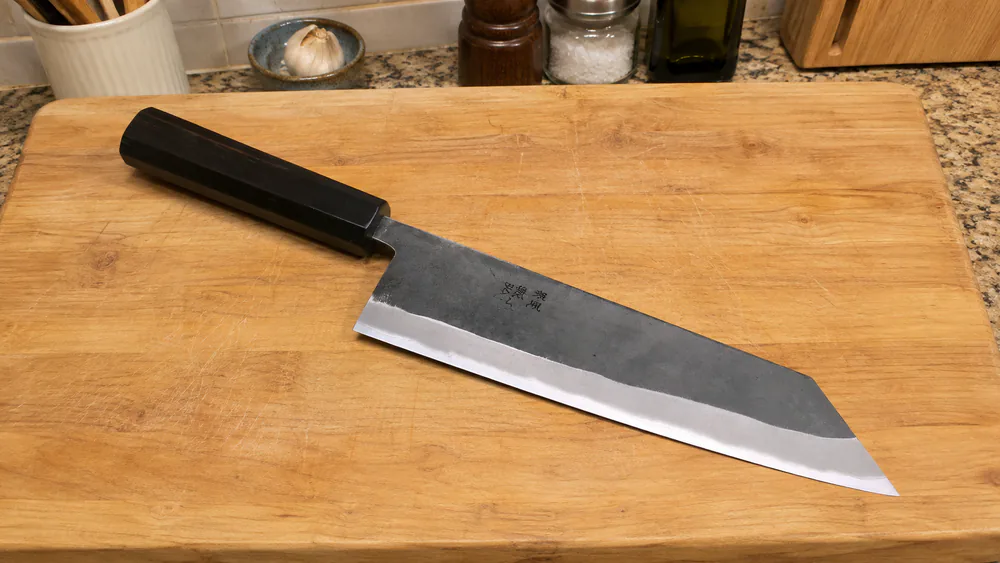
The selected SNAKUKI210EH has a Blue #2 carbon core, stainless cladding and a black kurouchi finish. Yoshihiro rates its hardness at 63-64 HRC. A kiritsuke has a long, flat edge and an angled tip that suits both slicing and push cuts.

This version has a 210mm blade and an octagonal ebony handle; the linked option is supplied without a saya. A hammered-Damascus kiritsuke rated at HRC 60 is a different knife from the carbon kurouchi line.

Tip. Dry a carbon edge straight after use and wipe it with a thin film of oil now and then. A grey or blue patina is normal. Orange rust is not, and it should be removed with a fine abrasive before it spreads.

8. Yoshihiro VG10 Petty Utility Knife: Best Budget Pick

Yoshihiro VG10 Petty Utility Knife
8

Yoshihiro VG10 Petty Utility Knife

Best Budget Pick
Check Price on Amazon
4.1/5

At the small end of the lineup, the petty is the cheapest way to try Yoshihiro steel. It is nimble through long sessions of peeling, trimming and detail work. It will not replace a chef knife, but it suits the jobs where a big blade is too much.

Pros

  • Nimble and comfortable for long sessions
  • The lowest cost way into Yoshihiro VG10
  • Western handle adds a little heft

Cons

  • Needs touching up more often than the bigger knives
  • Too small to replace a chef knife

It needs touching up more often than the bigger knives. Some cooks also find the wa-handled petties too light at first, though ours has a Western handle.

Specs and Blade Geometry

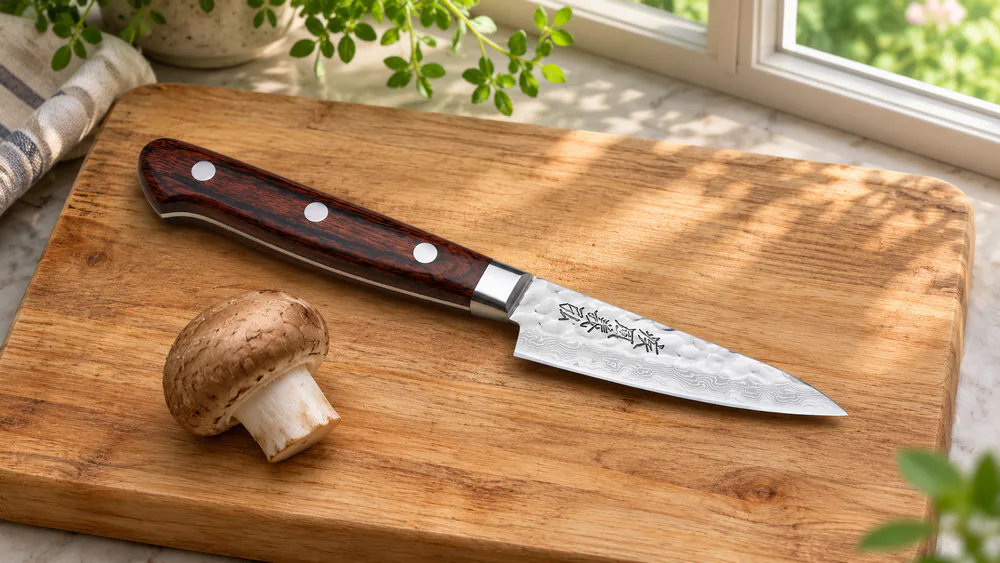
This is the 3.2-inch (80mm) paring-size blade, a VG10 core with 16-layer hammered Damascus and a Western handle. A larger petty also exists if you want more length. The small size makes it nimble but gives the edge less steel to work with, which is why it needs attention sooner.

Who Should Buy It

Buy this as a first Yoshihiro or as a companion to a larger knife. It suits cooks who peel and trim a lot and want a sharp tool that stays out of the way.

Yoshihiro Steels and Layers Explained

Most of these knives share a VG-10 core. VG-10 is a Japanese stainless steel with added vanadium and cobalt, known for keeping a sharp edge while resisting rust. Yoshihiro rates it at about HRC 60, compared with about 56-58 for German knives. The harder the steel, the finer the edge, but the more brittle it becomes.

VG-10, SG2 and carbon

VG-10 is the easy choice. It is stainless, sharpens without drama and forgives small mistakes. SG2 is a powder steel with a finer structure, so it holds an edge longer and polishes finer. Carbon steel, such as White #2 or Blue #2, takes the keenest edge of the three and sharpens easily, but it rusts if you leave it wet.

16 layers vs 46 layers

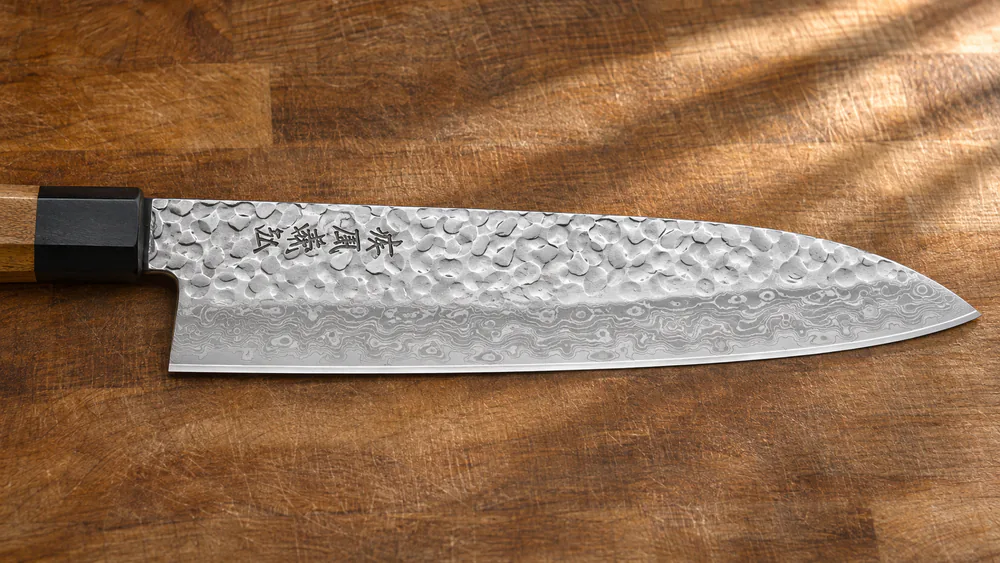
The layers are the Damascus cladding that wraps the core. They give the blade its rippled pattern and help protect the core steel. The cutting edge is the VG10 core in both cases, so more layers mean a more elaborate look and a slightly different feel, not a sharper blade.

Close-up of the hammered Damascus pattern on a Yoshihiro gyuto blade, with the VG10 core edge visible along the bevel
Hammered Damascus cladding wraps the VG10 core.

How to Choose a Yoshihiro Chef Knife

Start with the cooking you do most, then work out the steel and the handle. Every knife on this list is a fine tool, but each one suits a different kitchen.

The best Yoshihiro is the one that matches your cutting, not the one with the most layers.

Gyuto vs Santoku vs Nakiri

A gyuto is the Japanese chef's knife, a curved blade that rocks and slices. A santoku is a multipurpose knife with a flatter belly, and a nakiri is a flat-edged vegetable knife. The Japanese kitchen knife styles and types page explains how these shapes grew up in Japanese kitchens.

Pick the gyuto if you want one knife for nearly everything. Pick the santoku if your board is small. Add the nakiri if you cut vegetables most nights.

Handle Style: Wa vs Western

A wa handle is a lighter Japanese-style handle, often octagonal, that moves the balance point toward the blade. Wa handles need occasional oiling and careful storage. A Western handle adds weight and low-maintenance durability.

If you want a nimble, forward-balanced feel, choose wa. If you prefer a handle that feels like your German knife and needs less fuss, choose Western. The 16-layer gyuto's Western handle centers weight at the heel, so the knife sits level on the board.

Care and Sharpening

Hand wash and dry every Yoshihiro knife straight after use. Never put one in the dishwasher. Sharpen on water whetstones.

Keeping these Japanese-style knives at their best takes practice and suitable sharpening stones, ranging from 600 to 8000 grit. For routine honing, a whetstone from 1000 to 3000-6000 grit is the right route. Pull-through sharpeners are too coarse for these thin edges and can chip them.

Warning. Check any Yoshihiro listing carefully before you buy. Confirm that the model name, steel, layer count and blade length match what you expect. If a listing is vague on those details, move on.

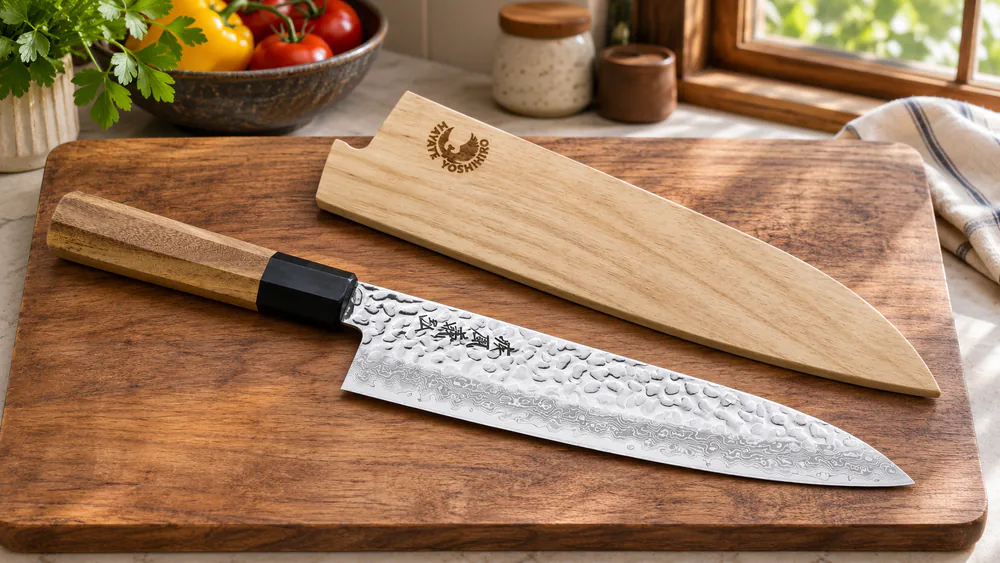
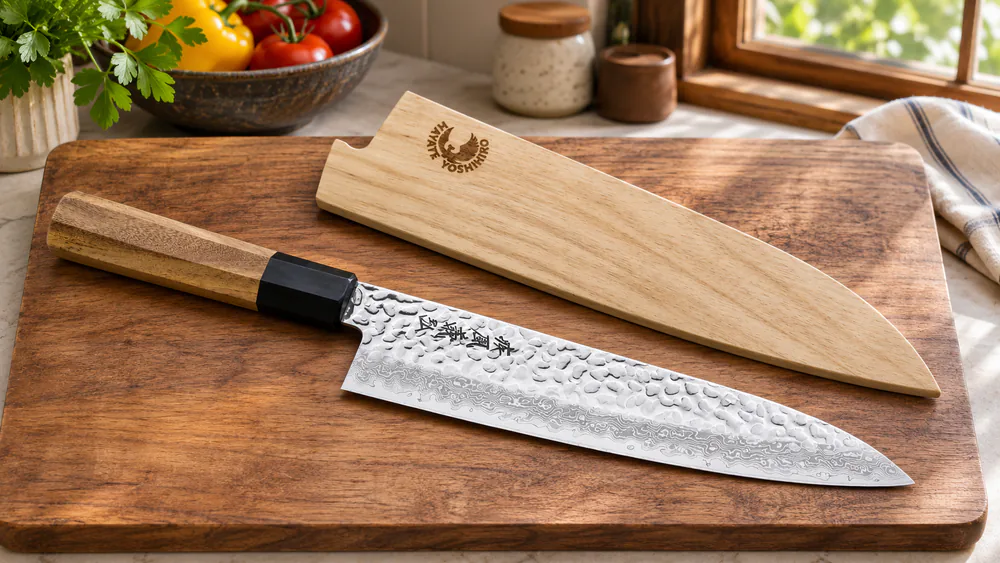
A Yoshihiro VG10 46-layer gyuto resting on a wooden board beside its wooden saya
The Yoshihiro VG10 46-layer gyuto and its wooden saya.

Is Yoshihiro Worth It Compared with Other Japanese Brands?

Yes, if you value sharpness and a clean cutting feel over a large range of handle options. Yoshihiro is made in Japan, and the brand cites over 100 years of craftsmanship. The VG10 line delivers a razor-sharp edge, and the 16-layer gyuto came out sharper than a Wusthof Ikon.

If you are weighing alternatives, we have also reviewed Miyabi, Shun, Tojiro, Takamura and MAC. Each makes a slightly different trade between price, steel and handle style.

Common Mistakes

The first mistake is cutting through bones or frozen food. The 15-degree VG10 edge chips or rolls on chicken bones, frozen food, hard squash stems and twisting cuts. Keep to slicing, dicing and precision work, and use a wood or soft synthetic board.

The second is skipping the stone. A thin, hard edge rewards regular sharpening, so learn the basics before the edge fades. The third is leaving a carbon blade wet, which invites rust within hours.

Frequently Asked Questions

Are Yoshihiro knives good, and are they worth it?

Yes, for cooks who want a sharp, well-balanced Japanese blade. The VG10 gyutos arrived razor-sharp out of the box in our tests. They suit careful cutting rather than heavy-duty work with bones.

What does HRC mean, and does a higher number matter?

HRC is the Rockwell hardness scale for steel. A higher number means a harder blade that takes a finer edge but is more brittle, which is why these knives sit at about 60 against 56-58 for German ones.

Can I put a Yoshihiro knife in the dishwasher?

No. The brand says to hand wash and dry every knife, and a carbon edge left wet will rust.

Is a grey patina on the carbon kiritsuke a problem?

No. A grey or blue patina is normal. Orange rust is not, and it should be removed with a fine abrasive before it spreads.

Where should I buy a Yoshihiro knife, and how do I avoid fakes?

Buy from a seller you trust and check that the model name, steel, layer count and blade length match your expectations. We could not verify a specific authentication method, so rely on a reputable seller. The buy links in this guide go to the models reviewed here.

How should I sharpen and care for these knives?

Hand wash and dry them right away, and sharpen on water whetstones from about 1000 to 6000 grit. Avoid pull-through sharpeners, which are too coarse for these thin edges.

Should I buy a gyuto or a santoku?

Choose a gyuto for reach, rocking cuts and large ingredients. Choose a santoku for a shorter, flatter, more controlled blade on a small board. Both use the same VG10 core in the models we tested.

Final Verdict

If cost matters most, the 16-layer gyuto gives you the same VG10 core and a Western handle. If you sharpen on stones and cut mostly soft foods, the SG2 gyuto is the upgrade. And if you cook mostly vegetables, add the nakiri to whichever gyuto you pick.

Whichever you choose, treat the edge with respect. Cut on wood, dry the blade straight away and keep it away from bones. A Yoshihiro knife repays that care every time you reach for it.

Read next

Ready to upgrade your kitchen?

Browse our buying guides to find the right knife for the way you cook.